
Ok

En poursuivant votre navigation sur ce site, vous acceptez l'utilisation de cookies. Ces derniers assurent le bon fonctionnement de nos services. En savoir plus.

jeudi, 20 septembre 2012

Allemagne/Russie: alliance eurasiatique!


1296227506.jpg

Giacomo GABELLINI:

Allemagne/Russie: alliance eurasiatique!


La rigidité, qui caractérise les rapports que Berlin vient d’instaurer avec l’Europe (suite à la crise grecque), ne correspond nullement au dynamisme dont l’Allemagne fait preuve en se rapprochant de la Chine, de la Russie et de l’Inde, trois Etats qui forment les principaux piliers de soutien de l’ensemble désormais dénommé BRICS. La visite d’Angela Merkel à la Nouvelle Delhi en mai 2011 est venue sceller la collaboration avec l’Inde, surtout dans le domaine de la haute technologie. Les échanges entre l’Allemagne et la Chine en 2011 s’élevaient, en chiffres, à 144 milliards de dollars et seront sans nul doute doublés d’ici 2015, année où on les estime d’ores et déjà à quelque 280 milliards. Ces chiffres permettront à l’Allemagne de se hisser sur le podium des principaux pays exportateurs de biens et de services vers la Chine et de dépasser les Etats-Unis. Berlin resserrera ispso facto ses rapports stratégiques avec la Chine. En avril 2012, le premier ministre chinois Wen Jibao s’est rendu à Wolfsburg, la ville-mère de l’entreprise automobile Volkswagen, dans le but de sceller un accord visant à installer une nouvelle usine Volkswagen dans la région du Xinjiang (le “Turkestan” chinois). Les autorités chinoises prévoient, par cet accord, de diminuer le taux élevé de chômage dans cette province, qui a contribué, dans un premier temps, à alimenter les sentiments centriguges de la population indigène.


Cette intensification des rapports avec la Chine constitue la part intégrante et principale d’un processus qui vise le repositionnement de l’économie allemande en direction des marchés émergeants. Selon un rapport établi par l’“European Council on Foreign Relations”, “l’Allemagne tend désormais à se considérer comme une force crédible dans un monde multipolaire, ce qui alimente son ambition de devenir ‘globale’ en tablant sur ses propres forces” (1).


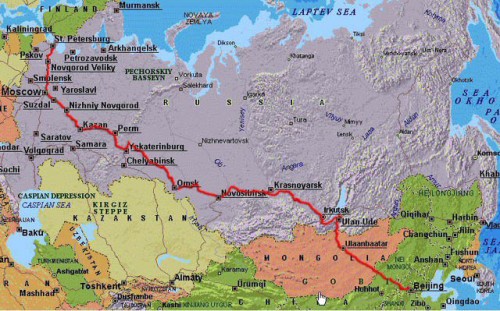
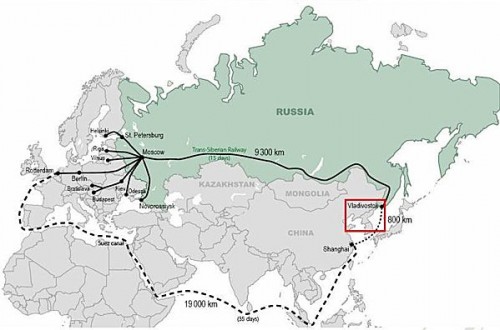
Cet accroissement important des échanges germano-chinois est toutefois dû au rôle joué par la Russie, à laquelle l’Allemagne est liée par le biais d’une alliance stratégique et énergétique de tout premier ordre. Outre la mise en oeuvre du gazoduc “Nord Stream” —qui permet au méthane russe de s’acheminer vers le terminal allemand de Greifswald et d’alimenter ainsi la croissance économique allemande— et la présence de 6000 entreprises allemandes sur le territoire russe, il faut compter le projet d’aménager une ligne ferroviaire moderne capable de transporter 400.000 tonnes de marchandises de la Chine à l’Allemagne, grâce à un accord conclu entre les chemins de fer allemands (Deutsche Bundesbahn) et leurs homologues russes (Rossiyskie Zheleznye Dorogi). Il s’agit là d’une réalisation économique d’importance fondamentale qui garantira des perspectives stratégiques de premier plan. Le but ultime de cet accord se perçoit dans l’émergence d’une nouvelle société mixte, l’“Eurasia Rail Logistics”, par laquelle les chemins de fer allemands sont appelés à s’occuper de la modernisation des lignes russes en fournissant les services d’ingénierie technique —subsidiés par des entreprises comme “Simens”— afin de remplacer des milliers de kilomètres de vielles voies binaires par des parcours de haute vitesse. Cette modernisation concerne surtout le “Transsibérien” —le “pont eurasiatique” par antonomase— dont on doit la construction, commencée en 1890 et terminée en 1916, à la volonté de ce grand premier ministre russe que fut Sergueï Witte, qui voulait relier par fer tous les points de l’immense espace couvert par l’Empire russe. Le “Transsibérien”, dont le trajet dépasse les 9000 km, demeure la plus longue voie ferrée du monde. Il relie le port russe de Vladivostok à Moscou. Le tracé qui reliera Moscou au port hollandais de Rotterdam allongera le trajet Pacifique/Atlantique de quelque 3000 km. Il sera construit ultérieurement. Les problèmes de manutention et la vitesse maximale réduite constituent les deux facteurs qui avaient, jusqu’ici, limité considérablement les potentialités de ce formidable corridor eurasiatique. L’intervention de la Deutsche Bundesbahn renverse la situation. La modernisation des structures du Transsibérien par les chemins de fer allemands a permis, en janvier 2008, de transporter par voie ferrée des marchandises par le “Beijing-Hamburg Container Express”, connecté au Transsibérien au point de jonction russe d’Oulan Oudé. Ces marchandises sont arrivées à destination en l’espace de quinze jours alors que le transport par mer demande le double de temps au minimum. Cet “exprès” a parcouru plus de 10.000 km, en passant par la Mongolie, la Russie, la Biélorussie et la Pologne.


Map-Siemens-Track.jpg


De cette façon, la Russie aura la possibilité de moderniser ses propres voies de communication stratégiques, en apprenant des Allemands comment construire des chemins de fer à haute vitesse et à géer le trafic par ordinateurs. Ils revendront ensuite cette technologie allemande à des pays asiatiques comme l’Iran et l’Inde. L’Allemagne a ainsi obtenu l’accès direct à la Chine, à travers l’immense territoire russe. La Deutsche Bundesbahn, grâce à cette formidable projection vers l’Est, pourra diffuser dans toute l’Eurasie les critères stabilisés par l’UE et consignés dans le “Trans-European Transport Network” (TEN), un projet visant à favoriser les trafics en provenance d’Europe et en direction de l’Extrême-Orient et, à l’inverse, à transporter des matières premières vers les industries européennes. Le projet TEN, pour lequel on prévoit des crédits de 400 milliards d’euro, n’envisage pas seulement de construire des voies de chemin de fer mais aussi de faciliter la construction de routes et d’autres “corridors transcontinentaux”. L’Allemagne cherche donc à se redonner du “Lebensraum”, de l’“espace vital”, en reprenant sa politique traditionnelle de “Drang nach Osten” (de “poussée vers l’Est”) et, par la même occasion, en créant une série de corridors stratégiques qui partent de l’Ouest vers l’Est. Le concept d’“espace vital” avait été élaboré par le géopolitologue allemand Karl Ernst Haushofer, bien avant qu’il ne fut exploité et détourné de son sens par les Nazis). Il suffit de jeter un coup d’oeil sur une carte géographique pour constater que la “poussée vers l’Est” est la voie traditionnelle de l’expansion allemande. Seul l’Est est capable de rapporter des bénéfices énormes, que ce soit sur le plan politique ou sur le plan économique, non seulement à la métropole allemande mais aussi à tous les pays impliqués, tout simplement parce qu’elle permet d’accélérer l’inéluctable intégration économique de la Russie, riche en matières premières, et de l’Allemagne, qui dispose d’une industrie très importante et d’un savoir-faire technologique enviable. C’est justement pour empêcher l’émergence d’un aussi formidable bloc économique intégré, qui assurerait l’hégémonie germano-russe sur l’ensemble de l’Eurasie, que les Etats-Unis ont déclenché l’attaque contre la Serbie de Slobodan Milosevic. En 1999, les premières cibles détruites par les bombardiers de l’OTAN ont été les ponts sur le Danube et sur la Save parce que l’objectif principal était de barrer la route au trafic fluvial allemand (comme nous avons déjà eu l’occasion de le démontrer) en direction du Sud-Est de l’Europe (et donc de la Méditerranée orientale).


Les prémices de la formation d’un bloc hégémonique continental similaire se sont manifestés dès 1989, suite à l’écroulement du Mur de Berlin. L’Allemagne s’est alors réunifiée sous la houlette du Chancelier Helmut Kohl et, surtout, d’un homme très habile, le Président de la “Deutsche Bank”, Alfred Herrhausen. “D’ici dix ans, affirmait Herrhausen, l’Allemagne de l’Est deviendra le complexe technologiquement le plus avancé de l’Europe et, en même temps, le tremplin qui permettra de lancer notre économie vers l’Est, de manière telle que la Pologne, la Hongrie, la Tchécoslovaquie et aussi la Bulgarie joueront, à leur tour, un rôle essentiel dans le développement européen” (2). En conformité avec cet objectif, Herrhausen entendait supprimer la dette “inter-entreprises”, fait comptable qui pesait sur l’industrie ex-communiste (en 1994, cette dette s’élevait à 200 milliards de marks), en considérant que cette dette, précisément, était un atout entre les mains de la Banque Mondiale et du FMI qui, tous deux, s’opposaient, de manière irréductible, à tout assainissement du secteur industriel hérité par l’Allemagne suite à la réunification. Le Président de la Deutsche Bank soutenait, entre autres choses, le projet, jugé nécessaire, de construire des voies ferrées rapides menant à Moscou. C’est là exactement le type de projet que les puissances maritimes —l’Angleterre d’abord, les Etats-Unis ensuite— ont toujours rejeté. Herrhausen se distinguait en proposant une vision nouvelle et innovante des rapports internationaux et proposait de redimensionner le rôle de l’Allemagne qui, selon sa conception, devrait fonctionner comme un “pont” entre l’Est et l’Ouest et comme le moteur d’une reconversion industrielle et d’un développement nouveau dans une Europe soustraite au contrôle de la Banque Mondiale et du FMI.


Transsiberien.jpg


Tandis qu’il se décarcassait pour mettre ses plans en oeuvre, Herrhausen dénonçait ceux qui le critiquaient outrageusement (3), quand il exposait ses vues et demandait à la Banque Mondiale et au FMI d’épargner aux pays ex-communistes la “thérapie de choc” préconisée par un Jeffrey Sachs; il demandait, en insistant beaucoup, que soit accordé à ces pays un moratoire sur leurs dettes pendant quelques années, de manière à ce qu’ils puissent exploiter leurs propres ressources pour la reconstruction plutôt que payer immédiatement aux banquiers, dès l’exercice suivant, une part de leurs dettes, ou les intérêts dus. Malgré l’hostilité de la BM et du FMI, Herrhausen réussit à trouver bon accueil partout en Europe pour ses idées et projets; en l’espace de quelques petites années, la traduction de ses plans dans les réalités européennes et euro-russes aurait pu s’avérer suffisante pour faire décoller ses grands projets. Le plus important de ceux-ci fut la création, à Varsovie, d’une banque pour le développement, destinée à financer la reconstruction et l’intégration de l’Europe centrale et orientale à l’Europe occidentale. Le 1 décembre 1989, avec une ponctualité effrayante, un engin explosif —équipé d’un système d’amorçage sophistiqué fonctionnant au laser— fait sauter l’automobile blindée dans laquelle Herrhausen se déplaçait. La responsabilité de l’attentat a été attribuée au groupe terroriste communiste de la “Rote Armee Fraktion” (RAF), après une enquête des plus superficielles.


Immédiatement après la disparition tragique de Herrhausen, un économiste mieux noté, comme Detlev Karsten Rohwedder, a cherché à poursuivre le sillon ouvert par son malheureux prédécesseur. Rohwedder était le chef de la “Treuhandanstalt”, un holding public qui regroupe toutes les industries d’Etat de l’ex-République Démocratique Allemande (DDR/RDA), après une belle carrière déjà, où il avait préparé et géré en personne le plan d’assainissement et la réorganisation du colosse chimique et pharmaceutique Hoechst AG. Rohwedder affirmait: “A partir du moment où un libéralisme de marché de type doctrinaire ne fonctionne plus, il faut néanmoins privilégier une politique publique d’assainissement dans le cadre plus général des privatisations” (4). C’était là la politique contraire de celle réclamée par le FMI et la Banque Mondiale. Rohwedder avait l’intention de favoriser les investissements publics pour remettre en état de marche et pour moderniser le vieil appareil industriel hérité de la RDA, afin que “la population d’Allemagne de l’Est puisse dépasser au plus vite sa condition d’infériorité matérielle” (5). Cet économiste, relativement inconnu, projettait de transférer le contrôle de la “Treuhandanstalt” du ministère des finances à celui de l’économie, de façon à ce que le holding devienne l’organe central d’un dirigisme allemand rénové. Le 12 avril 1991, un ou plusieurs assassins stipendiés prennent Rohwedder pour cible, tirent trois coups de fusil à visée infra-rouge qui fracasent une fenêtre de sa maison à Düsseldorf, la fenêtre de la pièce où il se trouvait, et le tuent. La RAF revendique la responsabilité de l’attentat, ce qui démontre, une fois de plus, quelle est la véritable fonction de tout “terrorisme extrémiste”. La menace que représentait des personnalités comme Herrhausen et Rohwedder est dénoncée, de manière très précise, par un Henry Kissinger, d’après qui: “Si les deux puissances que sont l’Allemagne et la Russie s’intègrent économiquement, en tissant des liens plus étroits entre elles, alors surviendra le péril que peut représenter leur hégémonie” (6). Le rapprochement actuel entre l’Allemagne et la Russie est dû essentiellement, aujourd’hui, aux efforts de Vladimir Poutine: c’est lui qui met tout en oeuvre pour que les plans d’intégration, pensés par Herrhausen et Rohwedder, reçoivent une nouvelle chance. La situation actuelle montre que l’Allemagne a reconsidéré de manière radicale son positionnement stratégique, en se repprochant des nouveaux centres de gravité de la planète, soit les centres que représente le BRICS, qui sont en train de faire basculer l’axe de la croissance mondiale de l’Atlantique en direction des Océans Indien et Pacifique, tout en ouvrant des perspectives nouvelles et profondément révolutionnaires pour le continent européen tout entier.


Si l’Allemagne parvient à bétonner solidement sa tentative d’entraîner l’Europe dans le sillage de Berlin, le péril, que pointait Zbigniew Brzezinski dans ses admonestations aux Etats-Unis, risquerait bien de prendre forme. Brzezinski: “Pour tout dire en des termes qui rappellent l’ère la plus brutale des empires antiques, les trois grands impératifs de la géostratégie impériale des Etats-Unis sont d’empêcher la collusion entre les vassaux et de les maintenir dans la dépendance (en ce qui concerne leur défense), de garder des tributaires faibles qu’il faut protéger et d’empêcher les barbares de s’unir” (7). Une “union des barbares” est justement en train de se forger et elle pourrait apporter une certaine discontinuité dans les scénarios du futur...


Giacomo GABELLINI,

Article paru sur le site: http://www.eurasia-rivista.org/

URL: http://www.eurasia-rivista.org/germania-russia-l’alleanza-eurasiatica/16549/print/ - Mis en ligne le 26 juillet 2012.


Notes:

(1)   Corriere della Sera, 24 avril 2012.

(2)   Il Tempo, 30 novembre 2009.

(3)   Ibid.

(4)   Frankfurter Allgemeiner Zeitung, 30 mars 1991.

(5)   Ibid.

(6)   Welt am Sonntag, 1 mars 1992.

(7)   Zbigniew Brzezinski, Le grand échiquier.

Marc. EEMANS: La Vision de Tondalus

Marc. EEMANS:

La Vision de Tondalus et la littérature visionnaire au moyen âge


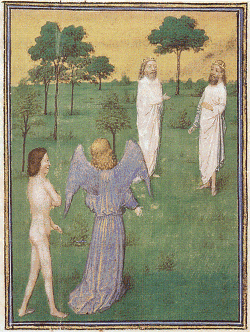
simon-marmion-ca-1475-tondalus-ziet-de-gevreesde-koningen-conchober-en-donatus.gifLa vision est un des genres mystico-littéraires des plus goûtés au moyen âge. Innombrables sont, en effet, les textes visionnaires parvenus jusqu'à nous et, sans parler de ces sommets que sont les visions de Sainte Hildegarde et de Hadewych, l'on peut dire que la vision a fleuri dans tous les pays de l'Europe occidentale. La plupart des textes conservés semblent d'abord avoir été écrits en langue latine, pour être traduits par la suite en langue vulgaire et se répandre ainsi dans toutes les couches de la société.

A en juger d'après le grand nombre de visions d'origine irlandaise, l'on peut affirmer que c'est avant tout un genre propre au monde celtique (1) où il se confondrait avec la tradition païenne de l'imram (2) ou voyage maritime à la Terre des Ombres, île lointaine et inaccessible où tout n'est que félicité.

Par la suite, se rencontrant avec d'autres récits de tradition strictement chrétienne, ce voyage se serait confondu avec les « ravissements dans l'esprit », au cours desquels les visionnaires visitent l'au-delà.

L'une des premières visions chrétiennes dont le texte nous soit parvenu est la Vision de Salvius qui nous apporte, d'emblée deux éléments propres au style visionnaire: la mort apparente du visionnaire et l'apparition du guide qui Je conduit sain et sauf à travers les embûches de l'au-delà.

Dans tous les textes visionnaires du quatrième au sixième siècle, le paradis des élus se rapproche encore beaucoup de l’Élisée des Grecs ou du Hel des anciens Germains: c'est une espèce de pays de cocagne ou tout n'est que joie et allégresse, et qui se confond volontiers avec le paradis terrestre dont Adam en Eve furent chassés après la faute.

Dans un des Dialogues du Pape Grégoire le Grand, nous trouvons également la description classique d'une mort apparente accompagnée d'un voyage dans l'autre monde, tandis que des considérations eschatologiques viennent utilement nous renseigner sur notre vie future. Maïs l'originalité de cette vision réside dans le fait que nous y rencontrons pour la première fois le thème du pont étroit qui est une des épreuves les plus redoutables pour les âmes damnées.

Le texte de Grégoire le Grand semble avoir donné un essor définitif au genre et dès le huitième siècle les visions se multiplient, en étant toutes construites sur le même schéma.

L'Historia Ecclesiastica de Beda Venarabilis (3) nous rapporte à elle seule la relation de trois morts apparentes accompagnées de visions à tendances eschatologiques. La plus remarquable d'entre elles est la Vision de Drithelm qui s'apparente de très près à la Vision de Tondalus, aussi la considère ton comme une de ses sources.

Sous le règne de Charles Magne, nombreuses sont les visions qui s 'inspirent des thèmes de Grégoire le Grand, mais sous l'influence de certains facteurs extérieurs, elles perdent petit à petit leur sens religieux pour revêtir un aspect politique. La plus célèbre des visions de ce genre est certainement la Vision d'une Pauvresse. Elle nous conte l'histoire d'une pauvre femme, du district de Laon, tombée en extase en l'année 819, et dont les visions auraient inspiré directement la politique carolovingienne.

Faisant exception dans la série des visions politiques de l'époque, les Visions d'Anscarius (4) sont de la plus pure inspiration eschatologique. Dès sa prime jeunesse, Anscarius connut les visions et les ravissements, aussi vécut-il de la manière la plus sainte, loin des rumeurs du vaste monde. Puis, certain jour, une vision lui ayant montré les beautés de l'apostolat, il alla convertir les hommes du Nord à la foi chrétienne. Les Visions d'Anscarius s'apparentent de fort près à la Vision de Salvius, tout en s'inspirant des principaux thèmes eschatologiques de l'Apocalypse. Jusqu'ici, le style visionnaire était encore tout entaché de matérialité, voire même de vulgarité. Chez Anscarius, au contraire, le récit se spiritualise et l'âme qui s'échappe du corps endormi se pare d'une essence vraiment impondérable, tout comme Je Ciel se colore d'une indicible fluidité. Anscarius reconnaît cependant son incapacité à traduire l'ineffable et il avoue que ses descriptions ne sont que des approximations qui se trouvent bien en-dessous du réel.

Pendant les deux siècles qui suivent, la littérature visionnaire connaît une certaine régression. Hormis la Vision de Vauquelin, qui date de 1091, il n'y a aucun texte marquant à signaler.

Dès le début du 12° siècle, les textes visionnaires se suivent de très près, nous y relèverons surtout des visions d' origine irlandaise dont la Vision d'Adamman semble être la plus ancienne. Tout en relevant d'un certain conventionnel, le genre se traduit en récits d'une très grande beauté de style. Ces visions nous révèlent, en effet, le merveilleux chrétien dans toute sa diversité, depuis la description des plus misérables scènes du monde des damnés, jusqu'à l'épanouissement béatifique des âmes au sein de Dieu. Les thèmes traditionnels se développent et s'amplifient d'un récit à l'autre. Des réminiscences orientales, dues aux Croisades, s'y révèlent, tandis que des rappels des auteurs anciens viennent témoigner des premières influences du monde antique.

Cette littérature visionnaire à tendance eschatologique connaîtra bientôt son apogée dans la Divine Comédie (5) du Dante, tandis que les visions d'inspiration plus mystique aboutiront aux plus sublimes révélations de Sainte Hildegarde et de Hadewych (6). Tant par leur popularité ,que par la beauté de leur style, la Vision de Tondalus et le Purgatoire de St-Patrice occupent une place d'exception dans la littérature eschatologique du moyen âge.

La Vision du Chevalier Ovin relatée dans le Purgatoire de St-Patrice se rattache à l’antique tradition celtique des Imrama, aussi n ' est-ce point en état de léthargie que le Chevalier Ovin s'aventure dans le monde des ténèbres, mais en y pénétrant volontairement par une grotte qui communique avec les entrailles de la terre. Sur le plan chrétien il refera le voyage déjà entrepris avant lui par Orphée, Ulysse et Enée. Tout comme eux il pénètrera de son plein gré dans le monde de l'au-delà, mais son voyage est un véritable pélerinage: c'est, en effet, pour se purifier qu'il veut contempler les peines infligées aux âmes damnées. Il est ainsi porteur de cette foi essentiellement chrétienne et médiévale en la Rédemption de l'homme.
6758028-M.jpgLe Chevalier Ovin n'a point le bonheur d'avoir un guide dans son voyage, mais là ou les dangers seront par trop menaçants, il lui suffira de prononcer le nom de Jésus pour se sentir aussitôt à l'abri. Il ira ainsi de supplice en supplice, en se purifiant chaque fois davantage, pour arriver enfin aux partes du Paradis.

Par les nombreuses recommandations à l'adresse du lecteur qui entrecoupent le récit, cette vision se révèle avant tout comme une œuvre d'édification et une exhortation à la pénitence.

Ce récit, qui se rattache au fameux Pélerinage de St-Patrice, en Irlande, a rencontré un succès sans précédent dans les annales de la littérature médiévale. Ecrit en latin par un moine irlandais du nom d'Henry de Saltrey vers 1189, il fut bientôt traduit dans toutes les langues de l'Europe occidentale. De nombreux auteurs célèbres s'en inspirèrent, notamment Calderon qui en tira son El Purgataria de San Patricio. Jusqu'au milieu du 19° siècle il a servi de trame à un mystère fort populaire dans toute la Bretagne.

Quant à la Vision de Tondalus, due vers le milieu du 12° siècle à la plume du moine Marcus, son succès dura plus de trois siècles. Plus de 60 versions latines, toutes du 12° ou du 13° siècle en ont été conservées jusqu'à nos jours. Sa traduction en langue vulgaire se répandit dans tous les pays de l'Europe occidentale. Vincentius Bellavacensis recopia intégralement cette vision dans son Speculum Ristoriale (vers 1244) , tandis que Denys le Chartreux en donna un résumé fort circonstancié dans deux de ses ouvrages Quatuor Novissima et De Particulari Judicia Dei. C'est grâce à ces deux auteurs, particulièrement populaires à l'époque, que la Vision de Tondalus pénétra dans tous les milieux.

Cette vision nous conte les mésaventures du Chevalier Tondal qui, étant tombé certain jour en état de léthargie, eut le privilège de descendre en Enfer et d'en rapporter le récit que le frère Marcus (7) a trancrit pour l'édification des pécheurs.

Dès le seuil de l'autre monde, Tondal est accueilli par son ange gardien et ensemble ils traverseront l'Enfer pour visiter ensuite le Paradis et y contempler les âmes bienheureuses.

La délimitation de l'au-delà en trois zônes bien définies- Enfer, Purgatoire, Paradis - telle que nous la trouvons dans la Divine Comédie n' est pas encore bien fixée dans le récit du frère Marcus, aussi a-t-on pu soulever une controverse quant à la définition des lieux visités par Tondalus Selon certains, seul le supplice infligé par Lucifer, relèverait des peines de l'Enfer, toutes les autres étant encore celles du Purgatoire.

Quoi qu'il en soit, nous constatons que dans la Vision de Tondalus onze supplices s'étagent jusqu'aux partes du Paradis et que même à l'intérieur de celui-ci, certaines âmes doivent encore souffrir des supplices temporaires, tels les deux rois ennemis Concober et Donacus, qui avaient cependant déjà fait pénitence sur terre, maïs qui ne furent pas « entièrement bons » ... Quant au roi Cornacus, il y doit également expier certains crimes et y subit ainsi chaque jour, durant trois heures, la peine du feu jusqu'au nombril, tandis que la partie supérieure de son corps se recouvre entièrement de poils. Comme on le voit, dans le Paradis de Tondal, la première joie connaît encore ses heures de détresse, mais les cinq joies suivantes, elles, sont toute félicité. Elles sont réservées aux âmes nobles qui vécurent d'une vie exemplaire ici-bas.

Tondal serait volontiers resté en ces lieux, mais son ange gardien lui fait comprendre qu'il n'en est pas encore digne. S'il persévère dans ses bonnes résolutions, il reviendra certainement en ces lieux pour y prendre part aux chœurs des bienheureux. Maïs avant d'en arriver là Tondal devra vivre, pendant le temps qui lui reste à demeurer sur terre, une vie de mortification et de charité. C'est à ce moment que l’âme de Tondal va rejoindre son corps pour s'adonner à l’œuvre de la gräce.

La Vision de Tondalus a laissé des traces profancles dans toute la littérature de moyen âge. Son iconographie est des plus abondantes, car des artistes de la qualité d'un Pol de Limbourg ou d'un Jéröme Bosch y ont trouvé de fécondes sources d'inspiration. Nombreux sont également les incunables qui ont reproduit cette vision. La première édition typographique de ce livre serait celle d'Anvers « gheprent bi mi Mathijs van der goes », portant le millésime 1472.

Les bibliographes sont toutefois unanimes pour affirmer que cette édition a été antidatée par van der goes qui voulait ainsi s'attribuer la gloire d'avoir imprimé le premier livre paru dans les Pays-Bas.

Presque toutes les éditions de la Vision de Tondalus datent du 16° siècle et dès le 17°, cet ouvrage qui avait connu tant de vogue ne reparut plus au catalogue des éditeurs. Au 19° siècle il sortit de l'ombre grâce à la curiosité des philologues romantiques et dès 1837 Octave Delepierre, archiviste de la Flandre Occidentale en présenta une nouvelle version française d'après le texte la tin de Vincentius Bellavacensis, à laquelle nous empruntons les fragments publiés dans le présent cahier.

Dans plusieurs pays d'Europe les philologues se sont depuis lors occupés fort longuement des innombrables manuscrits de l’œuvre. Certains d'entre eux nous ont dotés ainsi de la présentation critique de quelques-uns d’entre-eux, notamment MM. R. Verdeyen et J. Endepols qui publièrent une version moyen-néerlandaise de la Vision de Tondalus et du Purgatoire de St. Patrice. Nous devons la plupart des données historiques réunies dans cette étude aux patientes recherches de ces deux savants.

Une étude détaillée du sujet, que nous venons d'esquisser ici et qui relève autant de l'histoire de la littérature comparée que de l'histoire de la dévotion occidentale au moyen âge, reste encore à écrire.

Marc. EEMANS.

(1) Rappelons cependant que le monde antique tout comme le monde oriental connurent ce genre et bien souvent nos visions médiévales en sont des démarcations plus ou moins conscientes.
(2) Le plus célèbre Imram connu à ce jour est celui du Voyage de Bran ou de Saint Brandan.
(3) Moine et historien anglais, né à Wearmouth (675-735).
(4) Saint Anschaire, évèque de Hambourg (801-865) .
(5) Les constantes allusions du Dante à des personnages politiques contemporains rattachent également la Divine Comédie à la tradition carolovingienne des visions politiques.
(6) Parmi les grandes femmes visionnaires citons également: Elisabeth de Schönau, Marie d'Oignies, Christine de St-Trond, Lutgarde de Tongres, Beatrice de Nazareth, Mechtild de Magdebourg, etc.
(7) L'auteur de la Vision de Tondalus, probablement un moine Irlandais du XIIe siècle, n'est connu que sous ce prénom. C'est ainsi qu'il se présente lui-même au debut de son récit.

Hermès, n° 3, mars 1937.

Nicholas Goodrick-Clarke, R.I.P.

Nicholas Goodrick-Clarke, R.I.P.

By John Morgan

Ex: http://www.counter-currents.com/

On Wednesday, August 29, 2012, the British scholar of esotericism, Nicholas Goodrick-Clarke, passed away from cancer at the age of 59. Professor Goodrick-Clarke must have dealt with his illness quite well, as he was at work until only a few hours before his death, according to the testimony of some of his students. This is yet another great blow to our community, following hard on the heels of the loss of two other Englishmen, Jonathan Bowden and Anthony Hancock, earlier this year.

I must admit that I don’t know a great deal about Professor Goodrick-Clarke’s life. My personal contact with him was limited to a few e-mails, although I can attest that he was always a well-wisher to my company, Arktos, and its predecessor, Integral Tradition Publishing. He was always cordial and offered words of support to my own endeavors in the realm of the esoteric. According to his obituaries, he left behind a wife, Clare, who is a Professor of History at the University of Exeter, where he himself taught.

In 2005, Goodrick-Clarke was one of the founding members of the European Society for the Study of Western Esotericism (ESSWE) (http://www.esswe.org/ [2]), an organization which promotes the academic study of Western esotericism and supervises the studies of a number of graduate-level students at several European universities. He was also Professor of Esotericism at the University of Exeter and the Director of the Exeter Centre for the Study of Esotericism, which is the British branch of the ESSWE. I have known a number of students, some of whom travel in our circles, who went through this program and who have spoken highly of it. As such, Professor Goodrick-Clarke was actively engaged in the preservation and promotion of the traditions which form the eternal core of our civilization.

In addition to the program he founded and the students he taught, however, Goodrick-Clarke’s greatest legacy will be the books that he wrote. Most prominent among these is his 1985 study, The Occult Roots of Nazism: Secret Aryan Cults and Their Influence on Nazi Ideology [3],[1] which remains the definitive work on the subject in any language (it has even been translated into German).

As anyone who has studied National Socialism or the Third Reich in detail will know, tales of secret occult conspiracies at the highest levels of the NSDAP have abounded since at least the 1930s. Prominent among these works are Louis Pauwels and Jacques Bergier’s Morning of the Magicians and Trevor Ravenscroft’s The Spear of Destiny, the former of which claimed that National Socialism was little more than “Guénonism plus tanks”[2] run by occultists of the Vril and Thule societies who convinced the NS leadership that they needed to establish contact with a lost theocratic  civilization in the interior of the Earth, while the latter claimed that the entire history of the Third Reich was nothing more than a prolonged effort by Hitler, inspired by a mushroom trip he had had in his youth in Austria, to obtain the Spear of Longinus that pierced the side of Christ at the crucifixion.

Unfortunately, the vast majority of literature on the relationship between National Socialism and mysticism, both before and since Goodrick-Clarke’s study, has relied upon these and similar sources for their inspiration (or upon even more fantastic claims, such as that Hitler was working with Aleister Crowley).

Occult Roots is unique in that it is one of the few books to be written on this topic in a serious way, and not for the purposes of sensationalism. It is also unique in that it relies largely on primary sources from the German – one is loath to find a single German work referenced in many of the popular books on Nazi occultism. Indeed, entire shelves of other works on the subject could be thrown into the garbage in favor of this book.

Goodrick-Clarke traces the origins and development of Ariosophy, a type of theosophical mysticism infused with myths about the history and destiny of Aryan humanity and a great deal of “Orientalist” and Nordicist philosophies, in late 19th-century Germany. He follows its path through the anti-Semitic Germanenorden and other groups, to the origins of the Thule Society in Munich, which in turn sponsored the founding of the German Workers’ Party in 1919, which was transformed the following year into the National Socialist German Workers’ Party by Hitler.

Goodrick-Clarke’s ultimate conclusion is that, while there was indeed an organizational connection between the NSDAP and Ariosophy in its earliest days, and that some members of the NS leadership evinced interest in Ariosophy at some point in their lives, that “Ariosophy is a symptom rather than an influence in the way that it anticipated Nazism.”[3] The fact is that there is no evidence to support the claim that there was a hidden, mystical agenda behind the politics and strategies of the Third Reich.

As such, Goodrick-Clarke’s book provided a much-needed corrective to the oceans of ink that have been spilled attempting to link the Third Reich to wacky ideas, further consigning what is useful in its legacy to the gutter in the popular imagination. Regrettably, however, works which continue to foster this notion will doubtless continue to be written and published for many years to come, and will sometimes be cited with approval even by those who claim to be on our side.

Goodrick-Clarke later expanded his studies into the realm of post-war Nazi occultism, the first of which, Hitler’s Priestess: Savitri Devi, the Hindu-Aryan Myth, and Neo-Nazism [4][4] was published in 1998. This book holds a special place in my heart, as I came across the book by chance in a bookstore shortly after it was published, and it was the first time that I had come across such figures and movements as Savitri Devi, Julius Evola, and the Traditionalists; the connection between Indian politics and culture and Aryan thought; and the European New Right.

At the time, the book hit me like a bolt of lightning. I had no idea that over in Europe (little was happening in America at that time) an entire intellectual tradition had arisen to defend and propagate the ideas of the “true Right”! So the book allowed me to discover ideas which have come to play a central role in my life ever since, and for that, I must always be grateful to Goodrick-Clarke. I know from others that the book had a similar impact upon them at the time – one must remember that 1998 was in the days before one could learn very much about these subjects on the Internet, as is the case today.

In retrospect, I can see that the book has many flaws, as Goodrick-Clarke based his biography largely on Savitri Devi’s taped autobiographical interviews, and his depiction of the other movements and figures he discusses is shallow, to say the least. Still, until someone willing to delve deeper writes a more definitive biography of Savitri Devi, it is the only resource available, and it remains a good introduction to her life and work.

The next book Goodrick-Clarke wrote on this theme was Black Sun: Aryan Cults, Esoteric Nazism, and the Politics of Identity [5],[5] published in 2002. This is by far the least satisfactory of the three books. Goodrick-Clarke abandoned the scholarly rigor he had employed in Occult Roots, instead compiling a compendium of information derived almost entirely from secondary sources and the Internet. The chapter on Savitri Devi is little more than a summary of Hitler’s Priestess. And, inevitably I suppose given the time it was published, we are dutifully warned that such dangerous ideas could lead to another 9/11, and he continually attempts to link his subjects to terrorism, Islamic and otherwise.

And yet one cannot escape the feeling that Goodrick-Clarke vastly overestimates the power and influence that the groups he discusses actually had or have. As a review of the book at the Vanguard News Network put it at the time, “Want to be a threat to Western civilization? All you need is a post office box and a copy machine. Goodrick-Clarke will do the rest.”[6] I suppose Black Sun could be useful for someone who has never heard of such figures as Miguel  Serrano, James Mason, David Myatt, James Madole or Wilhelm Landig before to serve as an introduction, but as an attempt at a comprehensive study, even from a hostile perspective, it is a dismal failure. (A book which came closer to fulfilling that need, albeit with its own problems and deficiencies, is Kevin Coogan’s Dreamer of the Day[7] about Francis Parker Yockey and his milieu, and for which Goodrick-Clarke provided an Introduction).

Goodrick-Clarke also authored, edited, and translated a few other books unrelated to Nazi esotericism. The most important, in my view, is his 2008 book The Western Esoteric Traditions: A Historical Introduction [6],[8] which is a solid, if far from comprehensive, introduction to some of the most important figures in the tradition for newcomers. The others include a selection from the writings of the German alchemist Paracelsus [7]; another from H. P. Blavatsky [8], founder of the Theosophical Society, as well as a volume of selections from G. R. S. Mead [9], another Theosophist; and translations of books about the Swedish mystic Emanuel Swedenborg [10].

The question which often arises in our circles regarding Goodrick-Clarke is whether or not he was “one of us.” Certainly, to judge by his writings, he comes across as yet another of those career academics, such as Roger Griffin or Stanley Payne, who build their careers on writing book after book about “fascinating fascism” (to borrow Susan Sontag’s term) and yet claim to feel nothing but the obligatory liberal revulsion for it. Since I never had the good fortune of knowing Goodrick-Clarke in person, I cannot say with any certainty, but there do seem to be interesting hints in his Conclusion to Black Sun, that he was more than just an academic critic of the far Right.

The concluding chapter of Black Sun seems to be the author’s attempt to provide at least a minimum of balance against his exaggerated efforts to link the Right with absolute evil in the rest of the book.  Goodrick-Clarke attributes the rise of White racialism to the introduction of racial preferences in Western societies. He writes:

The discriminatory effects of these policies on whites, both potential and actual, has understandably caused some resentment among whites. . . . But liberal support for affirmative action has gone further in producing a climate of white guilt. The causes of black crime, drug involvement and welfare dependence are often sought in white racism. Black on white crime in terms of murder, rape and robbery with violence is many times greater than white on black crime. However, the national media typically highlight instances of white racial attacks, while many reports of black crime are ‘colorblind’ and mostly confined to the local press. The massive overrepresentation of blacks in the penal system, evident testimony of black crime, violence and underperformance are largely ignored by the liberal media, or otherwise invoked as further evidence of black disadvantage and white racism.[9]

Later in the same chapter, he also writes:

The question of whether the United States can actually assimilate such immigrants is begged by policies of bilingualism and multiculturalism in the education system. Assimilation is further undermined by the expansion of affirmative action, originally intended to benefit blacks as a result of civil rights legislation, into a government-mandated discrimination against white Americans (but also blacks in practice) in favor of Third World immigrants. The ascendancy of international human rights over notions of national sovereignty has also led to a progressive erosion of citizenship, whereby illegal aliens are granted welfare, education, government subsidies and even voting rights. These issues are a matter of deep concern to conservative groups in the United States, who see no particular reason to transform the demography of the United States, given its wholly unforeseeable consequences. The conversion of the United States into a ‘colony of the world’ or a ‘universal nation’ is without precedent in the modern world. Similar forces are at work in Europe, especially Britain, where multiculturalism is promoted by left-wing and liberal political agendas in the quest for the electoral support of the growing ethnic minorities. A recent report on the future of multi-ethnic Britain has even questioned whether the national epithet ‘British’ carries a racist taint.[10]

Such comments would certainly not be out-of-place at Counter-Currents or other “New Right” publications, but are surprising coming from the keyboard of an esteemed university professor. Even more shocking, in the passages quoted above, Goodrick-Clarke cites Jared Taylor (specifically, his book Paved with Good Intentions) and Peter Brimelow (Alien Nation) for support in his footnotes – sources which would surely mean professional death if quoted with approval in the work of less established academics.

He concludes the chapter as follows:

We cannot know what the future holds for Western multicultural societies, but the experiment did not fare well in Austria-Hungary, the Soviet Union and Yugoslavia. The multiracial challenges in liberal Western states are much greater, and it is evident that affirmative action and multiculturalism are even leading to a more diffuse hostility toward liberalism. From the retrospective viewpoint of a potential authoritarian future in 2020 or 2030, these Aryan cults and esoteric Nazism may be documented as early symptoms of major divisive changes in our present-day Western democracies.[11]

Goodrick-Clarke is careful to couch his prophecy of a catastrophic failure of liberal democracy only as a possibility, and not necessarily a positive one, but nevertheless, the fact that he even discusses the possibility is greatly at variance with the usual platitudes from the academy about the absolute need for ever-more diversity and multiculturalism in the Western nations.

Whether or not Goodrick-Clarke actually held more sympathy for the milieu he studied than he let on has now become irrelevant, since the Conclusion to Black Sun represents the totality of what he had to say on the matter publicly.  I would hazard to guess that, while he may have seen value in efforts to protect the cultures of the West from foreign influence, he probably had little regard for its more ridiculous and extreme elements, particularly those who make the world of Right-wing politics a playground for their own private obsessions and fantasies.  And, in that, I find little with which to disagree. Efforts to wed the philosophy and politics of the true Right to tales of Nazi UFOs and sinister pseudo-occult orders do more harm than good to those seriously engaged in the dialogues and struggles of our time.

Clearly, Goodrick-Clarke recognized that genuine esotericism was valuable, since he spent his life studying it, but at the same time, he must have made a distinction between genuine esotericism and those who ape its forms in the pursuit of their goals in some dark role-playing game, acted out using real people and very real problems. But genuine esotericism does exist, and it can be a force for good. The Traditionalists have taught us that.

Goodrick-Clarke’s understanding of the real issues at stake was further reinforced for me in our correspondence. When he first contacted me regarding some of Integral Tradition Publishing’s books in 2009, I felt compelled to tell him about how his Occult Roots and Hitler’s Priestess had led me to eventually become involved with ITP. He responded by writing, “Thank you for your appreciative comments regarding the inspiration of my own books.  They were written to give a voice to the excluded discourse of liberal modernity and its neglect of order and truth.”[12] This confirms for me that he was certainly no uncritical citizen of the world that has been produced by liberalism. Although regrettably, I never attempted to get him to discuss his views on this any further, fearing that he might think I was attempting to trick him into saying or writing something that might later come back to haunt him. In retrospect, perhaps I should not have been so cautious.

That said, Professor Goodrick-Clarke is not destined to be remembered as a political figure. He will be remembered for his scholarship – for setting the record straight regarding the relationship between the occult and National Socialism, and also for his efforts to preserve the genuine esoteric strivings of our people which have been sidelined by science, technology, and modernity. For that we should remain forever grateful.

Notes

1. Nicholas Goodrick-Clarke, The Occult Roots of Nazism: Secret Aryan Cults and Their Influence on Nazi Ideology (New York: New York University Press, 1992).

2. Pauwels and Bergier, The Morning of the Magicians (New York: Stein & Day, 1964), p. 180.

3. The Occult Roots of Nazism, p. 202.

4. Nicholas Goodrick-Clarke, Hitler’s Priestess: Savitri Devi, the Hindu-Aryan Myth, and Neo-Nazism (New York: New York University Press, 1998).

5. Nicholas Goodrick-Clarke, Black Sun: Aryan Cults, Esoteric Nazism, and the Politics of Identity (New York: New York University Press, 2002).

6. The Cat Lady, “Nutty Nazis,” at Vanguard News Network (http://www.vanguardnewsnetwork.com/v1/books8.htm [11]).

7. Kevin Coogan, Dreamer of the Day: Francis Parker Yockey and the Postwar Fascist International (Brooklyn: Autonomedia, 1999).

8. Nicholas Goodrick-Clarke, The Western Esoteric Traditions: A Historical Introduction (Oxford: Oxford University Press, 2008).

9. Black Sun, pp. 303-304.

10. Black Sun, p. 313.

11. Black Sun, p. 313.

12. Personal correspondence, September 16, 2009.


Article printed from Counter-Currents Publishing: http://www.counter-currents.com

URL to article: http://www.counter-currents.com/2012/09/nicholas-goodrick-clarke-r-i-p/

00:05 Publié dans Hommages | Lien permanent | Commentaires (0) | Tags : hommages, histoire, ésotérisme | |  del.icio.us | | Digg! Digg |  Facebook

Unthinking Liberalism: A. Dugin’s The Fourth Political Theory

Unthinking Liberalism:
Alexander Dugin’s The Fourth Political Theory

by Alex KURTAGIC

Ex: http://www.counter-currents.com/

Alexander Dugin
The Fourth Political Theory, London: Arktos, 2012

Arktos recently published what we can only hope will be the first of many more English translations of Alexander Dugin’s work. Head of the sociology department in Moscow State University, and a leading Eurasianist with ties to the Russian military, this man is, today, influencing official Kremlin policy.

The Fourth Political Theory is a thoroughly refreshing monograph, combining clarity of analysis, philosophical rigor, and intellectual creativity. It is Dugin’s attempt to sort through the confusion of modern political theory and establish the foundations for a political philosophy that will decisively challenge the dominant liberal paradigm. It is not, however, a new complete political theory, but rather the beginning of a project. The name is provisional, the theory under construction. Dugin sees this not as the work of one man, but, because difficult, a collective heroic effort.

The book first sets out the historical topology of modern political theories. In Dugin’s account, liberalism, the oldest and most stable ideology, was in modernity the first political theory. Marxism, a critique of liberalism via capitalism, was the second. Fascism/National Socialism, a critique of both liberalism and Marxism, was the third. Dugin says that Fascism/National Socialism was defeated by Marxism (1945), that Marxism was defeated by liberalism (1989), leaving liberalism triumphant and therefore free to expand around the globe.

According to Dugin, the triumph of liberalism has been so definitive, in fact, that in the West it has ceased to be political, or ideological, and become a taken-for-granted practice. Westerners think in liberal terms by default, assuming that no sane, rational, educated person could think differently, accusing dissenters of being ideological, without realizing that their own assumptions have ideological origins.

The definitive triumph of liberalism has also meant that it is now so fully identified with modernity that it is difficult to separate the two, whereas control of modernity was once contested by political theory number one against political theories two and three. The advent of postmodernity, however, has marked the complete exhaustion of liberalism. It has nothing new to say, so it is reduced endlessly to recycle and reiterate itself.

Looking to identify what may be useful to salvage, Dugin proceeds to break down each of the three ideologies into its component parts. In the process of doing so, he detoxifies the two discredited critiques of liberalism, which is necessary to be able to cannibalize them. His analysis of liberalism follows Alain de Benoist. Because it is crucial, I will avail myself of de Benoist’s insights and infuse some of my own in Dugin’s explication of liberalism.

Dugin says that liberalism’s historical subject is the individual. The idea behind liberalism was to “liberate” the individual from everything that was external to him (faith, tradition, authority). Out of this springs the rest: when you get rid of the transcendent, you end up with a world that is entirely rational and material. Happiness then becomes a question of material increase. This leads to productivism and economism, which, when the individual is paramount, demands capitalism. When you get rid of the transcendent, you also eliminate hierarchy: all men become equal. If all men are equal, then what applies to one must apply to all, which means universalism. Similarly, if all men are equal, then all deserve an equal slice of the pie, so full democracy, with universal suffrage, becomes the ideal form of government. Liberalism has since developed flavors, and the idea of liberation acquires two competing meanings: “freedom from,” which in America is embodied by libertarians and the Tea Party; and “freedom to,” embodied by Democrats.

Marxism’s historical subject is class. Marxism is concerned chiefly with critiquing the inequities arising from capitalism. Otherwise, it shares with liberalism an ethos of liberation, a materialist worldview, and an egalitarian morality.

Fascism’s historical subject is the state, and National Socialism’s race. Both critique Marxism’s and liberalism’s materialist worldview and egalitarian morality. Hence, the simultaneous application of hierarchy and socialism.

With all the parts laid out on the table, Dugin then selects what he finds useful and discards the rest. Unsurprisingly, Dugin finds nothing useful in liberalism. The idea is to unthink it, after all.

Spread out across several chapters, Dugin provides a typology of the different factions in the modern political landscape—e.g., fundamental conservatism (traditionalism), Left-wing conservatism (Strasserism, National Bolshevism, Niekisch), conservative revolution (Spengler, Jünger, Schmitt, Niekisch), New Left, National Communism, etc. It is essential that readers understand these so that they may easily recognize them, because doing so will clarify much and help them avoid the errors arising from opaque, confused, contradictory, or misleading labels.

Liberal conservatism is a key category in this typology. It may sound contradictory on the surface, because in colloquial discourse mainstream politics is about the opposition of liberals vs. conservatives. Yet, and as I have repeatedly stated, when one examines their fundamentals, so-called “conservatives” (a misleading label), even palaeoconservatives (another misleading label), are all ideologically liberals, only they wish to conserve liberalism, or go a little slower, or take a few steps back. Hence, the alternative designation for this type: “status-quo conservative.”

Another key category is National Communism. This is, according to Dugin, a unique phenomenon, and enjoys a healthy life in Latin America, suggesting it will be around for some time to come. Evo Morales and Hugo Chavez are contemporary practitioners of National Communism.

Setting out the suggested foundations of a fourth political ideology takes up the rest of Dugin’s book. Besides elements salvaged from earlier critiques of liberalism, Dugin also looks at the debris that in the philosophical contest for modernity was left in the periphery. These are the ideas for which none of the ideologies of modernity have had any use. For Dugin this is essential to an outsider, counter-propositional political theory. He does not state this in as many words, but it should be obvious that if we are to unthink liberalism, then liberalism should find its nemesis unthinkable.

But the process of construction begins, of course, with ontology. Dugin refers to Heidegger’s Dasein. Working from this concept he would like the fourth political theory to conceptualize the world as a pluriverse, with different peoples who have different moralities and even different conceptions of time. In other words, in the fourth political theory the idea of a universal history would be absurd, because time is conceived differently in different cultures—nothing is ahistorical or universal; everything is bound and specific. This would imply a morality of difference, something I have proposed as counter-propositional to the liberal morality of equality. In the last consequence, for Dugin there needs to be also a peculiar ontology of the future. The parts of The Fourth Political Theory dealing with these topics are the most challenging, requiring some grounding in philosophy, but, unsurprisingly, they are also where the pioneering work is being done.

Also pioneering, and presumably more difficult still, is Dugin’s call to “attack the individual.” By this he means, obviously, destabilizing the taken-for-granted construct that comprises the minimum social unit in liberalism—the discrete social atom that acts on the basis of rational self-interest, a construct that should be distinguished from “a man” or “a woman” or “a human.” Dugin makes some suggestions, but these seem nebulous and not very persuasive at this stage. Also, this seems quite a logical necessity within the framework of this project, but Dugin’s seeds will find barren soil in the West, where the individual is almost sacrosanct and where individualism results from what is possibly an evolved bias in Northern European societies, where this trait may have been more adaptive than elsewhere. A cataclysmic event may be required to open up the way for a redefinition of what it is to be a person. Evidently the idea is that the fourth political theory conceptualizes a man not as an “individual” but as something else, presumably as part of a collectivity. This is probably a very Russian way of looking at things.

The foregoing may all seem highly abstract, and I suspect practically minded readers will not take to it. It is hard to see how the abstract theorizing will satisfy the pragmatic Anglo-Saxon, who is suspicious of philosophy generally. (Jonathan Bowden was an oddity in this regard.) Yet there are real-world implications to the theory, and in Dugin’s work the geopolitical dimension must never be kept out of sight.

For Dugin, triumphant liberalism is embodied by Americanism; the United States, through its origins as an Enlightenment project, and through its superpower status in the twentieth and twenty-first century, is the global driver of liberal practice. As such, with the defeat of Marxism, it has created, and sought to perpetuate, a unipolar world defined by American, or Atlanticist, liberal hegemony. Russia has a long anti-Western, anti-liberal tradition, and for Dugin this planetary liberal hegemony is the enemy. Dugin would like the world to be multipolar, with Atlanticism counterbalanced by Eurasianism, and maybe other “isms.” In geopolitics, the need for a fourth political theory arises from a need to keep liberalism permanently challenged, confined to its native hemisphere, and, in a word, out of Russia.

While this dimension exists, and while there may be a certain anti-Americanism in Dugin’s work, Americans should not dismiss this book out of hand, because it is not anti-America. As Michael O’Meara has pointed out in relation to Yockey’s anti-Americanism, Americanism and America, or Americans, are different things and stand often in opposition. Engaging with this kind of oppositional thinking is, then, necessary for Americans. And the reason is this: liberalism served America well for two hundred years, but ideologies have a life-cycle like everything else, and liberalism has by now become hypertrophic and hypertelic; it is, in other words, killing America and, in particular, the European-descended presence in America.

If European-descended Americans are to save themselves, and to continue having a presence in the North American continent, rather than being subsumed by liberal egalitarianism and the consequent economic bankruptcy, Hispanization, and Africanization, the American identity, so tied up with liberalism because of the philosophical bases of its founding documents, would need to be re-imagined. Though admittedly difficult, the modern American identity must be understood as one that is possible out of many. Sources for a re-imagined identity may be found in the archaic substratum permeating the parts of American heritage that preceded systematic liberalism (the early colonial period) as well as in the parts that were, at least for a time, beyond it (the frontier and the Wild West). In other words, the most mystical and also the least “civilized” parts of American history. Yet even this may be problematic, since they were products of late “Faustian” civilization. A descent into barbarism may be in the cards. Only time will tell.

For Westerners in general, Dugin’s project may well prove too radical, even at this late stage in the game—contemplating it would seem first to necessitate a decisive rupture. Unless/until that happens, conservative prescriptions calling for a return to a previous state of affairs (in the West), or a closer reading of the founding documents (in America), will remain a feature of Western dissidence. In other words, even the dissidents will remain conservative restorationists of the classical ideas of the center, or the ideas that led to the center. Truly revolutionary thinking—the re-imagining and reinvention of ourselves—will, however, ultimately come from the periphery rather than the center.


Article printed from Counter-Currents Publishing: http://www.counter-currents.com

URL to article: http://www.counter-currents.com/2012/09/unthinking-liberalism/

Derechos humanos como disvalor


Droits%20de%20lHommeII%20300305.jpg

Derechos humanos como disvalor


Alberto Buela (*)


Como hace muchos años que venimos escribiendo sobre el tema de los derechos humanos y lo hemos encarado desde distintos ángulos: a) derechos humanos de primera, segunda y tercera generación, b) derechos humanos e ideología, c) derechos humanos o derechos de los pueblos, d) derechos humanos: crisis o decadencia.

En esta ocasión vamos a meditar sobre los derechos humanos como un disvalor o, si se quiere para que sea más comprensible, como una falsa preferencia.


Es sabido que la Declaración Universal de los Derechos Humanos proclamada por las  Naciones Unidas a finales de 1948, afirma en su artículo 3 que: Todo individuo tiene derecho a la vida, a la libertad y a la seguridad de su persona.

Con lo cual los legisladores correctamente nos vinieron a decir que los derechos humanos proclamados alcanzan al hombre en tanto que individuo, esto es, formando parte de un género y una especie: animal rationale o zoon lógon éjon, como gustaban decir griegos y romanos.

Pero, al mismo tiempo, nos dicen que estos derechos son inherentes al hombre como persona, esto es, en tanto ser único, singular e irrepetible. Y acá está implícita toda la concepción cristiana del hombre.[1]

Si bien, este magistral artículo 3, merecedor de una exégesis abundantísima, se apoya, tiene su basamento en una concepción sesgada o parcial del hombre: como sujeto de derechos. Y es acá donde comenzamos a barruntar lo que queremos decir.

El hombre durante toda la antigüedad clásica: greco, romano, cristiana nunca fue pensado como sujeto de derechos, y no porque no existieran dichos derechos, sino porque la justicia desde Platón para acá fue pensada como: dar a cada uno lo que corresponde. Con lo cual el derecho está concebido desde el que está “obligado” a cumplirlo y no desde los “acreedores” del derecho. Es por ello que la justicia fue concebida como una restitutio, como lo debido al otro.

Esto es de crucial importancia, pues sino se lo entiende acabadamente, no puede comprenderse la Revolución Copernicana, que produjeron los legisladores onunianos en 1948.

Al ser lo justo, dar a cada uno aquello que le corresponde y no el obtenerlo para uno, la obligación de realizarlo es del deudor. Y ello está determinado por el realismo filosófico, jurídico, político y teológico de la mencionada antigüedad clásica. Así el peso de realización de lo justo recae sobre aquel que puede y debe realizarlo, el acreedor de derechos solo puede demandarlo.

Al respecto relata Platón cómo respondió Sócrates cuando le proponen fugarse de la cárcel al ser condenado a muerte: Nunca es bueno y noble cometer injusticia (Critón, 49ª5) En cualquier caso es malo y vergonzoso cometer injusticia (Critón, 49b6). Nunca es correcto retribuir una injusticia por una injusticia padecida, ni mal por mal (Critón 49 d7), pues es peor hacer una injusticia que padecerla.

Así, Sócrates no ignora que tiene “derecho humano a conservar su vida”, pero prima en él, el “derecho humano de los atenienses”, de los otros. Pues si se fuga realiza un acto de injusticia, peor aún que la recibida.


Hoy la teoría de los derechos humanos invirtió la ecuación y así viene a sostener la primacía del acreedor de derechos por sobre la obligación de ser justos.


Viene entonces la pregunta fundamental: ¿A qué debe el hombre otorgar primacía en el ámbito del obrar: a ser justo o a ser acreedor de derechos?


Sin lugar a dudas todo hombre de bien intenta ser justo en su obrar, sin por ello renunciar a sus derechos pero, si el acto justo implica posponer algún derecho, es seguro que el justo lo pospone.

Ello nos está indicando la primacía y la preferencia axiológica de lo justo sobre el derecho.

Si invertimos esta relación los derechos humanos terminan siendo concebidos como un disvalor.

De modo tal que, obviamente, no estamos en contra del rescate que los derechos humanos han realizado en cantidad de campos y dominios. Estamos en contra que la vida del hombre se piense limitada y girando exclusivamente sobre los derechos humanos.

Y así como el bien tiene una primacía ontológica sobre el deber porque el hombre no es bueno cuando realiza actos buenos, sino que el hombre realiza actos buenos cuando es bueno. Analógicamente, lo justo=ius la tiene sobre el derecho y la lex.


(*) buela.alberto@gmail.com  arkegueta, aprendiz constante

www.disenso.com 


[1]Es cierto que se han producido éticas ateístas de la persona (Nicolai Hartmann) pero eso no dejó de ser un mero ejercicio filosófico que no jode a nadie.