Ok

En poursuivant votre navigation sur ce site, vous acceptez l'utilisation de cookies. Ces derniers assurent le bon fonctionnement de nos services. En savoir plus.

samedi, 30 mars 2013

Colloque "Maison Commune"

Birmanie : Violences accrues dans un pays riche en hydrocarbures, stratégie du chaos US ?

Birmanie : Violences accrues dans un pays riche en hydrocarbures, stratégie du chaos US ?

Simple hasard ? la Birmanie est le pays qui a accueilli le 19 novembre dernier Barack Obama, pour son premier voyage à l’étranger depuis sa réélection. Déplacement annoncé comme un soutien de Washington au processus politique actuel en œuvre dans le pays.

Autre élément notable : alors qu’en novembre 2012, un séisme venait de frapper la Birmanie, pays d’ores et déjà théâtre de violences meurtrières entre bouddhistes et musulmans, nous rappelions ici-même qu’en avril 2012, les Etats-Unis avaient annoncé la levée de sanctions interdisant l’exportation vers le territoire birman de certains services financiers.

Parmi les objectifs autorisés, cités expressément dans le texte publié, figuraient alors « la construction de la démocratie et la bonne gouvernance », l’assistance aux réfugiés ainsi que les activités religieuses.

Autre hasard ? rappelons que depuis mars 2012, les autorités birmanes ont conclu d’importants contrats dans le domaine du pétrole avec des sociétés étrangères. « Nul doute que la course aux hydrocarbures va s’intensifier » prédisait alors le site asie-info.fr.
Un contexte permettant de redouter que les Etats-Unis ne mettent encore une fois en oeuvre leur stratégie du chaos ?


Des violences inter-religieuses accrues

Le ministère de l’Information birman a par ailleurs indiqué qu’en dehors de Meiktila, des incidents avaient eu lieu dans trois autres communes, et notamment des incendies volontaires. Ajoutant que des dizaines de personnes avaient été arrêtées dans cette région toute proche de la capitale Naypyidaw.

Samedi, l’armée birmane a repris le contrôle de Meiktila, laquelle avait été placée la veille sous état d’urgence, à la suite de trois journées de violences à l’issue desquelles 32 morts ont été déplorés selon le dernier bilan officiel.

Mercredi, une simple querelle mercredi entre un vendeur musulman et des clients avait mis le feu aux poudres, des quartiers entiers de la ville ainsi des mosquées étant par la suite incendiés, des corps calcinés gisant dans les rues.

Des groupes d’émeutiers transformant la ville en un véritable coupe-gorge, témoignant d’une tension accrue entre bouddhistes et musulmans dans le pays.

Quand l’International Crisis Group s’inquiétait des poussées nationalistes et communautaires

En novembre dernier, quelques heures avant un fort séisme frappant la Birmanie – nous y reviendrons – l’International Crisis Group estimait dans un rapport que le pouvoir birman mais également Aung San Suu Kyi « devaient faire preuve de courage politique face aux poussées nationalistes et communautaires qui fragilisent les réformes ».

Le groupe de réflexion, dont le siège est à Bruxelles, exprimant parallèlement son inquiétude à la suite des violences entre bouddhistes et musulmans qui avaient fait près de 200 morts dans l’Etat Rakhine depuis juin 2012, événements à l’origine du départ forcé de 110.000 personnes.

« L’embrasement dans l’Etat Rakhine représente un pas en arrière profondément dérangeant », estimait ainsi l’ICG, qui relèvait que « l’ouverture politique depuis un an et demi, aussi positive qu’elle soit, libère aussi des discours potentiellement dangereux dans la société ».

« Il y a un potentiel pour des violences similaires ailleurs, au moment où le nationalisme, l’ethno-nationalisme et des préjudices anciens refont surface », précisait encore l’ICG.

On voudrait semer chaos et terreur parmi les populations qu’on ne s’y prendrait pas autrement …. avais-je alors indiqué.

« Le gouvernement a été incapable de contenir la violence, les autorités et forces de sécurité locales ont parfois agi de façon partisane, et la rhétorique extrémiste n’a fait l’objet de quasiment aucune contestation de la part des autorités et de l’opposition », regrettait par ailleurs l’Institut.

« Une autorité morale décisive est nécessaire, de la part du président Thein Sein et d’Aung San Suu Kyi, pour empêcher la propagation (des violences) et fournir des solutions à long terme », estimait par ailleurs l’ICG …. préparant peut-être d’ores et déjà le terrain à une « occupation » internationale du pays sous couvert de raisons humanitaires et de maintien de l’ordre … ? Qui sait .. une invasion humanitaire US étant tout à fait envisageable … l’ONG Save The Children (USA ) étant « idéalement » placé pour initier le mouvement sur place … et qui plus est à la « faveur » d’un fort tremblement de terre.

Quelques jours auparavant, Aung San Suu Kyi avait réclamé dans un communiqué l’envoi de forces de sécurité supplémentaires.

Car, fin octobre, le gouvernement birman avait d’ores et déjà mis en garde, estimant que les violences meurtrières entre bouddhistes et musulmans dans l’ouest de la Birmanie « étaient susceptibles de se transformer de violences classiques en actes terroristes armés, après des attaques contre les forces de sécurité avec des armes artisanales ».

Après des semaines d’accalmie dans l’Etat Rakhine placé sous état d’urgence depuis des affrontements en juin 2012, des violences ont de nouveau éclaté le 21 octobre dernier entre bouddhistes de l’ethnie rakhine et musulmans de la minorité apatride des Rohingyas. Le gouvernement précisant alors que cette nouvelle vague de violences avait fait 89 morts et 136 blessés. Plus de 5.000 maisons ayant également été détruites, faisant plus de 32.000 sans-abri.

« Certaines organisations locales et internationales sont impliquées dans les violences ainsi que des organisations politiques », avait indiqué tout net le gouvernement, sans préciser à quels groupes il faisait référence, mais promettant d’agir fermement contre ceux qui ont incité aux violences. No comment …

Surin Pitsuwan, secrétaire général de l’Association des Nations d’Asie du sud-est (Asean) dont la Birmanie fait partie, avait également mis en garde fin octobre contre un risque de déstabilisation de la région si le désespoir des Rohingyas les poussaient à se radicaliser. « La Birmanie pense qu’il s’agit d’une affaire intérieure, mais votre affaire intérieure peut devenir la nôtre du jour au lendemain si vous ne faites pas attention », avait-il déclaré, observant que Naypyidaw avait refusé une offre de discussion avec l’ONU et l’Asean.

Avec le nouvel afflux de plusieurs milliers de déplacés vers ces camps déjà surpeuplés, le Haut commissariat pour les réfugiés des Nations unies (HCR) avait alors prévenu qu’il avait dépassé leurs capacités en terme d’espace, d’abris et d’approvisionnement de base tel que nourriture et eau.

Quand Washington levait des sanctions financières envers la Birmanie

Simple hasard ? Rappelons qu’en avril 2012, les Etats-Unis ont annoncé la levée de sanctions interdisant l’exportation vers le territoire birman de certains services financiers. Le département du Trésor ayant en effet publié à cette date un règlement autorisant ceux à visée humanitaire, démocratique, éducative, sociale et sanitaire, sportive ou religieuse. Parmi les objectifs autorisés, cités expressément dans le texte publié, figurent désormais « la construction de la démocratie et la bonne gouvernance », l’éducation, la santé, l’assistance aux réfugiés ainsi que les activités religieuses. No comment …

Cette annonce inaugure une première d’une série de mesures prévues par Washington en vue de récompenser la Birmanie d’avoir organisé de manière adéquate ce mois-ci des élections législatives partielles nous avait-on affirmé à cor et à cris.

Début avril 2012, à la suite des élections qui ont permis à la Ligue nationale pour la démocratie (LND) de Aung San Suu Kyi de devenir la première force d’opposition au parlement birman, la secrétaire d’Etat américaine Hillary Clinton avait annoncé l’allègement à court terme des restrictions pesant sur les investissements à destination de la Birmanie ainsi que la nomination rapide d’un ambassadeur. Le pays étant alors redevenu fréquentable à la suite de son engagement à poursuivre des réformes … voire à la faveur de ses richesses de son sous-sol diront certains ….

La politique américaine étant loin d’être dénuée d’intérêts, avais-je alors indiqué, précisant que les Etats-Unis souhaitaient rompre la stratégie d’isolement de la Birmanie, en vue d’éviter que ce pays riche en matières premières ne tombe chaque jour un peu plus dans le giron de la Chine.

En novembre dernier, si à la « faveur » du séisme qui venait de frapper le pays, une invasion humanitaire des Etats-Unis pouvait être redoutée, nous laissions entendre que la catastrophe pourrait également « offrir l’opportunité » aux banques américaines – comme Goldman Sachs ? – de prêter de l’argent au gouvernement birman en vue de faire face aux dépenses sanitaires – voire de reconstructions ? – occasionnées par le séisme.

 La Birmanie : un pays prometteur en terme d’hydrocarbures

Mais au delà des lobbies bancaires US, les ficelles pourraient également être tirées par les lobbies pétroliers du pays de l’oncle Sam …

En effet, depuis mars 2012, les autorités birmanes ont conclu une dizaine de contrats dans le domaine du pétrole avec des sociétés étrangères.

Selon le journal Myanmar Ahlin, cité par Mizzima, des accords ont été signés avec l’entreprise publique Myanma Oil and Gas Enterprise (MOGE).

Sans fournir de plus amples informations quant aux éléments financiers concernant ces contrats, le journal gouvernemental avait alors précisé que des sociétés birmanes étaient impliquées dans ces accords conclus avec EPI Hodlings de Hong Kong, Geopetro International Holding de Suisse, Petronas de Malaisie, Jubilant Energy d’Inde, PTTEP de Thaïlande, Istech Energy d’Indonésie et CIS Nobel Oil de Russie.

A cette date, toujours selon le gouvernement birman, dix compagnies pétrolières étrangères conduisaient des travaux exploratoires dans 24 lots offshores et huit autres dans vingt gisements sur terre.

Le site asie-info.fr indiquant alors que si « jusqu’à maintenant, les capitaux provenaient essentiellement d’Asie », désormais « à la faveur de l’assouplissement des sanctions économiques imposées au régime birman, les Occidentaux prennent position dans un secteur qui leur a été longtemps fermé ».

Ajoutant – cerise sur le gâteau « que « seuls l’Américain Chevron et le Français Total avaient investi, avant l’entrée en vigueur de ces sanctions, dans le projet de Yadana exportant du gaz vers la Thaïlande ».

Le 14 juin dernier à Genève, tout en encourageant les investisseurs occidentaux à se rendre en Birmanie, Aung San Suu Kyi, avait exprimé de fortes réserves concernant la MOGE, estimant que cette dernière «manqu(ait) à la fois de transparence et responsabilité».

Parallèlement, l’Irrawaddy avait rapporté que des élus du Congrès américain avaient appelé les entreprises américaines à attendre avant d’investir dans ce secteur. Ajoutant que ces derniers espéraient qu’Aung San Suu Kyi, en tant que parlementaire, puisse initier une réforme de la société d’Etat.

leblogfinance

Jean-Claude Michéa : « Pourquoi j'ai rompu avec la gauche»...

Jean-Claude Michéa : « Pourquoi j'ai rompu avec la gauche»...

Ex: http://metapoinfos.hautetfort.com/

Nous reproduisons ci-dessous un entretien avec Jean-Claude Michéa, cueilli sur le site de l'hebdomadaire Marianne et consacré à son dernier livre Les mystères de la gauche, publié aux éditions Climats. 

Michéa 2.jpg

Jean-Claude Michéa : « Pourquoi j'ai rompu avec la gauche»

Marianne : Vous estimez urgent d'abandonner le nom de «gauche», de changer de signifiant pour désigner les forces politiques qui prendraient à nouveau en compte les intérêts de la classe ouvrière... Un nom ne peut-il pourtant ressusciter par-delà ses blessures historiques, ses échecs, ses encombrements passés ? Le problème est d'ailleurs exactement le même pour le mot «socialisme», qui après avoir qualifié l'entraide ouvrière chez un Pierre Leroux s'est mis, tout à fait a contrario, à désigner dans les années 80 les turlupinades d'un Jack Lang. Ne pourrait-on voir dans ce désir d'abolir un nom de l'histoire comme un écho déplaisant de cet esprit de la table rase que vous dénoncez sans relâche par ailleurs ? 

Jean-Claude Michéa : Si j'en suis venu - à la suite, entre autres, de Cornelius Castoriadis et de Christopher Lasch - à remettre en question le fonctionnement, devenu aujourd'hui mystificateur, du vieux clivage gauche-droite, c'est simplement dans la mesure où le compromis historique forgé, au lendemain de l'affaire Dreyfus, entre le mouvement ouvrier socialiste et la gauche libérale et républicaine (ce «parti du mouvement» dont le parti radical et la franc-maçonnerie voltairienne constituaient, à l'époque, l'aile marchante) me semble désormais avoir épuisé toutes ses vertus positives. A l'origine, en effet, il s'agissait seulement de nouer une alliance défensive contre cet ennemi commun qu'incarnait alors la toute-puissante «réaction». Autrement dit, un ensemble hétéroclite de forces essentiellement précapitalistes qui espéraient encore pouvoir restaurer tout ou partie de l'Ancien Régime et, notamment, la domination sans partage de l'Eglise catholique sur les institutions et les âmes. Or cette droite réactionnaire, cléricale et monarchiste a été définitivement balayée en 1945 et ses derniers vestiges en Mai 68 (ce qu'on appelle de nos jours la «droite» ne désigne généralement plus, en effet, que les partisans du libéralisme économique de Friedrich Hayek et de Milton Friedman). Privé de son ennemi constitutif et des cibles précises qu'il incarnait (comme, la famille patriarcale ou l'«alliance du trône et de l'autel») le «parti du mouvement» se trouvait dès lors condamné, s'il voulait conserver son identité initiale, à prolonger indéfiniment son travail de «modernisation» intégrale du monde d'avant (ce qui explique que, de nos jours, «être de gauche» ne signifie plus que la seule aptitude à devancer fièrement tous les mouvements qui travaillent la société capitaliste moderne, qu'ils soient ou non conformes à l'intérêt du peuple, ou même au simple bon sens). Or, si les premiers socialistes partageaient bien avec cette gauche libérale et républicaine le refus de toutes les institutions oppressives et inégalitaires de l'Ancien Régime, ils n'entendaient nullement abolir l'ensemble des solidarités populaires traditionnelles ni donc s'attaquer aux fondements mêmes du «lien social» (car c'est bien ce qui doit inéluctablement arriver lorsqu'on prétend fonder une «société» moderne - dans l'ignorance de toutes les données de l'anthropologie et de la psychologie - sur la seule base de l'accord privé entre des individus supposés «indépendants par nature»). La critique socialiste des effets atomisants et humainement destructeurs de la croyance libérale selon laquelle le marché et le droit ab-strait pourraient constituer, selon les mots de Jean-Baptiste Say, un «ciment social» suffisant (Engels écrivait, dès 1843, que la conséquence ultime de cette logique serait, un jour, de «dissoudre la famille») devenait dès lors clairement incompatible avec ce culte du «mouvement» comme fin en soi, dont Eduard Bernstein avait formulé le principe dès la fin du XIXe siècle en proclamant que «le but final n'est rien» et que «le mouvement est tout». Pour liquider cette alliance désormais privée d'objet avec les partisans du socialisme et récupérer ainsi son indépendance originelle, il ne manquait donc plus à la «nouvelle» gauche que d'imposer médiatiquement l'idée que toute critique de l'économie de marché ou de l'idéologie des droits de l'homme (ce «pompeux catalogue des droits de l'homme» que Marx opposait, dans le Capital, à l'idée d'une modeste «Magna Carta» susceptible de protéger réellement les seules libertés individuelles et collectives fondamentales) devait nécessairement conduire au «goulag» et au «totalitarisme». Mission accomplie dès la fin des années 70 par cette «nouvelle philosophie» devenue, à présent, la théologie officielle de la société du spectacle. Dans ces conditions, je persiste à penser qu'il est devenu aujourd'hui politiquement inefficace, voire dangereux, de continuer à placer un programme de sortie progressive du capitalisme sous le signe exclusif d'un mouvement idéologique dont la mission émancipatrice a pris fin, pour l'essentiel, le jour où la droite réactionnaire, monarchiste et cléricale a définitivement disparu du paysage politique. Le socialisme est, par définition, incompatible avec l'exploitation capitaliste. La gauche, hélas, non. Et si tant de travailleurs - indépendants ou salariés - votent désormais à droite, ou surtout ne votent plus, c'est bien souvent parce qu'ils ont perçu intuitivement cette triste vérité. 

Vous rappelez très bien dans les Mystères de la gauche les nombreux crimes commis par la gauche libérale contre le peuple, et notamment le fait que les deux répressions ouvrières les plus sanglantes du XIXe siècle sont à mettre à son compte. Mais aujourd'hui, tout de même, depuis que l'inventaire critique de la gauche culturelle mitterrandienne s'est banalisé, ne peut-on admettre que les socialistes ont changé ? Un certain nombre de prises de conscience importantes ont eu lieu. Celle, par exemple, du long abandon de la classe ouvrière est récente, mais elle est réelle. Sur les questions de sécurité également, on ne peut pas davantage dire qu'un Manuel Valls incarne une gauche permissive et angéliste. Or on a parfois l'impression à vous lire que la gauche, par principe, ne pourra jamais se réformer... Est-ce votre sentiment définitif ? 

J.-C.M. : Ce qui me frappe plutôt, c'est que les choses se passent exactement comme je l'avais prévu. Dès lors, en effet, que la gauche et la droite s'accordent pour considérer l'économie capitaliste comme l'horizon indépassable de notre temps (ce n'est pas un hasard si Christine Lagarde a été nommée à la tête du FMI pour y poursuivre la même politique que DSK), il était inévitable que la gauche - une fois revenue au pouvoir dans le cadre soigneusement verrouillé de l'«alternative unique» - cherche à masquer électoralement cette complicité idéologique sous le rideau fumigène des seules questions «sociétales». De là le désolant spectacle actuel. Alors que le système capitaliste mondial se dirige tranquillement vers l'iceberg, nous assistons à une foire d'empoigne surréaliste entre ceux qui ont pour unique mission de défendre toutes les implications anthropologiques et culturelles de ce système et ceux qui doivent faire semblant de s'y opposer (le postulat philosophique commun à tous ces libéraux étant, bien entendu, le droit absolu pour chacun de faire ce qu'il veut de son corps et de son argent). Mais je n'ai là aucun mérite. C'est Guy Debord qui annonçait, il y a vingt ans déjà, que les développements à venir du capitalisme moderne trouveraient nécessairement leur alibi idéologique majeur dans la lutte contre «le racisme, l'antimodernisme et l'homophobie» (d'où, ajoutait-il, ce «néomoralisme indigné que simulent les actuels moutons de l'intelligentsia»). Quant aux postures martiales d'un Manuel Valls, elles ne constituent qu'un effet de communication. La véritable position de gauche sur ces questions reste bien évidemment celle de cette ancienne groupie de Bernard Tapie et d'Edouard Balladur qu'est Christiane Taubira. 

Contrairement à d'autres, ce qui vous tient aujourd'hui encore éloigné de la «gauche de la gauche», des altermondialistes et autres mouvements d'indignés, ce n'est pas l'invocation d'un passé totalitaire dont ces lointains petits cousins des communistes seraient encore comptables... C'est au contraire le fond libéral de ces mouvements : l'individu isolé manifestant pour le droit à rester un individu isolé, c'est ainsi que vous les décrivez. N'y a-t-il cependant aucune de ces luttes, aucun de ces mouvements avec lequel vous vous soyez senti en affinité ces dernières années ? 

J.-C.M. : Si l'on admet que le capitalisme est devenu un fait social total - inséparable, à ce titre, d'une culture et d'un mode de vie spécifiques -, il est clair que les critiques les plus lucides et les plus radicales de cette nouvelle civilisation sont à chercher du côté des partisans de la «décroissance». En entendant par là, naturellement, non pas une «croissance négative» ou une austérité généralisée (comme voudraient le faire croire, par exemple, Laurence Parisot ou Najat Vallaud-Belkacem), mais la nécessaire remise en question d'un mode de vie quotidien aliénant, fondé - disait Marx - sur l'unique nécessité de «produire pour produire et d'accumuler pour accumuler». Mode de vie forcément privé de tout sens humain réel, inégalitaire (puisque la logique de l'accumulation du capital conduit inévitablement à concentrer la richesse à un pôle de la société mondiale et l'austérité, voire la misère, à l'autre pôle) et, de toute façon, impossible à universaliser sans contradiction dans un monde dont les ressources naturelles sont, par définition, limitées (on sait, en effet, qu'il faudrait déjà plusieurs planètes pour étendre à l'humanité tout entière le niveau de vie actuel de l'Américain moyen). J'observe avec intérêt que ces idées de bon sens - bien que toujours présentées de façon mensongère et caricaturale par la propagande médiatique et ses économistes à gages - commencent à être comprises par un public toujours plus large. Souhaitons seulement qu'il ne soit pas déjà trop tard. Rien ne garantit, en effet, que l'effondrement, à terme inéluctable, du nouvel Empire romain mondialisé donnera naissance à une société décente plutôt qu'à un monde barbare, policier et mafieux. 

Vous réaffirmez dans ce livre votre foi en l'idée que le peuple serait dépositaire d'une common decency [«décence ordinaire», l'expression est de George Orwell] avec lesquelles les «élites» libérales auraient toujours davantage rompu. Mais croyez-vous sincèrement que ce soit aujourd'hui l'attachement aux valeurs morales qui définisse «le petit peuple de droite», ainsi que vous l'écrivez ici ? Le désossage des structures sociales traditionnelles, ajouté à la déchristianisation et à l'impact des flux médiatiques dont vous décrivez ici les effets culturellement catastrophiques, a également touché de plein fouet ces classes-là. N'y a-t-il donc pas là quelque illusion - tout à fait noble, mais bel et bien inopérante - à les envisager ainsi comme le seul vivier possible d'un réarmement moral et politique ? 

J.-C.M. : S'il n'y avait pas, parmi les classes populaires qui votent pour les partis de droite, un attachement encore massif à l'idée orwellienne qu'il y a «des choses qui ne se font pas», on ne comprendrait pas pourquoi les dirigeants de ces partis sont en permanence contraints de simuler, voire de surjouer de façon grotesque, leur propre adhésion sans faille aux valeurs de la décence ordinaire. Alors même qu'ils sont intimement convaincus, pour reprendre les propos récents de l'idéologue libéral Philippe Manière, que seul l'«appât du gain» peut soutenir «moralement» la dynamique du capital (sous ce rapport, il est certainement plus dur d'être un politicien de droite qu'un politicien de gauche). C'est d'ailleurs ce qui explique que le petit peuple de droite soit structurellement condamné au désespoir politique (d'où son penchant logique, à partir d'un certain seuil de désillusion, pour le vote d'«extrême droite»). Comme l'écrivait le critique radical américain Thomas Franck, ce petit peuple vote pour le candidat de droite en croyant que lui seul pourra remettre un peu d'ordre et de décence dans cette société sans âme et, au final, il se retrouve toujours avec la seule privatisation de l'électricité ! Cela dit, vous avez raison. La logique de l'individualisme libéral, en sapant continuellement toutes les formes de solidarité populaire encore existantes, détruit forcément du même coup l'ensemble des conditions morales qui rendent possible la révolte anticapitaliste. C'est ce qui explique que le temps joue de plus en plus, à présent, contre la liberté et le bonheur réels des individus et des peuples. Le contraire exact, en somme, de la thèse défendue par les fanatiques de la religion du progrès. 

Jean-Claude Michéa, propos recueillis par Aude Ancelin (Marianne, 12 mars 2013)

Poutine veut un BRICS stratégique, vite…

brics195082191.jpg

Poutine veut un BRICS stratégique, vite…

Ex: http://www.dedefensa.org/

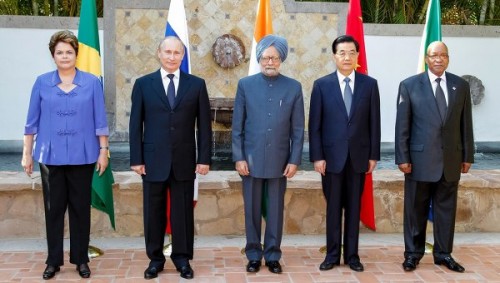
Le président russe Poutine annonce qu’il proposera à la prochaine réunion du BRICS, les 26-27 mars à Durban, en Afrique du Sud, une extension décisive du rôle de ce regroupement jusqu’ici essentiellement économique de cinq puissances de ce qu’on a coutume de nommer un peu vite “le monde émergent”. Poutine prend garde d’identifier le BRICS comme “un élément-clef du monde multipolaire émergent”, ce qui a une toute autre signification, quasiment opposée, à l’expression “monde émergent”. L’expression “monde émergent”, avec sa connotation dégradante ou implicitement méprisante rappelant l’expression “Tiers-Monde”, implique évidemment le suprématisme anglo-saxon étendu au bloc BAO, conduisant à considérer le modèle BAO comme la Lumière du monde en tous points mais essentiellement économique et moral pour satisfaire les convictions de la modernité, le “monde émergent” évoluant avec comme destin fatal de s’intégrer au bloc BAO. Poutine voit le BRICS comme un élément d’une alternative à la structure du monde actuel régentée par le bloc BAO, alternative fondée sur la multipolarité contre l’unipolarité arrogante, ex-USA et désormais bloc BAO. (Selon notre rangement, nous qualifierions les puissances du BRICS, effectivement selon une vision multipolaire, comme déterminant un “monde se constituant aux marges du Système”, disons “un pied dedans, un pied dehors”, ou encore “dans le Système d’une certaine façon, avec un œil critique et éventuellement réformiste sur le Système d’une autre façon”.)

Cette annonce est faite dans une interview de Poutine à l’agence ITAR-TASS, avec le texte retranscrit le 22 mars 2013 sur le site de la présidence. En préliminaire, Poutine rappelle ce qu’est le BRICS, et surtout les principes sur lesquels est fondée ce regroupement. On retrouve l’accent sur le respect de la légalité internationale et sur le principe de la souveraineté… «BRICS is a key element of the emerging multipolar world. The Group of Five has repeatedly affirmed its commitment to the fundamental principles of the international law and contributed to strengthening the United Nations central role. Our countries do not accept power politics or violation of other countries' sovereignty. We share approaches to the pressing international issues, including the Syrian crisis, the situation around Iran, and Middle East settlement.»

Puis une des questions porte sur le rôle géopolitique du BRICS : «Does it go beyond the purely economic agenda and should the BRICS countries accept greater responsibility for geopolitical processes? What is their policy with regard to the rest of the world, including its major actors such as the United States, the European Union, Japan… What future do you see for this association in this regard?» On trouve dans la réponse de Poutine la présentation et l’explicitation de son initiative.

«At the same time, we invite our partners to gradually transform BRICS from a dialogue forum that coordinates approaches to a limited number of issues into a full-scale strategic cooperation mechanism that will allow us to look for solutions to key issues of global politics together.

»The BRICS countries traditionally voice similar approaches to the settlement of all international conflicts through political and diplomatic means. For the Durban summit, we are working on a joint declaration setting forth our fundamental approaches to pressing international issues, i.e. crisis in Syria, Afghanistan, Iran and the Middle East.

»We do not view BRICS as a geopolitical competitor to western countries or their organisations — on the contrary, we are open to discussion with any country or organisation that is willing to do so within the framework of the common multipolar world order.»

Notre ami M K Bhadrakumar a repris instantanément la nouvelle sur son blog (Indian PunchLine), le 22 mars 2013. Manifestement, il juge extrêmement importante la proposition russe. Par ailleurs, selon son scepticisme habituel pour la direction indienne qu’il tient en piètre estime, il se demande quelle va être l’attitude de l’Inde… M K Bhadrakumar note que Poutine envisage cette transformation du BRICS comme graduelle et étendue sur un laps de temps.

«What stands out is the stunning suggestion Putin has made to reorient the BRICS. He said, “we invite our partners [Brazil, India, China and South Africa] to gradually transform BRICS from a dialogue forum that coordinates approaches to a limited number of issues into a full-scale strategic cooperation mechanism that will allow us to look for solutions to key issues of global politics together.” [Emphasis added.] Putin acknowledges that such a profound transformation will take time. Aside across-the-board harmonization of foreign policies amongst the BRICS members, a fundamental reorientation of the foreign-policy doctrines may also be required.

»How India responds to the grand idea remains to be seen. To be sure, a ‘leap of faith’ is required. India has been comfortable with the fact that the leitmotif of BRICS is economics. Putin’s proposal would fundamentally readjust the BRICS’ orientation…»

… Justement, nous différons quelque peu de M K Bhadrakumar sur l’appréciation du tempo que Poutine voudrait voir suivre pour la transformation du BRICS. Il nous semble que sa proposition, loin de n’être que théorique et laissée au temps pour mûrir, est d’ores et déjà basée sur des propositions spécifiques de prises de position sur des problèmes précis («…a joint declaration setting forth our fundamental approaches to pressing international issues, i.e. crisis in Syria, Afghanistan, Iran and the Middle East»). Cela peut aussi bien signifier que la Russie aimerait voir, dès le sommet de Durban, le BRICS prendre position sur les problèmes spécifiques identifiés, – on verra cela d’une façon concrète la semaine prochaine. Cette perspective signifierait que les Russes voudraient au contraire aller très vite. La position de l’Inde paraîtrait sans aucun doute parmi les plus incertaines vis-à-vis d’un tel projet, quoique les Indiens, comme l’avait signalé M K Bhadrakumar lui-même, ont été les premiers à prendre l’initiative de réunir les conseillers de sécurité nationale des pays du groupe (voir le 7 janvier 2013), ce qui va évidemment dans le sens prôné par Poutine.

Quoi qu’il en soit et si l’on s’en tient à une appréciation objective, il serait évidemment logique de penser que les Russes veulent aller vite, parce que la situation générale des relations internationales et des crises continue à se détériorer à une très grande vitesse et demande la mise en place de forces, soit pour contenir cette descente dans le désordre, soit pour équilibrer les autres forces (le bloc BAO, principalement) qui alimentent ce désordre. Il paraît également très probable que les Russes ont le soutien de la Chine pour ce projet. (Le président chinois commençait sa visite à Moscou le jour où cette interview de Poutine était diffusée, ce qui ne peut être tenue pour une coïncidence, et au contraire doit être apprécié comme un signe puissant dans le sens d'une communauté de vues Russie-Chine.) D’une façon générale, on pourrait apprécier que la proposition russe vient à son heure, qu’il existe autour du BRICS une urgence d’évolution et d’intervention, selon laquelle un tel rassemblement peut difficilement restreindre sa propre dynamique au seul champ économique ; c’est notamment, voire essentiellement par le champ économique que le Système active son travail de déstructuration et de dissolution, et par conséquent des acteurs de cette importance, regroupés autour du champ économique dans la situation pressante qu’on connaît, ne peuvent pas ne pas considérer tous les effets engendrés par ce domaine.

Le projet russe n’a rien à voir, à notre sens, avec la constitution d’un pôle de puissance pouvant éventuellement concurrencer d’autres pôles de puissance (le bloc BAO, évidemment), – comme le dit justement Poutine et, selon notre approche, en exprimant sa véritable pensée. Le BRICS, s’il était réformé dans le sens voulu par Poutine, ne constituerait pas une partie prenante dans la situation actuelle, mais bel et bien une tentative de stabilisation de la dite situation. De ce point de vue, les Russes cherchent des partenaires capables de les épauler, ou au moins de les soutenir, dans cette même entreprise de “tentative de stabilisation”, comme ils font en Syrie, et leur initiative vers le BRICS est une démarche naturelle.

Continuant à considérer objectivement la situation, le BRICS n’apparaît en aucun cas assez puissant et assez organisé pour bouleverser complètement la situation générale. Il est vrai qu’il n’a pas affaire seulement à d’autres groupes dont la plupart sont déstabilisateurs, mais, au-dessus, à une tendance générale de déstructuration-dissolution qui dépasse évidemment les capacités humaines d’organisation ou de désorganisation. Le BRICS transformé-selon-Poutine, serait une saine et juste réaction face à cette tendance, mais absolument insuffisante pour espérer la stopper de quelque façon que ce soit. Par contre, et sans que ce soit justement le but conscient et élaboré de Poutine, cette évolution du BRICS apparaîtrait au bloc BAO comme un défi, ou bien une pression nouvelle et menaçante, – même faussement apprécié mais peu importe, le bloc BAO vit dans ses narrative, – et l’effet général serait d’accentuer le trouble et l’inquiétude au sein de ce même bloc, c’est-à-dire d’y attiser un désordre dont les effets seraient bienvenus, au moins pour la raison évidente que le bloc BAO est le principal relais des forces de désordre qu’on a identifiées.

Aucune force politique n’est aujourd’hui capable de stabiliser la situation générale du monde et, encore moins, d’en restructurer les composants pour transformer cette restructuration temporaire en une structure nouvelle et solide. La marche du désordre dépend de forces hors du contrôle humain et disposent donc d’une complète immunité sur l’essentiel du mouvement. Le véritable apport d’un BRICS renforcé serait, justement, de renforcer les puissances qui le composent et de les conduire à rassembler leurs forces ; et, ce faisant, d’accentuer la pression sur le bloc BAO qui est le principal vecteur de désordre, donc d’accélérer les pressions qui l’affectent du point de vue de sa situation intérieure. L’effet net d’une telle évolution serait alors d’accroître le désordre interne, et donc le processus de déstructuration-dissolution des forces du bloc BAO. Objectivement, il s’agirait d’une accélération supplémentaire du désordre en cours, – mais, bien entendu, d’une accélération vertueuse puisque le désordre se développerait dans un champ éminemment défavorable au bloc BAO, et influant directement sur la cohésion et la solidité interne des membres de ce bloc.

Céline: Viaggio al termine dell'Apocalisse

“Irak : dix ans après l’invasion, le risque d’une guerre civile”

“Irak : dix ans après l’invasion, le risque d’une guerre civile”

Bagdad. Une image parmi d’autres des attentats qui ont fait 65 morts en Irak, le 19 mars 2013, à l’occasion du dixième anniversaire de l’invasion du pays

Dix ans après la mission Iraqi Freedom, menée par les Américains et les Anglais, pour renverser Saddam Hussein, l’Irak est toujours un pays d’une grande instabilité, déchiré par des tensions entre communautés et secoué par des attentats terroristes.

Pourquoi, alors que le pays s’est doté d’une constitution et est redevenu un grand pays exportateur de pétrole, la situation est-elle toujours aussi instable d’un point de vue politique et communautaire ?

Karim Pakzad, chercheur à l’Iris, spécialiste de l’Irak, analyse pour BFMTV.com une situation complexe aux sources de tension multiformes.

Quelle est la situation politique en Irak aujourd’hui ?

L’Irak connait une crise politique multiforme. Malgré les élections législatives et la formation d’un parlement, il y a de nombreuses tensions, d’une part entre la communauté chiite qui gouverne l’Irak et qui compose la majorité de la population, et les sunnites, mais aussi entre les Kurdes et le gouvernement. Après la chute de Saddam Hussein, les Irakiens se sont dotés d’une constitution qui leur a permis d’organiser des élections dans des conditions assez satisfaisantes, à laquelle l’ensemble des communautés ont eu accès.

Mais c’est la communauté chiite, majoritaire en Irak, qui gouverne. Entre sunnites et chiites, le conflit date de l’intervention américaine, qui a privé les arabes sunnites du pouvoir. Jusqu’à 2003, les sunnites gouvernaient. Ils ont perdu le pouvoir à la suite des élections.

Quelles sont les critiques émises à l’encontre du gouvernement irakien ?

Les sunnites accusent le Premier ministre d’autoritarisme et de monopoliser le pouvoir. Nouri al-Maliki, en place depuis 2006, est à la fois Premier ministre, ministre de la Défense, de l’Intérieur et de la Sécurité nationale.

De leur côté, les Kurdes accusent le gouvernement de Maliki de ne pas appliquer la constitution. Celle-ci prévoit un système fédéral en Irak. Les Kurdes ont appliqué ce principe, dès le lendemain de l’adoption de la constitution. Ils ont leur propre gouvernement, leur propre président et leur propre parlement. Mais les chiites et les sunnites n’ont pas encore appliqué ce système.

Les chiites qui détiennent le pouvoir central, et les ressources pétrolières, n’y ont pas intérêt. Les sunnites n’y ont pas intérêt non plus, parce que les régions qu’ils occupent sont dépourvues de ressources pétrolières.

Y a-t-il un risque de guerre civile en Irak ?

Tous les éléments d’une guerre civile sont réunis en Irak, si la crise politique continue. Les sunnites n’ont jamais accepté d’avoir perdu le pouvoir et les chiites ne sont pas disposés à partager ce pouvoir de façon équitable.

En outre, la région occupée par les Kurdes apparaît presque comme un état indépendant. C’est une région qui connait un développement économique foudroyant. Les Kurdes revendiquent la ville de Kirkouk, qu’ils considèrent comme leur capitale historique. Mais ni les chiites ni les sunnites ne sont disposés à leurs céder. Et la constitution, qui prévoit un référendum sur le sort de Kirkouk, n’est pas appliquée.

La guerre civile peut-elle être évitée ?

L’influence des Ayatollah chiites, qui commencent à critiquer et prendre leurs distances vis-à-vis de Maliki, pourrait être déterminante. Les Ayatollah chiites ont en effet une influence extraordinaire sur les chiites irakiens, le gouvernement irakien, mais aussi sur les chiites du monde entier.

Plusieurs conditions sont nécessaires pour installer en Irak une certaine stabilité. Il faudrait d’une part que les prochaines élections, qui auront lieu dans un an, se déroulent d’une manière satisfaisante, et qu’une autre alliance autour des chiites et des Kurdes arrive à former un gouvernement plus acceptable pour les sunnites. D’autre part, il faudrait que ce gouvernement arrive à limiter l’influence des pays étrangers comme l’Iran et Arabie saoudite.

L’Irak a les moyens suffisants pour se développer. Les revenus pétroliers irakiens s’élevaient ainsi à 100 milliards de dollars en 2012.

Quels sont les autres facteurs de déstabilisation du pays?

Avec le renversement de Saddam Hussein, l’Irak n’est plus aujourd’hui un pays uniquement arabe. La constitution irakienne définit l’Irak comme un pays composé de différentes communautés. Ainsi le président de la République, Jalal Talabani, est-il kurde, et le Premier ministre chiite. Or, l’Arabie saoudite et les pays du Golfe persique (peuplés de sunnites) n’ont jamais accepté le pouvoir chiite. A mesure que les rivalités dans la région entre l’Iran (chiite) et l’Arabie saoudite, les Emirats et le Qatar (tous trois sunnites) augmentent, cela déstabilise un peu plus la situation en Irak.

Depuis dix ans, les attentats ont principalement visé la communauté chiite. La branche irakienne d’Al-Qaïda, mais aussi les anciens du parti Baas (le parti de Saddam Hussein), ou encore les islamistes irakiens, tentent de déstabiliser l’Irak pour revenir au pouvoir, aidés en cela par l’Arabie saoudite. Ils tablent sur la marginalisation de l’Iran, menacé par certaines puissances étrangères, qui ne pourrait pas intervenir en cas de guerre civile. C’est aussi l’analyse des nationalistes sunnites du parti Baas et des partis islamistes sunnites. Voilà pourquoi les attentats anti-chiites continuent.

Enfin, la situation en Syrie envenime la crise politique en Irak. Le gouvernement irakien craint que le remplacement de Bachar al-Assad (qui est soutenu par l’Iran chiite) ne permette l’arrivée au pouvoir des sunnites en Syrie. En renforçant la communauté arabe sunnite cela renforcerait la crise politique en Irak. Voilà pourquoi le pouvoir irakien est l’un des gouvernements arabes qui n’est pas tout à fait favorable à l’opposition syrienne.

BFMTV

La psychologie US contre son gouvernement

tread2_460x276.jpg

La psychologie US contre son gouvernement

Ex: http://www.dedefensa.org/

L’institut PEW Research publie les résultats de ses sondages annuels sur l’attitude des citoyens américains vis-à-vis de leur gouvernement central (fédéral), sous la présidence du démocrate Obama, ainsi que vis-à-vis de nombreuses autres autorités. Il agrémente le résultat de ses enquête de résultats comparatifs divers, dans les années et décennies passées. (Voir le 9 mars 2013 pour les divers résultats.)

Ainsi peut-on prendre connaissance d’un graphique qui indique les grandes tendance dans la confiance du citoyen US pour le gouvernement central depuis les années 1950. (Il s’agit de chiffres annuels déterminés à partir d’une moyenne des grands sondages effectués sur un échantillonnage d’institut.) Pour mesurer l’évolution vertigineuse en un peu plus d’un demi siècle, on observera que cet indice de la “confiance moyenne” du citoyen pour le gouvernement se situait durant la période de la présidence Eisenhower (à partir de 1956, premières enquêtes effectuées) jusqu’à la mort de Kennedy, au-dessus de 70%, – entre 73% en 1956 et 79% en 1963, à la mort de Kennedy. La période actuelle est évidemment la plus basse de toute l’histoire de cette courbe : depuis 2006 et toujours aujourd’hui, le niveau moyen de confiance du citoyen US s’est situé largement en-dessous de 30%, – précisément entre les deux extrêmes de 18% et 26%, avec des variations sans signification de durée. (Vue la durée du phénomène, on peut avancer que cette impopularité catastrophique actuelle du gouvernement est devenue structurelle.)La dynamique générale est bien entendu celle d’une chute continue de la confiance, avec divers “accidents”, redressements temporaires et partiels, etc., n’affectant pas la tendance générale.

• De la mort de Kennedy (1963) à la fin de l’administration Carter, la chute est continue, des 79% mentionnés à l’extrême 28%/30% durant la période de crise interne du gouvernement de la fin de l’administration Carter.

• Depuis Carter, il y a eu deux “rebonds” notables : l’administration Reagan (1981-1989), culminant à un peu plus de 40% dans les années 1986-1988 ; l’administration Clinton, surtout dans son second mandat, exactement entre 1994 et 2000, mais n’atteignant jamais les 40% de confiance. Il y a eu également deux “accidents” notables, ayant entraîné un pic très rapide de popularité et une chute aussi rapide : la victoire dans la première guerre du Golfe (on passe en un an de 32% à près de 45%, et on retombe au point le plus bas de la période, autour de 25%, en un an) et l’attaque du 11 septembre 2001 (on atteint 55% en 2001 et on est déjà retombé à 36% en 2004 pour se stabiliser en-dessous des 30%, autour des 25%, à partir de 2006). La différence entre ces deux “accidents” (bond de la popularité-chute de la popularité) est que l’épisode de 1991-1992 n’empêche par le redressement très vite (1994) avec Clinton, largement au-dessus de 30%, tandis que l’épisode 9/11, lui, ouvre vraiment une nouvelle “époque” qui établit une sorte de stabilité dans la dissolution continue de la popularité du gouvernement. Le mythe de la capacité d’influence du président se dissout également. Nous sommes installés dans une situation structurelle d'hostilité au gouvernement central.

• Avant l’époque actuelle, il y a eu deux très fortes périodes de dépression psychologique du citoyen par rapport à son gouvernement : la chute continuelle depuis la mort de Kennedy, dramatisée par la présidence Carter succédant à la démission de Nixon et au Watergate ; la chute brutale, moins compréhensible directement que la précédente, durant la présidence G.H. Bush (père) jusqu’en 1992 et la première partie de la présidence Clinton. (Cet épisode, particulièrement révélateur des premiers signes d’une réelle crise psychologique, puisque sans cause extérieure catégorique [l’Amérique sortit au printemps 1991 d’une récession commencée en 1988, beaucoup moins sévère que celle du début de la présidence Reagan]. Le phénomène de cette période est très rarement mentionné alors qu’il est pour nous fondamental : voir notamment sur ce site, le 2 septembre 2005.)

• L’actuelle défaveur du public pour le gouvernement central touche tous les domaines de ce gouvernement, dans une mesure jamais vue jusqu’ici. Un cas très important et particulièrement convaincant est celui du Congrès, dont la popularité s’est effondrée durant les dix dernières années, avec, de façon encore plus significative, une accélération remarquable de cet effondrement depuis 2009 correspondant à la mise en lumière de la corruption, de l’impuissance, de la paralysie de ce centre du pouvoir… «Opinions about Congress remain very negative, according to our Jan. 2013 survey: just 23% offer a favorable opinion while 68% express an unfavorable view. In 2009, 50% of the public regarded Congress favorably and, between 1985 and 2005, Congress was viewed more favorably than unfavorably.»

• Un autre point parmi ces nombreux sondages et enquêtes du PEW Research Center, est la mise à jour d’une attitude nouvelle, extrêmement soupçonneuse et hostile des citoyens US vis-à-vis du gouvernement. Cet aspect est mis en évidence par Paul Joseph Watson dans Infowars.com le 13 mars 2013 : pour la première fois dans ces enquêtes de PEW Research Center, il ressort qu’une majorité de citoyens juge que le gouvernement fédéral constitue une menace contre “leurs droits civiques et leur liberté” (53% pensent dans ce sens, 43% ne pensent pas dans ce sens, le reste sans opinion). Watson relève d’autres résultats allant dans le même sens général qu’on signale ici, et affectant également le sentiment et l’attitude du citoyen US vis-à-vis du gouvernement et du pouvoir en général.

«A total of 53% of Americans view the government as a threat to their “personal rights and freedoms,” with 43% not believing it poses a threat and 4 don’t knows. The poll also found, “Only 26% saying they can trust government always or most of the time, while 73% say they can trust the government only some of the time or never. Majorities across all partisan and demographic groups express little or no trust in government.” Just 20% of of whites trust the federal government while a mere 26% of Americans across the board view Congress favorably…

»The poll arrives in the aftermath of a separate Rasmussen survey that found just 6 per cent of Americans now rate the mainstream news media as “very trustworthy”. […] In 2011, pollster Pat Caddell warned that Americans were “pre-revolutionary” after a survey found that just 17 per cent of Americans believed that the U.S. government had the consent of the governed, an all time low…»

Il nous apparaît évident que ces résultats, portant sur l’opinion des citoyens US sur leur direction politique ne constitue pas un facteur détaché de la situation de cette direction, mais un témoignage direct et intéressé de l’état de cette direction. Les tendances sont assez fortes pour être considérées comme une expression de cela, et le système de la communication assez puissant aux USA pour établir un lien de cause à effet entre cette opinion d’une part, l’état et le comportement du pouvoir d’autre part. Le sentiment et le jugement de l’opinion publique sur la direction à la fois reflète l’état de cette direction, à la fois pèse sur elle pour accentuer les tendances mises à jour. La psychologie joue un rôle fondamental à cet égard, et il existe, de plus en plus fortement, de plus en plus agressivement, une rupture psychologique antagoniste explosive entre l’opinion publique et la direction.

Pour l’immédiat, on observera que la situation actuelle fait litière des évaluations ou des affirmations faites au moment de la réélection d’Obama, et présentant cet événement comme un grand succès politique, cela conduisant certains à penser que le deuxième terme d’Obama pourrait être novateur et audacieux. On voit ce qu’il en est, au travers d’une situation statistique qui se traduit par un climat général qui est clairement défavorable au président dans son second terme. Il est également évident que nombre de dirigeants étrangers qui attendaient des incurvations politiques intéressantes avec le deuxième mandat d’Obama réalisent cette situation et modifient leur attitude. C’est le cas de la direction iranienne, qui a cru pendant quelques mois, avant et pendant la réélection, qu’elle pourrait arriver à des perspectives nouvelles avec le mandat BHO-II (des rumeurs insistantes d’accord USA-Iran sur le point de se faire ont circulé à la fin 2012), et qui est revenue sur ce sentiment. La deuxième victoire d’Obama, compte tenu de l’apport des minorités (les noirs et les hispaniques comme il est également relevé) qui ont voté dans ce sens parce que le président est africain-américain, apparaît suffisamment trompeuse, déséquilibrée et étriquée, pour confirmer dans l’idée que la paralysie agressive et obstructive exécutif-législatif qui a marqué la vie politique US depuis le début 2010 ne va faire que croître et embellir et s’installer comme un caractère institutionnel du gouvernement des États-Unis. D’où l’analyse modifiée des Iraniens, qui savent par ailleurs que le Congrès est complètement encalminé dans une agressivité totalement incontrôlable contre l’Iran et qui n’espèrent plus aucune avancée significative avec les USA.

Si l’on considère ces divers résultats d’une façon plus large, notamment sur le terme long où nous les avons envisagés d’abord et tout en observant qu’ils n’apportent pas vraiment de surprise par rapport à notre jugement général courant, l’on admettra qu’ils permettent de substantiver presque scientifiquement des sentiments et des hypothèses souvent développés depuis quelques années. Ce qui est remarquable selon notre appréciation et par rapport à ce qui est perçu d’une façon courante et, dirions-nous, presque “traditionnelle” selon l’image qu’on se fait de la puissance US, c’est la perte complète d’influence du président depuis le 11 septembre, avec la paralysie grandissante du pouvoir qui s’ensuit, jusqu’à la situation actuelle de paralysie, et l’encalminage général dans des politiques extrémistes, agressives, déclamatoires, et sans le moindre but cohérent. Cette situation est en effet absolument favorable à la déstructuration du pouvoir entre les centres divers de pouvoir que sont les ministères, les agences, les bureaucraties, les groupes d’intérêt, les lobbies, les influences privées et étrangères, etc., ce qui prive la politique US de toute cohérence et de toute possibilité d’intégration et favorise des tendances systémiques échappant au contrôle humain.

C’est effectivement sur ce dernier point que nous voulons insister. D’une façon plus large, et qui dépasse évidemment le seul domaine de la politique et même de la question de la direction politique, il apparaît bien dans ces résultats sur le long terme que la conduite de la politique dans son orientation et dans ses buts, justement, a échappé à ceux qui sont censés l’élaborer et la conduire, – en un mot, au facteur humain. La chose est évidente par rapport aux événements, avec cette perte d’influence du président manifeste depuis le 9/11, pour les deux présidents Bush et Obama qui sont condamnés à suivre une politique qui les dépasse et ne les consulte même plus… Même la vision critique classique d’une politique US conduite d’une façon cynique “pour les intérêts des USA” n’est plus justifiée. Cette brutale situation d'impuissance générale des présidents depuis 9/11 alors que l’exécutif ne cesse d’amasser des pouvoirs, de suivre des politiques illégales nouvelles génératrices en principe d'une puissance supplémentaire, de lancer des mesures qui violent les grands principes civiques du pays, dépasse le cadre du paradoxe incompréhensible pour épouser la thèse que la politique générale “conduite” en apparence par une direction humaine ne doit plus rien à la raison humaine d’une façon générale, ou d’une façon disons inspiratrice et conductrice. Ce que nous nommons “le Système” est bien totalement “en charge” et exerce sans aucune limite le vrai pouvoir. La politique n’a nul besoin d’être explicitée ni de justifier de sa cohérence, parce qu’il s’agit de la politique-Système. Sa puissance impose silence et sa justification de dépend plus de l’élaboration de l’esprit humain ; de celui-ci, l’esprit humain, dans le contexte washingtonien, on n’attend plus, selon les exigences du Système, qu’une justification constante, en des termes les plus arrangeants et les plus faussement rationnels possibles, d’une politique à laquelle il ne comprend rien et qui échappe à son entendement encore plus qu’à son contrôle. Il nous paraît évident que cette situation de type métahistorique où des forces extra-humaines sont à l’œuvre ne peut échapper, par l’influence qu’elle exerce, à une perception inconsciente de la psychologie : d'où l'hostilité de l'opinion publique.

Il y a donc là une part essentielle, voire pour nous exclusive, de l’explication de l’hostilité de l’opinion publique vis-à-vis de sa direction, avec comme corollaire un repli de la psychologie du citoyen sur les dimensions centrifuges, antiSystème, et porteuse des dynamiques de déstructuration des USA et de dissolution de l’esprit de l’union. L’effet intérieur de ce phénomène, sur la perception de la structure interne des USA, est nécessairement dévastateur. Il apparaît surtout depuis l’arrivée d’Obama au pouvoir, ce qui est un cas d’une ironie étrange lorsqu’on se rappellera que la référence d’Obama lors de son élection de 2008 et lors de son inauguration de janvier 2009 était Abraham Lincoln, l’homme de l’union par tous les moyens, y compris par la force arbitraire et brutale… BHO, serait-il finalement l’anti-Lincoln par excellence, l’homme de la désunion “par tous les moyens, y compris par la force arbitraire et brutale” (drones-tueurs, droits civiques bafoués, etc.), le président qui a accéléré la dissolution des véritables pouvoirs du président en même temps qu’il suscitait la dissolution de l’esprit de l’union fédérale ? C’est là que se goûte l’amertume de l’ironie, puisqu’on voit qu’il préside, ce président, dans les opinions comparatives, à une désaffection hostile du gouvernement fédéral établissant une opposition désormais hautement significative avec les opinions favorables aux pouvoirs locaux et aux pouvoirs des États de l’Union : «Since Barack Obama’s first year in office, public assessments of the federal government dropped nine points, according to our April 2012 survey. Most of the change was among Democrats and independents, as the level of favorable views of government among Republicans was already low.[…] Ten years ago, roughly two-thirds of Americans offered favorable assessments of all three levels of government: federal, state and local. But in a survey conducted in April 2012, those having a favorable view of the federal government numbered just 33% compared to 61% who regarded their local government favorably, and 52% who had a positive opinion of their state government.»

Obama, excellent serviteur-exécutant du Système, certes…

Stalin’s Fight Against International Communism

Stalin’s Fight Against International Communism

By Kerry Bolton stalin-the-enduring-legacy

Ex: http://www.counter-currents.com/

Editor’s Note:

This is the first chapter of Kerry Bolton’s new book Stalin: The Enduring Legacy [2] (London: Black House Publishing, 2012). The chapter is being reprinted as formatted in the book. Counter-Currents will also run a review of the book, which I highly recommend. 

The notion that Stalin ‘fought communism’ at a glance seems bizarre. However, the contention is neither unique nor new. Early last century the seminal German conservative philosopher-historian Oswald Spengler stated that Communism in Russia would metamorphose into something distinctly Russian which would be quite different from the alien Marxist dogma that had been imposed upon it from outside. Spengler saw Russia as both a danger to Western Civilisation as the leader of a ‘coloured world-revolution’, and conversely as a potential ally of a revived Germany against the plutocracies. Spengler stated of Russia’s potential rejection of Marxism as an alien imposition from the decaying West that,

Race, language, popular customs, religion, in their present form… all or any of them can and will be fundamentally transformed. What we see today then is simply the new kind of life which a vast land has conceived and will presently bring forth. It is not definable in words, nor is its bearer aware of it. Those who attempt to define, establish, lay down a program, are confusing life with a phrase, as does the ruling Bolshevism, which is not sufficiently conscious of its own West-European, Rationalistic and cosmopolitan origin.[1]

Even as he wrote, Bolshevism in the USSR was being fundamentally transformed in the ways Spengler foresaw. The ‘rationalistic’ and ‘cosmopolitan’ origins of Bolshevism were soon being openly repudiated, and a new course was defined by Zhdanov and other Soviet eminences.

Contemporary with Spengler in Weimer Germany, there arose among the ‘Right’ the ‘National Bolshevik’ faction one of whose primary demands was that Germany align with the Soviet Union against the Western plutocracies. From the Soviet side, possibilities of an alliance with the ‘Right’ were far from discounted and high level Soviet sources cultivated contacts with the pro-Russian factions of the German Right including the National Bolsheviks.[2]

German-Soviet friendship societies included many conservatives. In Arbeitsgemeinschaft zum Studium der Sowjetrussichen Planwirtschaft (Arplan)[3] Conservative-Revolutionaries and National Bolsheviks comprised a third of the membership. Bund Geistige Berufe (BGB)[4] was founded in 1931 and was of particular interest to Soviet Russia, according to Soviet documents, which aimed ‘to attract into the orbit of our influence a range of highly placed intellectuals of rightist orientation’.[5]

The profound changes caused Konstantin Rodzaevsky, leader of the Russian Fascist Union among the White Russian émigrés at Harbin, to soberly reassess the USSR and in 1945 he wrote to Stalin:

Not all at once, but step by step we came to this conclusion. We decided that: Stalinism is exactly what we mistakenly called ‘Russian Fascism’. It is our Russian Fascism cleansed of extremes, illusions, and errors.[6]

In the aftermath of World War II many German war veterans, despite the devastating conflagration between Germany and the USSR, and the rampage of the Red Army across Germany with Allied contrivance, were vociferous opponents of any German alliance with the USA against the USSR. Major General Otto E Remer and the Socialist Reich Party were in the forefront of advocating a ‘neutralist’ line for Germany during the ‘Cold War’, while one of their political advisers, the American Spenglerian philosopher Francis Parker Yockey, saw Russian occupation as less culturally debilitating than the ‘spiritual syphilis’ of Hollywood and New York, and recommended the collaboration of European rightists and neo-Fascists with the USSR against the USA.[7] Others of the American Right, such as the Yockeyan and Spenglerian influenced newspaper Common Sense, saw the USSR from the time of Stalin as the primary power in confronting Marxism, and they regarded New York as the real ‘capitol’ of Marxism.[8]

What might be regarded by many as an ‘eccentric’ element from the Right were not alone in seeing that the USSR had undergone a revolutionary transformation. Many of the Left regarded Stalin’s Russia as a travesty of Marxism. The most well-known and vehement was of course Leon Trotsky who condemned Stalin for having ‘betrayed the revolution’ and for reversing doctrinaire Marxism. On the other hand, the USA for decades supported Marxists, and especially Trotskyites, in trying to subvert the USSR during the Cold War. The USA, as the columnists at Common Sense continually insisted, was promoting Marxism, while Stalin was fighting it. This dichotomy between Russian National Bolshevism and US sponsored international Marxism was to having lasting consequences for the post-war world up to the present.

Stalin Purges Marxism

The Moscow Trials purging Trotskyites and other veteran Bolsheviks were merely the most obvious manifestations of Stalin’s struggle against alien Marxism. While much has been written condemning the trials as a modern day version of the Salem witch trials, and while the Soviet methods were often less than judicious the basic allegations against the Trotskyites et al were justified. The trials moreover, were open to the public, including western press, diplomats and jurists. There can be no serious doubt that Trotskyites in alliance with other old Bolsheviks such as Zinoviev and Kameneff were complicit in attempting to overthrow the Soviet state under Stalin. That was after all, the raison d’etre of Trotsky et al, and Trotsky’s hubris could not conceal his aims.[9]

The purging of these anti-Stalinist co-conspirators was only a part of the Stalinist fight against the Old Bolsheviks. Stalin’s relations with Lenin had not been cordial, Lenin accusing him of acting like a ‘Great Russian chauvinist’.[10] Indeed, the ‘Great Russians’ were heralded as the well-spring of Stalin’s Russia, and were elevated to master-race like status during and after the ‘Great Patriotic War’ against Germany. Lenin, near death, regarded Stalin’s demeanour as ‘offensive’, and as not showing automatic obedience. Lenin wished for Stalin to be removed as Bolshevik Party General Secretary.[11]

Dissolving the Comintern

The most symbolic acts of Stalin against International Communism were the elimination of the Association of Old Bolsheviks, and the destruction of the Communist International (Comintern). The Comintern, or Third International, was to be the basis of the world revolution, having been founded in 1919 in Moscow with 52 delegates from 25 countries.[12] Zinoviev headed the Comintern’s Executive Committee.[13] He was replaced by Bukharin in 1926.[14] Both Zinonviev and Bukharin were among the many ‘Old Bolsheviks’ eliminated by Stalin.

Stalin regarded the Comintern with animosity. It seemed to function more as an enemy agency than as a tool of Stalin, or at least that is how Stalin perceived the organisation. Robert Service states that Dimitrov, the head of the Comintern at the time of its dissolution, was accustomed to Stalin’s accusations against it. In 1937 Stalin had barked at him that ‘all of you in Comintern are hand in glove with the enemy’.[15] Dimitrov must have wondered how long he had to live.[16]

Instead of the Communist parties serving as agents of the world revolution, in typically Marxist manner, and the purpose for founding the Comintern, the Communist parties outside Russia were expected to be nationally oriented. In 1941 Stalin stated of this:

The International was created in Marx’s time in the expectation of an approaching international revolution. Comintern was created in Lenin’s time at an analogous moment. Today, national tasks emerge for each country as a supreme priority. Do not hold on tight to what was yesterday.[17]

This was a flagrant repudiation of Marxist orthodoxy, and places Stalinism within the context of National Bolshevism.

The German offensive postponed Stalin’s plans for the elimination of the Comintern, and those operatives who had survived the ‘Great Purge’ were ordered to Ufa, South of the Urals. Dimitrov was sent to Kuibyshev on the Volga. After the Battle of Stalingrad, Stalin returned to the issue of the Comintern, and told Dimitrov on 8 May 1943 to wind up the organisation. Dimitrov was transferred to the International Department of the Bolshevik Party Central Committee.[18] Robert Service suggests that this could have allayed fears among the Allies that Stalin would pursue world revolution in the post-war world. However, Stalin’s suspicion of the Comintern and the liquidation of many of its important operatives indicate fundamental belligerence between the two. In place of proletarian international solidarity, Stalin established an All-Slavic Committee[19] to promote Slavic folkish solidarity, although the inclusion of the Magyars[20] was problematic.

Stalin throughout his reign undertook a vigorous elimination of World Communist leaders. Stalin decimated communist refugees from fascism living in the USSR. While only 5 members of the Politburo of the German Communist Party had been killed under Hitler, in the USSR 7 were liquidated, and 41 out of 68 party leaders. The entire Central Committee of the Polish Communist Party in exile were liquidated, and an estimated 5000 party members were killed. The Polish Communist Party was formally dissolved in 1938. 700 Comintern headquarters staff were purged.[21]

Among the foreign Communist luminaries who were liquidated was Bela Kun, whose psychotic Communist regime in Hungary in 1919 lasted 133 days. Kun fled to the Soviet Union where he oversaw the killing of 50,000 soldiers and civilians attached to the White Army under Wrangle, who had surrendered after being promised amnesty. Kun was a member of the Executive Committee of the Comintern. A favourite of Lenin’s, this bloody lunatic served as a Comintern agent in Germany, Austria and Czechoslovakia during the 1920s. In 1938 he was brought before a tribunal and after a brief trial was executed the same day.[22]

Another action of great symbolism was Stalin’s moves against the ‘Old Bolsheviks’, the veterans of the 1917 Revolution. Leon Sedov, Leon Trotsky’s son, in his pamphlet on the Great Purge of the late 1930s, waxed indignant that Stalin ‘coldly orders the shooting of Bolsheviks, former leaders of the Party and the Comintern, and heroes of the Civil War’.[23] ‘The Association of Old Bolsheviks and that of the former political prisoners has been dissolved. They were too strong a reminder of the “cursed” revolutionary past’.[24]

In place of the Comintern the Cominform was established in 1947, for the purpose of instructing Communist parties to campaign against the Marshall Aid programme that was designed to bring war-ravished Europe under US hegemony. ‘European communism was to be redirected’ towards maintaining the gains of the Red Army during World War II. ‘Communist parties in Western Europe could stir up trouble’, against the USA. The Cominform was far removed from being a resurrection of the old Comintern. As to who was invited to the inaugural meeting held at a secluded village in Poland, ‘Stalin… refused a request from Mao Zedong, who obviously thought that the plan was to re-establish the Communist International’. The Spanish and Portuguese parties were not invited, nor were the British, or the Greek Communist Party, which was fighting a civil war against the royalists.[25]

The extent of the ‘fraternity’ between the USSR and the foreign Communists can be gauged from the delegates having not been given prior knowledge of the agenda, and being ‘treated like detainees on arrival’. While Soviet delegates Malenkov and Zhdanov kept in regular communication with Stalin, none of the other delegates were permitted communication with the outside world.[26]

Repudiation of Marxist Doctrine

The implementation of Marxism as a policy upon which to construct a State was of course worthless, and Stalin reversed the doctrinaire Marxism that he had inherited from the Lenin regime. Leon Sedov indignantly stated of this:

In the most diverse areas, the heritage of the October revolution is being liquidated. Revolutionary internationalism gives way to the cult of the fatherland in the strictest sense. And the fatherland means, above all, the authorities. Ranks, decorations and titles have been reintroduced. The officer caste headed by the marshals has been reestablished. The old communist workers are pushed into the background; the working class is divided into different layers; the bureaucracy bases itself on the ‘non-party Bolshevik’, the Stakhanovist, that is, the workers’ aristocracy, on the foreman and, above all, on the specialist and the administrator. The old petit-bourgeois family is being reestablished and idealized in the most middle-class way; despite the general protestations, abortions are prohibited, which, given the difficult material conditions and the primitive state of culture and hygiene, means the enslavement of women, that is, the return to pre-October times. The decree of the October revolution concerning new schools has been annulled. School has been reformed on the model of tsarist Russia: uniforms have been reintroduced for the students, not only to shackle their independence, but also to facilitate their surveillance outside of school. Students are evaluated according to their marks for behaviour, and these favour the docile, servile student, not the lively and independent schoolboy. The fundamental virtue of youth today is the ‘respect for one’s elders’, along with the ‘respect for the uniform’. A whole institute of inspectors has been created to look after the behaviour and morality of the youth.[27]

This is what Leon Sedov, and his father, Leon Trotsky, called the ‘Bonapartist character of Stalinism’.[28] And that is precisely what Stalin represents in history: the Napoleon of the Bolshevik Revolution who reversed the Marxian doctrinal excrescences in a manner analogous to that of Napoleon’s reversal of Jacobin fanaticism after the 1789 French Revolution. Underneath the hypocritical moral outrage about Stalinist ‘repression’, etc.,[29] a number of salient factors emerge regarding Stalin’s repudiation of Marxist-Leninist dogma:

  • The ‘fatherland’ or what was called again especially during World War II, ‘Holy Mother Russia’, replaced international class war and world revolution.
  • Hierarchy in the military and elsewhere was re-established openly rather than under a hypocritical façade of soviet democracy and equality.
  • A new technocratic elite was established, analogous to the principles of German ‘National Bolshevism’.
  • The traditional family, the destruction of which is one of the primary aims of Marxism generally[30] and Trotskyism specifically,[31] was re-established.
  • Abortion, the liberalisation of which was heralded as a great achievement in woman’s emancipation in the early days of Bolshevik Russia, was reversed.
  • A Czarist type discipline was reintroduced to the schools; Leon Sedov condemned this as shackling the free spirit of youth, as if there were any such freedom under the Leninist regime.
  • ‘Respect for elders’ was re-established, again anathema to the Marxists who seek the destruction of family life through the alienation of children from parents.[32]

What the Trotskyites and other Marxists object to was Stalin’s establishment the USSR as a powerful ‘nation-state’, and later as an imperial power, rather than as a citadel for world revolution. However, the Trotskyites, more than any other Marxist faction, allied themselves to American imperialism in their hatred of Stalinist Russia, and served as the most enthusiastic partisans of the Cold War.[33] Sedov continued:

Stalin not only bloodily breaks with Bolshevism, with all its traditions and its past, he is also trying to drag Bolshevism and the October revolution through the mud. And he is doing it in the interests of world and domestic reaction. The corpses of Zinoviev and Kamenev must show to the world bourgeoisie that Stalin has broken with the revolution, and must testify to his loyalty and ability to lead a nation-state. The corpses of the old Bolsheviks must prove to the world bourgeoisie that Stalin has in reality radically changed his politics, that the men who entered history as the leaders of revolutionary Bolshevism, the enemies of the bourgeoisie, – are his enemies also. Trotsky, whose name is inseparably linked with that of Lenin as the leader of the October revolution, Trotsky, the founder and leader of the Red Army; Zinoviev and Kamenev, the closest disciples of Lenin, one, president of the Comintern, the other, Lenin’s deputy and member of the Politburo; Smirnov, one of the oldest Bolsheviks, conqueror of Kolchak—today they are being shot and the bourgeoisie of the world must see in this the symbol of a new period. This is the end of the revolution, says Stalin. The world bourgeoisie can and must reckon with Stalin as a serious ally, as the head of a nation-state…. Stalin has abandoned long ago the course toward world revolution.[34]

As history shows, it was not Stalin to whom the ‘world bourgeoisie’ or more aptly, the world plutocracy, looked on as an ally, but leading Trotskyites whose hatred of Stalin and the USSR made them vociferous advocates of American foreign policy.

Family Life Restored

Leon Trotsky is particularly interesting in regard to what he saw as the ‘revolution betrayed’ in his condemnation of Stalinist policies on ‘youth, family, and culture’. Using the term ‘Thermidor’, taken from the French revolutionary era, in his description of Stalinism vis-à-vis the Bolshevik revolution, Trotsky began his critique on family, generational and gender relations. Chapter 7 of The Revolution Betrayed is worth reading in its entirety as an over-view of how Stalin reversed Marxism-Leninism. Whether that is ‘good’ or ‘bad’ is, of course, left to the subjectivity of the reader.[35]

The primary raison d’etre of Marxism for Trotsky personally seems to have been the destruction of religion and of family (as it was for Marx).[36] Hence, the amount of attention Trotsky gives to lamenting the return to traditional family relations under Stalin:

The revolution made a heroic effort to destroy the so-called ‘family hearth’ – that archaic, stuffy and stagnant institution in which the woman of the toiling classes performs galley labor from childhood to death. The place of the family as a shut-in petty enterprise was to be occupied, according to the plans, by a finished system of social care and accommodation: maternity houses, creches, kindergartens, schools, social dining rooms, social laundries, first-aid stations, hospitals, sanatoria, athletic organizations, moving-picture theaters, etc. The complete absorption of the housekeeping functions of the family by institutions of the socialist society, uniting all generations in solidarity and mutual aid, was to bring to woman, and thereby to the loving couple, a real liberation from the thousand-year-old fetters. Up to now this problem of problems has not been solved. The forty million Soviet families remain in their overwhelming majority nests of medievalism, female slavery and hysteria, daily humiliation of children, feminine and childish superstition. We must permit ourselves no illusions on this account. For that very reason, the consecutive changes in the approach to the problem of the family in the Soviet Union best of all characterize the actual nature of Soviet society and the evolution of its ruling stratum.[37]

Marxism, behind the façade of women’s emancipation, ridicules the traditional female role in the family as ‘galley labour’, but does so for the purpose of delivering women to the ‘galley labour’ of the Marxist state. The Marxist solution is to take the child from the parents and substitute parental authority for the State via childcare. As is apparent today, the Marxist ideal regarding the family and children is the same as that of big capitalism. It is typical of the manner by which Marxism, including Communism, converges with plutocracy, as Spengler pointed out soon after the 1917 Revolution in Russia.[38]

Trotsky states, ‘you cannot “abolish” the family; you have to replace it’. The aim was to replace the family with the state apparatus: ‘During the lean years, the workers wherever possible, and in part their families, ate in the factory and other social dining rooms, and this fact was officially regarded as a transition to a socialist form of life’. Trotsky decries the reversal by Stalin of this subversion of the family hearth: ‘The fact is that from the moment of the abolition of the food-card system in 1935, all the better placed workers began to return to the home dining table’. Women as mothers and wives were retuning to the home rather than being dragooned into factories, Trotsky getting increasingly vehement at these reversals of Marxism:

Back to the family hearth! But home cooking and the home washtub, which are now half shamefacedly celebrated by orators and journalists, mean the return of the workers’ wives to their pots and pans that is, to the old slavery.[39]

The original Bolshevik plan was for a new slavery where all would be bound to the factory floor regardless of gender, a now familiar aim of global capitalism, behind the façade of ‘equality’.  Trotsky lamented that the rural family was even stronger: ‘The rural family, bound up not only with home industry but with agriculture, is infinitely more stable and conservative than that of the town’. There had been major reversals in the collectivisation of the peasant families: they were again obtaining most of their food from private lots rather than collectivised farms, and ‘there can no longer be any talk of social dining rooms’. ‘Thus the midget farms, [were] creating a new basis for the domestic hearthstone…’[40]

The pioneering of abortion rights by the Leninist regime was celebrated as a great achievement of Bolshevism, which was, however, reversed by Stalin with the celebration instead of motherhood. In terms that are today conventional throughout the Western world, Trotsky stated that due to the economic burden of children upon women,

…It is just for this reason that the revolutionary power gave women the right to abortion, which in conditions of want and family distress, whatever may be said upon this subject by the eunuchs and old maids of both sexes, is one of her most important civil, political and cultural rights. However, this right of women too, gloomy enough in itself, is under the existing social inequality being converted into a privilege.[41]

The Old Bolsheviks demanded abortion as a means of ‘emancipating women’ from children and family. One can hardly account for the Bolshevik attitude by an appeal to anyone’s ‘rights’ (sic). The answer to the economic hardship of childbearing was surely to eliminate the causes of the hardship. In fact, this was the aim of the Stalinists, Trotsky citing this in condemnation:

One of the members of the highest Soviet court, Soltz, a specialist on matrimonial questions, bases the forthcoming prohibition of abortion on the fact that in a socialist society where there are no unemployed, etc., etc., a woman has no right to decline ‘the joys of motherhood’.[42]

On June 27 1936 a law was passed prohibiting abortion, which Trotsky called the natural and logical fruit of a ‘Thermidorian reaction’.[43] The redemption of the family and motherhood was damned perhaps more vehemently by Trotsky than any other aspect of Stalinism as a repudiation of the ‘ABCs of Communism’, which he stated includes ‘getting women out of the clutches of the family’.

Everybody and everything is dragged into the new course: lawgiver and litterateur, court and militia, newspaper and schoolroom. When a naive and honest communist youth makes bold to write in his paper: ‘You would do better to occupy yourself with solving the problem how woman can get out of the clutches of the family’, he receives in answer a couple of good smacks and – is silent. The ABCs of Communism are declared a ‘leftist excess’. The stupid and stale prejudices of uncultured philistines are resurrected in the name of a new morale. And what is happening in daily life in all the nooks and corners of this measureless country? The press reflects only in a faint degree the depth of the Thermidorian reaction in the sphere of the family.[44]

A ‘new’ or what we might better call traditional ‘morale’ had returned. Marriage and family were being revived in contrast to the laws of early Bolshevik rule:

The lyric, academical and other ‘friends of the Soviet Union’ have eyes in order to see nothing. The marriage and family laws established by the October revolution, once the object of its legitimate pride, are being made over and mutilated by vast borrowings from the law treasuries of the bourgeois countries. And as though on purpose to stamp treachery with ridicule, the same arguments which were earlier advanced in favor of unconditional freedom of divorce and abortion – ‘the liberation of women’, ‘defense of the rights of personality’, ‘protection of motherhood’ – are repeated now in favor of their limitation and complete prohibition.[45]

Trotsky proudly stated that the Bolsheviks had sought to alienate children from their parents, but under Stalin parents resumed their responsibilities as the guardians of their children’s welfare, rather than the role being allotted to factory crèches. It seems, that in this respect at least, Stalinist Russia was less a Marxian-Bolshevik state than the present day capitalist states which insist that mothers should leave their children to the upbringing of crèches while they are forced to work; and ironically those most vocal in demanding such polices are often regarded as ‘right-wing’.

Trotsky lauded the policy of the early Bolshevik state, to the point where the state withdrew support from parents

While the hope still lived of concentrating the education of the new generations in the hands of the state, the government was not only unconcerned about supporting the authority of the ‘elders’, and, in particular of the mother and father, but on the contrary tried its best to separate the children from the family, in order thus to protect them from the traditions of a stagnant mode of life.[46]

Trotsky portrayed the early Bolshevik experiments as the saving of children from ‘drunken fathers or religious mothers’; ‘a shaking of parental authority to its very foundations’.[47]

Stalinist Russia also reversed the original Bolshevik education policy that had been based on ‘progressive’ American concepts and returned authority to the schools. In speaking of the campaign against decadence in music,[48] Andrei Zhdanov, Stalin’s cultural adviser, recalled the original Bolshevik education policy, and disparaged it as ‘very leftish’:

At one time, you remember, elementary and secondary schools went in for the ‘laboratory brigade’ method and the ‘Dalton plan’,[49] which reduced the role of the teacher in the schools to a minimum and gave each pupil the right to set the theme of classwork at the beginning of each lesson. On arriving in the classroom, the teacher would ask the pupils ‘What shall we study today?’ The pupils would reply: ‘Tell us about the Arctic’, ‘Tell us about the Antarctic’, ‘Tell us about Chapayev’, ‘Tell us about Dneprostroi’. The teacher had to follow the lead of these demands. This was called the ‘laboratory brigade method’, but actually it amounted to turning the organisation of schooling completely topsy-turvy. The pupils became the directing force, and the teacher followed their lead. Once we had ‘loose-leaf textbooks’, and the five point system of marks was abandoned. All these things were novelties, but I ask you, did these novelties stand for progress?

The Party cancelled all these ‘novelties’, as you know. Why? Because these ‘novelties’, in form very ‘leftish’, were in actual fact extremely reactionary and made for the nullification of the school.[50]

One observer visiting the USSR explained:

Theories of education were numerous. Every kind of educational system and experiment was tried—the Dalton Plan, the Project Method, the Brigade Laboratory and the like. Examinations were abolished and then reinstated; though with a vital difference. Examinations in the Soviet Union serve as a test for scholarship, not as a door to educational privilege.[51]

In particular the amorality inherent in Marxism was reversed under Stalinism. Richard Overy sates of this process:

Changing attitudes to behaviour and social environment under Stalin went hand-in-hand with a changing attitude towards the family… Unlike family policy in the 1920s, which assumed the gradual breakdown of the conventional family unit as the state supplied education and social support of the young, and men and women sought more collective modes of daily life, social policy under Stalin reinstated the family as the central social unit, and proper parental care as the model environment for the new Soviet generation. Family policy was driven by two primary motives: to expand the birth rate and to provide a more stable social context in a period of rapid social change. Mothers were respected as heroic socialist models in their own right and motherhood was defined as a socialist duty. In 1944 medals were introduced for women who had answered the call: Motherhood medal, Second Class for five children, First Class for six; medals of Motherhood Glory in three classes for seven, eight or nine offspring, for ten or more, mothers were justly nominated Heroine Mother of the Soviet Union, and an average of 5,000 a year won this highest accolade, and a diploma from the Soviet President himself.[52]

No longer were husband and wife disparaged as the ‘drunken father’ and the ‘religious mother’, from whom the child must be ‘emancipated’ and placed under state jurisdiction, as Trotsky and the other Old Bolshevik reprobates attempted. Professor Overy states, rather, that ‘the ideal family was defined in socialist-realist terms as large, harmonious and hardworking’. ‘Free love and sexual licence’, the moral nihilism encouraged by Bolshevism during its early phase, was being described in Pravda in 1936 as ‘altogether bourgeois’.[53]

In 1934 traditional marriage was reintroduced, and wedding rings, banned since the 1920s, were again produced. The austere and depressing atmosphere of the old Bolshevik marriage ceremony was replaced with more festive and prolonged celebration. Divorce, which the Bolsheviks had made easy, causing thousands of men to leave their families, was discouraged by raising fees. Absentee fathers were obliged to pay half their earnings for the upkeep of their families. Homosexuality, decriminalised in 1922, was recriminalised in 1934. Abortion, legalised in 1920, was outlawed in 1936, with abortionists liable to imprisonment from one to three years, while women seeking termination could be fined up to 300 roubles.[54] The exception was that those with hereditary illnesses could apply for abortion.[55]

Kulturkampf

The antithesis between Marxist orthodoxy and Stalinism is nowhere better seen than in the attitudes towards the family, as related above, and culture.

Andrei Zhdanov, the primary theoretician on culture in Stalinist Russia, was an inveterate opponent of ‘formalism’ and modernism in the arts. ‘Socialist-realism’, as Soviet culture was termed from 1932,[56] was formulated that year by Maxim Gorky, head of the Union of Soviet Writers.[57] It was heroic, folkish and organic. The individual artist was the conveyor of the folk-soul, in contrast to the art of Western decline, dismissively described in the USSR as ‘bourgeoisie formalism’.[58]

The original Bolshevik vision of a mass democratic art, organised as ‘Proletkult’, which recruited thousands of workers to be trained as artists and writers, as one would train workers to operate a factory conveyor built, was replaced by the genius of the individual expressing the soul of the people. While in The West the extreme Left and its wealthy patrons championed various forms of modernism,[59] in the USSR they were marginalized at best, resulting in the suicide for example of the Russian ‘Constructivist’ Mayakovsky. The revitalisation of Russian-Soviet art received its primary impetus in 1946 with the launching of Zhdanovschina.[60]

The classical composers from the Czarist era, such as Tchaikovsky, Glinka sand Borodin, were revived, after being sidelined in the early years of Bolshevism in favour of modernism, as were great non-Russian composers such as Beethoven, Brahms and Schubert.[61] Maxim Gorky continued to be celebrated as ‘the founder of Soviet literature and he continued to visit the USSR, despite his having moved to Fascist Italy. He returned to Russia in 1933.[62] Modernists who had been fêted in the early days of Bolshevism, such as the playwright, Nikolai Erdman, were relegated to irrelevance by the 1930s.[63]

Jazz and the associated types of dancing were condemned as bourgeoisie degeneracy.[64]

Zhdanov’s speech to the Central Committee of the Communist Party of the Soviet Union (Bolshevik) intended primarily to lay the foundations of Soviet music, represents one of the most cogent recent attempts to define culture. Other than some sparse references to Marx, Lenin and internationalism, the Zhdanov speech should rank alongside T S Eliot’s Notes Towards A Definition of Culture[65] as a seminal conservative statement on culture. The Zhandov speech also helped set the foundation for the campaign against ‘rootless cosmopolitanism’ that was launched several years later. Zhdandov’s premises for a Soviet music were based on the classical and the organic connexion with the folk, striving for excellence, and expressing lofty values, rejecting modernism as detached from folk and tradition.

And, indeed, we are faced with a very acute, although outwardly concealed struggle between two trends in Soviet music. One trend represents the healthy, progressive principle in Soviet music, based upon recognition of the tremendous role of the classical heritage, and, in particular, the traditions of the Russian musical school, on the combination of lofty idea content in music, its truthfulness and realism, with profound, organic ties with the people and their music and songs – all this combined with a high degree of professional mastery. The other trend is that of formalism, which is alien to Soviet art, and is marked by rejection of the classical heritage under the guise of seeming novelty, by rejection of popular music, by rejection of service to the people in preference for catering to the highly individualistic emotions of a small group of select aesthetes.[66]

While some in the Proletkult, founded in 1917 were of Futurist orientation, declaring like the poet Vladimir Kirillov, for example, that ‘In the name of our tomorrow, we will burn Raphael, we will destroy museums, we will trample the flowers of art’, the Proletkult organisation was abolished in 1932,[67] and Soviet culture was re-established on classical foundations. Khdanov was to stress the classical heritage combined with the Russian folk traditions, as the basis for Soviet culture in his address:

Let us examine the question of attitude towards the classical heritage, for instance. Swear as the above-mentioned composers may that they stand with both feet on the soil of the classical heritage, there is nothing to prove that the adherents of the formalistic school are perpetuating and developing the traditions of classical music. Any listener will tell you that the work of the Soviet composers of the formalistic trend is totally unlike classical music. Classical music is characterised by its truthfulness and realism, by the ability to attain to unity of brilliant artistic form with profound content, to combine great mastery with simplicity and comprehensibility. Classical music in general, and Russian classical music in particular, are strangers to formalism and crude naturalism. They are marked by lofty idea content, based upon recognition of the musical art of the peoples as the wellspring of classical music, by profound respect and love for the people, their music and songs.[68]

Zhdanov’s analysis of modernism in music and his definition of classic culture is eminently relevant for the present state of Western cultural degeneracy:

What a step back from the highroad of musical development our formalists make when, undermining the bulwarks of real music, they compose false and ugly music, permeated with idealistic emotions, alien to the wide masses of people, and catering not to the millions of Soviet people, but to the few, to a score or more of chosen ones, to the ‘elite’! How this differs from Glinka, Chaikovsky, Rimsky-Korsakov, Dargomyjsky and Mussorgsky, who regarded the ability to express the spirit and character of the people in their works as the foundation of their artistic growth. Neglect of the demands of the people, their spirit and art means that the formalistic trend in music is definitely anti-popular in character.[69]

Zhdanov addressed a tendency in Russia that has thrived in The West: that of the ever new and the ‘theoretical’ that is supposedly so profound as to be beyond the understanding of all but depraved, pretentious or commodity-driven artistic coteries in claiming that only future generations will widely understand these artistic vanguards. However, Stalinist Russia repudiated the nonsense; and exposed the emperor as having no clothes:

It is simply a terrible thing if the ‘theory’ that ‘we will be understood fifty or a hundred years hence’, that ‘our contemporaries may not understand us, but posterity will’ is current among a certain section of Soviet composers. If this altitude has become habitual, it is a very dangerous habit.[70]

For Zhdanov, and consequently for the USSR, the classics were a folkish manifestation arising from the soul of the Russian people, rather than being dismissed in Marxian manner as merely products of bourgeoisie culture. In fact, as indicated previously, it was modernism that was regarded as a manifestation of ‘bourgeois decadence’. Zhandov castigated the modernists as elitist, aloof, or better said, alienated from the folk. On the other hand the great Russian classicists, despite their class origins, were upheld as paragons of the Russian folk culture:

Remember how the classics felt about the needs of the people. We have begun to forget in what striking language the composers of the Big Five,[71] and the great music critic Stasov, who was affiliated with them, spoke of the popular element in music. We have begun to forget Glinka’s wonderful words about the ties between the people and artists: “Music is created by the people and we artists only arrange it.” We are forgetting that the great master did not stand aloof from any genres if these genres helped to bring music closer to the wide masses of people. You, on the other hand, hold aloof even from such a genre as the opera; you regard the opera as secondary, opposing it to instrumental symphony music, to say nothing of the fact that you look down on song, choral and concert music, considering it a disgrace to stoop to it and satisfy the demands of the people. Yet Mussorgsky adapted the music of the Hopak, while Glinka used the Komarinsky for one of his finest compositions. Evidently, we shall have to admit that the landlord Glinka, the official Serov and the aristocrat Stasov were more democratic than you. This is paradoxical, but it is a fact. Solemn vows that you are all for popular music are not enough. If you are, why do you make so little use of folk melodies in your musical works? Why are the defects, which were criticised long ago by Serov, when he said that ‘learned’, that is, professional, music was developing parallel with and independently of folk music, repeating themselves? Can we really say that our instrumental symphony music is developing in close interaction with folk music – be it song, concert or choral music? No, we cannot say that. On the contrary, a gulf has unquestionably arisen here as the result of the underestimation of folk music by our symphony composers. Let me remind you of how Serov defined his attitude to folk music. I am referring to his article The Music of South Russian Songs in which he said: ‘Folk songs, as musical organisms, are by no means the work of individual musical talents, but the productions of a whole nation; their entire structure distinguishes them from the artificial music written in conscious imitation of previous examples, written as the products of definite schools, science, routine and reflexes. They are flowers that grow naturally in a given locale, that have appeared in the world of themselves and sprung to full beauty without the least thought of authorship or composition, and consequently, with little resemblance to the hothouse products of learned compositional activity’. That is why the naivete of creation, and that (as Gogol aptly expressed it in Dead Souls) lofty wisdom of simplicity which is the main charm and main secret of every artistic work are most strikingly manifest in them.[72]

It is notable that Zhdanov emphasised the basis of culture as an organic flowering from the nation. Of painting Zhandov again attacked the psychotic ‘leftist’ influences:

Or take this example. An Academy of Fine Arts was organised not so long ago. Painting is your sister, one of the muses. At one time, as you know, bourgeois influences were very strong in painting. They cropped up time and again under the most ‘leftist’ flags, giving themselves such tags as futurism, cubism, modernism; ‘stagnant academism’ was ‘overthrown’, and novelty proclaimed. This novelty expressed itself in insane carryings on, as for instance, when a girl was depicted with one head on forty legs, with one eye turned towards us, and the other towards Arzamas. How did all this end? In the complete crash of the ‘new trend’. The Party fully restored the significance of the classical heritage of Repin, Briullov, Vereshchagin, Vasnetsov and Surikov. Did we do right in reinstating the treasures of classical painting, and routing the liquidators of painting?[73]

The extended discussion here on Russian culture under Stalin is due to the importance that the culture-war between the USSR and the USA took, having repercussions that were not only world-wide but lasting.

Notes

[1] Oswald Spengler, The Hour of Decision (New York: Alfred A Knopf, 1963), 61.

[2] K R Bolton, ‘Jünger and National-Bolshevism’ in Jünger: Thoughts & Perspectives Vol. XI (London: Black Front Press, 2012).

[3] Association for the Study of the Planned Economy of Soviet Russia.

[4] League of Professional Intellectuals.

[5] K R Bolton, ‘Jünger and National-Bolshevism’, op. cit.

[6] Cited by John J Stephan, The Russian Fascists (London: Hamish Hamilton, 1978), 338.

[7] K R Bolton, ‘Francis Parker Yockey: Stalin’s Fascist Advocate’, International Journal of Russian Studies, Issue No. 6, 2010, http://www.radtr.net/dergi/sayi6/bolton6.htm [3]

[8] K R Bolton, ‘Cold War Axis: Soviet Anti-Zionism and the American Right’’ see Appendix II below.

[9] See Chapter III: ‘The Moscow Trials in Historical Context’.

[10] R Service, Comrades: Communism: A World History (London: Pan MacMillan, 2008), 97.

[11] Ibid., 98.

[12] Ibid., 107.

[13] Ibid., 109.

[14] Ibid., 116.

[15] G Dimitrov, Dimitrov and Stalin 1934-1943: Letters from the Soviet Archives, 32, cited by R Service, ibid., 220.

[16] R Service, ibid., 220.

[17] G Dimitrov, op. cit., cited by Service, ibid., 221.

[18] R Service, ibid., 222.

[19] Ibid.

[20] Hungarians.

[21] Richard Overy, The Dictators: Hitler’s Germany and Stalin’s Russia (London: Allen Lane, 2004), 201.

[22] L I Shvetsova, et al. (eds.), Rasstrel’nye spiski: Moskva, 1937-1941: … Kniga pamiati zhertv politicheskii repressii. (‘The Execution List: Moscow, 1937-1941: … Book of Remembrances of the victims of Political Repression’), (Moscow: Memorial Society, Zven’ia Publishing House, 2000), 229.

[23] L Sedov, ‘Why did Stalin Need this Trial?’, The Red Book on the Moscow Trials, http://www.marxists.org/history/etol/writers/sedov/works/red/ch01.htm [4]

[24] . Ibid., ‘Domestic Political Reasons’.

[25] R Service, op. cit., 240-241.

[26] Ibid., 242.

[27] Ibid.

[28] Ibid.

[29] Given that when Trotsky was empowered under Lenin he established or condoned the methods of jurisprudence, concentration camps, forced labour, and the ‘Red Terror’, that were later to be placed entirely at the feet of Stalin.

[30] Karl Marx, ‘Proletarians and Communists’, The Communist Manifesto, (Moscow: Progress Publishers, 1975), 68.

[31] K R Bolton, ‘The State versus Parental Authority’, Journal of Social, Political & Economic Studies, Vol. 36, No. 2, Summer 2011, 197-217.

[32] K Marx, Communist Manifesto, op. cit.

[33] See Chapter V.

[34] L Sedov, op. cit., ‘Reasons of Foreign Policy’.

[35] L Trotsky, The Revolution Betrayed, Chapter 7, ‘Family, Youth and Culture’, http://www.marxists.org/archive/trotsky/1936/revbet/ch07.htm

[36] K R Bolton, ‘The Psychopathology of the Left’, Ab Aeterno, No. 10, Jan,-March 2012, Academy of Social and Political Research (Athens), Paraparaumu, New Zealand. The discussion on Marx and on Trotsky show their pathological hatred of family.

[37] L Trotsky, The Revolution Betrayed, op. cit., ‘The Thermidor in the Family’.

[38] ‘There is no proletarian, not even a communist, movement that has not operated in the interests of money, in the directions indicated by money, and for the time permitted by money — and that without the idealist amongst its leaders having the slightest suspicion of the fact’. Oswald Spengler, The Decline of The West (London: George Allen and Unwin, 1971),Vol. II, 402.

[39] L Trotsky, op.cit.

[40] Ibid.

[41] Ibid.

[42] Ibid.

[43] Ibid.

[44] Ibid.

[45] Ibid.

[46] Ibid.

[47] Ibid.

[48] See below.

[49] A laudatory article on the ‘Dalton Plan’ states that the Dalton School was founded in New York in 1919 and was one of the most important progressive schools of the time, the Dalton Plan being adopted across the world, including in the USSR. It is described as ‘often chaotic and disorganized, but also intimate, caring, nurturing, and familial’. Interestingly it is described as a synthesis of the theories of John Dewey and Carleton Washburne. ‘Dalton School’, http://education.stateuniversity.com/pages/1902/Dalton-School.html [5]

Dewey along with the Trotsky apologist Sidney Hook (later avid Cold Warrior and winner of the American Medal of Freedom from President Ronald Reagan) organised the campaign to defend Trotsky at the time of the Moscow Purges of the late 1930s. See Chapter II below.

[50] A Zhandov, Speech at the discussion on music to the Central Committee of the Communist Party SU (Bolshevik), February 1948.

[51] Hewlett Johnson, The Socialist Sixth of the World (London: Victor Gollanncz, 1939), Book IV, ‘New Horizons’, http://www.marxists.org/archive/johnson-hewlett/socialistsixth/ch04.htm [6]

[52] R Overy, op. cit., 255-256.

[53] Ibid.

[54] Ibid., 257.

[55] Ibid., p. 258.

[56] Ibid., 352.

[57] Ibid., 353.

[58] Ibid.

[59] K R Bolton, Revolution from Above, op. cit., 134-143.

[60] Overy, op.cit., 361.

[61] Ibid., 366-367.

[62] Ibid., 366.

[63] Ibid., 371.

[64] Ibid., 376.

[65] T S Eliot, Notes Towards the Definition of Culture (London: Faber and Faber, 1967).

[66] Zhdanov, op. cit., 6.

[67] Encyclopaedia of Soviet Writers, http://www.sovlit.net/bios/proletkult.html [7]

[68] Zhdanov, op. cit., 6-7.

[69] Ibid., 7

[70] Ibid.

[71] The Big Five – a group of Russian composers during the 1860’s: Balakirev, Mussorgsky, Borodin, Rimsky-Korsakov, Cui.

[72] Zhdanov, op. cit., 7-8.

[73] Ibid., 12.


Article printed from Counter-Currents Publishing: http://www.counter-currents.com

URL to article: http://www.counter-currents.com/2013/03/stalins-fight-against-international-communism/

URLs in this post:

[1] Image: http://www.counter-currents.com/wp-content/uploads/2013/02/stalin-the-enduring-legacy.jpg

[2] Stalin: The Enduring Legacy: http://www.amazon.com/gp/product/1908476443/ref=as_li_ss_tl?ie=UTF8&camp=1789&creative=390957&creativeASIN=1908476443&linkCode=as2&tag=countercurren-20

[3] http://www.radtr.net/dergi/sayi6/bolton6.htm: http://www.radtr.net/dergi/sayi6/bolton6.htm

[4] http://www.marxists.org/history/etol/writers/sedov/works/red/ch01.htm: http://www.marxists.org/history/etol/writers/sedov/works/red/ch01.htm

[5] http://education.stateuniversity.com/pages/1902/Dalton-School.html: http://education.stateuniversity.com/pages/1902/Dalton-School.html

[6] http://www.marxists.org/archive/johnson-hewlett/socialistsixth/ch04.htm: http://www.marxists.org/archive/johnson-hewlett/socialistsixth/ch04.htm

[7] http://www.sovlit.net/bios/proletkult.html: http://www.sovlit.net/bios/proletkult.html

Turnvater Jahn

Turnvater_Jahn_300x155.jpg


Ohne die Geschichte des Vaterlandes kann der Bürger sein Vaterland nicht lieben, ohne die Tugenden seiner Väter zu wissen, kann er ihnen nicht nachstreben, ohne von den Patrioten gehört zu haben, kann er ihnen nicht nacheifern, kurz ohne die Kenntnis der vaterländischen Geschichte ist der Bürger ein Spielball in der Hand des schlauen Betrügers


Friedrich Ludwig Jahn


S’il ne connait pas l’histoire de sa patrie, le citoyen ne peut aimer celle-ci, s’il ne connait pas les vertus de ses ancêtres, le citoyen ne peut s’efforcer de les imiter; s’il n’a pas entendu parler des patriotes d’antan, il ne peut suivre leur exemple, bref, si le citoyen ne connait pas son histoire nationale, il n’est plus qu’un jouet aux mains de l’escroc rusé


Friedrich Ludwig Jahn