Ok

En poursuivant votre navigation sur ce site, vous acceptez l'utilisation de cookies. Ces derniers assurent le bon fonctionnement de nos services. En savoir plus.

samedi, 29 juin 2013

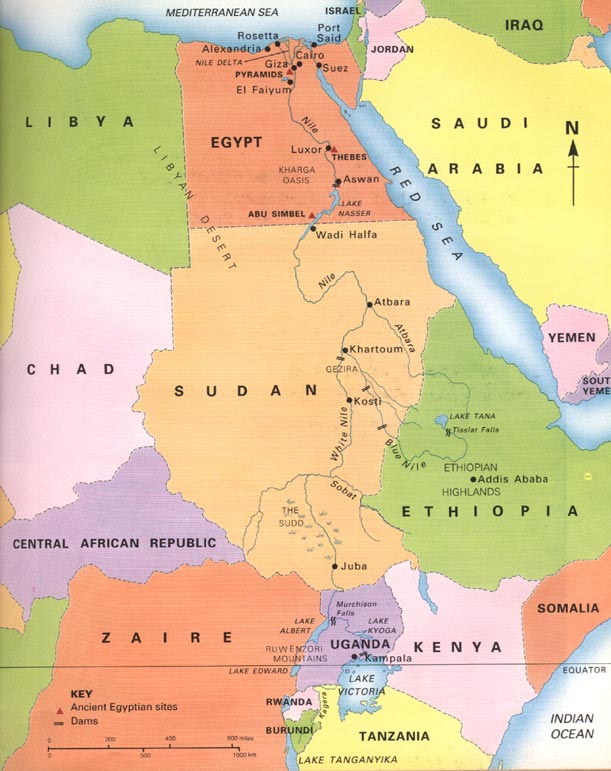
Africa in the Context of BRICS and Geopolitical Turbulence

afr.png

Africa in the Context of BRICS and Geopolitical Turbulence

by Leonid SAVIN

Ex: http://www.geopolitica.ru/

After the terrorist attacks on the WTC in New York, the US began to implement a new foreign policy vision and strategy for global order. Its elements synchronized with the doctrine of ‘Full Spectrum Dominance’ that was detailed in the 1996 Defense Department policy directive “Joint Vision 2010”[1]. In accordance with this concept, US armed forces should be "persuasive in peace, decisive in war, pre-eminent in any form of conflict"[2]. The militarization of the Africa continent is to be conducted hand-in-hand with the exploitation of African resources by Western corporate interests. The terrorist attack on the World Trade Centre on September 11th 2001 opened US eyes to the strategic advantage of  creating a relatively ‘safer’ West and West-Central African, in particular Nigeria, whose sources of high quality crude oil are rapidly transportable across the Atlantic Ocean to refineries in populous cities on the North American eastern industrial seaboard[3]. For example, 92.3 % of African imports to U.S in 2008 consisted of oil[4]. The ‘War on Terror’ has also provided US-NATO command with justification for securitising the ‘dangerous’ West African Muslim states.

In 2006 the US began military exercises on land and sea in different African countries. Since 2008, AFRICOM, the US military Command Center responsible  for Africa, has been officially operational. In 2010 the Pentagon began active military cooperation with several governments in the region (Senegal, Cape Verde, Ghana, Cameroon, the Democratic Republic of São Tomé e Príncipe, Mali, and Niger) and has established a military presence in the southern and northern states of Nigeria where the oil fields are located.

The argument that AFRICOM is primarily designed to provide humanitarian support has largely disappeared. Yet the United States still struggles to persuade the African people of the benefits of AFRICOM. To most observers, Africa has never been the intended beneficiary of AFRICOM. Based on the historical record, including direct comments from National Security Advisor James Jones, co-founder of AFRICOM, the goal of the new command is to protect U.S. access to oil and to protect U.S. corporate interests in Africa. Many African countries certainly have serious security concerns. But the behaviour of the states and the national militaries in question, combined with international economic interests, are often the catalysts for that insecurity. The question is whether the United States supports the forces of democracy and rule of law in Africa or whether, by treating dissent with military force rather than traditional law enforcement techniques, the United States has undermined democratic movements and encouraged extremism and the growth of anti-Americanism[5]. Another strategic goal of AFRICOM is to counter and roll-back Chinese economic expansion in the region[6].      

The other reason that African policy is a US priority for the next decade is geopolitical and strategic order. In the midst of the current economic-financial crisis, Washington should, as a major global player, direct its efforts in maintaining its positions in global zones, penalty to pay, in the best outcome, a rapid reorganization in regional power, or in the worst, a disastrous collapse, difficult to overcome in the short term. Instead, in line with the traditional geopolitical expansion that has always marked its relations with other parts of the planet, Washington chose Africa with its ample space to manoeuvre, from which to relaunch its military weight on the global plane in order to contest the Asian powers for world supremacy[7]. 

Another tool of US penetration into Africa is economic-financial structures and programs (seen in the case of sanctions against Sudan and the interference of the International Monetary Fund and the World Bank in the relationship between the Democratic Republic of Congo and China) with such initiatives like the Overseas Private Investment Corporation (OPIC) and the African Growth and Opportunity Act (AGOA).  Communication strategy should also be seen as a vector for US interest promotion in Africa, such as Obama’s speeches, already considered “historic”, in Cairo and Accra[8].

Attempts to establish control over Africa runs under the guise of new generation partnership and dialogue as well[9]. Africa underdevelopment is also a strategic concern for US geopolitical designs. U.S. military strategist Thomas Barnett has spoke about the ‘non-integrated gap’ of Africa and Middle Asia that must be integrated into the functional global core[10].

The Council of Foreign Relations (CFR), as an influential instrument of U.S. foreign policy also provides the US government with recommendations for dealing with African states. In Contingency Planning Memorandum No.11 "Crisis in the Congo" issued in May 2011 CFR advocated Washington to take several bilateral and multilateral steps to reduce the risk of violent instability, including: to improve Regional Engagement, use its influence through the office of the World Bank's American executive director, ensure a UN Presence, increase support for basic military training , etc.[11].

The US’s military presence in Africa also facilitates control over the Pacific and Atlantic Oceans, particularly in light of the emergence of new phenomena and threats such as piracy, the spreading of information technologies that can to be used for destabilization, water crises, and demographic crises.

The potential threat of conflicts rooted in ethnicity, religion, and tribal politics is a serious challenge for Africa. For example, in Nigeria with a population of 150 million, there are about 250 different ethnic groups, the population is divided between Christians and Muslims, and there are several active rebel groups. Out-of-the-box Western principles of parliamentary democracy based on class divisions do not function in societies divided in terms of identity on these lines[12]. A more complex and tailored approach taking into account regional history, culture, and identity divisions is needed. African critics claim that Europe and the US do not understand the nature and needs of social mobilization in Africa, where economic concerns coexist with ethnic and other divides.

But the economic crisis also demonstrates the contradictions and instability of the neoliberal global economic system, because of which, on the one hand African countries are threatened by transnational capital and re-colonialism, and on the other hand alternatives open to the issues of multilateral cooperation and self governance[13].

An important strategic initiative is the bloc of BRICS countries that have the possibility to turn African policy into a new paradigm. Geopolitically, Russia, India, Brasil and China are Land Powers (Not excluding of course, the necessity to have strategic sea lines of communication for transportation of goods, energy and natural resources).

China, India and Brazil are building relationships that take place within the framework of interaction between post-colonial countries[14], and therefore, these States inspire a higher degree of confidence and trust in Africa, than does the EU and the US with their colonial legacies The most successful foreign policy has been demonstrated by China, through the mechanisms of soft power for economic, industrial and cultural penetration.

 One possible alternative trend also is the possibility of the strengthening of the East African Community – a regional economic group with a population of more than 126 million people, whose members include Burundi, Kenya, Rwanda, Tanzania and Uganda. South Sudan with its huge oil reserves also has the potential to join this group[15]. 

Italian geopolitician Tiberio Graziani notes that,

Africa, in order to safeguard its own resources and stay out of disputes between the US, China, and probably Russia and India – disputes that could be resolved on its own territory – needs to get organised, at least regionally, along three principal lines that pivots with the Mediterranean basin, the Indian Ocean, and the Atlantic Ocean.

The activation of economic and strategic cooperation policies, at least regarding security, between the countries of North Africa and of Europe, on the one hand and similarly with India (to that aim note the Delhi Declaration, drawn up in the course of Summit 2008 India-Africa), on the other, besides making the African regions more interconnected, sets up the basis for a potential future unification of the continent along regional poles and entered in the broadest Euro-Afro-Asian context. Likewise, the Atlantic line, that is the pursuit of strategic south-south cooperation  between Africa and Indo-Latin America, would foster, in this case, the cohesion of western African nations and would contribute to the unification of the continent.  In particular, the development of the Atlantic line would reinforce the weight of Africa relative to Asia, and to China in the first place[16].

But this plan is based on the old geopolitical scenario of the political game. We have proposed to look at this situation from another point of view. Besides the established concept for global order of unipolarity and multilateralism, there exists the alternative concept of multipolarity (or pluripolarity).

In the unipolar world model, the BRICS countries are thought of separately, as intermediates zones between the core and the periphery of the world or between the centre of globalization and the non-integrated gap. With this approach, the elite of these countries must integrate into the global elite and the masses be consumed in a global melting pot with other lower social strata, including through migration flows and in so doing, lose their cultural and civilizational identity.

But in terms of the multipolar world view, the BRICS can be conceived fundamentally differently. If these countries can develop a common strategy, form a consolidated approach to major global challenges, and develop a joint political bloc, there will come into being a powerful international institution capable of birthing the multipolar world, with enormous technical, diplomatic, demographic and military resources[17].

This project should change the structure of the BRICS to that of a powerful global organization that will be able to dictate their demands to other participants (three countries of BRICS have armed with own nuclear weapons).

  So, with the economic and intellectual potential of the BRICS countries and the experience of intercultural and interethnic relations of complementarity, the only true geopolitical strategy for the African continent and in relation to it will be multipolarity.


[1] Joint Vision 2010. Pentagon. Washington, DC. 1996. [Электронный ресурс] URL: http://www.dtic.mil/jv2010/jv2010.pdf (дата обращения 01.09.2010).

[2] Ibid. P. 2.

[3] Ifeka C. AFRICOM, the kleptocratic state and under-class militancy. 2010-07-22, Issue 491. [Электронный ресурс] URL: http://pambazuka.org/en/category/features/66140 (дата обращения 12.03.2011).

[4] U.S. - African Trade Profile. Dept. of Commerce of  the U.S. [Электронный ресурс] http://www.agoa.gov/resources/US_African_Trade_Profile_2009.pdf (дата обращения 15.12.2010).

[5] Africa Action and FPIF Staff. Africa Policy Outlook 2010. January 22, 2010. [Электронный ресурс] URL: http://www.fpif.org/articles/africa_policy_outlook_2010 (дата обращения 04.03.2011).

[6] Энгдаль У. АФРИКОМ, Китай и война за ресурсы Конго. 06.12.2008. [Электронный ресурс] URL:  http://www.warandpeace.ru/ru/exclusive/view/30290/ (дата обращения 15.12.2010).

[7] Graziani T. L’Africa nel sistema multipolare. 27 novembre, 2009. [Электронный ресурс] URL:  http://www.eurasia-rivista.org/lafrica-nel-sistema-multipolare/2311/ (дата обращения 15.05.2011).

[8] Ibidem.

[9] Molefe M. Oxford opens a New Chapter on Pan-Africanism. 2011.03.16. [Электронный ресурс] URL:  http://pambazuka.org/en/category/Announce/71762 (дата обращения 15.12.2010).

[10] Barnett T. The Pentagon's New Map. Putnam Publishing Group, 2004.

[11] Marks, Joshua. Crisis in Congo. Contingency Planning Memorandum No. 11. N.Y.: C.F.R. May 2011. [Электронный ресурс] URL: http://www.cfr.org/democratic-rep-of-congo/crisis-congo/p25031?cid=nlc-rfpbulletin-memorandum_crisis_congo-051911 (дата обращения 15.05.2011).

[12] Amin S. Eurocentrism. Modernity, Religion and Democracy: A Critique of Eurocentrism and Culturalism. Fahamu books, 2010.

[13] Dani Wadada Nabudere. The Crash of International Finance-Capital and its Implications for the Third World. Fahamu books, 2009.

[14] Emma Mawdsley, Gerard McCann (ed.). India in Africa: Changing Geographies of Power. Pambazuka Press, 2011.

[15] Marco Picardi and Hamish Stewart. Building Africa: Where's The United States? May 27, 2010. [Электронный ресурс] URL: http://www.fpif.org/articles/building_africa_wheres_the_united_states (дата обращения 15.12.2010).

[16] Graziani T. L’Africa nel sistema multipolare. 27 novembre, 2009. [Электронный ресурс] URL: http://www.eurasia-rivista.org/lafrica-nel-sistema-multipolare/2311/ (дата обращения 15.05.2011).

[17] Дугин А.Г. Геополитика. – М: Академический проект, 2011. С. 511.


Регион: 

vendredi, 28 juin 2013

Le désordre vertueux

turkish-riot.jpg

Le désordre vertueux

Ex: http://www.dedefensa.org/

24 juin 2013 – Parmi les pays que nous classons hors-bloc BAO, celui qui nous paraît à la fois le plus engagé, le plus actif, et, sans doute paradoxalement pour certains jugement, le plus solide, est la Russie. La Russie a un niveau économique acceptable, une puissance de sécurité considérable (jusqu’à l’arsenal nucléaire), une population qui a une immense expérience des temps difficiles après des périodes socio-politiques terrifiantes, qui est caractérisée par un patriotisme résilient que structure un mysticisme puissant avec une dimension religieuse, par un très fort sentiment d’appartenir à l’histoire, voire à la grande Histoire, enfin par une référence permanente aux principes, notamment par rapport à la politique générale du pays. (Nous nous sommes assez souvent exprimés sur la Russie, tant à propos de sa capacité de résistance à l’“agression douce“, qui s’attaque aux principes, qu'à propos de sa politique syrienne, essentiellement principielle.) La Russie représente pour nous le pays qui est le plus fortement, le plus dynamiquement antiSystème, et son socle intérieur puissant (patriotisme et dimension mystique) lui assure à notre sens une stabilité intérieure remarquable, contrairement à ce qui est en général pronostiqué à la bourse des perspectives-Système du bloc BAO. De ce point de vue, l’histoire autant que les conditions générales du pays font que son cadre structurel, fortement principiel, est extrêmement résistant, surtout dans une époque si dangereuse qui a pour effet l'avantage paradoxal pour la Russie de mobiliser les énergies.

Nous suivons donc avec attention l’évolution de la Russie, tant dans sa capacité de résistance à l’“agression douce“, qui s’attaque aux principes, que dans sa politique syrienne, essentiellement principielle et plutôt de nature offensive. Malgré cela et comme nous l'avons déjà suggéré, et avec beaucoup de regrets conjoncturels, nous ne lui donnons pas une chance, essentiellement sur un point précis qui est nécessairement le but implicite de sa politique, – quoique ses dirigeants assurent et conçoivent. Ce pays par essence antiSystème n’a pas la capacité, par la seule action politique, même si cette action est dominante et victorieuse, même si elle est suivie par d’autres, de donner des résultats approchant du décisif contre le Système (contre la politique-Système). Cela n’a rien à voir spécifiquement avec la seule Russie et tout avec le Système, contre qui rien n’est fait tant que le décisif n’est pas accompli, et contre qui aucune force terrestre constituée ne peut accomplir ce décisif-là à cause de la puissance hermétiquement inviolable dudit Système par cette voie... (Dans les citations suivantes, il va de soi qu’en citant par exemple les USA, nous parlons du Système et de rien de moins.)

• Le 22 avril 2013... «Observons qu’il s’agit là d’une approche rationnelle et ultra-réaliste, bien dans la manière de Poutine pour la forme diversifiée de sa politique. La Russie développe une politique appuyée d’une part sur des principes intangibles [...] d’autre part sur une tactique flexible... [...] L’entêtement russe est proverbial et sans doute admirable mais n'est qu'humain et armé de la seule logique ; il est loin, très loin d’être dit qu’il sera suffisant face au phénomène du nihilisme par déstructuration et dissolution de l’action des USA, et à la constante puissance de la politique-Système qui anime le tout...»

• Le 5 juin 2013 : «Il est effectivement acquis, comme un premier fait objectif à leur avantage, que les Russes sont les maîtres du jeu, qu’ils sont désormais considérés comme les principaux acteurs dans la région ; mais le désordre général dans la région est un autre fait objectif très puissant sinon désormais structurel, qui échappe à leur maîtrise comme il échapperait en fait à quelque maîtrise humaine que ce soit.»

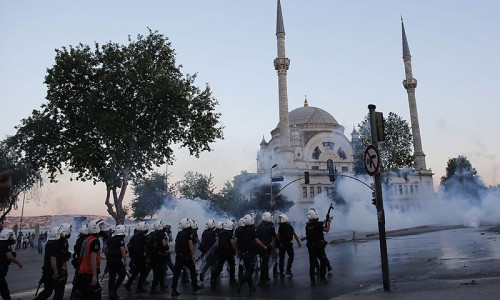
Dans l’actualité courante, on sait également que les événements de Turquie ont pris une place importante. Ils ne cessent pas (voir Russia Today le 22 juin 2013), montrant une résilience significative malgré des mesures constantes de dispersion de la part du gouvernement Erdogan. Nous avons déjà traité cette question à deux reprises (le 3 juin 2013 et le 10 juin 2013). Notre analyse est bien qu’Erdogan, avec sa “politique syrienne”, s’est délégitimé, après avoir assuré un gouvernement brillant jusqu’en 2011, fondé sur le respect des principes tels que la souveraineté, lui assurant une forte position antiSystème. Sa politique syrienne a renversé tout cela. Étant passé de facto dans le camp du Système à cause de cette politique syrienne, il a installé les conditions pour que le malaise général qui affecte tous les pays et toutes les situations se transforment en situation de désordre. (N.B. : peut-être est-il en train de changer ?)

• Le 3 juin 2013 : «Notre conviction est que cet aspect puissant de l’évolution turque et de l’évolution d’Erdogan joue un rôle fondamental dans la crise actuelle, où aspects intérieur et extérieur se mélangent pour organiser la perception d’un dirigeant politique légitime perverti dans la délégitimation, et instituer un jugement de condamnation que nourrit la psychologie ainsi orientée. C’est bien la dissolution puis l’entropisation de la légitimité d’Erdogan qui assurait son autorité, qui ont conduit par contraste à l’affirmation d’un autoritarisme illégitime, qui alimente la revendication et la colère populaires. [...] L’on voit donc que la crise turque, puisque crise il y a finalement, rejoint la cohorte des autres crises rassemblées et exacerbées par l’“insaisissable guerre syrienne”, comme une des expressions de la crise haute et, plus généralement, de la crise d’effondrement du Système...»

• Le 10 juin 2013 : «Adressées le 4 juin, le lendemain d’une chute de 10,5% de la bourse d’Ankara, à une assemblée de l’Association des Investisseurs Internationaux en Turquie, ces paroles du président Gül se voulaient ironiques et rassurantes à la fois… “Two years ago in London, cars were burned and shops were looted because of similar reasons. During revolts in Spain due to the economic crisis, people filled the squares. The Occupy Wall Street movement continued for months in the United States. What happens in Turkey is similar to these countries…”

»Tout cela est au fond très juste et particulièrement révélateur mais nous nous demandons avec un certain scepticisme et même un scepticisme certain s’il faut y voir de quoi rassurer les investisseurs d’un système en déroute erratique et chaotique. Qu’il l’ait réalisé ou pas, Gül signifiait à ses auditeurs que la Turquie est entrée en part très active dans la grande crise d’effondrement du Système, et l’on peut penser qu’il y a des nouvelles plus rassurantes que celle-là pour les investisseurs qui ont nécessairement partie liée avec le Système. Voilà donc la grande nouvelle, – “la Turquie entrée en part très active dans la grande crise d’effondrement du Système”. C’est bien entendu le principal enseignement de la crise turque, le seul qui vaille d’être reconnu et retenu à partir de notre posture d’inconnaissance, Erdogan ou pas, manœuvres américanistes et finaudes ou pas...»

Aujourd’hui, nous passons au Brésil, qui connaît depuis presque deux semaines des agitations sans précédent, drainant des foules énormes qui se décomptent par millions. La protestation s’appuie sur un argument en apparence mineur, qui est passé au second plan (l’augmentation des tarifs des transports en commun, mesure sur laquelle la présidente Rousseff est revenue), et sur un argument complètement inattendu : les dépenses considérables faites par le Brésil pour préparer la Coupe du Monde de football de 2014, alors que la population connaît une détresse considérable. Dans ce pays qui constitue évidemment le temple de l’adoration du football, cette réaction est tout aussi évidemment une surprise considérable. Même le roi-Pelé , la gloire nationale par excellence (mais recyclée-Système  : «[T]he superstar turned MasterCard ambassador»), est en train de perdre son auréole... (Voir le Guardian du 21 juin 2013.)

«More than a million people took to the streets on Thursday night in at least 80 cities in a rising wave of protest that has coincided with the Confederations Cup. This Fifa event was supposed to be a dry run for players and organisers before next year's finals, but it is police and protesters who are getting the most practice... [...]

»But the mega-event has been the lightning conductor. Many protesters are furious that the government is spending 31bn reals (£9bn) to set the stage for a one-time global tournament, while it has failed to address everyday problems closer to home. “I'm here to fight corruption and the expense of the World Cup,” said Nelber Bonifcacio, an unemployed teacher who was among the vast crowds in Rio on Thursday. “I like football, but Brazil has spent all that money on the event when we don't have good public education, healthcare or infrastructure.”

»It was all very different in 2007 when Brazil was awarded the tournament. Back then, crowds in Rio erupted with joy and Ricardo Teixeira, president of the Brazilian Football Confederation, was hailed as he said: “We are a civilised nation, a nation that is going through an excellent phase, and we have got everything prepared to receive adequately the honour to organise an excellent World Cup.” In the outside world, few doubted the wisdom of the decision. Football belonged in Brazil. In the home of carnival and samba, it would be a party like no other.

»But euphoria has steadily faded as preparations for 2014 have drawn attention to the persistent ills of corruption, cronyism, inequality and public insecurity. Those who appeared to have the Midas touch in 2007 now seem cursed. Teixeira was forced to resign last year amid accusations of bribery. Former president Luiz Inácio Lula da Silva has been tainted by revelations of massive vote-buying by the ruling Workers party. Fifa too is mired in a series of corruption scandals that have led to the resignations of several senior executives.

»The renovation and construction of most of the 12 World Cup stadiums has been late and over budget. Several have been pilloried as white elephants because they are being built in cities with minor teams. The new £325m Mane Garrincha stadium in Brasília – which hosted the opening game of the Confederations Cup – has a capacity of 70,000, but the capital's teams rarely attract more than a few hundred fans.»

Les soubresauts de la crise d'effondrement du Système

Si nous avons mis ces trois pays en parallèle, alors que leurs situations sont apparemment différentes ou très différentes, c’est d’abord parce qu’ils appartiennent à une même catégorie. On pourrait dire, pour simplifier, des pays du type-BRICS ; certes, la Turquie n’en fait pas partie, mais elle constitue un modèle de pays qui correspond parfaitement au BRICS, et il fut à un moment question de son adhésion, comme il y a par ailleurs une plus grande proximité entre la Turquie et l’OCS, ou Organisation de Coopération de Shanghai (voir le 2 mai 2013), qui est un organisme d’esprit et de situation assez similaires au BRICS. (Deux membres du BRICS, la Russie et la Chine, font partie de l’OCS, et un troisième, l’Inde, y a le statut officiel d’“observateur” qui lui permet d’assister statutairement à toutes les réunions de l’OCS.)

... En rapprochant ces trois pays, après avoir rapidement survolé leurs situations et souligné les différences de ces situations, nous voulons justement ne tenir aucun compte de ces différences, qui sont celles de leurs situations spécifiques, pour conclure à une sorte d’unité de situation générale. (Au contraire, pour voir des analyses dans ce sens que nous rejetons complètement, on peut parcourir la presse en général en allant par exemple de WSWS.org, le 22 juin 2013, à Marianne.net, le 22 juin 2013. On y retrouvera l’atmosphère de la lutte des classes des années 1950-1970 ou bien l’atmosphère du débat sur l’immigration et l’islamisme à partir des années 1980-1990.)

Nous refusons en effet absolument le traitement spécifique de ces situations, qui est l’aliment évident du réductionnisme par quoi l’on évite d’aller au cœur du seul problème qui compte dans notre temps. Plus encore, nous estimons que ce que nous avons déterminé comme la “sorte d’unité de situation générale” de ces trois pays qui font partie d’un groupe spécifique qu’on juge plus ou moins, selon les circonstances et malgré les accidents (Turquie), de tendance antiSystème, ne doit en aucun cas être séparé de la situation générale des pays du bloc BAO telle que nous l’observons depuis au moins 2008. (Cette situation spécifique des pays du bloc BAO étant faite de protestations sporadiques de la population, sans aucune organisation oppositionnelle, donc sans offre d’alternative ; de directions politiques discréditées et impuissantes ; d’une politique générale favorisant tous les centres-Système de pouvoir, instaurant une politique de surveillance systématique de la population, etc. ; bref d’une instabilité grandissante et d’une crise générale en constante aggravation à mesure que les autorités-Système affirment lutter avec succès contre l’instabilité et la crise.)

Nous devons ajouter bien entendu que ces pays, qu’on juge effectivement plutôt de tendance antiSystème, sont nécessairement soumis au Système, ou dans tous les cas intégrés dans le Système, dans le chef des aspects financier, économique et social (avec une certaine réserve mais tout de même nullement décisive pour la Russie, dont l’exécutif fort, la tradition étatiste affirmée, etc., limitent certains aspects de la pénétration-Système aux niveau financier, économique et social). Cela implique pour ces pays plus ou moins antiSystème les maux habituels engendrés par le schéma capitaliste, et surtout de notre capitalisme-turbo actuel, de l’austérité aux restrictions de l’aide sociale, des spasmes de développement à la destruction de l’environnement, de l’accroissement de l’inégalité à la corruption, etc. Le schéma capitaliste, absolument déstructurant et dissolvant, est évidemment aussi destructeur, sinon plus dans ce type de pays, et il est universel puisqu’émanant directement du Système. Les autres pays peu ou prou dans la même catégorie, qui ne sont pas cités ici parce qu’ils ne sont pas dans l’actualité ou qu’ils ont un rôle moins affirmé que les trois cités, sont dans la même situation, – la Chine notamment, certes. La cause en est évidemment, selon notre point de vue fondamental, que le Système est “la source de toutes choses” selon les seules normes effectivement en cours dans notre “contre-civilisation” aujourd’hui, ce que nous rappelons systématiquement. Rien de construit, d’efficace à l’échelle de l’organisation d’une nation, ou d’un groupe de nations, ne peut se faire hors du Système, et par conséquent hors de ses règles... Quelques rappels à cet égard, pour affiner la définition et mieux définir la situation, avec citations de deux textes éloignés de deux ans, – où l’on voit, signe de l’affirmation et de l’approfondissement de notre point de vue, qu’“un système” est devenu “le Système” majusculé et exclusif.

• Le 10 septembre 2010 : «D’autre part, ce qui nous invite à procéder de la sorte est le constat que nous avançons sans la moindre hésitation que la manifestation fondamentale de cette civilisation arrivée au point où elle se trouve, se fait sous la forme d’un “système” extrêmement élaboré et complexe, dont nous parlons souvent et qui est le principal objet de notre étude. Ce “système” a l’unicité, la puissance, l’universalité qui en font la source de toutes choses dans le chef d’une civilisation dont on peut dire qu’elle est une “contre-civilisation” »)

• Le 29 septembre 2012 : «Le Système est complètement fermé… Il est hermétique, selon cette définition de base que nous offrions le 20 mai 2011 : “Le Système qui régit le monde aujourd’hui est […] dans une situation de surpuissance extraordinaire, une situation de surpuissance que nous qualifierions d’hermétique dans le sens où cette situation est bouclée et inexpugnable… […] Lorsque nous disons que le Système est hermétique, nous soulignons par là que sa surpuissance s’exprime dans les deux voies essentielles de la puissance aujourd’hui. Il y a d’une part la puissance brute du système du technologisme, qui est si grande que rien ne peut être fait de structurant qui ne passe par les outils de cette puissance que contrôle, voire qu’engendre le Système, comme seule source de puissance matérielle et technique dans le monde. Il y a d’autre part la puissance d’influence du système de la communication, qui détermine la perception unique, et donc l’état de la psychologie. Cette formule idéale détermine l’hermétisme du Système, qui fait que rien n’est possible hors du Système.” L’hermétisme du Système est donc d’abord l’hermétisme du au souffle de sa surpuissance qui vous cloue sur place, qui fixe les moyens de son hermétisme autour de lui, comme une centrifugeuse créant une atmosphère qui lui est propre et séparant hermétiquement son monde des autres, et réduisant à néant toutes les tentatives antiSystème élaborées, rationnelles, construites à l’intérieur du Système lui-même, en utilisant nécessairement certaines de ses normes...»

Ainsi, lorsque nous parlons d’actions ou de collectivités, de nations, etc., antiSystème, il est entendu que nous parlons d’entités qui sont à l’intérieur du Système mais qui, pour une raison ou l’autre, par tel moyen ou tel autre, parviennent à exercer une action antiSystème de l’intérieur du Système. Cela rejoint d’ailleurs notre appréciation principale du phénomène antiSystème, qui est d’une logique évidente, qui est que le système antiSystème ne peut s’organiser qu’en fonction du Système puisque tout est dans le Système. D’une façon générale, également, son action, que nous qualifions évidemment de “Résistance”, est impuissante en elle-même, en tant que telle, et elle acquiert au contraire toute son efficacité essentiellement en “jouant avec le Système” ; c’est-à-dire, en retournant contre lui la force du Système, notamment pour éventuellement exacerber son processus de surpuissance et accélérer prodigieusement sa transmutation en processus d’autodestruction.

(Voir par exemple le 2 juillet 2012 : «L’intérêt de la résistance est moins de détruire, ou d’espérer détruire le Système, que de contribuer à l’accélération et au renforcement de son autodestruction. [...] L’opérationnalité de la résistance antiSystème se concentre naturellement dans l’application du principe fameux, et lui-même naturel, de l’art martial japonais aïkido : “retourner la force de l'ennemi contre lui...”, – et même, plus encore pour notre cas, “aider la force de cet ennemi à se retourner naturellement contre lui-même”, parce qu’il est entendu, selon le principe d’autodestruction, qu’il s’agit d’un mouvement “naturel”.»)

Ainsi nous trouvons-nous, dans les trois cas évoqués, et malgré les différences parfois considérables entre ces trois cas, dans une même situation paradoxale et contradictoire. Ce n’est pas une surprise puisque, lorsqu’il s’agit du Système, de ses spasmes et de ses convulsions, nous sommes absolument dans une situation qui ne peut se définir que par le paradoxe et la contradiction. D’un côté, on peut juger dommageable que des pays qui semblent plus ou moins d’orientation antiSystème se trouvent confrontés à des troubles intérieurs (certains le regrettent tant qu’ils insinuent que la main de la CIA se trouve pour une part non négligeable dans les troubles au Brésil, – ce qui peut se concevoir, certes, mais pour partie et sans action fondatrice, selon la “doctrine” dite du “prendre le train en marche”, comme éventuellement, pour ce qui est de la “doctrine”, dans le cas turc pour ceux qui restent favorables à Erdogan). Au pire et dans le meilleur des cas pour notre conception, on peut juger dommageable qu’un pays nettement d’orientation antiSystème (la Russie) ne puisse espérer (selon nous) pousser sa politique pourtant brillante et surtout principielle jusqu’à une issue antiSystème achevée. Mais ce jugement conjoncturel est infondé sur le fond, puisque l’action de la Russie exacerbe effectivement la surpuissance du Système et la transmue presque simultanément en processus d'autodestruction (l’exemple de la Syrie est évident).

D’un autre côté, ces pays étant tout de même dans le Système, parce qu’il ne peut en être autrement, leurs troubles affectent le Système qui est un ensemble absolument universel, hermétique, fondé sur une intégration absolue et totalitaire de toutes les forces existantes. Le Système ayant comme objectif l’équation dd&e (déstructuration, dissolution & entropisation), son but est l’entropisation de tout ce qui figure en son sein, c’est-à-dire tout ce qui figure dans cette “contre-civilisation” complètement globalisée et à laquelle rien d’humain, ni rien de la nature des choses et du monde, ni rien de structurant finalement, ne doit pouvoir échapper dans son chef. Par conséquent, les parties de ce tout qui connaissent des troubles interférant sur la bonne marche de l’objectif dd&e vers l’entropisation, constituent un grave problème, voire un revers pour le Système. Par conséquent, ce qu’on pourrait interpréter comme des événements satisfaisant le Système puisque touchant des pays antiSystème, – notamment les troubles en Turquie et au Brésil, la position de la Russie qui semblerait susciter des forces à l’intérieur de ce pays conduisant à la mise à l’index de ce pays, dans tous les cas par rapport au bloc BAO, – tout cela constitue en réalité des préoccupations majeures pour le Système par définition, par rapport au fonctionnement des processus de globalisation. Même si la politique du Brésil, type-BRICS, est perçue avec une certaine hostilité par le Système, les troubles au Brésil le sont encore plus et conduisent le Système à souhaiter finalement que le gouvernement brésilien rétablisse le calme (éventuellement, ce serait encore mieux, en modifiant sa politique dans un sens pro-Système). Même si la politique de Poutine, notamment syrienne, est perçue avec une hostilité considérable par le Système, la Russie est tout de même nécessairement perçue comme faisant partie du Système évidemment, et tout est fait pour affirmer que la Russie évolue pour se rapprocher du bloc BAO, et tout le monde, du président-poire Hollande au Premier ministre Cameron, répète régulièrement que la Russie va être bientôt “des nôtres”. Leur sottise conjoncturelle à cet égard, – concernant la vérité des événements en cours, – répond de leur complète loyauté au Système reflétant l’emprise-Système sur leurs psychologies absolument épuisées et dévastées.

Pour prendre une référence évidente, par rapport à ce que l’on a nommé le “printemps arabe”, où l’enjeu paraissait clair face à des dirigeants-Système avérés jusqu’à la caricature grotesque, le cas présent est très différent. Les dirigeants de ces pays ne sont pas irrémédiablement des dirigeants-Système, tant s’en faut, et même pas du tout pour certains. Ils sont eux-mêmes coincés entre paradoxe et contradiction. La Brésilienne Rousseff, venue de la gauche extrême, après des années de prison et de torture de la part des militaires brésiliens commandités par la CIA, est au fond en bonne partie du côté des foules en colère. Elle ne manque pas de le dire, d’ailleurs, ce qui ne manque pas de donner un sel surréaliste à la situation. Elle lâche le plus qu’elle peut mais, arrivée à un certain point, se trouve bloquée par les sommes en jeu, les investissements, les programmes colossaux engagés pour la Coupe du Monde. Même les Russes, même un Poutine, rencontrent des limitations, bien qu’ils soient, avec l’appui de la puissance et de l’essence historique et fondée sur la Tradition de la Russie, les plus en avant dans l’audace antiSystème, presque jusqu’au défi et au mépris. Ces limitations sont celles du Système dont ils sont malgré tout partie prenante, en partie certes, dont ils ne peuvent pas ne pas tenir compte.

Ainsi en est-il de leur position dans ces pays à la fois antiSystème et dans le Système. Finalement, cette position n’est pas originale même si elles se distingue par les politiques affichées telles qu’on les a détaillées. De façon plus générale on dira que cette position, à des degrés d’intensité très différents, est finalement universellement partagée, dans tous les pays et dans tous les continents dominés nécessairement par le Système, mais où des explosions et des projets antiSystème, très visibles ou à peine identifiés, apparaissent tout aussi nécessairement, de plus en plus souvent à mesure de la dégradation du Système, de la surpuissance à l’autodestruction. Même les pays les plus totalement entités-Système, dans le bloc BAO nécessairement, sont néanmoins, également, prisonniers du Système, et laissent échapper ici et là des manifestations antiSystème  ; les USA, on le sait bien assez, n’y échappent pas. Nous sommes dans un univers total où une bataille totale est en cours, mélangeant les uns et les autres, transcendant toutes les lignes conventionnelles, balayant toutes les étiquettes, à la mesure de la puissance extraordinaire du Système (surpuissance) et de sa crise d’d’effondrement (autodestruction). Simplement, on observera que l’épisode actuel, que nous analysons ici, avec les positions qu’on a dites, différant notamment du “printemps arabe”, marque une étape de plus, et éventuellement une avancée, dans la bataille autour du Système. Quoi qu’on fasse dans le sens des analyses spécifiques et réductionnistes, l’essentiel et l’unique chose qui compte est qu’il s’agit d’une bataille contre le Système, partout et de toutes les façons.

Il est donc impératif de considérer ces troubles pour ce qu’ils sont en vérité, comme reflet de l’infiniment complexe opérationnalité de la situation, et reflet de la terrible et bouleversante simplicité de la vérité de la situation. Les crises ou incertitudes dans les pays et groupes de pays auxquels on vient de s’intéresser, qui se retrouvent partout ailleurs sous des formes nécessairement différentes, sont accessoires dans leur signification pour tous ces pays et groupes de pays même si elles apportent un poids terrible de troubles, une quantité énorme de malheurs et de souffrances. Le fait est que tout cela marque d’abord, on serait presque tenté d’écrire exclusivement, les soubresauts terribles de la crise d’effondrement du Système.

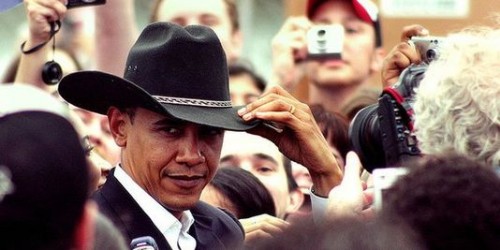
Obama veel erger dan George Bush

barack-obama_7f.jpg

Global Research denktank: Obama veel erger dan George Bush

Stiglitz: Europa en VS in laatste, door IMF geplande fase om financiële elite totale controle te geven

Hij presenteerde zich als man van het volk, maar blijkt als geen andere president het werktuig van de globalistische machtselite te zijn.

Voor 'links' is hij een enorme teleurstelling, voor 'rechts' is hij de man die langzaam maar zeker hun allerergste nachtmerries werkelijkheid laat worden. Barack Hussein Obama is in de ogen van de antiglobalistische denktank Global Research nog véél erger dan zijn door velen gehate voorganger George W. Bush. Obama is het belangrijkste werktuig van de wereldwijde financiële elite, die volgens de over de hele wereld bekende econoom Joseph Stiglitz de Westerse landen wil onderwerpen aan een feodaal systeem waarin de gewone bevolking tot bezit- en willoze slaven is gemaakt.

Volgens Global Research heeft Obama de ongelijkheid in de VS vergroot. De kleine groep rijken is nog rijker geworden en de inkomensongelijkheid is toegenomen. Terwijl de hoogste officier van justitie de banken heeft uitgesloten van strafvervolging redt Obama de grote banken met jaarlijks $ 780 miljard. Tevens heeft de eerste zwarte president meer klokkenluiders veroordeeld dan alle andere presidenten bij elkaar.

Het internationale persbureau AP concludeerde onlangs dat de overheid onder Obama ongekend veel informatie achterhoudt voor de media. Bovendien heeft de president de Amerikaanse Grondwet meerdere malen overtreden, bijvoorbeeld door zonder instemming van het Congres talrijke nieuwe oorlogen te beginnen (zoals tegen Libië) en toestemming te geven om Amerikanen zonder vorm van proces op hun eigen grondgebied te vermoorden.

Obama dankt verkiezing aan financiële elite

Enkele weken geleden verklaarde Clarence Thomas, de hoogste rechter in de VS, in een toespraak voor juridische studenten dat Obama door de elite en media werd geaccepteerd 'omdat hij dat zou doen wat de elite van een zwarte president verwacht.' Met andere woorden: Obama werd niet gekozen door het Amerikaanse volk, maar aangesteld door de elite.

Obama had zijn verkiezingsoverwinning vorig jaar met name te danken aan de financiële bijdragen van Google, Facebook en een groep van 30 van de machtigste banken, en de politieke steun van de Wereldbank, de Trilaterale Commissie, de Economic Club of New York en het IMF.

Vier door IMF geplande fases bijna voltooid

Joseph Stiglitz, één van 's werelds meest gezaghebbende economen en beslist geen complotfanaat, legde al in 2001 aan de Britse Guardian uit wat het grote plan van het IMF was. Dit plan bestond volgens Stiglitz uit vier fases:

1. Privatisering, zodat de financiële elite de controle zou krijgen over alles wat zich eens in publieke- of staatshanden bevond.

2. Liberalisering van de kapitaalmarkten, waarmee blokkades voor internationale investeringen werden opgeheven. Brazilië en Indonesië laten zien waar dit toe geleid heeft: het geld is niet naar, maar uit deze landen weggevloeid.

3a. Marktconforme prijzen. In de praktijk leidde dit ertoe dat de prijzen van voedsel, water en brandstof explodeerden.

3b. Sociale onrust. In deze, door het IMF geplande tussenfase bevindt de wereld zich nu. Stiglitz: 'Als een land op de bodem ligt, perst het IMF het laatste bloed eruit. Ze verhitten het vuur net zolang totdat alles explodeert.' De multinationals profiteren enorm van sociale onrust, omdat ondernemingen en andere 'assets' (waardevolle bezittingen) in de getroffen landen hierdoor veel goedkoper worden en makkelijk kunnen worden ingelijfd. Hiermee worden forse winsten gemaakt.

4. Vrijhandel. Onder leiding van Obama zijn op dit moment diverse nieuwe vrijhandelszones in de maak, zoals tussen Amerika en Europa en Amerika en het Verre Oosten. Stiglitz vergeleek deze fase met de koloniale oorlogen die Amerika en Europa in de 19e eeuw voerden. Om vrij kapitaalverkeer te bereiken werden Latijns-Amerika, Azië en Afrika met militaire blokkades gedwongen hun grenzen te openen, terwijl de VS en Europa zelf protectionistische maatregelen namen. Het enige verschil met nu is dat de militaire blokkades grotendeels zijn vervangen door financiële blokkades.

Stiglitz werd bij het IMF ontslagen omdat hij met hervormingen probeerde te voorkomen dat de globalistische elite de macht over alle grond zou krijgen. Het door hem onthulde vierstappenplan van het IMF is anno 2013 verbijsterend actueel in de Europese Unie. De kapitaalmarkten werden geliberaliseerd door de invoering van de euro; 'marktconforme' prijzen zijn een hoofdthema van Brussel; sociale onrust is losgebarsten in Griekenland, Spanje en Portugal, en de vrijhandelszone wordt op dit moment door Obama aan de Duitse bondskanselier Merkel opgedrongen.

Grote uitbuiting van de massa

Dat de financiële elite haast maakt met het plan om over alle landen totale controle te krijgen blijkt uit de enorme snelheid waarmee Europese politici en bankiers de afgelopen maanden toewerken naar een bankenunie en de massale onteigening van spaarders en rekeninghouders. Cyprus was een blauwdruk van hoe het er straks in heel de EU aan toe zal gaan.

De kapitaalcontroles op Cyprus zijn een kleine terugslag, maar de privatiseringen in Zuid Europa gaat in sneltreinvaart verder. Het streven naar 'marktconforme' prijzen zal er voor de gewone Europeaan toe leiden dat de prijzen van levensmiddelen, water en energie de komende jaren nog veel duurder zullen worden (en de winsten van de multinationals en banken verder zullen toenemen). Ondanks de euro-ideologie doen veel EU-landen echter nog steeds precies wat ze zelf willen, waardoor de grote uitbuiting van de massa langer duurt dan gepland.

Leugens over vrijhandelszone

De vrijhandelszone tussen de EU en de VS markeert de implementatie van de vierde en laatste fase. Alle berichten over 180.000 extra arbeidsplaatsen die dan in Europa zullen komen zijn pure flauwekul. De IMF heeft het de afgelopen jaren in niet één prognose bij het rechte eind gehad en blijkt zelfs te hebben gelogen door de economische en financiële vooruitzichten doelbewust veel te rooskleurig voor te stellen.

Volgens Stiglitz is er maar één land ter wereld dat zich met succes verzet heeft tegen de wereldwijde uitbuiting door de financiële elite: Botswana. Hoe hebben ze dat gedaan? Stiglitz: 'Ze hebben het IMF simpelweg gezegd uit hun land te verdwijnen.'

Europa en VS in wurgslang financiële elite

Eenzelfde escalatie wil men in Europa en Amerika ten koste van alles voorkomen. De crisislanden worden al lang gegijzeld door de schuldeisers van de banken en zijn daardoor eenvoudig af te persen. Dankzij het EU/eurosysteem worden via hen ook de financieel gezondere landen zoals Nederland afgeperst en mee naar de bodem gezogen. Inmiddels ervaart ook u daar de gevolgen van, nu het kabinet keer op keer opnieuw 'moet' besluiten tot nieuwe miljardenbezuinigingen en lastenverhogingen.

Dat komt omdat alle politici, in Amerika en Europa, zich hebben laten verleiden zich tot over hun oren in de schulden te steken, waardoor wij allemaal in de tang van de grote wurgslang van de financiële machtselite zijn terechtgekomen. En het is absoluut zeker dat die slang op zeker moment zal bijten. (1)


Xander

(1) Deutsche Wirtschafts Nachrichten

00:05 Publié dans Actualité | Lien permanent | Commentaires (0) | Tags : politique internationale, obama, états-unis | |  del.icio.us | | Digg! Digg |  Facebook

jeudi, 27 juin 2013

Énigme turque et ours russe

bosphore-peinture-L-4uNxJe.png

Énigme turque et ours russe

Ex: http:://www.dedefensa.org/

Le site DEBKAFiles annonce que la Turquie a décidé de fermer ses frontières aux rebelles syriens, et plus précisément au passage d’armes US et otaniennes vers la Syrie. On connaît DEBKAFiles, dont les informations sont diffusées à partir de milieux proches des services de sécurité israéliens et sont nécessairement de véracité variable. Pourtant, il est un domaine où DEBKAFiles s’est montré ces derniers temps particulièrement attentif, qui est celui du comportement de la Russie, et du poids grandissant de la Russie sur la crise syrienne et tout ce qui va autour. Il semble d’ailleurs que cette orientation corresponde à une attention grandissante d’Israël vis-à-vis de la Russie, considérant ce pays désormais comme un acteur majeur de la région avec lequel il faudrait éventuellement envisager (dans le chef d’Israël) certains arrangements, à mesure que les USA sont moins actifs et dominateurs qu’auparavant et le sont de moins en moins. Par conséquent, les nouvelles que donne DEBKAFiles concernant la Russie sont particulièrement soignées et, souvent, reflètent certaines vérités de la situation. Or, la nouvelle rapportée ici concernant la Turquie est directement liée à la Russie, et à la crainte d’Erdogan concernant les réactions de la Russie si la Turquie continue à aider les rebelles syriens. Tout cela correspondrait assez justement au rôle grandissant de la Russie.

Le texte dont nous faisons ci-dessous des citations est donc de DEBKAFiles, du 22 juin 2013.

«The US decision to upgrade Syrian rebel weaponry has run into a major setback: DEBKAfile reveals that Turkish Prime Minister Tayyip Erdogan phoned President Barack Obama in Berlin Wednesday, June 19, to report his sudden decision to shut down the Turkish corridor for the transfer of US and NATO arms to the Syrian rebels. [...]

»Erdogan’s decision will leave the Syrian rebels fighting in Aleppo virtually high and dry. The fall of Qusayr cut off their supplies of arms from Lebanon. Deliveries through Jordan reach only as far as southern Syria and are almost impossible to move to the north where the rebels and the Hizballah-backed Syrian army are locked in a decisive battle for Aleppo.

»The Turkish prime minister told Obama he is afraid of Russian retribution if he continues to let US and NATO weapons through to the Syrian rebels. Since the G8 Summit in Northern Ireland last week, Moscow has issued almost daily condemnations of the West for arming “terrorists.”

»Rebel spokesmen in Aleppo claimed Friday that they now had weapons which they believe “will change the course of the battle on the ground.” DEBKAfile’s military sources are strongly skeptical of their ability – even after the new deliveries — to stand up to the onslaught on their positions in the embattled town by the combined strength of the Syrian army, Hizballah troops and armed Iraqi Shiites. The prevailing intelligence assessment is that they will be crushed in Aleppo as they were in Al Qusayr. That battle was lost after 16 days of ferocious combat; Aleppo is expected to fall after 40-60 days of great bloodshed.

»The arms the rebels received from US, NATO and European sources were purchased on international markets – not only because they were relatively cheap but because they were mostly of Russian manufacture. The rebels are thus equipped with Russian weapons for fighting the Russian arms used by the Syria army. This made Moscow angrier than ever.»

Par ailleurs, le même DEBKAFiles annonce des renforts importants venant de Russie pour la Syrie, notamment un contingent de 600 “marines” russes, soldats d’infanterie de marine ou/et forces spéciales (Spetnatz). Ce déploiement est présenté comme une mesure consécutive au sommet du G-8, et à ce qui est présenté par DEBKAFiles comme “un échec” (le sommet) et l’occasion pour les Russes de se forger une conviction concernant les livraisons d’armes du bloc BAO vers les rebelles, non seulement projetées mais d’ores et déjà en cours. Ce point est évidemment à mettre en corrélation avec la nouvelle que le même DFEBKAFiles annonce ci-dessus concernant la décision turque de fermer sa frontière aux rebelles syriens. L’argument de la protection des 20.000 citoyens russes en Syrie est largement présenté comme impératif dans la décision russe d’envoyer ces forces en Syrie, avec l’annonce supplémentaire que des forces aériennes russes seraient déployées en Syrie si une no-fly zone était établie par le bloc BAO. (DEBKAFiles, le 21 juin 2013 .)

«Just one day after the G8 Summit ended in the failure of Western leaders to overcome Russian resistance to a resolution mandating President Bashar Assad’s ouster, Moscow announced Wednesday June 19, the dispatch to Syria of two warships carrying 600 Russian marines. They were coming, said the official statement, “to protect the Russian citizens there.” Russian Deputy Air Force Commander Maj.-Gen. Gradusov added that an air force umbrella would be provided the Russian expeditionary force if needed.

»DEBKAfile's military sources report that the pretext offered by Moscow for sending the force thinly disguised Russian President Vladimir Putin’s intent to flex Russian military muscle in response to the delivery of Western heavy arms to Syrian rebels – which DEBKAfile first revealed Tuesday, June 18.»

Si elle est confirmée, la nouvelle donnée par DEBKAFiles concernant la Turquie est évidemment du plus grand intérêt. Si l’on s’en tient aux seules circonstances décrites et toujours en leur accordant le crédit de la véracité, on dirait, en un terme hérité du temps de la Guerre froide, qu’une telle circonstance se nommerait “finlandisation”, en plus appliquée à un membre de l’OTAN dans le cas turc (ce que n’était pas la Finlande dans les années de Guerre froide). Il s’agit de la paralysie, ou plus simplement de l’absence volontaire d’actes de politique extérieure, et encore plus d’actes militaires contraires aux intérêts de l’URSS, qui caractérisait la politique générale de la Finlande en échange de l’indépendance que respectait cette même URSS.

Dans tous les cas, – véracité ou pas de la nouvelle, – il ne fait aucun doute qu’en cas d’aggravation de la tension en Syrie, avec renforcement russe direct, pour une raison ou l’autre, la Turquie sera soumise de facto à de très fortes pressions russes dans le sens qu’on devine. Cela conduirait effectivement à une situation tout à fait inédite, dans la mesure extrêmement importante pour ce cas où la Turquie est membre de l’OTAN. On rapprochera ce cas d’une autre occurrence évoquée le 4 juin 2013 (Russia Today) par Medvedev, lors de questions qui lui étaient adressées par des journalistes, durant le Euro-Atlantic Forum, en Ukraine, et qui concernent plutôt le flanc Nord des rapports Russie-OTAN. Les réponses de Medvedev sur l’attitude de la Russie concernant de nouveaux membres de l’OTAN pourraient être extrapolées pour d’actuels membres de l’OTAN, notamment la Pologne, particulièrement concernée puisqu’elle déploie des missiles antimissiles US contre lesquels sont déployés des SS-26 Iskander russes dans l’enclave de Kaliningrad. Là aussi, la démarche russe telle qu’elle se dessine, également contre des membres de l’OTAN (la Pologne pouvant bien être la Turquie du Nord à cet égard), prend de plus en plus l’aspect d’une riposte offensive aux pressions exercées contre la Russie depuis vingt ans par l’OTAN, les USA et les divers États-clients (anciens d'Europe de l'Est complètement “rachetés” par les réseaux et l'argent US) et autres ONG téléguidés par les USA (type “révolutions de couleur“ et “agression douce“).

«When a reporter asked Dmitry Medvedev how the balance of forces in Europe will change if Sweden and Finland decide to enter NATO, the Russian Prime Minister answered that his country would have to react to such developments. “This is their own business; they are making decisions in accordance with the national sovereignty doctrine. But we have to consider the fact that for us the NATO bloc is not simply some estranged organisation, but a structure with military potential,” the head of the Russian government said adding that under certain unfavorable scenarios this potential could be used against Russia. “All new members of the North Atlantic alliance that appear in proximity of our state eventually do change the parity of the military force. And we have to react to this,” the top official noted.»

D’autre part, et considérant d’un autre point de vue la nouvelle initiale concernant la Turquie, on admettra qu’un (nouveau) changement d’orientation sinon d’“alliance” de facto de la part d’Erdogan, prenant ses distances du bloc BAO pour s’extraire du guêpier syrien et se replacer dans un axe Moscou-Ankara-Téhéran, pourrait être de bonne politique intérieure pour lui. Cela permettrait de remobiliser puissamment les forces qui l’ont soutenu fermement jusqu’à ce qu’elles perdent un peu de leur allant avec sa politique syrienne anti-Assad, détestée par de nombreux milieux turcs, y compris dans son propre parti, y compris chez les contestataires qui occupent actuellement les rues. Il s’agirait, comme nous l’avons envisagé, d’une voie vers une “relégitimisation” d’Erdogan (voir le 10 juin 2013), qui pourrait contribuer notablement à réduire les dimensions et le dynamisme de la contestation publique.

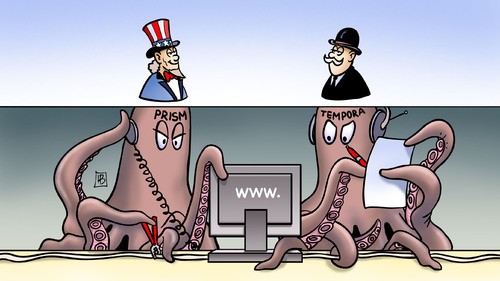
Britisches Abhörprogramm empört deutsche Politiker

tempora_und_prism_2029105.jpg

Britisches Abhörprogramm empört deutsche Politiker

Ex: http://www.jungefreiheit.de/

Sicherheitsprotokolle: Millionen E-Mails wurden abgefangen

BERLIN. Das britische Abhörprogramm „Tempora“ ist in Deutschland auf scharfe Kritik gestoßen. „Das massenhafte Ausspähen von Deutschen ist durch nichts gerechtfertigt“, sagte der innenpolitische Sprecher Michael Hartmann. Nach Angaben des Guardian hat der britische Geheimdienst seit eineinhalb Jahren Millionen E-Mails und Telefonate überwacht, die über transatlantische Glasfaserkabel verschickt wurden.

Zudem teilten die Briten die gewonnenen Informationen mit dem amerikanischen Geheimdienst NSA, der in den vergangenen Tagen wegen einem ähnlichen Spitzelprogramm in die Kritik geraten war. Die Bundesregierung erklärte, sie nehme den Zeitungsbericht „sehr ernst“ und werde „zum gegebenen Zeitpunkt“ Stellung dazu beziehen. 

„Krise des Rechtsstaates“

Auch der innenpolitische Sprecher der Grünen-Bundestagsfraktion, Konstantin Notz, griff die Maßnahmen scharf an: „Wir befinden uns an der Schwelle zu wohlmeinend autoritären Demokratien westlicher Prägung. Unser Rechtsstaat ist durch diese Entwicklung ernsthaft bedroht.“ Er sprach von einer „Krise des Rechtsstaates“.

Der stellvertretende Unionsfraktionschef im Bundestag, Michael Kretschmer (CDU), warnte, das Internet dürfe kein „rechtsfreier Raum für die Geheimdienste“ werden. „Wir Deutsche reiben uns verwundert die Augen, welche Handlungsmacht andere Demokratien ihren Geheimdiensten ermöglichen.“

600 Millionen überwachte Telefonate am Tag

Insgesamt wurden nach Angaben der britischen Zeitung bisher täglich 600 Millionen „telefonische Ereignisse“ überwacht. Hinzu kommen Millionen E-Mails und Einträge in den sozialen Netzwerken. Die privaten Daten der Internetnutzer sollen 30 Tage gespeichert worden seien. Zugriff auf die Daten hatten offenbar etwa 850.000 amerikanische und britische Geheimdienstmitarbeiter und Staatsangestellte sowie externe „Spezialisten“.

Die Informationen über die Überwachungsmaßnahmen stammen von dem amerikanischen IT-Spezialisten Edward Snowden, der bereits das US-Spitzelprogramm „Prism“ enttarnt hatte. Snowden befindet sich seitdem auf der Flucht vor den US-Behörden. Mittlerweile ist er von Hongkong aus nach Moskau weitergereist und hat Asyl in Ecuador beantragt. (ho)

Eine Frage der Macht

NSa.jpg

Eine Frage der Macht

Von Thorsten Hinz

Ex: http://www.jungefreiheit.de/

Die Enthüllung des amerikanischen Spionageangriffs namens „Prism“ löst zwei spontane Regungen aus: Erstens Schadenfreude darüber, daß die US-Führung, die sich gerade über Hacker-Angriffe aus China empörte, nun selber als der „Big Brother“ entlarvt ist, den man in ihr vermutet hat. Zweitens Empörung, weil die NSA, die nationale Sicherheitsbehörde der USA, in den globalen und vor allem deutschen Internetverkehr hineinschaut wie in ein offenes Buch. Es wäre jedoch kindisch, es bei diesen Reaktionen zu belassen.

Das „Prism“-Programm ist keine Überraschung. Die NSA betreibt schon seit Jahrzehnten das weltweite Abhörsystem Echolon, an dem auch Großbritannien, Kanada, Australien, Neuseeland beteiligt sind: ein angelsächsischer Machtblock. „Prism“ stellt die logische Ergänzung dazu dar. Wir müssen einsehen, daß die nationalen Diskussionen um den Datenschutz virtuell und gegenstandslos sind. Längst sind wir gläserne Bürger und damit kontrollier-, erpreß- und steuerbar. Steuerbar durch die Instanzen, die Zugriff auf unsere Daten haben. Sie können zur sanften Manipulation, aber auch zur handfesten Erpressung genutzt werden.

Die deutschen Beamten eines Protektorates

Zur Begründung für „Prism“ wird der Kampf gegen den Terror angeführt. Der ist wichtig, aber zugleich ein Vorwand. Konkret geht es um den islamistischen Terror. Dessen Drohung ist nicht zuletzt eine Begleiterscheinung der falschen Zuwanderung, die von denselben Machtinstanzen, die uns kontrollieren, als Bereicherung oder „Diversity“ gepriesen wird. Um die entstandenen Risiken zu begrenzen, wird jetzt ein Netz der Spitzelei über Staaten und Gesellschaften geworfen. So werden das Selbst- und das zwischenmenschliche Vertrauen schleichend zerstört und gemeinsames Handeln zur Gegenwehr verhindert. Desto leichter lassen die Atomisierten sich beherrschen.

Nicht zufällig ist es ein amerikanischer Geheimdienst, der die nationalen und europäischen Regeln und Gesetze beiseite wischt. Innenminister Hans-Peter Friedrich (CSU) erklärte zunächst, er habe nichts davon gewußt. Eine glaubhafte Aussage, aber auch ein Armutszeugnis für einen Mann, dem der Schutz des Landes und seiner Bürger unmittelbar anvertraut ist. Wenige Tage später wies er deutsche Kritik an „Prism“ zurück. So dürfe man nicht mit den amerikanischen Freunden umgehen, die im Kampf gegen den Terrorismus unsere wichtigsten Partner seien. So redet kein Minister eines selbstbewußten Staates, sondern der Beamte eines Protektorats.

Die USA sind ein Imperium, und sie handeln danach

Friedrich hatte sich inzwischen wohl darüber informieren lassen, daß deutsche Geheimdienste mit den amerikanischen zusammenarbeiten und deren Erkenntnisse nutzten. Das ändert nichts daran, daß deutsche Behörden im eigenen Land als Hilfstruppen agieren. Das hat Tradition, denn die Überwachung von Post und Telefon in Deutschland war jahrzehntelang durch das Besatzungsrecht gedeckt. Hohe deutsche Sicherheitsbeamte wie der BKA-Präsident Paul Dickopf (1965–1970) waren zugleich CIA-Agenten. Zwar ist die Bundesrepublik seit 1990 formal souverän, aber die alten Gewohnheiten und Verhaltensweisen wirken weiter.

Bloßes Moralisieren läuft ins Leere. Die USA sind ein Imperium, und sie handeln danach. Wer die Macht hat, der legt auch die Grammatik des Völkerrechts fest. Es ist rührend, wenn deutsche Politiker jetzt gemeinsame Regeln für die Überwachung fordern. Denn hier geht es nicht um technische Fragen oder liberale Werte, sondern um Macht.

Deutschland ist ein natürliches Zielobjekt der Wirtschaftsspionage

Bis in das 20. Jahrhundert war England der Welthegemon, weil es die globalen Seewege beherrschte. Heute ist – neben der Herrschaft über den Luft- und den Weltraum – die Gewalt über die globalen Datenautobahnen entscheidend. Die USA sind sich dessen bewußt und schlagen gnadenlos zu, wenn ihre Macht hier angetastet wird. Wikileaks-Gründer Julian Assange befindet sich seit Jahren auf der Flucht, sein Informant, Bradley Manning, wird sein restliches Leben wohl hinter Gittern verbringen. „Prism“-Enthüller Edward Snowden kann sich seines Lebens nicht sicherer sein als sowjetische Dissidenten zu KGB-Zeiten.

Mit den US-Behörden ziehen Tausende amerikanische Technologie-, Finanz- und Kommunikationsfirmen an einem Strang. Die einen arbeiten wider-, andere freiwillig mit den Geheimdiensten zusammen. Die freie und multinationale Wirtschaft hin oder her – für den Rest der Welt stellt es ein Risiko dar, daß amerikanische Firmen die globale Kommunikationsbranche monopolisiert haben. Das Echolon-System dient bekanntermaßen auch der Wirtschaftsspionage. Deutschland, die viertgrößte Wirtschaftsmacht, ist ein natürliches Zielobjekt.

Warum sollte es bei „Prism“ anders sein? Es ist naiv, die außenpolitischen Kombinationen auf Handels- und Wirtschaftspolitik zu beschränken und im übrigen auf eine Interessenidentität befreundeter Staaten zu vertrauen. Und dann ist da noch der nette Obama, den die Zeit einst euphorisch als „guten Führer“ titulierte. In Wahrheit gibt es keinen prinzipiellen Unterschied zu seinem Vorgänger, es kann ihn gar nicht geben. Den Deutschen bietet die „Prism“-Affäre ein Lehrstück in mehreren Akten.

JF 26/13

mercredi, 26 juin 2013

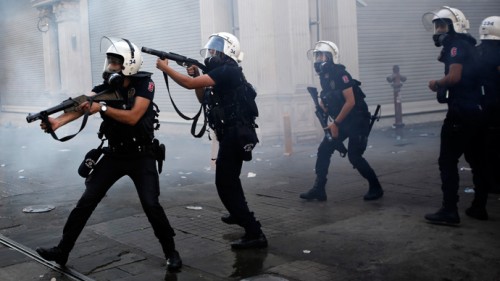
Disturbances Continue, Schism in Society Intensifies

turkey-police-main.jpg

Disturbances Continue, Schism in Society Intensifies

Dmitriy SEDOV


Ex: http://www.strategic-culture.org/

The events on Istanbul's Taksim Square are presented in the world media as the consequences of an «ecologically incorrect» decision by the government to clear a landscaped area in a park located on the square. This is far from the truth and raises questions about the real interests of the West in the spreading conflict.

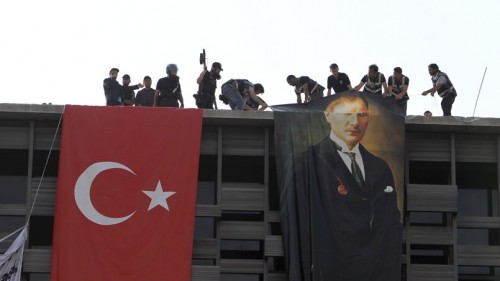
In fact, the landscaped area plays but a minor role in the civil clash. This is really about Recep Erdoğan's intention to demolish the Mustafa Kemal Atatürk Cultural Center, which is located there, and also to remove the monument to the founder of the secular Turkish Republic. In place of the Cultural Center Erdoğan has decided to build a mosque, even though there is already a mosque on the square, Taksim Mescid Camii.

It is this intention which has united the secular part of society in protesting against the prime minister. A wide variety of community groups, including those which were previously irreconcilable, have united in opposition to Erdoğan's policy of actively destroying Atatürk's political legacy.

Of course, the consistent Islamization of the country over the past 10 years was causing an undercurrent of discontent among many societal forces before this. The potential for protest was gradually building.

So when society learned of Erdoğan's attempt to demolish the Atatürk Center, a symbol of the secular order, there was an explosion.

The cult of the Republic's founder is unshakable among the Turkish people. There are few political figures in the world who enjoy such unconditional respect as that which surrounds the figure of the founder of the modern Turkish state.

Only a politician who imagines himself to be Atatürk's equal could publicly encroach on his authority.

It seems that Recep Erdoğan imagines himself to be some kind of «Anti-Atatürk». He is planning a historical accomplishment on the same scale, but the other way around; he wants to turn Turkey from a modern secular state to an Islamist regime.

To this end it is necessary to remove symbols connected with Mustafa Atatürk, and that is why Erdoğan is so stubbornly and ferociously holding on to the idea of demolishing the center and the monument. For him it will be an ideological victory at a crucial moment in history. But the protesters also see the fight for the monument as a fight for the path Turkey will take.

Erdoğan has already done a lot to eradicate Atatürk's legacy.

At one time, Mustafa Kemal, with the support of the army, purged Turkey of any attributes of a «Muslim state» and turned the core of the former feudal Ottoman Empire into a Europeanized secular country. According to Atatürk's precepts, the army was the buttress of the secular authorities and their protector against Islamization.

Erdoğan has devoted all 10 years of his administration to depriving the army of its cementing role in society, replacing the officer corps with imams. In recent years there has been a growing «epidemic» of dismissals, criminal cases and scandals in connection with Turkish officers and generals, who have been accused of attempting coups d’état, corruption and much more.

Erdoğan himself has been speaking of the «inevitable Islamization» of the country since 2007. He has also been supporting Islamists abroad, especially in neighboring countries. Chechen, Ingush and Dagestani rebels to this day often receive supplies from Ankara. In the Chechen Wars there were «Turkish amirs» («amir bilal»). Among the rebels liquidated by federal forces there were as many Turks as there were Saudis.

In his own country Erdoğan has been conducting a policy of neo-Ottomanism, which is a mixture of national socialism and Sunnism.

Erdoğan has achieved recognition both among the lower social classes of Turkey and in Europe. Among European countries, the most active supporters of Turkey's current policy are Spain and Germany, the latter of which has very close ties with Turkey. Overall, Erdoğan is a favorite of the European socialists who are in power. To them he is the personification of their idealistic notion of «rational Islam».

Erdoğan began storming Kemalism on the crest of his influence within the country and abroad. Turkey was developing economically at an enviable rate and was strengthening its positions in the region. The war in Syria was a long-awaited chance for Erdoğan to show himself even more boldly. The irony of the situation is that he heatedly accused al-Asad of «undemocratic» methods of dealing with the opposition.

Now the mass dispersals and arrests of demonstrators in Turkish cities are showing what a «true democrat» he is himself.

The coverage of the events in Turkey in the Western media is worth examining separately. It is difficult to shake the feeling that these media have no interest in the truth about what is happening. They do not know how to present information on Erdoğan's Islamist «irresistible force» meeting the «immovable object» of the Kemalist opposition.

It doesn't fit in with the concept of the civilized Islamization which was supposed to make Recep Erdoğan the authorized representative of Western interests in the region. A month ago Europe was providing all possible support to Turkish Islamization, and the Western media were acting accordingly. And suddenly an openly anti-Islamist movement, behind which stand the army and broad social strata (and possibly some groups of the Turkish elite) has appeared in the country.

Nationwide solidarity, declaration of will through peaceful means and consolidation via Facebook and Twitter are taking place according to all the canons of neoliberalism. But it's directed against the interests of the West. A «color revolution in reverse» is in the making, and the results for the European capitals could be unpredictable. After all, forces which advocate a foreign policy governed by the precepts of the «Father of the Turks» could end up in power; such precepts include «No problems with neighbors,» which first and foremost means Syria. This would be a big surprise for NATO strategists.

For that reason many things are being kept quiet in the Western media, and the few stories that appear try very hard to pass over the anti-Islamist rhetoric of the protesters, but they are not very successful at it. Not a word is mentioned about Atatürk.

In the meantime, the conflict is spreading.

On Sunday 300,000 supporters of Recep Erdoğan, organized by the government, came out on the streets. It was meant to be a demonstration of the forces which support the prime minister. And such forces undoubtedly exist. However, in order to turn the situation around with their help, Erdoğan must de facto be equal in authority to Atatürk. But it seems that he has overestimated himself, because in response the protesters came out again and are fighting with the police. The prime minister summoned 1,000 special forces agents to Istanbul, and rather unexpectedly the powerful Turkish labor unions, which are threatened with extinction if Islamic norms are introduced, joined the conflict.

Reuters reports that one of Turkey's largest labor unions, the «Confederation of Unions of State Employees» (KESK), called for the organization of a general strike on Monday, June 17. The leadership of another Turkish labor union, the «Confederation of Revolutionary Labor Unions» (DISK), held an emergency meeting at which it decided to join this action.

Observers are following sentiments in the army attentively. Something unexpected could take place here as well.

It seems that the price Recep Erdoğan will have to pay for his attempt to banish Kemal Atatürk from Turkish history is becoming higher and higher. Soon rapidly developing events will show whether or not he will be able to pay it…

mardi, 25 juin 2013

P. Scholl-Latour: “L’Occident s’allie avec Al-Qaeda”

“L’Occident s’allie avec Al-Qaeda”

Peter Scholl-Latour, le grand expert allemand sur le Proche et le Moyen Orient s’exprime sur la guerre civile syrienne, sur le rôle de l’Europe et des Etats-Unis, sur le programme nucléaire iranien qui suscite bien des controverses...

Entretien avec Peter Scholl-Latour

PSLatour.jpgQ.: En Syrie, l’armée vient de reprendre un bastion des rebelles, la ville de Qussayr et a enregistré d’autres succès encore. Ces victoires représentent-elles un tournant dans cette guerre civile atroce, cette fois favorable à Bechar El-Assad?

PSL: Jamais la situation n’a vraiment été critique pour le Président El-Assad, contrairement à ce qu’ont toujours affirmé nos médias. Il y a bien sûr des villages qui sont occupés par les rebelles; des frontières intérieures ont certes été formées au cours des événements mais on peut difficilement les tracer sur une carte avec précision. La Syrie ressemble dès lors à une peau de léopard. Aucun chef-lieu de province n’est tombé aux mains des rebelles, bien que bon nombre d’entre eux soient entourés de villages hostiles à El-Assad. Il est tout aussi faux d’affirmer que tous les Sunnites sont des adversaires d’El-Assad, et la chute d’une place forte stratégique aussi importante que Qussayr est bien entendu le fruit d’une coopération avec le Hizbollah libanais.

Q.: Le Liban sera-t-il encore plus impliqué dans la guerre civile syrienne qu’auparavant? 

PSL: Le Liban est profondément impliqué! Quand j’étais à Tripoli dans le Nord du pays, il y a trois ans, des coups de feu s’échangeaient déjà entre les quartiers alaouites et sunnites. La ville de Tripoli a toujours été considérée comme le principal bastion au Liban de l’islam rigoriste et, pour l’instant, on ne sait pas encore comment se positionneront vraiment les chrétiens. On peut cependant prévoir qu’ils en auront bien vite assez de la folie des rebelles syriens, dont le slogan est le suivant: “Les chrétiens à Beyrouth, les alaouites au cimetière!”.

Q.: L’UE vient encore de prolonger l’embargo sur les armes contre la Syrie, vu que l’Europe ne montre aucune unité diplomatique ou stratégique. Peut-on considérer cette posture comme un prise de position inutile de la part de l’UE?

PSL: Les Européens montrent une fois de plus une image lamentable, surtout les Français et les Anglais. Cette image lamentable, à mes yeux, se repère surtout dans la tentative maladroite des Français de prouver que le régime d’El-Assad utilise des gaz de combat, affirmation purement gratuite car il n’y a pas l’ombre d’une preuve. Cependant, les seuls qui auraient un intérêt à utiliser des gaz, même en proportions très limitées, sont les rebelles, car Obama a déclaré naguère que l’utilisation de telles armes chimiques constituerait le franchissement d’une “ligne rouge”, permettant à l’Occident d’intervenir.

Q.: L’Occident pourra-t-il encore intervenir, surtout les Etats-Unis, même sans utiliser de troupes terrestres et en imposant militairement une zone interdite aux avions d’El-Assad?

PSL: Les Américains ne sont pas prêts, pour le moment, à franchir ce pas parce qu’ils ne veulent pas s’impliquer encore davantage dans les conflits du Proche Orient et surtout parce qu’ils en ont assez du gâchis libyen. L’Occident a certes connu une forme de succès en Libye, en provoquant la chute de Khadhafi, mais le pays est plongé depuis lors dans un inextricable chaos dont ne perçoit pas la fin. En Cyrénaïque, plus précisément à Benghazi, où l’on a cru naïvement qu’un soulèvement pour la démocratie avait eu lieu, l’ambassadeur des Etats-Unis a été assassiné. On aurait parfaitement pu prévoir ce chaos car la Cyrénaïque a toujours été, dans l’histoire, la province libyenne la plus travaillée par l’islamisme radical.

On a cru tout aussi naïvement que des élections allaient amener au pouvoir un gouvernement modéré et pro-occidental, mais on n’a toujours rien vu arriver... Les luttes acharnées qui déchirent la Libye sont organisées par les diverses tribus qui ont chacune leurs visions religieuses propres.

Q.: L’Occident soutient les rebelles en Syrie tandis que la Russie se range derrière El-Assad. Peut-on en conclure que, vu les relations considérablement rafraîchies aujourd’hui entre l’Occident et la Russie, la guerre civile syrienne est une sorte de guerre russo-occidentale par partis syriens interposés?

PSL: Bien sûr qu’il s’agit d’une guerre par partis syriens interposés: les Russes se sont rangés derrière El-Assad, comme vous le dites, de même que l’Iran et le premier ministre irakien Nouri Al-Maliki. La frontière entre la Syrie et la Turquie est complètement ouverte, ce qui permet aux armes, aux volontaires anti-Assad et aux combattants d’Al Qaeda de passer en Syrie et de renforcer le camp des rebelles. De plus, en Turquie, on entraîne des combattants tchétchènes, ce qui me permet de dire que l’Occident s’est bel et bien allié à Al-Qaeda.

Q.: Quelles motivations poussent donc les Turcs? Sont-ils animés par un rêve de puissance alimenté par l’idéologie néo-ottomane?

PSL: Selon toute vraisemblance, de telles idées animent l’esprit du premier ministre turc Erdogan. Mais, depuis peu, des troubles secouent toute la Turquie, qu’il ne faut certes pas exagérer dans leur ampleur parce qu’Erdogan est bien installé au pouvoir, difficilement délogeable, ne peut être renversé. Mais les événements récents égratignent considérablement l’image de marque de la Turquie, telle qu’elle avait été concoctée pour le public européen, celle d’un pays à l’islam tolérant, exemple pour tout le monde musulman. Cette vision vient d’éclater comme une baudruche. Mais les véritables inspirateurs des rebelles syriens sont les Saoudiens, dont la doctrine wahhabite est précisément celle des talibans.

Q.: L’Autriche va retirer ses casques bleus du Golan. On peut dès lors se poser la question: la mission de l’ONU dans cette région pourra-t-elle se maintenir? Si la zone-tampon disparaît, ne peut-on pas craindre une guerre entre Israël et la Syrie?

PSL: Pour les Israéliens, ce serait stupide de déclencher une guerre, ce serait une erreur que personne ne comprendrait car depuis la fin de la guerre du Yom Kippour, il y a près de quarante ans, il n’y a pas eu le moindre incident sur la frontière du Golan. J’ai visité là-bas les casques bleus autrichiens et ils ne m’ont pas mentionné le moindre incident. Aujourd’hui toutefois les échanges de tirs ont commencé et les groupes islamistes extrémistes s’infiltrent; il vaut donc mieux que les Autrichiens, qui ont l’ordre de ne jamais tirer, se retirent au plus vite.

Q.: Mais alors une guerre entre Israéliens et Syriens devient possible...

PSL: Israël a une idée fixe: la grande menace viendrait de l’Iran, ce qui est une interprétation totalement erronée. Si les rebelles ont le dessus en Syrie, Israël aura affaire à des islamistes sunnites sur les hauteurs du Golan. Bien sûr, on me rétorquera que le Hizbollah chiite du Liban est, lui aussi, sur la frontière avec Israël, mais il faut savoir que le Hizbollah est une armée disciplinée. Sa doctrine est aussi beaucoup plus tolérante qu’on ne nous l’a dépeinte dans les médias occidentaux: par exemple, dans les régions tenues par le Hizbollah, il n’y a jamais eu de persécutions contre les chrétiens; les églises y sont ouvertes et les statues mariales y demeurent dressées. Toutes choses impensables en Arabie Saoudite, pays qui est un de nos chers alliés, auquel l’Allemagne ne cesse de fournir des chars de combat... Nous vivons à l’heure d’une hypocrisie totale.

Q.: Vous venez d’évoquer l’Iran: un changement de cap après les présidentielles est fort peu probable, surtout si la figure de proue religieuse demeure forte en la personne de Khamenei...

PSL: On a largement surestimé Ahmadinedjad. Il a certes dit quelques bêtises à propos d’Israël mais dans le monde arabe il y a bien d’autres hommes politiques qui ont dit rigoureusement la même chose, sans que les médias occidentaux n’aient jugé bon de lancer des campagnes d’hystérie. Certes, le zèle religieux est bien repérable chez les Chiites d’Iran et, dans les villes surtout, le nationalisme iranien est une force politique considérable. Si un conflit éclate, l’Iran n’est pas un adversaire qu’il s’agira de sous-estimer.

Q.: Le programme nucléaire iranien, si contesté, est aussi et surtout l’expression d’un nationalisme iranien...

PSL: On ne peut prédire si l’Iran se dotera d’un armement nucléaire ou non. Mais on peut émettre l’hypothèse qu’un jour l’Iran deviendra une puissance nucléaire. Cela ne veut pas dire que l’Iran lancera des armes atomiques contre ses voisins car Téhéran considèrera cet armement comme un atout dissuasif, comme tous les autres Etats qui en disposent. L’Iran, tout simplement, est un Etat entouré de voisins plus ou moins hostiles et aimerait disposer d’un armement atomique dissuasif.

Propos recueillis par Bernhard Tomaschitz.

(entretien paru dans “zur Zeit”, Vienne, n°24/2013).

Выпуск XIX. Индия

Выпуск XIX. Индия


Раджа Мохан
Новая внешняя политика Индии
 
Леонид Савин
Идеология и стратегия
 
Шаши Тхарур
Глобальный индиец
 
Родни В. Джоунс
Тема войны и мира
в индийской стратегической культуре
 
Смрути С. Паттанаик
Индия и Пакистан: на пути к мирному процессу 
 
Фрэнсис Корнигэй
Индия, Южная Африка
и уравнение IBSA-BRICS 2013
 
Табасум Фирдоус
Инициативы Индии в Центральной и Южной Азии:
проблемы и перспективы
 
Мохаммад Самир Хуссейн
Проблемы безопасности в Центральной Азии
и роль Индии
 
Адит Чарли
Ответ Индии на арабскую весну
 
Харш Пант, Джулия Супер
Балансирующие конкуренты:
Индия между Ираном и США
 
Герард О’Туатайл
Геополитические условия постмодерна:
государства, государственное управление и безопасность 
в новом тысячелетии
 
Николай Малишевский
Политическая картография
 
Рецензии
Сведения об авторах

Файл в формате pdf: 

Parijs mogelijk al deze zomer in brand

Harvard-econoom en historicus: Parijs mogelijk al deze zomer in brand

Gezaghebbende economen en instanties vrezen meer geweld, revoluties, burgeroorlog en zelfs een wereldoorlog


De Fransen hebben wat protesten, geweld en revoluties betreft een zekere 'reputatie' hoog te houden.

De zware rellen in Turkije en Brazilië hebben voor onrust gezorgd op de financiële markten. Harvard-historicus en econoom Niall Ferguson, in 2004 door Time één van de 100 invloedrijkste mensen ter wereld genoemd, denkt net als veel anderen dat de protesten van burgers, die steeds heviger moeten bloeden voor het beleid van de politiek om ten koste van de samenleving de banken met honderden miljarden belastinggeld overeind te houden, zich verder zullen verspreiden en dat Parijs mogelijk al deze zomer de volgende brandhaard van geweld zal zijn.

'Parijs in brand'

In China zijn de communistische partijleiders begonnen de boeken van Alex de Tocqueville te lezen, met name zijn standaardwerk over het einde van de oude elite tijdens de Franse Revolutie. Ferguson acht Frankrijk en Parijs 'extreem vatbaar' voor massale sociale onrust. In een interview met CNBC zei hij dat 'het al deze zomer zover kan komen dat we de stad in vlammen zullen zien.'

Belangrijkste reden: de belabberde economie, die onder het bewind van de socialist Francois Hollande pijlsnel in elkaar is gestort, gekoppeld aan de torenhoge jeugdwerkloosheid. Hierdoor is de algemene stemming in Frankrijk zeer gespannen. Hollande is inmiddels de minst geliefde president ooit. Uit peilingen blijkt dat nog maar 19% van de Fransen opnieuw op hem zou stemmen en slechts 15% op zijn socialistische partij. Als er nu verkiezingen zouden worden gehouden zou oud-president Sarkozy 34 % van de stemmen krijgen, gevolgd door Le Pen (23%) van het rechtse Front National (2).

Ook protesten in Zuid Amerika en Egypte

Volgens Ferguson blijkt uit de geschiedenis dat Parijs een stad is waar het traditioneel snel tot onrust en massale protesten komt. Daarnaast voorziet hij ook voor steden in Zuid Amerika en voor de Egyptische hoofdstad Caïro grote gevaren. In veel landen kunnen de burgers de fors gestegen prijzen voor basiszaken zoals levensmiddelen en energie niet meer betalen. Ook is er veel woede over de slechte publieke dienstverlening.

In de Braziliaanse metropool Sao Paolo hebben de rijken zich teruggetrokken uit het dagelijkse leven. De stad heeft het hoogste aantal landingsplaatsen voor helicopters op hoge gebouwen. Hiermee ontlopen de rijken niet alleen de files, maar mijden ze ook de almaar bozer wordende bevolking. Veel rijken zijn bang dat de woede van de gewone man zich op een dag tegen hen zal keren.

'Chinese partijleiders lezen boek over Franse Revolutie'

De Britse econoom vertelde ook over zijn uitgebreide reis naar China. Hij zei verbluft te zijn toen de communistische partijleiders hem vertelden dat ze het boek 'De Oude Staat en de Revolutie' aan het lezen zijn. In dit boek, dat in 1856 werd geschreven door Alexis de Tocqueville, worden de oorzaken van het ontstaan van de Franse Revolutie beschreven. Het partijkader hoopt zich hierdoor beter voor te bereiden op het ontstaan van nieuwe massale protestdemonstraties.

Ferguson gelooft overigens niet dat het tot een revolutie in China zal komen. Het regime heet de politiestaat namelijk zo goed uitgebouwd, dat de bevolking goed onder controle kan worden gehouden.

Onrust, geweld, revolutie, burgeroorlog, wereldoorlog

Zoals we eerder deze week al schreven zijn de massale sociale onlusten volgens de vermaarde Amerikaanse econoom Joseph Stiglitz doelbewust gepland door het IMF, met als doel de wereldeconomie te hervormen en de wereldwijde politieke, financiële en corporatieve machtselite alle macht en totale controle te geven. (1)

Ferguson en Stiglitz zijn zeker niet de enigen die waarschuwen voor meer geweld. Ook de VN en het Rode Kruis verwachten grote sociale onrust en 'Arabische Lente-achtig geweld' in Europa. De Duitse minister van Financiën Schäuble zei zelfs te vrezen voor een nieuwe revolutie. Eerder dit jaar zei een oud-topambtenaar van de EU dat er een heuse burgeroorlog in Europa kan ontstaan. De voormalige voorzitter van de Eurogroep van Ministers van Financiën, Jean-Claude Juncker, impliceerde bij zijn afscheid begin dit jaar zelfs een mogelijke wereldoorlog in 2014. (zie linken onderaan)

Xander

(1) Deutsche Wirtschafts Nachrichten
(2) Deutsche Wirtschafts Nachrichten

Turkey doomed to collapse?

tkpol.jpg

Turkey doomed to collapse?

Araik STEPANYAN

Ex: http://english.pravda.ru/

Is this a chain reaction or mass epidemic? Either way, the fact remains - the political upheavals in the Muslim world that began in Tunisia swept across North Africa and Syria, and now a wave of instability has reached Turkey. A member of the Presidium of the Academy of Geopolitical Issues Araik Stepanyan analyzed this complex, ambiguous situation in the country.

"We will identify the external and internal factors that have caused, for the lack of a better word, social unrest in Turkey.

Internal factors have deep roots. The main reason is the collapse of the Ottoman Empire after the First World War and the Turkish Republic established by the "father of the Turks" Kemal Ataturk. He decided to raise the status of the ethnic Turks that was low in the Ottoman Empire, turning them into an overriding ethnic group and create a political nation - the Turks.

In 1926, a law was passed stating that all residents of Turkey were ethnic Turks, and different names - the Kurds, Armenians, Laz, Circassian, and so on - were insulting to the Turkish national identity and must not be used. Everybody was recorded as Turks. And, although many years have passed, the first problem in Turkey is a problem of national identity.

There is a huge mass of people, more than half of today's Turkish population, who do not consider themselves Turks. They see themselves as citizens of Turkey, but ethnically they do not identify themselves with the Turks, and do not want to. But because they live in the country where they have to be Turks to have a chance for a career, they are considered Turks. In 2000-2002, Western funds conducted a secret survey of the Turkish population and obtained evidence that only 37 percent of all Turkey residents saw themselves as ethnic Turks. The national issue has aggravated, and rallies and slogans are convincing evidence. 

The second internal factor that undermines today's Turkey is a debate about the type of the government - secular or theocratic. The elite of modern Turkey have serious disagreements about this. The heirs of the Ottoman Empire believe that the highest level of prosperity in Turkey was in the days of the Ottoman Empire, where all citizens were equal, except for Christians, and ethnicity was not emphasized. That means, people were Osman regardless of the ethnicity - the Turks, Circassian, or Kurds. 

The secular government afraid of Islamic influence is holding to the legacy of Kemal Ataturk. This is the army general staff who until recently served as the guarantor of the Constitution by the secular power. But Erdogan came to power and abolished that item of the Constitution. Incidentally, this is a revolutionary step, and can be compared with the constitution of the Soviet Union whose sixth article stated that the Communist Party was the governing body of the Soviet state. Once it was removed, the state has collapsed. Eliminating his "sixth paragraph," Erdogan dealt a crushing blow to the General Staff and the army. Naturally, the army is very unhappy and wants to overthrow Erdogan, although it is not directly involved in the rallies.

Third internal factor is the Kurdish issue. The Kurds are seeking autonomy in Eastern Anatolia (the largest region of Turkey), their number is approximately 20 million. Despite the talks started by Erdogan (negotiations with Barzani, president of the Kurdish autonomy in northern Iraq, and Ocalan, the PKK leader) armed clashes between Kurdish rebels and the official Turkish army continue, with daily casualties on both sides. Thus, this is the third most important factor.

The fourth factor is the Armenian issue. Armenians living in the south-eastern and eastern Anatolia, the original Armenian territories of Western Armenia, have, so to speak, their hidden aspirations. They are hidden because they have bitter experience of being eliminated and thrown out. The Turkish elite, the intelligentsia, too, in turn, realizes that it is impossible not to recognize the Armenian Genocide. About three thousand Turkish intellectuals on Turkish websites apologized to the Armenians for the Genocide and eviction. Then there was football diplomacy with signing the agreement on opening the border between Turkey and Armenia. The Armenians are now fighting with diplomatic methods.  

Turkish demographic policy denies all other nationalities. Turkey strongly advocates that 82 percent of the population is Turks. But for obvious reasons this is not the case. There is a vast array of Greek Muslims who do not even speak the Turkish language and as many Bulgarian Muslims.

There are Armenians who speak Kurdish, Armenians who speak Turkish and Armenians who speak the Armenian dialect. But the state considers them all Turks. This is not the case, but a reason to oppose the government in one form or another.

The fifth factor is internal - it's Alawites, a religious movement with millions of people who adhere to the same religious beliefs as Bashar al-Assad, the Syrian Alawi. When I see banners proclaiming "Erdogan, you are a thief!" I understand that these are Alawites. In the course of combat activities in Syria, Aleppo in particular, gunmen took out everything - from machines to museum exhibits, and exported them to Turkey, with the connivance of the authorities, and sold or appropriated them.

But Gezi Park or Taksim Square where rallies are held now is a special topic that overlaps, incidentally, with the Armenian issue.

First, in 1500 sultan Suleiman presented this territory to his Armenian assistant who uncovered a conspiracy. In 1560, an Armenian cemetery was laid there. The cemetery existed until late 19th century and was eliminated after a well-known cholera epidemic, but the ownership was left to the Armenian community. After the genocide in 1915, when the Armenians were expelled, the owner clearly changed. Barracks were built there, then a park. When the authorities planned to build a shopping center, the community exploded. All ethnic minorities, anti-globalization activists, gays, lesbians, football fans, the "green" joined against the destruction of the park. Clearly, everyone had different views and goals, but the only reason was rejection of the current government that none of these social groups liked. Yes, individually they are in the minority, but this is the case where the sum of minorities produces the majority, incidentally, in contrast to Russia.

There is also an external factor. The U.S. lost interest in Turkey after the collapse of the Soviet Union. The Turks tried to start building a new Turkic empire, the so-called Great Turan based on pan-Turkism, but the Turkic-speaking states, newly formed in the Soviet Union, gave the initiative a cold shoulder despite the extent of the economic expansion of Turkey in these regions is impressive.

The U.S. does not really support these imperial ideas. Especially when Turkey did not provide its territory for ground operations during the recent war in Iraq, did not let the American ships into the Black Sea during the Russian-Georgian conflict in 2008, incidentally, rightly so, in accordance with the international status of the Black Sea and the Bosporus and the Dardanelles.

The White House is beginning to move away from its ally. Moreover, according to the plan of a military expert Ralph Peters of the National Military Academy of the United States, in accordance with the concept of the Greater Middle East, Turkey is disintegrated. A large Kurdistan is created, and Mount Ararat goes to Armenia. Most important task, of course, is to take control of the Bosporus and the Dardanelles, close access for Russia to the Mediterranean Sea, and so on. The U.S. has a clear plan and is implementing it. The European Union, of course, agrees with this plan.

America will not save Erdogan despite the fact that he supported the Muslim extremists against Assad. Only Assad is winning, and Turkey has lost its authority with the nearby neighbors. It is likely to face open hostility, because no one has forgotten the Ottoman Empire or the imperial motives of the Turkish foreign policy. Turkish leaders have painted themselves into a geopolitical trap. There are still chances of getting out of it, but, judging by Erdogan's recent statements, they are becoming slimmer every day.

All of these factors combined lead Turkey to a collapse. It will not happen overnight, but the trend is moving in this direction. All mass movements just show the causes, both external and internal. Therefore, even if the military who wants to overthrow Erdogan comes to power, and the constitution and the role of the General Staff is restored, it will be impossible to stop the process of globalization and crush the rebellion of ethnic groups.

Araik Stepanyan

Pravda.Ru

Read the original in Russian


Дмитрий Судаков

lundi, 24 juin 2013

Turquie: détricoter le kémalisme

tkmka.jpg

“M.”/” ’t Pallieterke”:

Turquie: détricoter le kémalisme

Le mécontentement qui agite la Turquie à l’heure actuelle a des racines profondes mais fort hétérogènes. Un large éventail de motivations anime les contestataires mais l’Occident ne braque les projecteurs de ses médias que sur la relation difficile qui a toujours existé entre l’Etat et la religion dans la République turque. On peut le comprendre. Les émeutes nocturnes ne sont que le sommet de l’iceberg: voilà ce qui importe de constater. Le pays connait depuis des années des glissements considérables. Ils ont toujours été minimisés ou ignorés.

Si le Proche et le Moyen Orient nous ont appris quelque chose au cours des dernières années écoulées, c’est bien que le terme “révolution” doit être pris, désormais, avec des pincettes. On ne peut plus l’utiliser à tort et à travers. Le syndrôme “Vivaldi”, qui consiste à placarder le rythme des saisons sur la vie politique des peuples arabo-musulmans, est, lui aussi, une aberration qu’il faudra bien vite jeter à la poubelle de l’histoire. Donc, disons-le une fois pour toutes, il n’est pas question d’évoquer ici un “printemps turc” tout comme il n’y a plus lieu de répéter à satiété la formule “printemps arabe”. La Turquie, d’abord, est un pays bien différent de l’Egypte ou de la Tunisie d’il y a deux ans. Le premier ministre turc Erdogan, dans certains cas, agit de manière aussi tyrannique que le faisaient Mubarak en Egypte ou Ben Ali en Tunisie mais, force est aussi de constater, qu’il a gagné les élections trois fois de suite. Les adversaires de son régime font face à un gouvernement bien ancré, qui a engrangé quelques beaux succès économiques. Ce n’est là qu’un premier aspect de la situation actuelle de la Turquie qui nous intéresse ici.

Dans les médias en général, on a tendance à utiliser des anecdotes hautes en couleurs pour simplifier les choses qui, en réalité, ne sont pas simples du tout. Exemple: quelques habitants d’un quartier d’Ankara sortent le soir de chez eux en frappant des couvercles de casseroles avec des cuillers en scandant des slogans pro-kémalistes comme “Nous sommes les soldats de Mustafa Kemal”, vociférés par des jeunes gens qui passent à toute vitesse en voiture. Quand les médias extrapolent et mettent ce type d’incident en exergue, cela devient la narration médiatique d’une “résistance séculière contre la ré-islamisation” envisagée par Erdogan. On a commis la même erreur en Egypte. Quelques manifestants sur la Place Tahir militaient effectivement pour une démocratisation du pays mais, en bout de course, la plupart des manifestants qui se sont joints à eux avaient de toutes autres idées derrière la tête, tout en voulant, eux aussi, chasser Moubarak du pouvoir. Sur la Place Taksim, c’est le même topo. L’Occident évoque certes un ressentiment chez les forces séculières et laïques mais, simultanément, tente de relativiser ce mécontentement . A tort, nous semble-t-il, car il y a vraiment, en Turquie, aujourd’hui, un ressentiement kémaliste.

Tansu Çiller

C’est un fait incoutournable: au cours de ces dernières années, le gouvernement AKP a provoqué des transformations profondes au sein de la tradition séculière du pays. Ainsi, de manière systématique, le gouvernement verse plus de fonds aux écoles religieuses au détriment des établissements d’enseignement qui entendent promouvoir un regard séculier sur la société. Pour des raisons financières, les écoles se transforment, par la force des choses, en institutions religieuses. Rien qu’à Istanbul, 98 écoles primaires ont déjà franchi le pas. Conséquence logique de cette politique de subsides: suivre les cours dans une école séculière devient plus cher et n’est plus accessible qu’aux seules classes aisées. Les familles normales sont obligées désormais de faire suivre un itinéraire religieux à leurs enfants.

Le climat est bien différent aujourd’hui qu’hier, disent tous ceux qui sont à même de comparer. Apparemment, il faut du culot et du courage désormais pour manger en public pendant la période du Ramadan. Il y a deux ans, deux amoureux se sont embrassés dans le bus (public!): une émeute a failli se déclencher... La colère du chauffeur (“Mon bus n’est pas un bordel!”) a été suivie d’une action de protestation en faveur des deux tourtereaux, suivie d’une deuxième action de protestation, religieuse celle-là, et hostile, comme il se doit, à ces deux “dangereux pervers”. Au cours des années écoulées, la violence à l’endroit des femmes aurait augmenté de 1400%. Mais lorsqu’on a appris qu’un homme de 78 ans avait des relations sexuelles avec une jeune fille de 14 ans, aucun acteur en vue de la sphère religieuse n’a émis de protestation. Ensuite, que faut-il penser d’un premier ministre qui appelle les femmes à rester chez elles et à faire beaucoup d’enfants? Rappelons qu’Erdogan est l’homme politique qui a un jour déclaré que la démocratie, c’était un autobus: “Dès qu’on arrive à destination, on en sort!”. Dans son cas, et vu les incidents de ces dernières semaines, cette réflexion est exacte. Récemment, une loi réglementant de manière drastique la vente d’alcool a suscité du mécontentement. Elle a été concoctée par les députés de l’AKP, soi-disant pour éviter les abus, alors que la Turquie est le pays de l’OCDE qui présente la consommation d’alcool la plus basse... Ce ne sont là que quelques exemples dans une longue série. Tout cela se déroule, rappellons-le aussi, dans un pays qui, il y a vingt ans seulement, avait une femme pour premier ministre: Tansu Çiller, ancienne étudiante de Yale.

Les forces armées

L’absence de toute influence religieuse sur la vie socio-économique est un trait caractéristique de tout Etat séculier. En Turquie, aujourd’hui, il faut bien constater que de nombreuses initiatives gouvernementales visent à ruiner le caractère séculier de l’Etat. Le changement de donne s’observe surtout au sein des forces armées et est sans doute l’indice le plus patent de ce glissement. On a certes appris que des soldats ont distribué des masques à gaz aux manifestants hostiles à Erdogan et ont évacué les blessés vers des hôpitaux militaires. Mais, mis à part de tels cas, on s’est également aperçu que l’emprise religieuse est désormais plus forte dans l’armée, certainement dans le corps des sous-officiers. N’oublions pas qu’un général turc sur dix est actuellement en prison, pour participation présumée à la préparation d’un quelconque coup d’Etat. Dans le passé, on disait que la Turquie était un simple decorum d’Etat autour d’une armée, noyau réel de la République. Cette armée était la gardienne de la tradition séculière voulue jadis par Atatürk. Aujourd’hui, cette armée est soumise à deux pressions: sa composition est plus marquée par la religion et par ailleurs elle perd tout soutien politique. Les pouvoirs politiques réduisent les moyens mis à disposition de l’armée. Plusieurs analystes constatent en effet que le nombre d’accident d’avions militaires, ces derniers temps, sont l’effet de ces restrictions.

La République turque, née en 1923, a été un laboratoire fort intéressant. Dans quelle mesure les principes de démocratie et de sécularisme étaient-ils compatibles dans une société musulmane? Bien sûr, un certain équilibre a été atteint, pendant un assez long moment de l’histoire de la Turquie kémaliste, mais, aujourd’hui, force est de constater que ces équilibres n’existent quasi plus. Personne n’ose augurer ce que deviendra la Turquie le jour du centième anniversaire de la République. Ah oui... n’oublions pas que la Turquie, par dessus le marché, est candidate à l’adhésion pleine et entière à l’UE...

“M.” / “ ’t Pallieterke”, Anvers, 19 juin 2013.

jeudi, 20 juin 2013

EL TRATADO DE LIBRE COMERCIO ESTADOS UNIDOS – UNIÓN EUROPEA OTRO PASO HACIA LA GLOBALIZACIÓN


Union-Europénne-Etats-Unis.jpg

EL TRATADO DE LIBRE COMERCIO ESTADOS UNIDOS – UNIÓN EUROPEA OTRO PASO HACIA LA GLOBALIZACIÓN
 
 
Enrique Ravello
Ex: http://enricravello.blogspot.com/

Jean Baptiste Collbert, fue ministro  de fianzas de Luis XIV, el llamado “Rey Sol”, orador, inteligente, eficaz, gran parte del esplendor del reinado de Luis XIV se debió a su brillante  gestión. Collbert, impulsó una política económica llamada “colbertismo” o de forma más genérica, mercantilismo, su aplicación estuvo asociada al fortalecimiento de la monarquía absoluta y por lo tanto a la centralización del poder, y la capacidad e dirigir la economía del mismo.
El mercantilismo –aplicado también en otros estados europeos– se basa en un intervención dirigista del poder político en la actividad económica y el control de la moneda por parte del Estado, así como en la unificación del mercado interno, el aumento de la producción propia -controlando recursos naturales y mercados-,  la protección de la producción local ante la competencia extranjera, la imposición de aranceles a los productos extranjeros y el incremento de la oferta monetaria. Estas actuaciones tuvieron como finalidad última la formación de Estados lo más fuertes posible, lo que permitió un aumento de la riqueza, una mejora de la calidad de vida y el aumento de la población europea.
 
 
Proteccionismo frente a liberalismo
 
El mercantilismo como concepción tuvo su antítesis en el liberalismo, el hecho de que las potencias que defendía uno y otro modelo económico (Francia y Reino Unido) pugnasen por el dominio del comercio mundial, hizo de este enfrentamiento algo más que una cuestión ideológica. El liberalismo se fundamenta en el principio ideológico  de que  el individuo prima por encima del interés colectivo, la economía debe ser una vector independiente y alejado del control político, confiando de forma inconsciente en el “mercado” que mediante un “mecanismo invisible” (sic) autorregula sus diferencias y corrige las desigualdades sociales, de donde deriva su economicismo antipolítico. El mundo debe convertirse en un mercado mundial donde ni leyes ni estado, ni aranceles coarten su funcionamiento. No es de extrañar que los dos principales críticos del mercantilismo fueran los pensadores de referencia del liberalismo: Adam Smith y especialmente Ricardo.
La pugnas entra las dos concepciones se en el  XVIII y  XIX,  y la primera parte del siglo XX, en el que el liberalismo se fue imponiendo pero con fuertes resistencias en amplias zonas de Europa.
 
De la OMC al Tratado Interatlántico, la creación de un mercando mundial
 
Tras el final de la Segunda Guerra Mundial, se asiste a una liberalización continua del comercio mundial bajo el impulso de las grandes instituciones librecambistas y mundialistas como la Organización Mundial del Comercio (OMC), el Banco Mundial o el Fondo Monetario Internacional (FMI). 
 
En esos años el gobierno de los Estados Unidos propone a varios otros gobiernos la convocatoria de una Conferencia Internacional sobre el Comercio. En 1947 la ONU recoge esta iniciativa, eligiendo la ciudad de La Habana para celebrarla, en esa reunión establece el Acuerdo General de Arancel y Comercio (GATT), suscrito finalmente en Ginebra el 30 de octubre 1947 por 30 estados. Este GATT se basa en el principio del libre comercio internacional y en la progresiva supresión de aranceles y medidas proteccionista.  El GATT ha organizado sucesivas rondas en las que ha ido modelando su política neoliberal y aumentando el número de países firmantes. En la última ronda (Uruguay-Marrakesch 1986-1993) el número de estados firmantes llega a 120 y se constituye la Organización Mundial del Comercio (OMC) organismo que encargado de unificar las nomenclaturas arancelarias y de promover el librecambio a nivel mundial, los gobiernos de los estos miembros de OMC obedecen ciegamente las instrucciones de la OMC cuyo fin es la unificación del mercado mundial; hay que destacar que  Bruselas (UE) destaca en este nivel de sumisión al GATT, a pesar de ser Europa la zona más perjudica del mundo en la aplicación de  las directrices que emana de este organismo,  dejando a nuestras economías sin defensa ante el dumping social y económico de los productos llegados desde el tercer mundo.
 
Es en esta doble dinámica -creación de un mercado mundial y empobrecimiento de la economía europea- en el que se sitúa el nuevo Tratado de Libre Comercio entre la UE y EEUU, en cuyo texto se incluyen artículo que dicen cosas de este tipo:
 
Una estrecha asociación transatlántica es un instrumento clave para favorecer la mundializaicón basada en nuestros valores comunes y en la perspectiva  de un orden mundial equilibrado en materia económica y política.(Ya sabemos la idea de “equilibro” que tienen las élites mundialistas)
…reforzar el proceso de integración económica transatlántico… mediante la adopción de un marco en el que progresar en la integración económica entre la UE y los EEUU mediante la creación de un Consejo Económico Transatlántico (CET)
El acuerdo ya ha recibido la “luz verde” por parte de David Cameron y Angela Merkel tras la visita del secretario de Estado norteamericano, John Kerry en gira por Europa, que también le llevó a París donde fue recibido con fumata blanca por el sumiso François Hollande, que prometió también el apoyo de Francia al nuevo tratado.
 
El acuerdo, además de perpetuar la sumisión económica y política de la UE ante EEUU, pretende eliminar las restricciones europeas sobre la importación y comercialización de productos OMG, las desregularización en materia de protección de datos en favor de compañías como Google, Facebook o Amazoon, así como la derogación de la legislación en materia de medio ambiente y no contaminación.
 
En su sitio de internet el político y sociólogo Vicenç Navarro se sorprende la poca atención mediática que está teniendo la aprobación de esta tratado, que –como el también afirma– tendrá fatales consecuencias sobre la capacidad económica y calidad de vida de las clases populares de la UE. Navarro señala que –como siempre ocurre en este tipo de tratados– los únicos beneficiados serán las grandes empresas financieras y de servicios, cuyos lobbies presionan en Washington y Bruselas para acelerar la firma del proyecto. Además el Tratado prohibirá el monopolio de los servicios públicos, como en el terreno de la sanidad por ejemplo, lo que dejará abierta la puerta abierta al desmantelamiento de la Seguridad Social y la privatización total del sector.
 
Que la clase dirigente europea esté dispuesta a aceptar y firmar este Tratado que condena a la economía europea a la sumisión, provocará la pauperización de nuestra clases medias y populares, autorizará el desmoronamiento del sector público y permitirá atentados contra nuestra salud, es una prueba más de la necesidad de un cambio de paradigma político profundo y urgente en clava ecologista, social e identitaria.
 
Enric Ravello
Secretario de relaciones nacionales e internacionales de Plataforma per Catalunya.

mercredi, 19 juin 2013

Élection d’Hassan Rohani

cheikh-hassan-rohani1.jpg

Élection d’Hassan Rohani : vers un rééquilibrage géopolitique de l’Iran ?

 
Le résultat des élections est il une surprise ?

A l’évidence, aucun analyste n’avait prévu la victoire d’Hassan Rohani au premier tour de l’élection présidentielle [vendredi dernier]. Mais il ne faut pas oublier que l’Iran est un pays imprévisible qui puise sa créativité et son esprit d’innovation dans une culture poétique inaccessible aux prévisions mathématiques.

Les réformateurs l’ont ils emporté ?
 
Contrairement à ce que l’on pourrait penser, la distinction entre réformateurs et conservateurs s’avère peu opérante en Iran. La preuve en est que parmi les six candidats en lice, cinq étaient classés ultraconservateurs ou conservateurs pragmatiques. Il s’agit de Saïd Jalili, d’Ali-Akbar Velayati, de Mohsen Rezaï d’Hassan Rohani et de Mohammad Ghalibaf. Seul un candidat, Seyed Mohammad Gharazi, était qualifié de modéré. A ce compte, les Iraniens avaient mathématiquement 83% de chances d’élire un conservateur. C’est oublier que le monde iranien est marqué depuis des siècles par un rêve qui n’a rien de conservateur, celui de réformer le monde musulman en prenant sa tête. Mais ce rêve souterrain, qui hante la plupart des hommes d’État iraniens se heurte à deux obstacles : l’Iran n’est ni Sunnite ni Arabe. Il est par conséquent tenu à l’écart par les pays musulmans qui s’effraient de son inépuisable créativité. Devant ce rejet, les Iraniens sont tiraillés entre deux types d’évolutions : soit un basculement vers l’Occident ou à l’inverse une consolidation des liens avec l’Asie. Même si les Iraniens se perçoivent comme des Occidentaux, ils ont été contraints par les sanctions récentes à se rapprocher simultanément de la Russie et de la Chine pour former une alliance plastique que l’on pourrait qualifier de Nouvel Empire Mongol.

Il conviendrait, par conséquent, de repenser la distinction entre réformateurs et conservateurs au profit d’un nouveau gradient Occident/Orient. Or cette nouvelle distinction bouleverse les schémas établis car il n’est pas plus conservateur de se tourner vers la Chine que vers l’Europe. La véritable question est par conséquent la suivante : qui l’a emporté entre les Océanides – partisans d’un rapprochement avec la puissance maritime américaine – et les Gengiskhanides – qui souhaitaient un rapprochement avec la Russie et la Chine. Les Iraniens nous ont répondu aujourd’hui de façon totalement inattendue avec la victoire des Iranides un tiers parti qui souhaite le retour à une politique d’équilibre internationale. Aujourd’hui, le Nouvel Empire Mongol connaît un vacillement et ce n’est pas tout à fait un hasard si les chancelleries russe et chinoise ont du mal à se positionner ce soir sur le résultat de l’élection.

Quel est le profil du nouveau président ?

Parmi les six candidats, les hommes ayant exercé des fonctions diplomatiques importantes étaient surreprésentés : il s’agissait de Saïd Jalili, ancien Vice-Ministre des Affaires Étrangères, d’Akbar Velayati ancien Ministre des affaires étrangères, et d’Hassan Rohani qui a une grande expérience de la diplomatie puisqu’il a été personnellement en charge du dossier nucléaire. A l’évidence, ces diplomates l’ont emporté sur les spécialistes de l’ordre intérieur

Peut on espérer un règlement de la question nucléaire ?

Il faut s’attendre à une inflexion sur ce point. Nous avons aujourd’hui un signe fort. Même s’il est improbable qu’Hassan Rohani remette en cause la volonté de l’Iran de mettre en place une filière nucléaire, les négociations peuvent avancer. Leur échec actuel s’explique en partie par la très grande difficulté pour les Occidentaux à prendre au sérieux les spécificités culturelles et juridiques de l’Iran. A la différence de la France, l’Iran a été occupé pendant près de mille ans par des puissances étrangères. Cette occupation a marqué en profondeur ses élites qui ont mis au point des procédés de négociation extrêmement sophistiqués afin d’assurer leur survie politique. Or, depuis la découverte des hydrocarbures, l’Iran est devenu le centre géopolitique de la planète contrôlant simultanément les richesses énergétiques de la mer Caspienne et du Golfe Persique. Cela amène les négociateurs iraniens à réfléchir à chaque mouvement diplomatique. Contrairement à ce que l’on pourrait penser, l’Iran n’a pas donné le signal d’une proche normalisation. D’un point de vue intérieur, il a opéré un rééquilibrage en se repositionnant au centre. Dans ces circonstances, il ne fait guère de doute qu’Hassan Rohani n’acceptera de ralentir la nucléarisation de l’Iran qu’à condition que la communauté internationale accorde à l’Iran le statut de puissance régionale. Car au fond, par delà ses difficultés économiques, l’Iran aspire par dessus tout à une dignité retrouvée sur la scène internationale.

Thomas Flichy

Historien du droit et des institutions
Source : Realpolitik.tv.

Rassegna Stampa (06/2013-1)

giornali.jpg

Rassegna Stampa:
articoli in primo piano


   Clicca qui per visitare il nostro Archivio articoli.

mardi, 18 juin 2013

JAPON 2013: l’Empire du soleil déclinant

japs.jpg

JAPON 2013: l’Empire du soleil déclinant

Auran Derien
Ex: http://metamag.fr/
Le Japon sera-t-il le modèle de la décadence occidentale? La conversion de ses dirigeants aux tripotages financiers anglo-saxons, qu’elle soit volontaire, par aliénation, ou obligée, sous l’influence de chantages divers, est étonnante: le saut dans la création monétaire débridée imitant l’escroquerie de la réserve fédérale aura des effets pervers. Pourtant, dans les années 80 tout se présentait bien
 
Le grand ingénieur OHNO et sa révolution organisationnelle.
 
On se souvient que la méthode OHNO eut tant de succès qu’elle transforma toutes les entreprises dans le monde. Elle reposait sur deux piliers : la production juste à temps et l’activation automatique de celle-ci. Dans un pays totalement détruit après la guerre, les entreprises devaient offrir des produits très différents en petites quantités et dans des variétés multiples. 
 

Taiichi Ohno
 
Aussi, l’ingénieur Ohno utilisa-t-il l’expression : penser à l’envers (de l’occident) quand il chercha et trouva comment augmenter la productivité lorsque les quantités produites sont stables. La révolution dans l’organisation se concentra sur la chasse aux excédents, tant de matière que de personnes, ce qui obligea à repenser toute la structure des entreprises pour faire apparaître ces derniers où qu’ils soient, et les éliminer par des adaptations. Bien sûr, le succès japonais d’alors possédait quelques traits spécifiques, en particulier la pratique du marché du travail interne aux organisations, des syndicats d'entreprises avec une éthique coopérative, l’emploi à vie car le Japon manquait alors de main d’œuvre adulte, et un salaire croissant avec l’ancienneté. Ainsi, le Japon transforma le monde. Jusqu’à ce que les voyous de la finance bloquent son développement.
 
La crise asiatique des années 90.
 
Le fondement du pillage de la finance repose sur la création puis la dévalorisation de créances. Ce processus donne vie aux assassins financiers, leur fournit l’oxygène nécessaire à leurs entreprises. Ils gonflent les créances (les croyances en l’avenir radieux d’un secteur, d’un pays, d’une technique) puis les dégonflent en leur faisant perdre toute valeur. Alors ils volent, désarticulent et tuent. Cela permet d’empêcher le développement de zones car celles-ci sont ruinées au moment où les créances sont dégonflées.
 
Le Japon a subi une agression similaire dans les années 90. La finance anglo-saxone voulait déstructurer son économie, l’émietter, la vider de sa substance comme ils le font avec l’Europe moribonde. Le Japon a cependant préféré l’austérité. La déflation s’est effectuée en interne, sans démembrement. Pendant des années, les gains ont servi à compenser la bulle antérieure. Le dégonflement a signifié stagnation. Pendant ce temps, la commission européenne était corrompue pour un prix modique, les frontières détruites par Lord Brittan, l’homme de Rothschild, et la Chine pouvait décoller, écoulant en Europe ses produits puis acquérant peu à peu une technologie que les Européens sont désormais incapables de renouveler car tout le tissu humain, culturel, socio-politique, éducatif s’effrite sous l’œil torve de dégénérés béats placés là par la supra classe financière. Malheureusement, il semble que le Japon ne veuille plus résister.

Un présent qui ne prépare pas l’avenir.
 
D’abord, la population japonaise vieillit. On sait que le nombre de retraités va augmenter et que le système de retraite a placé son épargne dans les titres publics. Le niveau de vie des anciens est donc conditionné par la politique monétaire. On ne sait pas si le désastre de Fukushima, qui va marquer génétiquement la zone pour une assez longue période, résulte d’un phénomène naturel ou si le système HAARP en est la cause. Toujours est-il que le pouvoir politique a voulu tout secouer et s’est lancé dans la production monétaire avec l’allégresse de l’enfant découvrant la machine à fabriquer des bulles de savon. On s’attendra donc à deux phénomènes, au moins: les folies monétaires font croître à court terme les valeurs des actifs, car il faut bien utiliser ces yens. 
 
 
La bourse va donc monter. La rapidité de l’inondation monétaire, sans investissements nouveaux - et rentables - suffisants provoque l’achat d’autres devises, à titre de placements. Le yen baisse. Le premier ministre, nouveau converti aux béatitudes monétaristes, espère que cela maintiendra un écart constant entre le yen et les autres monnaies soumises au même phénomène de production inflationniste. Aucun effet sur les exportations et importations n’en est attendu. Il est probable qu’une partie des yens émis sera convertie en devises d’autres zones, et que ces capitaux entreront dans des fonds souverains, peut-être pour acheter, eux-aussi, des terres, immeubles, etc. puisque tout est à vendre, surtout en Europe où les gagistes des ministères bradent tout pour se remplir les poches. 
 
L'Humain avant tout
 
La production de yens répond à la production de dollars, livres, etc. dans un monde dominé par les faux-monnayeurs. Il est regrettable que l’élite japonaise n’ait pas plus d’idées que Bernanke. Les modèles de développement sont à réinventer. La grande innovation japonaise d’après-guerre a porté ses fruits. Mais les pillards veillent et gardent le même cap: étouffer tout ce qui est humain car ils s’éduquent à cela.  Aucune réforme pertinente, tant dans la finance que dans l’éducation, dans les retraites comme dans l’écologie n’a jamais été décidée au Japon ou en Europe depuis la victoire de la finance mondialiste. Il faut repenser le développement car ni le FMI, ni l’OMC et ses démolisseurs, ni les tueurs en série des associations de financiers n’amélioreront le sort de quelque humain que ce soit. Ces institutions ont été pensées par des trafiquants pour assurer leur domination. Il ne faut jamais cesser de regarder du côté de la Grèce antique, seul moment où l’homme a été considéré comme la mesure de toute chose. Et non le dollar, le yen ou l’euro.

lundi, 17 juin 2013

AMERIQUE LATINE: l’Empire du néant s’accroche

AMERIQUE LATINE: l’Empire du néant s’accroche

Auran Derien
Ex: http://metamag.fr/

En 2011, les étatsuniens ont monté une Alliance du Pacifique, avec le Mexique, la Colombie, le Chili et le Pérou. Ce conglomérat est motivé par les sempiternelles justifications mensongères : stimuler le commerce entre tous, construire une zone de libre circulation  des personnes, biens, services et capitaux. Cette association aurait la capacité de négocier avec le monde asiatique. Elle vient de se réunir à Santiago de Cali.
 
 
En réalité, il s’agit d’attirer tous les pays qui se laisseraient duper par les éternels mensonges  sur le paradis sur terre qui devient possible grâce aux banquiers. Le totalitarisme qui guide cette mafia nordiste continue la stratégie de Monroe : réserver tout le continent aux élus auto-proclamés. L’année de création de l’Alliance du Pacifique, 2011, est bien la preuve d’une volonté d’éradiquer les élites non conformes, celles qui ont fondé l’UNASUR ou l’ALBA (Alianza Bolivariana para las Américas)(L’ALBA regroupe :  Bolivie,  Cuba,  République Dominicaine,  Equateur,  Nicaragua, Venezuela, plus Saint Vincent, La Grenade et les îlots Antigua et Barbuda). Dans un futur proche, sauf si l’Empire de la servitude s’écroule dans une gigantesque hyperinflation que le soviet de la réserve fédérale s’ingénie à déclencher, l’Amérique Latine devrait voir refleurir les méthodes infâmes des étatsuniens, appliquées à tous les pays qui ne se prosternent pas devant leur si sublime élection. 
 
La corruption permanente et systématique 
 
Le mécanisme est simple : offrir une vie de médiocrité satisfaite à ceux qui, détenant un pouvoir, obéissent aux ordres. Des politiciens français visitent par exemple les pays d’Amérique Latine qui se soumettent, comme eux, aux ordres venus des supérieurs inconnus. Un pays important reste incertain aujourd’hui, le Brésil, où une élite veut maintenir une politique spécifique. La tentative de corruption passe par l’octroi de postes dans la bureaucratie, comme la nomination d’un brésilien à la tête de l’OMC pour remplacer François Lamy. Une autre carotte agitée sous le nez des brésiliens est la possibilité d’entrer au Conseil de sécurité permanent de l’ONU. Mais, de même que les voyous globalitaires pratiquent la double morale, les élites bien éduquées de ces pays savent qu’il ne fait surtout pas les prendre au sérieux. D’ailleurs, il paraît que Leon Panetta est venu clairement exposer les termes du chantage traditionnel : l’appui pour le siège au Conseil de Sécurité de l’ONU si le Brésil achète des avions F-18 et coopère militairement avec les assassins moraux de Washington.
 
La Bolivie aussi donne le bon exemple
 
Depuis 2005, les Etats-Unis ne cessent de mentir sur l’Amérique du Sud. Ils cherchent à éveiller des phantasme sur l’axe Cuba-Vénézuela-Bolivie, parlant de populisme pour donner à la préoccupation pour son peuple une connotation négative alors que ces populations sont finalement sorties des despotismes militaires qu’avaient organisés, armés et soutenus les USA. Ce processus latino-américain de réappropriation porte aussi la volonté de jouir d’un peu de bien-être plutôt que de laisser des bandes de pillards, sous la forme d’une industrie bancaire et des multinationales exploitant les ressources, s’acoquiner avec une oligarchie locale kleptocratique, comme ce fut le cas au XX ème siècle. 
 
Car le problème brutal dans lequel a macéré l’Amérique Latine, depuis les ajustements structurels du FMI, est l’absence de croissance. Entre 1980 et 2000, le revenu par tête réel n’a augmenté que de 9%. ( Mark  Weisbrot:  Latin America : The End of an Era. Post-autistic economics review. Issue no. 39,  1 Oct 2006, p.18). On ne comprend pas la stagnation de ces régions si on oublie les destructions massives opérées par les régimes soutenus par le cartel de Washington. En particulier, les USA ont été coupables de crimes contre l’humanité au Guatemala, au Salvador et au Nicaragua. Il faudra bien que ses chefs passent en jugement, un jour ou l’autre, et qu’ils paient pour les souffrances  infligées là-bas et ailleurs, depuis plus d’un siècle, à toute forme d’humanité.
 
 
Dans cette ambiance où de nouvelles élites latines ont compris quel type de sauvages  contrôlent l’occident, le Président de la Bolivie, Morales, a expulsé début mai les agitateurs professionnels d’un organisme appelé USAID dont les conseils ont toujours été destructeurs. D’ailleurs la Russie a aussi fermé cette source de putréfaction en septembre 2012, car ses agents intriguaient en faveur des ennemis de la Russie. 
 
Tant va la cruche à l’eau qu’à la fin elle se casse
 
Il devient plus difficile, en Amérique Latine, de se faire passer pour l’Empire du bien. L’époque où cette escroquerie intellectuelle dominait est en voie de se terminer. Certes, la corruption et le crime, armes habituelles des soviets qui contrôlent l’Amérique ne cesseront pas. Et, comme le prouve l’exemple européen, chaque jour se lève un salaud qui accepte de trahir en échange d’un plat de lentilles. Mais la dure lutte pour la survie, dans un monde de plus de sept milliards de personnes, rend plus sensible l’humanité aux infamies occidentales. Il sera intéressant de vivre, en Amérique Latine, la dégradation du pouvoir de nuisance de l’Empire du néant. 

dimanche, 16 juin 2013

Une conférence de Bernard Lugan

Bernard Lugan

conférence

mars 2013

00:05 Publié dans Actualité | Lien permanent | Commentaires (0) | Tags : bernard lugan, politique internationale | |  del.icio.us | | Digg! Digg |  Facebook

Roland Dumas : les Anglais préparaient la guerre en Syrie deux ans avant les manifestations en 2011


Roland Dumas : les Anglais préparaient la guerre en Syrie deux ans avant les manifestations en 2011

samedi, 15 juin 2013

La indefensión de Europa vista desde América

europe-374.png

La indefensión de Europa vista desde América               

Alberto Buela (*)

Nosotros como dijo el Papa Francisco vivimos en “el fin del mundo” y por lo tanto no nos afectan los problemas de los países centrales. Y si nos afectan es colateralmente.  Si lo miramos bien, es en el hemisferio norte (USA, Europa. Rusia, China, Japón) donde ocurren los grandes acontecimientos que conmueven al mundo. En el hemisferio sur casi no pasa nada que tenga sentido para los mass media que son todos del norte. Así hoy nos venden a Mandela, cerca de la Parca, como campeón de la humanidad, cuando este antiguo PC y agente de Stalin practicó un racismo a la inversa con los blancos de Sudáfrica y con los zulúes, originarios habitantes del país. Y ayer nos vendían a Menem como paladín del libre mercado y terminó hundiendo la Argentina.

De modo que cada vez que nos hablan de Occidente nosotros, que vivimos en el extremo Occidente, decimos como el poeta Anzoátegui: Qué Occidente no nos venga con el cuento de Occidente.  Pero más allá del reparo notamos que Europa, en tanto que corazón de Occidente ofrece falsas respuestas a las agresiones que sufre y a los vejámenes y asesinatos de sus hijos que padece.

Así, acaban dos musulmanes de asesinar en plena calle de Londres a un soldado inglés, Lee Rigby, y el primer ministro inglés en lugar de declarar que fue el fundamentalismo musulmán el causante del asesinato y castigarlo, declaró muy suelto de cuerpo: el crimen es una traición al Islam.

Pero acaso, ¿le importa al algún musulmán que estos dos árabes hayan traicionado al Islam? No. Pues todo lo que sea en contra de Occidente es bienvenido para el mundo musulmán. Y esto desde su fundación ha sido, es y será así. Y el que no lo quiera ver no sabe sobre el tema o es “un entendimiento torcido”.

Ahora bien, si desde Inglaterra, que es como decir el meollo conservador y militar más concentrado de Occidente, puede su primer ministro cometer semejante desatino, qué nos está permitido esperar del resto de los dirigentes occidentales. Nada. En el 2012 fueron asesinados 105.000 cristianos en el ámbito del mundo musulmán, y salvo la investigadora  inglesa que lleva la cuenta y algún obispo en alguna comisión perdida de las Naciones Unidas, ningún dirigente político occidental dijo nada. Occidente ha sido entregado “con pito y cadena” a los designios del Islam.[1]

Y esto mismo lo afirma un interesante filósofo alemán Peter Sloterdijk en una reciente entrevista: Europa  no será capaz de una política suficientemente defensiva porque no puede practicar una política tan fea. Además estaría obligada a desmentir sus ideales liberales y democráticos.

Los más lúcidos de los pensadores europeos (de Benoist, Cacciari, Bueno) nos hablan de una especie de feminización de la cultura de Occidente: el uso abusivo del teléfono celular, la vestimenta, la pérdida del imperativo, el cambio de usos y costumbres, el avance exponencial del mundo gay, la alimentación light con cigarrillos sin nicotina y café sin cafeína, etc. etc.

Ayer nomás, el Papa Francisco declaró públicamente que: en la Curia vaticana hay un looby gay que provocó la filtración de informaciones que obligó a renunciar a Benedicto XVI: hay que ver lo que podemos hacer.  No es necesaria gran perspicacia para observar los modales y la cara de maricón que tiene el secretario de Estado del Vaticano.

Es decir, que los dirigentes de Occidente se niegan a ver lo que se cae de maduro, lo que es evidente, aquello que se muestra en forma descarada y manifiesta y dejan a los pueblos de matriz occidental librados a la voluntad de sus enemigos.[2] Lo mismo que hizo Venecia ante la caída inminente de Constantinopla. Si alguno de los que lee este breve comentario nuestro se quiere amargar,  puede leer el libro de Steven Runciman de la vieja editorial Espasa Calpe[3].

Nosotros desde el fin del mundo asistimos con pena a la destrucción de una tradición de la cual nos nutrimos y de la que somos deudores, pero como no es la única tradición cultural que nos conforma, que nos da forma, también le podemos rezar a la Pachamama. Sin embargo, tenemos la esperanza de que, islamizada Europa, el cristianismo pueda renacer en Iberoamérica.

Lo que barruntamos es que no va a ser una restauración genuina del cristianismo porque nuestros dirigentes políticos, culturales y religiosos, que no son mejores que los europeos, son en su mayoría pro sionistas y eso es una ventaja relativa, habida cuenta que el sionismo es la única oposición frontal al totalitarismo musulmán. Entonces el cristianismo que se impondrá será de sesgo hebreo, donde se van a licuar todas las relaciones y distinciones  teológicas conflictivas del cristianismo respecto de los llamados, anfibológicamente,“ hermanos mayores”. En el mejor de los casos se nos impondrá un cristianismo sin aristas donde desaparecerá todo lo heroico.

Esto es lo que vemos sine ira et studio,  sucintamente, desde América.


(*) buela.alberto@gmail.com


[1] El sociólogo Massimo Introvigne, coordinador del Observatorio sobre la libertad religiosa afirmó que “se estima que en 2012 murieron por su fe 105 mil cristianos, es decir, uno cada cinco minutos. Son proporciones espantosas”. Y monseñor Silvano Tomasi afirmó: “Cada año más de 100.000 cristianos son asesinados violentamente por alguna causa relacionada con su fe».

[2] Hace unos días nomás, se suicidó delante del altar de Notre Dame en París, el excelente historiador Dominique Venner en protesta por esta situación

[3] La caída de Constantinopla, Espasa-Calpe, Bs.As.-Madrid, 1973

vendredi, 14 juin 2013

M. Drac : Enjeux géopolitiques pour l'avenir

Entretien avec Michel Drac :

Enjeux géopolitiques pour l'avenir

War and Water

War and Water: Hydropolitics Propel Balkanization in Africa

Ex: http://www.globalresearch.ca/

Wherever there are reports of melting glaciers and a future of diminished water resources, there is an increasing Balkanization of nation-states. Those who manipulate world events for maximum profit understand that it is much easier to control water resources if one is dealing with a multitude of warring and jealous mini-states than it is to deal with a regional power…

The Nile Basin is seeing record fragmentation of nation-states by secessionist and other rebel movements, some backed by the United States and its Western allies and others backed by Egypt and Saudi Arabia. Yet other secessionist groups are backed by regional rivals such as Ethiopia, Eritrea, Uganda, and Sudan.

Ethiopia has announced that its Grand Ethiopian Renaissance Dam project on the Blue Nile will begin diverting the Blue Nile at the end of 2014. Ethiopia’s decision has set off alarm bells down river in Sudan and Egypt, which are both critically dependent on the Nile for drinking water, irrigation, and in the case of Egypt’s Aswan High Dam, electric power. A 1959 agreement between Egypt and Sudan guarantees Egypt 70 percent and Sudan 30 percent of the Nile’s water flow.

Egypt’s government has warned Ethiopia, a historical rival, not to restrict the Nile water flow to the extent that it would adversely affect the Aswan Dam or Egypt’s water supply. Sudan has voiced similar warnings. Cairo and Khartoum are also aware that their mutual enemy, Israel, has close relations with Ethiopia and the Republic of South Sudan, the world’s newest nation. The independence of South Sudan would not have been possible without the backing of Israel’s leading neo-conservative allies in Washington and London.

The White Nile flows from the Tanzania, Rwanda, Burundi, through Uganda and South Sudan, to Sudan. Egypt and Sudan have also been concerned about Israel’s heavy presence in South Sudan. The South Sudanese secession put tremendous pressure on the future territorial integrity of Sudan, which faces additional Western- and Israeli-backed breakaway movements in Darfur and northeastern Sudan.

Independence for South Sudan was long a goal of former Secretary of State Madeleine Albright and her god-daughter, current U.S. ambassador to the UN Susan Rice. The splitting of Sudan into an Arab Muslim north and a black Christian and animist south was also long a goal of Israel, which yearned for a client state in South Sudan that would be able to squeeze the supply of the Nile’s headwaters to Egypt and north Sudan.

South Sudan’s independence was cobbled together so rapidly, its Western sponsors were not even sure, at first, what to call the country. Although South Sudan was finally agreed upon, other proposals were to call the nation the «Nile Republic» or «Nilotia,» which were rejected because of the obvious threatening meaning that such names would send to Cairo and Khartoum.


The names «Cush» or «Kush» were also rejected because of their reference to the land of Cush that appears in the Jewish Bible and the obvious meaning that such a name would have for those who accuse Israel of wanting to expand its borders beyond the borders of the Palestinian mandate. «New Sudan» was also rejected because of implied irredentist claims by South Sudan on the contested oil-rich Abyei region between Sudan and South Sudan.

Egypt has been lending quiet support to Ethiopian and Somali secessionists, which Cairo sees as a counterweight to Ethiopian neo-imperialist designs in the Horn of Africa. Although Ethiopia maintains good relations with the breakaway Republic of Somaliland, Addis Ababa does not want to see Somalia fragmented any further. But that is exactly what is desired by Cairo to keep Ethiopia’s military and revenues preoccupied with an unstable and collapsing neighbor to the east.

Two other parts of Somalia, Puntland and Jubaland, also spelled Jubbaland, have declared separatist states. Jubaland should not be confused with the capital of South Sudan, Juba, which is being relocated to Ramciel, close to the border with Sudan. However, all this confusion and map redrawing is a result of increasing hydropolitics in the region, as well as the ever-present turmoil caused by the presence of oil and natural gas reserves. The Rahanweyn Resistance Army is fighting for an independent state of Southwestern Somalia.

Somaliland has its own secessionist movement in the western part of the country, an entity called Awdalland, which is believed to get some support from neighboring Djibouti, the site of the U.S. military base at Camp Lemonier.

Ethiopian troops, supported by the African Union and the United States, are trying to prop up Somalia’s weak Federal government but Somalia’s fracturing continues unabated with Kenya supporting a semi-independent entity called «Azania» in a part of Jubaland in Somalia.

There are also a number of nascent separatist movements in Ethiopia, many being brutally suppressed by the Ethiopian government with military assistance from the United States, Britain, and Israel. Some of these movements are backed by Eritrea, which, itself, broke away from Ethiopia two decades ago. Chief among the groups are the Ogadenis, who want a Somali state declared in eastern Ethiopia and the Oromo, who dream of an independent Oromia.

Ethiopia’s ruling dictatorship has tried to placate the Oromos and Ogadenis with peace talks but these moves are seen as window dressing to placate Ethiopia’s benefactors in Washington and London.

However, separatist movements throughout the Horn of Africa took pleasure in the advent of South Sudan because they saw the «inviolability» of colonial-drawn borders, long insisted upon by the Organization of African Unity and the African Union, finally beginning to wither. In fact, that process began with Eritrea’s independence in 1993. Eritrea also faces its own secessionist movement, the Red Sea Afars. The Afars also maintain separatist movements in Ethiopia and Djibouti, the latter having once been known as the French Territory of the Afars and Issas.

In another U.S. ally, Kenya, the homeland of President Barack Obama’s father, Muslims along the coast have dusted off the Sultan of Zanzibar’s 1887 lease to the British East Africa Company of the 10-mile strip of land along the present Indian Ocean coast of Kenya. Legally, when the lease expired the strip was to revert back to control of the sultan. Since the Sultan was ousted in a 1964 coup, the coastal Kenyans argue that the coastal strip was annexed illegally by Kenya and that, therefore, the coastal strip should be the independent Republic of Pwani. The discovery of major oil and natural gas reserves in Uganda and South Sudan has resulted in plans for pipelines to be built to the port of Mombasa, the would-be capital of Pwani on the Indian Ocean. In Kenya, hydropolitics and petropolitics in the Horn of Africa has resulted in Balkanization spilling into Kenya.

In the Himalayas, glacier retreat and rapidly diminishing snow cover are also adding to hydropolitical angst and fueling separatist movements backed by the bigger powers in the region: India, China, Pakistan, and Bangladesh. Snow melt is now being seen in some parts of the Himalayas in December and January. Four dams on the Teesta River, which flows from Sikkim through north Bengal to the Brahmaputra basin, have not only affected the geo-political situation in Sikkim, which has nascent independence and Nepali irredentist movements, but also helps to fuel demands for increased autonomy for Gorkhaland, Bodoland, and Assam, an independent Madhesistan in southern Nepal, an ethnic Nepali revolt in southern Bhutan, and consternation in Bangladesh, where the Brahmaputra and Ganges converge to largely support a country with a population of 161 million people. Bangladesh has also seen its share of secessionist movements, including the Bangabhumi Hindu and the Chittagong Hill Tracts movements.

Hydropolitics, petropolitics, and the status quo, like water and oil, do not mix, especially when it comes to the preservation of current borders. Northeastern Africa and South Asia are not unique in this respect.

Kabul, transizione sulle sabbie mobili

Karzai.jpg

Kabul, transizione sulle sabbie mobili

di Manlio Dinucci

Fonte: Il Manifesto [scheda fonte]


È rientrata dall'Afghanistan la 53ma «vittima» italiana, termine usato per definire i militari Natouccisi nelle operazioni belliche, non le migliaia di vittime civili che la guerra continua a provocare.


E mentre si spettacolarizza il dolore dei familiari e le massime autorità dello stato esprimono il solito «profondo cordoglio», il ministro della difesa Mauro declama: «La libertà, la pace e la democrazia, a cui noi contribuiamo in diversi teatri operativi nel mondo, hanno purtroppo un prezzo e questa volta a pagarlo sono i nostri soldati». Per ben altri scopi sono in Afghanistan oltre 3mila soldati italiani (il quarto maggiore contingente dopo quelli di Stati Uniti, Gran Bretagna e Germania).

Sono là, sulla scia della strategia Usa, per occupare un territorio che - situato al crocevia tra Asia centrale e meridionale, occidentale e orientale - è di primaria importanza geostrategica rispetto a Russia, Cina, Iran e Pakistan, e alle riserve energetiche del Caspio e del Golfo. Sono là sotto comando Usa da quando la Nato ha assunto nel 2003 con un colpo di mano (allora senza autorizzazione del Consiglio di sicurezza) la «leadership dell'Isaf, forza con mandato Onu». Dopo aver speso nella guerra circa 1.200 miliardi di dollari secondo il Pentagono (in realtà molti di più se si calcolano altre spese, tra cui quelle per gli oltre 18mila militari Usa feriti), gli Stati uniti hanno deciso di ridurre dal 2014 il numero delle loro truppe in Afghanistan da 68mila a circa 10mila. Riduzioni proporzionali sono state annunciate per gli altri contingenti, compreso quello italiano.

Secondo quanto prevede il piano, un crescente ruolo sul campo dovrà essere svolto dalle forze governative afghane addestrate, armate e di fatto comandate da quelle Usa/Nato, che conserveranno le principali basi in Afghanistan. La «transizione» consisterà non nella fine della guerra, ma nella sua trasformazione in guerra «coperta», condotta con forze speciali e droni.

Gli Usa hanno impegnato gli alleati a contribuire alla formazione delle «forze di sicurezza afghane», già costata oltre 60 miliardi di dollari. Le cose non vanno però tanto bene: diversi soldati afghani, una volta addestrati, rivolgono le armi contro gli addestratori. Per la «transizione» la Nato deve quindi puntare ancora di più sul governo afghano, ossia sul gruppo di potere che ha insediato a Kabul. A tal fine sarà accresciuto il «fondo per la ricostruzione», già costato oltre 20 miliardi. In tale quadro si inserisce l'Accordo di partenariato firmato da Monti e Karzai, che prevede crediti agevolati e altri investimenti italiani in Afghanistan per centinaia di milioni di euro. Questo fiume di denaro finirà in gran parte nelle tasche di Hamid Karzai e dei suoi familiari, molti dei quali hanno cittadinanza Usa. Continueranno così ad arricchirsi con i miliardi della Nato (che escono anche dalle nostre tasche), gli affari sottobanco con compagnie straniere e il traffico di droga.

Non a caso l'anno scorso l'Afghanistan ha accresciuto del 18% le proprie piantagioni di oppio, il cui traffico è gestito non solo dai taleban ma in primo luogo dalla cerchia governativa. Una inchiesta del «New York Times» conferma che, per oltre un decennio, sono arrivate nell'ufficio del presidente Karzai, tramite la Cia, «borse di denaro liquido» per l'ammontare di decine di milioni di dollari. Niente scandalo: lo stesso Karzai ha dichiarato di essere stato assicurato dalla Cia che continuerà a ricevere «denaro contante», parte del quale servirà a «pagare l'élite politica, dominata dai signori della guerra».

Tante altre notizie su www.ariannaeditrice.it

jeudi, 13 juin 2013

Europe, Globalization and Metapolitics


Robert Steuckers:

Europe, Globalization and Metapolitics

Questions by Leonid Savin (April/May 2013)

Ex: http://www.geopolitca.ru/

Mr. Steuckers, we would like to start our interview by describing the current situation in the EU, especially in its North-West region. What could you tell us about it?

 
The situation in the Benelux-countries is what I could call a blind alley: the Netherlands, as a multicultural state —now with a majority of Catholics since only a couple of decades, a strong minority of Protestants including the Calvinists, who gave the nation its very birth in the 16th and 17th centuries, Atheists, who currently reject all forms of religious belief, and a Muslim minority within the predominently Moroccan and Turkish immigrant communities— is trying to reject vehemently Islam, as most immigrants don’t behave properly according to the Dutch standards and don’t represent at all a dignified Islam that would fit the general tendency of the Dutch people towards decency, fair play, respectability and gentleness. The Netherlands, due to the long dominating Calvinist elite, show currently a tendency to imitate the worst British or American models, even if Catholics, now a majority, incline to be more receptive to German or other Continental models, be they left-wing or right-wing. The islamophobic bias of the current leader of the PVV-party (“Liberty Party”), Geert Wilders, induce the Dutch government to follow the British and American foreign policy, although the positions of the former islamophobic political leader of the Netherlands, Pim Fortuyn, who was a Catholic homosexual and was assassinated by a pseudo-environmentalist thug, was against all Dutch intervention in the Balkan to crush the Serbians and pleaded for a complete withdrawal of the Dutch units that had been sent to Bosnia: this may have been the real reason for his assassination and not the lack of ecological positions in his programme or the quite agressive stances against Muslims he had taken in his political speeches and pamphlets. The Netherlands, although a model state in the current EU-crisis, as its financial status in the euro-zone seems to be perfectly sound, are nevertheless at risk because, exactly like Spain, they have a speculative bubble in real estate, that could explode at any moment.
 
One thing we should not forget abroad: the Netherlands, together with Flanders in Belgium, are constantly producing a huge amount of books on all levels of human sciences, on topics we are interested in, but that are unfortunately largely ignored in non Dutch-speaking areas, never translated and never quoted in scientific works, despite the fact that Dutch and Flemish intellectuals generally understand and read at least four languages and are therefore able to make remarkable synthesis.
 
Belgium is now another multicultural state, divided by a linguistic border separating two mainly Catholic communities, the Dutch-speaking Flemings and the French-speaking Walloons (there is also a small German-speaking community in the East of the country, alongside the German border). The Flemings have nowadays a stonger tendency, like the Dutch, to imitate Anglo-Saxon models while the Walloons are deeply influenced by French ways of thinking. The Germans are of course strongly influenced by German ideas and debates. These Low Countries are an incredible patchwork of ideas: you don’t find overthere large currents of ideas widely partaken within the population; on the contrary, you’ll find everything, left-wing or right-wing, sometimes expressed in very original ways but no social coherence deduced from this wide variety of ideas. Even within the main political parties (liberal, christian-democrats, socialists), tendencies are numerous among the leaders and the militants. The main trend is of course to accept the Western views within the frame that NATO is, although all the opposite elements are historically (Harmel) or currently (Collon) available to develop a strong critique of the NATO-ideology and praxis. Besides, people are not really interested in the operations launched in Iraq, Afghanistan, Libya or Syria. They don’t support the army sent overthere in these NATO-invaded countries (surely because the army is not a conscription army anymore), just as Pim Fortuyn wanted to withdraw Dutch troops from ex-Yugoslavia. I think personally, and I repeat it here, that this was most probably the main reason for his assassination and not the deliberate act of a crazy environmentalist activist; later, when the filmmaker Theo Van Gogh was murdered in Amsterdam by a Muslim fanatic because he had produced a short film allegedly criticizing presumed Islamic anti-feminism, the religious creeds of the assassin contributed to justify paradoxically the pro-NATO attitudes of Fortuyn’s successor in the Dutch populist ideological area, i. e. Geert Wilders, whose father was born in the Catholic province of Limburg near the German City of Aachen and whose mother is an Indian Hindu, most probably quite hostile to Muslims. The loyalty of the son towards his mother could explain some islamophobic BJP-like attitudes...
 
In the Low Countries, you can perceive a lot of isolated reactions against the System whereby the efforts of a Chomsky-inspired politologist like the ex-Maoist activist Michel Collon in French-speaking Belgium are the most notorious abroad. Belgium is nevertheless a fragilized country, even if the three Low Countries belong to the strongest economical powers within the EU. The effects of the crisis and the recession are palpable in Belgium now, as prices for food and first necessity products are a lot higher than in France and Germany, reducing drastically the common people’s purchasing power. Belgium maintains its relative stability only because of the giant customer-neighbour that is Germany, that buys goods in Belgium to produce other goods in Germany for the Russian and Chinese markets. So Germany, and by “translation” as a math teacher would say, Belgium and the Netherlands, are main partners of the most prominent Eurasian BRICS-countries, even if the NATO-oriented thrash-elite doesn’t want to be considered as such, despite the economical and commercial facts and figures. Thus “Little Belgium” shares a part of the German pie in Eurasia: in high commercial caucuses they are well aware of it and some cleverer minds dream of recuperating the positions Belgium had before 1914 in Russia (as Russia was the main commercial partner of Belgium between 1890 and 1914) and even in China, where many commercial missions are sent regularly. 
 
To conclude these short thoughts about the Low Countries, I would suggest Russian friends to create a small caucus for Dutch and Flemish studies in order to gather useful information that no one else would in the long run be able to take profit of.
 
- Austerity policies are now implemented in Southern Europe: how do you perceive them in the North-West? And what about the idea of a Pan-European solidarity or concert of nations in a crisis context?
 
You’ll probably know in Russia that the tragedy in Europe is that Northern people don’t have high consideration for their Southern neighbours and a political thinker such as Jean Thiriart, who remains a source of inspiration for me and for Prof. Dugin, deeply regretted it. Most people in Northern Europe say that we should force Spain, Greece, Portugal and Italy to accept these austerity policies but by thinking so they refuse to take the plain fact into consideration: the speculation of Wall Street banksters against the more fragile Southern European countries are speculations against the EU as a whole and an attempt to smash the euro as an alternative currency to the dollar, that some BRICS countries could have accepted as a mean to regulate international trade. The Atlanticist blindness prevent the EU-leaders to perceive these US-based banksters speculation as an extreme lethal weapon in the new non military types of warfare, just as spying European labs or engineering bureaus through the ECHELON-satellites system, just as exciting immigrants in French suburbs to start a guerilla warfare against the police to finally eliminate Chirac (who committed two main sins: developing further a French autonomous nuclear armament in 1995, according to De Gaulle’s vision, and having supported the idea of an Alliance between Paris, Berlin and Moscow during the British-American assault on Iraq in 2003) and replace him by a wacko politician such as Nicolas Sarkozy, who would some months later reintroduce France in the NATO High Command, just as sending “femens” trying to ridicule able politicians or archbishops, just as creating ex nihilo “orange revolutions”, etc. Indeed, as you suggest it, a wide and indefectible solidarity would be preferable in Europa than the current Southerner-bashing we are experimenting these days, especially as the three main peninsulas in the Mediterranean area are of the highest strategical importance and are potential springboards to invade the Centre and the North of the European subcontinent. One key idea would simply be to support the Southern European countries in a new policy consisting of refusing to pay banks back and to restart a new area, as they successfully did in Iceland. This would of course ruin all the dogmas of neo-liberalism. But is this not the ultimate aim of our struggle? 
 
The more or less official journal of the EU, “Europe’s World”, presents in its Spring 2013 issue two positions about the crisis, the one of Hans-Olaf Henkel, President of the Federation of German Industries (BDI), once an avowed advocate of the euro: he suggests now to create a “Northern euro” making an end to the promised Pan-European solidarity. Then the head of the European Institute at the London School of Economics, Paul De Grauwe, in the same issue of “Europe’s World”, pleads in favour of a “fiscal union” as that in the United States, even if the process of establishing it would take time, in order to avoid eurozone governments issuing debt in euros without being able to control the currency, what, according to De Grauwe, “prevents governments to give a guarantee to bondholders that the cash will always be available to pay them at maturity” (p. 28). Even if we have to be quite suspicious in front of all what the mainly neo-liberal London School of Economics theorizes, this strategy, suggested by De Grauwe, would reinforce European unity and avoid speculation against weaker countries. De Grauwe calls his suggested system the “pooling of eurozone governments’ debts” in order that “the weakest are protected from destructive movements of fear and panic that arise in the financial markets, and that in theory can hit any member country” (for instance, the Netherlands if the real estate bubble would give some banksters the opportunity to speculate against this otherwise financial “sound state”). Only this way could Europe become a full actor on the multipolar chessboard and be protected against the weapon of speculation that is a permanent risk when you remain glued in the Euro-Atlanticist realm where the “allies” aren’t allies anymore since the Clinton Doctrine described them as mere “alien audiences” that can be thrashed if there is somehow a fear in Washington that these “allies” could become very soon real competitors. 
 
Northern pride or not, learned and authorized voices in Germany predict a bad future for the economical superpower in the very Middle of the European subcontinent: both Conservative Count Christian von Krockow and Socialist Thilo Sarrazin enumerate the problems Germany has now to face: dereliction of the education system, which is now unable to generate the needed amount of technical or scientific elites, demographic downfall, ideological stalemate, refusal of the immigrants to assimilate or even to integrate, non manageable crisis of the Welfare State, etc. The crisis affecting Greece or Spain are only preludes to the big crisis that will hit whole Europe, including Germany, in the next decades, if a complete and total change of mind doesn’t occur. 
 
- Are economics a fate for Europe or is there a deeper base for a union (or a separation) of all European people?
 
Europa had of course to harmonize its economy after the Second World War, as the five or six gloomy years that followed 1945 were a disaster for our countries, a tragical derelict period in our history that an American or British historian, Keith Lowe, describes in a recent book; these were years of misery just as in the former Eastern Block and in the Soviet Union. Germany was a heap of ruins and France and Italy had been harshly hit too by carpet bombings (although to a lesser extent than Germany) and destructions due to military operations dotted both countries. We cannot deny a real European patriotism among the first architects of the European unification process (as Schuman, Adenauer and De Gasperi): their obvious aim was to make of Europe —this time through economical and not through military means— what Carl Schmitt would have called a “Greater Area” (a “Grossraum”). But due to a degenerative process induced by mass consumption and “sensate” materialistic attitudes (I use here the word “sensate” as it was coined by Pitirim Sorokin), out of which the May 68 ideology was the apex, partly due to the constant but silent efforts of former OSS-agent Herbert Marcuse, the staunch vision of a United Europe (or even of a “Eurafrica”) gave way to a kind of general capitulation, leaving the leadership of the Euro-Atlantic zone to the United States, a process that is about to be definitively achieved now when the Americans are trying to control the whole African continent through the recently set up AFRICOM-Command and so to get rid there of the Chinese first, who will be followed by the French now helping the Yankees in Mali! Sic transit gloria mundi! We can agree with many observers that the “sensate” mentality and the priority given to materialistic values have been deliberately induced by American think tanks who were and are transfering into practice the ideas of Sun Tsu, according to whom you have to weaken your potential ennemies or competitors by awakening among them a Sybarite mentality. 
 
If set down as the main and only possible motor to create a social system at narrow-national or wide-continental levels, economics induces by fatality, and as a practice banking on quantities and not rightly on qualities, a materialistic worldview that emerges and eliminates quickly all other values, as Julien Freund could demonstrate it, and gets rid of all ethical or historical sense of duty. Each form of triumphant materialism prompt people not to feel linked to their fellow countrymen anymore or instigates them not to respect religious ethical duties towards others, be they partaking the same beliefs as they do or, as Christian or Tolstoian ethics lays it, be they simply human beings who should be respected as such with no other consideration. It is in this sense of abandoning all national-political or religious links that Arthur Moeller van den Bruck, who together with his wife Lucy Kerrick, translated Dostoievski into German, said that after only some decades of liberalism (i. e. The “sensate” materialistic ideology of what the Russian economist and sociologist Sergej Nikolaievich Bulgakov —1871-1944— called “bourgeoisnost”, a neologism aiming at defining the utilitarian ideology of British liberalism) a people simply dies as a genuine value-born community and become a heap of scattered individuals, as we have now in our countries. Europe should have first be unified by means of a common “culture”, by a common educational system, and, in a second step, we would have coined a common constitutional and civil law system, respecting ethnic and linguistic communities (“real communities”) throughout the subcontinent. So all the prerogatives of the Indo-European “First Function”, according to the French academician Georges Dumezil, would have been set down as a very first frame for a future unification process. Later, the “Second Function” should have been established by constituting an autonomous military system, not depending on the NATO structures (as it was fully juridically possible in each Western European country), including a European production network for modern weapons in order not to depend from abroad for military supplies. Only after having created a general culture, education, law and defence frame, we could have thought of various unification processes on economical levels. The first think you have to do is to design the frame for all non materialistic values, which would be the real backbone of the genuine “ideational” (Sorokin) civilisation you want to promote, except perhaps in the European context in the late Forties and in the beginning of the Fifties, where urgently needed attempts to unify the subcontinent on economical level were reduced to the essential and the minimum, i. e. the coal and steel industry (EGKS/CECA).
 
- After the Second World War, the United States got a very strong influence on Western Europe, that was subsequently transformed into a junior partner in a Euro-Atlantic political community with so-called “shared values”. How does “Euro-Atlanticism” works nowadays in Europe?
 
The process of linking Western Europe, and now all the former COMECON-countries, to the United States has been long and quite complicated to understand it in all its aspects (and to explain them in a short interview) but one can say without any hesitation that it has never been studied systematically till yet. Let’s say, to put it in a nutshell, that the first attempt of the United States to colonize mentally the Europeans (their most dangerous potential foes) was to submerge the European cinematographic industry in the ocean of Hollywood productions. The battle was thus “metapolitical”. Hollywood was supposed to replace entirely the European film industry. France, that had already developed a good film producing industry before 1939, was positively blackmailed by the Americans in 1948: if the French cinemas didn’t take at least 80% of Hollywood productions to be broadcast everywhere in France, the country wouldn’t benefit from the money of the Marshall Plan, at a crucial moment of postwar French history, when riots and strikes were paralysing the country, when food supplies in big cities were undergoing scarcity, so that we can now blankly ask the question: weren’t the Communists, who organized the strikes and were supposed to operate for the benefit of Moscow, not performing the job the American secret services wanted actually to be done, in order to force France to accept the American “diktat” to give money if the movies were alone productions of Hollywood? In the Fifties, the Social-Democrats were the main secret allies of the Americans, as a result that they were chosen as partners by the American Democrats around Franklin Delano Roosevelt, whose New Deal policy in the Thirties became a model for socialists throughout the European subcontinent. The metapolitical influence of socialism and social-democracy in Europe has as result that American Democrats are always prefered in Europe than Republicans: remember Kennedy, Clinton (who waged more wars than his Republican predecessors Reagan or Bush Senior), Obama (who’s continuing Bush Junior’s wars and replacing troops by drones, causing even more numerous casualties in Afghanistan and Pakistan...). I would like to take the opportunity to evoke here two important books to understand the mechanisms of Europe’s colonization by the United States: 
- Richard F. Kuisel, Seducing the French – The Dilemma of Americanization, University of California Press, Berkeley/Los Angeles, 1993;
- Reinhold Wagnleitner, Coca-Colonization and the Cold War – The Cultural Mission of the United States in Austria after the Second World War, The University of North Carolina Press, Chapel Hill, 1994.
 
But the strategies developed in the European countries didn’t work properly: France under De Gaulle left NATO and asserted an original diplomacy throughout the world, partly along the lines defined by the Non-Aligned as suggested by De Gaulle’s famous declaration in Pnonh Penh (Cambodia) in 1966. This new French diplomacy, supported by able ministers like Couve de Murville and Jobert, was also backed by the high technological development of French aeronautics industry, producing among others the famous Mirage III fighters, that gave Israel the victory in June 1967. These planes were sold everywhere in the world and were serious competitors to American equals. Germany, despite its total destruction in 1945 and the millions of men who were prisoners of war in Europe (one million alone for France!), in the Soviet Union and in America could recover completely, in particular due to the courage of the women who helped rebuild the towns, the so-called “Trummerfrauen” or “Ruins ladies”, and could start the real economical wonder at the end of the Fifties, what aroused admiration even among former anti-Fascists. Germany had and still has a weak point: it has no aeronautics industry anymore but a well-developed automobile industry, perhaps the best in the world. The United States lost a lot of parts on the car markets in Europe due to the renewal of the celebrated German car brands: even American consumers started to buy German Volkswagen, Mercedes or BMW, just as Chinese or Russian new rich do nowadays. So the United States, once favorable to the European unification process, in order to get a huge market for their own products, began to reject secretely Europe as a unified economical block and to organize a commercial war against a lot of products like Camembert or Gruyere cheese, bananas from the French islands in the Caribbean Sea etc. European high technology companies, such as a German one producing solar panels, were spied by the ECHELON-Satellites; some former COMECON-countries were invited to join the EU and the NATO, so that the Europeans would pay endlessly for the constitution of a new military block aiming at “containing” Russia. The Europeans were to pay to sustain the weak countries and the Americans were taking the strategic benefits of the new situation without giving out a single penny. The last act of war is of course the speculation against the weaker economies of Southern Europe, in order to strike the “weak Mediterranean” belly of the subcontinent officially described as an ally but actually treated as a foe. 
 
According to geopolitican Robert Strauss-Hupe, who was formerly a collaborator of General Karl Haushofer’s “Journal of Geopolitics” (“Zeitschrift fur Geopolitik”) in his native Germany but had to leave the Reich after Hitler’s arrival to power because he was partly Jewish or had a Jewish wife and had to settle in America where he became an adviser of the US war machine, Europe and Germany in its middle part will always be potentially stronger than the United States for several reasons, among which he counted the excellence of the education systems and the “racial homogeneity”. The May 68 plots, coined by former OSS-officers like Herbert Marcuse (another German emigre) and many others, managed to destroy or at least to handicap seriously the European education systems. The importation of immigrants, having not benefited from a serious level of education in their own derelict countries, aimed at paralysing the social security systems and at compelling the European States to devote incredibly huge budgets to help these new masses of jobless people to survive in everyday life instead of creating for instance a good military or aeronautics industry. Second purpose of mass immigration is to be able to manipulate these masses in order to create severe civilian disorder in countries that could, for one reason or another, loose the links that bond them to America: this was said frankly by a former US ambassador in Paris, Charles Rivkin (that we shouldn’t confuse with the economist Jeremy Rivkin), who started a policy of supporting leaders of agressive youth gangs in the Parisian suburbs and promising them American and Saoudi or Qatari support. The riots that set ablaze the Parisian suburbs in November 2005 were a revenge of the US neo-conservatives aiming at chasing “disloyal Chirac” from power and to replace him by the man who took away a maximum of votes from Chirac’s RPR/UMP and from Le Pen’s “Front National”, i. e. Nicolas Sarkozy, by promising the French to “karcherize the banlieues” and to eliminate the “racaille” (the riffraff) (a “Karcher” is a brand derived noun, as Karcher-machines are used to remove the dust or the filth from houses’ walls by using an extreme powerful water spray). Nothing of that sort was obviously ever done but Sarkozy came to power and brought France back in the NATO and waged a war against Libya, so that the Congress in Washington hadn’t to vote war credits... The 2005 Parisian riots were used to promote an obscure suburb politician, who uttered a strong agressive and hysterical language to gather votes in order to change radically the Gaullist political orientations of his country in favour of the American world strategy. Objective observers can so see what can be the useful purpose of jobless masses in “alien audiences” (Bill Clinton), that are perhaps “allies” but should sometimes be thrashed. 
 
American influence is consolidated by several musical fashions and modes and through media agencies that always convey the US interpretation of world events. In France, the best exemple is furnished by the so-called “nouveaux philosophes”. This bunch of jabbering nonsense and humbug producers is determining the agenda of French politics since the end of the Seventies. The figurehead of the bunch is undoubtedly Bernard-Henry Levy (BHL), who has indirectly —with a leftist or pseudo-theological or pseudo-republican (French style) “wind language” (this expression was coined by Regis Debray)— supported all the American or Israeli moves on the international chessboard, depicting all the ennemies of America as if they all were dangerous Fascists, venomous dictators or backward populists, nationalists or paleo-communists. In France, BHL lead a systematic campaign against all possible challengers in domestic politics and not only against the nationalists around Le Pen. So the “shared values” of the so-called “Atlantic Community of Values” are now a mix of conservative Atlanticists (when some naive Catholics or Protestants believe that Washington is a kind of new protecting and benevolent Rome, as an otherwise interesting student of late Carl Schmitt, Erich Voegelin, who migrated to the United States during Hitler’s time, theorized), of Socialists of all kinds linked to the American Democrats in the Rooseveltian tradition, Manchesterian liberals who believe religiously in the credos coined by Adams Smith’s heirs, left-wing liberals a la Cohn-Bendit whose endeavours to promote the dissoluting anti-values of May 68 in order to weaken permanently Europe for the benefit of the United States, recycled Trotskites who replace the former Bolshevik notion of “permanent revolution” by the the actual practice of “permanent war” on Brzezinski” Eurasian chessboard (see the polemic books and articles of Robert Kagan), a permanent war around the territory of Afghanistan aiming at containing and destroying Russia, perceived as the heir power of the Czars and of Stalin. These are of course the “anti-values”, the values of “Non Being” as Jean Parvulesco polemically called them, against which my friends and I have struggled since the very beginning of our public activities. They are indeed “non being” values as it is impossible to build a lasting state or empire banking on them (for instance Parvulesco’s vision of an “End of time’s Eurasian Empire”). BHL endeavours have as main and only purpose to prevent the return of real political values, such as the ones Carl Schmitt and Julien Freund (among many others) illustrated in their precious works.
 
- Do you feel more “freedom” in Europe after Obama announced the emergence of a US “Pacific Axis”?
 
No. Not really. But maybe we can say that constant pressure is not needed anymore in Western Europe now because our countries are politically dead after so many decades of “liberalism” as Arthur Moeller van den Bruck would have said. It is also true that after the tragical and awful events in Libya in 2011-2012, where BHL was Sarkozy’s adviser instead of the French army’s generals (!), the figurehead of the “nouveaux philosophes” has lost a good deal of his impact on public opinion. The Lybian affair caused among other changes in French domestic politics the fall of Sarkozy who betrayed De Gaulle’s vision of international politics, in which France should have played an independant role in front of the orther superpowers. One of the last flops BHL committed in April 2012 was to describe Algeria —which is now simultaneously courted by the United States to join an informal “Southern NATO” around US main ally Morrocco and threatened like Syria is for keeping the militarized FLN in power since the independance of the country in 1962— not as an Arab and Muslim country but as a Jewish and French country! This vicious attack is emblematic in a certain way as Algeria wanted to be an Arab, Panarabian and Arab nationalist country within the community of Arab countries, despite the fact that most of the Algerians are of Berber/Capsian stock. The Arab reference of the Algerian nationalists, who spoke in the Sixties a dialect quite different from the classical Arabic language, was to take the new independant country out of isolation, to participate to a wider range of non aligned nations and to be close to the Nasserite form of the Panarabian ideal. Although a very interesting political figure as the former Algerian President Houari Boumediene remained a purely political thinker who could generate a team of very able diplomats in the Seventies and Eighties (before the terrible civil war of the “Blood Decade” from 1992 to 2003). These diplmats could for instance solve the problems between Iran and Iraq in 1975, when the circulation of oil vessels could be pacifically regulated in the Chatt-el-Arab part of the Gulf. Iran was represented by the Shah and Iraq by Saddam Hussein. Mohammed Sahnoun, adviser of President Chadli (Boumediene’s successor), was the head of a geopolitcal school in Algeria and lead the diplomatic mission to solve the problems in the Grand Lakes area in Africa. Sahnoun pleaded for an Euro-African alliance aiming at keeping the United States out of the Black Continent, especially out of the Horn of Africa, a region which is a strategic bridgehead to the Indian Ocean, described by Mackinder’s heir as the “Heart Sea” in front of Russia as the “Heart Land”. Still more interesting, Sahnoun theorized in a positive way the pacific and cooperative juxtaposition on the international chessboard of “cultures”, that would have to come back to their roots and abandon the false seductions of mean modern ideologies. Sahnoun is the real antidote to the conflict arousing perspective of late Samuel Huntington, who perceived the cultures as automatically antagonist. His ideas find an echo in the works of his Japanese alter ego, Moriyuki Motono, adviser of former Prime Minister Nakasone, who also pleaded for a pacific juxtaposition of “cultural areas” but having this time neighbouring “intersection areas” which would help neighbours to understand each other better, simply because they have in their spiritual heritage values shared by both neighbouring cultures. 
 
Boumediene had been a student of Arab literature and was surely a pious Muslim but he never used religion as an emblem of his “Algerian specific socialism”. When BHL says that Algeria is neither a Muslim country, he attacks also the Salafists of the wide range of Muslim-oriented political forces in Algeria. To say that Algeria is both Jewish and French means that Algeria is unable to help itself and needs a recolonization by the Jews and French, who were expelled in 1962. BHL added that in the short run Algeria will be undergoing an “Arab Spring” like Libya and Syria. This is of course a clear threat to an independant country which has already experimented a civil war that caused hundreds of thousands of casualities. But this has been too much: BHL isn’t taken seriously anymore. Even the Belgian daily paper “Le Soir” (25th April 2013) titled “la Syrie ne fait plus recette” (“Syria doesn’t bring cash anymore”), deploring that initiatives to raise money for the Syrian rebels in Belgium isn’t a success. So the whole ideology that BHL and his chums are trying to impose with a good dose of forcefulness loses currently all impact: people aren’t interested anymore. 
 
This attack against Algeria brings me directly back to your question: the purpose of the Atlanticists is to include Algeria in a kind of “Southern NATO” by giving the former Spanish Sahara to Morrocco and give Mauretania as a kind of newly designed colony to an officially anti-colonialist Algeria, so that Algeria could get its geopolitical dream fulfilled by being simultaneously a Mediterranean and an Atlantic power. The problem is that the distance between de Mediterranean and the first parts of the Mauretanian Atlantic shore is incredbly long: more than three thousand kilometers of sand desert, with poor communications by road or railway and so without any economical utility and permanently under the threat of the Morroccan army, which can at any time withdraw in the Atlas mountains and strike back at will. The gift suggested is not a real gift. The US goal is to control the whole former French West Africa, from Dakar in Senegal to Somalia, Djibuti included, in order to protect the exploitation of oil fields in Nigeria, Camerun and Chad and to prevent the Chinese to be the leading exploiting power in Black Africa. So your question asking if Europeans feel more “safe” or “free” since Obama decided to give priority to a Pacific Axis can be obviously answered negatively as the containment of China in the Pacific implies a US presence in Africa and the creation of a “Southern NATO” being an annex of a general AFRICOM-bolt that would encircle completely Europe on its meridional flank. If China loses its African positions, it will be considerably weakened and unable to order as many goods as nowadays in Europe. Germany would also be weakened and Belgium risks to be in the same situation as Greece or Spain, as its public debt is quite high, especially since the compelled taking over of two bankrupt banks after 2008 (Fortis and Dexia/Belfius): the planned crumbling down of the eurozone would be brought to an end and the “Northern euro” would only be a dream of paleo-nationalists in Germany and Northern Europe. One must not forget that Belgium and especially the Walloon coal-and-steel areas were hit by the Iranian Islamic revolution that prevented the consolidation of the nuclear power and steel industry cooperation that the Shah started with France, Germany and Belgium. The so-called Islamic revolution in Iran had for us all severe consequences so that, even if we refused all forms of agression against present-day Iran and if we respect the positions of President Ahmadinedjad on the Eurasian chessboard and in Latin America (when he cooperated with Chavez), we don’t share some views of yours and of former ex-Maoist journalist Michel Collon about the history of Iran before the Islamic revolution of 1978-79. We don’t forget that the same “nouveaux philosophes” and Trotskites, who preached against the Shah in the streets of Paris, Brussels and Berlin in 1977-78, are now trying to excite people against Ahmadinedjad, exactly as they did against Milosevic, Putin, Lukachenko, Khadafi and others! The purpose is to prevent all cooperation between Europe and Iran, be the regime overthere Imperial or Islamic; therefore we defend the positions of the Shah in the Seventies and we support all initiatives trying to prevent a useless and criminal war against Ahmadinedjad’s Iran.
 
Obama’s Pacific Axis has thus effects on the Southern flank of Europe. Wherever they strike, they hit us all. Hitting China in Africa means hitting Europe here and there too. 
 
-What do you think about EU-outsiders such as Turkey, Serbia and some ex-Soviet countries like Moldova, Belarus and Ukraine?
 
Turkey is a tremendously interesting country to study and it fascinates me since two memorable periods in my life: 1) the long trip our Latin and Philosophy teachers organized for us to Turkey in the Summer of 1972; 2) My subsequent reading of Arnold Toynbee’s pages on Bythinia, the Byzantine Empire and the Ottoman Byzantine strategy; according to Toynbee, who was a “byzantologist”, the power that dominates the small narrow former Roman province of Bythinia and the neighbouring Bosphorus area is able to expend in all directions, i. e. the Black Sea, the Balkan, Caucasus, Syria, Egypt and Northern Africa and even beyond if enough material and human means are available. It’s maybe therefore that the American strategist Edward Luttwak has recently written a book about the Byzantine strategy, which aimed, when the Byzantine Empire was still a powerful commonwealth, at controlling all the former areas of the first Roman Empire exactly like the Ottomans will later try to expend alongside the same geostrategical lines. The Ottomans couldn’t perform the task: their sea power was fragilized after the battle of Lepanto (1571) and the definitive blowback was a fact after they failed to take the City of Vienna in 1683. After the terrible defeat in front of Vienna’s walls, their decay period started, even if they could maintain their grip on the Balkans, Syria, Palestina, Iraq and Egypt till the Russian-Turkish war of 1877-78, the Balkan uprisings of 1912-13 and the defeat of 1918. In the eyes of their leader Mustafa Kemal Ataturk, the Islamic-Ottoman option had been brought to an end and the remaining Turkish state had to follow other paths. It should first get rid of the Islamic past and find a new identity that according to Ataturk himself should be a Hittite identity (he therefore opened an archeological museum in Ankara). By choosing a Hittite identity, Ataturk intended to identify his country, reduced to the Anatolian part of the former Ottoman Empire and bereft of all the Iraqi oil fields, with an Indo-European people that came from Europe to conquer Anatolia, where it left an astonishing civilisation, and induced geostrategical lines that were taken over by the Romans and the Crusaders marching towards Syria and Mesopotamia. The Hittite rage didn’t last long in modern Turkey and was replaced in the political mythology of the anti-islamic military elite by Panturkism or Panturanism, aiming at assembling all Turkish-speaking people in one giant state from the Egean to China. This Panturkic ideology was resolutely anti-Soviet as the main Turkish-speaking area the Panturkists wanted to acquire were in Soviet hands in Central Asia. In 1942, when the Germans could have taken Stalingrad and cut in their very middle the supply routes the Americans had created in Iran by organizing the Paniranian railways and in the Northern Atlantic from New York to Murmansk by organizing huge convoys of “Liberty ships” bringing ammunitions and material to the Soviet Army, Turkish officers around Staff-Chief General Cakmak proposed in Berlin to invade the Caucasus but their scheme was so abstruse that the Germans didn’t want this suggested alliance implying the emergence of an even more dangerous super-state in the East. 
 
Erdogan has inaugurated a new era in Turkish politics as he rejects officially the non religious Hittite and Panturanic/Panturkic projects in favour of a renewed Ottoman-Islamic scheme. His aim is to crush the former military elite and to replace it by a new pious “bourgeoisie” that thrived economically in the new developing area in the South-East part of present-day Turkey. We cannot meddle in the domestic affairs of Turkey and dictate the Turks in which way they should think. So be the official ideology Kemalist or Neo-Ottoman/Islamic, we don’t care and simply hear and listen to what Turkish politicians say. But when Erdogan comes to Germany or Belgium and urges Turkish people living in our countries not to assimilate (which I can understand because Europe lives now in a dangerous and deleterious period of decay) and to form a kind of “Fifth Column” in a Europa that they will in the end control and bereave of its identity, we cannot agree. We disagree too with the Syrian policy that Erdogan followed in supporting the Western- and Qatari-backed rebels against the Baath regime of Bechar El-Assad. It would have been better if Turkey had followed its initial policy of friendly relationships with Syria before the fatidic visit of Erdogan and Gul in Damascus in August 2011, when they tried to impose ministers of the rebellious “Muslim Brotherhood” in a next hypothetical Syrian government. The links that the present-day Turkish president has in the bank world of the Gulf Emirates and most probably of Qatar are of course another problem, that can jeopardize fruitful future relations with Europe and Russia. Erdogan’s Minister of Foreign Affairs, Ahmet Davutoglu, nicknamed the “Hoca”, the “Professor”, in Turkey, wanted to develop a neo-Ottoman foreign policy, which we could have accepted in its first version, as it wanted “zero problems on our borders” and started the first positive policy towards Syria, Iran, Libya and other powers in the Near- and Middle-East. But this orientation has had no future, unfortunately. Of course from a European, Austrian, Panorthodox and Russian point of view, we cannot accept the expansion of a neo-Ottoman scheme in the Balkan, that would be backed by the United States, Saudi Arabia, Qatar and the so-called Islamic finance, from which apparently Gul proceeds. Even if Prof. Dugin and his Italian friend Claudio Mutti were deeply influenced by Leontiev’s ideas, which prefered an Ottoman domination in the Balkan than the juxtaposition of false Orthodox mini-powers strongly influenced by modern Western ideas, things have changed in the second half of the 20th century and it is of course now better for all of us to support in the Balkan Croatian or Serbian geopolitics. 
 
This brings us to Serbia. This country is the “core area” of the Balkan. Even if Germans had a general tendency to support Croatia in the Nineties instead of Serbia, the Austrian geopolitician Baron Jordis von Lohausen supported Serbia at the end of his life and even evoked an Axis “Vienna-Belgrado” to link Danubian Europe to the Egean by the shortest river and land roads. Croatia has a different perspective on geopolitics: its geopolitical lines are Adriatic-Mediterranean and the only conflict with Serbia was about a “window” on the Danube river at Vukovar where fierce fights opposed Croatian troops to the Serbian Army. In 1995, the Croatian Army conquered the Kraina region, which was peopled by Serbian villagers but was a strategic balcony threatening Dalmatia’s harbours which were formerly Croatian-Venetian. The dramas of Vukovar and the Kraina have certainly left a huge amount of bitterness in former Yugoslavia but the core area that Serbia is has not been so dangerously threatened as it was later by the Kosovar independance movement lead by the Albanian-speaking UCK-militia. Kosovo was till the Ottoman invasion in the 14th century a pure Serbian province, in which the tragical battle of the “Blackbirds’ Field” took place and in which the oldest Orthodox monastries stood. The independance of Kosovo is certainly the oddest mutilation of Serbian territory that we have to deplore. As you perhaps know, I am and was a friend of both Tomislav Sunic, the Croatian thinker, and of late Dragos Kalajic, the Serbian painter and traditional philosopher who published the Serbian version of the magazine “Elementy”. I am also a friend of Jure Vujic, the Croatian geopolitician and political scientist who recently published a book on Atlanticism and Eurasianism, for which I wrote a foreword: you have commented this book and my introduction on one of your websites. Sunic, Vujic and Kalajic were speakers at our Euro-Synergies’ Summer Courses in France, Italy and Germany. Sunic has written a book on the American Evil in Croatian and so did Kalajic (“Amerikanski Zlo”) in Serbian. In 1999, together with Laurent Ozon in France, I opposed the NATO-intervention against Yugoslavia and I spoke with Kalajic and his Italian friend Archimede Bontempi in Milano, together with the Mayor of the City, to explain how the war against Serbia was a war against Europe, which purpose it was to block all river traffic on the Danube and to destroy for long all developments in the Adriatic Sea, where NATO-fighters dropped their extra bombs in the sea, killing Italian fishermen. We dispatched the texts of the gallant American senator of Serbian origin, Bob Djurdjevic and, on their side, the left-wing Professors Michel Collon and Jean Bricmont did the same: Collon remembers this all around dispatching of counter-information on Serbia as the first resistance action on the internet in a recent speech he held in Brussels and Bricmont was even savagely beaten up by the thugs of the Brussels police and thrown an all night in a dirty cell because he stood in front of the NATO-buildings in the Belgian capital, just as some years later the Italian member of European Parliament and former Justice Secretary of State Mario Borghezio, who had opposed the bombings of Belgrado too, got also —even if he is an elderly man— a hiding with truncheons by the same scum and thrown in a cell: the Italian Embassy had to send officers to order the Belgian government to let him immediately free. 
 
Kosovo is the central part of what Kalajic called the “Islamic chain of States” that Americans and Saudis intended to install in the Balkan in order to bolt the landway between Central Europe and the Eastern Mediterranean, leaving Greece isolated and weakening all possible allies of Russia in this area. Kosovo will shelter the hugest military base of the United States in Europe, the “Camp Bondsteele”, that was built by Halliburton and where a substantial part of the US garrisons of Germany will move to. The purpose of this policy could have been read in Sir Nigel Bagnall’s book about the “Illyrians operations” of the Romans between 229 and 227 B.C. and between 215 and 205 B.C. In these historical studies by the former Chief of the British General Staff, the importance of the central areas of the Balkan are duly stressed: the book has been written in 1990 and its German translation dates back 1995, just four years before the bombings started in Serbia (Sir Nigel Bagnall, Rome und Karthago – Der Kampf ums Mittelemeer, Siedler, Berlin, 1995). A control of this central Kosovar-Serbian part of the Balkan allows every superpower to threaten or control Italy and to benefit from a springboard towards Anatolia and further East, exactly like the Ancient Macedonians did at the time of Alexander the Great at the eve of his invasion of the Persian Empire. The Ottomans, once they could control the same areas in the 14th century, became a permanent threat for Italy, Central Europe and the Black Sea (Pontic) area. So an intact Serbia could have been the territory that would have united Central Europe (Austria’s imperial heritage) and Russia (in a Panorthodox perspective) in the struggle to repel all foreign powers out of the Balkans, the Eastern Mediterranean, the Adriatic Sea and the Pontic area. 
 
Now the EU and the United States are trying to blackmail Serbia, promising a rapid membership in the EU if Serbia recognizes Kosovo as an independant state. I hope Serbia is not going to abandon its traditional position and still will consider Kosovo as a lost province that will one day be Serbian again. 
 
If we hear almost nothing about Moldova here in Western Europe, Belarus is described in our mainstream media as a clownish dictatorship of paleo-communist bigots. Belarus is nevertheless the central part of the North-South “Baltic/Pontic” line. There are three such North-South lines in Europe: 1) the Rhine/Rhone line linking by landways the North Sea to the Mediterranean; 2) the Baltic/Adriatic line from Stettin or Gdansk/Dantzig to Trieste in Italy or Pula in Croatia; this area will in the short run be linked by a direct railway track linking Dantzig to Ravenna in Northern Italy, a City that was the capital of the Ostrogothic Kingdom in Italy, which was conquered by the Byzantine General Belisarius in 536. In the Middle Ages, King Ottokar II Przmysl (1253-1278) of Bohemia wanted to create a realm linking the Baltic Sea to the Adriatic: the future rapid railway track between Gdansk/Dantzig and Ravenna will fulfill his dream; 3) the Baltic/Pontic line has never been united except perhaps by the Goths at the eve of the Hun invasion of Central Europe and the Roman Empire; therefore this line is sometimes called the “Gothic Axis”. The Polish-Lithuanian state was an attempt to restore this Axis under the Baltic-Slavonic Jagellon dynasty but the project failed due to the Ottoman conquest of the present-day Ukrainian territories beyond Odessa and of the Crimean peninsula. In the 18th century, the Empress of Russia Catherine dreamt together with the German philosopher Johann Gottfried Herder to create in this space between Lithuania and Crimea a realm that would be a new Germanic-Baltic-Slavonic Hellas, on the model of Ancient Greece. New enlightened societies would have been created in this area separating Western and Central Europe from Russia, that is simultaneously an “intersection area” according to the Japanese “culturalist” philosopher Moriyuki Motono (cf. supra), who perceives “intersection areas” as unifying factors and not as dividing forces. The very importance of Belarus, as the central part of this potential “intersection area” and of the “Baltic/Pontic” line should prevent the European medias to bash constantly Belarus and its President Lukatshenko and find instead all possible positive approaches of the Belarussian factor. 
 
At the time of the so-called “Orange revolution” (2004-2005), we could have feared that the Ukrainian state would have joined the NATO and have isolated the Crimean Navy base of the Russian Black Sea Fleet, which was one of the purposes Zbigniew Brzezinski hoped to achieve. For Brzezinski the fall of the Ukraine would have meant the total and complete achievement of his long elaborated strategy, as it would have weakened Russia definitively and made of the Black Sea an American-Turkish lake. Due to the victory of the anti-orange party in Kiev and Kharkov, Brzezinski’s project is doomed to be a failure, what he has recognized himself by saying that his long hammered policy of destroying Russia, by supporting the Mujahiddin in Afghanistan, the secessionist forces in the Muslim Republics of the former Soviet Union and the Ukrainian nationalists couldn’t be carried out in due time and that the United States had now to change strategy and try to ally with Russia in order to create a “Northern Hemisphere” Big Alliance with Northern America, Europe, Russia and Turkey (see one of his last books “Strategic Vision”, published in the United States in March 2012). 
 
- Do you think that some of these countries could possibly join the NATO or the EU for political reasons, like Rumania and Bulgaria did at the time of the so-called NATO-enlargement? 
 
Turkey is already a NATO-member and among the most important ones due to the old strategic position its territory occupies between the Black Sea, the Balkan, the Syrian area, the Eastern Mediterranean and Egypt. But there is absolutely no necessity for new countries to join the NATO as this Atlantic Alliance had been set up in the time when communism was still a quite virulent ideology that allegedly wanted to export a “world revolution” and put the rest of the world ablaze. This ideology doesn’t exist anymore, except in the form of “trotskism” now skillfully disguised in neo-conservatism as “permanent revolution” (Trotsky) has become “permanent war” (Kagan): the real “communist danger” nowadays is America as a trostskite/neo-con superpower, even more virulent than the Soviet Union ever was. And even in the last years of the “Cold War”, the American grip on Europe became tighter, after the “century’s market” which imposed American fighters in all the air forces of Western Europe instead of the French Mirage or the Swedish Viggen fighter or a new fighter having been produced by a joint Swedish-French venture. This incident proved that our political elite was rotten and corrupted and that they were not conscious of the treason they committed and, subsequently that we were not free and constantly betrayed by degenerated politicians; all that induced us to reject NATO as an enslaving organisation (slaves are not entitled to carry weapons). So since the very beginning of our activities we were hostile to NATO, as Jean Thiriart was some ten years before us. We could bank on several Belgian political traditions, that never could be implemented: when NATO was created under the impulse of the Belgian socialist minister Paul-Henri Spaak, the conservatives among the Belgian politicians were mocking the attempt to build such an Alliance and nicknamed it “Spaakistan”. They were reluctant to include Belgium and the Belgian Congo colony into such a “Spaakistanese” construct. Later the Catholic Prime Minister and future Foreign Affairs minister Pierre Harmel tried to escape the grip of America by proposing new bilateral relationships between small powers of the NATO commonwealth and small powers of the Warsaw Pact, i. e. between Belgium and, for instance, Poland or Hungary (as Catholic countries, Hungary being a State having belonged like Belgium to the Austrian Empire). These ideas, that were impossible to implement due to the total infeodation of Belgium, are nevertheless still alive in the debates run in the country: Prof. Rik Coolsaet and diplomatic TV-journalist Jan Balliauw continue this critical tradition of Belgian intellectuals and diplomatic personnel who were never tired to criticize American policies on the international chessboard. 
 
In 1984 I had the opportunity to meet at the Frankfurt Book Fair former Division General Jochen Loser of the German Army, who also was the last young officer who had been evacuated by a Ju52 plane from Stalingrad after having lost his hand. Loser had been disgusted by the colonialist behaviour of Americans and moreover by the policy of installing Pershing rackets targeting Warsaw Pact positions, risking to provoke Soviet retaliation on the German soil. Consequently Germany, East and West, could have been wiped out the map through a carpet bombing through nuclear weapons. A neutrality policy based on the models of Austria, Switzerland, Finland, Sweden and Yugoslavia was therefore the only rational possibility. The neutral central zone in Europe should, according to Loser, be enlarged to East and West Germany, Poland, Czechoslovakia, Hungary, the Netherlands, Belgium and Luxemburg. A Swiss-Yugoslavian bunkerized defence system should have sanctuarized the whole area. The perestroika of Gorbachev made this kind of speculations useless. One year later, General Gunther Kiessling, German delegate officer at the NATO Headquarters in Casteau (Belgium) was also disgusted by the fact that High Staf officers were always American or British despite the fact that European armies were more numerous in the forces displayed by NATO; Kiessling subsequently advocated a foreign policy based on Harmel’s ideas. Our positions, at the very beginning of the history of our magazines “Orientations” and “Vouloir”, stood in this rational, political and non ideological way of thinking and our hostility to Washington’s warmongers derives from these objective statements.
 
- In one of your articles issued in 1998 you wrote about the priority of “Volk” over abstract state. How do you think about this position now when we have a postmodern mix with the social networks, the long-distance nationalism and the immigrants flows?
 
I don’t remember exactly about which article you are talking. But nevertheless the sense of belonging, the sense of duty and, if necessary of sacrifice, is only possible when you are embedded in a blood and soil humus or if you’re “roped together” (“encordes”) like alpinists with your fellow-citizens as the present-day French philosopher Robert Redeker says in denouncing the degenerative Western fashions, focussing only on the diseased “ego” reduced to the only physical body, the “Egobody”, as he calls it, and trying to embellish it by artificial interventions or bizarre tricks like tattoos, piercings, mamal implants, etc. Modest traditional people should have a “craddle country”, have a dialect, i. e. words of their own that are a part of their intimate identity, an identity that has to be linked by a “long story” or a memory which ought to be embedded in a genuine history and in songs, poems and novels that are their own and non imported. Intellectuals of course have always had a more open mind, could always throw and catch a glimpse beyond the border of their own kinship but this is of course not a reason to reject viciously what’s carved in your own self and create artificially cosmopolitan societies and pseudo-values, believing they are the only keys to the future, i. e. cosmopolitan societies that neo-liberals a la Soros now call “open societies”. A society is dangerously “open” when all its members have lost their memories, when they are serialized like preserved meat cans or like poor battery chickens. The notion of “Volk” was first coined philosophically by Johann Gottfried Herder, who had a great influence in Russia and inspired the “Narodniki” thinkers. This enabled the Czar in the 19th century to pay linguists and grammarians to write down a first scientific Russian grammar and also, a couple of decades later, grammars of the Baltic languages. Later, even the Soviet system could better preserve the small peoples of the present-day Russian Federation like the Mordves, the Chuvashes, the Maris, etc. and give them autonomous districts or republics that kept their cultural heritage intact without even endangering Soviet Union or current Russia as supranational wholes. This also is a heritage of Herder’s thinking, which is “another Enlightenment” quite different than the Enlightenment that generated the Western ideology. You could of course say that the Soviet system of ethnical republics lead to the tragedy of Chechnya and the dangers of an Islamic rebellion in Tatarstan or Bashkirtostan. I answer this objection by remembering that other Republics, like of course Ossetia remained absolutely true to the links they have since about two centuries with Russia and that the Muslim religious authorities in Kazan develop an Islam that is original and immune in front of all the false seductions of Wahhabism. 
 
Religious values can only be kept alive in the “ethnical-ideational” frames that “Volker” objectively are, without any sanctimonious or bigot derivations. Big overcrowded Cities are a danger for the human kind not only in Europe, in Japan or in Russia but also in Africa (see the horrors of the slums in Nigeria for instance) and in Latin America (Mexico City and his criminal gangs having transformed this poor country —that once upon a time fascinated the English writer David Herbert Lawrence— in a “failed State”). Once more the idea of a variety of people on the surface of the Earth, expressed some decades ago by the Breton thinker Yann Fouere and his Irish fellows among the true leaders of Eire (De Valera, MacBride, etc.), is a true and acceptable “inter-national” idea, i. e. an idea shared “among nations” (Latin, “inter nationes”), as the people are “actually existing” and the pseudo-international, cosmopolitan ideas are mere chimaeras. You cannot sell the cosmopolitan ideas of Parisian intellectuals a la Bernard-Henri Levy in Africa. The Chinese by cleverly refusing to impose their own foreign notions to Africans could conquer markets in the most derelict states of the Black Continent because their leaders were fed up by the moralizing and intrusive interference of the West with their domectic affairs. The French-speaking poet and writer Leopold Sedar Senghor, who became President of Senegal, was an attentive reader of Count de Gobineau, described in all possible “antifa” books and essays as the “Father of Racism”. The couple of pages Gobineau devoted to the African people in is “Essay on the Inequality of Races” didn’t upset the future President of Senegal when he read them as a student involved in the “Negritude” movement in France and French-dominated Africa. Senghor stressed the necessity to keep in each possible culture, in Africa, Europe or elsewhere in the world, the figure of the “conteur”, the “storyteller”, who transmit the people’s memory to the future generations. In a developed country the collective “storyteller” could be the historians and philologists, who surely exist in the best way in our societies, but are edged out and bereft of all consideration in front of all the negative figures of modernity like bankers, economists, lawyers, technocrats, etc. who have wiped out the collective memories in our developed societies, destroying what Redeker, as an attentive reader of Heidegger, calls the “encordements”, the “roped-togetherness”, leaving behind a miserable crippled (sub?)human kind unable to react properly in front of all the challenges of postmodern age. 
 
Postmodern thoughts could have been an opportunity to get rid of the Western ideology that claims to be the only heir of the 18th Century Enlightenment and as such the only “true” acceptable way of thinking: all other forms of thoughts being dismissed as unacceptable, racist, fascist, non democratic, etc. becoming automatically a domestic outlaw, who would surely be totally ignored by the mainstream media (which is a contradiction to the “Human Rights” principles as such an edging-out is equivalent to the forbidden political crime of condemning a citizen to the “civil death”) or an international thug, whose state would be registered in the “Black List” of the contemptible “Axis of Evil States”. Armin Mohler —who wrote the most memorable book introducing us to all the aspects of the German so-called “Conservative Revolution” and asked all non-conformist Europeans in the Sixites and Seventies to show an actual solidarity towards all the States that the USA described as “Rogue States”— had hoped in 1988-89, just some months before the destruction of the Berlin Wall, that postmodern trends would have eroded the Western ideology, which in Germany had become a must in the versions coined by Sir Ralf Dahrendorf (who was a British citizen) and Jurgen Habermas. No one could think, elaborate an ideological corpus outside the only few paths indicated by Habermas, the atrabilious professor who was always rising an admonishing finger. Postmodernity signifies first of all relativism. One could have needed a relativism precisely to “relativize” the new compulsory ideology imposed not only in Germany but everywhere else in Western Europe. 
 
Unfortunately for Western Europe and for the ex-Comecon states now included in the EU, the relativism of some postmodern thinkers couldn’t perform the job that Mohler hoped that we would have achieved. The relativism of postmodern thoughts leads to a still more “sensate” world of decay, that the late and regretted French thinker Philippe Muray called the “festivism”, mocking the current trend to invent new “postmodern” festivities like Gay Prides to replace traditional and liturgical religious festivals or ceremonies. Mohler hoped that postmodernity would have restored an ironical criticism banking on the traditional irony of Ancient Greek philosophy (Diogenes), on the famous “Hammer’s philosophy” of Nietzsche aiming at generalizing a “joyful knowledge” and on some aspects of the Heideggerian will to “fluidify the concepts”, that’s to say to eliminate all the rigidities the concepts had acquired by time because of the bad habits of starchy philosophers who only could repeat stupidly what their brilliant teachers in the past had said, so that they were constantly losing the substance and rigidifying the forms. Heidegger had been ordered by Conrad Grober, his parish priest (who as an eminent theologist became later the Archbishop of Freiburg-im-Breisgau), to study the concepts of Aristoteles in order to think beyond the rigid concepts the Scholastics had clumsily fabricated out of the genuine Aristotelian materials. According to Grober, Aristoteles’ concepts were more dynamic than static: the schoolmen hadn’t understood properly the meaning of the Greek grammar tenses, that express a variety of time meanings, among which some were rather static and others frankly dynamic. The schoolmen had only kept the static meaning in their narrow brains. Grober wanted to restore the dynamic nuances and save the Catholic faith (it was his main aim!) of sclerosis due to a too static interpretation of Aristoteles’ concepts by the scholastic tradition. 
 
The worldwide adoption of the poor substanceless cosmopolitan cogitations will surely destroy ethnical and ethical values, i. e. the “Volker” and “volkisch”-determined values Herder and the Narodniki wanted to save by a constant acitvity of poets, archeologists, philologists, grammarians and historians as well as the religious traditional values eminent men like Guenon, Evola, Tucci, Schuon, Coomaraswamy, etc. wanted to restore. “Nationalism” in the positive sense of the word, that’s to say in the sense Herder had wanted to impulse in Germany, Russia and elsewhere, implies that you feel as your duty to immerge yourself in your national-ethnical-linguistic surroundings, as actual and non fictional surroundings, in your “Nahe”, your proximity, as Heidegger has taught us and as he had practiced it by drinking beers with his beloved and often forgotten brother Fritz in the pub of his native town of Messkirch in Schwabenland and by having long walks on the paths of the Black Forest near his small chalet of Todtnauberg. Heidegger also stressed the importance of the “Nahe” in a speech he held in plain language for the inhabitants of Messkirch in 1961; the speech was about television: Heidegger explained that television was a devilish device introducing “Farness” (“die Ferne”) into our “proximity” (our “Nahe”), ruining the entrenchments and real-life links we needed as stabile and not uprooted beings. Nowadays with modern devices as MP3, iPods and another useless knick-knacks every possible event or presposterous fancy spectacle is permanently irrupting in our daily lives: strident or cacophonic GSM-bells are ringing when you’re in your bath, in a tramcar, in a romantic restaurant, in your girlfriend’s bed or at a serious meeting, pupils can watch a film in the classroom without being caught by the unaware teacher, young girls and boys are emitting curious sounds in the bus because they’re listening to loud crazy music, so that they’re even conscious of making noises. This kind of subhumanity you can observe now in your daily life is maybe the humanity of the “last men twinkling their eyes” (Nietzsche) but they are surely “people without a centre” as Schuon explained it in his tremedously interesting book “Avoir un centre”, trying simultaneously to find a remedy to this anthropological disaster. Schuon opted for meditation in the Sahara desert or among the Sioux in North America. 
 
These are the very results of the lost of all form of liturgy in religious life: D. H. Lawrence warned against such a lost in his booklet “Apocalypse” and Mircea Eliade devoted almost all his life to the study of real-life faiths. Maybe as Orlando Figes explains it in “Natasha’s Dance”, his recent book about Russian intellectual life before the Bolshevik revolution, the “Old Believers” revolted against the modern world in being in the 16th, 17th and 18th centuries because rituals and liturgical sacred gestures were scrapped out of Russian religious life... So you can surely create a virtual community of “nationalists” or of “traditionalists” on the net, you can get a lot of information from all parts of the world but your duty is nevertheless “hic et nunc”, here and nowhere else, now and not in the past or in a hypothetical future, here in the liturgical traditions and gestures that have given cohesion to your ancestors’ communities. If these traditions have been forgotten or mocked away, you simply have to remember them and let them remember by your fellow-countrymen, by performing the sometimes modest job of the philologist or the ethnologist or the archeologist as Herder induced us to do. Scores of people in Western Europe are now trying to revive past gentle and well-balanced traditions, despite the silence of the mainstream medias.
 
Mass immigration is a weapon to destroy societies, as former US Ambassador Charles Rivkin has acknowledged it: the present-day European societies are destroyed because the relativism —induced by modernity and forcefully imposed by devilish postmodern subversive intellectuals— renders the people unable to find a positive solution to the problem. The immigrants are also destroyed by the simple fact that their traditional family values will also be eradicated, as all will in the short run become “centerless” beings. 
 
- And how would you link your traditional “volkisch” ideas with the suggestion Prof. Dugin has formulated in his 4th Political Theory, for which the “People” as “Volk” or “Narod” remains a subject of history but not expressed as a “nation” in a land or as a “class” but as a “Dasein” according to Heidegger’s philosophy?
 
Difficult question to answer as I wasn’t sent a copy of Dugin’s “Fourth Political Theory”. The “Volker” cannot be efficient subjects of history anymore, even if there are sometimes notable exceptions as the protesting Icelandic people that could escape the choking policy of the cosmopolitan banksters or the Venezuelan people that stood behind Hugo Chavez. Carl Schmitt explained very well that now the real subjects of history are the “Grossraume” (the “Greater Areas”), a volunteer assembly of ethnical or non ethnical countries around a hegemon (super)power. Small nations cannot achieve anything now, except domestic cohesion policies, which are of course duly needed. The BRICS-countries are now all “Greater Areas” and are hegemon in their own domestic territory; they are also able to assemble around their leadership smaller powers in their neighbourhood. 
 
“Dasein” means literally in German “to be there” or the “being-there”, so that we are brought back to the previous question. I am because I am located here. I cannot “be” ubiquitously in two or three different places, so I cannot act as a genuine “zoon politikon” (Aristoteles) if I have no location or a score of locations, like the so-called modern “nomads” that a mainstream pseudo-thinker like Jacques Attali admires so much and suggests as models for future mankind. Man is linked to his “oikos” and cannot be a perfect “zoon politikon” if he lives elsewhere or if he is moving ceaselessly. That’s one aspect. But Heidegger, even if he defined himself as a native of Messkirch, was certainly not a short-sighted thinker. I suppose the aspect Dugin wants to stress in his book is the notion of “authentic man”, willing to escape the world of modern standardization, the world that his student and former girlfriend Hannah Arendt called the “world of the petty jobs”. We live in the anthropological ruins (Evola!) of modern world where mere existence is repetitive, dull, nonsensical. This cannot be “real life” according to existentialist Heidegger. Therefore “Dasein” has, let’s say for the purpose of explaining here the matter in a narrow nutshell, a second meaning in Heidegger philosophy. “Dasein” is often translated into French by the word “existence” (as Sartre did in the late Forties). In this way the “Sein” is simply the world or the universe that was given a sense yet, be it static, lifeless, material or be it vivid, growing, dynamic, vegetal or animal. For a human being, or better said for a “zoon politikon”, “Sein” without a given sense is not enough. He or she has to jump voluntarily into existence and if you jump from (“ex”) an indefinite place, as the mere “Sein” (“res stantes”) is, you arrive of course “there” where you’re born or “there” where you’ve chosen to be, you are “ex” the “res stantes”, i. e. in a dynamic, dangerous world, an “ex-istence”, where you have to struggle or to suffer to be authentic. We are not satisfied with the ruins of modern world, with the mess of the “festivistic” postmodern societies in which we cannot do anything else but rebel. Our “Dasein” is also this rebellion which is the jump out of this mess, or better said the result of the willing jump we had the audacity to perform in order not to rotten in “in-authenticity”. This rebellious jump is performed by thousands and thousands of people throughout the world, resulting in the birth or rebirth in the “real risky and revolutionary life” of the authentic men, the ones who want to remain for ever traditional “zoon politikon” or traditional “Kschatriyas” or “Brahmani”. It is in this sense that I understand your question and subsequently Dugin’s position. Dugin dreams obviously of a worldwide rallying unity of “authentic traditional men” that have set a step backward in front of the mess that modernity is, thus having opted first for what Arnold Toynbee called a “withdrawal” to meditate, to recreate metaphysical authenticity in non modern spiritual areas, like the Old Believers lived in remote villages on the shore of the White Sea or in the deepest forests of Siberia, to come back one day, the day of the “return” (Toynbee), when a new cycle will start. 
 
To think further into this Heidegger and Arendt vision of “authentic life”, I am reading now the works of the Italian theologist Vito Mancuso, who wrote precisely a book significantly titled “La Vita autentica” (= “Authentic Life”). 
 
- In this sense how might political metaphysics become actual in Europe where strong secular moods are now dominating, while you have the rise of Islam within the European societies now as well as on the other side of the Mediterranean?
 
Dugin indeed very often uses the phrase “political metaphysics”, referring mainly to the traditional corpuses of Guenon and Evola. Dozens of authors revive now, after Evola, Guenon, Schuon and many others what we can call “political metaphysics” or simply “metaphysics”, whereby “metaphysics” can eventually be politicized. Metaphysics as the traditional knowledge of things active and linked together behind the physical appearances, as a non material, intuitive and poetical ability of selected humans to perceive the divine “noumena” beyond the mere “phenomena” has been gradually rejected as a “ridiculous irrationality” in the Western thought patterns and Immanuel Kant proclaimed the end of metaphysics in the last decade of the 18th century. Many tried to save metaphysics from oblivion, others replace it by “culture philosophy” (Hamann, Herder) or by history (Hegel, the Hegelians and the Marxists). The modern and postmodern world rejects metaphysics since the 18th century as well as, since the last phases of this catastrophic shift leading towards present-day visible “Kali Yuga”, culture as cement of societies and history as a prospective move towards a better future, because both culture and history implies also duties. Kant could theorize an ethical approach of duty without metaphysics, because he was the philosopher who declared metaphysics was abolished or to be abolished: this sense of Kantian (Prussian!) duty was ruined in the long run by extreme individualism and consumption society. “Culture” as Hamann or Herder undesrtood it has also vanished and history as it had been formerly conceived by some existentialists (Sartre, Camus, Malraux) and by the Marxists is also mocked and rejected by postmodern relativists. Even the most seducing “Ersatze” of metaphysics are now rejected and mocked by postmodern relativism. Nevertheless it must be said here that the true understanding of metaphysics was only a privilege of intellectual or religious elites, having undergone a long training or initiation: for common people liturgy, religious festivities and rites were factually more important, because they were giving sense to their lifes and were rhythming their daily existence. All these old peasants’ festivities and rites have also vanished out of our everyday life to be replaced by what Philippe Muray calls “attractions”, i. e. media tricks, or “parodies” as Guenon or Evola would have said. Francesco Lamendola, a present-day Italian philosopher, whose articles you can find on high interesting sites like http://www.arianneditrice.it or http://www.centrostudilaruna.it , explained us recently that even the official Catholic Church is now unable, despite certain efforts of Pope Benedict XVI, to revive metaphysics or traditional ways as it has too long tried to ape modern media subcultures to be saved again from total decay: his article was illustrated by a photo showing priests and nuns dancing and twisting their bodies like crazy youths, hippy-style... Once you tolerate such undignified attitudes by the very guardian of your religion you cannot find easily the way back to more worthy positions. Secular bric-a-brac has invaded and neutralized everything in the religious realm of people in America and Western Europe, what induces another current Italian philosopher, Umberto Galimberti, to define christianity as “a religion of the empty heavens” (“la religione dal cielo vuoto”). 
 
What concerns Islam, you must keep in mind that we would fully accept a truely traditional Islam as it has been illustrated by high figures such as Seyyed Hossein Nasr, Henry Corbin (and his follower Christian Jambet), Michel Chodkiewicz or the Algerian thinker Meriboute. Their visions, that could be spiritual models for Iran and Central Asia, or could be connected with the Iranian medieval mystique (Sohrawardi) or the Flemish-Rhinish mystical tradition (Ruusbroec, Meister Eckhart, Sister Hadewych, Nicolaus von Cues, etc.), have of course nothing to do with present-day salafism or wahhabism or with the inadequacies preached by the Muslim Brotherhood that has set Syria aflame in 1981-82 and once again since about two years. Unfortunately the mix of salafism, wahhabism and Brotherhood’s Islam is currently seducing thousands of young immigrants in Europe today, who then reject both the modernist lunacies and the healthy remains of traditional Europe. Tariq Ramadan’s thoughts have also a real impact nowadays on Muslims in Europe but, even if this Swiss-based Muslim intellectual leader seems to suggest some interesting anti-Western ideas, we should not forget that, according to very recent historical studies performed in the United States and in Germany, his uncle Said Ramadan, another prominent Muslim Brother in the Fifties, helped actively to replace all the pro-European (and anti-Soviet) imams of Munich’s main mosque and Muslim religious centre in Germany by Muslim Brothers with the help of CIA-agents as the Muslim Brothers were at that time plotting against the Egyptian leader Gamal Abdel Nasser (nicknamed the “Pharao” by his domestic foes) for the high benefit of Israel as they are plotting now against the Syrian Baathist power elite. This kind of Islam is, despite American-made “Golems” like Al Qaeda or Bin Laden, an instrument in the hand of the United States and Saudi Arabia and aims under many other projects at recreating a strong strategic “bolt” of islamized or semi-islamized states (Greater Albania, Kosovo, a potentially islamized Macedonia, autonomous Muslim-Turkish areas in Bulgaria, etc.) in the Balkan against Serbia, Europe and Russia, as the Serbian traditionalist thinker, diplomat and artist Dragos Kalajic observed attentively before his early death some years ago. Kalajic used to call this project the “dorsale islamique dans les Balkans”. 
 
- We see that many people are protesting in the streets of many European capitals but how resistance can occur and develop in “bourgeois societies” like these of the EU?
 
First “bourgeois” societies are going to vanish if middle classe people and workers all together will be completely ruined by inflation and economical crisis. In Spain, Portugal and Greece you’ve surely a social agitation but not a revolutionary spirit able to modify thoroughly society. In iceland the demonstrations have at least compelled the government to refuse to pay banks back and to sue the responsible ministers and throw them in jail. In Italy, the last elections, with the success of Beppe Grillo, prove that people don’t believe in the usual corrupted parties of the worn-out old partitocracy: this is a good thing, proving that the election process, presented in the media as the quintessence of true democracy, is ruined, is pure fake, as soon as non elected technocrats are taking over power in spite of people’s rejection of corruption and technocratic governance. In Belgium the conventional trade unions tried to mobilize their militants so that they refuse austerity but tell us nothing about the too high prices for energy, food in supermarkets and insurance fees, that are eroding the purchase power of all our fellow-citizens. In France, the situation is astonishing: people were tired of neo-liberal Sarkozy but reject also socialist Hollande whereby protests are focussed on homosexual marriage. France seems to reject left-wing Voltairian pan-criticism and the typical French May-68 ideology for which homosexuality, gender problems, criminality, marginality, etc. were considered as an aspect of a certain intellectual and moral superiority in front of the conventional mass of heterosexual women and men, of fathers and mothers: this previously non politicized mass seems now to be fed up to be seen by all mainstream medias as inferior (or as potential fascist thugs) and mocked by the so-called “intellectual elite”. Gender speculations and Gay Prides were also set out as expressions of the true “Republican values”, which are now rejected by a wider mass of citizens reacting in a non materialistic, non “sensate” way. This could be a way out of the bourgeois mentality which is of course “sensate” in the definition once given by Pitirim Sorokin. 
 
- In Gramsci’s words, citizens need a consensus for managemant and co-evolution but it seems now that the Euro-bureaucracy and the transnational financists have usurped all the necessary tools for decision-making...
 
Technologically speaking we don’t live in Gramsci’s time anymore so we must avoid all anachronisms. Gramsci was influenced by the Italian neo-Macchiavellian school of sociology (Mosca, Pareto, Michels) where the notions of ruling (oligarchy) and challenging elites (revolutionists) were very important. Gramsci was the main thinker of the pre-Fascist Italian communist movement, in which he saw an instrument to abolish the power of the Italian oligarchy (his beloved brother on the contrary saw Fascism as a better instrument to control the oligarchy!). In order to be efficient, the revolutionists had to start a cultural struggle mainly by using popular and classical theater as a tool. So did the Futurists around Marinetti, who became fascists, and so did Brecht in Germany, who remained a communist. In the eyes of Gramsci, modern Italian street theater would create consensus but now the heirs of the non communist but leftist (Lenin: “leftism as the infantile illness of communism”!) are creating dissensus in French society and the pussy riots or femen “happenings” in the purest Sixties’ style are mainly considered as vulgar and ridiculous. True “subversion” of the establishment’s power can only be now a kind of blowback, a return of the usual “decency” of traditional societies as George Orwell wanted also in his time to be the main option of socialist forces in Britain and elsewhere. Orwell and his heir the Slavist Anthony Burgess (who is not read anymore...) rejected deviant behaviours within the Left as it was, in their eyes, the best tools of the oligarchies to cancel the efficiency of peoples’ protest. 
 
The Eurocracy is now generally rejected in all Western European countries. The policy of austerity leads to a general contestation of the Eurocratic power so that at the end of April this year they announced officially that they would find out another solution. But it is impossible for them to change their type of governance as they would automatically and definitively be expelled from power. Europe has now to make a choice: either she takes the option for the shortsighted oligarchy’s “economical/financial reasons” or she makes the decision in favour of the “vital reasons”. The first option means political derath; the second, survival. 
 
- What do politicians and geopoliticans in Europe think about Russi and other Eurasian countries such as India and China?
 
Politicians and mainstream opinion-makers generally follows what NATO says. In France, despite the present-day revolt against the May 68-elites, the “nouveaux philosophes” still determine foreign policy. Bad things are said about Russia, of course, as Putin is described as a kind of “new Stalin” who manipulates all elections held in your country. In China the Human Rights are said to be fully neglected and Tibet is considered as crushed as well as the Uighours of Chinese Turkestan (Sin Kiang). India is perhaps better perceived, except when the BJP-Hindu nationalists are in power. The geopolitical schools in Europe on the contrary have an objective view on Russia, India and China. In Germany people as Peter Scholl-Latour or Alexander Rahr knows that the United States are constantly imposing geopolitical views that are opposite to the natural interests of Germany. Aymeric Chauprade, who published his books on geopolitics by the “Ellipses” publisher in Paris, was fired from the Military Academy as soon as Sarkozy came to power because he wanted to remain true to the Gaullist independent French position towards NATO. Geopolitical schools see the development of the BRICS-powers as positive because it allows us to escape America-centrered unipolarity on the international chessboard and, above all things, create a multipolar cohesion in the world that will be strongly linked by telluric-continental highways from the Atlantic shores till the Pacific Ocean.
 
- From the point of view of eurocentrism, what is Russia? Is there any fears of a “yellow threat”?
 
When we use the word “eurocentrism” in a positive way, we think about historical periods where a kind of Eurasian unity would have been possible without great efforts or was de facto actualized. In the 18th century, Louis XVIth, Maria Theresa of Austria and Catherine of Russia were allied against the Turks and the British (at least unofficially), and their kingdoms and empires stretched from the Atlantic to the Pacific, not to forget that Russia possessed at that time Alaska, the Hawai and a portion of the Pacific Coast of North America till Fort Ross on the former Russian-Spanish border in California! The Holy Alliance or Pentarchy (as Constantin Frantz called it) was an implict alliance from Ireland to Alaska that was deliberately destroyed by the British and the French at the time of the Crimean War. The “Drei-Kaiser-Bund” (the “Three-Emperors-Alliance”) of Germany, Austria and Russia was also an implicit alliance but not so strong as the two previous ones, as the Western Atlantic coast was lost and as the United States had become a non negligible power, that could conquer the Californian coast after a war against Mexico and buy Alaska to allow the Czar to conquer Central Asia. Arthur Moeller van den Bruck and the “National-Bolsheviks” among the German diplomats or militants wanted at least a German-Soviet tandem that would have strategically united half Europe and Sovietized Russia, from Hamburg till Vladivostok. The craze of a possible “yellow threat” is not a specific West-European or German phobia, even if Emperor Wilhelm II was maybe one of the main representative of this phobic trend before 1914. The French Slavist Georges Nivat has analyzed the fear of a “Chinese threat” in Russian literature between 1850 and 1914 as well as the ideological rejection of Asian or Buddhist fashions among some Petersburger intellectuals, whereby the “Chinese threat” shouldn’t be seen exclusively as racial but also as a rejection of a too centralized and bureaucratized state. The Imperial Chinese “Mandarinate” was seen as a threat for human freedom and free will, as genuine virtues of “Christianity” (i. e. of European and Ancient Greek culture). In principle China isn’t a danger as China is centered on itself. China proposes the world an international organization where no single power would have the right to interfere in others’ domestic affairs. In Africa, the only problem China can create is on the level of high sea fishing: if Africans cannot benefit from the fish along their own coasts, they risk an awful food dependancy that could have catastrophic consequences, especially if coupled with the already existing food shortages and the draughts in the Sahel area. 
 
- Nikolai Danilevski in his book “Russia and Europe” wrote that Europeans were afraid of Russia because of its huge landmass overhanging over Europe... But we have also differences in religion, ethos, etc.
 
We’ve stated since long that Russian patriots are swinging between a Danilevski-oriented nationalism and a Leontiev-oriented traditionalism. Danilevski was partially influenced by Darwinism like some but not all “Pangermans” and saw a coming struggle for survival and domination between “old peoples” (Britain, France) and “young peoples” (Russia, the Slavs in general). Leontiev was more traditional and ortthodox and wanted the status quo being preserved, especially in the Balkans. The Europeans feared Russia’s demographic boom in the 19th century, exactly as Europeans and Russians had also feared Chinese demography or fear the current African or Northern African population boom or as the French at the end of the 19th century were obsessed by the increase of German population, while their own population was decreasing. Russia in the 19th century was mainly a threat not for Europe, as France, Belgium, Germany invested a lot in Russia, but for British liberalism and for British India as soon as the Czar’s armies managed to control Central Asia till the Afghan borders: huge armies could have been ready to invade India, the cornerstone of the British Empire and the key to control the “Heart Sea”, which is the Indian Ocean. The Crimean War, that destroyed the strategical unity of Pentarchy, as the embodiment of European civilization, and weakened Russia only for a couple of decades, is the very source of the geopolitical and metaphysical opposition between East and West, as Dostoievsky pointed it out in his “Diary of a Writer”. The West appeared as a subversive force that was undermining the unity of “Christianity” (i. e. Europe and Russia perceived as a strategical unity). According to Constantin Frantz, the lack of interest in European unity in France and Britain was due to colonialism: both French and British empires hadn’t their centre in Europe anymore and could survive without the necessity of a unity: this lead directly to the catastrophe of World War One. The differences in religion and ethos can more easily be bridged, at the sole condition that Catholics or Protestants aren’t trying to convert others by all means, not only in Russia or in Orthodox countries but also in Muslim areas, in China or in India. Protestants US based sects should also give up their missions in Catholic Latin America. The giving up of proselytism should be one condition of world peace alongside the renouncing to interfere in domestic policies as the Chinese have asked for. 
 
This week, the French weekly magazine “Valeurs actuelles” (n°3989) publishes a world map showing the “clash between religious dynamics” where not only Islam or Muslim fundamentalism is pushing forward in Muslim countries, in Africa (Nigeria) or in India but where the mostly US based “Evangelic churches” are thriving tremendously as they are extremely active in Latin America (and in Spain due to Latino immigration!), in Catholic Black Africa (West Africa, Congo, Angola, etc.), in China, Japan and the Philippines. The map shows us also the progression of “religious diversity” in the United States, in Australia, in all European countries, in Russia and in China, Corea and Japan. “Religious diversity” means obviously a decrease in social coherence when this diversity is imported and means also, one should not forget it, a general and problematic uprooting of people when “natural” or “native” religions are disappearing, even in their christianized or islamized syncretic forms (see the recent tragical fate of Tumbuctu mosques and libraries or of the Serbian Orthodox monastries in Kosovo). Both the conquests of Wahhabism (or Salafism) and of the American “Evangelic Churches” are proofs of the victories of “unipolarity” even if the United States pretend to be the main foe of “Al Qaeda”. Both hyper-active fundamentalisms, i. e. Saudi Wahhabism and US-perverted Evangelism, aims at conquering or re-conquering lost territories or territories that had been previously immunized against Puritanical-Wahhabite subversion, for instance by intelligent and efficient civilian-military developing regimes. Latin America has reached a certain level of independance thanks to the Mercosur common market, the indigenist positions of Morales in Bolivia or the anti-imperialist actions and diplomacy of late President Chavez: the South-American continent risks in the long run to be totally subverted and reconquered by the social action of the Evangelic churches. In Africa it is obvious that the secret aim of these churches is to cut French-speaking Africa from France and the EU and to replace French or European (and Chinese!) influence by American domination in order to get the oil of this part of the world. In China the Evangelical moves have as purpose to break the cohesion of the Han Chinese society and to create confusion and dissensus, exactly like in the 19th century when a civil war lead by a curious convert to a kind of strange christianity cost China more than 20 millions dead. So this religious subversion is one of the weapons used to eliminate China as a competitor superpower in the Far East, like military containment, support of fundamentalist Uighurs in Sinkiang, Cyberwarfare, etc. are other weapons pointed against Beijing. 
 
The increase of “religious diversity” in the main countries of the EU means a lost of social and political cohesion that corresponds to the purposes of the geopolitician Robert Strauss-Hupe, who became an adviser of the US presidents Roosevelt and Truman, alongside a certain Mr. Morgenthau who wanted to transform Germany into a bucolic agrarian state in the very middle of Europe. Now, as Socialist Thilo Sarrazin fears it, Germany will be unable to produce the needed engineers to let the German industrial machine work properly. The same is true for other European countries and so Morgenthau’s dream risks to become reality: Germany as a weak industrial country animated by crazy sociologists, who would be a kind of leisure class priesthood, that would impose a “festivist” way of life (with ubiquitous sexual permissiveness and with the “femens” as new tarty nuns!) and would flay as “fascist” all those who would plead for a more rational society (see Helmut Schelsky, “Die Arbeit tun die Anderen”). 
 
- Thank you, Mr. Steuckers, for having answering these questions. Do you want to add something or to formulate some other remarks?
 
Caucuses like yours and ours should study geopolitics and history in all their aspects and know all about the forces that activate the Muslim world from the Atlantic coasts of Morrocco to the tiniest islands of Indonesia. We must create a world elite of men and women totally immune to the artificial propagandas produced by US based media agencies. Therefore we must meet as often as possible, exchange ideas by means of interviews, but at a more trepident tempo as it has been done till yet: the others are not lazy, so we may certainly not be less active, otherwise the metapolitical battle will be definitively lost for us. 

Interviewed by Leonid Savin

mercredi, 12 juin 2013

Mai 68 en Turquie

turkey-protests-3june2013.jpg

Mai 68 en Turquie :
Réelle malvie et nostalgie d’empire

«L’érudition n’est pas la science, de même que les matériaux ne sont pas l’édifice.»

 Proverbe turc

Des émeutes de plus en plus incontrôlables eurent lieu ces derniers jours en Turquie. Mis en cause un projet d’urbanisation et aussi la dureté de la répression par la police. La résistance face aux projets de construction dans le parc Gezi, dans le quartier Taksim à Istanbul, s’est transformée, ce week-end, en une remise en cause globale de la politique du gouvernement turc, et la révolte s’est propagée dans toute la Turquie.

Les médias occidentaux pensaient et pensent  que le dernier «domino» allait tomber. Ils ont présenté cette colère comme celle d’une Turquie ultralaïque qui en a marre de l’AKP et tout est fait pour forcer l’analogie avec les places Tahrir et partant avec les tyrans arabes. Pas un mot d’une analogie avec mai 1968 en Europe au sortir des trente glorieuses bâties sur la sueur des émigrés. Quand Daniel Cohn-Bendit et ses camarades avaient mis à mal le gouvernement de De Gaulle ce n’était pas pour du pain comme la plupart des révoltes dans les pays arabes, mais c’était pour secouer un ordre ancien en interdisant d’interdire…

Les journalistes voulaient ainsi, montrer que ce mouvement «spontané» touchait toutes les couches de la société, toutes sensibilités, jeunes ou vieux, mais en filigrane on sent l’attaque contre l’Islam, avec les allusions à l’alcool à la laïcité, au mode de vie à l’européenne Florilèges de quelques impressions le plus souvent sollicitées par les journalistes occidentaux qui avaient un cap: «Il y avait longtemps que le ´´peuple´´ n’avait pas réagi, malgré les restrictions sur l’alcool, l’annulation de certaines fêtes nationales par le gouvernement, l’impossibilité d’organiser le 1er-Mai… » (1)

 « A croire que tous les esprits s’étaient accordés: dans les rues d’Ankara, jeunes actifs, étudiants, pères et mères de famille, issus des classes moyenne et populaire marchaient ensemble pour soutenir Istanbul sans mauvaises intentions. A la base de toutes les manifestations qui se sont multipliées en Turquie pendant trois jours, il y a une colère irrésistible qui s’est développée pendant le gouvernement de l’AKP (le Parti pour la justice et le développement d’Erdogan). Les citoyens turcs sont confrontés à une attitude et une politique de renoncement par le gouvernement de plusieurs valeurs morales importantes pour les Turcs. Tout d’abord, des attitudes hostiles contre Atatürk et ses valeurs, comme la République, les fêtes nationales, la laïcité. (…) Les hommes dans ces manifestations ont essayé de souligner que nous n’avons pas seulement des valeurs religieuses, mais aussi celles nationales, sociologiques et plus profondément des valeurs réelles. Nous ne voulons pas une Istanbul qui devient un bazar de bâtiments et de shopping centers’. Nous ne voulons pas vivre dans une ville où les arbres sont coupés au nom d’une régularisation de l’environnement sans prendre l’avis des Stambouliotes.»(1)

Il y a cependant d’autres causes objectives. Il est vrai que l’on ne peut pas vivre uniquement pour survivre. Il est nécessaire que les corps exultent et toutes les conditions sont réunies pour que la mayonnaise prenne :

«Cette révolte peut être résumée par deux réalités: la jeunesse étudiante, se réclamant de Mustafa Kemal Atatürk, est dans la rue pour dénoncer la pratique trop longue du pouvoir de l’AKP. Mais il y a aussi la réalité alévie, niée par les médias: cette minorité religieuse en Turquie dénonce la politique fondée sur le sunnisme de M.Erdogan, qui se traduit par sa politique contre Bachar Al- Assad et le nom choisi au futur pont à Istanbul: Selim Ier ou Yavuz Sultan Selim, le sultan génocidaire des Alévis… La population veut simplement que le gouvernement respecte leur mode de vie, sans les insulter ni tenter d’islamiser la société. Beaucoup parlent de ´´démocratie à reculons´´, car les droits et les libertés sont de plus en plus limités. Depuis onze ans, nous sommes chaque jour un peu plus pris en étau par Erdogan, qui est le seul acteur dans toutes les lois et les sanctions grâce à son fort pouvoir au Parlement. (…) il insulte Mustafa Kemal Atatürk, notre grand héros et fondateur de la Turquie moderne et laïque, et ses sympathisants. (…) Nous sommes des socialistes, des républicains, des communistes, des libéralistes, des démocrates, des anarchistes. Nous sommes musulmans, athées, chrétiens, juifs. Nous sommes des gens qui nettoient les rues le lendemain de ´´la guerre´´.» (1)

Parti du parc Gezi à Istanbul, le mouvement de contestation en Turquie a surpris, autant par sa soudaineté que par son ampleur et son expansion à plus de quarante villes de province. ´´A Istanbul, comme à Ankara ou Izmir, cela était attendu depuis des mois. Les journaux étaient inondés de signaux alarmants à destination du pouvoir indiquant que les choses ne pouvaient continuer comme cela en matière de contrôle du corps et de l’espace public´´, analyse Hamit Bozarslan, historien à l’Ehess. (…)Parmi ces manifestants, nombreux sont sans affiliation politique mais ont une sensibilité de gauche libérale, écologiste, défendent les droits de l’homme, ´´Ces contre-pouvoirs se sont émoussés ces dernières années´´, indique Jean Marcou »

    « « La dérive autoritaire est très claire depuis 2008-2009. Il y a un culte de puissance. Individuel: Recip Tayyep Erdogan est devenu très puissant et dans son amour-propre, il n’arrive pas à comprendre pourquoi il est défié. National: de la Turquie qui se projette comme une superpuissance mondiale. Du parti: l’AKP est un super-parti avec 50% d’opinions favorables après onze ans au pouvoir. ´´On n’est pas dans un processus de soulèvement, de printemps turc’ comme on a pu le lire ici et là, car le pouvoir est politiquement et électoralement légitime´´, indique Jean Marcou. La société turque est devenue extrêmement conservatrice au cours des vingt dernières années. ´´Elle a été marquée, comme dans le reste du Moyen-Orient, par une crise identitaire violente allant dans le sens d’un conservatisme social face aux transformations socio-économiques considérables. Ce qui explique l’hégémonie de l’AKP´´, explique Hamit Bozarslan» (2).

Pour rappel, samedi 1er juin, tard dans l’après-midi, les forces de police se sont retirées de la place. Les bars de la rue de Pera sont envahis de jeunes gens exprimant leur frustration à grand renfort de bière. Les gens se pressent autour de moi pour me parler, l’air frondeur et déterminé. Ils demandent le départ du gouvernement d’Erdogan et sont résolus à rester sur la place Taksim tant qu’il le faudra. ´´Tous les Turcs ne sont pas pareils, me disent-ils. Il y a des Turcs, des Kurdes, des alévis et d’autres minorités, les gays, les hétéros et tout ça. Nous voulons que tout le monde soit respecté et accepté.» (3)

Pourquoi les manifestations contre un projet d’urbanisme à Istanbul se sont-elles transformées en protestations contre le pouvoir du Premier ministre? Parce que celui-ci s’est isolé dans un refus des critiques et semble avoir choisi la fuite en avant, estime un éditorialiste. Erdogan, qui s’est enfermé dans une tour d’ivoire où aucune critique ne peut plus l’atteindre, ne veut pas voir que les projets qu’il a décidés et qu’il estime utiles à la collectivité suscitent en réalité de sérieuses objections dans de nombreuses franges de la société. Il ne veut pas non plus entendre que cette société n’accepte plus que tous les mécanismes de décision ne se trouvent plus que dans les mains d’un seul homme. (…) Il n’a pas compris que ménager la minorité, même s’il dispose d’une majorité confortable, n’est pas le signe d’un manque de puissance mais bien une preuve de vertu, et que le pouvoir faire montre de souplesse quand il le faut n’est pas un signe de faiblesse mais bien d’une grande intelligence politique.

Par ailleurs à l’international après avoir, littéralement, contribué  à la « fitna » ( le chaos)  dans le Monde arabe, Erdogan se permet de par une ivresse du pouvoir, de donner des leçons çà et là dans le Monde arabe, Erdogan subit lui-même la colère de son peuple. « Erdogan commence à subir l’effet retour de sa politique d’ultralibéralisme défavorable aux pauvres et d’ingérence coûteuse dans les affaires syriennes. Le peuple turc ne veut pas de la politique d’Erdogan qui a coupé ses contacts commerciaux via la Syrie. Il veut la paix, le bon voisinage. Toutes les tendances ont des griefs: les laïcs, les Kurdes, les Alévites, les Arabes, les communistes en ont assez, mais aussi les partis islamistes d’opposition en ont assez de l’alliance entre la Turquie à l’Otan et à Israël. Tout cela sous couvert hypocrite d’islam ». (4).

La réalité du « modèle turc »

Pourtant, Erdogan c’est 52% des voix et 70% d’opinions favorables en Turquie, c’est l’homme qui a sorti le pays du tiers-monde et son gouvernement est considéré comme le plus populaire depuis l’avènement de la Turquie. Il y a une réalité: cet ancien empire est en train de revenir sur le devant de la scène. La Turquie de par son histoire, sa profondeur stratégique, son poids démographique, près de 80 millions, est en train de s’affirmer comme un pays émergent qui a toute sa place dans le Bric’s. Pour rappel, la Turquie d’Atatürk avait octroyé le vote aux femmes dès les années 30 bien avant la plupart des pays européens

«Contrairement à l’Union européenne, en plein marasme économique et politique, écrit José Ignacio Torreblanca, c’est un pays sûr de lui et en plein essor économique qui se rend aux urnes le 12 juin. Une puissance émergente érigée en modèle par les démocraties moyen-orientales naissantes et que l’UE n’a pas su garder dans son giron. Cela faisait des années qu’on se demandait si la Turquie était européenne ou asiatique, si elle était tournée vers l’Occident ou vers l’Orient, et on a enfin trouvé la réponse. En fait, la question était mal posée. La Turquie ne va ni vers l’est ni vers l’ouest, elle va vers le haut. En seulement une décennie, la Turquie a vu son PIB multiplié par quatre, passant de 200 à 800 milliards de dollars (550 milliards d’euros); elle a triplé son revenu par habitant, qui est passé de 3000 à 10.000 dollars; elle a réduit sa dette publique de 75% à 40% du PIB et ramené sa prime de risque très en dessous du niveau de la plupart des pays du sud de l’Europe. Entre-temps, l’Union européenne stagne, et beaucoup se demandent si elle n’a pas cessé de progresser, si son avenir n’est pas marqué par le déclin, si les Européens ne sont pas résignés à un recul de leur niveau de vie.(5)

« Poursuivant son plaidoyer, sur le feuilleton de l’adhésion à l’Europe depuis 1959, Ignacio Terreblanca écrit: «Alors même que l’Europe débattait sur l’adhésion de la Turquie, s’offrant le luxe de négliger ce pays, voire de le mépriser ouvertement, les Turcs ont battu en brèche tous les stéréotypes et ont volé de succès en succès. (…) Cette Turquie pauvre et analphabète qu’on nous a si souvent dépeinte, qu’on disait peuplée de paysans anatoliens ignorants, avides de prendre d’assaut la forteresse du bien-être européen, appartient au passé. Dans les rues de Rabat, de Tunis ou du Caire, l’Europe a cessé d’être le modèle à suivre au profit de la Turquie, un pays qui démontre qu’il peut être à la fois musulman, démocratique et prospère, et même avoir une politique extérieure indépendante, non soumise aux diktats de l’Occident. Apparue dans un espace méditerranéen sous le joug de dictatures serviles, la Turquie [du Premier ministre] Recep Tayyip Erdogan laisse présager un avenir où de nombreux régimes indépendants et fiers n’hésiteront plus à montrer du doigt l’Europe quand elle appliquera deux poids, deux mesures face à Israël, à l’ouverture des marchés, aux droits de l’homme, à la prolifération nucléaire ou à l’immigration».(5)

Il est vrai que nous sommes toujours à la promesse d’adhésion en 1999, les négociations durent depuis huit ans et des pays autrefois communistes sont maintenant adoubés, même la partie cypriote grecque fait partie de l’Union. Juste retour des choses, cette partie envie l’autre partie cypriote turque et il n’est pas sûr que les Turcs veulent bien encore d’une adhésion, à moins que cela l’Europe du déclin en fasse la demande.

L’ivresse du pouvoir et la nostalgie de l’empire perdu

Cependant tout n’est pas rose ; Au fil du temps Erdogan, devient de plus en plus mégalomane. Hassan Cemal ancien journaliste licencié nous parle de la folie des grandeurs et de la dérive progressive d’Erdogan lui qui a connu la torture. : « Erdogan, lui aussi, a connu la prison, et il y a même été torturé. (…)Dans le cadre du processus d’adhésion à l’Union européenne (UE), il a réalisé des avancées indéniables sur le plan du droit et de la démocratie. Il a ainsi mis un terme à la tutelle que l’armée exerçait sur la société et a fait en sorte que l’autorité militaire dépende désormais de l’autorité civile élue, c’est-à-dire du gouvernement, ce qui était juste. Sauf qu’il s’est ensuite substitué aux militaires qui freinaient le processus démocratique et s’est mis à son tour, considérant qu’il incarnait désormais l’Etat, à bloquer cette évolution démocratique.  Il est ainsi devenu avec le temps l’unique source du pouvoir, à tel point qu’il s’est mis à penser que “l’Etat, c’était lui”. Tout en recourant de plus en plus souvent à la force, il a, peut-être sans s’en rendre compte, été pris par une sorte d’ivresse du pouvoir. Une sorte d’orgueil d’enfant gâté qui ne veut plus lâcher le pouvoir, qui sait tout et qui ne tolère plus aucune critique » (6)

On l’aura compris l’ivresse du pouvoir la nostalgie d’empire a fait que progressivement il en soit amené à vouloir tout contrôler  et particulièrement le quatrième pouvoir des médias qui en vinrent à être tétanisés au point que la couverture de la révolte soit minimisée voire ignorée .Hassen Cema poursuit : «  (…) Il s’est aussi permis de réunir à Ankara les patrons de médias et des rédacteurs en chef pour leur expliquer quelles étaient les lignes rouges à ne pas franchir. C’est encore lui qui a le dernier mot lorsqu’il s’agit de savoir comment les journaux et les chaînes de télévision doivent être répartis entre ces différents patrons. Il décide alors à qui on va ôter un quotidien ou une chaîne et à qui on va les réattribuer. L’ombre d’Erdogan sur les médias s’est fait sentir dans la façon dont ont été couverts les événements du parc Gezi. Nous avons ainsi pu mesurer l’état pitoyable des médias dont la couverture de cette mobilisation a été scandaleuse.  (…) Le nombre de journalistes et d’éditorialistes qui ont perdu leur job à la suite des manœuvres en coulisse n’a cessé d’augmenter. (6)

Enfin parlant des disparités ethniques le journaliste pointe du doigt le peu d’effort d’Erdogan pour régler les problème  des minorités : « La sensibilité des alévis [chiites hétérodoxes anatoliens, minoritaires] pour lesquels aucune solution n’a été apportée durant les mandats d’Erdogan n’a absolument pas été prise en compte lors du choix du nom du troisième pont sur le Bosphore [Yavuz sultan Selim, c'est-à-dire Selim Ier, sultan ottoman connu pour avoir combattu violemment les chiites ; ce pont a été inauguré en présence d'Erdogan le 29 mai].  (…) Souhaitons que les personnes de bonne volonté qui sont dans son entourage puissent freiner ce penchant autoritaire et le ramener à la raison ».(6)

Erdogan à Alger malgré le chaos place Taksim

Laissant une situation de chaos, sûr de lui, Recep Tayyip Erdogan, se permet de s’absenter quatre jours de Turquie pour un périple en brochette au Maghreb. Il  est arrivé à Alger pour une visite d’une journée dans le cadre d’une tournée maghrébine qui l’a conduit, au Maroc et en Tunisie. A la tête d’une importante délégation comprenant plus de 200 acteurs et chefs d’entreprise.

Pour rappel, écrit Said Rabia décrivant l’ingérence turque dans le printemps arabe: «Aux côtés du Qatar, la Turquie a joué un rôle important dans la chute des régimes dictatoriaux. Dans le cas de la Libye, elle y a participé pleinement. Les Turcs voyaient d’un si bon oeil l’arrivée au pouvoir, au Maghreb et ailleurs dans le Monde arabe, des Frères musulmans prêts à ouvrir les portes aux frères de l’AKP plus qu’à n’importe quel autre. (..) En Algérie, la mayonnaise de l’AKP, bien qu’elle ait ses adeptes, n’a pas pris. C’est donc dans un contexte politique totalement différent de celui d’il y a deux ans que Recep Tayyip Erdogan arrive dans les pays du Maghreb. En Algérie, les Turcs sont depuis longtemps dans le secteur du bâtiment et viennent de mettre le paquet dans le textile avec plusieurs usines. Plus de 200 entreprises turques prendront part, aujourd’hui à Alger, à un forum pour explorer les opportunités de partenariat avec leurs homologues algériennes.» (6)

Le Premier ministre a prononcé, à cette occasion, un discours devant les élus de la nation. Au plan économique, cette visite permettra aux deux responsables de l’exécutif, de passer en revue l’ensemble des volets de la coopération bilatérale, notamment dans d’autres secteurs comme l’énergie, les transports, le commerce, la pêche, l’industrie, la construction des infrastructures économiques et sociales. Le Premier ministre turc, Recep Tayyib Erdogan, a émis mardi à Alger le voeu de supprimer les visas d’entrée entre l’Algérie et la Turquie. ´´Nous avons supprimé les visas d’entrée avec 70 pays, alors pourquoi pas avec l’Algérie´´, a-t-il indiqué La suppression des visas d’entrée entre l’Algérie et la Turquie va encourager les échanges entre les deux pays, notamment dans le domaine touristique.

On peut regretter cependant que l’aspect culture et archives historiques soit absent de ce deal. Les relations de plus de trois siècles ne peuvent et ne doivent pas se résumer à un dialogue de marchands C’est peut être là aussi, l’un des signes de mépris dans lequel  le « sultan » Erdogan croit pouvoir tenir les anciennes régences.

Aux dernières nouvelles, et malgré les excuses la tension ne faiblit pas. La porte-parole de la haute-commissaire des Nations unies aux droits de l’homme, Navy Pillay, a demandé à la Turquie de mener une enquête ´´rapide, complète, indépendante et impartiale´´ sur ´´les policiers qui auraient violé la loi et les normes internationales des droits de l’homme´´.

Nul doute cependant le croyons-nous -du fait des institutions légitimes-  que la Turquie surmontera cette crise, mais rien ne sera comme avant. L’autoritarisme  d’Erdogan isolé dans Tour d’ivoire plus craint que respecté , devrait laisser la place au dialogue et pourquoi pas à l’alternance après  dix ans de pouvoir sans partage. Le XXIe siècle est celui de la liberté et non celui de la contrainte . Il est vrai que  Les Turcs ne meurent pas de faim. Le chômage n’est pas structurel comme en Europe, mais il est important que toutes les sensibilités se sentent en sécurité, libres de réfléchir et de vivre en harmonie avec un libre arbitre qui respecte les autres sensibilités.

L’agitation des médias occidentaux n’est pas neutre en filigrane, il est demandé aux Turcs de jeter par-dessus bord des siècles d’équilibres sociologiques et d’espérance religieuse pour aller à l’aventure de  l’anomie , celle de la théorie du genre qui dit-on est l’asymptote vers laquelle il faut tendre.  Erdogan n’a pas compris,  le croyons nous, que s’il veut faire aimer l’Islam ce n’est pas par la contrainte –Pas de contrainte en religion lit on dans le Coran-  c’est l’adhésion de chacun qui pourra alors aboutir à une  vision  apaisée d’un Islam en phase avec le monde et qui demeure un repère moral  en ces temps où il devient évident qu’il de plus en plus difficile  interdit d’interdire ..

Professeur Chems Eddine Chitour

Ecole Polytechnique enp-edu.dz

1. http://www.lemonde.fr/europe/article/2013/06/03/on-se-sent-chaque-jour-un-peu-plus-pris-en-etau-par-erdogan_3422878_3214.html

2. http://www.lemonde.fr/europe/article/2013/06/04/en-turquie-le-ras-le-bol-face-a-la-marche-triomphante-de-l-akp_3423050_3214.html

3. Ariana Ferentinou Hürriyet Gouvernement démission!´´ scande la foule à Istanbul
Daily News 3 juin 2013

4. http://www.courrierinternational.com/chronique/2013/06/03/erdogan-assiege-dans-sa-tour-d-ivoire

5. José Ignacio Torreblanca http://www.presseurop.eu/fr/content/article/705901-ni-l-est-ni-l-ouest-mais-vers-le-haut

6. Hasan Cemal | 6 juin 2013 T 24 repris danshttp://www.courrierinternational.com/article/2013/06/06/comment-erdogan-est-devenu-autocrate?page=all

7.Said Rabia: Quand les affaires font oublier la politique El Watan 4 06 2013