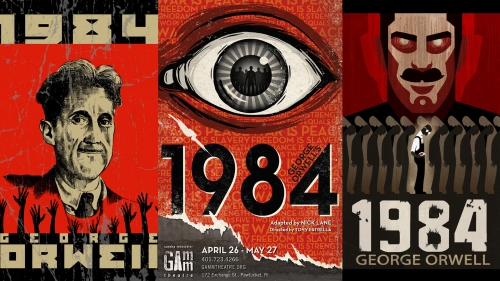
Did the international crises of 1947 and 1948 leave their mark on the writing of Nineteen Eighty-Four? I’ve spent a lot of time on this question, and so far as I can tell, the answer is – yes; but only obliquely. And George Orwell may not even have been conscious of the fact.
A couple of months into writing the first draft of the novel, he paused to do an article for the Partisan Review. This was one of an ongoing series by several authors called “The Future of Socialism.” Orwell’s contribution for the July-August 1947 issue was titled “Toward European Unity,” and it includes some recognizable themes that were finding their way into Nineteen Eighty-Four.
Actually, the piece itself doesn’t have much to say about socialism. (One of Orwell’s last essays was on Oscar Wilde’s notion of “socialism.” Like Wilde, Orwell thought it all sounded like a nice idea, but he was one of those socialists who never read Marx.) As for “European unity,” Orwell saw only dim prospects. He was much more interested in rather whimsical speculation about how the world could survive after the Third World War started and the “atomic bombs” dropped. His least favorite outcome happened to be the background to the world of Nineteen Eighty-Four. (I’ll excerpt these at the end.)
But there’s a throwaway line in “Toward European Unity” that might be an eye-opener for people today, though it was a reasonably sound, matter-of-fact assessment of the political scene in mid-1947:
. . . American pressure is an important factor because it can be exerted most easily on Britain, the one country in Europe which is outside the Russian orbit.[1] [2]
The hard fact here is that most of western Europe was slipping into the Soviet grip. Communist parties in France and Italy were getting ready to seize power, with the Communists already the largest party in the French assembly. The USSR was maneuvering to take control of the 1945 rump of Germany, by first uniting the four zones – British, American, French, Soviet – under a Sovietized “neutral” government. Meanwhile, Europe’s post-war economic recovery had stalled and backslid, largely because of the destruction of German mines and industry, and punitive reparations and deindustrialization under the still-operative Morgenthau Plan.[2] [3] France and Britain were effectively bankrupt, living on loans and remittances from the US.[3] [4]
The stage, then, was set for the wave of revolutions, wars, and brutal regimes that form the backstory to Nineteen Eighty-Four. More memorably, these conditions are the background to the American foreign policy initiatives remembered as the Truman Doctrine and the Marshall Plan. For most people, these things are mainly recalled as chapter subheadings in high school texts, or even as examples of insuperably dull, indecipherable topics best treated as punchlines to jokes. (The writer Tobias Wolff once wrote a cruelly humorous short story in which the running gag was about a job-seeking professor forced to give a lecture with someone else’s dreary paper on the Marshall Plan.)[4] [5]
What is generally forgotten these days – or more likely, unknown – is the worldwide campaign of agitprop and civil unrest that the Soviet Union mounted in 1947-48 in retaliation for the Marshall Plan. You really need to go back to the newspapers of the era to see how far and wide was the campaign’s reach. Throughout western Europe, there were riots, work stoppages, mine floodings, and anti-Marshall Plan posters, films, flyers, and newspapers. Factories and wharves were shut down throughout France for much of late 1947; in Italy, the Communists held a sit-down strike in the Parliament. Dockworkers on the Continent, in Britain, and even in Australia, New Zealand, and North America refused to unload ships.
In America, the most memorable efflorescence of the anti-Marshall Plan drive (though seldom remembered as such) was the strange presidential campaign of ex-Vice President Henry Wallace. Wallace and other “Progressives” (for such he called his party) aimed to punish President Truman and pro-Marshall Plan Democrats by splitting their vote in 1948. They did not succeed, as it rapidly became clear that these efforts were directed by the Soviet Central Committee and the Communist Party of the USA, operating through labor unions, particularly the CIO. In 1947 and 1948, Dwight Macdonald (Orwell’s friend and political soulmate) devoted many pages of his magazine, Politics, to exposés of the Stalinist machinations behind the Wallace campaign.[5] [6]
In that same paragraph from the Partisan Review piece by Orwell that I quoted above, there’s a curious and most un-Orwellian comment about U.S. trade:
If the United States remains capitalist, and especially if it needs markets for exports, it cannot regard a Socialist Europe with a friendly eye.[6] [7]
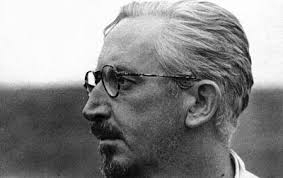
Dwight Macdonald
What exactly is he saying here? In all his writings, Orwell seldom, if ever, affects interest in such peripheral economic matters as trade policy. Yet here he is, professing to suspect that the “capitalist” US has a great need to expand its overseas (specifically European) markets. Now, in the late 1940s American exports worldwide comprised about five percent of its GNP.[7] [8] That is, most of the GNP was from domestic consumption, and need for exports would have been negligible.
Knowing when Orwell wrote this, in about June 1947, gives us a clue as to where he got this funny notion. Apparently he’d just read something in the papers pertaining to the newly-proposed Marshall Plan. I doubt Orwell knew where the story originated, or detected its ring of Marxian economics; but that is essentially what it was. Right about this time, the Soviet Foreign Minister, Vyacheslav Molotov, was putting out a tale that the European Recovery Plan, aka the Marshall Plan, had an ulterior motive: to forestall an inevitable and approaching depression due to American war debts and its unsold “surplus goods.”
Shortly after Secretary of State George Marshall gave his so-called “Marshall Plan Speech” (at Harvard’s commencement on June 5, 1947), Molotov had asked the top Soviet economist, Yevgeny “Jeno” Varga,[8] [9] to provide a report on the American economy. Specifically, he wanted Varga to “assess motives” behind this proposed aid plan. Varga came back with a suitably dire forecast: the US was facing a depression nearly the size of the Great Depression of the 1930s, with ten million unemployed and a twenty percent drop in GNP.
Per Varga, the apparent rationale for the Marshall Plan was that by lending billions in credits to Europe, the US could get rid of its “surplus goods” (as it was suffering from a “crisis of overproduction”). It could thereby avoid the forthcoming economic collapse – temporarily, at least – even though the countries to which it was “lending” credits were themselves bankrupt. Varga most likely did not believe what he wrote here. In 1946, he had written an in-depth economic study putting forth the thesis that because of changes in the American economy and government, it was no longer subject to the classic boom-and-bust “Crisis of Capitalism.” But now he was simply telling Molotov what Molotov wanted to hear.[9] [10]
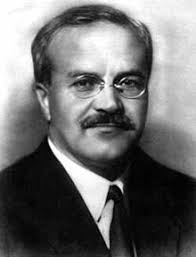 And so, when Molotov went to Paris to meet the British and French foreign ministers at a preliminary conference on the Marshall Plan (this is still June 1947), he told them he believed the proposed Plan was really conceived in America’s own interest, “to enlarge their foreign markets, especially in view of the approaching crisis.” To no one’s great surprise, Molotov soon announced that neither the USSR nor any of the Communist satellite states would be participating in the European Recovery Plan.
With the passing months, Soviet propaganda evolved somewhat. In September, Molotov’s deputy and eventual successor, Andrei Vyshinsky, told the UN General Assembly that “[t]he United States . . . counted on making . . . countries directly dependent on the interests of American monopolies, which are striving to avert the approaching depression by an accelerated export of commodities and capital to Europe.”[10] [11] This soon turned into a more pointed accusation, that the US was setting up a “Western Bloc” as an economic and political beachhead. Soviet spymaster Pavel Sudoplatov explained that “the goal of the Marshall Plan was to ensure American economic domination of Europe.”[11] [12]
What were these “surplus goods” that the US supposedly wanted to offload onto Europe via the Marshall Plan? Mostly, they were the same goods that America had been providing all along: grain and fuel, primarily coal. (While western Europe had endless reserves of coal, the mines in Germany had been so damaged that Europe suffered from severe coal shortages for the first few years after the war.) When European countries bought these with Marshall credits beginning in 1948, it freed up their own capital for “recovery” uses. And, pace Varga and Molotov, America was not disposing of these goods in order to forestall an economic crisis. There wasn’t even a recession in 1947 or 1948; just a mild downturn that came in 1949.
But the notion of “surplus goods” and its Marxian companion, the “crisis of overproduction,” found their way into an obscure corner of Nineteen Eighty-Four. They provide the stated (though rather illogical and unnecessary) rationale for eternal war, as set forth in The Theory and Practice of Oligarchical Collectivism:
The primary aim of modern warfare (in accordance with the principles of doublethink, this aim is simultaneously recognized and not recognized by the directing brains of the Inner Party) is to use up the products of the machine without raising the general standard of living. Ever since the end of the nineteenth century, the problem of what to do with the surplus of consumption goods has been latent in industrial society. . . . The war, therefore, if we judge it by the standards of previous wars, is merely an imposture. It is like the battles between certain ruminant animals whose horns are set at such an angle that they are incapable of hurting one another. But though it is unreal it is not meaningless. It eats up the surplus of consumable goods, and it helps to preserve the special mental atmosphere that a hierarchical society needs.[12] [13]
It’s all a joke, of course: Oligarchical Collectivism is not a serious treatise even within its fictive realm. It’s something that O’Brien and his colleagues concocted (or so O’Brien tells us) as a plausible excuse for a revolutionary tract that the non-existent Goldstein might write. It puts forth “the problem of what to do with the surplus of consumption goods” as though that were a real conundrum, one that can only be solved by constant pseudo-warfare.
It would have been quite enough just to say fake wars provide “the special mental atmosphere that a hierarchical society needs.” But Orwell apparently had export markets and “surplus goods” on his mind, so he threw those in as well.
* * *
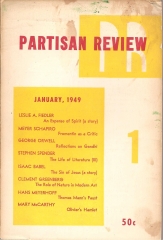 This tortured, unnecessary explanation ties up nicely with the alternative predictions Orwell offers in his Partisan Review article. As I said, he doesn’t really say much about socialism, and he doubts European unity, but he puts an awful lot of (overly) complex thought into how it’s all going to end. He’s writing this while he’s mainly focused on Nineteen Eighty-Four, so we end up with three James Burnham-esque scenarios of what may face us when the bombs start a-flying:
As far as I can see, there are three possibilities ahead of us:
-
- That the Americans will decide to use the atomic bomb while they have it and the Russians haven’t. This would solve nothing. It would do away with the particular danger that is now presented by the U.S.S.R., but would lead to the rise of new empires, fresh rivalries, more wars, more atomic bombs, etc. In any case this is, I think, the least likely outcome of the three . . .
- That the present ‘cold war’ will continue until the U.S.S.R., and several other countries, have atomic bombs as well. Then there will only be a short breathing-space before whizz! go the rockets, wallop! go the bombs, and the industrial centres of the world are wiped out, probably beyond repair . . . Conceivably this is a desirable outcome, but obviously it has nothing to do with Socialism.
- That the fear inspired by the atomic bomb and other weapons yet to come will be so great that everyone will refrain from using them. This seems to me the worst possibility of all. It would mean the division of the world among two or three vast super-states, unable to conquer one another and unable to be overthrown by any internal rebellion. In all probability their structure would be hierarchic, with a semi-divine caste at the top and outright slavery at the bottom, and the crushing out of liberty would exceed anything that the world has yet seen . . .[13] [14]
Notes
[1] [15] George Orwell, “Toward European Unity,” Partisan Review (New York), July-August 1947, Vol. 14, No. 4.
[2] [16] One sometimes hears that the Morgenthau Plan for the starvation and pastoralization of Germany was floated as an idea but sternly rejected. Actually, as Joint Chiefs of Staff directive No. 1067 [17], it was the basis of American occupation policy, effective from April 1945 until July 1947. Both the US and the Soviet Union dismantled German industrial plants in this period.
[3] [18] There are countless sources for this subject, but Benn Steil’s 2018 book, The Marshall Plan (New York: Simon & Schuster, 2018), gives a detailed overview of the economic crisis.
[4] [19] Tobias Wolff, “In the Garden of the North American Martyrs,” originally published in Antaeus (New York), Spring 1980.
[5] [20] Macdonald’s most thorough examination of Wallace and company was in the Summer 1948 issue of Politics.
[6] [21] Orwell, “Toward European Unity.”
[7] [22] See chart, The Hamilton Project [23].
[8] [24] Jeno Varga was a Hungarian Jew (his real name was Eugen Weisz) who had been in the Hungarian Communist Party since the Béla Kun days in 1919. After this, he fled to the USSR and became Stalin’s longtime economic adviser. Like Molotov in the late 1940s, Varga was about to fall out of favor.
[9] [25] Scott D. Parrish & Mikhail M. Narinsky, “New Evidence on the Soviet Rejection of the Marshall Plan, 1947 [26]” (Washington, DC: Wilson Center), 1994.
[10] [27] Andrei Vyshkinsky’s speech [28] at the United Nations, September 1947.
[11] [29] Steil, The Marshall Plan.
[12] [30] George Orwell, Nineteen Eighty-Four, 1949, Part II.
[13] [31] Orwell, “Toward European Unity.”

 del.icio.us
 Digg
Digg Facebook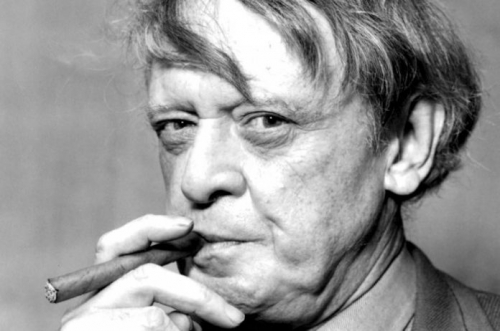
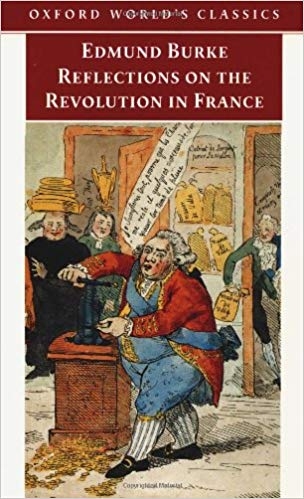 Mais en 89 Burke sent que cette fois la France ne se relèvera pas. Il en donne les raisons, avant Chateaubriand, Tocqueville, Balzac ou Bernanos :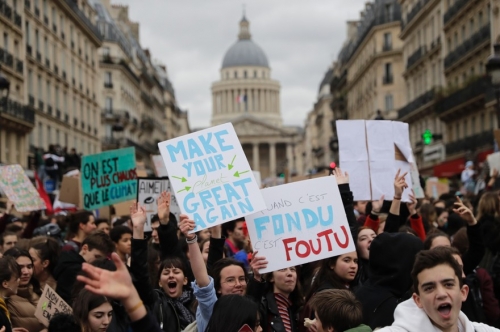

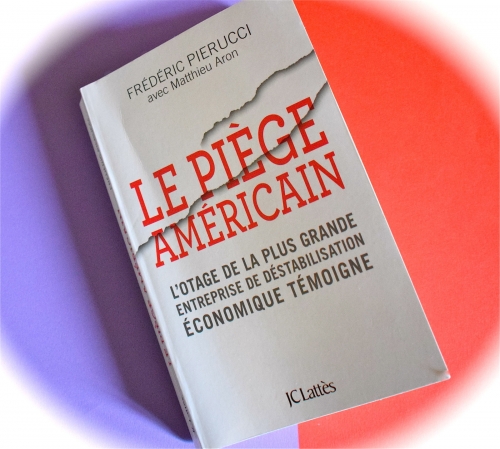







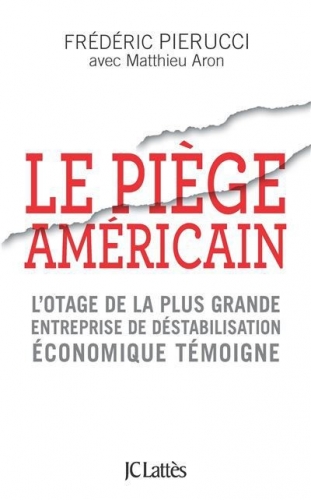 Ce patron monde de la division chaudière d’Alstom basé à Singapour est arrêté par le FBI dès l’arrivée de son avion de ligne à New York, le 14 avril 2013. Accusé de corruption d’élus indonésiens afin d’obtenir la construction d’une centrale électrique à Tarahan sur l’île de Sumatra, il pâtit du Foreign Corrupt Practices Act (FCPA), une loi qui permet depuis 1977 aux autorités étatsuniennes et en particulier au ministère fédéral de la Justice – ou DOJ (Department of Justice) – de poursuivre n’importe qui n’importe où pour n’importe quoi. En 1998, le Congrès lui a conféré une valeur d’extraterritorialité. Cette loi dispose en outre des effets pernicieux du Patriot Act, de l’espionnage numérique généralisé orchestré par la NSA et encourage le FBI à placer au sein même des compagnies étrangères suspectées, souvent en concurrence féroce avec des firmes yankees, un mouchard infiltré prêt à tout balancer, puis une fois les entreprises condamnées, un « monitor », c’est-à-dire « un contrôleur qui rapporte au DOJ durant une période de trois ans (p. 80) ». Cette inacceptable ingérence résulte d’une conception hégémonique des activités économiques étatsuniennes. « Les autorités américaines considèrent que le moindre lien avec les États-Unis, cotation en bourse, échanges commerciaux en dollars, utilisation d’une boîte mail américaine, les autorise à agir (p. 77). » Le FCPA constitue donc une arme redoutable de la guerre économique et juridique que mène Washington au reste du monde. Par exemple, si le DOJ s’attaque aux sociétés pharmaceutiques, c’est parce qu’il considère les médecins étrangers comme des agents publics exerçant une délégation de service public !






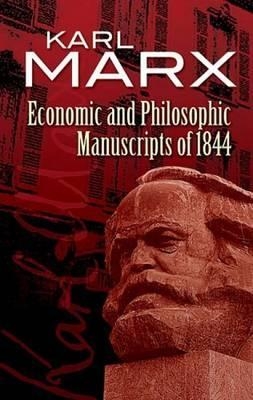 Et Marx commente et explique les passages cités :
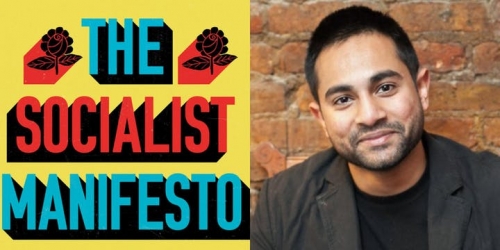
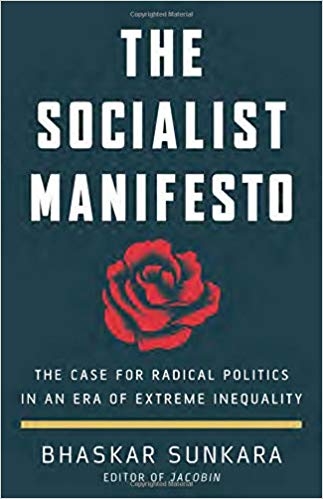 Through most of the book, the arguments are anchored in sturdy common sense, however much one might contest a point or emphasis here and there. On “Third World socialism,” for example, whether in China or Africa or the Americas, Sunkara is right that it turned Marxism on its head, so to speak: “revolutionaries embraced socialism as a path to modernity and national liberation. Adapting a theory that was built around advanced capitalism and an industrial proletariat, they struggled to find ‘substitute proletariats’—from peasants to junior military officers to deprived underclasses—to achieve these ends.” None of it was socialism in the Marxist sense, as coming from the breakdown (literal or not) of capitalism and signifying the liberation of humanity from alienated and exploitative production. It was a “socialism” subordinated to nationalistic ends.



 The Seven Principles
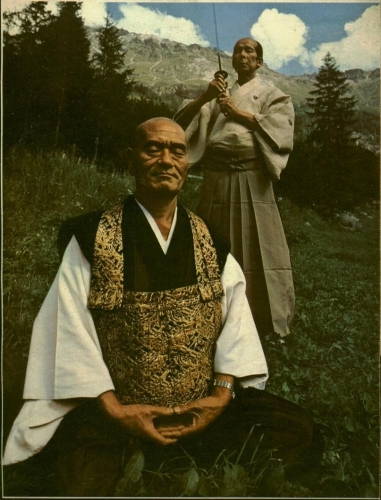
 No one is normal today. Everyone is a bit mad, with their mind working all the time: they see the world in a narrow, impoverished way. They are consumed by their ego. They think they see, but they are wrong: they are projecting their madness, their world, onto the world. No lucidity, no wisdom in that! That is why Socrates, like Buddha, like all sages, first says, “Know yourself and you will know the universe.” That is the spirit of traditional Zen and Bushido! For this, the observation of one’s behavior is very important. Behavior influences consciousness. With the right behavior, there is the right consciousness. Our attitude here, now, influences the entire environment: our words, our gestures, our bearings, all this influences what happens around us and within us. The actions of every moment, of every day, must be right. The behavior in the dojo will spill over in your daily life. Every gesture is important! How to eat, how to get dressed, how to wash, to go to the toilet, how to put things away, how to behave with others, with one’s family, one’s wife, how to work, how to be completely in each gesture. One must not dream one’s life! But one must be completely in everything we do. This is training in the kata.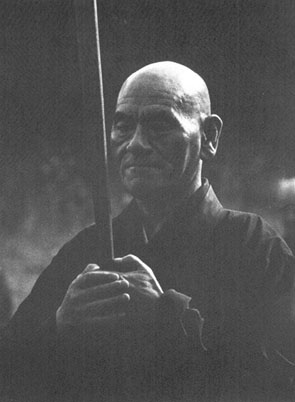

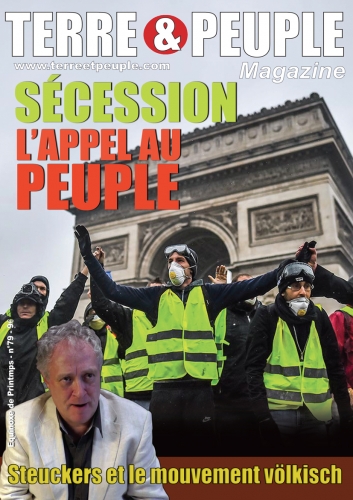
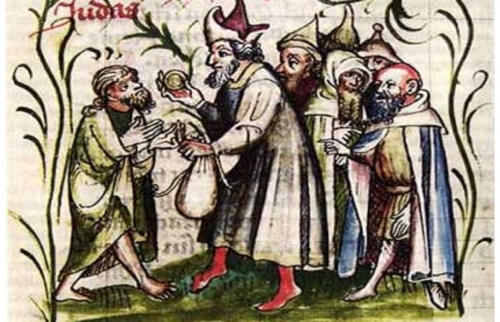
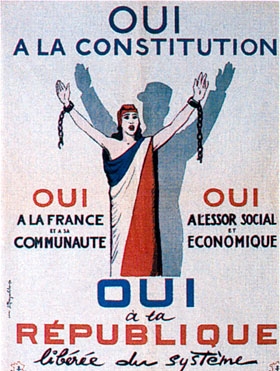 De Gaulle, créant la Ve République, érige le référendum en principe, lequel se retournera contre lui en 1969. Le référendum d’initiative populaire, très présent en Suisse, est aujourd’hui revendiqué, sous l’étiquette RIC, par les Gilets Jaunes. Ce soulèvement évoque les jacqueries paysannes médiévales et les Rebeynes lyonnaises. En 1436, à Lyon, les sauvages du baz estat se sont assemblés de leur propre autorité pour imposer dix élus commis par le peuple au Consulat de la ville, afin de faire payer les coupables de fraude fiscale. La Grande Rebeyne de 1529 vise la gestion municipale qui favorise les marchands. Ceux-ci contraignent les artisans par la concurrence des étrangers et détruisent la commune. On refuse aux métiers des jurandes pour organiser leur solidarité. Alors que le luxe des riches s’étale, le pouvoir d’achat du peuple baisse jusqu’à la disette. Au mois d’avril 1529, des placards séditieux signés le Povre apparaissent aux carrefours, appelant à punir les coupables et leurs complices du Consulat. Ils fixent rendez-vous au peuple le 25 avril au couvent des Cordeliers. S’y retrouve une multitude de ‘menu peuple, povres mesnagers’, qui pille le couvent et ensuite les demeures des ‘gros accapareurs, bourgeois, gens riches et apparents de la ville’. Le consulat fait appel au roi qui envoie cent gentilhommes ordinaires. Dans les jours suivants, on dresse onze potences pour les meneurs. Lyon connaîtra par la suite encore bien d’autres révoltes résultant de l’opposition entre le capital et le travail pour déboucher, au XIXe siècle, sur les insurrections des Canuts. Mais le pouvoir royal a tôt compris la volonté du peuple d’être entendu lorsqu’il est victime des manœuvres des ‘gros’. C’est la raison des Etats généraux.
 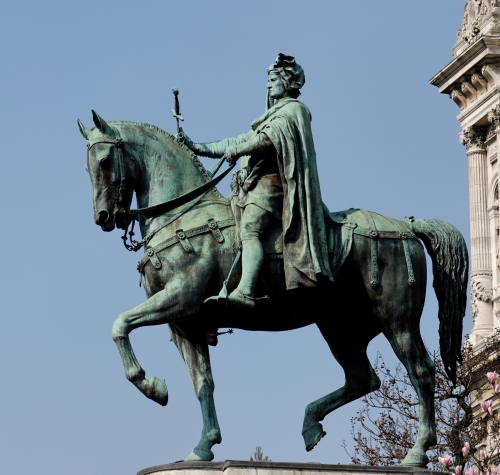 Dès le XIIe siècle, les seigneurs féodaux et les dignitaires ecclésiastiques ne suffisent plus. La bourgeoisie urbaine, enrichie et instruite, veut se faire entendre, de même que la petite noblesse et le bas clergé. Ainsi naît une représentation du peuple selon les trois ordres de la tripartition fonctionnelle des Indo-Européens, mais qui fait peu de cas des artisans et des ouvriers et des masses paysannes. Aux XIVe et XVe siècles, le pouvoir royal s’appuie souvent sur les états, lesquels sont parfois tentés de s’imposer, notamment pour contrôler la perception des impôts et l’utilisation des recettes. Dans les années 1355-58, les états de langue d’oïl sont des foyers d’agitation incessante, notamment de la part d’Etienne Marcel, riche prévôt des marchands parisiens, qui profite de la minorité du dauphin Charles mais sera finalement tué. Le dauphin accorde habilement un pardon général et liquide les états généraux. Quand, en 1789, Louis XVI convoque les états généraux, chaque bailliage rédige son cahier de doléances : il n’y a pas d’exemple dans l’histoire d’une pareille consultation écrite de tout un peuple. La nuit du 4 août, alors qu’une ‘grande peur’ se propage dans les campagnes, la Constituante décide l’abolition des privilèges fiscaux et la condamnation de tout un système. Est-ce à envisager aujourd’hui ?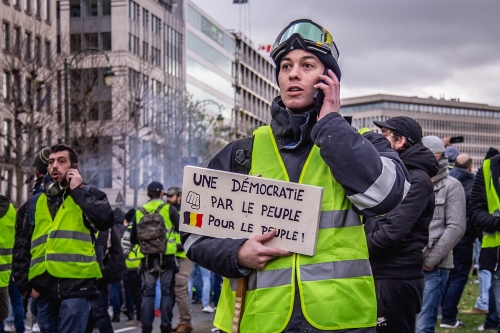

 Thierry Durolle
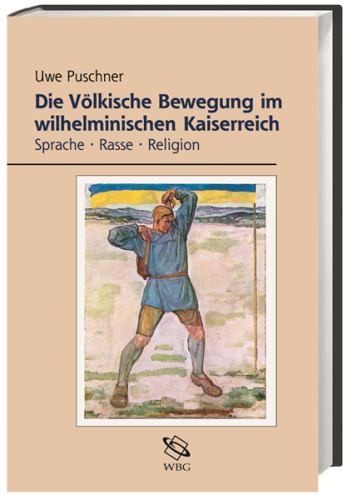
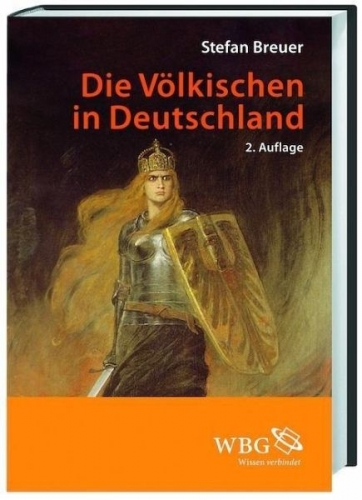 Robert Steuckers a évoqué le mouvement de la « Lebensreform », adventice au filon folciste et qui comporte nombre de ramifications, dont le mouvement colonial, le mouvement racialiste-hygiéniste, le mouvement eugéniste et les mouvements de jeunesse dont les Wandervögel, le végétarisme et le naturisme et un féminisme issu des religiosités nordiques pré-chrétiennes qui n’a rien de commun avec les Femens. Le völkisch peut passer pour un écologiste avant la lettre, si on ne perd pas de vue qu’il défend à l’origine la petite paysannerie contre la ploutocratie financière. Mais la défense des terroirs est aussi religieuse, réaction romantique au mécanicisme des Lumières. Elle regarde au contraire les faits de nature comme une croissance chaque fois originale. Alors que le mouvement socialiste soutient l’industrialisation et considère la protection de la nature comme un colifichet de luxe. Le mouvement bio-régionaliste des terroirs du Heimatschutz est politiquement indépendant, bien que dans l’Allemagne de Guillaume II les frontières soient poreuses entre le culturel, le social et le politique. Pour ce qui est de la spiritualité, les folcistes sont pénétrés de l’idée que la tradition germanique et européenne est immémoriale et qu’elle a été refoulée par la modernité. Ayant lu Lagarde et Nietzsche, le pasteur Bonus est enthousiasmé par la mythologie germanique et scandinave et veut germaniser le christianisme. Le dominicain rhénan Maître Eckhart (1260-1327), incarnation de la pensée germanique persécutée, a exercé une influence spirituelle majeure. Sur le plan socio-économique, le folcisme, né de la grande crise économique, bancaire et boursière du laisser faire et laisser passer, veut une protection des producteurs, paysannerie et artisans, posés comme les meilleurs, contre les spéculateurs, lie du peuple, contre les parasitaires, parmi lesquels les praticiens du droit, jugés étrangers au réel, les fonctionnaires, les intellocrates et journalistes et les boursicoteurs. Seules les strates des secteurs primaire et secondaire seraient représentées dans les assemblées. Dans sa révolution conservatrice, Armin Mohler oppose la pensée völkisch au nationalisme soldatique des frères Jünger, qui escomptaient une guerre héroïque et loyale, alors qu’elle est désormais une guerre des matériels, la perfection de la technique acculant à une décélération, pour préserver les rythmes lents de la nature. Le caractère extrême de la défaite de 1918 va susciter une virulence du militantisme, un radicalisme folciste de la part de plusieurs figures marquantes du futur mational-socialisme. La crise de 2008, dont les banquiers sont responsables, rend actuel l’héritage folciste.
 LE FIGARO. -
  Pourtant, les pays de l'Est, notamment la Pologne, ne jurent toujours que par elle...
 Les méthodes de travail du Parlement dit européen s’approchent de la gouvernance du roi Ubu. Outre le rôle majeur, reconnu et officiel des groupes d’influence et/ou de pression (les lobbies), le Parlement de Bruxelles – Strasbourg exerce une co-décision avec la Commission européenne. Il peut même la renverser comme ce fut le cas en 1999 avec la Commission du trilatéraliste luxembourgeois Jacques Santer. En pratique, les parlementaires votent à la chaîne des directives et n’en débattent qu’une fois le scrutin clos. Cette originalité fonctionnelle confirme l’incongruité permanente que s’assigne ce Parlement fictif qui décerne chaque année un prix Sakharov (et non Alexandre Soljenitsyne !) à un quelconque « dissident » quelque part dans le monde entier. Le parlementaire européen se voit en paragon moral et bienfaisant de la planète entière. Il se détourne en revanche du sort des véritables dissidents de l’Occident, à savoir l’Australien Julian Assange, l’Étatsunien Edward Snowden, l’Allemand Horst Mahler, le Breton Boris Le Lay ou les Français Dieudonné, Alain Soral, Vincent Reynouard et Hervé Ryssen, tous persécutés, harcelés, condamnés, voire emprisonnés, pour « crimes » d’opinion.
 Le programme Erasmus facilite la formation des étudiants dans d’autres universités européennes. Il stimule un indéniable esprit européen à l’instar de leurs très lointains prédécesseurs qui traversaient toute la Chrétienté médiévale. Il incite à la formation de familles inter-européennes. En 2002, Cédric Klapisch réalisa L’Auberge espagnole, un film bobo autour du quotidien et de la vie sentimentale à Barcelone d’un Italien, d’une Anglaise, d’un Danois, d’un Allemand, d’un Français et d’une Belge. Derrière sa miéverie, ce film relança l’engouement des jeunes Français pour cet excellent programme universitaire. La citoyenneté européenne et Erasmus constituent deux exemples tangibles qui font avancer l’idée européenne de quelques centimètres. Il reste néanmoins plus d’un millier de kilomètres à parcourir !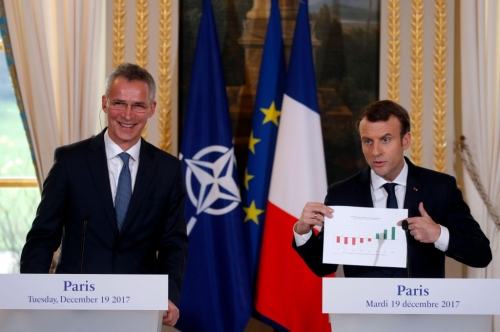
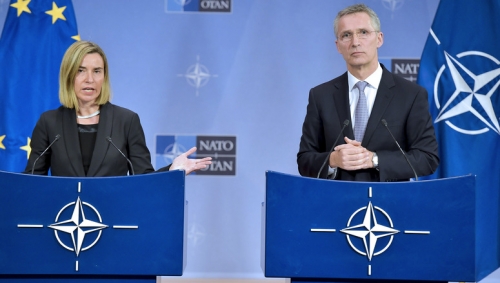
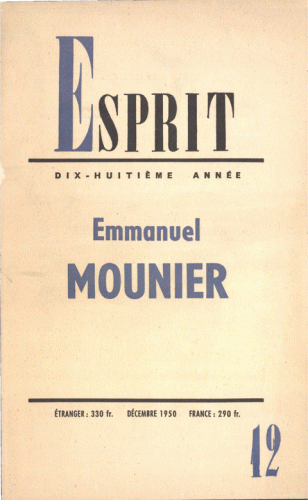 Président populiste (ou contre-populiste) élu en mai 2017 sur une forte vague « dégagiste », Emmanuel Macron défend souvent et avec une sincérité certaine le concept de « souveraineté européenne ». Son emploi à la banque Rothschild et ses fonctions successives de secrétaire général-adjoint à la présidence de la République et de ministre de l’Économie font oublier qu’il collabora à Esprit. Cette revue proche de la deuxième gauche chrétienne fut fondée en 1932 par le philosophe personnaliste Emmanuel Mounier, figure de l’aile « gauche » des non-conformistes des années 1930. Débattant régulièrement avec les fédéralistes intégraux de L’Ordre nouveau comme Denis de Rougemont, Mounier participa un temps à l’école des cadres de la Révolution nationale d’Uriage. Or, dès 1946, bien des inscrits aux cours d’Uriage, après un passage dans les maquis de la Résistance, s’installèrent dans les cabinets ministériels et contribuèrent autour de l’anglomane Jean Monnet au lancement des premiers traités européens. La Révolution nationale célébrait la « communauté française ». Les anciens promus d’Uriage célébreraient, eux, les « Communautés européennes » (7). Les définitions sémantiques s’adaptent et changent en suivant l’échelle géographique…
 Les objections qu’avance Pierre de Villiers n’en sont pas moins justifiées. Peut-on mourir pour l’euro, les fonctionnaires de la Commission de Bruxelles et L’hymne à la Joie ? La réponse immédiate est bien sûr négative. Mais faudrait-il, le cas échéant, se sacrifier pour Emmanuel Macron, François Hollande ou Nicolas Sarközy, voire pour les fameuses valeurs républicaines françaises, soit le mariage pour tous, la lutte contre toutes les discriminations possibles et imaginables, l’égalitarisme total, le féminisme outrancier et le Diktat de « Big Other » ? Non bien sûr ! Notre loyauté va à notre vision du monde, pas aux drapeaux qui étouffent nos identités organiques.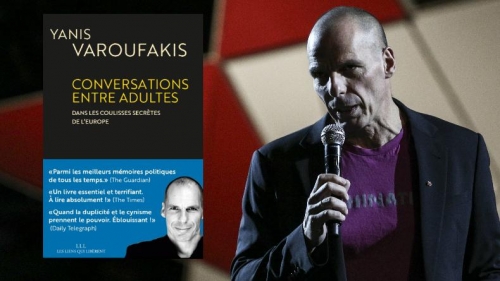
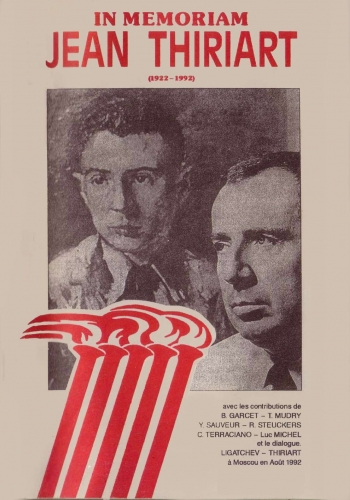 Seule la civilisation européenne peut réunir de grands orchestres polyphoniques. Au début du XIIIe siècle apparaît l’« école musicale de Notre-Dame » à Paris avec Léonin et Pérotin le Grand. C’est la naissance de la polyphonie, de l’association simultanée de plusieurs voix indépendantes. La polyphonie est la seule capable de s’approcher du divin par ses compositions musicales. Par conséquent, si l’Europe ne relève pas le fantastique défi que lui impose l’histoire, nos compatriotes vivant sur un continent devenu un protectorat de forces extérieures et un haut lieu touristique muséal se demanderont en de rares moments de lucidité et avec regret : « Mais quelle Europe fallait-il construire ? S’agissait-il d’une palingénésie de l’Empire romain germanique recouvrant ses “ droits ” sur la France et les autres anciens royaumes ? S’agissait-il d’un nouveau mouvement des peuples pour dépasser leurs nationalités et s’intégrer à une communauté souveraine ou, plus vulgairement, d’une coalition entre de grandes firmes bancaires, industrielles ou commerciales ? (37) » Clio a souri aux Européens qui, frileux et craintifs, ont détourné leur regard.