Ok

En poursuivant votre navigation sur ce site, vous acceptez l'utilisation de cookies. Ces derniers assurent le bon fonctionnement de nos services. En savoir plus.

lundi, 03 février 2020

Coomaraswamy et l’éternel péril occidental

coomaraswamy.jpg

Coomaraswamy et l’éternel péril occidental

Les Carnets de Nicolas Bonnal

Créature instable et périlleuse, l’occident menace le monde en se menaçant lui-même. Il a tout détruit avec le capital et les bons sentiments qui vont avec. L’impérialisme américain en phase terminale mais hystérique veut exterminer russes, chinois, iraniens et sanctionner ce qui lui résiste. Les européens (petit cap de l’Asie ou de l’Amérique ?) suivent extatiques ou éteints.  En même temps l’occident s’autodétruit rageusement à coups d’oligarchie, d’écologie, de féminisme, d’antiracisme et d’humanitarisme ; il contaminera le reste du monde comme toujours.

Golem dérangé ou marionnette folle, on ne l’arrêtera pas comme cela, cet occident. Sa matrice garde son pouvoir d’attraction étrange en plein Kali-Yuga : rappelons Spengler pour qui le triomphe de l’empire romain était déjà celui du pas grand-chose sur le vide. Ceux qui applaudissent le crépuscule américain oublient que l’on navigue dans la matrice américaine – dans un marécage de signes qui aura tout noyé, traditions, culture, spiritualités.

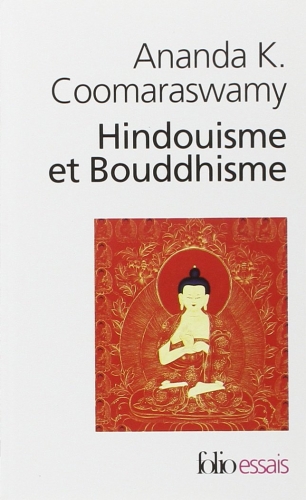
61TKv-9h3iL.jpgOn sait ce que Guénon pensait de l’occident et de sa mission civilisatrice. On va rappeler le grand hindouiste de Ceylan Coomaraswamy (s’il voyait ce qu’on a fait de son île…) qui écrivait vers 1945 :
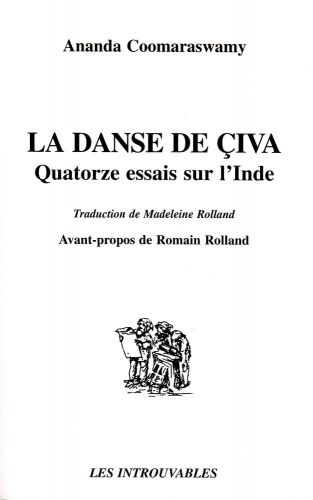
« Parmi les forces qui font obstacle à une synthèse culturelle ou, pour mieux dire, à une entente commune indispensable en vue d’une coopération, les plus grandes sont celles de l’ignorance et du parti pris. L’ignorance et le parti pris sont à la base de la naïve présomption d’une «mission civilisatrice». Celle-ci apparaît, aux yeux des peuples «arriérés», contre qui elle est dirigée et dont elle se propose de détruire les cultures, comme une simple impertinence et une preuve du provincialisme de l’Occident moderne. »

Mais il ne faut pas mépriser le provincialisme américain ou occidental. Car il est résilient, insatiable, protéiforme, infatigable, et il a depuis tout corrompu avec son confort et sa propagande. Coomaraswamy écrivait il y a presque un siècle… que de progrès accomplis depuis !

Et Coomaraswamy ajoute sur l’arrogance du blanc :

« A vrai dire, si l’on veut qu’il y ait sur terre un peu plus de bonne volonté, l’homme blanc devra réaliser qu’il doit vivre dans un monde peuplé en grande partie de gens de couleur (et «de couleur» signifie habituellement, pour lui, «arriéré», c’est-à-dire différent de lui-même). Et le chrétien devra réaliser qu’il vit dans un monde à majorité non chrétienne. Il faudra que chacun prenne conscience de ces faits et les accepte, sans indignation ni regret. »

Comme on sait, l’occident est aujourd’hui suffisamment civilisateur pour vouloir effacer et le reste de blancs et le reste de christianisme (le fils de Coomaraswamy lamenta le concile antichrétien de Vatican II). Coomaraswamy rappelle ce complexe de maître d’école (Chesterton parlait de crèche féministe) :

« Avant même de pouvoir songer à un gouvernement mondial, il nous faut des citoyens du monde, qui puissent rencontrer leurs concitoyens sans se sentir gênés, comme entre gentlemen, et non en soi-disant maîtres d’école rencontrant des élèves que l’on instruit «obligatoirement» même si c’est aussi «librement». Il n’y a plus place dans le monde pour la grenouille dans le puits; elle ne prétend juger les autres que par sa propre expérience et ses propres habitudes. »

Et de se montrer polémique sur les réactions à cet occident, à une époque où l’on compte sur l’islam :

« Nous avons ainsi fini par réaliser que, comme l’a dit, il y a peu, El Glaoui, le pacha de Marrakech, «le monde musulman ne veut pas de l’inimaginable monde américain ou de son incroyable style de vie. Nous (les musulmans) voulons le monde du Qoran», et il en est de même, mutatis mutandis, pour la majorité des Orientaux. Cette majorité comprend non seulement tous ceux qui sont encore «cultivés et illettrés», mais aussi une fraction, bien plus importante qu’on ne le croit, de ceux qui ont passé des années à vivre et à étudier en Occident, car c’est parmi ceux-ci qu’il est possible de trouver bon nombre des «réactionnaires» les plus convaincus. Parfois, « plus nous voyons ce qu’est la démocratie et plus nous estimons la monarchie»; plus nous voyons ce qu’est l’« égalité », et moins nous admirons «ce monstre de la croissance moderne, l’État commercialo-financier» dans lequel la majorité vit de ses « jobs», où la dignité d’une vocation ou d’une profession est réservée au très petit nombre et où, comme l’écrit Éric Gill, «d’un côté, il y a l’artiste voué uniquement à s’exprimer, de l’autre l’ouvrier privé de tout “soi” à exprimer». »

Disons-le nûment, l’idéal occidental c’est du point de vue traditionnel le degré zéro de l’humain.

Coomaraswamy ajoute qu’il est bon de résister au commerce :

6700_1425892170.jpg« M. Brailsford objecte que «les seuls obstacles à l’accroissement du commerce intérieur sur une échelle gigantesque sont la pauvreté des villages et l’autarcie qui est propre à leurs plus anciennes traditions... Il existe encore maint village, où les artisans héréditaires, qui servent pour une ration de grains ou quelques arpents de terre franche, tisseront les étoffes dont il aura besoin, forgeront ses houes et tourneront ses pots». Malheureusement, «l’accroissement du commerce intérieur sur une échelle gigantesque » n’est aucunement l’une de nos ambitions principales. Nous tenons encore (avec Philon, De Decalogo, 69) pour vérité patente que l’artisan est de valeur supérieure au produit de son métier, et nous avons conscience que c’est avant tout dans les sociétés industrielles que cette vérité est ignorée. »
Le monde traditionnel est plus « démocratique » (Bernanos et Chesterton l’ont aussi compris, à propos de notre moyen âge des communes et des cités) :

« …le gouvernement traditionnel de l'Inde est bien moins centralisé et bien moins bureaucratique que n’importe quelle forme de gouvernement connue des démocraties modernes. On pourrait même dire que les castes sont la citadelle d’un gouvernement autonome bien plus réel que ce qu’on pourrait réaliser par le décompte de millions de voix prolétaires. Dans une très large mesure, les diverses castes coïncident avec les corps de métier. »

Et de défendre le modèle corporatif (la révolution libératrice supprima comme on sait cent jours fériés et chômés en France) :

« On pourrait dire que si l’Inde ne fut pas, au sens chinois ou islamique, un pays démocratique, elle fut néanmoins la terre aux multiples démocraties, c’est-à-dire aux groupes autonomes maîtrisant pleinement toutes les questions qui sont réellement dans leur compétence, et que peut-être aucun autre pays au monde n’a été mieux formé pour l’autonomie. Mais, comme l’a dit sir George Birdwood, «sous la domination britannique en Inde, l’autorité des corporations s’est nécessairement relâchée»; la nature d’une telle «nécessité» ne supportera guère l’analyse. »

Puis Coomaraswamy décrit l’horreur économique et militariste (et humanitaire, car tout vient avec dans le paquet-cadeau occidental,le bandage avec les bombes, comme dit le capitaine Villard dans le film Apocalypse now) :

« La simple existence de ces grands agrégats prolétariens dont les membres, qui s’exploitent les uns les autres, prolifèrent dans des «capitales» - lesquelles n’ont plus aucun rapport organique avec les corps sociaux sur lesquels elles croissent, mais dépendent des  débouchés mondiaux qui doivent être créés par des «guerres de pacification» et sans cesse stimulés par la «création de nouveaux besoins» au moyen d’une publicité suggestive - est fatale aux sociétés traditionnelles les plus fortement différenciées, dans lesquelles l’individu possède un statut déterminé par sa fonction et, en aucune manière, uniquement par la richesse ou la pauvreté; leur existence ruine automatiquement l’individu dont l’« efficacité » le ravale au niveau de producteur de matières premières, destinées à être transformées dans les usines du vainqueur; et on s’en débarrasse en les vendant à bas prix aux mêmes peuples «arriérés» qui doivent accepter leur quantité annuelle de gadgets, si l’on veut que les affaires prospèrent. »

Guénon aussi perçoit à cette époque que l’orient va craquer bien aidé par les guerres dites mondiales puis par la décolonisation (voyez notre texte sur Burckhardt). 

Puis Coomaraswamy cite le fameux et si peu lu Dr Schweitzer :

« Albert Schweitzer caractérise les conséquences économiques de l’exploitation commerciale (le «commerce mondial»): «Chaque fois que le commerce du bois marche bien, une famine permanente règne dans la région de l’Ogooué.» Lorsque ainsi «le commerce élit domicile dans chaque arbre», les conséquences spirituelles sont encore plus dévastatrices; la «civilisation» peut détruire les âmes aussi bien que les corps de ceux quelle contamine. »

Malheureusement il y a les premiers convertis à la matrice (la jeunesse orientale nage et navigue dedans) :

« Bien entendu, je n’ignore pas qu’il existe une foule d’Orientaux occidentalisés qui sont tout à fait disposés et même impatients de recevoir les dona ferentes de l’industrie sans s’attarder à examiner un seul instant ces «chevaux» donnés… »

A l’époque on résiste dans le cadre de la décolonisation (dont les effets furent pervers) :

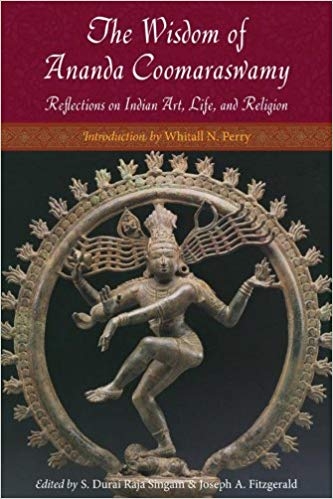
wisdom.jpg« Qu’avez-vous exactement à nous offrir, vous qui êtes si pénétrés de votre «mission civilisatrice»? N’êtes-vous point étonnés «qu’il n’y ait plus de peuple dans toute l’Asie qui ne regarde l’Europe avec crainte et soupçon», comme l’a dit Rabindranath Tagore, ou que nous redoutions la perspective d’une alliance des puissances impérialistes dont la «Charte de l’Atlantique» ne devait pas s’appliquer à l’Inde et ne s’appliquera pas à la Chine si on peut l’éviter? »
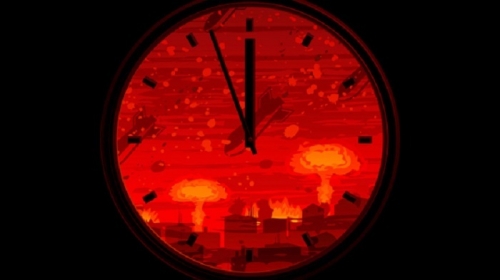
Depuis on a progressé et tout a été balayé ou presque, même quand on prétend résister au nom du monde soi-disant multipolaire. Ni la Russie ni aucun pays oriental (pauvre Corée du Nord…) ne proposent de modèle alternatif. La Chine est bien compliquée – et combien peu attirante. Quant à Cuba ou au Venezuela…

Un peu de Debord pour compléter le maître, car le monde des années 2020 (ou 1980) est certainement plus effarant que celui des années quarante, hors-zone de guerre occidentale :

« Hormis un héritage encore important, mais destiné à se réduire toujours, de livres et de bâtiments anciens, qui du reste sont de plus en plus souvent sélectionnés et mis en perspective selon les convenances du spectacle, il n’existe plus rien, dans la culture et dans la nature, qui n’ait été transformé, et pollué, selon les moyens et les intérêts de l’industrie moderne. »

Et Debord de dénoncer justement les « inconséquents » qui croient que quelque chose du monde ancien a (ou aurait pu) subsisté :

« Non seulement on fait croire aux assujettis qu’ils sont encore, pour l’essentiel, dans un monde que l’on a fait disparaître, mais les gouvernants eux-mêmes souffrent parfois de l’inconséquence de s’y croire encore par quelques côtés. »

Lucien Cerise conclura logiquement :

« Pour Baudrillard, la véritable apocalypse n’était pas la fin réelle du monde, sa fin physique, matérielle, assumée, mais son unification dans ce qu’il appelait le « mondial », ce que l’on appelle aujourd’hui le mondialisme, et qui signait la vraie fin, le simulacre ultime, le « crime parfait », c’est-à-dire la fin niant qu’elle est la fin, la fin non assumée, donnant l’illusion que ça continue. La Matrice, comme dans le film, si vous voulez. »

Sources 

Ananda K. Coomaraswamy, Les illusions de la démocratie, in suis-je le gardien de mon frère (the bugbear of literacy), Pardes.

Lucien Cerise, gouverner par le chaos

Debord – Commentaires

Jean Baudrillard – La guerre du golfe n’a pas eu lieu (Galilée)

jeudi, 30 janvier 2020

Les signes de la Fin des Temps

ob_bebde0_apoc.jpg

Les signes de la Fin des Temps


Les principaux signes annonciateurs de la fin du monde selon diverses traditions :
 
-Dégénérescence de l'humanité, divisions et dissensions familiales
Seconde bataille de Mag Tured (vieux récit irlandais) : « Je verrai un monde qui ne me plaira pas ; été sans fleurs, vaches sans lait, femmes sans pudeur, hommes sans courage, (…), mauvais avis des vieillards, mauvais jugement des juges, chaque homme sera un traître ». Völuspa (45) : « Les frères s'entrebattront et se mettront à mort ». Ovide, Les métamorphoses (L. I) : « On vit de rapt ; l'hôte n'est pas en sécurité auprès de son hôte, ni le gendre auprès de son beau-père ; entre frères même, la bonne entente est rare. L'époux est une menace pour la vie de son épouse, l'épouse pour celle de son mari ». Vishnou-Purâna (L. VI) : « Les femmes n'obéiront pas aux maris et aux parents. Elles seront égoïstes, abjectes, désaxées, menteuses, et c'est à des dissolus qu'elles s'attacheront (…) Elles deviendront simplement un objet de satisfaction sexuelle ». Lingâ-Purâna : « On tuera les fœtus dans le ventre de leur mère ». Ibn 'Amr affirme que le prophète a dit : « L'Heure ne viendra pas avant qu'apparaissent la bassesse et la vulgarité, les liens de parenté seront rompus et le mauvais voisinage se répandra » (Hadith rapporté par Ahmad).
 
-Calamités naturelles
Matthieu (XXIV, 7) : « On verra s'élever nation contre nation, royaume contre royaume, et il y aura des pestes, des famines et des tremblements de terre en divers lieux ». Maslama Ibn Nufayl affirme que le prophète a dit : « Avant l'Heure, il y aura une épidémie sévère et après viendront les années de séismes » (Hadith rapporté par Ahmad). Vishnou-Purâna (L. IV) : « La terre ne sera respectée qu'à cause des trésors minéraux qu'elle renferme ». Ovide, Les métamorphoses (L. I) : « Les hommes ne se bornèrent point à demander à la terre ses moissons et ses fruits, ils osèrent pénétrer dans son sein; et les trésors qu'elle recelait, dans des antres voisins du Tartare, vinrent aggraver tous leurs maux. Déjà sont dans leurs mains le fer, instrument du crime, et l'or, plus pernicieux encore. La Discorde combat avec l'un et l'autre ».
 
-Régression des castes et métissage
Lactance, Institutions divines (VII, 17) : « Tout sera confus, contraire au droit divin et au droit naturel, tout sera mêlé ». Dans le célèbre « hadith de Gabriel », le prophète Mohammed cite parmi les signes de l'Heure : « Lorsque la servante engendrera sa maîtresse, et que tu verras les va-nu-pieds, les pâtres, se faire élever des constructions de plus en plus hautes ». Vishnou-Purâna (L. VI) : « Les gens du kali-yuga (l'âge sombre) prétendront ignorer les différences des races et le caractère sacré du mariage, la relation de maître à élève, l'importance des rites. Durant le kali-yuga des gens de toutes origines épouseront des filles de n'importe quelle race ». Apocalypse syriaque de Baruch (LXX, 5) : « Les sages se tairont et les fous parleront ».
 

00:40 Publié dans Traditions | Lien permanent | Commentaires (0) | Tags : tradition, traditions, traditionalisme, fin des temps | |  del.icio.us | | Digg! Digg |  Facebook

mardi, 14 janvier 2020

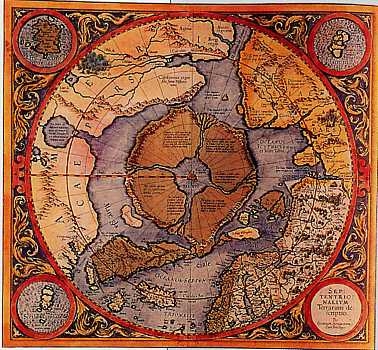
Le symbolisme du Pôle, du Nord et de l'Hyperborée

anciennecartemerlibre1.jpg

Le symbolisme du Pôle, du Nord et de l'Hyperborée

 
Lecture de mon article "Le symbolisme du Pôle et du Nord" concernant le mythe universel du continent nordique primordial d'une nature tant physique que spirituelle.


jeudi, 28 novembre 2019

Chroniques d'une fin de cycle : Les enfers parodisiaques

PEB-cycle2.jpg

L'anthologie des écrits de Pierre-Emile Blairon aux éditions du Lore !

Chroniques d'une fin de cycle : Les enfers parodisiaques

Pour toute commande: http://www.ladiffusiondulore.fr/home/781-chroniques-d-une-fin-de-cycle-les-enfers-parodisiaques.html

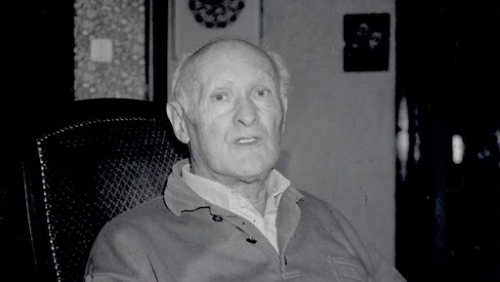
PEB-portrait.jpgDans le monde d’avant 1968, point de photographie du Président de la République française enlacé par deux jeunes hommes noirs, torses nus ; encore moins de plug anal géant défigurant la très distinguée place Vendôme à Paris. Et s’il n’y avait que cela…
Par quel « sortilège » de telles aberrations se présentent-elles comme banalités quotidiennes aux yeux d’une population aveuglée, presque éteinte ? Notre antique Kalos kagathos (le beau pour le bien) aurait-il été remplacé par « le laid pour le mal » ?

Les êtres différenciés observent que leurs familles, collègues de travail, voisins, semblent avoir perdu tout bon sens. Nous soustraire à ce processus de lobotomisation générale, telle est l’ambition à laquelle aspire l’auteur.

Vivre dans ce monde tout en n’étant pas de ce monde : c’est ainsi que Pierre-Emile Blairon propose au lecteur quelques clefs afin de comprendre le fonctionnement de l’ennemi.

Un ouvrage efficient à l’heure où sida mental et cancer moral semblent s’imposer.

L’auteur :

Né en 1948, Pierre-Emile Blairon réside près d’Aix-en-Provence.

HYPER003.jpgIl partage ses activités littéraires entre deux passions :
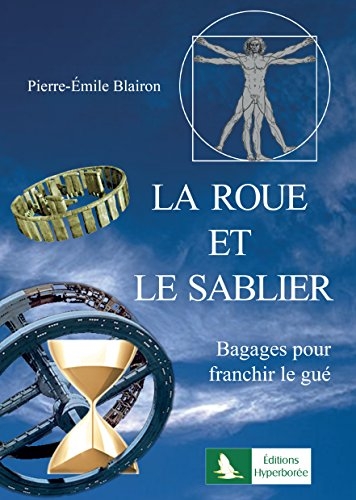
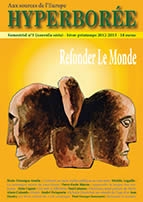
 - Les spiritualités traditionnelles : il anime la revue Hyperborée qui se consacre à l’histoire spirituelle de l’Europe et à son devenir. Son livre La Roue et le sablier résume la vue-du-monde de l’auteur et des collaborateurs de la revue.

 - La Provence : il anime la revue Grande Provence, a écrit plusieurs ouvrages sur la Provence secrète : La Dame en signe blanc, Le Guide Secret d’Aix-en-Provence, Le Guide Secret de la Côte d’Azur et deux biographies sur deux grands Provençaux : Jean Giono et Nostradamus.

SOMMAIRE

 Introduction

Chapitre I : Origines

-          Les solstices

-          Nos ancêtres ? Rien n’a changé, ce sont toujours les Gaulois !

-          Spiritualité païenne

Chapitre II : L’Algérie

-          Algérie française : la France doit être fière de l’œuvre accomplie !

-          1962 : l’abandon de l’Algérie ouvrait la porte au déferlement des populations africaines sur l’Europe

Chapitre III : La Provence

-          Nostradamus, le messager des dieux

-          De l’Avent à Caramentran

-          Provence et Tradition, entretien avec Thierry Durolle

-          Pour une « Grande Provence »

-          Homo festivus sur le cours Mirabeau

Chapitre IV : Chevaucher le tigre

-          Légitime défense et défense immunitaire : tout peuple qui se renie disparaît

-          La police de la pensée dans l’affaire Piquemal

-          Vergogna à tè chì vendi a terra !

-          17 novembre : fronde des automobilistes ou nouvelle Révolution française ?

-          Gilets jaunes : jacquerie française ou révolution planétaire ?

-          Guillaume Faye : un météore de la pensée vient de s’éteindre

Chapitre V : La décomposition

-          La République est-elle une valeur française ?

-          Aide aux « migrants » : compassion ou collaboration ?

-          Passeurs de clandestins : la mafia en cause

-          Voulez-vous manger des cafards ?

-          Signes religieux distinctifs : la kippa et… la mini-jupe

-          Le système à remplacer Dieu

-          Made for sharing : qui « partage » encore le respect de la langue française ?

-          La Morsure des dieux : le mariage de la terre et du ciel

-          La bicyclette est-elle une tradition française ?

-          Les mots qui font peur

-          Le problème des expulsions : une honte française

-          Villages à vendre

-          Architecture contemporaine : le triomphe de la vanité

-          Non, M. Wauquier, la république n’est pas la France !

-          Les nouveaux gladiateurs et l’hymne républicain Les manipulateurs sont au pouvoir

-          This is the end… : Fête de la musique 2018 à l’Élysée

-          La mode : les manipulations physiques de la subversion mondiale

-          L’art de la provocation

-          Les piétons sont-ils des Gaulois réfractaires ?

-          La disparition programmée de la langue française

-          Policiers et paysans : pourquoi se suicident-ils ?

Chapitre VI : Le nouveau cycle

-          Condition animale entre éco et égo, quelle est la responsabilité des humains ?

mercredi, 27 novembre 2019

Guénon, Saint-Point, and Agarttha

saintpoint.jpg

Guénon, Saint-Point, and Agarttha
 
Ex: https://traditionalistblog.blogspot.com
 
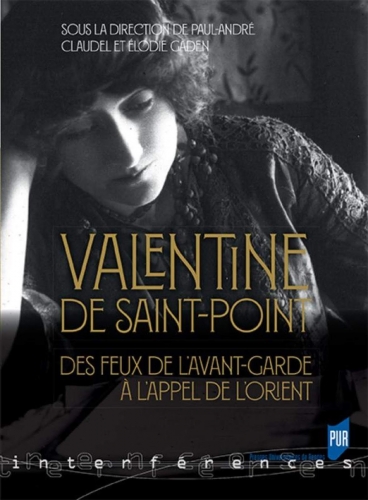
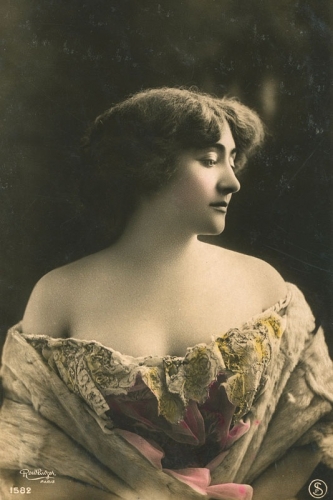
A new collection in French casts light on the life of Valentine de Saint-Point (1875-1953), best known for the first part of her life as poet and novelist, Futurist and feminist, but also a convert to Islam (as Rawhiya Nour Eddine) and friend of René Guénon in Cairo. It is Valentine de Saint-Point. Des feux de l'avant-garde à l'appel de l'Orient (Valentine de Saint-Point: From the Fires of the Avant-garde to the Call of the Orient), edited by Paul-André Claudel and Élodie Gaden, and published by the Presses Universitaires de Rennes (2019) at €28.

The book consists of seven sections: artistic beginnings, artistic experiments, “Latin Sisters: Artistic and Theoretical Dialog with Italy,” feminism, politics, influences, and inheritance. Most of these deal with the avant-garde. The call of the Orient is dealt with primarily in the section on politics, in which three of four chapters cover the last three decades of Saint-Point’s life, spent in Cairo, and her Islam. They are by Frédérique Poissonier, Daniel Lançon, and Alessandra Marchi. Poissonier looks primarily at French diplomatic correspondence relating to the attempted expulsion from Egypt of Saint-Point for conducting Bolshevik propaganda, Lançon looks most importantly at Saint-Point’s short-lived Egyptian journal, Le Phœnix. Revue de la renaissance orientale (The Phoenix: Review of the Oriental Renaissance), and Marchi looks at Saint-Point’s conversion to Islam, which she compares to that of an Italian contemporary of Saint-Point, the Italian anarchist (and friend of Benito Mussolini) Leda Rafanelli (1880-1971).

The main source for the relationship between Guénon and Saint-Point is Saint-Point herself, writing in the newspaper L’Egypte nouvelle in 1952, on the first anniversary of Guénon’s death. She had been forewarned of Guénon’s arrival in Cairo, she wrote, and during the years before Guénon’s marriage in 1934 he had visited her weekly, and they spent many hours together. She was not, however, a disciple of his, having made her own study of religions and esotericism before she met him. His work contributed some details to her understanding that were interesting, but “not indispensable.”

One writer who seems to have been more indispensable for Saint-Point was an earlier French esotericist, Alexandre Saint-Yves d’Alveydre (1842-1909), who was also appreciated by Guénon. This, and the fact that the circles Saint-Point had inhabited in Europe connected with those that Guénon had inhabited, probably explains the close relationship between Saint-Point and Guénon.

Saint-Yves was best known for a political system, “synarchy,” that he proposed as an alternative to anarchy. He was also known for his description of Agarttha, a subterranean synarchical utopia located somewhere in Asia, probably in India. Agarttha was described in Saint-Yves’ Mission de l'Inde en Europe, mission de l'Europe en Asie. La question du Mahatma et sa solution (India's mission in Europe, Europe's Mission in Asia: The Question of the Mahatma and its Solution), written in 1886 but withdrawn from the press and then not published until after Saint-Yves’ death, in 1910. Its final publication was the work of Papus (Gérard Encausse, 1865-1916), the founder of the Martinist Order, to which Guénon had once belonged. Encausse had acquired Saint-Yves’ papers.

littérature,tradition,traditionalisme,valentine de saint-point,rené guénon

Mission de l'Inde does not deal directly with the question of the Mahatma, which may have been added as a subtitle by Papus to improve sales. This question was raised by the Theosophist Helena Blavatsky (1831-91), who claimed to be in receipt of communications from enlightened adepts known as Mahatmas. It was never made clear who these Mahatmas were. Saint-Yves’ book suggests an answer: they were inhabitants of Agarttha, initiates who guarded the ancient, esoteric Tradition (given a capital T by Saint-Yves).

Guénon addressed the issue of Agarttha (now generally spelled Agartha) in Le roi du monde (The King of the World, 1927), treating accounts of it primarily as myth, and comparing them to other, similar myths. It seems, however, that he did on balance accept that Agarttha, or something like it, actually existed. So did Saint-Point, who wrote of Sufism as “anterior to Islam” and as connected to Agarttha. Guénon, of course, also saw Sufism as a repository of ancient, esoteric Tradition, though he would not necessarily have drawn a connection through Agarttha.

Saint-Point and Guénon agreed on a number of other points, too. Both valued Oriental civilization over Western civilization, which both condemned, and both were French converts to Islam. Again, there were differences, however. Saint-Point’s commitment to the Orient was political and activist, unlike Guénon’s. This was the motivation for her journal and the cause of her political difficulties, resolved only through the personal intervention of the French foreign minister, Aristide Briand (1862-1932), who knew Saint-Point’s ex-husband, Charles Dumont (1867-1939), a member of the French Senate who was twice minister of finance. Briand knew that Saint-Point was not a Bolshevik. Her anti-colonial agitation was probably inspired by Theosophy.

Saint-Point’s Islam was also different from Guénon’s. She admired Abd al-Aziz ibn Saud (1875-1953), the founder of the Kingdom of Saudi Arabia, who she saw as a “young patriot” who was “returning Muslimism [Musulmanisme] to its origins, to the Spirit.” She evidently knew little of Ibn Saud’s Wahhabism, and he probably appealed to her romantic view of Islam as “the religion of silence, the Voice that speaks in the desert, the poetry of horizons framed by the sands.”

Those who are interested in Agarttha and do not read French may refer to the English translation of Mission de l'Inde, as The Kingdom of Agarttha: A Journey into the Hollow Earth (Inner Traditions, 2008, $14.95), with an excellent introduction by Joscelyn Godwin which is recommended even to those who do read French.

[This post has been edited to remove a quotation incorrectly attributed to Saint-Point that was actually from Rafanelli.]

vendredi, 22 novembre 2019

Hagakure, ou comment affronter des temps misérables

hagakure3.jpg

Lire, méditer, pratiquer – et survivre. Hagakure, ou comment affronter des temps misérables

par Nicolas Bonnal
Ex: https://nicolasbonnal.wordpress.com

Hagakure, ou comment supporter des temps misérables

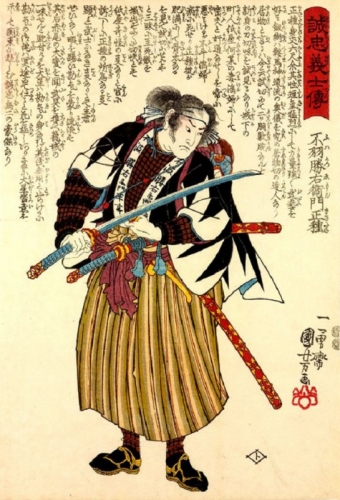
hagakure1.jpgJocho Yamamoto a « écrit » le traité Hagakure au début du siècle des Lumières, quand la crise européenne bat son plein. On passe en trente ans de Bossuet à Voltaire, comme a dit Paul Hazard, et cette descente cyclique est universelle, frappant France, Indes, catholicisme, Japon. J’ai beaucoup expliqué cette époque : retrouvez mes textes sur Voltaire ou sur Swift et la fin du christianisme (déjà…). Le monde moderne va se mettre en place. Mais c’est ce japonais qui alors a le mieux, à ma connaissance, décrit cette chute qui allait nous mener où nous en sommes. On pourra lire mes pages sur les 47 rônins (que bafoue Yamamoto !) dans un de mes livres sur le cinéma. Le Japon, comme dit notre génial Kojève, vit en effet une première Fin de l’Histoire avec cette introduction du shogunat et ce déclin des samouraïs, qui n’incarnèrent pas toujours  une époque marrante comme on sait non plus. Voyez les films de Kobayashi, Kurosawa, Mizoguchi et surtout de mon préféré et oublié Iroshi Inagaki.

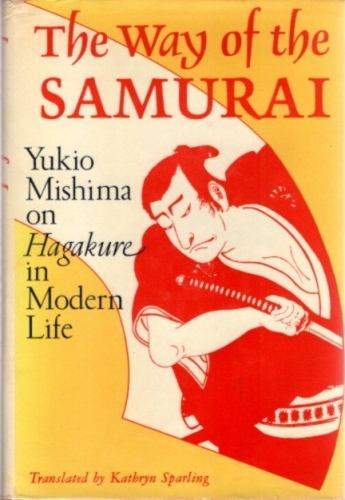
Comment supporter notre temps alors ? Voyons Yamamoto.

Les hommes deviennent (ou sont invités à devenir) des femmes ? Eh bien pour Yamamoto aussi, déjà :

« Lorsque j’essaie d’appliquer à mes patients mâles les soins prévus à leur intention, je n’obtiens aucun résultat. Le monde est, en effet, en train d’aborder une période de dégénérescence ; les hommes perdent leur virilité et ressemblent de plus en plus aux femmes. C’est une conviction inébranlable que j’ai acquise au cours de mon expérience personnelle et que j’ai décidé de ne pas ébruiter. Depuis, n’oubliant jamais cette réflexion, quand je regarde les hommes d’aujourd’hui, je me dis : « Tiens, Tiens, voilà un pouls féminin ». Je ne rencontre pratiquement jamais ce que je nomme un homme véritable. »

On est déjà dans la dévirilisation moderne. Pensez aux courtisans poudrés et étriqués de nos rois-sommeil. Hagakure :

« C’est d’ailleurs pour cette raison qu’il est possible, de nos jours, d’exceller et d’accéder à une position importante avec un moindre effort. Les hommes deviennent lâches et faibles, la preuve en est que rares sont ceux qui ont, aujourd’hui, l’expérience d’avoir tranché la tête d’un criminel aux mains liées derrière le dos. Quand il leur est demandé d’être l’assistant de celui qui va se suicider rituellement, la plupart considèrent qu’il est plus habile de se défiler et invoquent des excuses plus ou moins valables. Il y a seulement quarante ou cinquante ans, on considérait la blessure dans un combat comme une marque de virilité. Une cuisse sans cicatrice était un signe tellement rédhibitoire de manque d’expérience que personne n’aurait osé la montrer telle quelle, préférant plutôt s’infliger une blessure volontaire. « 

katana-2.jpg

Le maître ajoute :

« On attendait des hommes qu’ils aient le sang bouillant et soient impétueux. Aujourd’hui, l’impétuosité est considérée comme une ineptie. Les hommes de nos jours utilisent l’impétuosité de leur langue pour fuir leurs responsabilités et ne faire aucun effort.  J’aimerais que les jeunes gens réfléchissent sérieusement à cet état de choses. »

Il ajoute avec pessimisme :

« J’ai l’impression que les jeunes Samouraïs d’aujourd’hui se sont fixés des objectifs pitoyablement bas. Ils ont le coup d’œil furtif des détrousseurs. La plupart ne cherchent que leur intérêt personnel ou à faire étalage de leur intelligence. Même ceux qui semblent avoir l’âme sereine ne montrent qu’une façade. Cette attitude ne saurait convenir. Un Samouraï ne l’est véritablement que dans la mesure où il n’a d’autre désir que de mourir rapidement – et de devenir un pur esprit – en offrant sa vie à son maître, dans la mesure où sa préoccupation constante est le bien-être de son Daimyo à qui il rend compte, sans cesse, de la façon dont il résout les problèmes pour consolider les structures du domaine. »

hagakure2.jpgOn pourra rappeler de belles analyses sur le roi Lear. On passe au métier de roi, dans la pièce de Shakespeare comme à la cour du roi de France (dixit Macluhan bien sûr au début de sa trop oubliée galaxie). Voyez aussi le Mondain de Voltaire.
Yamamoto s’exprime parfois comme un Calderon ou un Shakespeare justement à propos de ce monde qui devient un simulacre, qui passe de l’état solide à l’état liquide :

« Il est bon de considérer le monde comme un rêve. Quand on fait un cauchemar et qu’on se réveille, on se dit que ce n’était qu’un rêve.

On dit que le monde dans lequel nous vivons n’est pas très différent d’un rêve. »

Ailleurs il se rapproche même de l’époustouflant monologue de Figaro :

« La vie humaine ne dure qu’un instant, il faut avoir la force de la vivre en faisant ce qui nous plait le plus.

Dans ce monde fugace comme un rêve, vivre dans la souffrance en ne faisant que des choses déplaisantes est pure folie. Ce principe, mal interprété, peut toutefois être nuisible, aussi ai-je décidé de ne pas l’enseigner aux jeunes gens…

J’adore le sommeil. En réponse à la situation actuelle du monde, je pense ce que j’ai de mieux à faire est de rentrer dormir chez moi. »

Et son message triste se manifeste encore plus ici :

« On ne peut changer son époque. Dès lors que les conditions de vie se dégradent régulièrement, la preuve est faite que l’on a pénétré dans la phase ultime du destin. On ne peut, en effet, être constamment au printemps ou en été, il ne peut pas non plus faire jour en permanence ; c’est pourquoi il est vain de s’entêter à changer la nature du temps présent pour retrouver les bons vieux jours du siècle dernier. L’important est d’œuvrer pour que chaque moment soit aussi agréable que possible. L’erreur de ceux qui cultivent la nostalgie du passé vient de ce qu’ils ne saisissent pas cette idée. Mais ceux qui n’ont de considération que pour l’instant présent et affectent de détester le passé font figure de gens bien superficiels. »

En France cette réaction aristocratique et pessimiste aura lieu après la Révolution et notre aplatissement impérial. C’est Alfred de Vigny qui dans sa servitude et grandeur militaire aura bien décrit et pressenti ce passage du guerrier français traditionnel au soldat-militaire moderne.

Alors je citerai l’oublié Vigny pour finir – et sa mort du loup :

« Gémir, pleurer, prier, est également lâche.

Fais énergiquement ta longue et lourde tâche

Dans la voie où le Sort a voulu t’appeler,

Puis après, comme moi, souffre et meurs sans parler. »

Sources :

http://jeanclaude.vidal1.free.fr/Hagakure.pdf

Nicolas Bonnal – Le paganisme au cinéma

http://www.dedefensa.org/article/les-47-ronins-a-la-lumie...

23:55 Publié dans Traditions | Lien permanent | Commentaires (0) | Tags : tradition, traditionalisme, japon, hagakure | |  del.icio.us | | Digg! Digg |  Facebook

mercredi, 20 novembre 2019

Alexandre DOUGUINE: Principles for Comprehending Chinese Civilization

chinese-dragon_0.jpg

Principles for Comprehending Chinese Civilization

Ex: https://www.geopolitica.ru

China is recognized to be an independent and unique civilization by virtually everyone, and therefore there is no need to prove this. Rather, we are faced with attempting to reveal the structure of this civilization’s Logos and to determine as much as is possible its geosophical map both within the borders of China and beyond, as well as in its dialogue with neighboring civilizations.

Chinese culture has exercised an enormous and at times decisive influence on neighboring peoples, first and foremost on Korea, Vietnam, and Japan, all of which during certain eras held themselves to be part of Great China – not in the sense of political unity, but as indelible and organic parts of Chinese civilization and the Chinese horizon. This horizon also substantially impacted the peoples of Tibet as well as the nomads of Turan bordering China from the North. Moreover, we can encounter definite influences of the Chinese element among the peoples of Indochina and South-East Asia, such as in Cambodia, Laos, Myanmar, Thailand, Malaysia, as well as, although to a lesser extent, Indonesia and the Philippines.

On the other hand, China itself has in some cases re-translated tendencies and influences originating in other civilizations. China was heavily influenced by the peoples of Turan, who often came to form the core of the ruling elites (such as among the Xianbei, the Mongols, the Manchurians, etc).[1] In the most ancient periods of Chinese history, the Indo-European factor was significant, as the Indo-Europeans remained the main force of the Eurasian Steppe up to the first few centuries AD.[2] It is from the Indo-Europeans that the ancient Chinese borrowed the horse, the chariot, and a number of cultural forms, above all the art of war, which the Indo-Europeans of Turan had developed with priority. 

Also Indo-European in semantics and origins was Buddhism, which became widespread in China from the first to third centuries AD and came to constitute an important component of the Chinese tradition. Buddhism spread to China directly from India [3], as well as from Central Asia and the Tarim Basin, which were inhabited by Indo-European peoples. A certain role in this process was played by Tibet which, on the one hand, itself experienced Chinese influence while, on the other hand, represented a civilization in which the Indo-European vector was decisive.[4]

In studying China, we can apply our traditionally employed methodologies of civilizational analysis which have helped us to attain the level of ultimate generalizations which we have in the topography of noology.[5] If we succeed in hinting at the priorities in the noological structure of Chinese civilization, if we can approach the revelation of the main characteristics (existentials) of the Chinese Dasein, and if we can reveal just which Logos or Logoi of the three main ones is dominant in China, then we will consider our task to be fulfilled. 

The Significance of the Works of Marcel Granet: “We, Chinese” 

In unraveling the intricacies of the deeply original, unparalleled, unique Chinese culture, we will be guided by the works of an author who, from our point of view, while himself a European, nevertheless maximally profoundly delved into this culture’s structures and provided a most reliable description of it. We have in mind the French sociologist Marcel Granet (1884-1940), who devoted all of his scholarly life to studying China. Granet built his methodology along the following principles: 

  1. Western European authors studying China have all, without exception, proceeded in their interpretations from the Eurocentric positions and paradigms of Modernity, reinterpreting social relations, political ideas, philosophical terms, religious practices, and so on in their own key, and thereby constructing an artificial Chinese historial seen from the position of either a detached observer nevertheless claiming universalism and truth in the final instance, or from direct (even if unconscious) colonial attitudes. Thus, any European interpretations will certainly remain within the paradigmatic treatment of China as a “society of barbarians”, that category into which all developed (“non-savage”) civilizations qualitatively differing in their structures from the European societies of Modernity automatically fall. Thus, Eurocentric Orientalism is one-sided, biased, and unreliable.
  2. Chinese historians themselves, in reflecting on the essence and structures of their civilizations, have erected an historial founded on one or another dynastic, philosophical, ideological, or at times religious preference, which also thereby presents a one-sided and ideologized version that cannot be taken as the final truth, and which must be constantly verified and corrected. 
  3. We are left with pursuing a third way, that of immersion into Chinese civilization, its language, history, philosophy, customs, rites, art, politics, and society as a whole, attempting to identify its immanently inherent patterns on the basis of sociological and anthropological methodologies, and trying to adhere as close as possible to how the Chinese understand themselves without losing sight of the distance necessary for correcting social self-consciousness (the collective consciousness a la Durkheim) with regards to the general process of its historical changes and dynastic, religious, and geographical versions and alternatives. 

Marcel Granet’s method applied towards China is in many respects similar to that of Henry Corbin (1903-1978) in his deep study of Iranian and Irano-Islamic civilization, a methodology which Corbin himself called the “phenomenology of religion.”[6] It is impossible to correctly describe a society’s self-consciousness if it is deliberately held that everything in which they themselves believe is “ignorant prejudice” or “empty chimeras.” Yet China can be understood only upon taking the position of the Chinese, agreeing to consciously trust how they see the world and just which world they constitute with their view. Just as Corbin said in his study of Iranian Shiism “We, Shiites”, Marcel Granet could well say of himself “We, Chinese” without any intention of irreversible altering his identity from being European to Chinese. In studying Chinese identity, European (or in our case Russian) identity ought, temporarily and in accordance with quite specific anthropological and sociological methodologies, be forgotten, so as to later (insofar as one desires) return to such, being enriched with radically new and previously inconceivable civilizational and even existential experience. 

In his approach, Marcel Granet combined the holistic sociology of the Durkheim school and the methodologies of the “annals school”, which resulted in the conceptualization of society as a whole phenomenon and the treatment of the changes in society’s structure over the course of long historical periods not as differing, strictly discontinuous periods, with which conventional historical chronicles usually operate, but as processes of continuous and gradual mutations. The foundations of this methodology were substantiated in detail by Fernand Braudel with his famous concept of the “long durée.”[7] Granet devoted a number of fundamental works to China, namely: The Ancient Festivals and Songs of ChinaThe Religion of the ChineseThe Dances and Legends of Ancient ChinaSociological Studies on China, and his two generalizing and most important works, Chinese Civilization and Chinese Thought.[8-13]

Georges-Albert de Pourvourville and the Traditionalists 

In addition to Granet, a substantial contribution to the comprehension of Chinese civilization has been supplied by Georges-Albert Puyou de Pourvourville (1862-1939), who wrote under the name Matgioi and studied Chinese civilization from within, spending many years in China. Pourvourville-Matgioi was initiated into the Taoist tradition by a Chinese teacher and passed on his acquired knowledge in his works on Chinese metaphysics, The Rational Way and The Metaphysical Way, in his books The Middle Empire and The China of the Learned, and in his translations of Lao Tzu’s Tao Te Ching and Quangdzu’s The Spirit of the Yellow Race.[14-19] Another outstanding Traditionalist, Julius Evola (1898-1974), subsequently translated the Tao Te Ching into Italian.[20]

Pourvourville formulated his aim in the following words:

“I shall try to reveal to the Western twentieth century this treasure, hidden for five thousand years and unknown even to some of its keepers. But first I wish to establish the main features of this tradition, by virtue of which it is the first and, as follows, the true Tradition, and to mainly determine, by way of the tangible evidence accessible to man which this tradition’s authors have left us, how the relics of this tradition date back to the era when in the forests covering Europe and even the West of Asia wolves and bears were nearly no different from people who, clothed like them in skins, devoured coarse flesh.”[21]

Matgioi thus emphasized that he believed the Chinese tradition to be the most ancient and primordial (similar to how other Traditionalists, such as Guénon and Coomaraswamy, saw the Primordial Tradition in Hinduism). At the same time, Pourvourville-Matgioi did not simply try to prove that the Chinese tradition is comparable to the European but, as can be seen in the preceding passage, he was convinced that in all of its completeness, depth, and antiquity, it was superior to European culture as a whole, not to mention the European culture of Modernity, which Traditionalists univocally regard as degenerate and in decline. 

Pourvourville was close to René Guénon (1886-1951), the founder of European Traditionalism, and was one of Guenon’s main sources of acquaintance with the Chinese tradition. Guénon himself devoted a fundamental work, The Great Triad, to Chinese metaphysics, and therein largely relied on the ideas of Matgioi.[22] Matgioi and Guénon’s works are important in that they approach Chinese metaphysics from within, accepting the religious point of view of the Taoist tradition to the extent that such is accessible to people of European culture. Further important accounts of the Chinese spiritual tradition are contained in the works of the historian of religions and author close to Traditionalism, Mircea Eliade (1907-1986), particularly his work Asian Alchemy,  a considerable portion of which is devoted to the Chinese tradition.[23]

The Han Horizon: The People of the Milky Way

As is the case with any people, in examining the Chinese it is difficult to definitively determine just which layer of identity, which is necessarily multilayered and dialectically changing in its proportions over time, ought to be taken as our point of reference. Without a doubt, we are dealing with a civilization, and this means with a formalized and reflexive Logos embodied in philosophy, tradition, culture, politics, and art. In antiquity Chinese civilization achieved full disclosure, that is to say the Ausdruck stage in Leo Frobenius’ terminology. We can study this Logos, analyze and comment on it by studying and systematizing its elements and layers. In and of itself, this is already an extremely complex task, as Chinese civilization has gone through multiple principal phases entailing qualitative semantic shifts and, as follows, substantial adjustments have been ingrained into the fundamental paradigm of the Chinese Logos. 

As we have shown in the volume of Noomakhia dedicated to Geosophy, the Logos of Civilization represents the highest layer of civilizational formation, from the “sowing” of the principal vertical Logoi (of Apollo, Dionysus, and Cybele) to its yields and crops in the form of culture. The Logos is the final stage when the yields of culture are harvested over the final stage of the agrarian cycle. At the base of civilization lies a cultural or existential horizon, or Dasein (in this case the Chinese Dasein). The latter precedes the formation of civilization, but is at the same time its semantic foundation. Dasein, as an existentially understood people, as an existing people (whose existing presupposes history, i.e., time) also presupposes Logological structures on which it is founded. [24-25] Therefore, we must study Chinese civilization by constantly taking into account the existential foundations on which it has been erected. 

Yet in order to correctly examine and interpret the Chinese historial, i.e., the forms of the historical being of this people, it is necessary to discern the main horizon to act as the semantic axis taken as the point of reference. This always requires a choice, insofar as every horizon is complex, composite and is co-participated in simultaneously by multiple sub-horizons or layers with often differing noological orientations and trajectories. Thus, from the very outset, we must make a choice and recognize as the main existential core one Dasein which will be the “subject” of this historial. In the case of the Chinese horizon, the Han should be considered this axis as the people embodying the Chinese Logos that built this civilization, this Empire, and its special Chinese world. 

The Han people emerged as a self-designation only with the Han Dynasty from 206-220 BC, which replaced the short-lived Qin Dynasty, when the unification of Chinese territories was accomplished. The name “Han” (Chinese: ) literally means “Milky Way”, which points towards the symbolic connection between Han identity, the sky, and cyclical movement.[26] In the Qin and Han eras, different tribes inhabiting the territory China and belonging predominantly to the Sino-Tibetan language group began to recognize their unity – culturally, historically, religiously, and so on. It is also evident that a certain unity of tradition was necessarily characteristic of even earlier forms of tribal associations, such as in the Zhou and more ancient periods, memory of which was imprinted in myths and legends. In any case, it is the Han people that ought to be taken, in a broad sense, as the foundational pole of the Chinese historial. We can define the earlier stages of the Han historial as proto-Han, after which Han identity later began to spread to neighboring horizons both within China and beyond, thereby including in the composition of its Dasein other ethnic and cultural groups. Yet at all of these stages, we are dealing with a semantic whole that is predominant and dominant in the space of Chinese history and Chinese geography. The Han Chinese are the subject of Chinese civilization, and they can be regarded as the main bearers of the resulting Logos, whose noological nature we are tasked with discerning over the course of our study. 

Therefore, the phenomenological formula by which we shall be guided should be clarified: moving from “We, Chinese” to “We, Han” reflects our intention to be in solidarity with the Han Dasein in the reconstruction of the Chinese historial and to look through its eyes at the history, mythology, politics, and religion of China.

Footnotes:

[1] Alexander Dugin, Noomakhia: The Horizons and Civilizations of Eurasia – The Indo-European Legacy and the Traces of the Great Mother (Moscow: Academic Project, 2017)

[2] Alexander Dugin, Noomakhia: The Logos of Turan – The Indo-European Ideology of the Verticle (Moscow: Academic Project, 2017)

[3] Alexander Dugin, Noomakhia: Great India – Civilization of the Absolute (Moscow: Academic Project, 2017)

[4] Dugin, Noomakhia: The Horizons and Civilizations of Eurasia

[5] Alexander Dugin, Noomakhia: Geosophy – Horizons and Civilizations (Moscow: Academic Project, 2017).

[6] Ibid. See also: Alexander Dugin, Noomakhia – Wars of the Mind: The Iranian Logos: The War of Light and the Culture of Awaiting  (Moscow: Academic Project, 2016)

[7] Braudel F. Écrits sur l’histoire. Paris: Arthaud, 1990. See also: Alexander Dugin, Noomakhia: Geosophy

[8] Granet М. Fêtes et chansons anciennes de la Chine. Paris: Albin Michel, 1982.

[9] Granet M. La Religion des Chinois. Paris: Albin Michel, 2010.

[10] Granet M. Danses et légendes de la Chine ancienne. Paris: Les Presses universitaires de France, 2010.

[11]Granet M. Études sociologiques sur la Chine. Paris Les Presses universitaires de France, 1953.

[12] Granet M. Китайская цивилизация. Moscow: Algoritm, 2008.

[13] Granet M. Китайская мысль от Конфуция до Лао-цзы. Moscow: Algoritm, 2008.

[14] Matgioi. La Voie Rationnelle. Paris: Les Éditions Traditionnelles, 2003.

[15] Matgioi. La Voie Métaphysique. Paris: Les Éditions Traditionnelles, 1991

[16] Matgioi. L’Empire du Milieu. Paris: Schlercher frère, 1900.

[17] Matgioi. La Chine des Lettrés. Paris: Librairie Hermétique, 1910.

[18] Le Tao de Laotseu, traduit du chinois par Matgioi. Milano: Arché, 2004.

[19] L’esprit des races jaunes. Le Traité des Influences errantes de Quangdzu, traduit du chinois par Matgioi. Paris: Bibliothèque de la Haute Science, 1896.

[20] Evola J. Tao te Ching di Lao-tze. Roma: Edizioni Mediterranee, 1997. Другие тексты Эволы о даосизме собраны в небольшой брошюре «Даосизм»; Evola J. Taoism. Roma: Fondazione Julius Evola, 1988.

[21] MatgioiМетафизический путь, p. 41 —42.

[22] Guénon R. La Grande Triade. Paris: Gallimard, 1957.

[23] Eliade М. Азиатская алхимия. М.: Янус-К, 1998.

[24] Dugin, Noomakhia: Geosophy – Horizons and Civilizations 

[25] Dugin А.G. Мартин Хайдеггер. Последний Бог [Martin Heidegger: The Last God]. Мoscow: Academic Project, 2015.

[26] It is also possible that the name of the Han Dynasty was derived from the river Hanshui or Han River which runs through Central China. 

Translator: Jafe Arnold

Chapter 1 of Noomakhia – The Yellow Dragon: The Civilizations of the Far East (Moscow: Academic Project, 2018)

mercredi, 30 octobre 2019

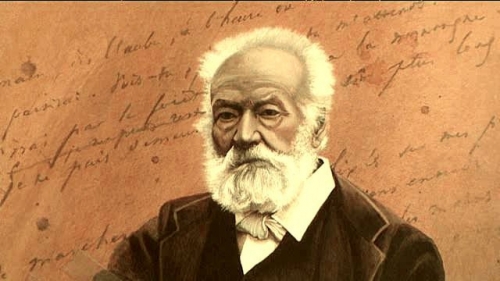
Victor Hugo et le mouvement de l’Histoire. Lecture d’un chapitre de Notre-Dame de Paris

hugovictorcouleur.jpg

Victor Hugo et le mouvement de l’Histoire. Lecture d’un chapitre de Notre-Dame de Paris

par Daniel COLOGNE

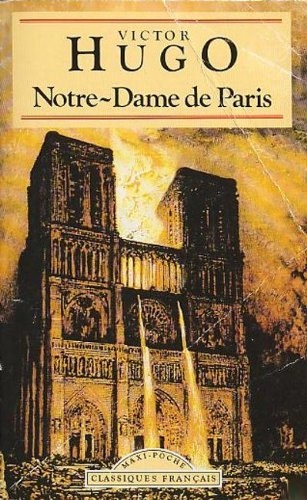
Les réflexions qui suivent sont inspirées par le chapitre II du livre cinquième du célèbre roman hugolien. Victor Hugo (1802 – 1885) parsème son récit de quelques chapitres qui relèvent de la philosophie de l’Histoire, de la conception architecturale ou de la vision imaginaire du Paris médiéval (voir notamment le livre troisième). Car le roman se passe en 1482, date faisant partie intégrante du titre, millésime ravalé au rang de sous-titre ou carrément occulté au fil des innombrables éditions, adaptations cinématographiques ou conversions en comédies musicales.

Adrien Goetz, préfacier de l’édition 2009 chez Gallimard (coll. « Folio classique »), a le mérite de réhabiliter cette année 1482 sans insister sur sa proximité avec 1476 – 1477 : défaites de Charles le Téméraire à Grandson et Morat, sa mort à Nancy, extinction des derniers feux de ce que Julius Evola appelle « l’âme de la chevalerie », tandis que pointe comme une improbable aurore le pragmatisme calculateur de Louis XI. Nonobstant une importante réserve que je formulerai en conclusion, je trouve la préface d’Adrien Goetz remarquable et je m’incline devant l’étonnante érudition des 180 pages de notes de Benedikte Andersson.

Le volume contient aussi d’intéressantes annexes où l’on découvre sans surprise un Victor Hugo admirateur de Walter Scott, en face duquel Restif de la Bretonne fait piètre figure en apportant « sa hottée de plâtres » au grand édifice de la littérature européenne. Pourtant, Victor Hugo cite rarement ceux qu’il juge responsable du déclin des lettres françaises. Il ne fait qu’égratigner Voltaire, vitupère globalement les récits trop classiques dans des pages critiques où peuvent se reconnaître pour cibles l’Abbé Prévost, Madame de La Fayette, voire le Diderot de Jacques le Fataliste. Pour qui sait lire entre les lignes et connaît quelque peu la production littéraire du siècle des prétendues « Lumières », les considérations désabusées sur le roman épistolaire ne peuvent viser que Choderlos de Laclos et ses Liaisons dangereuses. Mais le chapitre II du livre cinquième vaut surtout par sa profondeur historique et une véritable théorie des trois âges de l’humanité que Victor Hugo nous invite à méditer avec une maîtrise stylistique et une organisation du savoir assez époustouflantes chez un jeune homme de 29 ans (Notre-Dame de Paris 1482 paraît en 1831).

hugovndp.jpg« Quand la mémoire des premières races se sentit surchargée, quand le bagage des souvenirs du genre humain devint si lourd et si confus que la parole, nue et volante, risqua d’en perdre en chemin, on les transcrivit sur le sol de la façon la plus visible, la plus durable et la plus naturelle à la fois. On scella chaque tradition sous un monument. » Ainsi Victor Hugo évoque-t-il le premier passage d’une ère d’oralité à un âge où l’architecture devient « le grand livre de l’humanité ». Souvenons-nous cependant de la parole biblique concernant la pierre que les bâtisseurs ont écartée et qui est justement la pierre d’angle. Le risque de « perdre en chemin » un élément essentiel deviendrait-il réalité dès que s’élèvent les premiers menhirs celtiques que l’on retrouve « dans la Sibérie d’Asie » ou « les pampas d’Amérique » ?
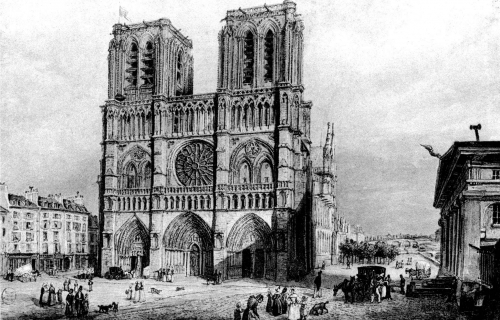
Toute tradition devant contenir une part de trahison (le latin tradition a donné le français traître), l’âge architectural serait alors le monde de la Tradition proprement dite, déjà synonyme de déclin par rapport aux temps originels et primordiaux, illuminés par la prodigieuse mémoire des « premières races ». Depuis « l’immense entassement de Karnac […] jusqu’au XVe siècle de l’ère chrétienne inclusivement », l’architecture est le mode d’expression dominant. Il ne faut pas pour autant tenir pour négligeable les autres fleurons artistiques et littéraires qui s’échelonnent tout au long de cette période plurimillénaire : les épopées et tragédies, l’Odyssée, l’Énéide et la Divine Comédie, dont on a pu écrire dans Éléments (n° 179, p. 68), qu’elles sont les trois piliers de la culture européenne. À plus forte raison, Victor Hugo mentionne les vénérables textes sacrés, et notamment le Mahabharata, dont l’auteur légendaire Vyasa « est touffu, étrange, impénétrable comme une pagode ».

Dans la Chrétienté médiévale, le style des édifices religieux romans est analogue à celui de l’architecture hindoue. La « mystérieuse architecture romane » est « sœur des maçonneries théocratiques de l’Égypte et de l’Inde », écrit Hugo. C’est une architecture de caste, où l’on ne voit que le détenteur de l’autorité sacerdotale. « On y sent partout l’autorité, l’unité, l’impénétrable, l’absolu, Grégoire VII; partout le prêtre, jamais l’homme; partout la caste, jamais le peuple. » « Qu’il s’appelle brahmane, mage ou pape, dans les maçonneries hindoue, égyptienne ou romane, on sent toujours le prêtre, rien que le prêtre. Il n’en est pas de même dans les architectures de peuple. »

Le style gothique est, selon Hugo, une « architecture de peuple ». Il assure la transition entre le Moyen Âge et les Temps modernes. Ceux-ci débutent avec l’invention de l’imprimerie. Avant de revenir en détail sur la vision hugolienne de la période gothique – passage du chapitre qui me semble le plus contestable -, brossons rapidement le tableau d’une modernité où la littérature devient l’art dominant, mais où les autres arts s’émancipent de la tutelle architecturale. « La sculpture devient statutaire, l’imagerie devient peinture, le canon devient musique. » L’architecture « se dessèche peu à peu, s’atrophie et se dénude ». Mais la littérature l’accompagne rapidement dans son déclin, hormis « la fête d’un grand siècle littéraire », qui est celui de Louis XIV et qui éclipse injustement Montaigne, Rabelais et la Pléiade.

gravure-parvis-458a-diaporama.jpg

L’objectif du romantisme est la résurrection simultanée de l’architecture et des lettres, ainsi qu’en témoigne l’engagement de Victor Hugo depuis la Bataille d’Hernani jusqu’à la mobilisation de son ami Viollet–le-Duc pour restaurer la cathédrale parisienne et l’Hôtel de Ville de Bruxelles. Achevé en 1445 sous le duc de Bourgogne Philippe le Bon, père de Charles le Téméraire, l’Hôtel de ville de Bruxelles est encore de style gothique et Victor Hugo saisit très bien le mouvement créatif qui s’étend de l’architecture religieuse à l’architecture civile en traversant les trois ordres dont Georges Duby démontre magistralement qu’ils constituent les fondements de l’imaginaire médiéval. « L’hiéroglyphe déserte la cathédrale et s’en va blasonner le donjon pour faire un prestige à la féodalité. » Mais il s’en va également orner les édifices qui font la fierté de la commune qui perce sous la seigneurie tout comme « la seigneurie perce sous le sacerdoce ».

Dans l’acception hugolienne du terme, le peuple apparaît comme l’opposition solidaire de toutes les couches sociales dominées contre la caste dominante, en l’occurrence le sacerdoce. Ce type d’antagonisme peut approximativement s’observer au cours de l’histoire des Pays-Bas espagnols. Plus encore que l’Église catholique, l’oppresseur est alors une forme de durcissement politico-religieux incarné par Philippe II et ses gouverneurs au premier rang desquels le sinistre duc d’Albe. La toile de Breughel intitulée Les Mendiants symbolise la solidarité de toutes les strates de la population des Pays-Bas contre la tyrannie hispano-chrétienne. Ce sont deux aristocrates, les comtes d’Egmont et de Hornes, qui prennent l’initiative de l’insurrection et qui sont décapités juste en face de l’Hôtel de Ville, devant le bâtiment qui abrite aujourd’hui le musée vestimentaire de Manneken-Pis !

Aux voyageurs désireux de découvrir ce patrimoine européen septentrional au rythme du flâneur dont Ghelderode fait l’éloge, et non dans la précipitation propre au tourisme de masse (voir l’éditorial d’Alain de Benoist dans la livraison d’Éléments déjà citée), je conseille de s’attarder au square du petit-Sablon, dont l’entrée est gardée par l’imposante statue d’Egmont et de Hornes, « populistes » ante litteram. Dans la lutte actuelle entre « populistes » et « mondialistes », les premiers peuvent-ils encore compter sur le Gotha et sur l’Église ? Car la caste dominante n’est plus le sacerdoce, mais une « hyper-classe mondialiste (Pierre Le Vigan) », une coterie de capitalistes revenus à leurs fondamentaux, à l’individualisme hors-sol et au déplacement massif de populations coupées de leurs origines, depuis la traite des Noirs jusqu’aux migrants d’aujourd’hui en passant par le regroupement familial des années 1970 transformant une immigration de travail en immigration de peuplement. Les déclarations pontificales et l’attitude des dernières monarchies européennes dévoilent plutôt une position favorable au mondialisme. Tout ceci ne nous éloigne de Victor Hugo qu’en apparence. Hugo est aussi « populiste » avant l’heure en attribuant au « peuple » une créativité, un peu comme Barrès l’accorde au « visiteur de la prairie », à la différence près que le rôle de la « Chapelle » barrésienne est d’orienter les élans et les rêves vers des fins spirituelles supérieures.

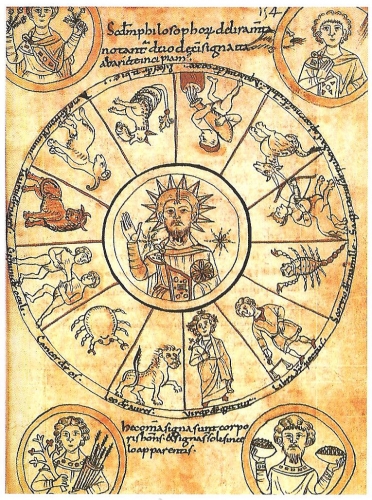
Chez Hugo, la créativité populaire, dont témoigne le foisonnement du style gothique, est magnifiée comme une sorte de préfiguration de la libre pensée. Hugo relève à juste titre que l’architecture gothique incorpore des éléments parfois « hostiles à l’Église ». Ce n’est pas à l’astrologie qu’il pense alors qu’il semble bien connaître la cathédrale de Strasbourg à laquelle on a consacré un livre entier décrivant ses innombrables figurations zodiacales.

L’hostilité à l’Église dans certains thèmes gothiques n’est pas une offensive anti-cléricale par le bas (catagogique, dirait Julius Evola), comparable à la critique pré-moderne qui va culminer chez un Voltaire dans ses imprécations contre « l’Infâme », mais l’affirmation d’un imperium supérieur à l’Église (dépassement anagogique, par le haut, de la théocratie pontificale). Julius Evola associe cette idée impériale gibeline au mystère du Graal dont Victor Hugo ne souffle mot et qui est pourtant contemporain de la naissance du style gothique. En effet, c’est entre le dernier quart du XIIe siècle et le premier quart du XIIIe siècle que prolifèrent les récits du cycle du Graal, comme s’ils obéissaient à une sorte de directive occulte, à un mot d’ordre destiné à la caste guerrière visant à la sublimer en une chevalerie en quête d’un élément essentiel perdu.

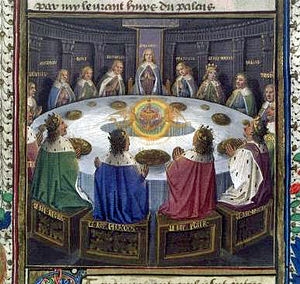
Round_Table._Graal_(15th_century).jpgLe thème du Graal est l’équivalent païen, au sens noble du terme, de la pierre d’angle biblique rejetée par les bâtisseurs. Énigmatique demeure à mes yeux cette phrase de René Guénon : « Le Graal ne peut être qu’un zodiaque. » Mais je suis convaincu que, pour déchirer le voile qui recouvre le mystère des origines, pour retrouver ce « grain d’or » dont parle l’astronome Kepler (1571 – 1630), il faut emprunter la voie de l’astrologie, domaine impensé de notre mouvance intellectuelle (du moins à ma connaissance), art antique vénérable raillé par La Fontaine et Voltaire, discipline dévoyée depuis quatre siècles, hormis quelques soubresauts : le marquis de Boulainvilliers (1658 – 1722), une école française aux alentours de 1900 (Caslant, Choisnard, Boudineau), une école belge (avec Gustave-Lambert Brahy comme figure de proue), les travaux plus récents de Gauquelin et Barbault (tous deux nés en 1920). Si le Graal est un vase, ce n’est pas exclusivement parce que Joseph d’Arimathie y a recueilli le sang de Jésus crucifié, mais c’est, par-delà sa dérivation chrétienne, par son identification plus générale à un récipient recueillant la pluie des influences cosmiques. Cet élargissement de la signification du Graal s’inscrit, soit dans la « Préhistoire partagée (Raphaël Nicolle) » des peuples indo-européens, soit dans une proto-histoire plus ample, ainsi qu’en témoigne le rapprochement d’Hugo entre les pierres levées d’Europe occidentale et celle de l’Asie sibérienne et de l’Argentine.
Que Victor Hugo soit passé à côté de cette importante thématique note rien à la qualité de son chapitre que j’ai relu avec un intérêt admiratif et donc je vais conclure la recension en prenant mes distance par rapport à Adrien Goetz, excellent préfacier par ailleurs. Trois âges se succèdent donc dans la vision hugolienne du mouvement de l’Histoire. Le premier âge est celui de la transmission orale. Le deuxième est celui de la parole écrite et construite, où l’architecture est l’art dominant. Le troisième est celui de la parole imprimée, de la domination du livre, de la « galaxie Gutenberg » qui inspire en 1962 à McLuhan son ouvrage majeur.

Né à Besançon comme les frères Lumière, Victor Hugo assiste au balbutiement d’un quatrième âge que le préfacier Adrien Goetz nous convie à nomme l’âge des « révolutions médiologiques ». Cette nouvelle ère présente aujourd’hui le visage d’un « magma », le spectacle d’un « boueux flux d’images » avec pour fond sonore « le bruissement des images virtuelles et des communications immédiates ». Ses lucides observations n’empêchent pas le préfacier de rêver que « l’œuvre d’art total du XXIe siècle » puisse surgir bientôt de la toile d’araignée réticulaire en offrant aux générations futures un éblouissement comparable à celui que génère la lecture d’Hugo ou de Proust. Adrien Goetz va plus loin : « Les multimédias […] sont les nouvelles données de l’écriture peut-être, bientôt, de la pensée. » Il appelle de ses vœux « une sorte de cyberutopie ». Mais qu’elle soit « œuvre-réseau », livre imprimé, monument de pierre ou litanie psalmodiée des premiers temps d’avant l’écriture, l’utopie ne peut s’appuyer que sur les invariants anthropologiques qui, précisément, se désagrègent au fil de « la généralisation de la webcam ».

Ces invariants sont l’espérance d’un au-delà transfigurant, la certitude d’un en-deçà déterminant, la nécessité d’une Gemeinschaft hiérarchique ne faisant toutefois pas l’économie de la justice. Ils sont certes remis en question depuis plusieurs siècles, mais c’est l’individualisme post-moderne qui en constitue le contre-pied parfait. En même temps que les « liens hypertextes », qu’Adrien Goetz destine à une transmutation comparable à celle des alchimistes, s’affirme un type humain dominant dénué d’élan spirituel, oublieux de ses atavismes et fiévreusement lancé dans une course au plaisir qu’il s’imagine régie par l’« égalité des chances ».

Daniel Cologne

vendredi, 18 octobre 2019

Alexander Dugin & Nicolas Gomez Davila: The Rebellion of the Eternal

ob_79b2b3_nicolas-gomez-davila-signe.jpg

Alexander Dugin & Nicolas Gomez Davila: The Rebellion of the Eternal

Ex: https://www.geopolitica.ru

History as “leitmotiv”

Between the motives of revolutionary deeds of modernity, the infamous scourges of slavery, servility, misery, inequality, ignorance and submission have always marched by its rhetoric paths. Tangible and conscious motivations which transit from the lips of individuals to the parliaments of the great contemporary societies and whose combat cements the reasons for being of our modernistic social pacts. Much less adverted is the role of the image-concepts which lay transparent to our daily comprehension of reality and which on the contrary to their overstated and overestimated qualities, conform the rhizomatic nucleus that thrills the movement of men, societies, epochs. We talk of the capital ideas which build the visions about the world, men and history: the great metapolitical triad. Specially is, on the latter variable of the equation –history– that as fundamental category, gravitates the deep thinking of two great geniuses keep apart by geographic antipodes, but reunited in a very singular spirit of the critique against modernity. Nicolás Gómez Dávila, untimely genius of Colombian thinking, and Aleksandr Gel’evich Dugin, grand illustrious of the Russian intelligentsia; represent two taxa of one same philosophy, rising parallels in the illiberal denounce and building their critique, their poetry and their analytics around the different feelings of history which are being played to death in our contemporary epoch.

The authentic reactionary

The feeling of history which detents hegemony in modernity is the linear conception of history. According to the characterization of Dugin, this movement is denominated as monotonic process, understood as growth and accumulation in its own sense and by which one has “the idea that human society is developing, progressing, evolving, growing and each time is better and better”. And in front of the historic eugenics of such conception which debugs the spiritual manifestations still “archaic, pre-modern and not civilized”, diversity of criticisms arise which praises another understanding of time and history. Between them and our Colombian nation, the spirit of Nicolás Gómez Dávila is school for all the dissidents of modern times.

In his condemnation of modernity, the epithets of conservative and reactionary that are centered over Gómez Dávila do not represent to the author however, ashamed motives, but instead the opportunity to realize a transgressive position against modernist morality, re-signifying the appellatives as foundation of his own affirmative stance. Categorically and by principle we must reject any association of the traditional conception of reactionary with that of typical conservative. This is not the counter-revolutionary who fights against liberal and socialist ideas in order to save his comfortable position in the system. His reaction is found by us again in the terrain of confronted histories.

In front of the progressive liberal who swindles that history is liberty and to the radical progressive he affirms that history is right, the reactionary then exerts a haughty attitude in so far as, by accepting the partial dominion of both visions, decides to condemn both. The radical progressive is diagnosed with stupidity because history is immanent rationality which is insinuated progressively towards their absolute revelation. The liberal on his behalf assumes him as immoral in so far as history is liberty which wishes to be absolutely possesses by the man. Liberty as supreme value must not back down not even by the weight of honor. Both progressives guided –despite their differences– by the theological fatality of his history, they demand of the reactionary, gestures and symbols of compensation.

The first demands of him to renounce to condemn the fact is necessary, and the second to not limit himself to abstain if he confesses that the fact is reproachable. Both censor their passive loyalty to defeat.

The revolutionary ethic imperative of the radical and of the liberal, also comes from its historic conceptions. For the radical the spirit of history is the succession of progressive, necessary and determined phases towards the final dominion of universal reason. The moral obligation of the revolutionary is to contribute to the final advent the historic sense.

The radical progressive only adheres to the idea that history cautions, because the profile of necessity reveals the characteristics of new born reason. Since the very same course of history emerges the ideal norm which surrounds it.

dugin_Kult_35_03.jpegMeanwhile for the liberal, the reason that the radical displays its creation of the human will which aspire for absolute freedom.
The revolutionary act condenses the ethical obligation of the liberal, because breaking with whatever bothers him is the essential act of freedom which he realizes.

However, and in front of kilometers of ink that liberals and radicals inject in order to legitimize their historical idea, the reactionary offers lessons and refutes the partial dogmas of the revolutionaries. “History is not necessity, nor freedom, but instead its flexible integration”. He refutes the progressives with their Hemiplegic stories:

The human dust does not seem to rise up like under the breath of a sacred beast; epochs do not seem to order themselves as stadiums in the embryogenesis of a metaphysical animal (…) The whimsical and free of charge will of man is not its rector supreme. The facts do not mold, like a viscous and plastic paste, between eager fingers.

History is not that “autonomous and unique dialectic process” which preaches the Hegelian theory of the one-history, the one-humanity realized in universal reason. All of the contrary, is dialectic diversity.

Indeed, history is not a result of one impersonal necessity, nor from human caprice, but from a dialectic of wills where freewill develops in necessary consequences (…) History, thus, is a tight union of hardened wills in dialectic processes. As deeper the layer where the freewill spreads would be, more diverse the zones of activity which the process determines, and greater its duration would be. The superficial and peripheral act runs out in biographic episodes, while the central and deep act can create an epoch for an entire society.

And under Dugin’s light, this central and profound action is found in the levels of the self-referentiality from one’s own consciousness, there where it runs away from itself in order to give origin to the intimate texture of time: the notions of present, past and future. It is not the world the one which contains time, but instead, the consciousness of man; which by endowing the world with time gives it reality, dimension and figure; in sum, the creation of the world by the internal me. Just as our Russian professor exposes, the future has an ontology, a reality which is nothing more than the one granted by the historicity of a people, of a civilizational organism. History for Dugin is melody –applying Husserlian phenomenology–; it has a content and a sense which is not comprehended without the existence of the entire musical structure, in so, the future as essential component of the melody.

When we comprehend well history, and its logic we can easily guess what will follow, what is about to occur and what will come next. Knowing society, we could identify in its history the harmony, the newspapers, the chorus and the structure of the piece.

Against all Universalist pretension Dugin affirms the cultural diversity of historic time. In each people the self-referentiality of their own historical consciousness –there where the contact with their own being configures their sense of time–, falls into different versions of history. In this sense, the eternal circular time finds its short-circuit in the center of its own consciousness: the past unites infinitely with the future; the image of the Ouroboros. The traditional time on its behalf finds the reencounter with its consciousness in the past, on that every sacred act would be a tireless search of getting back in time. On the contrary, the messianic time, hopes to re encounter its historical consciousness in the future; the inherent scatology to linear history. History, time itself, is and will always be local. Dugin claims:

It is for this reason that humanity as a whole, cannot have a future. It doesn’t have one.

The only possibility that men have –according to the Spenglerian vision– is the one of achieving the possibilities of their own culture not achieved yet. However, Dugin and Gómez Dávila evoke this crusade, the commonality of what surpasses what is purely historical in each culture.

Two stances facing history and the opening of the eternal

Asking for history is reflecting in front of the human condition and its freedom itself in and by time. It’s like this that diversity of answers installs different ethical stances and their consecutive historical praxis in front of how to act and build history. Alexander Dugin and Nicolás Gómez Dávila converge in such a way in their analysis of history and the ethical stance in front of the very same, however their praxis of rebellion moves divergently, but only for matter of layers.

Refuting the progressive sentiment of history does not contaminate Gómez Dávila to give for granted his own understanding of it. Precisely from these comes its ethical reactionary stance as pessimism and historical negation.

The collective epochs are the result of an active communion in an identical decision, or of passive contamination of inert wills; but while the dialectic process in which liberties have been verted lasts, the freedom of the uncomfortable one twists in ineffective rebellion.

duginbooks.jpg

In the democratic epoch, the man-mass –according to the Orteguian (Ortega y Gasset) conceptualization– determines the inclination of the historic balance. It is not justice or reason, neither freedom already alienated, but instead the weight of the number and the quantitative which moves our epoch to the endgame of senselessness. By recognizing the futility of its complaint, the reactionary gives the sober contemplation of inevitable defeat.

The reactionary admits the present sterility of its principles and the inutility of his censorships, it not because the spectacle of human confusions is enough. The reactionary does not abstain of acting because the risk might spook him, but because he estimates that actually the social forces are pouring fast the goal he disdains. Inside the present process, the social forces have dug its channel in the rock, and nothing will twist its course while it doesn’t fall in the satin of an uncertain plain.

This stance of patient contemplation which waits for the oppression of historic dialectic falls into its necessary consequences, recalls the opinion of Dugin about the attitude of the conservative revolutionaries which assume how the bad consciousness of times which passes by waiting for the final fatality provides a new opening for authentic freedom.

Let’s leave buffoonery of post-modernity to follow its course; let’s leave it erode the defined paradigms, the ego, the super-ego and the logos; let’s leave it join with the rhizomes, the schizophrenic masses and the fragmented consciousness; for nothingness to leave the substance of the world and, then, the secret doors will open and ancient and eternal ontological archetypes will come to the surface and, in a terrible way, will finish the game.

Then enters the scene of the “temporal” horizon over which his rebellion stance of both authors is funded. Critiquing modernity and its historical dialectic do not condemn them to sigh about past time. Here is the key of their lectures: history will always be history of men. Their social archetypes are trans-historical, supra-historical. The human history is just the excuse for eternal motives; the mundane epochs, colored projections from a far-away ether. Like this is for Dávila:

In effect, even when it would not be necessity, nor caprice, the history for the reactionary, is not however, dialectic of immanent will, but instead temporal adventure between men and what transcends him (…) If the progressive leans towards the future, and the conservative towards the past, the reactionary does not measure his desires with yesterday’s history or with the history of tomorrow.

In that same way Dugin clears the purpose of his rebellion against the monotonic system:

We want to oppose triumphant liberalism something that goes far beyond modernity, advocating the return of pre-modernity, to the traditional world. However, we must comprehend that it must not be a return to the past, but instead to the eternal principles of the tradition which belong to all epochs.

Eternity as its atemporal horizon then opens itself both in its philosophy which is rooted in the ontological, in the eternal present of the human being and the powers that transcends him. While the liberal conservative simply resists to negative tendencies of modernity and the traditionalist longs to return to the golden epochs of his culture, the conservative revolutionary clashes in order to:

Take out from the structure of the world, the roots of evil in order to abolish time itself as a destructive quality of reality and, by doing so, to fulfill like this some kind of parallel secret, the non-evident intention of deity itself.

History does not escape from man, but man does not escape man himself. The absolute liberty of the will from which the progressive mockingly displays has a “genetic” seal. The causality of freewill points out an ontological fingerprint in the effect it imprints over reality: it is the character of human nature, the Dasein (being-there) as the being of the authentic man.

frase celebre nicolas gomez davila libros-books-amazonia.png

But this liberty is falsified when the understanding of man in modernity, in his desire to conquer absolute liberty, abstracts man from himself. It is the kingdom of the inauthentic, of the crippled human essence. Just as it is warned from Heidegger to Dugin, is the inauthenticity of the Dasman (the-they). For Dugin and Gómez Dávila the true liberty is realized when man by opening himself to the eternal is reintegrated in his ontological essentiality recovering what’s contingent in the perennial and the perpetual in the immortal moment: the temporality of myth. And by opening himself to the eternal it is not but an excuse to accommodate for the sacred, understood as the permanent and most truthful, in the core of our being. As this for Gómez Dávila the liberty:

Is not an instance which fails conflicts between instincts, but instead the mountain from which the man contemplates the ascension of nine stars, between the luminous dust of the starred sky (…) the free instant dissipates the vain clarity of the day, in order for it to raise above the horizon of the soul, the immobile universe which slips its passing lights over the tremble of our flesh.

It is not the past which is eternal what gives absolute sense to the stance of the reactionary. Here in his final lines the “Authentic reactionary” unveils his spiritual inclination:

The reactionary does not claim what the next dawn might bring, neither does he grasps the last shadows of the night. His lair rises in that luminous space where the essences interpellate him with their immortal presences.

Action and contemplation

In the search of this “return”, or rather, des-hiding of the eternal sacred, both authors diverge in the what-to-do in front of modern domination. The anti-modern rebellion of Gómez Dávila is not a praxis of active aggressive politics, but instead a very personal negation to following the modern trend.

The reactionary, however, is the stupid which assumes the vanity of condemning history, and the immorality of yielding to it.

His stance is the patient personal contemplation which condemns and denies through crude and transgressive truth in the form of a prosaic, irreverent, elegant, aggressive criticism; but which is assumed as defeated in the contingency of the historical epoch. The reactionary rebels in regards of the sacred and the eternal are revealed freeing him of historical alienation.

The reactionary escapes servitude of history, because he chases in the human jungle the footsteps of divine steps. The men and the facts are, for the reactionary, the servile and mortal flesh which encourages tramontane wind blows. To be reactionary is to defend causes that do not roll over the board of history, causes which are not important to lose

On his behalf, Dugin prefers to choose the path of action and the active revolution in order to give a fatal blow to the already aging modernity and to redirect what must be fate itself. Everything is synthesized in his political work that culminates in revolutionary action which overcomes modern paradigms.

The return to the sacred must be conceived, in the Heideggerian context, as a new beginning, to be built around the concept of Dasein; this, the destruction of the individual concept in favor of the human, concrete, thoughtful fact (…) Marxists and socialists are kids in relation with the great spiritual, social and political revolution which we the representatives of the fourth political theory must realize.

Action and contemplation synthesize the stances which both intellectuals take facing history and which diverge the direction of their own existence. Both however realize their crusade against the tyranny of time and historical progressivism in order to reintegrate to the atemporal of the sacred. We must not discard however the literary plastering of Gómez Dávila simply as passivity and renunciation, the fact of eternizing his denounce already represents a rupture of political transgression. The difference of both perhaps could be understood by the historical contexts in which their biographies are framed. Gómez Dávila suffered the weight of “an epoch without foreseeable”, a “somber place of history” which determined his pessimism and condemned him to “resign to look with patience the human arrogances”, waiting to “act only when necessity is overthrown”. His projection is directed at the transcend which beats and calls inside each man. He points out with passionate prose:

The reactionary is not a nostalgic dreamer of abolished pasts, but instead the hunter of sacred shadows above eternal hills

On the other hand, Dugin enters into scene in a modernity which is crumbling but threatens to take to the grave the human essence itself with it. His rebellion is projected revolution over the earthly and the political action, without pretending in any way to transcend Dasein, which is an imperative task for each people. His proposal demands a new historical principle which culminates completely the end of modernity founding a new epochal life over the return of the sacred and eternal archetypes. For Gómez Dávila, this would be the return of the sign of Christ; its historical praxis: the devotion to the miracle. For Dugin, the aegis of his Russian Orthodox Church, which reaffirms however, a plural comprehension of the gods: the logos of each people.

CrTxttdVIAAFn3f.jpg

In order to culminate such shallow exposition of two great anti-modern iconoclasts, we must comprehend that both thinkers complement each other in a rebellion which, being personal stance or political project, shows the anguish of two existences which have dealt with an oppressing and falsifying history for both, and that, however, they do not decant for completing the process with contingent propositions, rather attracting to themselves the immortal presences of the eternal as dominant recuperation of the authenticity of man in an “central and profound act” which could give origin to a new era for awakening the sacred.

References

Dugin, Alexander. (2012). “The Fourth Political Theory”. New Republic Editions. Barcelona-Spain.

Gómez Dávila, Nicolás (2013). “The authentic reactionary”. Properties of the Chimera N°314 (15-19). University of Antionquia.

Geopolitica.ru. (2017). “Tenemos que hacer explotar el sistema liberal: entrevista al politólogo ruso Alexander Dugin”.

Translation of the above article is also available at The Fourth Revolutionary War: https://4threvolutionarywar.wordpress.com/2017/07/02/aleksandr-dugin-we-...

L’homme religieux – l’unique barrière contre le satanisme politique

roscareligieux.jpg

L’homme religieux – l’unique barrière contre le satanisme politique

Ex: https://flux.md
 

Notes sur le discours de Mme Marion Sigaut au Forum de Chisinau III

Vidéo du discours de Mme Sigaut: (https://flux.md/stiri/chisinau-forum-iii-marion-sigaut-lo... )

Le discours prononcé par Mme Marion Sigaut, historienne française, au Forum de Chisinau III le 20 septembre 2019, qui résume dans un court texte les principales étapes de la guerre contre nature et de la normalité, doit être lu avec la plus grande attention.Il montre sans aucun doute qu’il s’agit d’une stratégie à long terme, secrètement développée et promue pas à pas par des forces occultes de caractère maçonnique, avec une cible précise. Il s’agit de la destruction de l’homme en tant qu’être guidé par des permanences axiologiques et comportementales qui constituent l’essence même de toutes les religions, civilisations et cultures traditionnelles.

Plus spécifiquement, il s’agit de la soi-disant théorie du genre, qui prétend interpréter l’appartenance sexuelle comme optionnelle. Elle qualifie les déviations sexuelles de normes obligatoires auprès des organisations internationales les plus importantes, et promeut la légalisation des mariages homosexuels et des adoptions d’enfants par ces couples déviants, et impose l’éducation sexuelle des élèves dans un but d’aliénation et de destruction definitive des sociétés humaines telles qu’elles se sont formées au cours des millénaires.

S’opposer à cette agression totale avec les armes de l’idéologie libérale, de l’état de Droit ou de la religion des droits de l’Homme est au moins naïf et absolument improductif.
Ou, plus précisément, cela implique de respecter les règles imposées par les manipulateurs d’ombres et de vous assurer le rôle de perdant éternel et la cible de l’ostracisme pratiqué par la nouvelle Inquisition. Ce qui est fondamental à comprendre dans ce cas, est réduit à la vérité suivante, sans la reconnaissance de laquelle nous resterons toujours dans la position des idiots utiles et du bétail poussé  à l’abattoir. Il est formulé si-dessous en quelques lignes.L’agression totale à laquelle l’humanité est soumise par l’aliénation de sa perception des traits d’identité immuables et ele dynamitage définitir tous les codes culturels qui définissent la notion de honte, de modestie, de décence, de bon sens, est d’origine non matérielle et vient de l’extérieur de ce monde. Je veux dire que c’est une guerre spirituelle.Malheureusement, cette vérité simple ne peut être connue que par les personnes religieuses, qui possèdent un système de référence supérieur, immuable et révélé. Et toute tentative visant à s’opposer à l’invasion de la perversion, à la dépravation et à la suppression de l’état de normalité en recourant à une morale laïque est sapée jusqu’à être annihilée par le relativisme d’une société façonnée par les couches déformées du libéralisme, dans laquelle il est prétendu que chaque individu est le propriétaire de sa propre vérité. Seulement l’idéologie dominante est obligatoire et profondément totalitaire.

La vraie résistance à cette invasion ne peut être manifestée que par des pratiquants fidèles, qui pratiquent la prière et le font comme un combat spirituel contre le Malin. Et il serait utile de rappeler aux athées une phrase célèbre de Charles Baudelaire citée par Denis de Rougemont même dans les premières lignes du livre « La part du diable » :  « La plus belle ruse du Diable est de nous persuader qu’il n’existe pas » . Parce qu’affronter un Nobody est à la fois difficile et absurde. En d’autres termes, l’art de la guerre repose sur le principe « Connais ton ennemi. » Si vous ne le connaissez pas, vous ne savez pas qui vous agresse et vous n’avez donc aucune chance de le vaincre.


Quiconque suit de près la logique, durant les dernières décennies, du plan de destruction identitaire de l’homme par le bouleversement de l’état de normalité sexuelle et la désintégration des codes moraux traditionnels, ne peut manquer d’observer ce qui suit. La source d’inspiration, le grand manipulateur, celui qui tire les ficelles de ces actions concertées n’est autre que le Malin, dont le nom n’est pas invoqué de peur de ne pas l’approcher. Et l’armée de serviteurs de cet esprit malefique se rassemble depuis des centaines d’années au sein d’organisations secrètes, dont la partie visible s’appelle Franc-maçonnerie, cette dernière prenant le contrôle des grands centres du pouvoir financier, politique et médiatique dans le monde entier. Ce sont ces centres de pouvoir qui placent leurs marionnettes dans des postes clés au niveau des organisations internationales et des hiérarchies des États, ces derniers n’étant que des exécutants dociles de la stratégie démoniaque.

Dans cette perspective, il est assez facile d’esquisser une géopolitique des forces qui sont en collision à l’échelle planétaire. Cela nous permet de choisir plus facilement le camp à éviter comme source de mal absolu, mais aussi de regarder avec sympathie et même d’approcher le camp en tant qu’individus, groupes civiques et politiques. ou même des Etats. De toute évidence, le camp des forces du mal est incarné par l’élite mondialiste qui contrôle l’Occident collectif, les États-Unis et leurs alliés au sein de l’OTAN et de l’UE, ainsi que ses satellites dans l’ancien espace communiste, au Moyen-Orient (Arabie saoudite, Qatar, Émirats arabes unis), en Amérique latine, en Afrique ou en Asie. Ce sont précisément ces forces occultes qui dominent les organisations internationales telles que l’ONU, l’UNESCO, la Commission européenne, etc.

D’autre part, tous ceux qui s’y opposent, malgré toutes les différences qui existent, doivent être regardés avec sympathie. Ils représentent les forces de résistance contre le monstre mondialiste qui se manifeste à tous les niveaux: politique, militaire, économique, culturel, éducatif, médiatique. Mais surtout sur le plan spirituel, axiologique et religieux. Nous n’appellerons pas ici les maximes de Sun Tzu, Carl von Clausewitz ou Carl Schmitt pour formuler la théorie de l’ennemi.

Mais le temps des équivoques et des euphémismes est terminé. Et le choix doit être fait, l’ennemi identifié, et son nom doit être prononcé de manière tres claire. L’axe de la résistance internationale au mal absolu est représenté aujourd’hui par la Russie, la Chine, l’Iran, la Syrie, le Venezuela et les autres États qui n’obéissent pas à la dictée de cet empire avec des revendications d’hégémonie mondiale totale. Ce qui ne veut pas dire que ces pays n’auraient pas leurs propres problèmes internes, et certains d’entre eux, comme la Russie et le Venezuela, par exemple, des ‘”ennemis internes” ou de „cinquième colonne” au service du centre impérial contrôlé par des forces occultes.

Par conséquent, il suffit de dresser une liste des pays qui ont capitulé devant l’agresseur invisible, acceptant l’homosexualité comme une normalité, la pédocriminalité, les couples de déviants, la prétendue éducation sexuelle et les autres composantes du ce plan diabolique, et une autre liste de ceux qui résistent aux pressions de l’agresseur afin que tout devienne le plus clair possible.
Mais le problème de l’Homme de nos jours n’est pas que la vérité serait trop compliquée et difficile à comprendre, mais que son système de référence, sa vision du monde a été viciépendant des siècles. Et dans ces conditions, rares sont ceux qui gardent ou retrouvent leur clairvoyance. Mais encore moins nombreux sont ceux qui ont le courage de dire toute la vérité, sans contournement ni euphémisme. C’est exactement le cas de Mme Marion Sigaut, qui est par ailleurs une chrétienne catholique pratiquante et qui fait partie de ces figures lumineuses de l’élite de la nouvelle dissidence européenne qui méritent d’être appréciées et suivies.

Iurie Roșca

mercredi, 16 octobre 2019

La révolution du soi gnostique (+ VIDEO)

ovidiu-hurduzeu-682x350.jpg

Chisinau Forum III:

La révolution du soi gnostique (+ VIDEO)

Ovidiu Hurduzeu,

écrivain et critique social, Roumanie

Il y a une bataille en cours pour le corps et l’âme de l’ordre mondial à venir. Cette bataille se déroule sur plusieurs fronts: politique, social, culturel, religieux. Souvent, cette bataille est présentée comme un différend entre „libéralisme” et „conservatisme” et, dans un sens plus large, entre „libéralisme” et tout ce qui s’y oppose. Et pourtant, le véritable conflit ne se situe pas entre les libéraux et les conservateurs – des mots dont le sens précis est devenu au mieux vague, au pire trompeur. Au contraire, la vraie lutte se situe entre deux traditions religieuses: le gnosticisme et ses alliés, contre le christianisme trinitaire. Par christianisme trinitaire, je comprends non seulement l’Église d’Orient, mais aussi toute tradition chrétienne ayant combattu les gnostiques au nom de la Sainte Trinité.

Je n’ai pas l’intention ici de retracer le gnosticisme depuis ses débuts au premier et au deuxième siècle de notre ère,  à travers le Moyen Âge jusqu’à nos jours. Ce serait une entreprise inutile car le gnosticisme défie une interprétation historique ordinaire. Le lien entre le gnosticisme ancien et le gnosticisme moderne peut être établi par l’identification d’un type ou d’un motif gnostique. Une méthodologie typologique est mieux adaptée pour saisir la relation entre les gnostiques de tous les temps et les dangers qu’ils ont causés à notre civilisation.

La subversion du christianisme par le gnosticisme est un vaste phénomène. Nous n’avons pas le temps de traiter les nombreux aspects de cette subversion. Je voudrais juste porter à votre attention deux  problèmes troublants. Premièrement, l’enseignement gnostique selon lequel la gnose, la connaissance de Dieu reçue au cours d’un voyage spirituel intérieur, était le seul chemin menant au salut. Selon le gnosticisme, un homme n’atteint pas le ciel en menant une bonne vie, ou par la foi, mais par la possession de gnose. Cependant, l’illumination gnostique n’est pas pour tout le monde. Seule une élite spirituelle peut accéder à cette connaissance pure de Dieu – connaissance non encombrée par le temps, le lieu, les événements, les personnes ou tout autre enchevêtrement matériel.

La recherche ésotérique de Dieu et la recherche du moi intérieur, désincarné, deviennent synonymes grâce à une identification ontologique entre les deux. L’évasion gnostique du monde est fondamentalement une évasion dans son propre soi. Quand on reçoit de la gnose, le soi devient effectivement un dieu et ne peut être corrompu par rien que l’on puisse faire dans ce monde.

Le deuxième point  qui mérite d’être mentionné concerne la dégradation totale du monde tangible. Si les gnostiques se dégagent du monde réel, c’est parce que la création – matière, lieu, temps, changement, corps et tout ce qui est vu, entendu, touché ou senti – a été un foutoir. Pour exonérer Dieu d’un travail catastrophique, les gnostiques établissent un dualisme radical entre Dieu et la Création. Ils attribuent le mal à un second pouvoir, un démiurge incompétent, coéternel avec, mais sans aucun lien avec le Dieu de l’amour. Contre le gnosticisme et le dualisme sous toutes ses formes, le christianisme affirme la bonté intrinsèque du monde matériel.

Il est vrai que l’ordre du temps est imparfait à cause du péché. Et pourtant, le naturel, l’historique et la matière elle-même ne doivent pas être écartés, ils doivent seulement être perfectionnés dans le temps et à travers le temps par l’action du Saint Esprit. La création est un projet à compléter de manière eschatologique. Ce n’est pas parfait mais perfectible dans le sens qu’il n’est pas complet. L’imperfection de la création n’est nullement due à une déficience ontologique. Malgré la chute, le christianisme célèbre la bonté intrinsèque de l’ordre créé – créé comme une bénédiction. Pour les chrétiens, la vie est un pèlerinage à travers le monde et non une évasion du monde.

Le grand écrivain anglais G.K. Chesterton a dit un jour que l’Amérique était „une nation avec l’âme d’une église”. Une meilleure description serait „une nation avec l’âme d’une église gnostique”. Le consumérisme mondial actuel, basé sur le modèle américain de consommation par l’élite, est totalement gnostique. Je dirais que c’est plus un modèle religieux qu’un modèle économique.

Le soi postmoderne ne cherche que lui-même à travers la consommation. „Je consomme donc je suis” est son premier principe. Le fait de consommer ne fournit que la possibilité de s’auto déifier. La campagne publicitaire de Reebok – „Je suis ce que je suis” est emblématique du désir infini de l’ego de se façonner à travers la consommation. Dans une société de consommation, les objets en eux-mêmes sont sans importance. Transformés en marchandise, ils doivent être constamment modifiés afin de maintenir le désir individuel de se réaffirmer. Le consommateur d’aujourd’hui n’attache aucune valeur au monde extérieur, car tout attachement le rendrait moins libre. La liberté est comprise ici de manière gnostique comme une totale indépendance envers les objets et les relations externes. Tout attachement à un monde objectif et restrictif, toute «fidélité» aux valeurs, au sens et à la tradition sont perçus comme une contrainte, une limitation de la liberté individuelle. Ce qui compte vraiment, c’est la marchandise en tant que spectacle, des images sans substance, mais irrésistibles, qui offrent un plaisir immédiat et ne demandent aucun effort.

De la même manière, l’empire américain se comporte comme un consommateur colossal;  obsédé par la divinisation de lui-même, qui n’est plus lié aux  réalités substantielles du monde. Le projet américain consiste à libérer le «soi  impérial souverain» (Weigel)  de la pluralité afin de devenir de plus en plus identique à soi-même. Pour l’Empire américain, la pluralité, caractéristique des réalités intrinsèques , est un défaut d’être. La pluralité doit être abolie car l’empire américain ne cherche rien au-delà de lui-même. Un des assistants de George Bush, qui s’est moqué de ce qu’il appelle une „communauté basée sur la réalité”, a déclaré: „Nous avons un empire maintenant, et lorsque nous agissons, nous créons notre propre réalité”.

L’empire américain est la première source et le principe même de la réalité. Créer «notre propre réalité»; surplombant le monde temporel et spatial;  est un projet élitiste appelé par euphémisme «révolution démocratique mondiale». Un grand nombre de „destructions créatrices” (comme en Syrie) et quelques archontes tyranniques, réels ou inventés, ont été les ingrédients essentiels nécessaires pour que le projet américain continue de fonctionner comme une pure action sans objectifs ni intentions spécifiques.

Comme l’a écrit l’analyste néo-conservateur Michael Ledeen peu après les événements du 11 septembre: «Nous ne devrions avoir aucune crainte quant à notre capacité à détruire les tyrannies. C’est ce que nous faisons le mieux. Cela nous vient naturellement, car nous sommes le seul pays véritablement révolutionnaire au monde, comme nous le sommes depuis plus de 200 ans. La destruction créative est notre deuxième prénom… En d’autres termes, il est temps d’exporter à nouveau la révolution démocratique. Pour ceux qui disent que cela ne peut pas être fait, il suffit de citer les années 1980, lorsque nous avons dirigé une révolution démocratique mondiale qui a renversé des tyrans de Moscou à Johannesburg ».

Et pourtant, le triomphe de l’empire américain n’a pas été la destruction des tyrannies mais  “franchiser”  la consommation de l’élite au monde entier. De New York à Johannesburg, de Téhéran à Bucarest, des masses d’individus interchangeables ne sont plus confrontés à la réalité. En dépensant de l’argent – l’argent est la forme minimale de la matérialité – ils convoitent la consommation de l’élite comme moyen de se libérer  de l’humanité ordinaire. Leur liberté retrouvée exclut tout attachement et renonce à toute chose tangible sauf à la plus insignifiante: le soi.

La „destruction créatrice” vraiment dévastatrice n’a pas été apportée de l’extérieur. Cela vient de l’intérieur. Comme une bombe à fragmentation, „le soi impérial souverain ” a éclaté en milliards de soi sans substance, vides, chacun engagé dans sa propre „destruction créatrice”.

Quel que soit le degré de désincarnation du moi consommateur; il dépend toujours du réseau mondial de chaînes de magasins, de centres commerciaux, de vastes étendues de banlieues et d’une culture d’entreprise obsédée par le “résultat net”: maximiser les profits. L’Amérique, à son tour, est toujours empreinte d’une culture et d’une histoire particulières. Tout cela rend son projet impérial mal équipé pour faire face à la prochaine phase de la révolution gnostique: libérer le soi du soi-même et sa disparition en un code numérique.

09:56 Publié dans Philosophie, Traditions | Lien permanent | Commentaires (0) | Tags : tradition, traditionalisme, philosophie | |  del.icio.us | | Digg! Digg |  Facebook

mardi, 11 juin 2019

Alba Rosa with Alexander Wolfheze

wolfheze.png

Alba Rosa with Alexander Wolfheze


ar500.jpgAlexander Wolfheze, author of 'Alba Rosa' (https://arktos.com/product/alba-rosa), joins us to discuss what the Traditionalist perspective can teach us about Cultural Nihilism and the crisis of our times.


18:20 Publié dans Livre, Livre, Traditions | Lien permanent | Commentaires (0) | Tags : tradition, traditionalisme, alexander wolfheze, livre | |  del.icio.us | | Digg! Digg |  Facebook

lundi, 03 juin 2019

Zen & Martial Arts

deshimarucolor.jpg

Zen & Martial Arts

Translated by Guillaume Durocher

Ex: http://www.counter-currents.com

Translator’s Note: The following extracts are drawn from Taisen Deshimaru, Zen et Arts martiaux (Paris: Albin Michel, 1983 [1977]). The style reflects the rambling, spontaneous speaking of many Zen masters, whose “writings” are often not of their own initiative, but rather sayings recorded by their pious (often Western) followers. Another example of this would be Shunryū Suzuki, who was popular in California. This does raise the question of how “Taisen Deshimaru” authored the books ascribed to him. Deshimaru’s French was poor and his English a tolerable “Zenglish.” The particular French language used then must be the product of his followers. Still, as with all foundational spiritual texts, whatever the relationship with the founder himself, the words are a genuine reflection of his school or movement, and, in this case, of an authentically Francophone and European Zen.

Is there not a Way which would allow man to surpass the limits of his humanity? To go beyond?

It was to answer this fundamental hope that Budo[1] [2] produced the principle of wasa. One can define a wasa as an art, as a kind of super-technique passed on from master to student, enabling one to impose oneself on other man and to elevate oneself above them. The wasa of Japanese Budo goes back to the historical age of the samurai. It is a power, beyond the individual’s own strength.

Zen, for its part, has created another super-technique, which not only grants physical and mental strength, but even opens the path to Wisdom, the path of a wisdom comparable to that of God or Buddha. This is zazen:[2] [3] a training in sitting down in a traditional posture, a training in walking, in feeling oneself standing up, in breathing correctly; a mental attitude, the hishiryo[3] [4] state of consciousness, a profound and unique education. (16)

* * *

deshimarubook2.jpgThe Seven Principles

The fusion of Buddhism and Shintoism enabled the creation of Bushido, the Way of the samurai. One can sum up this Way in seven fundamental points:

  1. Gi: right decision in equanimity, the right attitude, truth. When we must die, we must die.
  2. Yu: bravery with shades of heroism.
  3. Jin: universal love, benevolence towards humanity.
  4. Rei: right behavior, which is a fundamental point.
  5. Makoto: total sincerity.
  6. Melyo: honor and glory.
  7. Chugi: devotion, loyalty.

These are the seven principles of the spirit of Bushido. Bu: martial arts. Shi: the warrior. Do: the Way.

The way of the samurai is imperative and absolute. The practice coming from the body via the unconscious is fundamental. Hence the very great importance assigned to education in right behavior.

The influences between Bushido and Buddhism have been reciprocal. But Buddhism was influenced by Bushido in five respects:

  1. The calming of sentiments.
  2. Tranquil obedience in the face of the inevitable.
  3. Self-mastery in the presence of any event.
  4. Greater intimacy with the idea of death than with that of life.
  5. Pure poverty.

Before the Second World War, Zen Master Kodo Sawaki gave lectures to the greatest martial arts masters, to the highest authorities of Budo. In French, we confuse martial arts and the arts of wars; but in Japanese the former is the Way. In the West, these martial arts, which are now fashionable, have become a sport, a technique, without the spirit of the Way.

In his lectures, Kodo Sawaki said that Zen and the martial arts have the same taste and are united. In Zen as in the martial arts, training counts for a lot. How long must one train? Many people have asked me: “How many years must I do zazen?” And I answer: “Until your death.” Then my conversation partners are not very happy. Europeans want to learn quickly, some even in a single day. “I’ve been once and I’ve understand,” so they say! But the dojo is different from University.

And Budo, too, one must continue up to one’s death. (20-21)

* * *

In the martial arts, one must penetrate the elements, the phenomena, and not miss the mark. The martial arts are then essentially virile, because man penetrates woman. But nowadays, everyone saves their energy and only half-lives. We are always incomplete. People half-live, tepid like bathwater. (31)

* * *

We must create our life, make ourselves free, detached, attentive only to the here and now: everything is there. (32)

* * *

To concentrate means the complete expulsion, the total discharge of energy. This must be found in all the acts of our life. In the modern world, we see just the opposite: the young half-live and are half-dead. And during their work or during zazen, they think of sex, and vice versa: it is like this in all the acts of life. (33)

* * *

One must channel the body’s tension and the technique’s skill into the mind’s mindfulness-intuition. The mind is then empty, ku,[4] [5] flawless. This is Zen. This is also the true way of Budo. In the face of death, as with life, the consciousness must be calm. And one must decide, all the while accepting, one’s life as much as one’s death. To not passively endure.[5] [6] Even if my body dies, my mind must remain upright: this is the training of Zen and Budo. (48)

* * *

In the spirit of Zen and Budo, daily life becomes a battlefield. Every moment one must be conscious, getting up, working, eating, going to sleep. Self-mastery is found here. (49)

* * *

You can use [controlled breathing] in your daily life. In a discussion, when you are getting emotion, practice it, and you will calm yourself. You keep your control. (53)

* * *

One must not bow any old which way: in the West, one vaguely joins the hands together and one bends the head down a bit; one has not understood anything about the gesture’s beauty! One must bow completely: join one’s hands together slowly, arms straight, parallel to the ground, the ends of the fingers coming to the nose’s height, then curving thus one’s back towards the ground, powerfully, to get back up with one’s hands still joined and putting the arms naturally along the body. Body upright, neck upright, feet on the ground, the mind calm. (In a majestic gesture, Taisen Deshimaru got up and bowed to us.) Thus you show the respect you have for your opponents, for your master, for the dojo, and for life! I am sometimes asked why I bow before the statue of the Buddha, in the dojo: I am not bowing to a wooden statue, but to all those who are here with me, in the dojo, and also to the entire cosmos. (55)

* * *

deshib3.jpgNo one is normal today. Everyone is a bit mad, with their mind working all the time: they see the world in a narrow, impoverished way. They are consumed by their ego. They think they see, but they are wrong: they are projecting their madness, their world, onto the world. No lucidity, no wisdom in that! That is why Socrates, like Buddha, like all sages, first says, “Know yourself and you will know the universe.” That is the spirit of traditional Zen and Bushido! For this, the observation of one’s behavior is very important. Behavior influences consciousness. With the right behavior, there is the right consciousness. Our attitude here, now, influences the entire environment: our words, our gestures, our bearings, all this influences what happens around us and within us. The actions of every moment, of every day, must be right. The behavior in the dojo will spill over in your daily life. Every gesture is important! How to eat, how to get dressed, how to wash, to go to the toilet, how to put things away, how to behave with others, with one’s family, one’s wife, how to work, how to be completely in each gesture. One must not dream one’s life! But one must be completely in everything we do. This is training in the kata.[6] [7] The spirit of Zen and Buddha tends to this: they are true sciences of behavior. This has nothing to do with the imagination that transforms the world, as in many religions. One must live the world with one’s body, here and now. And completely concentrate on each gesture. . . . Modern civilization understands nothing of all this, from school onward we are cut off from life in order to do theory. (55-56)
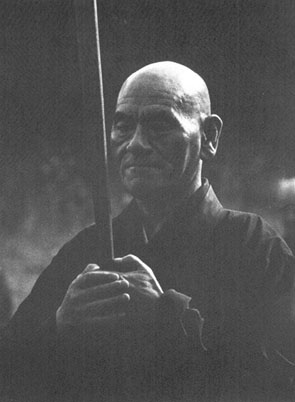
* * *

“What is the Buddha way?” It is to study the ego. “What is studying the ego?” To forget oneself. . . . “Do not think. Do not search. Do not desire. Do not hold yourself back. Do not obtain. Do not give up.” (66)

* * *

You must kill yourself, kill your own spirit. (69)

* * *

“The moon’s reflection in the river water does not move, does not flow. It’s only the water which is passing.” . . . If one wants to explain the relationships between spirit, consciousness, and the true self, it is exactly like the relationships between the Moon, its reflection, and the river water. (69-70)

* * *

In Budo, consciousness and action must always be a unity. At first, in aikido, kendo, etc., one repeats the wasa, the techniques, and the kata, the forms. One repeats them constantly for two or three years. The kata and wasa, the forms and techniques, also become a habit. At first to practice them, one must use one’s personal consciousness. It is the same in playing the piano, the drum, or the guitar, for example. At the end, it is possible to play unconsciously, without attachment anymore, without using the principles anymore. One can play naturally, automatically. It is possible to create something fresh by this wisdom. And it is the same in our daily life. This is Zen, the spirit of the Way.

The great works of art are created beyond technique. In the field of technology and science, the great discoveries go beyond principles and techniques. To be attached to only one idea, one category, one system of values, is a false conception, contrary to the laws of life and of the Way. (81)

* * *

If we only think about the result, the fruits [of our actions] with our personal consciousness, then we cannot concentrate nor evacuate our full energy. If we only make the make, the greatest fruits will then appear, unconsciously, naturally. Practice without consciousness is better than conscious practice. (83)

* * *

There need only be neither love nor hatred
For understanding to appear
Spontaneously clear
Like the light of day in a cave.

— From the Shin Jin Mei (Poem on Faith and Mind, 89)[7] [8]

* * *

[How can one exercise one’s ki?[8] [9]] By practicing zazen! (People laugh.) But also by training oneself in combat, in action. Today, children are too weak: modern education makes them weak, soft, ki-less. Master Obaku always educated with his kyosaku (staff) by striking great blows upon this follower who was too intelligent, asked too many questions, and always analyzed each situation with his conscious mind. (102-3)

* * *

taisen-Deshimaru_5833.jpeg

There is no reason to be afraid of anything. Those who are afraid are too selfish, think only of themselves. One must abandon one’s ego, then fear vanishes. When you always go against, fear arises. Even in a fight, one must have the same consciousness as one’s opponent and not go against, but with. This is a great koan.[9] [10]

One must become the situation and not differentiate oneself from it. A selfish being can never be brave, never. The true traditional education of the martial arts strengthens ki, destroys egoism and fear, makes one abandon the dualistic spirit, and develop mushin consciousness,[10] [11] which forgets the self.

No need to want to win; only then can one win.

To abandon the ego . . . That is the secret to the right life. The strengthening of the will, strength, and skill are necessary in life as in the practice of the martial arts. But to strengthen the spirit and find one’s freedom remain essential!

Mushin . . . nothingness. (103)

* * *

[Does the spirit remain?] Perhaps. I don’t agree with the Western theories which separate body and spirit. The spirit needs a form to realize itself, therefore a body. Also, if a body is dead, what we know under the name of spirit also dies, returns to the cosmic energy. Our ki, upon death, returns to the cosmos.

The real problem remains: where does all this come from? (105)

* * *

Another factor in the loss of ki, especially in modern civilization, is dispersion, mental agitation, anxiety, disordered thoughts: today, we use the frontal lobes too much, whereas one should develop the unconscious activity of the hypothalamus to strengthen the deep brain, intuition, instinct. And the lack of vital energy is making everyone sick: everyone is more or less sick today. (106)

* * *

To know how to concentrate is to put one’s ki, one’s vital energy, in one single action at a time.

Training in concentration means that, little by little, one knows how to concentrate on one thing at a time, but also to be conscious of everything which is happening around us. . . . In general, we need to fully concentrate in each situation. Here, now, I drink water; to only do this, to drink water. To concentrate on the water I drink. And so forth. No need to think too much! . . .

Concentration is acquired through training: to be concentrated on each gesture. To return to the normal state of the body and the mind. In the end, will plays no more role, it is done automatically, naturally, unconsciously. Without fatigue. Whereas with the will, the frontal lobes become tired, and with them, the entire being. During fights, the lower dan[11] [12] tire quickly because they are tense, always ask themselves what they should do, when to act, and so on. It’s the same thing for an actor who thinks about his role while acting, he is bad: he must live his role, that’s all, commit himself completely. . . . (107-8)

* * *

[What is the Way?] To look at one’s consciousness, here and now . . . and the Zen koan says: the Way is under your feet. (108)

* * *

[T]he martial arts ultimately aim to keep oneself alive in the face of contrary forces, whereas zazen resolves the question of death. I often say: practicing zazen is likely entering your coffin because, in the end, you abandon everything. . . . It follows that in being alive, we need to concentrate on life and the approach of death, we need to abandon life and know how to die. That is wisdom. But what is life, what is death?

Then, if we want to really live, we need to know death within oneself. Life is a succession of here-and-nows: one needs to constantly concentrate, in the here and now. People, who are worried by the future or the past, do not realize the illusion in which they live. One must resolve the contradiction in oneself, the contradiction carried by the brain itself. (108-9)

* * *

[What should I do when I am attacked? One cannot think of all these things at once.] Don’t think, of course! But react with wisdom. One must always be wise. If you are attacked by someone stronger than you and you really don’t feel you are up to size, it is better to flee! No need to get whooped! (People laugh.) Otherwise, one needs to fight. Without passion, with instinct, strength, and wisdom. (109)

* * *

td.jpg

By reflecting on oneself, one can then see the imperfections of one’s karma and control the bonno,[12] [13] desires, and passions. And in this zazen is the great mirror to ourselves which allows us to improve ourselves. If in life there is no such practice which rebalances tendencies, we develop only a part of ourselves. One becomes, one way or another, too spiritualist or too materialist. That is the mistake of all of modern civilization and the cause of the current crisis. (110)

* * *

. . . understand that your life is nothing but a dream, a bubble, a shadow . . . Your death will come soon: never forget this from one moment of consciousness to another, from each breath in to each breath out. (118)

* * *

With a long experience, and thanks to the infinite merits of zazen, you will understand all this unconsciously . . . Nor is it from one day to the next that we will become sensitive to the goodness of the people with whom we live. On the Buddha-Way, you must always keep hope without ever tiring, whether this be in happiness or misfortune. . . .

It is within us that is found the root, the origin of life and death. (121)

* * *

If the mind is calm, the body can act spontaneously; action then becomes free and easy. If one always uses one’s conscious mind, the body is constrained in its action. (131)

* * *

Nowadays people are too chatty. When they talk, they only speak according to the result of the words, at a superficial level, to be polite, out of interest or competition. Human interrelations become complexity, worry, and pride. By the practice of zazen, we learn to have direct, natural ties, not influenced by our ego, and we also learn the merits of silence. (134)

* * *

“To study the Buddha-Way is to study oneself; to study oneself is to abandon the ego; to abandon to ego is to melt into the whole cosmos.” (136)

* * *

Cosmic energy is concentrated in the lower belly, and in particular in the genitals. Sexual energy, indeed, is the primary manifestation of this universal life in us, and enables the relationship between the life of the universe and individual life, between the world of phenomena and the invisible world of ku. . . .

Sexual energy during procreation enables the manifestation of the force (ki) of universal life in the phenomenal world. (137)

* * *

In Europe, the philosophers have tried to realize this fusion between mind and matter, but only at a superficial, purely intellectual level. (138)

Notes

[1] [14] The martial arts. The Way of the samurai, to be precise: bushido. Budo is the way of combat. But the kanji bu really means: to stop the sword, to stop using the sword, to cease fighting. [Unless otherwise indicated, footnotes are taken from Zen et arts martiaux’s Glossary. – GD]

[2] [15] Seated meditation. – GD

[3] [16] Thinking without thinking. Beyond thought.

[4] [17] Vacuity. Existence without a noumenon. In Buddhism, it also means: the Invisible. A notion identical with the notion of God.

[5] [18] For subir. – GD

 [6] A “form” in Budo. All the martial arts – judo, kendo, aikido, etc. – have kata: forms, actions, training exercises aimed at winning. The beginners must learn the kata, internalize them, use them, and then create based on them, from this original and specific form unique to each of the martial arts.

[7] [19] Translated from the French. – GD

[8] [20] Invisible activity imbued with the energy of the cosmos. Becomes the energy of the body, in all its cells.

[9] [21] A Zen riddle, often apparently absurd. – GD

[10] [22] “Mind without mind,” a kind of detached activity, comparable to “flow.” – GD

[11] [23] A rank in Eastern martial arts. – GD

[12] [24] Illusions, attachments. – GD


Article printed from Counter-Currents Publishing: https://www.counter-currents.com

URL to article: https://www.counter-currents.com/2019/05/zen-martial-arts/

URLs in this post:

[1] Image: https://www.counter-currents.com/wp-content/uploads/2019/05/5-31-19-2.jpg

[2] [1]: #_ftn1

[3] [2]: #_ftn2

[4] [3]: #_ftn3

[5] [4]: #_ftn4

[6] [5]: #_ftn5

[7] [6]: #_ftn6

[8] [7]: #_ftn7

[9] [8]: #_ftn8

[10] [9]: #_ftn9

[11] [10]: #_ftn10

[12] [11]: #_ftn11

[13] [12]: #_ftn12

[14] [1]: #_ftnref1

[15] [2]: #_ftnref2

[16] [3]: #_ftnref3

[17] [4]: #_ftnref4

[18] [5]: #_ftnref5

[19] [7]: #_ftnref7

[20] [8]: #_ftnref8

[21] [9]: #_ftnref9

[22] [10]: #_ftnref10

[23] [11]: #_ftnref11

[24] [12]: #_ftnref12


lundi, 27 mai 2019

Analysis of "Men Among the Ruins" (Kulturkampf Podcast)

evolamar.jpg

Analysis of "Men Among the Ruins" (Kulturkampf Podcast)

Full episode about Julius Evola's most political work - "Men Among the Ruins" which was written after the second World War. It has previously been taken off youtube.
 

mardi, 21 mai 2019

Guénon et le rejet des élites en Chine ancienne

chinois.jpg

Guénon et le rejet des élites en Chine ancienne

Les Carnets de Nicolas Bonnal

Ex: http://www.dedefensa.org

Les élites sont rejetées ou carrément craintes maintenant en occident, et la grande élection de Trump aura marqué ce moment, comme le reconnaissait Nassim Nicholas Taleb. Ce penchant anarchiste – ou libertaire-libertarien – est très marqué dans notre vague mondiale de contestation antitout et je lui trouve sinon une origine, du moins un beau précédent – en Chine ancienne. Pays du nombre et de la récurrente organisation totalitaire et massifiée, la Chine a été aussi, dans une lointaine antiquité, le pays du rejet de cette organisation.

Il y a vingt-cinq siècles donc les gilets/périls jaunes existent en Chine et rejettent, avec les penseurs taoïstes, la hiérarchie, l’empereur, la bureaucratie, l’armée et les fameux « lettrés » alors incarnés par Confucius. On se référera ici surtout à Tchouang-Tseu.

Et comme René Guénon, cet immense et si traditionnel auteur n’en veut pas au peuple :

« Petits mais respectables sont les êtres qui remplissent le monde. Humble mais nécessaire est le peuple. »

J’ai cité Guénon, et ce n’est pas pour rien. Un bref rappel de sa vieille crise du monde moderne que j’ai étudiée ici-même :

« Au VIe siècle avant l’ère chrétienne, il se produisit, quelle qu’en ait été la cause, des changements considérables chez presque tous les peuples ; ces changements présentèrent d’ailleurs des caractères différents suivant les pays. Dans certains cas, ce fut une réadaptation de la tradition à des conditions autres que celles qui avaient existé antérieurement, réadaptation qui s’accomplit en un sens rigoureusement orthodoxe ; c’est ce qui eut lieu notamment en Chine, où la doctrine, primitivement constituée en un ensemble unique, fut alors divisée en deux parties nettement distinctes : le Taoïsme, réservé à une élite, et comprenant la métaphysique pure et les sciences traditionnelles d’ordre proprement spéculatif ; le Confucianisme, commun à tous sans distinction, et ayant pour domaine les applications pratiques et principalement sociales. »

Guénon a ici tort de notre point de vue ; la pensée taoïste, puisqu’elle va au Principe, se moque de la Tradition, des rites, de la musique, et elle humilie Confucius au service de ses maîtres et des cruels guerriers. Mais il ajoute :

« Dans l’Inde, on vit naître alors le Bouddhisme, qui, quel qu’ait été d’ailleurs son caractère originel, devait aboutir, au contraire, tout au moins dans certaines de ses branches, à une révolte contre l’esprit traditionnel, allant jusqu’à la négation de toute autorité, jusqu’à une véritable anarchie, au sens étymologique d’« absence de principe », dans l’ordre intellectuel et dans l’ordre social. »

Cela s’applique parfaitement à la pensée anarchiste-taoïste de cette époque.

Je rappelle pourquoi pour Guénon cette époque est importante :

mandarin.jpg« En nous rapprochant de l’Occident,… le VIe siècle fut le point de départ de la civilisation dite « classique », la seule à laquelle les modernes reconnaissent le caractère « historique », et tout ce qui précède est assez mal connu pour être traité de « légendaire », bien que les découvertes archéologiques récentes ne permettent plus de douter que, du moins, il y eut là une civilisation très réelle ; et nous avons quelques raisons de penser que cette première civilisation hellénique fut beaucoup plus intéressante intellectuellement que celle qui la suivit, et que leurs rapports ne sont pas sans offrir quelque analogie avec ceux qui existent entre l’Europe du moyen âge et l’Europe moderne. »

Mais on en revient au manège antiélitiste et antitraditionnel (au sens de sclérotique et de hiérarchique, c’est un rejet aussi de toute taxinomie) de notre taoïste Tchouang-Tseu. Pour lui les sages (ou intellectuels, ou politiciens, on dirait maintenant « experts ») ont gâché le monde et ils sont « des emballeurs de brigands » :

« Le vulgaire ferme, avec des liens solides et de fortes serrures, ses sacs et ses coffres, de peur que les petits voleurs n’y introduisent les mains.

Cela fait, il se croit et on le trouve sage. Survient un grand voleur, qui emporte sacs et coffres avec leurs liens et leurs serrures, très content qu’on lui ait si bien fait ses paquets. Et il se trouve que la sagesse de ces vulgaires avait consisté à préparer au voleur son butin.

Il en va de même en matière de gouvernement et d’administration. Ceux qu’on appelle communément les Sages ne sont que les emballeurs des brigands à venir. »

Ces lettrés sont critiqués car ils se mettent souvent au service des autorités :

« Les plus renommés d’entre les Sages historiques ont ainsi travaillé pour de grands voleurs, jusqu’au sacrifice de leur vie. Loung-fang fut décapité, Pi-kan fut éventré, Tch’ang-houng fut écartelé, Tzeu su périt dans les eaux.

Le comble, c’est que les brigands de profession appliquèrent aussi à leur manière les principes des Sages. »

Dans le même esprit, Lao Tsé a écrit (§ 57, traduction Stanislas Julien) :

« Plus le roi multiplie les prohibitions et les défenses, et plus le peuple s’appauvrit ; Plus le peuple a d’instruments de lucre, et plus le royaume se trouble ; Plus le peuple a d’adresse et d’habileté, et plus l’on voit fabriquer d’objets bizarres ; Plus les lois se manifestent, et plus les voleurs s’accroissent. »

tchouangtseu.jpgEt Tchouang-Tseu :

« Oui, l’apparition des Sages cause l’apparition des brigands, et la disparition des Sages cause la disparition des brigands. Sages et brigands, ces deux termes sont corrélatifs, l’un appelle l’autre, comme torrent et inondation, remblai et fossé. »

Et d’enfoncer nûment son clou :

« Je le répète, si la race des Sages venait à s’éteindre, les brigands disparaîtraient ; ce serait, en ce monde, la paix parfaite, sans querelles.

C’est parce que la race des Sages ne s’éteint pas qu’il y a toujours des brigands. Plus on emploiera de Sages à gouverner l’État, plus les brigands se multiplieront. »

Tchouang-Tseu recommande même les us et manières des…casseurs, « la civilisation étant une conspiration » (John Buchan) qui fait déchoir les hommes et par là le monde. Il est important de détruire la musique rituelle et, avec elle, instruments et outils :

« Détruisez radicalement toutes les institutions artificielles des Sages, et le peuple retrouvera son bon sens naturel. Abolissez la gamme des tons, brisez les instruments de musique, bouchez les oreilles des musiciens, et les hommes retrouveront l’ouïe naturelle. Abolissez l’échelle des couleurs et les lois de la peinture, crevez les yeux des peintres, et les hommes retrouveront la vue naturelle. Prohibez le pistolet et le cordeau, le compas et l’équerre ; cassez les doigts des menuisiers, et les hommes retrouveront les procédés naturels… »

Comme Hésiode ou Ovide, Tchouang-Tseu célèbre l’âge d’or, la Tradition primordiale, l’In Illo Tempore de Mircea Eliade. On cite Ovide (Métamorphoses, I, 94-107) :

« Les pins abattus sur les montagnes n’étaient pas encore descendus sur l’océan pour visiter des plages inconnues. Les mortels ne connaissaient d’autres rivages que ceux qui les avaient vus naître. Les cités n’étaient défendues ni par des fossés profonds ni par des remparts. »

Ovide poursuit :

« La terre, sans être sollicitée par le fer, ouvrait son sein, et, fertile sans culture, produisait tout d’elle-même. L’homme, satisfait des aliments que la nature lui offrait sans effort, cueillait les fruits de l’arbousier et du cornouiller, la fraise des montagnes, la mûre sauvage qui croît sur la ronce épineuse, et le gland qui tombait de l’arbre de Jupiter. C’était alors le règne d’un printemps éternel. »

Et on reprend Tchouang-Tseu :

« Ils trouvaient bonne leur grossière nourriture, bons aussi leurs simples vêtements. Ils étaient heureux avec leurs mœurs primitives et paisibles dans leurs pauvres habitations. Le besoin d’avoir des relations avec autrui ne les tourmentait pas. Ils mouraient de vieillesse avant d’avoir fait visite à la principauté voisine, qu’ils avaient vue de loin toute leur vie, dont ils avaient entendu chaque jour les coqs et les chiens. En ces temps-là, à cause de ces mœurs-là, la paix et l’ordre étaient absolus. »

tchouanggrandlivre.jpgLe développement intellectuel, administratif et bureaucratique est cause de la décadence. Tchouang-Tseu :

« L’invention de la sophistique, traîtresse et venimeuse, avec ses théories sur la substance et les accidents, avec ses arguties sur l’identité et la différence, a troublé la simplicité du vulgaire. »

Et de taper sur les sophistes comme un bon Socrate :

« Oui, l’amour de la science, des inventions et des innovations est responsable de tous les maux de ce monde. Préoccupés d’apprendre ce qu’ils ne savent pas (la vaine science des sophistes), les hommes désapprennent ce qu’ils savent (les vérités naturelles de bon sens).

Préoccupés de critiquer les opinions des autres, ils ferment les yeux sur leurs propres erreurs. »

Le désordre moral rejaillit sur la nature :

« De là un désordre moral, qui se répercute au ciel sur le soleil et la lune, en terre sur les monts et les fleuves, dans l’espace médian sur les quatre saisons, et jusque sur les insectes qui grouillent et pullulent à contretemps (sauterelles, etc.). Tous les êtres sont en train de perdre la propriété de leur nature. C’est l’amour de la science qui a causé ce désordre. »

Shakespeare fait dire comme on sait à Titania à la fin de son fameux monologue (il ne s’agit pas du tout de faire de la littérature comparée, mais d’établir des correspondances traditionnelles) :

« Le printemps, l’été, le fertile automne, l’hiver chagrin, échangent leur livrée ordinaire ; et le monde étonné ne peut plus les distinguer par leurs productions. Toute cette série de maux provient de nos débats et de nos dissensions ; c’est nous qui en sommes les auteurs et la source… »

Mais on en revient à l’étonnante modernité de Tchouang-Tseu, à sa rage anti-verbeuse :

 « Depuis dix-huit siècles, on s’est habitué à faire fi de la simplicité naturelle, à faire cas de la fourberie rituelle ; ou s’est habitué à préférer une politique verbeuse et fallacieuse au non-agir franc et loyal. Ce sont les bavards (sages, politiciens, rhéteurs), qui ont mis le désordre dans le monde. »

La sophistication est alors telle que notre penseur dénonce un gouvernement mathématique :

« Tout le monde voulut devenir savant pour parvenir, et le peuple s’épuisa en vains efforts. C’est alors que fut inventé le système de gouvernement mathématique.

L’empire fut équarri avec la hache et la scie. Peine de mort pour tout ce qui déviait de la ligne droite. Le marteau et le ciseau furent appliqués aux mœurs. »

C’est la révolte contre la méga-machine de Lewis Mumford, qui lui analysait l’Egypte. Mais restons-en là : alors arrive une révolte façon gilets jaunes :

« Le résultat fut un bouleversement, un écroulement général. C’est que le législateur avait eu le tort de violenter le cœur humain. Le peuple s’en prit aux Sages et aux princes. Les Sages durent se cacher dans les cavernes des montagnes, et les princes ne furent plus en sûreté dans leurs temples de famille. »

La rage de Tchouang-Tseu devient donc destructrice :

 « Il a raison, l’adage qui dit : exterminez la sagesse, détruisez la science, et l’empire reviendra à l’ordre spontanément. »

Et de finir sur cette étonnante question rhétorique :

« Qui trouble l’empire, qui violente la nature, qui empêche l’action du ciel et de la terre ? qui inquiète les animaux, trouble le sommeil des oiseaux, nuit jusqu’aux plantes et aux insectes ? qui, si ce n’est les politiciens, avec leurs systèmes pour gouverner les hommes ? ! »

Le secret serait de laisser le monde tel quel (le rêve libertarien de Rothbard) :

« Il faut laisser le monde aller son train, et ne pas prétendre le gouverner. Autrement les natures viciées n’agiront plus naturellement (mais artificiellement, légalement, rituellement, etc.). Quand toutes les natures, étant saines, se tiennent et agissent dans leur sphère propre, alors le monde est gouverné, naturellement et de lui-même ; pas n’est besoin d’intervenir. »

Sources

Ovide – Métamorphoses, I, traduction Villenave (ebooksgratuits.com)

Shakespeare – le songe d’une nuit d’été, II, 2 (ebooksgratuits.com)

Zhuang Zi – Œuvre de Tchouang-Tseu

René Guénon – La crise du monde moderne, pp. 21-23 (classiques.uqac.ca)

Tao Te King – Lao Tsé – Livre de la Voie et de la Vertu, traduction Julien

vendredi, 10 mai 2019

Evola and Neo-Eurasianism

evolalivre.jpg

Evola and Neo-Eurasianism

Ex: https://www.geopolitica.ru

We must understand Julius Evola’s work in the same vein as we understand Heidegger’s approach to metaphysics and Western civilization.

While we can know, for sure, that the current state of Western civilization no longer resembles, in toto, the idealistic image once pictured by Heidegger and Spengler, we must be aware that their work constitutes an important and vital watershed.

The spirit of of old Europe is alive in Heidegger’s work, just as much as in Evola’s work. Both represent the spirit of an age that knew – intimately, perhaps – the Nietzschean drive to its deep modernistic roots and its essence, and perhaps could be depicted in a certain sense as representing the age of the (aspiring) Overman, the active nihilist, and of the regimes that sought a new model of man – many of them Fascist, Communist or even Liberal – as opposed to the current age of the Last Man, a man who has lost the Faustian drive almost entirely and therefore succumbed to passive nihilism, and to the spirit of an age that has fully transitioned from Modernity to Post-Modernity. An age that now consequently, in our current epoch, faces complete dissolution.

Evola addresses this age of dissolution just as intensively and concisely as Heidegger deconstructs the essence of Western logos and of its Metaphysics focused on unreal abstract presences, on reified essences, and on the thinking subject.

We must understand Evola as a savant who was deeply aware of his own role within the End Times, and the sort of distillation, of objectivity (sachlichkeit), that would be necessary in confronting the dimensions and challenges given in our age. We must sense, in him, a man who grasped the inevitable dissolution and destruction of the standards of the bourgeois era, and the age of so-called “Old” Europe, of the Europe that was still recognizable to a man like Oswald Spengler, and about whose inevitable destiny Goebbels firmly proclaimed – as he spoke, during the aftermath of the Dresden bombing and the late 2nd major global confrontation: “all of old Europe comes crashing down, and will be buried, with this war. With this conflict, comes down the ruin of the bourgeois age.” [rough translation]

Even if this fundamentally correct intuition did not come in the style of perverted Nazi dreams, with the construction of the fascist Neue Ordnung, but instead with the building of a demented, sick, geriatric and nihilistic liberal regime within an Americanized mold, we must still see in Evola a sort of logical conclusion to the presuppositions that have so far underlined the later stages of European reaction.

Evola must be understood as constituting the bridge from late Western European continental thought, to Tradition as we should know, and properly understand in the conception that must underlie the foundations of a new, post-liberal civilization that we – as men of the Midnight – must necessarily aspire to.

The very movement of Evola’s life, from the Absolute Idealism of his youth, towards the Neo-Platonic intellectual rigidity, the cemented and refined orthodoxy of the “late” Evola, is indicative of the way that we should take in our age.

Evola wrote precisely for us, the men of the midnight. His writings concerned not just the critique of late Western metaphysics, from a partial point of view that is perhaps much more complete in the work of Rene Guenon and Martin Heidegger, but carries in itself the apocalyptic and eschatological vision of the End – although within Evola’s work, we must understand the undertones of this view of the End Times as being fundamentally different from the Semitic bluster of emotions that have characterized our understanding of the term within Christian civilization.

Evola’s view of the End Times is strictly aligned with a different Orthodoxy, namely, that of Platonism, Hermeticism, Buddhism in its early purer form, and also Samkhya, Advaita and other such currents that can still be discerned in our age. In them, while the End Times and the Dark Age form a coherent given, there’s a marked absence of the pathos of the Semitic type within the scope of these alternative traditional teachings.

The current age of liberal decadence, of the end of Western humanity, must be understood within the aegis and scope of the broad movement of dissolution, of fragmentation, that precedes the end of the cycle. And this is followed, markedly, by the search for transcendence in a world that has become meaningless, formless, objectified, banal and the passive receptacle of a process very similar to the fetish of commodities described by Marxist ideologues. And within this dystopian world of the late times, we can also witness the correspondence made in a very precise fashion with the age of the fourth caste, the age of the Sudra – characterized for instance by the domination of the formless mass man, of pure quantity and of machines – as opposed to the previous bourgeois age that retained the remnants of deeper, older organic elements.

eurasia.jpg

Within this age, and within the West, we must acknowledge that everything that was still organic and traditional in the previous “bourgeois” age, that ended most definitely in 1945, is now coming to an end or has already been destroyed. The anti-modernist teaching of the Roman Church was killed and buried together with its ceremonial and liturgical core, and so were the remnants of the organic, pre and anti-modern social elements, like the aristocracy, the clergy, and the broad aristocratic and hierarchical structures that still played their role in granting a deep and effective sense of societal and personal differentiation no longer present in our day and age.

In our age, which is marked deeply by the liberal and also former Communist erosion of all the remaining standards of organic civilization, we cannot count on the luxury of having the old models and superstructures present within our current milieu. The organic society of the Renaissance, and its predecessor, the organic society of the Middle Ages, are now but a distant memory. What is present right now is precisely the inorganic model of the civilized, late liberal world, that drags itself inexorably towards a vortex of imbecility, downwards leveling of the social structure, and also self-disintegration. Of this, we can only take into account the brilliant work “Jihad vs McWorld”, the sort of book that bears a title very fitting to the current age of Spenglerian early Caesarism, money politics, and solidification.

We have already discussed briefly here and elsewhere the nature of this age. And now, we must understand that when the West lies close to its stage of effective mortality, the initiative must be seized decisively towards a new direction. This initiative consists in the gathering of the men of the Midnight, the differentiated men who “ride the tiger”, to the construction of a new paradigm that must necessarily come after the deep, dark night of Western modernity, and that shall come to the fore as the necessary civilizing Traditional force over a world in ruins. Of a world that has lost sight of itself, and has submerged itself into the most elementary and animal-like barbarity.

L’altro ’68 tra Julius Evola e Jan Palach

evola.jpg

L’altro ’68 tra Julius Evola e Jan Palach

da Giovanni Sessa
Ex: http://www.barbadillo.it

Molti dei mali del nostro tempo hanno avuto una lunga incubazione storica. Non può, però, essere messo in dubbio che, un momento di evidente accelerazione dei processi di crisi, si sia mostrato, in modo lapalissiano, nel tanto mitizzato 1968 e nella contestazione studentesca. Due recenti pubblicazioni vengono, opportunamente, a ricordarcelo. Si tratta di Julius Evola, Scritti sul ’68, comparso nel catalogo dell’editore l’Arco e la Corte (per ordini: arcoelacorte@libero.it, pp. 130, euro 15,00), e del volume di Petr Vyoral, Jan Palach, Praga 1969. Una torcia nella notte, di recente nelle librerie per Ferrogallico (per ordini: info@ferrogallico.it, pp. 111, euro 15,00).

9788894398328_0_306_0_75.jpg   Il primo libro, come ricorda nell’informata Premessa Alessandro Barbera, raccoglie gli articoli che Evola pubblicò su il Borghese nel biennio 1968-1969, aventi per tema la contestazione, due suoi scritti apparsi su Il Conciliatore, nonché un’intervista rilasciata, per lo stesso mensile, a Gianfranco de Turris. Infine, un articolo pubblicato sul Roma nel 1971 e il capitolo tratto da L’arco e la clava, intitolato La gioventù, i beats e gli anarchici di destra. Chiude il volume, un’Appendice che riunisce scritti di Mario Tedeschi, Giano Accame ed Adriano Romualdi. Dalla lettura è possibile evincere l’effettiva posizione che il filosofo assunse nei confronti del movimento studentesco. Evola iniziò la propria collaborazione a il Borghese di Tedeschi, per chiamata diretta dello stesso Direttore. Questi non condivideva le posizioni fatte proprie, in tema di movimento studentesco e «cinesi» all’Università, da Giano Accame, intelligenza scomoda formatasi sui testi di Evola, ma aperta, lo ricorda Barbera, alla modernità. Mentre Accame rilevava assonanze teoriche di fondo tra il pensiero di Tradizione ed alcuni assunti teorici espressi dai francofortesi, gli interventi Evola, misero in luce come, nell’antropologia disegnata da Marcuse, emergesse un debito rilevante nei confronti del freudismo.

   L’uomo che i contestatori avevano in vista per il superamento della società ad una dimensione, vedeva il prevalere della spinta meramente pulsionale, legata ad un’idea di libertà quale puro svincolo, libertà-da e non libertà-per. Inoltre, Evola espresse una critica radicale del maoismo, ideologia sostanziata dal marxismo e da un nazionalismo collettivistico, del tutto alieno dall’idea di comunità tradizionale. Ciò lo indusse a prendere, con chiarezza, le distanze dai gruppi nazi-maoisti che sostenevano di ispirarsi alle sue idee, come ribadito anche nell’intervista concessa a de Turris. Sulle medesime posizioni si schierò lo stesso Adriano Romualdi. La vera urgenza, per Evola, non andava individuata nella contestazione al sistema, ma nella Rivolta contro l’intera civiltà moderna. Non esistendo strutture politiche, né partitiche, atte a tanto, sarebbe stato necessario dedicarsi alla formazione personale, spirituale ed esistenziale, per farsi trovare pronti al momento opportuno. Evola fu, dunque, lungimirante.

    Comprese che il ’68 era funzionale al sistema e che i contestatori avrebbero semplicemente scardinato, a favore dei padroni del vapore, il ruolo dei corpi intermedi, della famiglia, avrebbero soprattutto messo in atto l’assassinio del Padre, indispensabile figura della trasmissione della Tradizione, al fine di liberare l’energia sovversiva del capitalismo, fino ai limiti estremi. Coglie nel segno, nella postfazione, Manlio Triggiani nel sostenere che Evola criticò, ad un tempo, i contestatori, e quanti a destra svolsero il ruolo di guardie bianche del sistema, «liberando» le Università dai «cinesi» che le occupavano. Comprese, che, per costruire un Nuovo Inizio europeo, sarebbe stato necessario lasciarsi alle spalle la mera nostalgia, così come gli sterili richiami patriottardi.

   Il secondo volume che presentiamo è dedicato a Jan Palach e richiama l’attenzione sull’Altro Sessantotto, quello combattuto, oltre la cortina di ferro, non dai figli della borghesia americanizzata dell’Occidente, dai narcisi à la page, ma dai figli del popolo che lottavano per affermare, sacrificando la propria vita, la dignità dell’uomo e della Tradizione. Il libro è costituito da testi e da disegni. Presenta in modalità decisamente accattivante, nel fumetto ottimamente realizzato da Vyoral, la storia, personale e politica, di Jan Palach, «torcia n. 1» che il 16 gennaio 1969, in piazza  san Venceslao a Praga, si diede fuoco per protestare, non solo contro l’occupazione del suo paese da parte delle truppe sovietiche ma, ancor di più, per suscitare una reazione forte nei confronti dell’asfissia prodotta dal sistema comunista. La primavera di Praga era stata stroncata nel sangue: non si trattava di «riformare» il comunismo, ma di sconfiggerlo. Il fumetto è accompagnato e completato dai testi di Emanuele Ricucci, autore della Prefazione, e di Umberto Maiorca, a cui si deve la Postfazione. Il primo ricostruisce, con toni lirici e appassionati, le tragiche vicende del giovane studente universitario ceco, ricordando quanto asserito da Marcello Veneziani: «i sessantottini incendiarono il mondo pensando a sé stessi, mentre Palach incendiò se stesso pensando al mondo» (p. 7). Maiorca ripercorre, in modo organico e compiuto, la breve esistenza di Jan, sottolineando, a beneficio del lettore, che nei Paesi dell’Est europeo, molte furono, in quegli anni, le torce che si accesero, perché la verità tornasse a riempire, luminosa, la vita offesa dal comunismo. Il 25 gennaio 1969, si svolsero i funerali del martire: «in una Praga avvolta dal silenzio e da una pioggia sottile […] sotto un cielo grigio seicentomila persone scendono in strada» (p. 96).

palach.jpg

  I suoi resti mortali non trovarono pace. La sua tomba divenne luogo di culto e di pellegrinaggio, che il regime non poteva tollerare. Il corpo venne riesumato, cremato, e le ceneri consegnate alla madre. Solo nel 1974 furono nuovamente sepolte, ma sulla tomba, perché non fosse riconosciuta, comparvero le sole iniziali del nome, «J. P.». Il senso comune contemporaneo tende a relegare gesti come quelli di Palach, nelle forme del patologico, riducendolo alla categoria della «follia». Ciò è naturale, la società post-moderna non riconoscendo più il Padre, il precedente autorevole, può mai comprendere la quint’essenza dell’Eroe? Jan Palach l’ha pienamente incarnata. Resterà per sempre simbolo del nostro Sessantotto.

@barbadilloit

Di Giovanni Sessa

lundi, 08 avril 2019

Yggdrasil - l'arbre mondes

weltesche.jpg

Yggdrasil - l'arbre mondes

Yggdrasil est au cœur de la mythologie nordique dont il relie les neuf mondes.
Mais quelle est son histoire ?
Plus d'info sur le site ici: http://mythesetlegendes.wix.com/mythe...
Vidéo d'introduction: Yann Texte/montage/voix: illifire
Musiques: DC Love Go Go - Silent Partner Donors - Letter Box
Ending template: RAVEN DESIGN
 
Bibliographie:
BOYER Régis, L'Edda poétique, éd. Fayard, Daumont, 2010
BOYER Régis, Snorri Sturluson, le plus grand écrivain islandais du Moyen Âge, éd. Orep, coll. Héritages Vikings, Bayeux, 2012
Dillmann F.-X., L'Edda, récits de mythologie nordique par Snorri Sturluson, éd. Gallimard, coll. L'aube des peuples, 2014
DUMEZIL Georges, Mythes et dieux des Indo-Européens, Loki, Heur et malheur du guerrier, éd. Flammarion, Lonrai, 2011.
GUELPA Patrick, Dieux et mythes nordiques, éd. Presses Universitaires du Septentrion, Paris, 1998
KERSHAW Kris, The One-eyed God, Odin and the (Indo-)Germanic Männerbünd, Journal of Indo-European Studies Monograph Number Thirty-Six, Washington D.C., 2000.
MIRZA Sandrine, La mythologie, éd. Gallimard Jeunesse, coll. Tothème, Paris, 2010.
STURLUSON Snorri, Edda, récits de mythologie nordique, éd. Gallimard, France, 2014
THIBAUD Robert-Jacques, Dictionnaire de mythologie et de symbolique nordique et germanique, éd. Dervy, Clamecy, 2009.
 

dimanche, 07 avril 2019

Devotion of the Celtic Warrior Class

Celtic-warriors-2-1.jpg

Devotion of the Celtic Warrior Class

In the Gests of most Indo-European mythical war episodes, the chief, or king, has the responsibility to instruct and lead his fellow warriors into battle in order to ensure the protection of the subjects he defends. In this situation, he acts as a military officer according to the duties of the first function of teachers and instructors. These duties and responsibilities were defined and conditioned by set statutory rules. As Georges Dumézil explained in The Destiny of the Warrior, the central motif of the Indo-European tripartite ideology was one of force, protection, sovereignty, prosperity, and fecundity. The main purpose of sacred royalty is to maintain organization and capitalization in order to withhold the kingdom’s balance of power and justice. But before reaching chieftain-hood, or kingship, the young warrior must undergo a series of ritual initiations. This, before he is to become an accomplished combatant tested in battle.
 
Article on Academia: Devotion of The Celtic Warrior Class : Celtic Warrior class Devotion_Boutet.pdf
 

mercredi, 03 avril 2019

René Guénon et notre civilisation hallucinatoire

guenoncitation.jpg

René Guénon et notre civilisation hallucinatoire

Les Carnets de Nicolas Bonnal

Ex: http://www.dedefensa.org

Il est évident que nous vivons sous hypnose : abrutissement médiatique/pédagogique, journaux, actus en bandeaux, « tout m’afflige et me nuit, et conspire à me nuire. » Mais cette hypnose est ancienne et explique aussi bien l’ère d’un Cromwell que celle d’un Robespierre ou d’un Luther-Calvin. L’occident est malade depuis plus longtemps que la télé…O Gutenberg…

Je redécouvre des pages extraordinaires de Guénon en relisant Orient et Occident. Il y dénonce le caractère fictif de la notion de civilisation ; puis son caractère hallucinatoire à notre civilisation ; enfin son racisme et son intolérance permanentes (sus aux jaunes ou aux musulmans, dont les pays – voyez le classement des pays par meurtre sur Wikipédia – sont les moins violents au monde). Problème : cette anti-civilisation dont les conservateurs se repaissent, est la fois destructrice et suicidaire. Exemple : on détruit des dizaines de pays ou des styles de vie pour se faire plus vite remplacer physiquement (puisque métaphysiquement nous sommes déjà zombis)…

Voyons Guénon :

« La vie des mots n’est pas indépendante de la vie des idées. Le mot de civilisation, dont nos ancêtres se passaient fort bien, peut-être parce qu’ils avaient la chose, s’est répandu au XIXe siècle sous l’influence d’idées nouvelles…Ainsi, ces deux idées de « civilisation » et de « progrès », qui sont fort étroitement associées, ne datent l’une et l’autre que de la seconde moitié du XVIIIe siècle, c’est-à-dire de l’époque qui, entre autres choses, vit naître aussi le matérialisme; et elles furent surtout propagées et popularisées par les rêveurs socialistes du début du XIXe siècle.»

Guénon pense comme le Valéry de Regards (1) que l’histoire est une science truquée servant des agendas :

« L’histoire vraie peut être dangereuse pour certains intérêts politiques ; et on est en droit de se demander si ce n’est pas pour cette raison que certaines méthodes, en ce domaine, sont imposées officiellement à l’exclusion de toutes les autres : consciemment ou non, on écarte a priori tout ce qui permettrait de voir clair en bien des choses, et c’est ainsi que se forme l’« opinion publique ».

Puis il  fait le procès de nos grands mots (comme disait Céline : le latin, le latinisant en particulier estconifié par les mots), les mots à majuscule du monde moderne :

« …si l’on veut prendre les mêmes mots dans un sens absolu, ils ne correspondent plus à aucune réalité, et c’est justement alors qu’ils représentent ces idées nouvelles qui n’ont cours que moins de deux siècles, et dans le seul Occident. Certes, « le Progrès » et « la Civilisation », avec des majuscules, cela peut faire un excellent effet dans certaines phrases aussi creuses que déclamatoires, très propres à impressionner la foule pour qui la parole sert moins à exprimer la pensée qu’à suppléer à son absence ; à ce titre, cela joue un rôle des plus importants dans l’arsenal de formules dont les « dirigeants » contemporains se servent pour accomplir la singulière œuvre de suggestion collective sans laquelle la mentalité spécifiquement moderne ne saurait subsister bien longtemps. »

rg-quantité.jpgIl a évoqué la suggestion comme Gustave Le Bon. Il va même parler d’hypnose, notre René Guénon !

«  À cet égard, nous ne croyons pas qu’on ait jamais remarqué suffisamment l’analogie, pourtant frappante, que l’action de l’orateur, notamment, présente avec celle de l’hypnotiseur (et celle du dompteur est également du même ordre) ; nous signalons en passant ce sujet d’études à l’attention des psychologues. Sans doute, le pouvoir des mots s’est déjà exercé plus ou moins en d’autres temps que le nôtre ; mais ce dont on n’a pas d’exemple, c’est cette gigantesque hallucination collective par laquelle toute une partie de l’humanité en est arrivée à prendre les plus vaines chimères pour d’incontestables réalités ; et, parmi ces idoles de l’esprit moderne, celles que nous dénonçons présentement sont peut-être les plus pernicieuses de toutes. »

A l’époque moderne, le mot devient une idole. TS Eliot en parle aussi dans un poème célèbre, les chorus :

Words that have taken the place of thoughts and feelings…

La science ne nous sauve en rien, bien au contraire. Autre nom à majuscule, elle sert aussi notre mise en hypnose (pour René Guénon, aucun mot à particule n’a de sens sérieux, et il est important de le noter) :

« La civilisation occidentale moderne a, entre autres prétentions, celle d’être éminemment « scientifique » ; il serait bon de préciser un peu comment on entend ce mot, mais c’est ce qu’on ne fait pas d’ordinaire, car il est du nombre de ceux auxquels nos contemporains semblent attacher une sorte de pouvoir mystérieux, indépendamment de leur sens. La « Science », avec une majuscule, comme le « Progrès » et la « Civilisation », comme le « Droit », la « Justice » et la « Liberté », est encore une de ces entités qu’il faut mieux ne pas chercher à définir, et qui risquent de perdre tout leur prestige dès qu’on les examine d’un peu trop près. »

Le mot est une suggestion (repensez à la psychologie des foules de Le Bon) :

« Toutes les soi-disant « conquêtes » dont le monde moderne est si fier se réduisent ainsi à de grands mots derrière lesquels il n’y a rien ou pas grand-chose : suggestion collective, avons-nous dit, illusion qui, pour être partagée par tant d’individus et pour se maintenir comme elle le fait, ne saurait être spontanée ; peut-être essaierons-nous quelque jour d’éclaircir un peu ce côté de la question. »

Et le vocable reste imprécis, s’il est idolâtré :

« …nous constatons seulement que l’Occident actuel croit aux idées que nous venons de dire, si tant est que l’on puisse appeler cela des idées, de quelque façon que cette croyance lui soit venue. Ce ne sont pas vraiment des idées, car beaucoup de ceux qui prononcent ces mots avec le plus de conviction n’ont dans la pensée rien de bien net qui y corresponde ; au fond, il n’y a là, dans la plupart des cas, que l’expression, on pourrait même dire la personnification, d’aspirations sentimentales plus ou moins vagues. Ce sont de véritables idoles, les divinités d’une sorte de « religion laïque » qui n’est pas nettement définie, sans doute, et qui ne peut pas l’être, mais qui n’en a pas moins une existence très réelle : ce n’est pas de la religion au sens propre du mot, mais c’est ce qui prétend s’y substituer, et qui mériterait mieux d’être appelé « contre-religion ».

L’hystérie occidentale, européenne ou américaine, est violente et permanente (en ce moment russophobie, Afghanistan, Syrie, Irak, Venezuela, Libye, etc.). Elle repose sur le sentimentalisme ou sur l’humanitarisme :

« De toutes les superstitions prêchées par ceux-là mêmes qui font profession de déclamer à tout propos contre la « superstition », celle de la « science » et de la « raison » est la seule qui ne semble pas, à première vue, reposer sur une base sentimentale ; mais il y a parfois un rationalisme qui n’est que du sentimentalisme déguisé, comme ne le prouve que trop la passion qu’y apportent ses partisans, la haine dont ils témoignent contre tout ce qui contrarie leurs tendances ou dépasse leur compréhension. »

rg-cmm.jpgLe mot haine est important ici, qui reflète cette instabilité ontologique, et qui au nom de l’humanisme justifie toutes les sanctions et toutes les violences guerrières.  Guénon ajoute sur l’islamophobie :

« …ceux qui sont incapables de distinguer entre les différent domaines croiraient faussement à une concurrence sur le terrain religieux ; et il y a certainement, dans la masse occidentale (où nous comprenons la plupart des pseudo-intellectuels), beaucoup plus de haine à l’égard de tout ce qui est islamique qu’en ce qui concerne le reste de l’Orient. »

Et sur la haine antichinoise :

« Ceux mêmes d’entre les Orientaux qui passent pour être le plus fermés à tout ce qui est étranger, les Chinois, par exemple, verraient sans répugnance des Européens venir individuellement s’établir chez eux pour y faire du commerce, s’ils ne savaient trop bien, pour en avoir fait la triste expérience, à quoi ils s’exposent en les laissant faire, et quels empiétements sont bientôt la conséquence de ce qui, au début, semblait le plus inoffensif. Les Chinois sont le peuple le plus profondément pacifique qui existe… »

Sur le péril jaune alors mis à la mode par Guillaume II :

« …rien ne saurait être plus ridicule que la chimérique terreur du « péril jaune », inventé jadis par Guillaume II, qui le symbolisa même dans un de ces tableaux à prétentions mystiques qu’il se plaisait à peindre pour occuper ses loisirs ; il faut toute l’ignorance de la plupart des Occidentaux, et leur incapacité à concevoir combien les autres hommes sont différents d’eux, pour en arriver à s’imaginer le peuple chinois se levant en armes pour marcher à la conquête de l’Europe… »

rg-orocc.jpgGuénon annonce même dans la deuxième partie de son livre le « grand remplacement » de la population occidentale ignoré par les hypnotisés et plastronné par les terrorisés :

« …les peuples européens, sans doute parce qu’ils sont formés d’éléments hétérogènes et ne constituent pas une race à proprement parler, sont ceux dont les caractères ethniques sont les moins stables et disparaissent le plus rapidement en se mêlant à d’autres races ; partout où il se produit de tels mélanges, c’est toujours l’Occidental qui est absorbé, bien loin de pouvoir absorber les autres. »

A la même époque de nombreux écrivains (Chesterton, Yeats, Céline, Madison Grant ou Scott Fitzgerald en Amérique) pressentent/constatent aussi le déclin quantitatif de la population en occident. Guénon semble par contre avoir surestimé la résilience orientale au smartphone et au béton, à la télé et au shopping-center… Sans oublier Hollywood, le tabac et le chewing-gum. Mais on ne se refera pas.

Concluons : notre bel et increvable occident est toujours aussi belliqueux, destructeur et autoritaire ; mais il est en même temps humanitaire, pleurnichard, écolo, mal dans sa peau, torturé, suicidaire, niant histoire, racines, polarité sexuelle… De ce point de vue on est bien dans une répugnante continuité de puissance hallucinée fonctionnant sous hypnose (relisez dans ce sens la Galaxie Gutenberg qui explique comment l’imprimerie nous aura altérés), et Guénon l’aura rappelé avec une sévère maîtrise…

Note 

(1) Valéry : « L’Histoire est le produit le plus dangereux que la chimie de l’intellect ait élaboré. Ses propriétés sont bien connues. Il fait rêver, il enivre les peuples, leur engendre de faux souvenirs, exagère leurs réflexes, entretient leurs vieilles plaies, les tourmente dans leur repos, les conduit au délire des grandeurs ou à celui de la persécution, et rend les nations amères, superbes, insupportables et vaines… L’Histoire justifie ce que l’on veut. Elle n’enseigne rigoureusement rien, car elle contient tout, et donne des exemples de tout. »

Sources 

René Guénon, Orient et occident, classiques.uqac.ca, pp.20-35

mardi, 02 avril 2019

La Caballería Espiritual. Un ensayo de Psicología Profunda


lacaballeriaespiritual_web-400x560.jpg

La Caballería Espiritual. Un ensayo de Psicología Profunda

(Presentación de Eduard Alcántara)

La Caballería Espiritual. Un ensayo de Psicología Profunda.

La editorial EAS acaba de publicar el ensayo del filósofo y psicólogo Dr. Carlos X. Blanco, La Caballería Espiritual. Este es un texto que, según su prologuista, el profesor Eduard Alcantára, se enmarca plenamente en la Filosofía Tradicional, con numerosos ingredientes de la Psicología Jungiana y otras reflexiones encaminadas a lograr por parte del lector la sanación, el crecimiento interior y el equilibrio orgánico de la psique.

Eduard Alcántara:

Al prologar la presente obra nuestra intención no va a ser la de repetir lugares comunes con lo expresado por el autor. Las jugosas reflexiones, los muy necesarios consejos que ofrece para subsistir y existir dignamente y en armonía con uno mismo y la visión del hombre y del mundo que refleja en estas páginas tampoco tenemos necesidad de reiterarlos en este nuestro prólogo. Y no lo vamos a hacer por tres razones:

Una, porque no pretendemos desvelar, con antelación a su lectura, los contenidos del trabajo de Carlos X. Blanco.

Dos, porque no necesariamente tenemos que identificarnos al 100% con los postulados basilares del pensamiento de nuestro autor, aunque sí recomendemos encarecidamente la lectura de su libro por comulgar con casi todo lo que en él se nos transmite.

Tres, porque lo sustancioso de esta obra nos da pie a extraerle muchas citas de enjundia para reflexionar sobre ellas y para cotejarlas con el prisma de nuestra personal cosmovisión.

Basamos nuestra manera de concebir el mundo y la existencia en la Tradición. Por ello adherimos al Tradicionalismo, así con mayúsculas. Adherimos, pues, a una forma de entender y de vivir el mundo y la existencia que ha empujado al hombre, en determinados momentos de su historia, a encauzar todo su quehacer cotidiano hacia fines Elevados, Suprasensibles, Metafísicos,… y le ha llevado, en consecuencia, a configurar unos tejidos sociales, culturales, económicos y políticos guiados e impregnados hasta la médula por dichos valores Superiores y dirigidos a la aspiración de la consecución de un Fin Supremo, Trascendente.

Adherir al Tradicionalismo presupone aspirar a conformar un Hombre de la Tradición[1]. No creemos que los consejos expuestos por el Sr. Blanco, a lo largo del libro que tenemos la honra de prologar, tengan el de configurar un tipo de hombre disímil al Hombre Tradicional, pues bregar (tal como pretende, encomiablemente, nuestro autor) por evitar que el hombre sucumba a las disoluciones inherentes a nuestro disolvente y alienante mundo moderno es, a la postre, no otra cosa que pugnar por convertirlo en un Hombre de la Tradición. Y para que éste no acabe siendo algo así como un concepto etéreo y quimérico sino un ser con entidad la persona que aspire a construirlo en sí debe ser fiel a las que, en tiempos no disolutos, fueron sus más genuinas raíces y su más sacro origen, pues de faltar éstos su asunción se tornará irremisiblemente irrealizable. En este sentido Carlos X. Blanco no en vano nos señala, en su obra, que “en los mitos de pueblos más diversos se expresa esta necesidad de volver hacia atrás” y que “el hombre es un animal desarraigado, y por ese mismo motivo trascendental, necesita tener raíz”. Asimismo, nos dice que “crear también consiste en seguir fielmente un Arquetipo que el tiempo, el olvido, la futilidad del día a día ha podido dejar enterrado.” El no romper con las raíces es una necesidad ineludible que nos es introducida por el autor con lo que él denomina como “la estrategia de pulgarcito” …ilustrativa imagen para que entre nuestros orígenes más genuinos y remotos y nosotros vayamos siempre dejando un camino de piedrecitas que se constituya en nuestro particular cordón dorado.

Las raíces que deberá hacer crecer el hombre que se niegue a ser vapuleado por la barbarie de la modernidad estarán impregnadas por el halo de lo sagrado, que siempre fue consustancial al Mundo de la Tradición. Pero lo sacro no debe ser percibido como algo extrínseco a uno sino intrínseco a nuestro propio ser. El problema estriba en que aunque forma parte de nosotros (es el Atman, de la tradición hinduista: “el Santo Grial habita dentro de sus corazones y en las profundas simas del alma”, nos enseña Carlos X. Blanco), aunque, decíamos, lo sacro forma parte del alma lo está en forma aletargada y no en acto, contrariamente a lo que acontecía en la Tradición Primordial (en la Edad de Oro, de la que nos hablaba el griego Hesíodo). Despertarlo es el resultado del tránsito por un arduo, metódico y concienzudo camino que en ciertas tradiciones se conoció con el nombre de Iniciación. Despertar el Espíritu que atesoramos es sacarlo de ese estado de ignorancia (o avidja, en término propio al hinduismo) en que él mismo se halla con respecto a su misma esencia. Despertarlo nos llevará no sólo a Conocer a ese Principio Supremo que se halla en el origen del Cosmos sino también a hacernos uno con Él. En tal sentido nos resultan sumamente interesantes asertos de nuestro autor como aquél que dice que “conocer, como ya advirtiera el gran Platón, es ante todo rescatar”; rescatar a atman del olvido y la autoignorancia.

Emprender la vía Iniciática es el único camino que puede llevar al hombre a Conocer. Conociéndose a uno mismo conocerá todos los arcanos del mundo manifestado, porque en nosotros también se hallan todas esas fuerzas sutiles que “estructuran” y armonizan el cosmos. Así, el Sr. Blanco escribe que “La vieja sabiduría ya lo decía: en nosotros llevamos un mundo infinito. Somos un microcosmos”. En nuestro interior cohabitan todos los enigmas del mundo. En este sentido rescatamos pensamientos de nuestro autor como aquél de que “en mí está Todo” o aquél otro de que “todo habita en nosotros”. En la misma línea nos recuerda aquella sentencia del poeta griego Píndaro: “Aprende a ser el que eres”. Y nos señala que “toda transformación verdadera no supone más que un auto-conocimiento. El oráculo de Apolo en Delphos decía: Conócete a ti mismo”. Despertar lo sagrado que hay en nosotros dará sus frutos y, así, ese “seréis como dioses”, que dice el Sr. Blanco, tendrá pleno sentido.

Esa vía de remoción interna que supone la Iniciación huirá del ruido dispersor y buscará el silencio. No sentirá grima ante la soledad, pues ésta le ayudará en su camino de perfección. Nos impele a ello el autor de esta obra con ese “no huyas del silencio”. De la soledad, por el contrario, huye nuestro desnortado hombre moderno (al cual el Sr. Blanco se ha propuesto tender puentes liberadores), pues aquélla le hace toparse con su vacío existencial: “La soledad –dice– resulta insoportable”.

Lo primero por lo que bregará la via remotionis será por descondicionar al hombre con respecto a todo aquello que lo obnubila, lo aliena, lo atormenta, lo esclaviza, lo altera, lo ciega y lo encadena, pues sólo con la mente calma podrá aventurarse en la gnosis de los planos metafísicos de la Realidad y en la identificación ontológica de la persona con ellos.

A este proceso de descondicionamiento lo denominó ‘obra al negro’ o nigredo la tradición hermético-alquímica. También habló de él como de ennegrecimiento o putrefacción, pues de lo que se trata es de pudrir (de eliminar) o, al menos, de dominar todo aquello que aturde a la psique. Carlos X. Blanco parece invitar a transitar por la vía iniciática cuando refiriéndose a su ocurrente Maestro Viajero dice que “cuando partió para dejarnos, todos sus discípulos hemos asumido nuestro traje de peregrinos, y adoptamos como verdadera Casa el camino”. Nuestro autor, igualmente, nos pone en bandeja muchas reflexiones que encajan como anillo al dedo en el meollo del nigredo, pues le podemos leer que “los demonios comenzaron a hacerse más visibles, nítidos. Las neurosis, los complejos, las preocupaciones, todo aquello que tenga que ver con la inseguridad. El Viaje es destructivo en gran medida. Consiste en acabar con todo ese género de basura”. En igual sentido nos comenta que “allá abajo también se agitan monstruos desconocidos, seres adormecidos que pueden un día despertarse y llevarnos con ellos hacia lo más profundo”. También nos escribe que “las zancadillas nos las ponen esos demonios ocultos que trasguean con nuestra existencia” y que “el héroe de verdad es aquel que va a lo más profundo de la Oscuridad. Y después, vuelve” …pues ese bajar a “lo más profundo de la oscuridad” recuerda a la imagen de ‘bajar a los infiernos’, para confrontar en ellos a ese submundo irracional y subconsciente al que se debe domeñar para no sucumbir a su vorágine.

carlos-x-blanco.jpg

Pero no se trata “tan solo”, por un lado, de pavores, de demonios, de traumas y de miedos o de, por otro lado, pulsiones, pasiones desaforadas, sentimientos exacerbados, emociones cegadoras e instintos subyugantes de lo que el alma/mente ha de liberarse sino que también debe hacerlo con respecto a los paradigmas conceptuales, a los prejuicios incapacitantes, a los falsos mitos, al racionalismo, a los subproductos pseudointelectuales y pseudocientíficos o al método analítico-fenomenológico-dispersador (y no al sintético-unitario-holístico) que la modernidad le ha insuflado. El Sr. Blanco nos brinda pensamientos que a nosotros nos parecen brillantes a la hora de denunciar estas bloqueadoras inoculaciones que la mente sufre sin cesar. Cuanto mayor se hace uno mayor es, también, la dosis de inoculación recibida. Por ello nuestro autor nos dice: “¡Fíjate en los niños, esos seres que también pueden observar durante horas las más insignificantes criaturas del jardín, o las más diminutas estrellas del firmamento! Ellos todavía no han aprendido conceptos para matar su atención y curiosidad”. Y en la misma línea escribe que “la piedra que apartamos en el camino con la punta de nuestra bota, contiene mayor complejidad, infinitamente mayor “densidad” para nuestro entendimiento que todos los armazones conceptuales que el hombre de ciencia construya para entenderla y explicarla”. También le leemos que “los más antiguos pensadores supieron poseer algo más que una mente analítica y calculadora” o que “la verdadera Ciencia, me dijo el Maestro Viajero, no es patrimonio del racionalista estrecho actual que se empeña por hacer encajar los fenómenos en sus esquemas pre-establecidos, en sus niveles de análisis. La verdadera Ciencia, como ya afirmó Aristóteles, no otra cosa es salvo Admiración y búsqueda de lo Universal”.

Superar la nigredo, descondicionarse de las ataduras que se le van tejiendo a la mente, convierten al Iniciado en El Gran Autarca del que, allá por los años ’20 de la anterior centuria, nos habló el italiano Julius Evola. Ese hombre al que el Sr. Blanco pugna por ayudar ya habría salido, a estas alturas del camino andado, del lodazal al que el mundo moderno sumerge al común de los mortales. “Construir un ser pleno es hacerse autárquico”, nos dice el autor de este libro. Y es que hacerse autárquico supone no depender de ninguna atadura interior alienante y/o incapacitante ni tampoco de circunstancias exteriores (estrechos convencionalismos sociales, morales coercitivas,…). Hacerse autárquico equivale a asemejarse al ‘señor de sí mismo’ del que hablaba el taoísmo; justo la figura opuesta al esclavo producto de nuestro mundo moderno. Ahonda, nuestro autor, en la misma idea cuando nos señala que “la garantía de toda supervivencia, no requerir de nadie y de no crearse necesidades superfluas. Estas pulsiones, evidentemente, si son superfluas no son necesidades”.

Muchos son los Tradicionalistas que opinan que este camino de realización interior necesita, sí o sí, de la guía de un maestro espiritual. Así, por ejemplo, lo postulaba el francés René Guénon. Por el contrario, el ya citado Julius Evola sostenía la convicción de que, aunque en la mayoría de los casos se precisaba de ese maestro, en otros casos excepcionales existían personas que (por sus especiales potencialidad espiritual y voluntad) no precisaban de él y podían apostar por una ‘vía autónoma de realización espiritual’. Nos parece que difícilmente se puede ilustrar mejor esta última convicción que cuando el Sr. Blanco escribe que “este autodescubrimiento de la Verdad es como el caminar. Puedes tomar un bastón. Incluso a algunos les resultará imprescindible. Pero no es estrictamente necesario si cuentas con dos buenas piernas”. O cuando aduce que “los Caminos y los Felices Encuentros deben ser buscados por uno mismo”.

No es éste lugar donde seguir desarrollando el meollo de las fases que suceden al nigredo de la tradición hermético-alquímico. Sólo delinearemos, a grandes trazos, que tras aquélla sobrevendría la albedo u ‘obra al blanco’, en la que el hombre descondicionado en la etapa anterior y con la mente/alma ya calma podrá acceder al Conocimiento, y actualización en sí, de la fuerzas sutiles (metafísicas) que no sólo forman parte de la totalidad del cosmos sino también de uno mismo. Tras la albedo vendría la rubedo u obra al rojo, en la que la meta a alcanzar sería la de Despertar ese atman o Principio Eterno que atesora en su fuero interno.

La búsqueda de lo Eterno, de lo Imperecedero, es la búsqueda del Ser. Las culturas y/o civilizaciones Tradicionales eran las Civilizaciones del Ser. Su desaparición lo fue a costa de esta anomalía que es el mundo moderno y sus civilizaciones del devenir, en las que el factor tiempo y su vorágine lo enloquece todo e impide vivir la eternidad y recrear y vivificar mitos formadores que aluden a illo tempore. La materia ha suplantado al Espíritu y el ‘demon de la economía’, con su engranaje envolvente de producción-consumo, anega toda la existencia humana. De forma brillante el Sr. Blanco nos dice al respecto que “La civilización devino en barbarie en cuanto se inventó el reloj.

El mundo de hoy, basado en el Mercado y en el culto a la Técnica, es un mundo que ha enloquecido.

Abundan los que se toman sus horas de placer y ocio como una mera prolongación de su horario de oficina. Se habla de rentabilizar su tiempo y de aprovecharlo. La Edad Media contaba con una más exacta comprensión del tiempo. El tiempo del campesino y del monje se subordinaba a la negación misma del tiempo, esto es, la Eternidad”. También denuncia que “Han montado un mundo de prisas y relojes con el único fin de destruirnos”.

Estas civilizaciones del devenir, para las que la primacía se la lleva el factor tiempo, cae, por pura lógica, en el historicismo (la historia de la humanidad como mera sucesión, a lo largo del vector tiempo, de hechos acaecidos sin ningún tipo de referencia mítica formadora). La concepción lineal de la historia lleva aparejada la idea de progreso continuo. El hombre moderno piensa que una suerte de fatalidad, ante la que ha perdido la libertad, conduce a la humanidad a cada vez mayores cotas de progreso (siempre entendidas, por él, en un sentido material: de acumulación de riquezas). A nuestro entender el hombre sufre una regresión desde unos orígenes sacros a esta postración actual que padece y que lo ha dejado inmerso en el más burdo materialismo. Carlos X. Blanco nos confirma que “culturas dignas, modos de vida nobles, sanos y hermosos, han sucumbido en el altar del Progreso” y que “El Progreso es el enemigo irreconciliable de la Dignidad y de la Espiritualidad”.

chevelierespagne.jpg

Son muchas otras las problemáticas y los temas tratados por el autor de esta obra. El lector es el que tiene que ir sumergiéndose en ellos a través de su lectura. No es tarea nuestra el repasarlos todos en estas líneas; no es el cometido de un prólogo y no hay espacio en él para ello. Encontrará, el dicho lector, mucha luz para el buen alumbrar de su camino existencial. Se trata de no verse abocado a un simple vegetar, a un latir anodino o a un convulsionarse o agitarse sin rumbo y con desazón; Carlos X. Blanco ayudará mucho, con el contenido de sus páginas, para evitarlo.

De entre tantas tan sustanciosas citas como hay en este libro queremos concluir este prólogo con un par más de ellas, por cuanto 

señalan al binomio Espíritu/Tradición como las claves de bóveda que, como puntos de referencia insoslayables, deben erigirse en los puntales que rescaten a nuestro actual desasosegado hombre moderno.

A saber:

(…) tales estrechuras de una psicología estímulo-respuesta quedan relegadas a su condición de juguetes. Juguetes conceptuales y experimentales de unos sabios que han perdido (…) todo sentido espiritual de aquel ser que verdaderamente deberían estudiar: el ser espiritual.”

(…) ciencia no es Conocimiento. Cualquiera puede saber de esos obreros de laboratorio, vestidos con bata blanca: especialistas en naderías, ignoran de forma feroz la Historia, desprecian la Tradición. (…) hay también en la Tradición el hermoso legado del saber de nuestros predecesores, la bella lección de humildad que nos reporta saber que otros meditaron verdades eternas con mucho mayor tino y mucha mayor hondura de lo que podamos hacer nosotros”.

Eduard Alcántara

[del Prólogo]

Eduard Alcántara

Profesor y experto en Filosofía Tradicional  [https://septentrionis.wordpress.com/]

Web de la Editorial EAS: https://editorialeas.com/

Enlace al libro La Caballería Espiritual: https://editorialeas.com/shop/hesperides/la-caballeria-espiritual-por-carlos-x-blanco/

[1] Recomendamos la lectura de la obra de Eduard Alcántara “El Hombre de la Tradición”; 2ª edición, editorial EAS, 2016 (Alicante).

00:11 Publié dans Livre, Livre, Traditions | Lien permanent | Commentaires (0) | Tags : traditions, traditionalisme, chevalerie, livre | |  del.icio.us | | Digg! Digg |  Facebook

lundi, 01 avril 2019

Qu'est-ce que le pagano-christianisme?

Holy-grail-round-table-bnf-ms_fr-116F-f610v-15th-detail.jpg

Qu'est-ce que le pagano-christianisme?

par Eugène Guyenne

Ex: http://thomasferrier.hautetfort.com

Même si ces deux religions, paganisme et christianisme, ont été durant l'histoire antagonistes, rivales, il serait plutôt utile de réaliser un syncrétisme entre elles à l'heure actuelle. Sera évoquée, non pas une opposition, mais par la démonstration selon laquelle des faits chrétiens n'étaient souvent qu'une façade cachant autre chose, la continuité de l'esprit pagano-chrétien en Europe. Le pagano-christianisme, c'est l'union du paganisme et du christianisme, c'est tirer le meilleur de ces deux spiritualités.

Si le paganisme apparaît comme la religion originelle de l'Europe, avec tout un tas de rites, pratiques différents selon les peuples indo-européens (celtes, slaves, germaniques, latins essentiellement), marqués par des traditions orales et imaginaires, les christianismes qui ont existé en Europe (catholicisme, protestantisme, orthodoxie) ont souvent "emprunté" voire récupéré le paganisme, pour se faire accepter par les peuples (même s'il y a eu beaucoup de résistances entrainant des violences) et ainsi sublimer le paganisme par la perpétuation de l'Europe aussi bien dans sa spiritualité que dans son imaginaire et son esprit. Par les guerres victorieuses du Moyen-Âge à l'époque moderne, soit quatorze siècles, contre le monde non-européen (Sarrasins, Arabes, Perses, Ottomans, Turco-mongols), par l'imaginaire, par le génie dans les constructions d'édifices religieux.

Cette "paganité" sera abordée dans son aspect populaire chrétien médiéval, la légende arthurienne et le caractère historique du "paganisme" dans les constructions chrétiennes.

1. Dans la tradition populaire

Si l'évêque Adalbéron de Laon (947/1030) classifiait la société en 3 ordres (Laboratores, Bellatores, Oratores), une d'entre elle, celle des Laboratores, était associée au pagus durant l'Antiquité, signifiant "pays" en latin, donnant "paganus", c'est-à-dire "païen", où le "paysan" était "l'homme du pays". Les paysans, dans l'Antiquité, étaient donc "païens". Comme l'aristocratie et les prêtres. Mais le resteront encore un peu plus durant le Moyen-Âge. Notamment avec un vernis chrétien dans les paroisses rurales, où l'on avait une très bonne connaissance de l'environnement immédiat (en plantes, animaux, observation du ciel...) et l'instauration de rites visant à apaiser les forces invisibles qui régnaient dans un  univers hostile, pour rationaliser la vie, où le mythe en était un moyen.

2. La légende arthurienne

L'exemple le plus parlant de "pagano-christianisme" est peut-être la légende arthurienne. De religion chrétienne factuellement, mais qui s'insère dans la géographie des langues brittoniques avec des phénomènes "païens" (logique du chef, lien de la proximité avec la nature, incarnation en un animal, etc...). Les chefs, représentés comme chevaliers, sont Uther Pendragon (apparaissant dans le texte des Triades galloises, sources celtes, "païennes" et dont le nom veut dire "tête de dragon") et les douze chevaliers de la Table-Ronde (Arthur, Lancelot, Galahad, Sagremor, Tristan, Bedwere, Perceval, Hector, Urien, Bohort, Gauvain, Kay). Lancelot, et son lien dès sa naissance avec un lac (délaissé par sa mère après ses larmes à la mort de son mari), qui serait l'habitat de la fée Viviane.

La forêt de Brocéliande (qui est peut-être l'actuelle forêt de Paimpont en Bretagne), met en avant des personnages tels que Merlin, Morgane, Viviane et des liens surnaturels (existence de fées qui sont des êtres légendaires, l'épée magiquement sortie de pierre, etc) où Morgane, mère d'Yvain, serait l'incarnation de Morrigan (déesse celtique incarnant l'Aurore), qui paradoxalement va finir comme ennemie d'Arthur et Viviane.

Merlin, magicien, "enchanteur", pouvant paraître comme merle, existait dans la mythologie celtique galloise, "païenne". Le Graal, objet censé être conquis par les Chevaliers de la Table-Ronde, a une signification non seulement chrétienne (comme  accomplissement des efforts faits et de la supériorité du spirituel sur le temporel), mais aussi païenne, où sont assimilées magie et sorcellerie, finissant sur la naissance de la civilisation chrétienne.

La Table-Ronde, où on en retrouve une aujourd'hui au château de Wincheter en Angleterre, a une forme qui rappelle la fraternité, où les membres qui s'y trouvent le sont par mérite. Donc aspects d'égalité et de fraternité.

3. Édifices & reliques chrétiennes

Chose assez peu connue, beaucoup d'édifices chrétiens ont souvent été "païens" avant l'heure chrétienne: En France, les cathédrales Notre-Dame de Reims (401/1345), Strasbourg (VIIe/1439), Chartes (1145/1220) et Paris (1163/1345), qui abritaient autrefois respectivement des thermes gallo-romains, un sanctuaire pour Mars, une grotte pour les druides carnutes et un temple gallo-romain pour Jupiter. Les basiliques de Constantin a Trèves (IIIe/IVe), Saint-Denis (450/475), de Notre-Dame-du-Port de Clermont-Ferrand (XIIe) et de Montmartre (1875/1923), abritaient autrefois respectivement le trône de l'empereur Constantin, une chapelle gallo-romaine, une source gallo-romaine et des temples pour Mercure et Mars. Même chose pour les saints: Brigitte de Kildare, sainte d'Irlande, est assimilée à la déesse celte Brigit, associée à l'Aurore et la fertilité. Ou encore Ursule de Cologne (IXe siècle), sainte légendaire qui fait partie des 11.000 vierges.

Aujourd'hui, malgré les querelles médiévales entre païens et chrétiens, malgré les divergences de spiritualité (le monothéisme n'est pas le polythéisme et inversement), le christianisme a "complété" le paganisme, l'a sublimé. Il y a eu continuité d'un imaginaire "pagano-chrétien", fondamentalement européen. Essentiellement, le catholicisme a emprunté au paganisme romain, le protestantisme au paganisme germanique et l'orthodoxie au paganisme slave.

L'Europe s'est perpétuée grâce à l'influence intellectuelle gréco-romaine, grâce à la chevalerie "barbare" (celte, germanique, slave) et spirituellement grâce au pagano-christianisme (puisque le Christianisme a emprunté de nombreux éléments au paganisme). Ainsi, se sont perpétués le génie (matériel et littéraire), l'idéal et l'esprit européen.

En ces temps de vide spirituel, malgré ces siècles bien remplis, le chemin du réenracinement est un devoir pour tout Européen non renié et cela passe par cette voie, spirituelle, en retrouvant la voie du "pagano-christianisme", qui suscite le syncrétisme en chacun de nous, en dépassant ces querelles entre païens et chrétiens, en retrouvant la complémentarité des premiers temps du Moyen-Âge, marquée par le lien entre l'Européen et son environnement, donc enraciné dans sa terre, et inviter, comme certains le font, à considérer le pape comme un "antipape" comme ce fut le cas lors du Concile de Constance (1414/1418, où les antipapes étaient Jean XXIII et Grégoire XII).

Se rappeler ainsi de la querelle au XIIIe siècle entre les Guelfes (partisans du pape) et les Gibelins (partisans de l'empereur du Saint-Empire, Frédéric II de Hohenstaufen 1220/1250), refuser le cosmopolitisme de jadis des tyrans et des empereurs décadents, et assumer l'exclusivité citoyenne (mais au niveau européen) comme l'avait fait le stratège Périclès pour les Athéniens.

Eugène Guyenne (Le Parti des Européens)

Julius Evola pour tous (les hommes différenciés)

evola-pln.png

Julius Evola pour tous (les hommes différenciés)

par Thierry DUROLLE

L’un des plus célèbres penseurs de la Droite radicale européenne fait toujours parler de lui, quarante-quatre ans après sa disparition. Ce penseur est Julius Evola. Nous préférons le qualifier de penseur plutôt que d’intellectuel, terme originellement péjoratif et qui d’ailleurs ferait bien de recouvrir sa définition initiale. Gianfranco de Turris, président de la Fondation Evola en Italie et auteur d’un magistral Elogio e difesa di Julius Evola, nous rappelle qu’Evola fut « peintre et philosophe, poète et hermétiste, morphologue de l’histoire et politologue, critique des mœurs et sexologue, orientaliste et mythologue, spécialiste des religions et de la Tradition. Mais ce fut aussi un alpiniste chevronné,il fut journaliste, conférencier et universitaire (p. 6) ».

Julius Evola est-il toujours actuel ? N’a-t-il pas été relégué dans la poubelle de l’Histoire par les forces de la subversion ? Et, est-ce que ses idées demeurent pertinentes encore aujourd’hui ? « Au début de l’année 2018, le 12 février, le principal quotidien italien de gauche, La Repubblica, publia en première page un article au titre exceptionnel et extravagant : “ Evola et le fascisme inspirent Bannon, le cerveau de Trump. ” […] Le philosophe et politologue russe Alexandre Douguine admit dans plusieurs interviews que sa pensée avait été profondément influencée par celle de Julius Evola […]. Or, le fait est que Douguine est assez proche du président russe, et fut même présenté comme son “ conseiller ” (p. 8). »

Deux exemples plutôt maladroits pour tenter de justifier de l’actualité de la pensée du Baron. Deux éminences grises déchues, l’un publiciste, l’autre « Raspoutine de sous-préfecture », pour reprendre l’amusante expression d’un traducteur à l’ego hypertrophié. Deux agents de l’anti-Europe, l’un national-libérale (sioniste ?) et l’autre néo-eurasiste pan-russe, deux formes de soumission politiques et spirituelles. Bref, rien d’évolien là-dedans. À noter qu’un certain Jason Horowitz s’émut, dès février 2017, de la possible influence d’Evola sur Bannon dans un article intitulé « Steven Bannon cited Italian thinker who inspired fascists ». La pensée de Julius Evola représente toujours un danger pour l’ennemi.

Il est évident que l’œuvre de Julius Evola reste d’actualité, puisqu’elle met en exergue notre européanité d’une part (sur les plans mythologiques, culturels, spirituels, et politiques) et la Tradition d’autre part. « Ses » idées sont d’actualité aussi car il fut un temps où elles furent la norme, l’évidence même. Ceux qui connaissent bien les différents écrits d’Evola peuvent témoigner de la présence constante de la Tradition comme principe ordonnateur et, en ce sens, cosmique. La pensée de Julius Evola est authentiquement de Droite, d’une Droite métaphysique, éternelle, verticale, ordonnée du haut vers le bas. La cohérence entre le verbe et l’action chez Evola suscite le respect et l’admiration : rares sont ceux qui unirent les deux à un tel niveau.

Pénétrer la pensée protéiforme du penseur italien n’est pas forcément chose aisée. Cela peut demander une certaine persévérance mais aussi une entrée adéquate. Par où commencer ? En ce qui nous concerne, nous avons toujours conseillé, dans la mesure du possible, de lire en premier Révolte contre le monde moderne pour avoir, au minimum, le « décor » de la pensée évolienne. Puis Orientations et Les hommes au milieu des ruines nous semblaient être deux ouvrages politiques fondamentaux à lire à la suite du maître-ouvrage mentionné. Mais il s’agit là d’une première approche au caractère politique. Elle ne permet pas d’avoir une vue d’ensemble des thèmes évoliens.

C’est là que toute la pertinence du Petit livre noir s’offre aux néophytes. Et nous ne pouvons que nous réjouir de la réédition augmenté de ce vade mecum grâce à la toute jeune maison d’édition helvète Lohengrin ! Clin d’œil anti-marxiste-maoïste au malheureusement célèbre Petit livre rouge, ce recueil de citations représente probablement l’une des meilleures façons d’aborder l’œuvre d’Evola dans son intégralité. Les extraits – qui furent soumis en leur temps à l’auteur – sont classés dans onze catégories distinctes et sont issus de quasiment tous les ouvrages d’Evola, dont certains toujours en attente d’une traduction française (!) en plus d’articles et de divers entretiens.

La préface de Gianfranco de Turris se veut aussi synthétique que le contenu de l’ouvrage. Turris fait une présentation de l’homme et ses idées qui, ici aussi, sera idéale pour les nouveaux venus. Enfin, la couverture bien que de noire vêtue, arbore dorénavant un magnifique portrait de Julius Evola signé Jacques Terpant, illustrateur et peintre de grand talent. En quatrième de couverture cette citation d’Evola fait figure de programme : « Seule un retour à l’esprit traditionnel dans une nouvelle conscience unitaire européenne pourra sauver l’Occident. » Gageons que la lecture du Petit livre noir éveille une nouvelle génération d’Européens à un tel impératif.

Thierry Durolle

• Julius Evola, Le petit livre noir, édition augmentée, Éditions Lohengrin, 2019, 175 p., 18 €.

lundi, 11 mars 2019

Lumière de la Tradition

tradition-1.jpg

Lumière de la Tradition

par Alastair Crooke
Ex: https://echelledejacob.blogspot.com
 
Nous présentons rapidement un texte d’Alastair Crooke avant de revenir sur certaines réflexions qu’il suscite nécessairement, certes par son contenu, mais encore plus par sa chronologie qui renvoie à d’autres réflexions sur le même thème. Ce thème, c’est celui de l’interrogation fondamentale sur ce qu’on nomme la Tradition, comme orientation majeure qui pourrait nous suggérer des élans, des conceptions, des perceptions permettant d’aborder l’immense question du véritable “Grand Remplacement” qui devrait nous importer : qu’est-ce qui remplacera cette immense et infâme Système qui entend conduire la civilisation, la terre et tout le reste à un destin catastrophique anthropisation, et qui ne peut que s’effondrer lui-même, qui est d’ores et déjà en cours d’effondrement comme un s’affaisse un immense concentré de pourriture.

Alastair Crooke, qui introduit sa réflexion en faisant explicitement allusion à la Tradition et à l’un des philosophes du XXème siècle qui a illustré ce courant de pensée (Julius Evola), expose un aspect de la situation américaine (cette fois, nous écartons le qualificatif “américaniste”) où se développe une réflexion autour de cette référence qui est par définition “primordiale” et “principielle”. On voit que des esprits et des plumes sont au travail dans ce sens, éclairant une intuition qui éclaire notre temps parcouru des “Signes de la Fin des Temps”.

D’autre part, à partir de cette introduction avec ses données fondamentales, Crooke décrit, à partir d’auteurs essentiels, leurs interférences opérationnelles dans la situation politique actuelle aux USA, dans la “guerre civile en cours”. En même temps, on comprend bien la précision qui est faite selon laquelle cette interprétation essentielle de la situation US, notre “Rome postmoderne”, peut évidemment être étendue à d’autres territoires, d’autres ensembles, d’autres communautés et d’autres nations, parce qu’il s’agit du destin commun de l’effondrement d’une civilisation universelle et absolument perverse et de son remplacement. Tout cela fait une excellente illustration de l’évolution accélérée des dimensions catastrophiques de l’époque eschatologique que nous vivons.

Le titre original de Alastair Crooke sur Strategic-Culture.org du 4 mars 2019 était « US Conservatives Pursue a ‘Ben Option’ of Global Ramification ». Nous lui avons substitué la première phrase du texte.
dde.org
_______________________

« Sommes-nous Rome ? »

Sommes-nous ‘Rome’? La question prend aujourd’hui une place considérable dans l'esprit des conservateurs, des libertaires et des catholiques américains lors de leurs diverses conférences. L’Amérique suit-elle le destin de l’empire romain ? Décadence bureaucratique, dette publique massive, armée surchargée, système politique apparemment incapable de relever les défis ; « l’empire romain sur sa fin a souffert de ces maladies, et certains craignent que ce soit également le cas de l'Amérique contemporaine », note The American Conservative, une publication qui poursuit cette “ligne” éditoriale avec constance et avec un lectorat en constante augmentation depuis plusieurs années. (Notez que ce n’est pas la conception du vice-président Pence, qui argumente avec insistance à propos de ce qui est littéralement une Rédemption évangélique imminente, avec la politique dite de Rapture.)

The American Conservative choisit de façon très différente de sonner l’alarme :

« Si les libertaires de droite s'inquiètent de l’effondrement structurel, les conservateurs culturels et religieux ajoutent une dimension morale et spirituelle au débat. La montée de l'hédonisme, le déclin de l'observance religieuse, la séparation continue de la famille et la perte générale de cohérence culturelle, – pour les traditionalistes, ce sont les signes annonciateurs d’un âge des ténèbres. »

Et voici leur narrative en réponse à ces craintes : Vers l’an 500, une génération après la déposition du dernier empereur romain par les Francs, un jeune homme ombrien (originaire de la province de l’Ombrie, en Italie), fut envoyée à Rome par ses riches parents pour terminer ses études. Dégoûté par la décadence de Rome, il s’enfuit dans la forêt pour se faire ermite et choisir un destin de prière et de méditation.

Il s'appelait Benoît. Il fonda ensuite une douzaine de communautés monastiques et écrivit ses fameuses “règles” auxquelles on attribue le mérite d'avoir aidé la culture menacée et ses valeurs à survivre dans ces temps difficiles. Le professeur Russell Hittinger a résumé la leçon de Benoît dans l’âge des ténèbres : « Comment vivre la vie pleinement et complètement ? En écartant la recherche du succès dans le monde, au profit de la recherche du succès humain. »

Comment l’exemple d’un moine médiéval pourrait-il être pertinent pour notre époque laïque ? Parce que, dit le philosophe de la morale Alasdair MacIntyre, cette référence démontre qu'il est possible de construire « de nouvelles formes de communauté au sein desquelles la vie morale pourrait se maintenir » pendant un âge des ténèbres, – y compris, peut-être, un âge comme le nôtre.

MacIntyre propose la « suggestion inquiétante » selon laquelle la teneur du débat moral d'aujourd'hui (sa stridence et son interminabilité) est le résultat direct d'une catastrophe par rapport à notre passé ; une catastrophe si grande que son examen critique moral a été presque effacée de notre culture et de notre vocabulaire, exorcisé dans notre langue. Il fait référence aux “Lumières européennes”. Ce que nous possédons aujourd'hui, soutient-il, ne sont que des fragments d'une tradition plus ancienne. En conséquence, notre discours moral, qui utilise des termes tels que “bien”, “justice” et “devoir”, a été dépouillé du contexte qui le rend intelligible.

« Pour MacIntyre », écrit Rod Dreher, auteur de The Benedict Option, « Nous vivons une catastrophe semblable à celle de la chute de Rome, dissimulée par notre liberté et notre prospérité ». Dreher poursuit: « Dans son livre capital, ‘After Virtue’, publié en 1981, MacIntyre affirmait que le projet des Lumières avait coupé l’homme occidental de ses racines dans la tradition, mais il n’était pas parvenu à produire une morale contraignante fondée sur la seule raison. De plus, les Lumières vantaient l'individu autonome. Par conséquent, nous vivons dans une culture de chaos moral et de fragmentation dans laquelle de nombreuses questions sont tout simplement impossibles à régler. MacIntyre dit que notre monde contemporain est une forêt plongée dans l’obscurité et que, pour retrouver notre juste chemin, il faudrait créer de nouvelles formes de communauté ».

« L’‘option Benedict’ [‘option Benoît’] fait donc référence à [ceux] qui, dans l’Amérique contemporaine cessent d’identifier la continuation de la civilité et de la communauté morale avec le maintien de l’Empire américain et qui, par conséquent, souhaitent construire des formes de communauté locales en tant que lieux de résistance chrétienne contre ce que représente l'empire. En d’autres termes, l’option Benedict, – ‘BenOp’ – est un terme générique pour les chrétiens [et les conservateurs américains], qui acceptent la critique de MacIntyre sur la modernité ».

Le BenOp n’appelle pas le monachisme. Il est envisagé, en quelque sorte, comme un moyen plus pratique pour les Américains qui ont cette perception fondamentale de gérer la modernité d’aujourd’hui. Et… Où avons-nous entendu quelque chose comme ça auparavant ? Eh bien, dans les réflexions du philosophe politique italien Julius Evola, dans ses réflexions d’un traditionalisme radical de l’après-guerre, – L’homme au milieu des ruines, – dans lequel il plaide pour une défense et une résistance contre le désordre de notre époque. Ce sont les écrits d’Evola et d’autres auteurs du même genre [de défenseurs de la Tradition primordiale] qui ont soutenu les intellectuels russes tout au long de leur période sombre du communisme tardif, puis du néolibéralisme sauvage. Des impulsions largement similaires ont contribué à faire avancer le concept d'eurasianisme (bien que ses racines remontent aux années 1920 en Russie).

acrooke.jpg

Alastair Crooke
 
Ce dernier point reflète la tendance contemporaine, manifestée plus particulièrement par la Russie, mais allant bien au-delà de la Russie, au soutien du pluralisme (l’axe principal du “populisme” contemporain) ; autrement dit, la “diversité” qui privilégie précisément la culture, les récits nationaux, la religiosité et les liens de sang, de terre et de langue. Cette idée est tout à fait conforme à l'argument de MacIntyre, à savoir que seule la tradition culturelle donne un sens à des termes tels que “bien”, “justice”, etc. « En l'absence de traditions, le débat moral est dissocié et devient un théâtre d'illusions dans lequel la simple indignation et la simple protestation occupent le devant de la scène. »

L’idée est qu’il s'agit plutôt d'un groupe de “nations” et de “communautés”, chacune renouant avec ses cultures et ses identités primordiales, – c'est-à-dire que l'Amérique est “américaine” dans sa propre “voie culturelle” américaine (ou russe, dans sa propre voie), – et se refusant d’être absorbée et dissoute en succombant à la coercition d’un ensemble où les diversités se dissolvent, d’un empire cosmopolite.

Il est clair que cela ne va pas du tout dans le sens de la tendance générale américaine d’un ordre globaliste conforme aux règles de cette dynamique. C’est aussi un rejet catégorique de l’idée que le cosmopolitisme du “melting pot” puisse créer toute identité véritable ou tout fondement moral. En effet, « sans la notion de telos (directionnalité et détermination de la vie humaine) servant de moyen de triangulation morale, les jugements de valeur morale perdent leur caractère factuel. Et, bien sûr, si les valeurs sont privées de “faits” pour les substantiver, aucun appel à des faits ne pourra jamais régler un désaccord sur une valeur ».

Dreher est explicite à propos de cette opposition radicale. Il dit de BenOp : « Vous pourriez même dire que c’est une appréciation des possibilités progressives de la tradition et un retour aux racines, – contre une époque sans racines. »

Et pour ne laisser planer aucune ambiguïté, il est noté que les conservateurs américains qui pensent avoir trouvé un allié “facile” dans MacIntyre montrent qu’« ne parviennent pas à comprendre le type de politique nécessaire pour préserver les vertus [toute qualité requise pour se frayer un chemin dans la vie]. »

« MacIntyre précise que son problème avec la plupart des formes de conservatisme contemporain est que les conservateurs reflètent les caractéristiques fondamentales du libéralisme. L'engagement conservateur envers un mode de vie structuré par un marché libre aboutit à un individualisme, et en particulier à une psychologie morale, aussi antithétique à la tradition des vertus que le libéralisme. En outre, conservateurs et libéraux tentent tous deux d’utiliser le pouvoir de l’État moderne pour soutenir leurs positions d’une manière qui est totalement étrangère à la conception de MacIntyre des pratiques sociales nécessaires au bien commun ».

Ce qui est très intéressant pour un étranger, c’est la façon dont l'auteur de BenOp, Dreher, le situe dans le contexte politique américain :

« Beaucoup d’entre nous de droite qui avons été consternés par le Trumpening(sic) et qui ont été durement frappés par la débâcle de Kavanaugh ont conclu [néanmoins] que nous n’avions d’autre choix que de voter républicain en novembre [2018] par réflexe d’auto défense. »

benedict.jpgMais permettez-moi de citer deux passages de The Benedict Option :

« La gauche culturelle, – c'est-à-dire le courant dominant américain, – n'a pas l'intention de vivre dans la paix d’un après-guerre. Elle entend exercer une pression continue comme si elle exerçait une occupation dure et implacable du pays, aidée en cela par l’inconscience des chrétiens [i.e. ceux qui reflètent le libéralisme], qui ne comprennent rien à ce qui se passe. Ne vous laissez pas berner: la victoire à la présidentielle de Donald Trump nous a au mieux laissé un peu plus de temps pour nous préparer à l’inévitable » [souligné ajouté].

« [Ceux] qui croient que la politique seule suffira ne seront pas préparés à ce qui va se passer lorsque les républicains perdront la Maison Blanche et / ou le Congrès, ce qui est inévitable. Notre politique est devenue si furieuse qu’il y aura une surenchère vicieuse et méchante, et cette surenchère s’exercera principalement contre les conservateurs sociaux et religieux. Lorsque les démocrates reprendront le pouvoir, les chrétiens conservateurs vont connaître des temps extrêmement durs. ».

BenOp, en d’autres termes, est une autre façon de décrire de ce que le professeur Mike Vlahos a décrit comme “un regroupement” pour un prochain chapitre de la “guerre civile” non résolue de l’Amérique : « L’Amérique aujourd’hui est divisée en deux visions du mode de vie futur de la nation : le “Rouge”, dont la vertu est constituée de la continuité de famille et de la communauté au sein d'une communauté nationale affirmée publiquement. La vertu du “Bleu” envisage des communautés choisies individuellement et régies par des médiations déterminées par les relations entre l’individu et l’État. Certes, ces deux visions antagonistes de l'Amérique s’opposent depuis des décennies et contrôlent jusqu'à présent plus ou moins la violence potentielle de cette opposition mais il existe désormais [aujourd’hui] le sentiment de la nécessité de se rassembler de chaque côté pour la lutte finale ».

« Aujourd’hui, deux chemins qui se jugent également vertueux sont enchaînés dans une opposition irréversible… Rouge et Bleu représentent déjà un schisme religieux irréparable, plus profond en termes doctrinaux même que le schisme catholique-protestant du XVIe siècle. Ici, la guerre porte sur la faction qui réussit à conquérir l’étendard des médias sociaux, pour se proclamer comme le véritable héritier de la vertu américaine. Tous deux se considèrent comme des champions du renouveau national, de la purification des idéaux corrompus et de la réalisation de la promesse de l’Amérique. Tous deux croient fermement qu'ils sont les seuls à posséder la vertu. »

Nous pourrions en conclure que cette formule du BenOp n’est qu’une manifestation exclusivement américaine, d’un intérêt réduit pour le reste du monde. Nous aurions tort. Tout d'abord, MacIntyre identifie l’origine de la tradition morale dans la littérature Traditionaliste Homérique (c'est-à-dire jusqu'à ses racines présocratiques) et dans cette “société héroïque” comme dépositaire des appréciations morales liées aux valeurs éternelles. Il s’agit de Grands Récits avec la singulière vertu de s’incarner dans la vie de la communauté qui les chérit, et faisant de cette communauté “un personnage” dans un récit moral historiquement étendu.

En d'autres termes, BenOp n'est pas du tout rattaché exclusivement au christianisme. MacIntyre suggère plutôt que le récit fournit une meilleure explication de l’unité d’une vie humaine particulière. Le moi a une continuité parce qu'il a tenu le rôle du personnage unique et central dans une histoire particulière : c’est le récit de la vie d’une personne. MacIntyre exprime cela de cette façon : « En assumant ces rôles, nous devenons simultanément des sous-parcelles dans les histoires de la vie des autres, tout comme ils deviennent des sous-parcelles dans la nôtre. De cette manière, les histoires de la vie des membres d’une communauté sont enchevêtrées et imbriquées. L’enchevêtrement de nos histoires est le tissu de la vie en commun… Car l’histoire de ma vie est toujours enracinée dans l’histoire de ces communautés dont je tire mon identité. » Ici, nous sommes directement renvoyés à Homère.

Mais deuxièmement, si nous faisions de l’ethnicité et du genre un choix personnel (et par conséquent jamais définitif) il nous manquerait quelque chose d’essentiel qui lie l’impulsion de BenOp à la résistance plus large contre les globalistes millénaires d’aujourd’hui qui fondent leur “rédemption” dans un processus téléologique consistant à “dissoudre” leur identité culturelle.

Cette critique, émanant d’un importante groupe conservateur américain qui vote Trump mais qui est conscient de ses inconvénients, est susceptible de s’étendre plus largement vers d’autres groupes non américains. Comme le note Rod Dreher, qui a lancé cette campagne dès 2006, des membres de ses groupes différents comprennent déjà sa portée plus large. Dreher observe :

« Au fait, je ne suis pas catholique non plus. Et alors? Nous, les orthodoxes, réclamons [Benoît] comme l'un des nôtres, comme le sont tous les saints du pré-schisme. Mais peu importe. [Les chrétiens] doivent approfondir l'histoire de l'Église pour trouver les ressources nécessaires pour résister aux pressions de la modernité. Saint Benoît est l’un d’entre eux. En raison de la diversité de nos ecclésiologies, un BenOp catholique serait différent d'un protestant et un orthodoxe serait également différent. Cela n’importe pas. En fonction de telos de chaque interprétation du BenOp, nous devrions pouvoir travailler ensemble de manière œcuménique. » 

Alastair Crooke

jeudi, 07 mars 2019

Edelweiss The Archaeo-Futurist European Imperial Idea in Robert Steuckers’ Europa I. Valeurs et racines profonds de l’Europe

tours-vertes-au-centre-de-paris.jpg

Edelweiss

The Archaeo-Futurist European Imperial Idea in Robert Steuckers’ Europa I. Valeurs et racines profonds de l’Europe

(Madrid: BIOS, 2017)

by Alexander Wolfheze

Prologue: Wormtongue in Zürich

RS-trilogievol1.jpgFor the Brussels regime of globalist eurocrats the upcoming European elections obviously represent an opportunity to fit itself with a new set of ‘democratic clothes’, but it also offers the patriotic-identitarian resistance an opportunity to revisit its critique of the ‘EU project’. At this point, the camouflage cover of EU emperorship has become so threadbare that even its heir-apparent Mark Rutte openly wonders if the time has not come to switch from outdated democratic outfits to updated totalitarian styles. In this regard, the title of his Zürich ‘Churchill Lecture’ of 13 February 2019 - interpreted as yet another ‘job application’ by many political analysts - leaves little room for doubt: ‘The EU: from the power of principles towards principles and power’. Despite the grammatical ambiguity, the ‘semantic switch’ is clear for all to see: the ‘power principle’ is now foremost in the minds of the eurocratic elite. For the EU needs a reality check; power is not a dirty word read: ‘the EU should use its instruments of power’. For the importance of being less naïve and more realistic read: ‘it is time to end the idealistic charade’. For The requirement of unanimity reflects the fact that foreign policy is part of the core of national sovereignty... But when it comes to sanctions, I do think that we must give serious thought to enabling qualified majority voting for specific, defined cases read: ‘the remaining state sovereignty of the member states should be diminished even further’. In fact, the transformation of the EU into a ‘super state’ is already a palpable reality: the steady accumulation of censorship in the (social) media and digital sphere, through ‘hate speech codes’,[1] ‘fake news taskforces’[2] and ‘copyright directives’,[3] is approaching the level of Orwellian perfection. As the totalitarian finish line of the EU project is coming into view, it is important to re-view its historical genesis and ideological baseline.

The Maastricht Treaty that laid the formal groundwork for the present-day European Union was signed on 7 February 1992, only six weeks after the formal dissolution of the Soviet Union. Thus, the construction of the new cultural-marxist Western Bloc commenced almost immediately after the demolition of the old real-socialist Eastern Bloc. Since then, the EU was not only enlarged externally (most substantially through the hasty absorption of the Central European nation-states that had just freed themselves from Eastern Bloc rule) - it was also transformed internally, rapidly developing into a proto-totalitarian ‘super state’ project and a worthy successor to the Soviet Union. In a number of ways, the similarities are increasingly startling. The same social ‘deconstruction’ - Eastern Bloc: hyper-proletarian collectivism / Western Bloc: neo-matriarchal levelling. The same economic ‘deconstruction’ - Eastern Bloc: ‘forced collectivization’ / Western Bloc: ‘disaster capitalism’. The same ethnic ‘deconstruction’ - Eastern Bloc: ‘group deportation’ / Western Bloc: Umvolkung. In the contemporary West, the discrepancy between the theoretical discourse of the rulers and the practical lived reality of the people is approaching the same grotesque ‘doublethink’ level as it reached in the Eastern Bloc. The ideological doctrine of Western liberal-normativism theoretically upholds ‘freedom’, ‘equality’, ‘democracy’, ‘justice’ and ‘human rights’, but its real-time practice of nihilist deconstruction provides only social-darwinist economic jungle law, perverse social implosion, pervasive institutional corruption, failing law enforcement and wholesale ethnic replacement. In a certain sense, the Western Bloc has already surpassed Eastern Bloc totalitarianism: in all EU member states the EU flag is everywhere displayed right next to the national flag - a direct insult to national dignity that even the formally independent Soviet satellite states were spared.

Given this escalating discrepancy between theory and practice, the ruling class of the Western Bloc - a globalistically-eurocratically operating coalition between neo-liberal high finance and cultural-marxist intelligentsia - has been transformed into a hostile elite in the true sense of the word. Its EU project has been shown for what it truly constitutes: a globalist anti-Europe project. If European civilization, and the indigenous peoples of Europe that are the bearers of this civilization are to survive, the removal of the hostile elite must have absolute priority. In working towards this end, a fundamental (cultural-historical, political-philosophical) critique of its ideology is of crucial importance for the patriotic-identitarian resistance. An important contribution to this critique has recently been made by Belgian Traditionalist publicist Robert Steuckers: a better ‘guide’ to the issues at stake in the upcoming ‘European elections’ of May 2019 than his great trilogy Europa is hardly imaginable. This present essay aims at making Steuckers’ analysis of Europe’s authentic core values and identitarian roots, found in Part I of Europa but written in French and not yet translated, available to a wider English-speaking audience. Part I of Europa offers more than a thorough counter-analysis of the postmodern ‘deconstruction’ of Europe’s authentic values and identities: it offers a clear formulation of a viable alternative: an Archaeo-Futuristically inspired ‘Europe of the Peoples’, based on the complementary principles of autonomous ethnic communities, consistently-applied political subsidiarity and pragmatic confederative structures. It ought to be said once more: the Western patriotic-identitarian movement owes Robert Steuckers a great debt of gratitude for his tireless educational work. Above and beyond this, the patriotic-identitarian movement of the Low Countries congratulates him on rising above the usual intellectual mediocrity of our ‘lowlands’ - and reminding Europe of the fact that even in our backwaters thought is being given to the possible shape of a new Europe of the Peoples.

(*) As in the case of the preceding ‘Steuckers reviews’,[4] this essay is not only meant as a review: it also serves as a meta-political analysis in its own right - a contribution to the patriotic-identitarian counter-deconstruction of the postmodern deconstruction discourse of the Western hostile elite. The core of this essay provides a summary of Steuckers’ Traditionalist exploration of European identity. This exploration puts a full stop behind the postmodern deconstruction of that identity and provides a cultural-historical tabula rasa that allows the patriotic-identitarian movement to give an entirely new and revolutionary meaning to the idea that is ‘Europe’. In an intellectual sense, an Archaeo-Futurist Europe is now effectively within reach.

(**) This essay treats the ‘European case’ in three steps: the first paragraph triad offers base-line ‘diagnostics’, the second paragraph triad offers ‘therapeutic’ reference points and the seventh paragraph suggests avenues for a concrete ‘treatment’. In the first and last paragraphs, the reviewer gives an outline of the larger Archaeo-Futurist context within which Steuckers’ exploration of European identity becomes relevant for the patriotic-identitarian movement - the actual ‘review’ of Steuckers’ Europa I is found in paragraphs 2 through 6.

(***) For an explanation of the chosen linguistic form and note format the reader is referred to the prologues of the preceding ‘Steuckers reviews’.

1.

The Red Weed

(psycho-historical diagnosis)

‘Over Your Cities Grass Will Grow’[5]

wwwells2.jpgTill today, H.G. Wells’ masterpiece The War of the Worlds not only remains one of the greatest works of the entire literary science fiction genre: till today, this evergreen also retains a direct - albeit mostly unconsciously and instinctively recognized - relevance to the existential condition of Western civilization.[6] Wells’ masterful impressionist rendering of ‘Earth under the Martians’ sketches a world where mankind has lost its bearings - where all recognition and reference points have been wiped away. As human civilization is destroyed by superior alien technology, alien occupation reduces mankind itself to cattle for the slaughter - even earthly nature itself is displaced by alien vegetation. Thus a (literally) creepy ‘red weed’ - a reference to the red colour of ‘war planet’ Mars - grows over the ruins of human civilization, suffocating the remnants of earthly vegetation.[7] Literary analyses of The War of the Worlds recognize that Wells’ masterpiece can be plausibly interpreted as a series of retrospective and contextual psycho-historical ‘mirror images’. Thus, Wells projects the imperialistically rationalized and social-darwinistically justified genocide of ‘primitive peoples’ (such as the indigenous people of Tasmania)[8] by the ‘white master race’ throughout the modern era on the hypothetical extermination of humanity by a superior alien race. He also projects the dehumanizing horror of the rising ‘bio-industry’ of his time on humanity’s hypothetical ‘cattle status’ under alien dominion. Most literary analyses, however, stop of short of pointing to the predictive value of Wells’ work - a value that derives from its forward projection of multiple and simultaneous occurring technological and sociological developmental trajectories. Earlier times would undoubtedly have been recognized Wells’ genius literary packaging of these projections as straightforward ‘prophecy’ – our own time must make do with ‘scientific fiction’.

The existential stress fractures that Modernity has caused in Western civilization can be analyzed - and partially projected forward - by means of modern scientific models: economically as Entfremdung (Karl Marx), sociologically as anomie (Emile Durkheim), psychologically as cognitive dissonance (Leon Festinger) and philosophically as Seinsvergessenheit (Martin Heidegger). For the Western patriotic-identitarian movement the meta-political relevance of these analyses does not primarily reside in their - sometimes ideologically biased - ‘deconstructive’ capacity, but rather in their simple diagnostic value. In this respect, there exists an important similarity between such modern scientific models and modern artistic ‘models’ such as Wells’ The War of the Worlds: by interpreting societal develops as ‘omens’ they can provide societal ‘traffic signs’ - and existential ‘warning signs’. By now, the accumulative impact of Modernity on Western societies is so great that the existential condition of the Western peoples can no longer be described in terms of authentic civilizational continuities or historical ‘standard settings’. When deviation, aberration and derailment determine an entire existential condition, then historically recognizable ‘standards’ are obsolete. When scientifically formulated ‘traffic signs’ are ignored for long enough, then artistically ‘predicted’ dystopian abysses must be faced. It is not by chance that the current phase op (ex-)Western cultural history is described by the term ‘post-modern’: the (ex-)Western societies of today have largely left behind authentic civilizational continuity and they are now moving with increasing speed in the direction of existential conditions that bare an uncanny resemblance to those that prevailed in Wells’ vision of Earth under the Martians.

The new ‘globalist’ ruling class of the West has effectively separated itself from the Western peoples - and positioned itself above it. Now, its only ‘connection’ to these peoples is found in the impact of its power. The hostile elite now considers itself superior to the ‘masses’ that it has ‘outgrown’ in a sense that is not merely ethical and aesthetical: it considers itself evolutionarily superior - it has become alienated in the most literal sense of the word.[9] The consistently negative effects of the hostile elite’s exercise of power - felt most particularly in neo-liberal exploitation, industrial ecocide, bio-industrial animal cruelty, cultural-marxist deconstruction, social implosion, ethnic replacement - define its role as a literally hostile elite. It does not know empathy and sympathy in any way, shape or form: not for its Western enemies, not for its Third World servants and not for its home planet - it is now literally alien to the Earth itself. The globalists are at war with humanity as a whole. They seek to eliminate or enslave at will. They care about themselves and themselves alone. They are committed to concentrating all wealth in their hideous hands. In their evil eyes, our only purpose is to serve them and enrich them. Hence, there is no room for racism, prejudice, and discrimination in this struggle. It is not a race war but a war for the human race, all included, a socio-political and economic war of planetary proportions (Jean-François Paradis).[10]

globelite.jpg

The globalist - and therefore anti-European - geopolitical strategy of the hostile elite (which aims at industrial delocalization, social atomization and cultural deracination, cf. Steuckers 223ff.) may be recognized as social-economic and psycho-social warfare by a handful of patriotic-identitarian thinkers, but the Western masses only recognize its effects: economic marginalization (labour market manipulation, artificial unemployment, interethnic wealth redistribution), social malaise (matriarchal anti-law, family structure disruption, digital pornification) and cultural decadence (educational ‘idiocracy’, academic ‘valorization’, media ‘political-correctness’). Through a carefully calibrated - but now critically dosed - process of mass immigration, the hostile elite is constantly reinforcing these economic, social and cultural ‘deconstruction’ programs, to the point of irreversibility. The Umvolkung process aims at eradicating the Western peoples as ethnically, historically and culturally distinct entities by ‘dissolving’ them in an atomized mass of atomized déracinés - by stamping them down into la boue,[11] the ‘mud’ of identity-less, character-less and will-less ‘mass man’. This process of ethno-cultural, social-economic and psycho-social total levelling, for now directed primarily at Europe, aims at the ultimate Endlösung of the core problem of the New World Order, which is the continued existence of authentic - and therefore automatically anti-globalist - identities at the collective level. Most concretely, this Endlösung is realized through the totalitarian implementation of ethnocidal ‘multiculturality’ and anti-identitarian ‘mobocracy’.

The motivations and aims of the hostile elite effectively ‘surpass’ the imagination of the Western masses - in certain respects, they even ‘surpass’ the common categories of human thought. In fact, their ‘un-earthly’ and ‘diabolical’ quality is starting to become increasingly evident in its concrete effects.[12] Elsewhere, the ideology of the hostile elite was defined as ‘Culture Nihilism’, i.e. as an improvised amalgam of ideas characterized by militant secularism, social-darwinist hyper-individualism, collectively internalized narcissism and doctrinal culture-relativism aimed at the destruction of all authentic forms of Western civilization.[13] The fact that the Western masses are not able to grasp Cultural Nihilism as an ideology and a program is largely due to its deliberate ‘vagueness’: the explicit motivations and aims of the hostile elite are intentionally il-logical and anti-rational. The only thing that is important for the hostile elite is power: its so-called ‘ideas’ are mere stratagems to gain, retain and expand power: they should be understood as ‘frames’ that serve specific purposes in cognitive warfare.

spcar.jpgA good example of this cognitive warfare can be found in the currently fashionable ‘climate debate’: the ‘party (cartel) line’ that has been laid out by the hostile elite makes an appeal to Gutmensch eco-consciousness, but the punitive tribute that is imposed on the masses by means of new ‘climate taxes’ is exclusively used for ‘investment’ in commercial ‘climate business’ - and to subsidize politically-correct ‘climate clubs’. The inevitable popular backlash is then cognitively ‘transposed’ into a sub-rational ‘climate denial’ discourse that is projected on - even pragmatically claimed by - the ‘populist’ opposition, either in activism (the French ‘yellow vests’) or in parliament (the ‘0,00007 degrees centigrade’ slogan of the Dutch Forum for Democracy party). In this case, the cognitive dissonance that has been successfully created by the hostile elite runs so deep that the ‘common man in the street’ is actually denying the reality of vanishing winter ice and absurd February springs seasons to himself. The balancing act of the hostile elite is entirely effective: the ‘populist opposition’ is happy to abandon the moral high ground for the sake of a few extra parliamentary seats, the masses are happy because they can continue their ‘dance on the volcano’ with some extra years of holiday flights and automobile kilometres and the hostile elite is happy to continue in its ‘economic growth’ model - and with the extra ‘climate taxes’ that can be fed into ‘commercial investments’ and, of course, ‘climate refugees’. In the meantime, ‘business as usual’, or actually more than usual, means that the ecocidal clock of anthropogenic global warming and meteorological catastrophes is left to run its course - to the ‘final countdown’.

On balance, however, the Western masses do instinctively recognize the globalist megalomania of the hostile elite - the elite intelligentsia dismisses this instinctive recognition as ‘belly feel’ and it disqualifies its political expression as ‘populism’. This extreme demophobic arrogance may long retain its effectiveness, but in the longest run, it will come at a heavy price: even now, the Western peoples are beginning to experience the globalist regime of the hostile elite as an ‘alien occupation’. The masses are slowly by slowly starting to see the all-suffocating power of the hostile elite for what it is: an alien ‘red weed’ that is literally smothering Western civilization and the Western homeland.

I had not realised what had been happening to the world, had not anticipated this startling vision of unfamiliar things. I had expected to see... ruins - I found about me the landscape, weird and lurid, of another planet. For that moment I touched an emotion beyond the common range of men, yet one that the poor brutes we dominate know only too well. I felt as a rabbit might feel returning to his burrow and suddenly confronted by the work of a dozen busy navvies digging the foundations of a house. I felt the first inkling of a thing that presently grew quite clear in my mind, that oppressed me for many days, a sense of dethronement, a persuasion that I was no longer a master, but an animal among the animals, under [alien rule]. With us it would be as with them, to lurk and watch, to run and hide; the fear and empire of man had passed away. - Herbert George Wells, The War of the Worlds

2.

The European Kata-morphosis

(political-philosophical diagnosis)


Impia tortorum long[o]s hic turba furores sanguinis innocui, non satiata, aluit.

Sospite nunc patria, fracto nunc funeris antro, mors ubi dira fuit,

vita salusque patent.

[Here an impious mob of torturers, insatiable,

fed their long-lasting frenzies for innocent blood.

Now that the fatherland is safe, now that the cave of murder has been destroyed,

in the place where foul death once was,

life and health are open to all.][14]

After half a century of systematic demolition work on state structures and ethnic identities, Europe’s political, economic, social and cultural landscape has changed beyond recognition. The decades’ long outgrowths of parasitical neo-liberalism and prolific cultural-marxism have covered Europe as a ‘red weed’, creating previously unimaginable societal deformations. Hyper-mobile ‘flash capital’ is causing short-lived economic bubbles that give rise to architectural, artistic and fashion monstrosities, spreading outwards from ‘central business districts’, ‘leisure time resorts’ and ‘academic campus environments’. Ethnic ‘diversity’ is resulting in social-economic networks that are smothering the Western public sphere as so many ‘invasive species’: diaspora economies, drug mafias and polycriminal subcultures. These networks are supplemented by un-Western ‘spirit-based’ institutions: the awqāf[15] sponsored by Middle Eastern oil capital, the ‘asylum industry’ funded by public taxes and the ‘system media’ managed by globalist capital. What effectively links all these networks and institutions, systematically tolerated and facilitated by the hostile elite, is their common functionality, viz. their role as replacement mechanisms that are laying the groundwork for the New World Order. In this regard, a crucial role is reserved for the schwebende Intelligenz, viz. cultural-marxist intelligentsia that constitutes the globalist avant-garde. This intelligentsia is tasked with the supra-spatial and im-material deconstruction that precedes the spatial and material deconstruction of Western civilization. These ‘spiritual’ and ‘intellectual’ representatives of the globalist occupation regime ...se nichent dans [l]es trois milieux-clefs - média, économie, enseignement - et participent à la élimination graduelle mais certaines des assises idéologiques, des fondements spirituels et éthiques de notre civilisation. Les uns oblitèrent les résidus désormais épars de ces fondements en diffusant une culture de variétés sans profondeur aucune, les autres en décentrant l’économie et en l’éclatant littéralement par les pratiques de la spéculation et de la délocalisation, les troisièmes, en refusant l’idéal pédagogique de la transmission, laquelle est désormais interprétée comme une pratique anachronique et autoritaire, ce qu’elle n’est certainement pas au sens péjoratif que ces termes ont acquis dans le sillage de Mai 68. [...have settled in [the] three key positions [of globalist power] - media, economy [and] education - and there they work towards the slow but sure elimination of the ideological, spiritual and ethical foundations of our civilization. Some of them are engaged in the erasure of the already crumbling foundational remnants by disseminating superficial ‘cultural diversity’. Others [are engaged in] the ‘decentralization’ of the economy by literally blowing it up through speculation and delocalization. Yet others [are engaged in] the sabotage of the pedagogical ideal of [cultural] transmission by representing [that ideal] as an ‘outdated’ and ‘authoritarian’ practice on the basis of the negative connotation that these terms were charged with in the aftermath of May ’68.] (p. 262-3)

conflits-horssrie-n7-printemps-2018-1-638.jpg

The globalist intelligentsia is using refined ‘alien audience’ propaganda strategies and coordinates the cognitive warfare that the hostile elite is waging against the Western peoples: it is creating a liberal-normative habitus of exclusively ‘economic thought’ that justifies the physical deconstruction of Western civilization. ...[U]ne économie ne peut pas, sans danger, refuser par principe de tenir compte des autres domaines de l’activité humaine. L’héritage culturel, l’organisation de la médecine et de l’enseignement doivent toujours recevoir une priorité par rapport aux facteurs purement économiques, parce qu’ils procurent ordre et stabilité au sein d’une société donnée ou d’une aire civilisationnelle, garantissant du même coup l’avenir des peuples qui vivent dans cet espace de civilisation. Sans une telle stabilité, les peuples périssent littéralement d’un excès de libéralisme, ou d’économicisme ou de ‘commercialité’... [An econom[ic model] cannot refuse to take account of other spheres of human activity with impunity. The cultural sphere, the healthcare sphere and the educational sphere must always be prioritized above merely economic factors because they provide order and stability to a given community or civilization. They are the guarantors of the future of the peoples living within that civilization. Without such stability, the[se] peoples will literally die of an overdose of ‘liberalism’, ‘economism’ and ‘commercialism’...] (p. 216-7)

In the European context, the doubly neo-liberal and cultural-marxist deconstruction of Western civilization and peoples is implemented through the Brussels-based ‘EU project’. This project is characterized by a radical departure from all traditional notions of pan-European cooperation: in a meta-historical sense, the postmodern ‘EU project’ represents a structural inversion of the classical concept of the European empire. L’Europe actuelle, qui a pris la forme de l’eurocratie bruxelloise, n’est évidemment pas un empire, mais, au contraire, un super-état en devenir. La notion d’‘état’ n’a rien  à voir avec la notion d’‘empire’, car un ‘état’ est ‘statique’ et ne se meut pas, tandis que, par définition, un empire englobe en son sein toutes les formes organiques de l’aire civilisationnelle qu’il organise, les transforme et les adapte sur les plans spirituel et politique, ce qui implique qu’il est en permanence en effervescence et en mouvement. L’eurocratie bruxelloise conduira, si elle persiste dans ses errements, à une rigidification totale. L’actuelle eurocratie bruxelloise n’a pas de mémoire, refuse d’en avoir une, a perdu toute assise historique, se pose comme sans racines. L’idéologie de cette construction de type ‘machine’ relève du pur bricolage idéologique, d’un bricolage qui refuse de tirer des leçons des expériences du passé. Cela implique une négation de la dimension historique des systèmes économiques réellement existants, qui ont effectivement émergé et se sont développés sur le sol européen. [Contemporary ‘Europe’, as given shape by the Brussels ‘eurocrats’, is clearly not an empire - it represents its opposite: a superstate-in-the-making. The notion of the ‘state’ is essentially different from the notion of the ‘empire’: the ‘state’ is [literally] ‘static’ and [essentially] immovable, whereas the ‘empire’ is [always in a state of flux as it is] engaged in the [constant] absorption of the organic forms that come within its reach, re-shaping and re-adapting them in accordance with its spiritual and political precepts. [T]hus, [the empire] is a constant state of fermentation and movement. If the Brussels eurocracy continues on its current path, which is leading [in the opposite direction and] towards a dead end, then it will end up in a state of total ‘fossilization’. In its current form, the Brussels eurocracy lacks - and refuses - [any kind of historical] memory and it resists [any kind of historical] rootedness. [Its radically] constructivist and mechanical self-image is based on an ideological improvisation that refuses to learn from the lessons and experiences of [European] history. This involves a denial of the historical dimension of the [specific national] real-life economic systems that have [organically] sprung up from the soil of Europe.] (p. 215-6)

From a political-philosophical perspective, the deeply anti-European ‘EU project’ represents no less than a globalist Machtergreifung. Neo-Jacobin radicals have taken over the reins of power and the historical precedents for Jacobin power experiments[16] - as in French and Russian revolutionary terror - should set off alarm bells all over Europe. But knowledge of the European historical context of the ‘EU project’, by itself, is insufficient for a thorough understanding of its ostensibly contradictory - because self-destructive - anti-European aims. Such an understanding requires insight into the larger aims of globalism - in his Europa trilogy, Steuckers now provides that insight in a lucid and concise manner.

3.

Globalist Anti-Europe Project

(geo-political diagnosis)


Sometimes the crime that one is about to commit is so terrible

that to commit it on behalf nation is not enough

- one needs to commit it on behalf of humanity.

- Nicolás Gómez Dávila

Steuckers’ panoramic overview of the contemporary global geopolitical landscape proceeds from the notion that the anti-European ‘EU project’ can only be properly understood as the result of the Second World War. That conflict ended the great power status and imperial hegemony of the European nation-states: the military defeat of France (1940), Italy (1943) and Germany (1945) was followed by the liquidation of European colonial empires (British India in 1947, the Dutch East Indies in 1949, Belgian Congo in 1960, French Algeria in 1962 and Portuguese Africa in 1975). In a few short years, world rule shifted to two superpowers that were guided by universalist ideologies and globalist geopolitics: the United States as the champion of Liberalism and the Soviet Union as the champion of Socialism. The physical (geographic, demographic, industrial) assets of defeated Europe was divided between the victors through military treaties (NATO, Warsaw Pact) and economic structures (EEC, Comecon). It is important to remember these brutal realities of military defeat, colonial liquidation and political tutelage. La Seconde Guerre mondiale avait pour objectif principal, selon Roosevelt et Churchill, d’empêcher l’unification européenne sous la férule des puissances d’Axe, afin d’éviter l’émergence d’une économie ‘impénétrée’ et ‘impénétrable’, capable de s’affirmer sur la scène mondiale. La Second Guerre mondiale n’avait donc pas pour but de ‘libérer’ l’Europe mais de précipiter définitivement l’économie de notre continent dans un état de dépendance et de l’y maintenir. Je n’énonce donc pas un jugement ‘moral’ sur les responsabilités de la guerre, mais je juge son déclenchement au départ de critères matériels et économiques objectifs. Nos médias omettent de citer encore quelques buts de guerre, pourtant clairement affirmés à l’époque, ce qui ne doit surtout pas nous induire à penser qu’ils étaient insignifiants. [For Roosevelt and Churchill the main aim of the Second World War was to prevent of the unification of Europe under the Axis powers, which would have given rise to a [European] economy that would have been ‘impenetrable’ and ‘invincible’ as an independent force on the world stage. Thus, [their true] aim in fighting the Second World War was not the ‘liberation’ of Europe, but [merely] the reduction of [Europe’s] continental economy to a state of permanent dependence. This statement does not reflect any pronouncement on the ‘moral’ responsibility for that war - it merely reflects the objective material and economic goals [that shaped it]. The fact that [the system] media are [carefully] avoiding any mention of [those] other goals, [goals] that were clearly pronounced at the time, does not mean that they were unimportant.] (p.220)

tcherno.jpg

In the mid-‘80s, after four decades of Cold War, the first stress fractures started to appear the globally operating power structures of the two superpowers. The Challenger and Chernobyl disasters (respectively, 28 January and 26 April 1986) clearly illustrated the fact that the symptoms of ‘imperial overstretch’ could no longer be hidden from public view. Escalating economic chaos and increasing loss of political credibility forced both superpowers into radical domestic reforms: Reaganomics and Perestroika represent the superpowers’ geopolitical high water mark. After the implosion of the Soviet Union, the United States formally comes out ‘on top’, but the Pyrrhic quality of America’s Cold War ‘victory’ soon becomes undeniable: it immediately ‘rolls over’ when China transforms itself into an economic superpower and it soon retreats from the Third World, which had been the prime battlefield of the Cold War just a few years before. After the American defeat in Somalia (Black Hawk Down, 1993), Africa is allowed to collapse into ‘failed states’ and neo-tribal chaos. After the American retreat from Panama (Canal Zone Handover, 1999), Latin America is left to Bolivarianismo and the Marea Rosa.[17] The imperialist ‘rat race’ between sovereign nation-states that started with the ‘World War Zero’ Seven Years War (1756-63) may have ended with America as ‘last man standing’, but the enforcement of an authentically imperial Pax America is far beyond the scope of America’s geopolitical intent, ambition and capacity. Thus, despite the overt Wilsonian rhetoric that surrounded America’s interventions in Iraq (Bush Senior in 1991 and Bush Junior in 2003), these do not represent exercises in principled ‘global governance’ - rather, they simply represent attempts at pragmatic resource control. After the self-abolition of the Soviet Union as a superpower contender and after the official announcement of a ‘New World Order’ (Bush Senior, 1991), the American ruling class decided that the ‘End of History’ (Francis Fukuyama, 1992) had come: it decided to switch from Americanism to globalism. Thus, it deliberately transformed itself into a ‘world elite’, now accessible to anybody with very much money and very little morality. This new world elite considers itself entirely exempt from the old rules and laws of geopolitics: from its perspective, national sovereignty, cultural uniqueness and ethnic identity are hopelessly outdated phenomena that merely stand in the way of its ‘Brave New World’. As a group, this new ‘globalist’ elite has cut itself off from all ethnic, religious and cultural roots: on the basis of this self-willed rootlessness it turns against the rest of mankind, to the extent that the rest still possesses roots: against states that still possess sovereign rights, against cultures that still possess authentic essences and against peoples that still possess substantial identities. The globalist hostile elite is born.

Under the double banners of neo-liberalism and cultural-marxism, the hostile elite regards the ‘backward’ residue of humanity as little more than a mass of infinitely malleable ‘human material’ that it can use to fill its bank accounts, to serve its sexual perversities and to compensate for its existential crises. [La superclasse... domine à l’ère idéologique du néoliberalisme. Il n’est pas aisé de la définir : elle comporte évidemment les managers des grandes entreprises mondiales, les directeurs des grandes banques, de cheiks du pétrole ou des décideurs politiques voire quelques vedettes du cinéma ou de la littérature ou encore, en coulisses, des leaders religieux et des narcotrafiquants, qui alimentent le secteur bancaire en argent sale. Cette superclasse n’est pas stable : on y appartient pendant quelques années ou pendant une ou deux décennies puis on en sort, avec, un bon ‘parachute doré’. ...[N]umériquement insignifiante mais bien plus puissante que les anciennes aristocraties ou partitocraties, elle est totalement coupée des masses, dont elle détermine le destin. En dépit de tous les discours démocratiques, qui annoncent à cor et à cri l’avènement d’une liberté et d’une équité inégalées, le poids politique/économique des masses, ou des peuples, n’a jamais été aussi réduit. Son projet ‘globalitaire’ ne peut donc pas recevoir le label de ‘démocratique’. [The ‘superclass’... dominates the era of neo-liberal ideology. It is not easy to define it: it is most clearly composed of the managers of the great multinationals, the directors of the great banks, the oil sheikhs [and some prominent] political leaders, but [it also includes] some movie stars, intellectuals and ‘spiritual gurus’. Aside from these, [it also includes] a much more opaque number of [mafia bosses and] drug barons who feed its banking branch with ‘black money’. The ‘superclass’ is far from stable: it is possible to belong to it for some years or decades, and then to drop out of it again - mostly with a ‘golden parachute’. ...[N]umerically, it is small, but it is more powerful than any of the aristocracies and partitocracies that preceded throughout all of [recorded] human history. Despite a [public] discourse that continually speaks about a glorious dawn of unprecedented freedom and equality, the [real] political [and] economic weight of the masses has never been so small before. Thus, the globalist project [that is now pursued by the ‘superclass’] cannot be qualified as ‘democratic’ in any meaningful way.] (p. 291)

usmp.jpg

The globalist hostile elite instrumentalizes American military power and political influence: it uses American power and influence to further its own globalist agenda. It abuses American prestige, American wealth and American lives - this is the deepest reason for the anti-globalist and nationalist ‘populist’ backlash that brought Donald Trump into the White House. But the hostile elite operates above and behind formal institutions such as the presidency: in America, real power is largely exempt from institutional control and democratic correction. Real power resides in the ‘Washington swamp’, the ‘lying press’ and the ‘deep state’ - they determine policy; it is to fight these monsters that the American people chose Donald Trump to be its president. The monstrous power of the hostile elite, however, is so great that the public sphere is still dominated by Trump’s enemies, even two years after his election victory. The terrible anger and open sabotage with which the hostile elite responds to Trump is understandable: in the final analysis, the fate of the globalist hostile elite depends on its control over American military and political assets. The hostile elite needs to maintain its control over America’s monetary supply, America’ armed forces and America’s diplomatic network if it wants to maintain the international geopolitical chaos on which its financial interests and ideological chimaeras thrive.

The most pressing geopolitical concern of the hostile elite and the reason it needs absolute control over America is the permanent subjugation of its potentially most dangerous enemy: Europe. The deadly danger to nihilist and rootless globalism posed by Europe resides in its combination of technological-industrial/social-economic capacity with authentic cultural-historical rootedness/ethnicity-based identity. After the collapse of the Soviet Union the task of keeping Europe in subjugation to globalism, previously shared between the two superpowers, devolved on the United States alone. The globalist strategy to achieve this task started out twofold: the globalist hostile elite enforced a permanent weakening of newly re-united Germany (through formal sovereignty limits and ‘monetary union’ tribute payments to France) and it expanded American military presence eastward (through NATO enlargement). This double strategy, however proved problematic as a long-term solution to the ‘European Question’: given America’s many global commitments, its military presence throughout all of Europe constitutes a considerable liability that forces it into grotesque deficit spending and risqué diplomatic brinkmanship. Its centrepiece, the ‘containment’ of Germany, is also proving to be more problematic than previously thought: even the burdens of German unification (from 1990) and European single-currency liability (from 1999) have not been able to slow down the German social-economic motor. Quite the opposite has happened: EU expansion into the former Eastern Bloc (from 2004) is raising the old spectre of a German-led semi-autarkic geopolitical bloc. The prevention of such a Mitteleuropa project was the main aim of the Balkan ‘thwarting’ policy of the Entente powers in the early 20th Century: in the summer of 1914 it finally provoked the Central powers into starting the First World War. This geopolitical ‘larger picture’ provides an entirely different perspective on phenomena such as the ‘Financial Crisis’ of 2008, which started in America but led Europe into the crippling ‘European Debt Crisis’ of 2009, and the ‘Arab Spring’ of 2011, which led to the ‘European Migration Crisis’ of 2015.

Philosophy-Machiavelli.jpgThis perspective is best formulated by Steuckers himself: La globalisation, c’est... le maintien de l’Europe, et de l’Europe seule, en état de faiblesse structurelle permanente. Et cette faiblesse structurelle est due, à la base, à un déficit éthique entretenu, à un déficit politique et culturel. Il n’y a pas d’éthique collective, de politique viable ou de culture féconde sans que Machiavel et les anciens Romains, auxquels le Florentin se référait, appelaient des ‘vertus politiques’, le terme ‘vertu’ n’ayant pas le sens stupidement moraliste qu’il a acquis, mais celui, latin, de ‘force agissante’, de ‘force intérieure agissante’... [Globalization means this: ...the maintenance of Europe - and only Europe - in a permanent state of structural weakness. In the final analysis, this weakness is due to a permanent ‘ethical deficit’ [that translates into] a political and cultural deficit. Collective ethics, viable politics [and] fruitful cultures are impossible without what Machiavelli, and the ancient Romans on whom the Florentine based hi[s thought], termed the ‘political virtues’ - a phrase in which the meaning of the word ‘virtue’ does not have the short-sighted moralistic charge that it has attracted recently, but rather the [original] Latin [meaning] of ‘acting force’ [and] ‘inner guiding force’.] (p. 279-80) Steuckers correctly points to the ‘ethical deficit’ of Europe as being imposed by globalist cognitive warfare, resulting in Europe’s debilitating lack of purpose and willpower. This deficit prevents psycho-historical catharsis, geopolitical assertiveness and decisionist self-defence. It renders Europe helpless in the face of acute existential threats such as the social implosion, mass-immigration and jihadist terror that are deliberately fostered by its enemies. This globalist ‘anti-European’ Europe is realized in the internalization of the cognitively dissonant globalist ‘mainstream media’ discourse of self-destructively interpreted ‘human rights’, ‘multiculturality’ and ‘diversity’. L’arme principale qui est dirigée contre l’Europe est donc un ‘écran moralisateur’, à sens unique, légal et moral, composé d’images positives, de valeurs dites occidentales et d’innocences prétendues menacées, pour justifier des campagnes de violence politique illimitée. [The main weapon employed against Europe is the uniquely ‘moralist [television, computer and telephone] screen’ that [is imposing specific] legal and moral ‘values’ [through] the positive ‘frame’ of so-called ‘Western values’ and supposedly ‘threatened innocence’ by justifying a [systematic] campaign of endless political terrorism.] (p.281)

Everywhere across Europe this globalist discourse is entirely internalized and primarily represented by the soixante-huitard generation that achieved a power monopoly in the wake of its ‘long march through the institutions’. Pendant les années de leur traversée du désert, ...les [utopistes]de [la] génération soixante-huitard] feront... un ‘compromis historique’ qui repose, ...premièrement, sur un abandon du corpus gauchiste, libertaire et émancipateur, au profit des thèses néolibérales, deuxièmement, sur une instrumentalisation de l’idée freudo-sartienne de la ‘culpabilité’ des peuples européens, responsables de toutes les horreurs commises dans l’histoire, et troisièmement, sur un pari pour toutes les démarches ‘mondialisatrices’, même émanant d’instances capitalistes non légitimées démocratiquement ou d’institution comme la Commission Européenne, championne de la ‘néolibéralisation’ de l’Europe, dont le pouvoir n’est jamais sanctionné par une élection. [During their years in the desert... the [utopists] of the [‘68] generation... made a ‘historical compromise’ that is based... on [three complementary strategies]: (1) an [abandonment and] betrayal of their [core] leftist ideology [of] freedom and emancipation in favour of neo-liberalism, (2) a [political] application of the Freudian-Sartrean notion of the ‘guilt’ of the European peoples, [who are held] responsible for all crimes in history and (3) an adherence to ‘globalizing’ processes - even [if those processes] are driven by [un]democratic [and] illegitimate capitalist powers of institution[s] such as the European Commission, [which has become] the champion of the ‘neo-liberalisation’ of Europe and which has never received a democratic mandate.[18]] (p.293) This ideological betrayal and this globalist collaboration, now the standard modalities of the European hostile elite, have brought European civilization to the brink of the abyss.

soih.jpg

Steuckers points to the functionality of the treason of the European soixante-huitards in the larger framework of globalist geopolitics: this treason delivers Europe into the hands of a de facto ‘monster pact’ between two quintessentially anti-European globalist forces: liberal-normativism, as symbolized by American ‘Puritanism’, and islamism, symbolized by Saudi ‘Wahhabism’. Aujourd’hui, nous faisons face à l’alliance calamiteuse de deux fanatismes religieux : le wahhabisme, visibilisé par les médias, chargé de tous les péchés, et le puritanisme américain, camouflé derrière une façade ‘rationnelle’ et ‘économiste’ et campé comme matrice de la ‘démocratie’ et de toute ‘bonne gouvernance’. Que nous ayons affaire à un fanatisme salafiste ou hanbaliste qui rejette toutes les synthèses fécondes, génératrice et façonneuses d’empires, qu’elles soient byzantino-islamiques ou irano-islamisées ou qu’elles se présentent sous les formes multiples de pouvoir militaire équilibrant dans les pays musulmans, ou que nous ayons affaire à un fanatisme puritain rationalisé qui entend semer le désordre dans tous ces états de la planète, que ces états soient ennemis ou alliés, parce que ces états soumis à subversion ne procèdent pas de la même matrice mentale, nous constatons que toutes nos propres traditions européennes... sont considérées par ces fanatismes contemporains d’au-delà de l’Atlantique ou d’au-delà de la Méditerranée comme émanations du Mal, comme des filons culturels à éradiquer pour retrouver une très hypothétique pureté, incarnée jadis par les pèlerins du ‘Mayflower’ ou par les naturels de l’Arabie du VIIIe siècle. [In the contemporary world we are facing a disastrous [globalist, anti-European] alliance between two religious fanatisms: Wahhabism,[19] which is visualized as the scapegoat [‘bad cop’] in the [mainstream] media - and American puritanism, which is portrayed as a stable rational and economist reference frame [‘good cop’] that provides ‘democracy’ and ‘good governance’. But such [fanatisms] are [entirely] incompatible with our own European traditions. This is not only true for [‘Wahhabism’ and its] ‘Hanbalite and ‘Salafist’ [fellow-traveller] fanatisms[20] that are incompatible with the fertile, creative and imperial syntheses characteristic of [Traditional Islam, such as] Byzantine Islam and Persian Islam, but [it is] also [true] for the puritanically rationalized and militarily enforced [America-based] fanatism that is [now] creating chaos throughout the entire world (because all other cultural circles, irrespective of their allied or enemy status, necessarily represent incompatible mental worlds). To the fanatisms [that face Europe] across the Atlantic Ocean and Mediterranean Sea, [all of Europe’s authentic traditions] represent incarnations of Evil [pure and simple]: they represent mental worlds that they will fight to the death for the sake of their - highly hypothetical - purity, as modelled on the ‘Pilgrim Fathers’ [of the 17th Century] Mayflower[21] and the bons sauvages[22] of the 8th Century Arabian Desert.] (p.261-2)

The totalitarian-regressive fanatisms of ‘Puritanical’ liberal-normativism and ‘Wahhabist’ islamism have to be overcome emotionally, intellectually and spiritually if European civilization and the European peoples are to survive the Crisis of the Modern West. At this critical juncture, the therapy that Traditionalism can recommend as having the greatest chance of success is the ultimate political-philosophical ‘emergency option’: Archaeo-Futurism.

4.

The Archaeo-Futurist Alternative

(political-philosophical therapy)

Lo, all our pomp of yesterday
Is one with Nineveh and Tyre!
Judge of the Nations, spare us yet.
Lest we forget - lest we forget!

- Rudyard Kipling

The Archaeo-Futurist alternative for the globalist anti-European ‘EU project’ is based on a simultaneous retrograde recovery and forward projection of a Traditionalist concept that has long played a vital role in European history and may do so again: the European Imperial Idea. This is an idea that is strictly speaking supra-historical and can, therefore, be reactivated at any given point in history. The ideological abuse and historiographical misinterpretation of the European Imperial Idea in 19th and 20th Century (hyper-)nationalism - most recently in the ‘Third Reich’ - does not invalidate its supra-historical vitality. In this regard, Steuckers points to the vital importance of a correct understanding of the larger Traditionalist framework in which the Imperial Idea functions. Traditionalism states that all collective (linguistic, religious, ethnic, national) identities and the horizontally (worldly, physically) experienced differences between them are potentially organic parts of larger, synergetically unique entities with a higher, vertical, and transcendentally (spiritually, psychologically) experienced functionality. This entity can be identified as Imperium (German: Reich) - in the Western Tradition it derives its legitimacy from the ancient Roman Empire. Its numinous character becomes obvious from the fact that its mere mention conjures up a feeling of awe among those that naturally belong to it - and that inspires a feeling of fear among those that are unworthy of it.

Pour résumer brièvement la position traditional[iste],... disons que les horizontalités modernes ne permettent pas le respect de l’Autre, de l’être-autre. Si l’Autre est jugé dérangeant, inopportun dans son altérité, il peut être purement et simplement éliminé ou mis au pas, sans le moindre respect de son altérité, car l’horizontalité fait de tous des ‘riens ontologiques’, privés de valeur intrinsèque. Tel est l’aboutissement de la logique égalitaire, propre des idéologies et des systèmes qui ont voulu usurper et éradiquer la tradition ‘reichique’ : si tout vaut tout dans l’intériorité de l’homme, ou même dans sa constitution physique, cela signifie, finalement, que plus rien n’a de valeur spécifique, et si une valeur spécifique cherche à pointer envers et contre tout, elle sera vite considérée comme une anomalie qui appelle l’extermination. L’intervention fanatique et sanglante de ‘colonnes infernales’. La verticalité, en revanche, implique le devoir de protection et de respect, un devoir de servir les supérieurs et un devoir des supérieurs de protéger les inférieurs, dans un rapport comparable à celui qui existe, dans les sociétés et les familles traditionnelles, entre parents et enfants. La verticalité respecte les différences ontologiques et culturelles ; elle ne les considère pas comme des ‘riens’ qui ne méritent ni considération ni respect. [To summarize the traditional[ist] perspective... it may be said that modern[ist] horizontality impedes a[ny true] respect for [what is] Other and [what is D]ifferent. When the Other-ness of what is [D]ifferent is judged to be [mere] ‘interference’ [and] ‘inconvenience’, than it can be simply eliminated or ignored without the least respect for [its] Other-ness: [thus], modern[ist] horizontality reduces all [forms of authentic] identity to ‘ontological nullities’ without intrinsic value. This is the [inevitable] end result of the egalitarian logic that shapes ideologies and systems that aim at supplanting and erasing the imperial tradition. When everything is assumed to depend exclusively on human [subjective value], or even exclusively on [individual] human physical [existence], then nothing of specifically [objective] value remains. When any specific value points in a different [non-egalitarian] direction against the [perceived ‘common good’], then it is quickly identified as an ‘aberration’ that needs to be eliminated. This [results] in the fanatic and bloody intervention of ‘infernal columns’[23] [of modernist collectivism]. The principle of [Traditionalist] verticality, on the other hand, proceeds from a [reverse] duty: to protect and respect [the Other]. [This implies] the duty of [the commoners] to serve those set above them, and the duty of the higher-ranked to protect the lower-ranked, in a relationship that can be compared to that of parents and children in traditional communities and families. This verticality respects ontological differences and the cultural [expressions of these differences]: it does not reduce them to ‘[ontological] nullities’ unworthy of consideration and respect.] (p. 157)

louve.jpg

Thus, the Traditionalist Imperial Idea implies a holistic vision in which all collective and individual [authentic] identities are organically fitted into a larger entity of synergetic ‘added value’. Il faut enfin... que chaque communauté et chaque individu aient conscience qu’ils gagnent à demeurer dans l’ensemble impéria[ux]au lieu de vivre séparément. Tâche éminemment difficile qui souligne la fragilité des édifices impériaux : Rome a su maintenir un tel équilibre pendant les siècles, d’où la nostalgie de cet ordre jusqu’à nos jours. ...[L]a civitas de l’origine... de l’Urbs, la Ville initiale de l’histoire impériale, ...s’est étendue à l’Orbis romanus. Le citoyen romain dans l’empire signale son appartenance à cet Orbis, tout en conservant sa natio et sa patria, appartenance à telle nation ou telle ville de l’ensemble constitué par l’Orbis. [In the final analysis, it is necessary... that every community and every individual realizes that it stands to benefit more from its allegiance to the imperial entity than from a separate existence. [This requires] a difficult balancing act, underlining the vulnerability of [all] imperial projects: for centuries, Rome managed to maintain such a balance - hence the nostalgi[c longing] for the [Roman] order that pervades [Europe] up to today. ... [as the Roman Empire grew], the original civitas... of the ancestral Urbs, [i.e.] the City from which imperial history unfolded,... grew into an Orbis romanus. In th[at] empire, Roman citizenship meant identification with that Orbis, even if [citizens] still belonged to a particular natio and a particular patria, [i.e.] even if [they permanently] retained [their] specific nationality and fatherland within the [larger] Orbis.] (p.129-31) D’abord, il faut préciser que le ‘Reich’ n’est pas une nation, même s’il est porté, en théorie, par un populus (le populus romanus) ou une ‘nation’ (la deutsche Nation) : ...[c’est] n’est pas [une chose] nationaliste, [c’est] même [une chose] anti-nationaliste. [I]l n’a rien contre les sentiments d’appartenance nationale, contre la fierté d’appartenir à une nation. De tels sentiments sont positifs... mais doivent être transcendés par une idée. Cette transcendance conduit à une verticalité, qui oppose à toutes les formes modernes d’horizontalité, ce qui est, par ailleurs, le noyau idéel, de toutes les traditions... [Above all, it should be made clear that an ‘Empire’ is no nation, even if it is theoretically carried by a [particular] populus ([i.e. a ‘people’ such as] the populus romanus) or a [particular] nation ([i.e. a ‘nation’ such as] the deutsche Nation): ...[the Empire] is not nationalist, [it is, in fact,] anti-nationalist. [I]t does not oppose the [collective] nationalist sentiment or the [individual] pride that [rightly] derives from national identity. Such sentiments are positive [in themselves]... but they should be surpassed by the [still higher imperial] idea. This transcendence determines a vertical direction that opposes all modern forms of horizontality. In the final analysis, this [verticality] constitutes the ideal core of all [authentic T]raditions.] (p. 156-7)

The practical combination of collective and individual identities is realised in the political application of the Traditionalist principle of subsidiarity, a late trace of which can still be detected in the Dutch anti-revolutionary principle of ‘sphere sovereignty’[24]). ...[L]e principe de ‘subsidiarité’, tant évoqué dans l’Europe actuelle mais si peu mis en pratique, renoue avec un respect impérial des entités locales, des spécificités multiples que recèle le monde vaste et diversifié. [...The principle of ‘subsidiarity’, often claimed by seldom practised in contemporary Europe, can provide [a new] imperial[ly legitimate] respect for the [many] local communities [and] specific identities that are found in the real world of great [authentically-rooted] diversity.] (p. 139)

ahetn.jpg

In relation to the Imperial Idea, ‘identity politics’, ‘multiculturality’ and ‘diversity’ are effectively reduced to ‘non-issues’: they are organically resolved by - and dissolved in - a sublimation into the higher functionality of the Empire. L’empire est donc fait de multiplicités, de différences, qui n’ont rien de commun avec la fausse multiculturalité vantée par les médias d’aujourd’hui. Cette multiculturalité, escroquerie idéologique, relève justement de cette horizontalité qui vise à vider tous les hommes, autochtones et allochtones, de leur substance ontologique. Cette multiculturalité tue l’essentiel qui vit en l’homme. Toute politique qui cherche à la promouvoir est une politique criminelle, exterministe... [Thus, an Empire is based on [necessarily complex] pluralities [and] diversities that have nothing in common with the counterfeit ‘multiculturality’ currently promoted by the [main stream] media. This [fake] multiculturality represents an ideological deception that is based on [modernist] horizontality [and] that is meant to deprive all people - indigenous as well as non-indigenous - of their ontological substance. [That perverse kind of] multiculturality kills the essence that animates humanity. [Any form of] politics that aids and abet [this counterfeit multiculturality] constitutes criminal - and ethnocidal - politics....] (p.158) It is ironic that the Traditionalist concepts of the Imperial Idea and the Imperial Community provide much more tolerance and much more freedom than any kind of modernist ‘diversity’ and ‘democracy’ ever could.

5.

Sacrum Imperium

(neo-imperial therapy)

Hier die Ma[h]nen hehrer Krieger
Seien euch ein Musterbild
Führen e
uch vom Kampf als Sieger

[May the memory of the fearsome warriors

who fought before you, here inspire you

and lead you to glorious victory in battle]

- Joseph Hartmann Stuntz[25]

Western civilization is based on a vulnerable balance of complementary authentic identities that obtain synergetic ‘added value’ in a variety of historical interactions. This ‘added value’ can be expressed in the ‘hyper-boreal’ archetypes of Techne (technological liberation), Nomos (judicial liberation) and Evangelion (spiritual liberation).[26] But this ‘added value’, and the ethnicities on which it is based, require constant protection and guarding - this is the basis of the Traditionalist European Imperial Idea. En Europe, les structures de type impérial sont... une nécessité, afin de maintenir la cohérence de l’aire civilisationnelle européenne, dont la culture a jailli du sol européen, afin que tous les peuples au sein de cette aire civilisationnelle, organisée selon les principes impériaux, puissent avoir un avenir. [In Europe, structures of the imperial type... are indispensable for the cohesion of the European civilization sphere, which is grounded in the European soil - and for the future of the peoples that are indigenous to that sphere. [The maintenance of that cohesion requires] the organization of that sphere on imperial principles.] (p.214) A simultaneously idealistic and realistic - Archaeo-Futurist - reconsideration of the European Imperial Idea is essential for the protection of the European peoples and their common civilization. The extension of the European Imperial Idea to include the overseas peoples of European descent is a logical next step: this step has already been Archaeo-Futuristically explored in the concept of a ‘Boreal Alliance’. At a global level, such an alliance would find natural allies in the other two Indo-European Imperial Ideas: Persia and India - an Archaeo-Futurist exploration of this theme can be found in Jason Jorjani’s concept of the ‘World State of Emergency’. The alternative geopolitics that is required to do justice to these Archaeo-Futurist visions is already the object of concrete study in the anti-globalist Neo-Eurasianist movement.[27]

Traditionalism is tasked with the defence of the collective ‘Higher Vocation’ of the European peoples whenever it faces a serious threat.[28] Steuckers acts on this obligation by restating the Traditionalist vision of Europe: L’Europe, c’est une perception de la nature comme épiphanie du divin... L’Europe, c’est également une mystique du devenir et de l’action... L’Europe, c’est une vision du cosmos où l’on constate l’inégalité factuelle de ce qui est égal en dignité ainsi qu’une pluralité de centres... [C’est] une nouvelle vision de l’homme, impliquant la responsabilité pour l’autre, pour l’écosystème, parce que, ... sur [s]es bases philosophiques, ...l’homme... est un collaborateur de Dieu et un miles imperii, un soldat de l’empire. Le travail n’est plus malédiction ou aliénation mais bénédiction et octroi d’un surplus de sens au monde. La technique est service à l’homme, à autrui... La construction de l’Europe... nécessite de revitaliser une ‘citoyenneté d’action’, où l’on retrouve la notion de l’homme coauteur de la création divine et l’idée de responsabilité. [‘Europe’, [as a Traditionalist concept,] is a vision in which the natural world is treated as Divine Epiphany... [Such a] Europe is a mystery of becoming and enacting... [Such a] Europe is a cosmic vision that recognizes the factual inequality of all things as well as their equality in dignity - and [that validates cultural-historical and geo-political] multipolarity... [This] new vision of humanity implies a responsibility for [all that] is different [and] for the entire [natural and human] ecosystem because... at its philosophical [this vision establishes]... every man as a collaborator of God - [as] a miles imperii, a soldier of the [divinely instituted] Empire. Thus, work no longer represents a curse or alienation,[29] but a blessing as a duty regarding a [higher sense of] responsibility for [all of creation]. Technology serves man in his work - [also] for the benefit of the other...[30] The construction of Europe... demands a new ‘activist citizenship’ that is based upon the idea of man as a co-worker in the Divine Creation - and upon the idea of a [cosmic] responsibility that is rooted in authentic identity and vocation.] (p.138-9). It is clear that the Higher Vocation of the European peoples does not stop at the geographical borders of the European subcontinent: it is retained by the European peoples that have moved across these boundaries to dominate the boreal and austral regions overseas.

Emperor_Augustus.jpg

Inwardly, this Higher Vocation requires individual self-discipline, individual work ethic and individual acceptance of hierarchical order - and therefore a radical reversion of the narcissist, hedonist and collectivist existential modality that is fostered and maintained by the liberal-normativism that dominates the postmodern West. This requires a transition to a new (or re-newed) existential condition, dominated by authentic norms and values - and by a legitimate Authority. In the European Tradition, which is based on a Roman archetype, this Authority bears the title ‘Caesar’ - Emperor.[31] Dans la conception [traditionaliste] hiérarchique des êtres et des fins terrestres... l’empire constituait le sommet, l’exemple impassable pour tous les autres ordres inférieurs de la nature. De même, l’empereur, également au sommet de cette hiérarchie par la vertu de sa titulaire, doit être un exemple pour tours les princes du monde, non pas en vertu de son hérédité, mais de supériorité intellectuelle, de son connaissance ou des ses connaissances. Les vertus impériales sont justice, vérité, miséricorde et constance... [In the [Traditionalist] vision of the hierarchy of creatures and purposes... the Empire represents the highest aim, the unrivalled example for all lower natural orders. This means that the emperor, who stands at the apex of this hierarchy on the basis of his title, provides an example for all [other] worldly princes - not on the grounds of his [earthly] descent but [on the grounds] of his intellectual superiority and of his abilities and insights. [In him,] the imperial ‘[political] virtues’ of justice, truth, mercy and stability [are realized]...]. (p. 136) Obviously, a recognizably legitimate Authority is difficult to imagine in the present European context, but still, the archetype of this Authority is indispensable as a fixed point of reference. To a certain extent, the same applies to the Imperial Idea as such: within the present-day discourse of political philosophy, the concept is primarily meant as a thought experiment that allows the patriotic-identitarian movement to chart a new course towards a new destination. In the same way that the ‘Kingdom of Heaven’ embodies the Higher Vocation of Christianity, thus the Imperial Idea embodies the Higher Vocation of European civilization - even if the ideal has not yet been tangibly realized in the here and now. Thus, the old Traditionalist Imperial Idea can serve as a reference point for a new Archaeo-Futurist Imperial Idea. Here too, the hierarchical political philosophy of Neo-Eurasianism can serve as a bridge.

Outwardly, any Traditionalist Imperial Idea requires collective self-identification, collective pride and collective dedication - to the point of supreme self-sacrifice. In this regard, it is important to emphasize that the Imperial Idea, as it is defended by the highest command authority, has a positive relation to the various authentic identities that are protected by the Empire through subsidiary guarantees: it literally has ‘added value’. Thus, a Traditionalist definition of a European - or even Western - Empire does not diminish specific linguistic, religious, cultural and ethnic identities that it contains: it merely adds an extra identity, viz. a European - or even Western - identity. This identity is not dominant in an inward sense (i.e. in citizens’ self- representation on the individual level), but it is dominant in an outward sense: to the outside world it represents a collective will. This implies that, to the outside world, the Empire represents an absolute standard that must be expressed in physical boundaries. Thus, the liberal-normative delusion of globalist ‘universal values’ and ‘open borders’ are entirely incompatible with effective maintenance of the classical norms of civilization that are incarnated in the Traditionalist Imperial Idea. L’empire se conçoit comme un ordre, entouré d’un chaos menaçant, niant par là même que les autres puissent posséder eux-mêmes leur ordre ou qu’il ait quelque valeur. Chaque empire s’affirme plus ou moins comme le monde essentiel, entouré de mondes périphériques réduits à des quantités négligeables. L’hégémonie universelle concerne seulement “l’univers qui vaut quelque chose”. Rejeté dans les ténèbres extérieures, le reste est une menace dont il faut se protéger. [The Empire conceives of itself as an order that is surrounded by threatening chaos [and in doing so] it must effectively deny that other [civilizations] may have their own order of [equal] intrinsic value. To a certain extent, every Empire views itself as a ‘world on its own’, surrounded by ‘peripheral worlds’: these ‘other worlds’ are reduced to negligible entities.[32] Universal hegemony exclusively applies to the ‘valuable universe’ [that is one’s own]. The rest [of reality] is intellectually and psychologically rejected [and thrust] into the Outer Dark: it is reduced to a threat that should be defended against.[33]] (p. 129)

6.

Ex oriente lux

(psycho-historical therapy)


Hail to our Prince!

We have searched the northwest winds for you

To you we offer our mortality

You are our Oath!

- freely inspired by Hereditary

The effectiveness of any Archaeo-Futurist therapy for the psycho-historical self-mutilation of Western civilization depends on the re-discovery and the re-activation of its archetypes.[34] From a meta-historical perspective, the political experiment of the narrowly nationalist and hyper-biodeterminist ‘Third Reich’ represents a rather improvised attempt at re-activating of these archetypes. The (actually rather tenuous) association of the Traditionalist Imperial Idea with the ‘Third Reich’ and the European Götterdämmerung of 1945 effectively removed these archetypes from Western public discourse. Thus, the idealistic, knightly and ascetic existential models that are linked to these archetypes, as incarnated in the ancient vocations of Academy, Nobility and Church, lost their raison d’être -  the utter decay of the West’s academic, military and ecclesiastical institutions proves this point beyond a reasonable doubt. This psycho-historic Untergang has recently reached the point that anything that even vaguely refers to ‘aristocratic’, ‘aryan’ or ‘masculine’ quality is automatically considered ‘subject’ in the public sphere. Deep conditioning in matriarchal oikophobia and resentful feminization has destroyed the old Western institutions of Academy, Army and Church.

Even so, this process is far from irreversible - it may even be considered as an indispensable part of a purifying ‘dialectic process’.[35] In such a process, an extreme negative polarity is a necessary precondition for any extreme discharge of positive energy. Thus, the ‘deconstruction’ of the improvised and superficial ‘hyper-nationalist’ and ‘hyper-biodeterminist’ ideology of the ‘Third Reich’ may, in fact, turn out to be a necessary precondition for a re-discovery and re-activation of the deepest archetypes of the Indo-European Tradition. The Archaeo-Futurist exploration of these deepest archetypes has started only recently, but the direction in which the new Golden Dawn of the West must be sought is already clear: - ex oriente lux. Jason Jorjani, the philosophical pioneer of the Archaeo-Futurist Revolution in the New World has already crossed the ‘event horizon’ of Western Modernity and he has already reported back on the civilizational outlines that are becoming visible in the first rays of what may be termed its coming ‘Golden Dawn’. It is cannot be a coincidence that Robert Steuckers, the foreman of Traditionalism in the Low Countries, is pointing in the same direction. Both are pointing to the oldest Indo-European archetypes that have been preserved in the Persian Tradition - and both point to their imminent return to the West.

phk.jpgLa catégorie d’hommes capables d’incarner un ‘Reich’ est née de la tradition persane, laquelle a été longtemps un ‘Orient’ (in modèle sur lequel on s’‘orientait’)... Dans la tradition persane, il est question d’un ‘hiver éternel’, allusion plus que probable au début d’une ère glaciaire particulièrement rude, qui a surpris les premiers peuples européens dans leur habitat premier. Au moment où survient cet ‘hiver éternel’, un roi-héros, Rama, rassemble les tribus et les clans et se dirige, à leur tête, vers le sud, vers le Caucase, la Bactriane et la Perse (les hauts plateaux iraniens). Ce roi-héros fonde les castes, ou, plus exactement, les fonctions que George Dumézil étudiera ultérieurement. Après avoir mené son peuple à bonne destination, pour échapper aux rigueurs de cet ‘hiver éternel’, Rama se retire dans les montagnes. Cette figure héroïque et royale se retrouve dans les traditions avestique et védique où il s’appelle Yama ou Yima. Pour mener cette expédition et cette migration, Rama-Yama-Yima s’est servi de chevaux et de chars et a jeté ainsi les premiers principes d’organisation d’une cavalerie... Plus tard, Zarathoustra codifie les règles qui doit suivre chaque cavalier... La troupe de Zarathoustra, qui doit faire respecter son enseignement pratique, est armée de massues (la ‘Clave’ dans l’œuvre de Julius Evola). Au départ de la troupe des adeptes de Zarathoustra se forme la caste des guerriers, les Kshatriyas de la tradition indienne, une caste opérative ancrée dans le réel politique et géographique, qui domine la caste de prêtres, contemplative et moins encline à exercer sur elle-même une discipline rigoureuse. ...La figure iranienne de Sraosha, qui donnera le Saint-Michel de la tradition médiévale, évolue entre le ciel et la terre, c’est-à-dire entre l’idéal de la tradition et la réalité, va-et-vient qui postule une formation rigoureuse, à l’instar des disciples de Zarathoustra. Ceux-ci, au fur et à mesure que se consolide la tradition iranienne, sont formés à rendre claire leur pensée, à purifier leurs sentiments, à prendre conscience de leur devoir. Armés de ces trois principes cardinaux d’orientation, le disciple de Zarathoustra lutte contre Ahriman, incarnation du mal, c’est-à-dire de la déliquescence des sentiments, qui rend inapte à œuvrer constructivement et durablement dans le réel. Seul les chevaliers capables d’incarner cet idéal simple mais rigoureux se donneront un charisme, un rayonnement, une lumière, la kwarnah. Ils sont liés entre eux par un serment. (p. 159-60) [The category of people that is able to personify an Empire originates in the Persian [T]radition: this Oriental reference point has been a constant existential orientation point [for the West] throughout the ages. The Persian [T]radition speaks of an ‘eternal winter’, a concept that probably dates back to the beginnings of a particularly harsh Ice Age that struck the ancient European peoples in their original habitat. When the ‘eternal winter’ began, a heroic king [named] Rama assembled the[se] peoples and tribes and he led them southward, towards the Caucasus, Bactria and Persia (the Iranian Highlands). This heroic kind was the founder of [their] castes, or, to be more precise: the [social-hierarchic] functionalities that were eventually reconstructed by Georges Dumézil.[36] After having saved his people from the hardships of the ‘eternal winter’, Rama retired into the mountains. This heroic and royal personality subsequently recurs in the Avestan and Vedic [T]raditions, in which he is called Yama or Yima.[37] To achieve this mission and migration, Rama-Yama-Yima organized horses and wagons, providing the foundations of a cavalry organization... Later the rules that had to be followed by every mounted warrior, [or ‘knight’], were codified by Zoroaster... The host of Zoroaster that obeyed his practical injunctions was armed with the mace (Julius Evola’s clava).[38] [Subsequently,] Zoroaster’s ‘school’ gave rise to the caste of the warriors - the Kshatriyas of Indian Tradition - that established itself in political [institutions] and geographical [holdings] and that came to predominate over a caste of the priests that was inclined to contemplation and rejection of over-rigorous discipline. ...The Iranian figure of Sraosha,[39] who re-appears in the Medieval [Western] Tradition as Saint Michael, is [constantly] realized [through re-birth and re-discover] between Heaven and Earth, i.e. between the Traditional ideal and [worldly] reality: [for aspiring knights] this ‘re-cycling’ requires [a constantly maintained] rigorous schooling, as it was for the students of Zoroaster. [These are the people] who realize [and re-live] the Iranian Tradition in themselves by learning to cleanse their thought[s] and feelings and by becoming aware of their vocation. Armed with these three main principles of orientation, the student of Zoroaster engages in combat with Ahriman,[40] the personification of evil, which is primarily [defined as] the kind of emotional weakness that makes it impossible to act on reality in a constructive and durable manner. Only ‘knights’ who are able to realize this simple but rigorous ideal [in themselves], can achieve the charisma, the shining halo, the crown of light - the khvarenah.[41]] (p. 159-60)

hcislir.jpg

The Indo-European archetype that is able to realize the new Empire is above all the ‘knight’. As stated earlier, the oldest expression of this archetype is preserved in the Persian Tradition: ...le modèle de la chevalerie perse... constitue... pour l’Europe un mode opératif sans égal, de type ‘kshatriyaque’... [que] ne peut être pensé en dehors du projet de ‘nouvelle chancellerie impériale européenne’, énoncé par Carl Schmitt. Celui-ci a évoqué la nécessité de former une instance de ce type, après les catastrophes qui ont frappé l’Europe dans la première moitié du XXe siècle et pour préparer la renaissance qui suivra l’assujettissement de notre sous-continent. ...[for Europe... the model of Persian knighthood... represents... an unequalled modality of the ‘kshatriyan’ type... without which one cannot imagine the project proposed by Carl Schmitt: the ‘new European imperial chancellery’. [Schmitt] pointed to the necessity of such an institution in the wake of the catastrophes that had struck Europe during the first half of the 20th Century: is in indispensable for the preparation of the rebirth that will follow the subjugation of our subcontinent.[42]] (p.163) The chronicle of the Persian Tradition provides hope to the peoples of Europe: it shows how the oldest Indo-European archetypes can survive even the catastrophic immersion of alien subjugation, ethnic replacement and cultural regression. ...[Le] philosophe perse islamisé Sohrawardi, ...dépositaire de la sagesse iranienne originelle, s’insurge, avant la destruction de son pays par les Mongols, contre la bigoterie, le rationalisme étrique qui est son corollaire, et réclame le retour à une attitude noble, lumineuse, archangélique et michaëlienne, qui n’est rien de autre que la tradition perse/avestique des origines les plus lointaines. Sohrawardi réclame une révolte contre la caste des prêtres étriques, et, partant, contre toutes pensées et démarches impliquant des limitations stérilisantes. Cette attitude a toujours paru suspecte aux vastes de prêtres ou d’intellectuels, soucieux d’imposer des corpus figés aux populations qui leur étaient soumises, en Occident comme en Orient. Arthur de Gobineau... a été le premier... à attirer l’attention des Européens... sur le passé lumineux de la Perse antique, modèle plus fécond, à ses yeux, que la Grèce, trop intellectuelle et trop spéculative. Le modèle chevaleresque, dont les traces premières remontent à Rama et à Zarathoustra, induit une pratique de le maîtrise de soi, supérieure, pour Gobineau, à la spéculation intellectuelle des Athéniens. Et, de fait, quand la Perse a été laminée par les Mongols, l’islam tout entier a commencé à sombrer dans le déclin. Le fondamentalisme wahhabite est l’expression de cette décadence, dans la mesure où il est une réaction outrée, caricaturale, au déclin de l’islam, désormais privé de la grande Lumière de la Perse. Les pauvres simagrées wahhabites ne pouvant bien entendu jamais servir d’‘Orient’. [...Even before the Mongol devastation of his country,[43] ...[the] ‘islamicized’ Persian philosopher Sohrawardi,[44] ...made a stance against the religious bigotry and superficial rationalism... - he demanded a return to the aristocratic, enlightened, angelic and michaelean [existential] attitude that is a characteristic of the original Persian [T]radition, which may be traced back to its oldest historical [sources in the] Avesta.[45] Thus, Sohrawardi represents a revolt against the [intellectually and spiritually] superficial priestly caste and against all ideologies and activisms that submit to sterilizing self-censorship. Everywhere and always, in the East as well as the West, such a stance is ‘suspect’ to the [time-serving] priestly and intellectual establishment that base themselves on a dogmatic[ally imposed] consensus. Arthur de Gobineau[46]...was one of the first [thinkers] who... drew the attention of Europe... to the luminous past of Ancient Persia: [he thought it] represented a much more fertile model than [Ancient] Greece, which to his mind was too much [focussed on] intellectual and speculative [endeavour]. The knightly model that can be traced back to Rama and Zoroaster was based on a self-disciplinary praxis that De Gobineau considered superior to the speculative intellectualism of Athens. In fact, it is true that the entire Islam[ic world] sunk into [cultural] decay after Persia had been reduced to ashes [and rubble] by the Mongols. Wahhabist fundamentalism represents the [final] expression of this decadence: it represents a grotesque caricature of Islam after its greatest Persian light had been extinguished. The shallow arrogance of the Wahhabites can offer n[either East nor West] an existential ‘orientation’. (p. 162)

Throughout the ages, the Indo-European archetypes that are at the core of the Persian Tradition have been transmitted to the West through various channels: through the [Hellenic] Empire of Alexander the Great, through the Crusaders, through Oriental Studies - and through the philosophy of the Traditional School (Steuckers, p.161ff). Their power resides in their essence - an essence that can be destroyed neither by pseudo-islamic cultural levelling, nor by pseudo-christian psychological regression, nor by cultural-nihilist intellectual deconstruction. Nietzsche overcame modern European nihilism in an authentic re-activation of the Indo-European archetype that is embodied in the Persian prophet Zoroaster. Nietzsche not only sought physical health in the High Alps, but he also sought spiritual health on this most rarefied top of the Indo-European Tradition - there he found the cure for nihilism.

...wirf den Helden in deiner Seele nicht weg! Halte heilig deine höchste Hoffnung!

[...do not reject the hero in your soul! Preserve the sanctity of your highest hope!]

- Also Sprach Zarathustra

edelweissMONT.jpg

7.

Edelweiss-heit[47]

(Archaeo-Futurist medication)


                                                       Save a spot for me

Among the Edelweiss

- Danielle White

Every quest for the highest good must start with transforming the lowest defect. Thus, the foundation of the Western Imperial Idea depends on the proper tending of the Western soil. The building of the larger Western Empire depends on the proper construction of the smallest Western houses.

‘A better Netherlands starts in Small Houses!’ - these were the words of His Majesty King Willem Alexander of the Netherlands in his Christmas speech of 2018. These simple words express a profound truth: the King refers to the fact that all greatness starts small - even the greatest journey begins with one small step. For the Dutch people, a New West and a New Europe must start with a New Netherlands. It must start even tinier: it must start in a new city, a new village, a new street - and a new self. A New West starts with the basic qualities that define Western-ness: self-discipline, labour ethics, natural hierarchy and future planning. With basic ethics that include family dedication and marital faithfulness, modest wage demands and conscientious work, appropriate respect for high birth and natural abilities, social space for artistic talent and scientific achievement, solidarity with less fortunate fellow-countrymen and ecological responsibility. Thus, the characteristic features of the contemporary West and its liberal-normative postmodernity - collective narcissism, consumer hedonism and artificial class struggle - are entirely incompatible with Western-ness. But Western-ness is also incompatible with undignified reaction to these phenomena: a New West can never be achieved by ‘angry white men’. It can only be achieved - and maintained - by happy white people. It can only be achieved if it is built upon the positive energy of the indigenous European peoples - an ethnic collective that can only be historically defined as phenotypically ‘white’. This positive charge can only develop through self-esteem: in this regard, the slogan ‘it’s ok to be white’ is no more than a point of departure. This implies that not only European men but also European women should be able to positively experience their specific human identities as Europeans and as women - and to reject the artificially oikophobic and feminist ‘class warfare’ against European civilization and European men. It should be said that this New West - which must define itself as a universal standard of civilization - needs to reserve some space for a (limited number of) hard-working, well-behaved and well-intentioned (ex-colonial, inter-married, assimilated) non-Westerners, to the extent that they are able and willing to conform to the Western Leitkultur. This is an intrinsic feature of the Archaeo-Futurist Imperial Idea: it recognizes that the ‘magnetic’ effect of the authentic Western Tradition may result in an existentially regulating. i.e. inwardly transformative, attraction for gifted and talented individuals from other cultural circles. This effect, however, can never be assumed to automatically apply to entire ethnic collectives from other cultural circles: it requires an absolutely dominant Leitkultur that guarantees the high polar tension that is required for that inner transformation. The failure to impose that dominance is among the most reasons for the catastrophe of liberal-normative ‘multiculturalism’.

Steuckers points to the need for ‘micro-re-territorializations’ throughout the entire Western habitat, i.e. for a Reconquista of the West by means of a systematically planned and minutely exercised reclamation of the heritage of the West. Thus, for Steuckers too, the re-building of the larger Western Empire starts with the proper re-construction of the smallest Western houses: a New West starts with by re-living local traditions, regional cohesions and national identities. In the overseas Anglosphere, this requires a bottom-to-top reaffirmation of state rights and ethnostatist power devolution. In Europe, this requires the top-to-bottom rejection of hyper-nationalist Einzelgang, i.e. of nationalist projects such as Napoleon’s and Hitler’s. In Europe, a people - or a few peoples - may very well be the ‘chosen’ carrier(s) of the Imperial Idea, but this implies responsibility rather than superiority. Accordingly, the construction of an Archaeo-Futurist New European Empire will have to recognize the natural central role of the German people (which was also the ‘carrier nation’ of the ancient Holy Roman Empire), as well as the need for a pragmatic anti-globalist alliance on the Franco-German-Russian axis. Given the fact that the globalist hostile elite prioritizes the ‘pyro-political’ destruction of the Franco-German space - as currently realized in the Macron-Merkel strategy of Umvolkung à l’outrance - the Reconquista of Europe will have to start from its natural geopolitical citadel, which is Russia. The anti-globalist liberation of Russia, initiated by President Putin, provides a natural ‘fall back’ position for a meta-political counteroffensive that ‘rolls back’ globalism from east to west. The confederative and multipolar vision of Eurasianism, as formulated by Aleksandr Dugin, provides a good starting point. Once again the ancient adage holds true: ex oriente lux.[48]

To conclude this essay, it seems proper to support Steuckers’ plea for micro-re-territorialization by elaborating the strategy he suggests in the European context. Such elaboration will be required if the globalist ‘EU projects’ implodes within the foreseeable future - a scenario that is increasingly conceivable. Such implosion will require the smaller states of Europe to immediately re-position themselves in a post-globalist New Europe: they will have to re-invent and re-orient themselves. Even states of modest size and most weight, such as the three states currently occupying the Low Countries, may then gain a new lease of life. A New Europe will offer opportunities to regain lost state sovereignties, lost ethnic identities, lost national currencies and lost social welfare models. The collapse of the globalist ‘EU project’ and the disintegration of globalist control mechanisms will provide the smaller states of Europe with the freedom to develop themselves according to their particularities and unique characteristics.

vaduzC.jpg

At the micro-level this potential is illustrated by the smallest European states: in many regards, the microstates of San Marino, Andorra, Monaco and Liechtenstein have swum through the mazes of the globalist net. They have been able to optimally develop themselves in their own small biotopes without abandoning their identities. They have been far better able to defend the rights of their indigenous peoples than the smaller EU member states: their peoples still maintain many of the judicial privileges, economic safeguards, social dominance and cultural hegemony that have been lost under the direct globalist rule of the EU.[49] There, citizenship and residency are not handed out to every ‘labour migrant’. There, welfare payments and housing facilities are not made available to every ‘asylum seeker’. There, the indigenous people are not expected to bend to every whim of cultural-marxist ‘diversity’ spin doctors. There, modern technology and economic prosperity have been proven to be entirely compatible with ethnic dominance and cultural hegemony. Without denying the specific circumstances and without ignoring the specific problems of the microstates, it is still possible to discern in them the first features of an Archaeo-Futurist Revolution. In this regard, a place of honour is reserved for the Principality of Liechtenstein, which has been benefitted from the direct and personal rule of hereditary Prince Hans-Adam II since the democratically approved constitutional reform of 2003. The Liechtenstein Archaeo-Futurist experiment proves that semi-decisionist governance and protected ethnic identity can very well be combined with a free market mechanism, great prosperity and a high level of social-economic development. Perhaps it is no coincidence that Liechtenstein, which actually constitutes the last legitimately ruled remnant of the Holy Roman Empire, has given rise to a first indication of how an Archaeo-Futurist Europe may look like. This ‘Edelweiss Model’, hidden high between the Alpine peaks, may inspire the smaller and medium-sized member states of the EU to reject the ‘Calimero argument’, i.e. the globalist argument that they are ‘too small’ to be able to stand on their own legs.

From a global (not: globalist) perspective, the situation of the European microstates is effectively not all that different from that of the smaller EU member states. Even at a larger scale, the ‘Edelweiss Model’ offers a viable alternative to globalism: the social-economic and ethnic models of smaller and medium-size of the prosperous Pacific Rim - Malaysia, Singapore, Brunei, Taiwan, South Korea - offer ample illustrations of viable non-globalist policies.[50] The fact that the ‘backward’ institution of the Monarch has been preserved in some of the smaller EU member states - in Scandinavia and the Low Countries - may very well provide them with a distinct advantage: the Monarchy can function as a ‘reserve sovereignty’ on which, in due time, a decisionist counter-offensive against liberal-normative globalism can base itself. Thus, for the Small House of the Netherlands, a New Europe may start with an ‘Edelweiss Model’ re-positioning. Decades of neo-liberal ‘disaster capitalism’ and cultural-marxist ‘deconstruction’ have caused social implosion and ethnic replacement on an unprecedented scale: the ruins of fifty years ‘purple’[51] prove that the Small House known as ‘The Netherlands’ is slated for demolition under globalist EU rule. The Low Countries - Belgium, the Netherlands and Luxembourg - would be well advised to start thinking about a viable alternative: subsidiary-based sovereignty and ethnicity-based identity within a New Europe - a Europe that may be inspired by the Archaeo-Futurist Imperial Idea and the Eurasianist confederate idea. This is what the Low Countries - and all the nations of the West - deserve: a place between the Edelweiss.

Mon Dieu, ayez pitié de nos pauvres peuples[52]


Glossary


banlieusard

French: ‘suburban dweller’; referring specifically to the HLM social housing estates around Paris, largely inhabited by ethnic minorities;

decisionisme

doctrine of directly-concrete and physically-embodied command authority, opposite of indirectly-abstract and psychologically-manipulative Normativism (Rex vs. Lex);

éditocratie

or : ‘mediacracy’, ‘intellocracy’; rule of the mainstream media plus the politically-correct academic establishment;

éristique

Greek: εριστικός: ‘combative’, ‘battle ready’;

mobocratie

or: ‘ochlocracy’; mob rule, totalitarian hyper-collectivism;

partitocratie

political ‘hostage-taking’ of parliamentary institutions by party-political interests and party-cartels, politically-correct ‘1984’;

pyropolitiek

geopolitical ‘scorched earth’ strategy of the globalist hostile elite to ‘burn away’ all multipolar resistance to its New World Order;

soixante-huitard

French: ‘68 person’; reference to the Paris ‘cultural revolution’ of May 1968 and the ‘hippie-to-yuppie’ baby boomer generation that incarnates globalism through a combination of cultural-marxist theory and neo-liberal practice, currently being replaced by a successor generation of feminist-minority power elites;


Notes


[1] https://ec.europa.eu/digital-single-market/en/news/counte...

[2] https://ec.europa.eu/digital-single-market/en/fake-news-d...

[3] https://ec.europa.eu/digital-single-market/en/modernisati... - note the intriguingly explicit link that is here made between the proposed measures and the recent ‘Marrakesh Pact’ that aims at speeding up the ethnic replacement of the European peoples.

[4] https://www.geopolitica.ru/en/article/le-rouge-et-le-noir... and https://www.geopolitica.ru/en/article/arsenal-hephaestus

[5] A (double entendre) reference to the title of the post-modern – and ‘pre-apocalyptic’ - art documentary Sophie Fiennes (2010).

[6] For a summary Traditionalist interpretation of the science fiction genre – as hierophany and cryptomnesia – cf. Alexander Wolfheze, The Sunset of Tradition and the Origins of the Great War (Newcastle upon Tyne: Cambridge Scholars, 2018 - https://www.cambridgescholars.com/the-sunset-of-tradition... ) 240ff. For a psycho-historical ‘update’ on this theme cf. Alexander Wolfheze, Alba Rosa. Ten Traditionalist Essays about the Crisis in the Modern West (London: Arktos, 2019 - https://arktos.com/product/alba-rosa/ ) 35ff.

[7] Cf. the masterful illustrations that are added to Jeff Wayne’s Wells-based musical version: http://www.thewaroftheworlds.com/

[8] In pre-postmodern scientific sources Truganini is mentioned as the last full-blood Tasmanian and the last mother-tongue speaker of the Tasmanian language. She was born around 1812 as a daughter of the chief of the indigenous people of Bruny Island, located just off the southern coast of Tasmania. She survived the massacres, rapes and relocations of British colonial Umvolkung of her motherland and died in exile in 1876 – after her death, her skeleton was exhibited as a ‘scientific curiosity’. Cf. Wolfheze, Sunset, 318ff.

[9] For a ‘techno-philosophical’ forward projection of this ‘evolutionary’ development cf. Jason Jorjani, World State of Emergency (London: Arktos, 2017) 69ff.

[10] https://www.geopolitica.ru/en/article/what-white-genocide

[11] A term used by the anti-multicultural French political philosopher Charles Maurras (1868-1952), known as a proponent of ‘national integralism’ and chief ideologue of the monarchist and anti-revolutionary movement Action française.

[12] Wolfheze, Alba Rosa, 147ff.

[13] For a summary of the philosophical and cultural-historical context of Cultural Nihilism cf. https://www.geopolitica.ru/en/article/identitarian-revolu...

[14] The motto of Edgar Allen Poe’s The Pit and the Pendulum: ‘Quatrain composed for the gates of a market to be erected upon the site of the Jacobin Club House at Paris’. Comments and translation from http://blogicaster.blogspot.com/2010/10/epigraph-to-poes-...

[15] ‘Shielded property’; a charity institution serving the public good as defined by Islamic Law (e.g. a mosque, a school, a bathhouse).

[16] During the French Revolution, the Jacobin Club was based in the Jacobin monastery in the Paris Parijse Rue Saint-Honoré – it was an extreme-left party-political organization founded by radical freemasons led by Maximilien Robespierre. It attempted to enforce its vision of secular republicanism and social revolution through judicial murder and state-sponsored terrorism. During the Russian Revolution, Lenin’s political methodology was directly inspired by the Jacobin experiment.

[17] References to, respectively, the pan-Hispanic-American, anti-imperialist and semi-socialist ideology that is named after the 19th Century South American freedom fighter Simón Bolívar first formulated by Venezuelan President Hugo Chávez (1954-2013), and the ‘Pink Tide’ of (semi-)anti-globalist en progressivist political reform movement that dominated large parts of Latin America during the years between the election of Venezuelan President Hugo Chávez (1999) and the impeachment of Brazilian President Dilma Roussef (2016).

[18] The European Commission consists (after ‘Brexit’) of 27 unelected ‘Commissioners’ (mark the nomenclature similarity with the old Soviet ‘Commissars’) that are nominated by the member state governments and that have an absolute executive power, aside from their monopoly on legislation initiative and a strong control over the European judiciary. Thus, the European Commission, headed by former Luxembourgian PM Jean-Claude Juncker since 2014, effectively has dictatorial powers, even if it chooses to use this power in an almost exclusively negative sense through its institutional deference to laissez-faire neo-liberalism and ‘open borders’ cultural-marxism. In theory, the European Parliament has the power to veto Commission nominees and to fire sitting Commissioners, but in practice, these prerogatives are dead letter shams: appointments are exercises in consensus politics and dismissals are blocked by parliamentary sabotage. A further ‘democratic deficit’ is found in the fact that the turn-out for the elections of the supposedly ‘controlling’ European Parliament is structurally lower than 50%.

[19] Wahhabism, named after Sunni Islamic religious leader and reformer Mohammed al-Wahhad (1703-92), is a fundamentalist and iconoclastic doctrinal movement within the Hanbali School. The use of the term ‘Wahhabi’ as a reference to a follower of this movement is mostly restricted to its opponents: its supporters prefer to use terms such as muwahhīd (‘monotheist’) or Salafist. Wahhabism is characterized by a militant and even aggressive purism that is realized in regressive social practices within its community and institutional intolerance to the outside world. In contemporary geopolitics, the historically pragmatic alliance between the Wahhabite clergy and the Saudi Royal House results in phenomena such an ‘Al-Qaida’ and the ‘Islamic State’.

[20] Salafism (salaf, ‘predecessors, forefathers’, concrete: the first three generations of religious authorities in Islam) is a Sunni-Islamic religious reform movement that was inspired by 18th Century Wahhabism, originating in the 19th Century Egypt resistance movement against the social effects of Western imperialism. Although the whole Salafist movement opposes Western-style secularism and democracy, only a small minority of its followers (the so-called ‘Jihadists’) supports an armed ‘holy war’ to achieve the Salafist aims of social reform. The Hanbali maḏab (‘ethical code’, concrete: doctrinal ‘school’), which was founded by Ahmad ibn-Hanbal (780-855), is the smallest of the four legal traditions of Sunni Islam – its dominance as a religious and social code is limited to the Arabic Peninsula (where it has been incorporated in public law in Saudi-Arabia and Qatar). The Hanbali School is characterized by an effective rejection of ijmā‘ (‘specialist consensus’) and ijtihād (‘mental effort’) and a very restrictive application of qiyās (‘deductive analogy’) in Islamic legal practice. The social conservatism and financial power of the Gulf States have made the Hanbali School an attractive ideological base line for islamist extremists.

[21] The ‘Pilgrim Fathers’ were the English (mostly radical-Calvinist) religious dissidents who went into exile in the Dutch Republic in 1609 before emigrating to North America, where they founded Plymouth Colony (which was later absorbed into the Massachusetts Bay Colony). They are regarded as the founding fathers of the American nation (here ‘classically’ defined as ‘White Anglo-Saxon Protestant’) and as the instigators of the American Thanksgiving Day tradition (which may have been shaped by their memory of the Leyden October Festival celebrating the lifting of the Leyden Siege in 1584).

[22] The concept of the ‘noble savage’, supposedly still ‘uncorrupted’ by the globalist-imperialist expansion of ‘unnatural’ Western civilization, was an integral part of 18th Century Enlightenment thought. The term is widely but wrongly attributed to the French philosopher Jean-Jacques Rousseau (1712-78). Rousseau’s work did provide a prominently ‘proto-oikophobic’ twist to the older notion of ‘romantic primitivism’, which is, in fact, archetypal (cf. the ‘Enkidu’ character in the Gilgamesh Epic). For an Archaeo-Futurist re-interpretation of the Enlightenment motive of the ‘noble savage’, cf. Wolfheze, Sunset, 318ff.

[23] A reference to the semi-genocidal pacification campaign of early 1794 that was ordered by the Jacobin Republican regime in the aftermath of the War in the Vendée - it combined the strategies of scorched earth and ethnic cleansing and claimed the lives of up to 40.000 civilians.

[24] The concept of soevereiniteit in eigen kring, or ‘sphere sovereignty’, stipulates differentiated authority and responsibility and is a core element of Neo-Calvinist political theory - it was important in the policies of Dutch statesman Abraham Kuyper.

[25] Text written for the occasion of the ceremonial opening of the Bavarian Walhalla Memorial (1842) - translation Alexander Wolfheze.

[26] Cf. Alba Rosa, 112ff.

[27] For an introduction to Eurasianism cf. https://www.geopolitica.ru/en/article/le-rouge-et-le-noir...

[28] Cf. Wolfheze, Alba Rosa, 200ff.

[29] References to, respectively, the Biblical Fall (cf. Gen. 3:17) and Karl Marx’ theory of Entfremdung.

[30] Cf. Wolfheze, Alba Rosa, 55.

[31] In the European Tradition the Imperator, representing the highest command authority of the Empire, carries the honorary title ‘Caesar’ in tribute to the cognomen of Roman dictator Gaius Julius (100-44 v. Chr.). One of the historical etymologies of this cognomen assumes a link to a North African word for ‘elephant’ (much of Caesar’s coinage depicts an elephant).

[32] This ‘horizon’ principle a key component of the Dasein hermeneutics of German philosopher Martin Heidegger (1889-1976) – it has recently been reactivated for Archaeo-Futurism by the American-Persian philosopher Jason Jorjani (born 1981) – cf. Wolfheze, Alba Rosa, 228ff.

[33] A reference to the metaphysical dimension of the Traditionalist concept of the ‘Guardian of the Threshold’ that has been recently reactivated by Russian philosopher Aleksandr Dugin – cf. https://www.geopolitica.ru/en/article/broken-arrow

[34] Cf. Alba Rosa, 209ff.

[35] A reference to the modern dialectic method (‘thesis-antithesis-synthesis’), developed by German philosopher Friedrich Hegel (1770-1831) and ‘operationalized’ by German-Jewish political philosopher Karl Marx (1818-83).

[36] A reference to French comparative linguist Georges Dumézil (1898-1986) who did pioneering research into archaic Indo-European myths and social structures, known for his ‘Tri-functional Hypothesis’ regarding the original Indo-European caste system.

[37] In later Persian language forms and in the Shahnameh (the national epics of Iran entitled ‘The Book of Kings’ and written by the poet Ferdowsi at the end of the 10th Century AD) this king is named Jamshid (which means ‘Shining Yama’), a mythical priest-king who is said to possess supernatural abilities and who has the charismatic character associated with the highest Katechon.

[38] Later, the Indo-European mace became a ceremonial staff (often covered with gold foil) as a power symbol for high office in all Traditions of the Ancient Near East and the Classical World. The symbolic meaning of the mace can be related (through cultural-anthropological analyses of structural oppositions) to that of the sceptre (political power), the magic wand (spiritual power) and the baton (military power).

[39] The Avestan name for one of the Zoroastrian Yazata’s (deified principles ‘worthy of worship’ – the term is etymologically related to the Greek word ἅγιος ‘holy’): this is the principle of ‘Observance’ which functions as an ‘Archangel’ and is symbolically associated with the mace of worldly power – in later Persian language forms it is known as Sorush.

[40] The Middle Persian name Ahriman finds its older equivalent in Avestan Angra Mainyu, ‘Evil Spirit’, the cosmic archenemy of the highest creator divinity Ahura Mazda. As God (Light, Truth, Order) and the devil (darkness, deceit, chaos) oppose each other in Christianity, thus Ahura Mazda and Angra Mainyu oppose each other in Zoroastrianism.

[41] In the Christian Tradition, this charisma is symbolically expressed by means of an aureola, the halo effect that is associated with angels and saints. Modern science describes this phenomenon in neurological terms (as in relation to liminal phenomena such as epilepsy, synaesthesia and hallucination). For the historical context of the concept of the khvarenah cf. Jason Jorjani, World State of Emergency (Londen: Arktos, 2017) 153-92.

[42] For an introduction to Steuckers’ view of Europe as a subcontinental part of the larger Eurasian space cf. https://www.geopolitica.ru/en/article/le-rouge-et-le-noir...

[43] A reference to the Mongol conquest of the Khwarazmian Empire (approximately equivalent with ‘Persia’ at that time) by Genghis Khan that started in 1219.

[44] Shihab ad-Din Yahya Sohrawardi (1154-91), one of Persia’s Medieval ‘Masters of Enlightenment’, based his Illuminationism on the notion of prisca theologia – he was thus able to integrate pre-Islamic (philosophical concepts and) knowledge into his work. Esoteric symbolism and intellectual intuition pervade Sohrawardi’s work, which came to have a substantial influence on Western Traditionalism through the translations and interpretations of Henri Corbin (1903-78) and Seyyed Hussayn Nasr (born 1933).

[45] In the context of the Persian Tradition, this spiritual modality can be unreservedly characterized as ‘Aryan’ in the most precise sense of the word – it is this Aryan existential condition which is explored in Jason Jorjani’s books Prometheus and Atlas and The World State of Emergency.

[46] Joseph Count de Gobineau (1816-82) was a palaeo-conservative French thinker who is often mentioned as the founder of late 19th and early 20th Century ‘scientific racism’. During his diplomatic service in Persia, De Gobineau developed a life-long fascination with the philosophy, history and mysteries of the Persian Tradition.

[47] A contraction of the German words Edelweiss, for, and Weisheit, ‘wisdom’.

[48] https://www.geopolitica.ru/en/article/problems-european-s...

[49] In the wake of ‘Brexit’, even the mainstream media have picked up on the non-globalist ‘immigration model’ of Europe’s microstates, e.g. https://www.theguardian.com/politics/2016/oct/09/liechten...

[50] Models worth exploring are the ethnicity-based ‘Community Funds’ of Singapore and ‘Bumiputra’ privileges of Malaysia.

[51] A reference to De puinhopen van acht jaar paars, ‘The Ruins of Eight Years Purple’, the last book of assassinated patriotic leader Pim Fortuyn,. The term ‘purple’ here refers to the grand political coalition of ‘red’ social democrats and ‘blue’ neoliberals that ruled the Netherlands from 1994 to 2002.

[52] Freely inspired by the last words of William the Silent, Prince of Orange, leader of the Dutch Revolt and Dutch Father of the Fatherland (1533-84), spoken when he was assassinated after being declared an outlaw and a heretic by Philip II of Spain.