|

Tulaev Pavel Vladimirovich (1959) is a scholar and a writer, the director of the Russian ATHENAEUM. Web-page: http://ateney.ru Ph.D. in History (1985). He is vice-president of the Moscow department of “Synergy European”, one of the leaders of the Slavic and the New Right movement in Russia.
Tulaev is the author of many publications in different genres about Russia, Europe, Latin and North America: “K Ponimaniyu Russkogo” (Understanding Russia, 1994), “Veneti: predki slovjan” (Veneti: ancestors of Slavs, 2000), “Rodnyje bogui” (Native Gods, 2008), “Istoki rodnogo mira” (The Native World’s roots, 2011); “Russia and Spain: the two Europe’s wings” (getting ready to be published).
He is the editor of collections: “Rossia i Evropa: opit sobornogo analisa” (Russia and Europe: the Experience of Sobor Analysis, 1992), “Russkaya Perspectiva” (Russian Perspective, 1996), “Varvary” (Barbarians, 1999) and many authors’ works, including Andreas Gottliebe Mash, Yuri Venelin, Francisco Franco, Jose Antonio Primo de Rivera, Dmitry Dudko, Antony Sutton, Guillaume Faye.
Tulaev’s works have been published in foreign languages. Some of his articles and interviews have been collected in the book “THE WHITE STRUGGLE IN RUSSIA” (Moscow, 2007). Personal web-page with texts in 10 languages and new video interviews: http://.tulaev.ru
PAVEL TULAEV RESPONDS TO QUESTIONS BY ALFRED VIERLING
augustus 28th, 2011
ALFRED VIERLING: Dear Mr. Tulaev, let me ask you a few questions?
PAVEL TULAEV: Yes, of course, Mr. Vierling. Welcome to Russia. I had a chance to read your publication ‘The Netherlands, a failed State in a failed Continent’ in the English-language journal «AB AETERNO», which deserves attention. I am happy to answer your questions.
Demography
ALFRED VIERLING: In 2050, the peoples of European descent will be on the verge of extinction, forming less than 6% of the world’s population. The fertility rate in the European Union and Russia currently stands at 1.57, while the replacement fertility rate, as rate required to stabilize the population is equal to 2.1. And in the European Union and Russia alone there is a muslim population of about 30,000,000. Their birth rate being much higher. What do you think about these phenomena?
PAVEL TULAEV: Yes, we know this sad statistic and dangerous trend. In the latest issue of “Athenaeum” I have been published demographic study of two Russian authors, entitled ”Do the indigenous peoples of Europe survive?”. This issue is constantly discussed in the pages of our publication.
ALFRED VIERLING: The European Union intends to add to this current Muslim immigration another 25 million Africans, while Russia, I think, intends to stop non-European immigration.
PAVEL TULAEV: You know better the plans of the European Union’s immigration policy. As for Russia, it is true, the government limited the number of quota on the entry of migrant workers from Asia. At the same time, it prohibited the Movement Against Illegal Immigration (DPNI), which initially opposed the colonization of the Russian people from the South East and Eurasia. The real situation is very dramatic.
ALFRED VIERLING: Is it true that the Russian government provides parents with about 18,000 (eighteen thousand) euros for each second or third child?
PAVEL TULAEV: Your information on government grants on the occasion of the second, third and subsequent children are not fully reliable. As far as I know, the amount of actual subsidies are much lower. Young families in the age of 30 receive a one-time assistance in 2007 about 1.5 thousand euros for the second child (60 thousand) and 2000 euros (85 thousand) for the third and following. Within a month of giving birth an employer must pay an allowance to care for a baby of around 400 euros. From the perspective of many mothers, such financial assistance is low. However it is important from a moral point of view. In Germany and the Nordic countries, there are similar subsidies.
ALFRED VIERLING: You are the author of “White Struggle in Russia” (Moscow, 2007). What did you write there?
PAVEL TULAEV: The book “White Struggle in Russia», has been released in a small number of copies and is on display in PDF format on my personal site: http://tulaev.ru. It is a collection of opinion articles and interviews published in English, French, German and Spanish. It is not about demographics and the philosophical-historical and ideological issues. Originally, I wanted to convey to our Western colleagues the thought that we, Russians, are as much white Europeans, as they are. We belong to one race, we have common roots, traditions, values and similar interests. Therefore, the existing differences, such as language or religion, should not interfere with understanding and lead to geopolitical conflicts between sister nations, as it was during the Second World War. My essays are on the meaning of the White Revival, counter to 1917 and beyond, including modernity of the XXI century, and the spiritual and cultural solve the problems, and are not anthropological research.
ALFRED VIERLING: Will Russia’s population, which is expected to re-establish be about 150 million in 2030, be able to serve as a reservoir population (Hinterland) and a source of inspiration for the endangered white people in the European Union?
PAVEL TULAEV: Your forecast of the growth of Russia’s population to 150 million in 2030 is unrealistic. First, official data on the 2010 census are strongly distorted. In fact, the number of Russian citizens is not 142 million, but much smaller. Experts call a number about a hundred million (to be specified). Over 20 years of liberal-capitalist reforms, the Russian population has lost in the order of 15 million people (the exact figure is discussed). With increased an mortality rate among Russians, Ukrainians and Belarusians, simultaneously accompanied by a significant increase in fertility among the Armenians, Azerbaijanis, Chechens, Ingush, etc. Compensation for loss of the Slavic population of European origin, is due to the growth of Asians, Caucasians and Chinese. If this trend continues, in the long term it will significantly change the racial composition of the Russian citizens in the direction of East Asian and the Mongoloid will be dominant.
It is important to note that the quantitative reduction in population is accompanied by a general aging, degeneration, depravity and brainwashing under the influence of Western civilization. It is obvious deterioration in the quality of people, their health and moral character.
In this regard, philosophers and religious figures are reminiscent of the laws of the Kali Yuga, the era of total degradation, while state statisticians and demographers are recognizing the genocide.
Who could inspire such a reality? It remains to count on those devotees who go against the tide.
Civilization and Culture
ALFRED VIERLING: The European Union has been subordinated to the United States of America. It will be weakened by America’s “plague of pleasure,” which leads to the individualistic style of life of hic et nunc. In the interest of their Masonic lobby the U.S. is trying to weaken the euro-zone, preaching multiculturalism. This makes the population of European descent a minority in their own land, surrounded by a sea of Muslim and black immigrants. In connection with the rise of nationalist parties in all member states of the European Union recently such national leaders as Sarkozy in France, Merkel in Germany and Cameroon in Britain were forced to admit the failure of multicultural policy. However, after recognition, everything still remains the same like before.
So, can Russia offer an alternative to multiculturalism?
PAVEL TULAEV: We are attentively watching what is happening in the European Union and we hope for, eventually, a victory by common sense. Indigenous peoples have the right to a national environment. In this sense, Russia has something to offer as an alternative to the phenomenon which you call “multiculturalism.” After going through the experience of Soviet internationalism and cosmopolitanism, post-Soviet, the Russian people with the persistence of their home states cling to (native) culture against the influence of the globalist TV and the Internet. The current government recognizes the fundamental role of the Russian language and the importance of national culture, while simultaneously pursuing and blocking the Russian political parties for alleged extremism.
ALFRED VIERLING: What is the role of the Russian Orthodox Church in restoring the traditional way of family life and the revival of Russian civilization as a fundamental culture?
PAVEL TULAEV: The role of the Russian Orthodox Church in the life of modern Russia is significant. Among other religions, it is the dominant one in status and real impact, such as the Catholic Church in Europe. The church has taken a clear and active role in protecting the traditional family. It also affects the development of culture, seeing it from a Christian perspective. The greatest Russian philosophers of the XX century came from Orthodox values, and there is now a renaissance of religious culture, thousands of churches have been restored many thousands of copies published of Christian books, movies shot on a historical theme with a positive assessment of Orthodoxy. In this sense, the role of the Church – is consolidated. Moreover, its influence reaches beyond the borders of Russia and covers the territory of the former Russian Empire. It is evident in Belarus, Ukraine, the Baltic States. However, Russian culture in general is not limited to the Orthodox Church and the church. It has a liberal, socialist, technocratic, and other currents. Among young people Vedic direction is gaining momentum, which brings together various groups of modern pagans and rodnovery (Native Faith).
ALFRED VIERLING: How does Russia solve the problem of the present day managing of the huge Muslim population? The EU has not yet tackled this…
PAVEL TULAEV: This problem is not easy! In Russia live at least 20 million Muslims. Most of them inhabit the south of Russia, Tatarstan and the Volga. The number of citizens who practice Islam is growing in all major cities of our country, especially in Moscow, where two million Muslims have built new moskques. The peak growth of Islamic influence was in the 1990s, when a religious revival led to the wars in Chechnya and Dagestan. As you know, according to the Qur’an, a true believer in God should lead a holy war (jihad) against the “infidels.” This radical position is perceived by Christians as the Islamist extremism and terrorism. The Russian government has to take into account the interests of the dominant religions, including Islam, so it supports the policy of oecumenicalism, peaceful coexistence and dialogue between religions. In the Russian passport and national origin and faith cannot be specified. At the same time, it promotes a cosmopolitan culture in the form of variety, sensuality, all sorts of entertainment and recreation.
Security and energy
ALFRED VIERLING: The European Union does not have its own army and is occupied by NATO under U.S. military command. The European Union countries are forced to participate in U.S. wars, even in relation to European countries such as Serbia, creating Muslim enclaves in Bosnia and Kosovo, or to maintain the artificial revolutions, as in Ukraine, Georgia, Belarus and Kazakhstan.
Can Russia ensure the European Union sufficiently safe supplies of gas and oil so in order to enable Europeans to free themselves from the United States?
PAVEL TULAEV: Problems of security and sovereignty are not confined to energy policy, although it is one of the most important strategic factors. Of course, Russia can provide a reliable supply of the EU gas and oil. She is already doing so through the northern and central European pipeline, despite resistance from competitors. It must be borne in mind that there are other modern sources of energy such as nuclear power. They will grow, despite the recent accident in Japan. Europe’s dependence on U.S is rahter in militarily and more technologically and politically, rather than energy-wise. NATO helped Germany reunite, betraying the Soviet leadership, and now takes under its wing western parts of the former Russian Empire, including these into the European Union.
ALFRED VIERLING: What do you think of the Russian-European Union plan to ensure mutual security, earlier proposed by Gorbachev, and about Putin’s proposal in the spirit of the Treaty of Paris?
PAVEL TULAEV: The direction of the diplomatic effort to build a strategic axis Paris-Berlin-Moscow axis, it was generally correct. But by agreeing to concessions to Germany, it was necessary instead of opposing blocs of NATO and the Warsaw Pact to create alternative structures of collective security, such as the Northern Union. Unfortunately, Western strategists forced the Russian army to retreat eastward. Endless discussions about the program “Partnership with NATO”, are mere moves of military diplomacy. In this so-called “partnership” the U.S. waged local wars which it did not dare do so under its own name, to the obvious detriment of Russia. For example, the bloody partition of Yugoslavia. Tomorrow NATO swallowed Poland, Czech Republic, Slovakia and other Slavic countries of Europe and they may invite us to “divide Ukraine.” This will be the next hook, followed by a new promotion of strategic weapons of the West to the East. It pushes Russia closely into the arms of China, but China has its own interests. The Shanghai Cooperation Organization (SCO) may be a counterbalance to NATO, but Russia is squeezed in-between. As a result, there is a risk that fragments of the Soviet Union will become a bargaining chip, that is a victim of competition between two superpowers – the U.S. and China.
ALFRED VIERLING: All countries that have no debt to the banking system, the IMF (International Monetary Fund) are under threat. If the IMF has the tools of influence, as we see in modern Greece, it puts pressure on the country and brings it almost to bankruptcy, to the point of where the Anglo-Saxon banks are able to gain power over key primary resources.
PAVEL TULAEV: Indeed, today, as to the world’s banking systems not only small but also large countries are threatened. The International Monetary Fund (IMF) has nodifficulty in destroying Greece, and then arrange the sale of its economic resources. The mechanism of financial and political power has long been realized. It is well known also that the state itself of the USA has long been in terrible financial debt to the bankers. Its total amount is calculated to astronomical figures and growing. As a result, dollars are not backed with gold, and gradually depreciate. However, the bankers and their well-paid analysts – are not fools. They will look more and more new to forms of protection of their interests. For example, after the euro can be introduced a transcontinental currency, AMERICO. Of these financial games the relatively well protected China by the features of its independent economy will survive with a strong Yuan.
If Russia is to ensure its security with China, it will further strengthen the threat of sinicization of the eastern regions of our country in the process.
The utopian promise of the future
ALFRED VIERLING: In the spirit of Guillaume Faye’s archeofuturism you return to the traditional European gods. You are the author of this book with pictures of gods who represent the origin of the Slavs as the Indo-Europeans. What have they taught you?
PAVEL TULAEV: I am well acquainted with Guillaume Faye, not only from books, but also personally. At my invitation he came to Russia again. Here we have published in Russian two books, "World Revolution. An essay on the new American imperialism” and "What are we fighting for?", as well as several articles. I respect the author as a thinker and one of the most prominent ideologues of the New Right, but do not completely agree with him. My debate with Guillaume Faye is contained in the article "What we advocate?".
The philosophy of “archeofuturism” of Guillaume Faye is close to me, because it is addressed to the future. However, the European gods, I learned not from him, and, in general, not from Western authors. Russia has had a fundamental school of Indo-evolved scholars by the end of the XIX century. Let me mention only the names of Alexander Afanasiev, Alexander Hilferding, Boris Rybakov, Oleg Trubachev. Studies of these and many other authors suggest that Eurasia for millennia been a single cultural space. The motion passed as people from north to south (Hyperboreans and Arians), and from east to west (the Scythians, the Wends and Slavs), and then from south to north (the Romans), and from west to east (the Germans).
Along with these peoples have developed the presentation of the gods. For example, the cult of the thunderer, well-known in the Western tradition under the name of Zeus and Jupiter, in ancient times has been widely distributed on the Danube and the Dnieper under the name of Perun. Odin (Votan) came to Scandinavia, from Asia Minor, after passing through northern the Black Sea region. The European cult of the Holy Trinity was first known in India as the Trimurti. The ethical teachings of the Buddha were also preceded by the gospel of Jesus Christ, by not a few centuries.
The Album published by me includes 230 artistic images of Indo-European gods, and has 14 contemporary artists. I am the author of a popular science introduction to the book and co-author of an academic explanatory dictionary (96 articles of the gods). In fact, this book – as an illustrated encyclopedia of the Slavic-Aryan mythology- is a wonderful gift for both children and adults.
After all, gods – are the living principles of existence of the universe. We receive them from a single organism, we have a common genetic line. Not only people and nations, but also the gods could be close or distant relatives. Awakening of the Gods – is not only a religious activity, but creating a quality environment for the creation of new worlds better than the current civilization.
ALFRED VIERLING: How did you come to the conclusion that our rebirth depends on the axioms “first blood of the soil” and “biopolitics before geopolitics?” As a saviour concept for our race and our earth?
PAVEL TULAEV: There are the obvious facts that some people will recognize, while others either do not understand or do not want to understand. Human races and types – are as much an objective reality, as the species of animals or plants. To deny the diversity of biological life forms – is silly. The white man – even in Africa remains white, brings to the exploitation of the land their civilization. A Black (black race) and in the European world is black, as in psychology, and culture. Contemporary African-American music in the U.S. constitutes a glaring example. The same thing happens with the Arabs, who carry with them the religion of Islam to Europe and engage in trade, rather than the advancement of science or technology. And also Chinese. Once in Russia, they study the Russian language for communication with the indigenous population and for business, but the Chinese keep their traditional culture: native language, philosophy, ethics, Eastern martial arts.
ALFRED VIERLING: Tell me frankly, what do you think of racial mixing?
Mixed racial types and their development in new social conditions constitute a special theme. However, at odds of 10:1 if we talk of the relationship between European and non-European populations on a global scale, it is no longer about crossing or complementarity, but about the absorption of the white minority overwhelmed by much more numerous races. Therefore, the genetic principle must be taken into account in strategic planning in the interests of national security. Biopolitics must prevail over geopolitics, because it is very important, who will live in our land, who will manage it, who will create new values and laws? Will here still be the rightful place for White peoples of our sacred culture?
Strategy and tactics
ALFRED VIERLING: How did you imagine, the “Aryan Revolution ‘?
PAVEL TULAEV: I would prefer to speak of Aryan Renaissance or Rebirth, rather than revolution. The latter term is usually associated with political events, while we are faced with spiritual, intellectual and educational tasks.
In general, this question is very complicated, so a brief response to all exhausted. First of all, we should understand that the term “Arya” in Sanskrit means a person worthy of respect, a smart person and committed to faithful tradition. In India, it may be a man or woman of some kind, usually belonging to one of the three ruling castes: Brahmins (priests), Kshatriyas (warriors), Vaishyas (traders, farmers and pastoralists). In the modern consciousness, the distorted propaganda of the media, this historical and scientific concept is associated with the theory of “Aryan race” in the Third Reich, which means the people of Nordic origin. Hitler and his destructive war discredited the idea of Aryan, as it belongs to the swastika (in Russian “Kolovrat” or “Yarga”), which means heavenly blessing, and to this day is one of the main symbols of Buddhism. So the first task is to separate the indigenous knowledge of ideological propaganda and Nazi policy, dispelling myths of the XX century.
The second fundamental problem constitutes a thorough study and development of the Aryan notion, as if to say in a scientific way – the Vedic tradition. The Vedas – are vast ocean of sacred knowledge. It’s not just the famous “Rigveda”, “Atharvaveda”, “Samaveda” which contain hymns of the ancient rishis (priests), but also “Ayurveda” (traditional medicine and the science of zdovove), the Upanishads (the philosophical and religious tracts), the richest body Puranas (sacred stories about gods, kings and heroes), the shastras (treatises on war, state of art). For spiritual growth, regeneration and prosperity of this knowledge (Veda), we need these Veda like the European science needed Hellenic philosophers Pythagoras, Plato, Aristotle.
Spiritual knowledge (Veda) and the Aryan ethic will help us to consolidate the fraternal peoples of Eurasia, from Spain to India – on a positive basis (the traditional religion, a strong family, a healthy lifestyle, the teaching of the Dharma – the highest debt service). And ultimately, build a fair, efficient and technologically advanced society, what we ourselves want to be, rather than that imposed on us.
ALFRED VIERLING: What do you mean by tactics of “leaderless resistance? In the USSR, Stalin was as the tough leader needed to throw off Masonic conspirators and contain the spread of Islam: In 1917, in the Soviet Union, at the disposal of 47 forty-seven million Muslims were 23 000 mosques. In 1989 80 million Muslims had only 300 mosques at their disposal.
PAVEL TULAEV: The term LEADERLESS RESISTANCE does not belong to me, but to Simson Garfinkel, an article by him we reprinted in “Athenaeum.” He describes the tactics of guerrilla warfare of a world network type, which is qualitatively different from the old system of political parties and trade unions, built on a pyramid.
I think that the leaders we need have all the qualities according to dedicated leadership theory, on which there are many publications. The question is, what exactly is meant by the leader. Führer of the old type (the speakers for the area and narcissistic dictators) – do not suit us. A wise leader operates on the principle of 道 dao “Tao”: he knows things, understands how things happen and gives what already has essentially been realized. He is like a midwife that takes an unborn child. He knows how to listen, not just talk. And knows how to make his ideas sound as if they were put forward by others. A good leader successfully operates in a team.
Stalin (Dzhugashvili) was indeed a very strong leader, so much he could do. However, do not deify him. He brought a lot of grief to the people of Russia, including the Russian nation, though, and flatterned her. Stalin destroyed not only the Freemasons, but all dissidents. During his personal dictatorship he has killed millions of people for their beliefs. Yes, the mosques in the Soviet Union were in magnitude smaller, but it was the same proportion in the destruction of Christian churches. The Communists were atheists, and fought against religion as such, it had nothing to do with Christian orthodoxy versus Islam.
Dictatorship doesn’t appeal to me. As a professional Hispanist I was interested in the experience of Generalissimo Franco, who ruled the country for 40 years! I have issued in Russia, his book “Freemasonry.” However, I do not worship Franco. Today it is impossible to return to the days of the Catholic Inquisition, and it is not desirable.
ALFRED VIERLING: You seem to think about the possibility of restoring the autonomy of ethnic revival in Russia and Russian people, by self-esteem, to ensure the independence of national sovereignty or even of its civilization?
PAVEL TULAEV: Indeed, I devoted much of my life to the Russian national liberation movement and understanding of contemporary problems of my people. We can say that in the 1990s of the XX century in Russia there was an information boom, which allowed us to talk about the Russian Renaissance. While this has led to the return of national cultural heritage, it did not consolidate into the formation of Russian statehood.
The fact is that today the Russian Federation is inhabited by representatives of 180 nationalities that make up 83 territorial entities. Together, they form, according to the Constitution, “the multinational people of Russia.” It is believed that the Russians are about 80% of all citizens, but our federation is not a nation state. The Russian people are not recognized as a legal entity, which is why there are many political conflicts and problems. However, the general direction of this movement is striving towards a homogeneous society with a clear lead of Russian and Slavic ethnic groups.
ALFRED VIERLING: Please tell us about the importance of strategy and tactics of the “Athenaeum” for the White Revival throughout the world.
PAVEL TULAEV: “Athenaeum” as you know, the tradition goes back to the temples to Athena – goddess of wisdom. In the Age of Enlightenment in all European countries there emerged as the centers of the Athenaeum of Arts and Sciences. Russia before the Revolution, had also a magazine called “Athenaeum.” Our publication was founded in 2000, and has as its main objective the development of strategy and the semantic fields (information space) in the new Rules. These are disruptive (that is, revolutionary in fact) as the direction of Native Faith, Raciologie, white culture, technology, conspiracy, World War IV. We are not conservatives or progressives, but as you surely noticed, archaeo-Futurists. That is our goal – the birth and upbringing of a qualitatively new entity the White Revolution, which will be able to provide leadership to a national avant-garde.
By combining the best minds of Russia and Europe, our “Athenaeum” is best known outside the country. This enabled us to organize in 2006 a conference on “The Future of White World”, and in 2007, “Russia and Europe” which was attended by eminent Western thinkers [such as Guillaume Faye, Pierre Krebs, Pierre Vial, Robert Steuckers, Enrique Ravelo, Jann-Ber Tillenon, Gerhoh Rayzegger, David Duke, Manfred Roeder, Silvano Lorenzoni, Stefonos Gekas, Chris Roman, Anton Rachev, and from us, Anatoly Ivanov, Vladimir Avdeev and others]. Proceedings were issued in Moscow and we published a multilingual web site http://ateney.ru
True, our ideological opponents don’t like the active position of the leaders of the new rules. They tried to discredit both the conference in Moscow, its members have been exposed to initiated legal proceedings against the publishers of ‘right-wing’ literature. I have reported widely about this in the statement, “Athenaeum under threat.”
ALFRED VIERLING: Let me ask, what has happened to the Athenaeum recently?
PAVEL TULAEV: Oh, it’s an unpleasant story. In Russia there is a law about the Media and so called “Extremism”. If some statement, that could be treated as extremists is published, then that material is confiscated and its name is included in the list of forbidden literature. It’s very bad news. It’s inquisition. As a result, some publications of the last issue of the Athenaeum, including a report from David Duke criticizing Jewish politics, have been declared extremist and banned for distribution, although they do not contain any incitement to violence, but only objective information.
I think it’s wrong. We organize conferences of scientists, seminars, we discuss stuff. It’s the freedom of thoughts. How is it possible to forbid the freedom of thoughts in the XXI century, when there is internet? This policy has no future.
ALFRED VIERLING: Is it possible to create the “Alliance of the White nations” to fend off the approaching Fourth World War? What are its characteristics?
PAVEL TULAEV: The name “Alliance of White nations,” can hardly be taken seriously for any inter-state union. When the organizing committee of this conference in 2006 discussed the name of the forum, the French and Germans insisted on the term “people of European descent” and not “white people”. Whatever it was, we formed a coordinating council, which operates in the free exchange of information and opinions. The real breakthrough in this direction was the creation of an organization of “Euro-Russia” led by Kris Roman. Through its website it regularly informs our partners about the main news on the continent and within the movement.
The persecution of free thought, illegal from the standpoint of Russian and international law, is precisely a form of the fourth world war. It is carried out not by only nations or states, but also by latent international organizations for the benefit of transnational companies and banks, with their subordinate media. Their goal is world domination by their weapons, money, violence and depravity. Humans, like animals, are driven into the golden cage of consumerism, from which they cannot escape. During this “sweet war”, millions of people each year are destroyed by abortion, alcohol, tobacco and other drugs. It is the ‘Stylists’ new world order, modeling desirable from their point of view human types as selfish, idiot, playboy, bitch-like creatures.
These degenerative phenomena again remind us of the Vedic teachings of the Kali Yuga. Is it possible to save all people in an apocalypse? In any case, modern idiocy, and slavery in all its forms, that is what we must confront with our spiritual awakening and knowledge, without which there cannot be a true elite of reasonable humanity.
ALFRED VIERLING: Dear Pavel, I sincerely thank you for such thorough answers to my questions.
PAVEL TULAEV: Thank you, dear Alfred for coming to Russia, for this interview. And I hope our Friends from EuroRus would cooperate with us, learn about Russia, understand Russia and search for ways of cooperative peaceful building. We are not extremists, we represent the European Civilization and Culture. We want peace, so that our nations would prosper.
|



 del.icio.us
 Digg
Digg Facebook
 Am Sonntag haben die Delegierten der Partei „Geeintes Rußland“ einstimmig Wladimir Putin als Kandidaten für die Präsidentenwahl im März 2012 vorgeschlagen. Kommt es zur Perpetuierung des „Systems Putin“, sofern es ein solches überhaupt gibt?
 Certaines familles semblent vouées dès l'abord - on pourrait presque dire « abonnées » - à des destins exceptionnels. Tel fut le cas de la famille Koltchak.


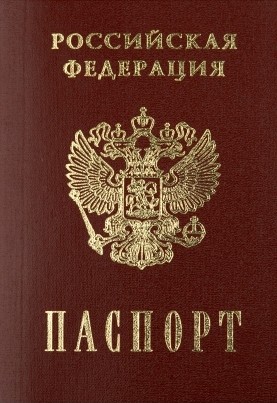 Les Serbes du Kosovo ont transmis à l'Ambassade de Russie à Belgrade une pétition afin de recevoir un passeport russe. Selon l'organisation «La Vieille Serbie», cela serait le seul moyen de se protéger contre les pressions dont ils sont victimes.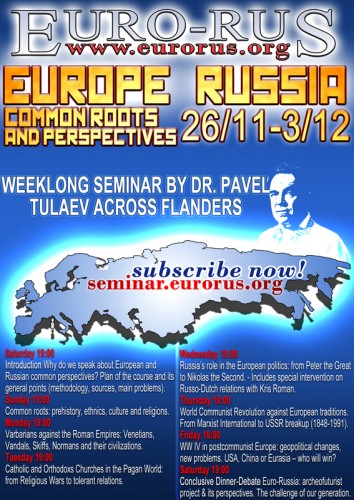
 La semaine dernière, j’ai écrit

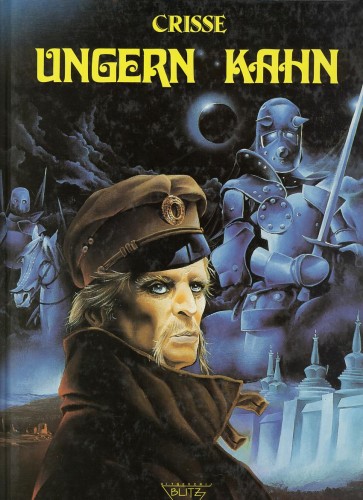 Im Regin-Verlag erscheint seit rund zwei Jahren ein ambitioniertes Programm, das sich – grob gesagt – dem traditionalen Gedankenkreis um Julius Evola, der Konservativen Revolution im weitesten Sinne sowie Figuren und Leitbildern einer Antimoderne widmet. Der Verleger bestückt also – salopp gesagt – die Nische in der Nische mit Büchern, und jeder, der sich ein bißchen mit dem Verlagsgeschäft auskennt, muß sich fragen, ob und wie man dort ein paar Mark verdienen will:
 After a series of pogroms tore through Russia in 1886, the young philosopher Vladimir Soloviev would exercise his prophetic impulse. Neither a slave to social fashions nor a stranger to controversy, Soloviev was a friend to the Jews out of sincerity rather than any calculation. Two years prior, he had published an article asserting the intertwined destinies of Christendom and Jewry as part of his greater vision of a “free theocracy.”1And so in the pogroms’ aftermath, Soloviev wrote in a letter to his acquaintance, the Talmudic scholar Feivel Getz: