


Ann Gauger
Evolution News
lundi, 25 février 2019
Le trésor transcendantal de la vérité, de la beauté et de la bienveillance s'estompe face au matérialisme et au postmodernisme

Le trésor transcendantal de la vérité, de la beauté et de la bienveillance s'estompe face au matérialisme et au postmodernisme
via: https://fr.sott.net
Si vous voulez développer un esprit de gratitude, j'aimerais vous suggérer de passer du temps à méditer sur la vérité, la beauté et la bonté. Chacune représente pour nous des dons, des choses qui rendent la vie possible, intelligible et digne d'être vécue. Ce sont des qualités si essentielles que nous les appelons transcendantales. Elles transcendent nos savoirs de tous les jours et indiquent une source qui est au moins capable de vérité, de beauté et de bonté.
Pourquoi les valorisons-nous ?
La beauté
Dans notre société actuelle, l'idée de valeurs transcendantes semble irréelle. On nous dit que tout est subjectif - il n'y a pas de norme précise pour la beauté. Tout est conditionnel - mon point de vue par rapport au vôtre. Les expositions dans les musées d'art ressemblent maintenant au contenu de mon placard empilé sur le sol, ou d'un stationnement abandonné, ou quelque chose d'épouvantable comme un crucifix plongé dans l'urine.
Que s'est-il passé ? Avons-nous oublié ce qu'est la beauté ? En rejetant le passé de « l'hégémonie culturelle oppressive du mâle blanc » de l'Occident chrétien, nous avons abandonné beaucoup de belles choses. Je n'ai aucun problème à inclure de belles choses d'autres civilisations ou peuples - ne rejetez donc pas les trésors de millénaires de notre culture.
Le David de Michel-Ange est un parfait exemple de cette beauté. Plus grand que nature, debout dans une position détendue, il semble respirer. Bien que fait de marbre, sa peau brille. Il est la beauté physique incarnée.
Une forme de beauté plus fonctionnelle apparait dans l'architecture. Ainsi, par exemple, les cathédrales gothiques attirent le regard vers le haut à la rencontre de la lumière, les palais baroques communiquent une exubérance extravagante, et les avenues majestueuses de Paris montrent la fierté d'une nation. En Amérique, comparez une église blanche à hauts remparts entourée de maisons à ossature blanche en Nouvelle-Angleterre avec les humbles murs de terre en pisé et les voûtes basses d'une mission de Californie, ou avec des maisons à colonnes blanches dans le sud, avec leurs larges vérandas et leurs plafonds hauts. Chaque style d'architecture est distinctif et reflète une partie différente de l'expérience américaine.
La vérité
Avons-nous perdu de vue la vérité ? Dans notre monde moderne, tout est subjectif ; il n'y a pas de sens de valeurs absolues, du bien ou du mal, du vrai ou du faux ; et la vie est un tourbillon de demandes personnelles et de dénégation des droits des autres. La liberté civile devient l'émeute incivique. Tout ce qu'une personne désire, même si c'est loin d'être raisonnable, devient son droit. La liberté devient un droit. Un choix moral de préserver la vie devient un crime. On a de fausses nouvelles partout. Personne ne sait qui croire, et la débauche vieille de plusieurs dizaines d'années de gens qui vivent dans le mensonge détruit la confiance.
La vérité est à l'épreuve depuis longtemps.
Nous ne pouvons pas avoir de confiance sans vérité. C'est la base d'une société civile. La vérité doit être dite et entendue si l'on veut qu'une communauté continue à travailler et à être honnête, et si l'on veut répondre aux besoins des gens. Les familles ont aussi besoin de la vérité tempérée par l'amour pour fonctionner. Les enseignants doivent fonder leurs leçons sur la vérité, et les affaires et la politique doivent être menées à la lumière de celle-ci.
Sans vérité, nous entrons dans un monde de déraison et de non-sens. La vérité, la vérité objective, sous-tend l'ensemble des mathématiques et des sciences. La logique est une exigence absolue pour en faire, et la base de toute logique est la vérité. Considérez ce qui suit :
Y a-t-il eu une époque où la vérité était la norme ? Pas depuis le Jardin d'Éden, je suppose.
La bienveillance
La beauté et la vérité sont essentielles, mais aussi la bonté, notre dernière valeur transcendantale. Il est possible d'imaginer un endroit où la vérité est toujours dite scrupuleusement, mais où la bonté, la compassion et la tendresse n'existent pas. Ce serait un lieu terrible à vivre.
La bienveillance est peut-être la valeur transcendantale la plus difficile à définir. Elle peut être considérée comme excellente, bienfaisante, bénéfique, utile et désintéressée. Cette description est pertinente :
La question de l'altruisme
Alors maintenant, pour faire face à la question de l'évolution : Avons-nous fait évoluer notre appréciation de la bonté, de la vérité et de la beauté ? Les évolutionnistes avaient l'habitude de penser qu'en se sacrifiant pour ses proches parents, une personne pouvait assurer la survie des gènes qu'elle partageait avec ses proches. Mais en 2010, la sélection familiale, comme on appelle cette théorie, a été abandonnée comme modèle par son auteur, E.O. Wilson. La théorie du remplacement, la sélection collective, n'a pas fait mieux. Au lieu de cela, on soutient maintenant que la sélection naturelle standard et une génétique démographique rigoureuse pourraient être en mesure de faire le travail.
 Les caractéristiques et le comportement des abeilles et d'autres insectes eusociaux peuvent être considérés comme un modèle de l'évolution de la « bonté » chez les créatures plus primitives. Ces insectes ont une vie très sociale. Pourtant, bien que leur « altruisme » a été longuement étudié, aucune piste plausible pour son développement par l'évolution n'a été démontrée. Les points d'achoppement sont le nombre de mutations nécessaires pour chaque nouveau caractère altruiste et le temps nécessaire pour que les insectes acquièrent ces caractères et les répandent dans la population.
La question de l'altruisme chez les êtres humains a également été étudiée sous l'angle de l'évolution. La description la plus approfondie que j'ai trouvée s'est en fait concentrée sur un problème à plus petite échelle, l'évolution de la coopération. Les auteurs de l'étude ont catalogué les comportements qui pourraient mener à une coopération, en cherchant à la fois une confirmation expérimentale et théorique. La réciprocité a été identifiée comme une caractéristique clé. On dit : « Tu me grattes le dos, je te gratte le tien. ».
Le problème, c'est que des études comme celle-ci montrent que les humains ont des comportements altruistes, mais pas pourquoi nous le faisons. Même si nous avons des régions neuronales dédiées à ce comportement, cela ne signifie pas que les régions neuronales ou le comportement ont évolué sans ligne directrice.
Quel est le problème avec ces arguments ? Tout d'abord, ils supposent (1) que l'usage des valeurs transcendantales est lié à un ou plusieurs gènes ; (2) que les valeurs de survie ou de reproduction ont une certaine importance par rapport à la reconnaissance des valeurs transcendantales ou dans l'étude de leurs perceptions ; et (3) que c'est au moins suffisamment bénéfique à la survie ou à la reproduction pour transmettre cette aptitude aux générations suivantes en priorité. Plus fondamentalement, ils supposent que la vérité, la beauté et la bonté ne sont pas des choses en soi, mais simplement des signaux qui nous permettent de faire de bons choix évolutionnaires. Compte tenu de ces hypothèses, j'aimerais que quelqu'un chiffre précisément le supplément de valeur pour la survie d'un groupe qu'entraine la capacité de ses membres à reconnaître la vérité, la beauté ou la bienveillance, puis à confronter le résultat à la loterie de la génétique des populations.
Pas de concordance
Le matérialisme scientifique ne peut rivaliser avec la beauté, la vérité ou la bonté. Ces valeurs transcendantales immatérielles donnent un sens à notre vie. J'espère que tous ceux qui lisent ceci ont fait l'expérience de la bienveillance, de la vérité et de la beauté dans leur vie. Si ce n'est pas le cas, recherchez-les en tant que guides de sagesse et en tant que dons qui nous ont été offerts pour aider à rendre la vie digne d'être vécue.
Pourquoi les valorisons-nous ?
- Elles sont les fondations sur lesquelles une vie digne d'être vécue est construite.
- Elles permettent la découverte, la création et la solidarité.
- Ce ne sont pas des chimères.
- Elles sont transformatrices.
- Ce sont des indicateurs que le monde est riche, intentionnel et plein de sens.
- Elles sont le produit d'un concepteur qui connaît la vérité, la beauté et la bonté.
La beauté
Dans notre société actuelle, l'idée de valeurs transcendantes semble irréelle. On nous dit que tout est subjectif - il n'y a pas de norme précise pour la beauté. Tout est conditionnel - mon point de vue par rapport au vôtre. Les expositions dans les musées d'art ressemblent maintenant au contenu de mon placard empilé sur le sol, ou d'un stationnement abandonné, ou quelque chose d'épouvantable comme un crucifix plongé dans l'urine.
Que s'est-il passé ? Avons-nous oublié ce qu'est la beauté ? En rejetant le passé de « l'hégémonie culturelle oppressive du mâle blanc » de l'Occident chrétien, nous avons abandonné beaucoup de belles choses. Je n'ai aucun problème à inclure de belles choses d'autres civilisations ou peuples - ne rejetez donc pas les trésors de millénaires de notre culture.
Le David de Michel-Ange est un parfait exemple de cette beauté. Plus grand que nature, debout dans une position détendue, il semble respirer. Bien que fait de marbre, sa peau brille. Il est la beauté physique incarnée.
Une forme de beauté plus fonctionnelle apparait dans l'architecture. Ainsi, par exemple, les cathédrales gothiques attirent le regard vers le haut à la rencontre de la lumière, les palais baroques communiquent une exubérance extravagante, et les avenues majestueuses de Paris montrent la fierté d'une nation. En Amérique, comparez une église blanche à hauts remparts entourée de maisons à ossature blanche en Nouvelle-Angleterre avec les humbles murs de terre en pisé et les voûtes basses d'une mission de Californie, ou avec des maisons à colonnes blanches dans le sud, avec leurs larges vérandas et leurs plafonds hauts. Chaque style d'architecture est distinctif et reflète une partie différente de l'expérience américaine.
La vérité
Avons-nous perdu de vue la vérité ? Dans notre monde moderne, tout est subjectif ; il n'y a pas de sens de valeurs absolues, du bien ou du mal, du vrai ou du faux ; et la vie est un tourbillon de demandes personnelles et de dénégation des droits des autres. La liberté civile devient l'émeute incivique. Tout ce qu'une personne désire, même si c'est loin d'être raisonnable, devient son droit. La liberté devient un droit. Un choix moral de préserver la vie devient un crime. On a de fausses nouvelles partout. Personne ne sait qui croire, et la débauche vieille de plusieurs dizaines d'années de gens qui vivent dans le mensonge détruit la confiance.
La vérité est à l'épreuve depuis longtemps.
Nous ne pouvons pas avoir de confiance sans vérité. C'est la base d'une société civile. La vérité doit être dite et entendue si l'on veut qu'une communauté continue à travailler et à être honnête, et si l'on veut répondre aux besoins des gens. Les familles ont aussi besoin de la vérité tempérée par l'amour pour fonctionner. Les enseignants doivent fonder leurs leçons sur la vérité, et les affaires et la politique doivent être menées à la lumière de celle-ci.
Sans vérité, nous entrons dans un monde de déraison et de non-sens. La vérité, la vérité objective, sous-tend l'ensemble des mathématiques et des sciences. La logique est une exigence absolue pour en faire, et la base de toute logique est la vérité. Considérez ce qui suit :
- Si une affirmation est vraie, alors c'est vrai. Une chose est elle-même. Ce n'est pas autre chose.
- Les énoncés contradictoires ne peuvent pas être vrais dans le même sens en même temps. Il ne peut pas être vrai qu'un chat est noir et pas noir en même temps.
- Une déclaration est soit vraie, soit fausse. Ce n'est pas quelque chose au milieu. Il n'y a pas de demi-vérités. Soit il pleut, soit il ne pleut pas.
« Ces lois fondamentales sont de véritables principes régissant la réalité et la pensée et sont assumées par les Écritures. Certains prétendent que ce sont des constructions occidentales arbitraires, mais c'est faux. Les lois fondamentales de la logique régissent toute réalité et toute pensée et sont connues pour être vraies pour au moins deux raisons : (1) Elles sont intuitivement claires et évidentes. Une fois que l'on comprend un principe fondamental de la logique, on peut voir que c'est vrai. (2) Ceux qui les nient utilisent ces principes dans leur réfutation, démontrant que ces lois sont inévitables et que c'est se réfuter soi-même que de les nier. »Les préjugés sont une forme de contre-vérité. Lorsque des individus ou des groupes se voient refuser l'accès à des ressources, des opportunités ou la possibilité de participer en fonction de ce qu'ils sont ou de leurs opinions, ils subissent une discrimination injuste.
Y a-t-il eu une époque où la vérité était la norme ? Pas depuis le Jardin d'Éden, je suppose.
La bienveillance
La beauté et la vérité sont essentielles, mais aussi la bonté, notre dernière valeur transcendantale. Il est possible d'imaginer un endroit où la vérité est toujours dite scrupuleusement, mais où la bonté, la compassion et la tendresse n'existent pas. Ce serait un lieu terrible à vivre.
La bienveillance est peut-être la valeur transcendantale la plus difficile à définir. Elle peut être considérée comme excellente, bienfaisante, bénéfique, utile et désintéressée. Cette description est pertinente :
« [La bonté] conduit à une vie caractérisée par des actes motivés par la droiture et le désir de faire le bien. . . . Le mot grec traduit par » bonté », agathosune, signifie « droiture du cœur et de la vie ». Agathosune est la bonté pour le bien des autres, et non la bonté simplement pour être vertueux. »Il est difficile de trouver des exemples non mélangés de bienveillance. On l'associe généralement à des saints, comme Mère Teresa, ou à des héros, comme Florence Nightingale. Les personnes qui mettent leur vie en danger pour s'occuper des victimes de la peste ou qui mènent une vie simple afin d'avoir plus à donner aux pauvres peuvent aussi être qualifiées de bonnes. Les personnes qui s'occupent des malades, des orphelins, des veuves, des prisonniers et des sans-abri manifestent cette valeur transcendantale de bonté. Mais il en va de même pour une mère qui prend soin de ses enfants avec amour, ou pour un père qui se dévoue pour sa famille.
La question de l'altruisme
Alors maintenant, pour faire face à la question de l'évolution : Avons-nous fait évoluer notre appréciation de la bonté, de la vérité et de la beauté ? Les évolutionnistes avaient l'habitude de penser qu'en se sacrifiant pour ses proches parents, une personne pouvait assurer la survie des gènes qu'elle partageait avec ses proches. Mais en 2010, la sélection familiale, comme on appelle cette théorie, a été abandonnée comme modèle par son auteur, E.O. Wilson. La théorie du remplacement, la sélection collective, n'a pas fait mieux. Au lieu de cela, on soutient maintenant que la sélection naturelle standard et une génétique démographique rigoureuse pourraient être en mesure de faire le travail.
Les caractéristiques et le comportement des abeilles et d'autres insectes eusociaux peuvent être considérés comme un modèle de l'évolution de la « bonté » chez les créatures plus primitives. Ces insectes ont une vie très sociale. Pourtant, bien que leur « altruisme » a été longuement étudié, aucune piste plausible pour son développement par l'évolution n'a été démontrée. Les points d'achoppement sont le nombre de mutations nécessaires pour chaque nouveau caractère altruiste et le temps nécessaire pour que les insectes acquièrent ces caractères et les répandent dans la population. La question de l'altruisme chez les êtres humains a également été étudiée sous l'angle de l'évolution. La description la plus approfondie que j'ai trouvée s'est en fait concentrée sur un problème à plus petite échelle, l'évolution de la coopération. Les auteurs de l'étude ont catalogué les comportements qui pourraient mener à une coopération, en cherchant à la fois une confirmation expérimentale et théorique. La réciprocité a été identifiée comme une caractéristique clé. On dit : « Tu me grattes le dos, je te gratte le tien. ».
Le problème, c'est que des études comme celle-ci montrent que les humains ont des comportements altruistes, mais pas pourquoi nous le faisons. Même si nous avons des régions neuronales dédiées à ce comportement, cela ne signifie pas que les régions neuronales ou le comportement ont évolué sans ligne directrice.
Quel est le problème avec ces arguments ? Tout d'abord, ils supposent (1) que l'usage des valeurs transcendantales est lié à un ou plusieurs gènes ; (2) que les valeurs de survie ou de reproduction ont une certaine importance par rapport à la reconnaissance des valeurs transcendantales ou dans l'étude de leurs perceptions ; et (3) que c'est au moins suffisamment bénéfique à la survie ou à la reproduction pour transmettre cette aptitude aux générations suivantes en priorité. Plus fondamentalement, ils supposent que la vérité, la beauté et la bonté ne sont pas des choses en soi, mais simplement des signaux qui nous permettent de faire de bons choix évolutionnaires. Compte tenu de ces hypothèses, j'aimerais que quelqu'un chiffre précisément le supplément de valeur pour la survie d'un groupe qu'entraine la capacité de ses membres à reconnaître la vérité, la beauté ou la bienveillance, puis à confronter le résultat à la loterie de la génétique des populations.
Pas de concordance
Le matérialisme scientifique ne peut rivaliser avec la beauté, la vérité ou la bonté. Ces valeurs transcendantales immatérielles donnent un sens à notre vie. J'espère que tous ceux qui lisent ceci ont fait l'expérience de la bienveillance, de la vérité et de la beauté dans leur vie. Si ce n'est pas le cas, recherchez-les en tant que guides de sagesse et en tant que dons qui nous ont été offerts pour aider à rendre la vie digne d'être vécue.
« Ce que vous créez dans la beauté, la bonté et la vérité vit pour toujours. Ne passez pas votre vie à accumuler des objets matériels qui ne deviendront que poussière et cendres. » - Denis WaitleyTraduction : SOTT
« La vérité, la beauté et la bonté vont ensemble. Par la vérité, nous sommes mis en contact avec la réalité, que nous trouvons bonne pour nous et belle à voir. Dans notre connaissance, notre amour et notre plaisir, le don de la réalité nous apparait comme quelque chose d'infiniment et inépuisablement précieux et fascinant. » - Thomas Dubay
09:43 Publié dans Philosophie | Lien permanent | Commentaires (0) | Tags : beauté, vérité, philosophie |  |
|  del.icio.us |
  |
|  Digg |
  Facebook
samedi, 23 février 2019
Ernst Jünger entre modernité technophile et retour au donné naturel
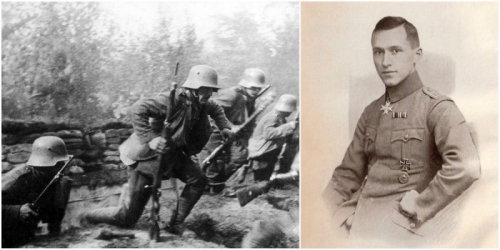
Robert Steuckers :
Ernst Jünger entre modernité technophile et retour au donné naturel
Le spécialiste des phénoménologies existentialistes et des théories conservatrices et conservatrices-révolutionnaires qu’est le Prof. Michael Grossheim à Rostock a eu le mérite de rappeler, l’année où Jünger fêta son centenaire, que l’ouvrage théorique majeur de notre auteur, Der Arbeiter (= Le Travailleur) avait laissé perplexes bon nombre d’amis de l’écrivain militaire et révolutionnaire, au moment de sa parution en 1932. Pour Grossheim, Ernst Jünger a eu, à cette époque-là de sa longue vie, une attitude très particulière face à la modernité. Le camp conservateur, auquel on le rattachait en dépit de ses sympathies révolutionnaires, qu’elles aient été nationalistes ou bolchevisantes, n’était pas spécialement technophile et regrettait le passé où les moteurs ne vrombissaient pas encore et où la vie ne subissait pas le rythme trépident des machines de tous genres.
Pour Grossheim, l’attitude de Jünger face à la technique, du moins jusqu’au début des années 1930, dérive des expériences de la première guerre mondiale qui a inauguré les terribles batailles de matériels : militaire jusqu’à la moelle, Jünger refuse toute attitude capitulatrice et passéiste face à l’effroyable déchaînement de la puissance technique sur le champ de bataille. Grossheim : « Il a appris à connaître le potentiel démoniaque de la technique mais ne veut pas le fuir ; il se soumet à la réalité (nouvelle) ».
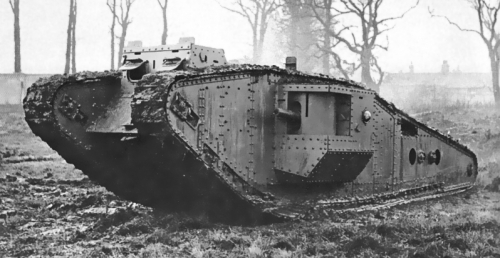
Derrière cette volonté délibérée de se soumettre à l’implacable puissance des machines de guerre se profile aussi un débat que Grossheim met en exergue : le mouvement conservateur, tel qu’il s’articule à l’époque dans les mouvements de jeunesse issus du Wandervogel, est tributaire, depuis 1913, de la pensée écologique et vitaliste de Ludwig Klages. Celui-ci est résolument anti-techniciste et antirationaliste. Il déplore amèrement le saccage du donné naturel par la pensée hyper-rationalisée et par les pratiques technicistes : déforestation à grande échelle, disparition des peuples primitifs, extermination d’espèces animales. Ernst Jünger ne contredit pas Klages quand ce dernier pose un tel constat et, même, s’alignera bientôt sur de pareilles positions. Cependant, en 1932, au terme d’un engagement révolutionnaire (finalement plus bolchevisant que conservateur) et à la veille de la prise du pouvoir par les nationaux-socialistes, Jünger raisonne sur base d’autres postulats, sans nier le caractère éminemment destructeur du technicisme dominant. Qui est destructeur et total, ce qui revient à dire que le Travail, expression de l’agir à l’ère de la technique, s’insinue en tout, jusque dans l’intimité et les moments de repos et de loisirs de l’homme. Chez Klages et ses adeptes des mouvements de jeunesse, les âges d’avant la technique sont l’objet d’une nostalgie envahissante et, pour Jünger, incapacitante. Face à ce naturalisme biologisant, Jünger plaide, explique Grossheim, pour un « réalisme héroïque » qui ne veut rien céder aux illusions sentimentales ni demeurer en-deçà de la vitesse nouvelle et inédite que les processus en marche depuis l’hyper-technicisation de la guerre ont imposée.
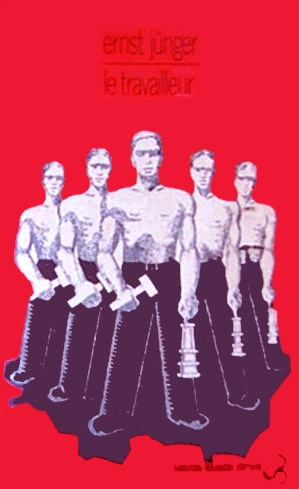 La phase du « Travailleur » a toutefois été très brève dans la longue vie de Jünger. Mais même après sa sortie sereine et graduelle hors de l’idéologie techniciste , Jünger refuse tout « escapisme romantique » : il rejette l’attitude de Cassandre et veut regarder les phénomènes en face, sereinement. Pour lui, il faut pousser le processus jusqu’au bout afin de provoquer, à terme, un véritablement renversement, sans s’encombrer de barrages ténus, érigés avec des matériaux surannés, faits de bric et de broc. Sa position ne relève aucunement du technicisme naïf et bourgeois de la fin du 19ème siècle : pour lui, l’Etat, la chose politique, le pouvoir sera déterminé par la technique, par la catégorie du « Travail ». Dans cette perspective, la technique n’est pas la source de petites commodités pour agrémenter la vie bourgeoise mais une force titanesque qui démultipliera démesurément le pouvoir politique. L’individu, cher au libéralisme de la Belle Epoque, fera place au « Type », qui renoncera aux limites désuètes de l’idéal bourgeois et se posera comme un simple rouage, sans affects et sans sentimentalités inutiles, de la machine étatique nouvelle, qu’il servira comme le soldat sert sa mitrailleuse, son char, son avion, son sous-marin. Le « Type » ne souffre pas sous la machine, comme l’idéologie anti-techniciste le voudrait, il s’est lié physiquement et psychiquement à son instrument d’acier comme le paysan éternel est lié charnellement et mentalement à sa glèbe. Jünger : « Celui qui vit la technique comme une agression contre sa substance, se place en dehors de la figure du Travailleur ». Parce que le Travailleur, le Type du Travailleur, s’est soumis volontairement à la Machine, il en deviendra le maître parce qu’il s’est plongé dans le flux qu’elle appelle par le fait même de sa présence, de sa puissance et de sa croissance. Le Type s’immerge dans le flux et refuse d’être barrage bloquant, figeant.
Jünger, au nom d’une efficacité technicienne qui est somme toute militaire, combat les peurs qu’engendre la modernisation technicienne. S’immerger dans le flux technique qui s’est amplifié rapidement depuis les grandes batailles de matériels est un service à rendre à la nation, contrairement aux attitudes incapacitantes qui empêcheraient les futures générations de maîtriser les outils techniques les plus performants, ceux qui donnent la victoire ou inspirent la crainte à l’ennemi potentiel. L’homme, devenu « Type », devient alors le chef d’orchestre secret qui gère le flux technique et les machines qu’il produit : ce n’est pas un combat que gagne la machine contre l’homme mais un combat qui se gagne avec des machines. L’homme-type reste le maître final de la situation : c’est lui qui impulse à la machine son mouvement, lui donne un sens, physiquement et spirituellement. L’homme est supérieur à la machine s’il a, face à elle, une attitude altière, dominatrice, pareille à celle du soldat qui a vécu les grandes batailles de matériels. En ce sens, le combattant de la Grande Guerre est bien le prélude de l’humanité « typifiée » de l’avenir.
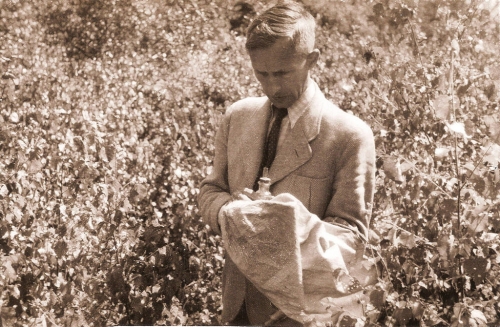
Mais, malgré cette grandiloquence techno-futuriste du Jünger de 1932, font surface, dans ses réflexions, le scepticisme et la conscience qu’il est impossible d’éradiquer la force tellurique et naturelle des faits organiques. Dès les mois qui ont suivi la parution du « Travailleur » (Der Arbeiter), Jünger glissera vers une posture ne réclamant plus l’accélération mais son contraire, la décélération. Pour son exégète actuel, Jan Robert Weber, ce glissement vers une pensée de la décélération (Entschleunigung) se fera en quatre étapes : celle de la découverte des « espaces de résilience » sous une « dictature cacocratique nihiliste » (1933-1939), la nécessité de s’accrocher aux espaces idylliques ou classiques (dont le Paris des années d’occupation) pendant les années de la seconde guerre mondiale, le recours à l’écriture à l’ère où la paix sera de longue durée (1946-1949) et, enfin, la période des refuges méditerranéens (dont la Sardaigne fut un prélude) et/ou tropicaux (visites en Amazonie, en Malaisie, en Afrique et en Indonésie – 1950-1960). Tout cela pour aboutir, écrit J. R. Weber, « au moi apaisé du voyageur de par le monde à l’ère de la posthistoire ».
Robert Steuckers.
Bibliographie :
- Michael GROSSHEIM, « Ernst Jünger und die Moderne – Adnoten zum ‘Arbeiter’ », in : ünter FIGAL und Heimo SCHWILK, Magie der Heiterkeit – Ernst Jünger zum Hundertsten, Klett-Cotta, Stuttgart, 1995.
- Andrea SCARABELLI, « Terra Sarda: il mediterraneo metafisico di Ernst Jünger », in : http://blog.ilgiornale.it/scarabelli (10 août 2018).
- Jan Robert WEBER, Ästhetik der Entschleunigung – Ernst Jüngers Reisetagebücher (1934-1960), Matthes & Seitz, Berlin, 2011.
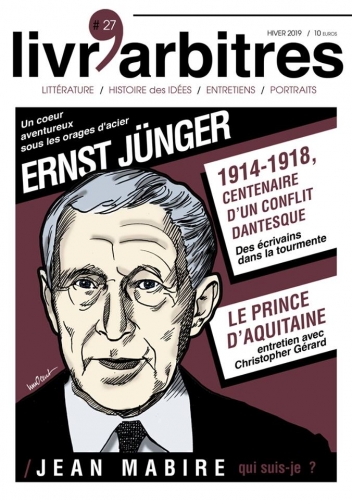
Ce texte est paru dans le numéro spécial de Livr'arbitres, n°27
13:52 Publié dans Littérature, Philosophie, Révolution conservatrice, Revue, Synergies européennes | Lien permanent | Commentaires (0) | Tags : ernst jünger, littérature, littérature allemande, lettres, lettres allemandes, révolution conservatrice, première guerre mondiale, philosophie, philosophie politique, allemagne, robert steuckers, synergies européennes | | del.icio.us | | Digg | Facebook
lundi, 18 février 2019
Cioran’s On France: Thriving Amidst Decay
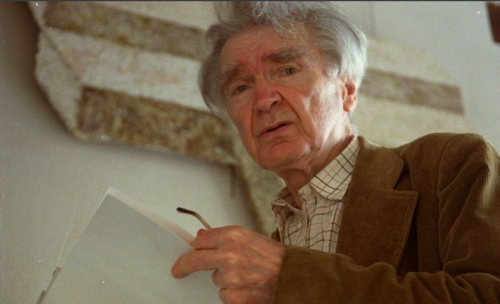
Cioran’s On France: Thriving Amidst Decay
By Guillaume DurocherEmil Cioran
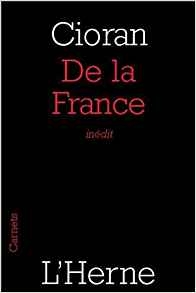
De la France
Paris: L’Herne, 2015
This is a strange, vile little book as only Emil Cioran [2] knew how to produce. It was only recently published, in both the original Romanian and in French translation,[1] [3] having been written in 1941 and left to languish for decades in some cardboard box in the Cioran archives. Cioran wrote the book in the wake of France’s pathetic defeat in 1940, inspired by his conversations in Parisian cafés and his bicycling through the villages of the French countryside. Contemporary political events are quite understated, however. For Cioran, there is no question of engaging in puerile journalism; in his view, France’s decay was many centuries in the making.
I first read the book some time ago and remembered nothing except a feeling of revulsion. I recently reread it, this time taking notes. As so often with Cioran, when I gather my notes, my initial revulsion gives way as I see the bigger picture and glimmers of hope, and the work ends up being strangely endearing to me.
I don’t know if the author ever meant for the text, which was written in pencil, to be published at all, let alone in its current form. It seems likely it was written in a few inspired bursts of Cioran’s brilliant and morbid Muse. It is a conversion note. Before 1941, Cioran thought in German, had wished he could have been German, and wrote in Romanian, oscillating between despair and the mad hope that a new barbarism could save Romania from irrelevance and Europe from decadence. After 1945, Cioran had settled into his Parisian home and would henceforth write exclusively in French, as a “lucid” aesthete of nihilism and decline.
Why would someone want such an intellectual destiny for oneself? On France explains it. This is a prolonged meditation upon France, her greatness, vanity, and decay, a book-long portrait of the past glories and the steady and pathetic decline of a great nation. Cioran has in fact fallen in love with his adoptive land; it is indeed a love letter. His prose is often overwritten, but quite insightful: “I perceive France rightly by all that is rotten within me” (40). France is decadent, lifeless, and over-intellectual, just like himself. The book opens with an apt anonymous quotation in French: “Collection d’exagérations maladives” (a collection of sickly/obsessive exaggerations). Rest assured there is a point to all of this, if one bears with it.
 Cioran, like Nietzsche, writes with a kind of visceral identification with human history and the evolution of our consciousness as recorded in our literature and philosophy. For Cioran, how could one live without being part of a great nation? For him, a nation is a social, linguistic, and ethnic reality culminating in a shared psychic reality; a great nation is an agent influencing the course of human history, rather than a collection of individuals. A nation is a kind of conversation, a shared mind, extending across the centuries; at the same time, nations are equally mortal and artificial creations. Hence for Cioran, “France,” “Germany,” and “Romania” are entities which are at once conventional and whose potentialities and defects are intimately felt, about which the stakes could not be higher.
Cioran’s actual observations on France can be stereotypical or overwritten, but they are often on point and insightful. France had been the quintessential nation, a historical agent like no other, “a nation afflicted with good fortune” (28), which had known a stable and “regular” development (unlike the stagnation of the Balkans, or the erratic history of Germany and Russia). France was a nation which had never been “humiliated by comparisons,” whose people had never felt themselves to be “deracinated” by foreign influences, who had never felt the material or psychological need to emigrate (27). France was a world unto itself, psychologically self-sufficient, and in that sense strangely provincial, at the same time setting the tone for the entire world: “France – like ancient Greece – has been a universal province” (24). The nation could happily develop at her own, leisurely pace, for she was the world.
In this sense, all of Europe, and indeed much of the world, existed in France’s shadow. For all those formless populaces which wanted to be nations, France set the tone for what was “normal.” France had been the “soul of Europe,” a cultural and even political hegemon. Cioran delights in the decline of the “Grande Nation”: “From the Frenchmen of the Crusades, they have become the Frenchmen of the kitchen and the bistrot: bien-être and boredom” (53).
I recently had reason to observe that I don’t know what it is like to have been born in a second-rate or failed nation. France’s (and the West’s) standard-setting “normality” is in fact highly exceptional [4].
By the time of the Enlightenment, French confidence was also grounded in a belief in reason and progress. This was an “acosmic” culture not troubled by the sublimity and dread of metaphysics, too comfortable in reason, a formal classicism, and an “anti-Dionysian” (80) culture of the head, not of the heart,[2] [5] and committed to the “sterile perfection” of writing (24). It became the nation of self-satisfied Alexandrianism.
All that was over and done with. In the late Middle Ages, France had wavered “between the monastery and the salon” (17), before decisively opting for the latter. The French, since the Enlightenment and in particular during the Revolution, were a perfect example of the weakness of “reason” as a guide for a people. France had degenerated from a nation into a mere populace of selfish individualists, hence sterile, and long given to chatter, overrefinement, and gastronomy (one appreciates the overgeneralizations here). The French gave no place to the unconscious, they were not “deep,” and they had become skeptical and unwilling to die for any ideal (38). Because at this time Cioran seems to only have cared for intensity of feeling and belief, he sees the only remaining vitality left in France in Communism and the working class, although her “revolutionary career” was probably over, anyway (73; hence also some Slavophile sentiments, since Cioran never really distinguished between Russians and Communism, 41).
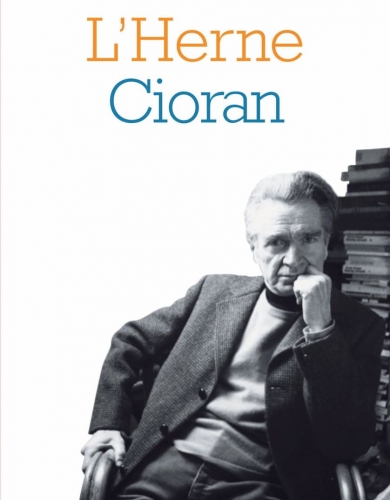 Cioran, a voracious reader with a vast intellectual culture, is extremely critical of French thought and culture throughout history. Cioran foresees a great convergence: France’s bourgeois decadence indicates where all the other nations are heading, and by that decadence she will also really become a “normal” country, as afflicted by doubt and inferiority complexes as all the rest (45, 49). Cioran writes implausibly, “Her decline, obvious for almost a century, has not been opposed by any of her sons with a desperate protest” (63).
By this point, one could fairly accuse the wretch Cioran of sadism. Some kids like to tear the wings off of flies, others just like to watch a once-beautiful flower slowly rot from blight.
Cioran has perhaps only one unambiguously positive thing to say about France, the embrace of fleeting beauty:
France’s divinity: Taste. Good taste.
According to which the world – to exist – must please; must be well-made; consolidate itself aesthetically; have limits; be a graspable enchantment; a sweet flowering [fleurissment] of finitude. (14-15)
He observes that France is “the country of the phenomenon in itself,” of impression, before adding, “If appearances are everything, France is right” (78). Very Zen and very true, no? If life is but a succession of fleeting moments, let them be beautiful.
Cioran luxuriates in France’s decay, and some of the passages are frankly revolting in embellishing – as Alain Soral has complained [6] – spiritual and civilizational rot:
[France] can only live up to [her past] if she accepts her end with style, by masterfully refining a crepuscular culture, by extinguishing herself with intelligence and even with splendor – not without corrupting the freshness of her neighbors or of the world through her decadent infiltrations and dangerous insinuations. (47-48)
There are fecund disintegrations and sterile ones. A great civilization which provincializes itself diminishes its spiritual volume; but, when it spreads the elements of its dissolution, when it universalizes its failure, the twilight retains some symbols of the mind and saves the appearance of nobility. (75)
He also writes, “Of France’s twilight we can only speak in aesthetic terms; we do not feel it, and the French do not feel it either” (59). Well, perhaps a metic could feel this way, but not a Frenchman raised in the knowledge that his country was a great nation among the lights of the world, passed down to us as a sacred patrimony by the sacrifice of millions of French soldiers and peasants. Let us recall Charles de Gaulle’s famous words:
All my life, I have had a certain idea of France. I am inspired in this as much by sentiment as by reason. . . . I instinctively have the impression that Providence has created her for consummate achievements or exemplary misfortunes. If mediocrity marks her deeds and actions, however, I have the feeling of an absurd anomaly, attributable to the faults of the French and not to the genius of the fatherland. But also, the positive side of my mind convinces me that France is only truly herself when she is at the first rank; that only vast enterprises can compensate for the ferments of dispersion which her people carries; that our country, as it is, among the others, as they are us, must, under penalty of death, aim high and stand tall. In short, by my lights, France cannot be France without greatness.
Let it be said that Charles de Gaulle, for all his failures [7], passed this conviction on to the more earnest and impressionable minds of the younger generation through this myth – those who only-too-naïvely took their elders’ words at face value, and who could therefore only be shocked by the nation’s decomposition and slouching into mediocrity. And are de Gaulle’s words not also true, to a great extent, for Europeans in general, who always yearn to dedicate themselves heart and soul to a great cause, without which they are prone to living like dogs? And I cannot tell you how many idealistic young Europeans I have met, who are among the best of our race, who dedicate themselves to the Third World, for there can still be found struggle, sacrifice, and emotional depth and intensity, which can only contrast with the superficiality and barrenness – a rare spiritual oblivion – of coddled life in the post-war West.
I can see a point in Cioran’s musing, but there is also something disgusting – and in some respects simply noxious – for both France and Europe. Cioran, in fact, seems torn: generally favoring belief and fanaticism as the antithesis of decadence (hence sympathy for Hitlerism and Bolshevism), but occasionally observing that perhaps Europe needs a bit of doubt, which France could bring (65).
Cioran is convinced of the catastrophic effects of the illusions of “reason” and “progress.” But if France, the pioneer-nation of the Enlightenment, would cease to believe in such follies . . . surely Western man could finally awaken from these self-satisfied, sterilizing slogans! Or, at least, Cioran believes he, as an “intellectual vampire” (60), could be a lucid and fecund writer in this context. He leapfrogs centuries of history:
Hailing from primitive lands, the Wallachian underworld, with the pessimism of youth, and then arriving in an overly ripe civilization, what a source of shivers before such a contrast! Without a past amidst an enormous past . . . From the pasture to the salon, from the shepherd to Alcibiades! (66)
Hence, Cioran loves France because she has fallen from self-assured greatness into a doubt and pessimism much like his own. Whereas he had previously loved Hitlerian Germany for its irrational faith, he now presents France as a mirror image of himself, an entire nihilist country in which he might be able to achieve the highest lucidity:
An entire country which no longer believes in anything, what an exalting and degrading spectacle! To hear them, from the lowest of citizens to the most lucid, say the obvious with detachment: “La France n’exist plus,” “Nous sommes finis,” “Nous n’avons plus d’avenir, “Nous sommes un pays en décadence,” what a reinvigorating lesson, when you are no longer a devotee of delusions! (69)
 France is “a consoling space” for Cioran: “With what impatience I have awaited this outcome, so fertile for melancholic inspiration!” (70). The wandering and soon-to-be stateless Cioran wants to limit himself to a particular culture and place: “He who embraces too much falsifies the world, but in the first instance, himself . . . A great soul enclosed in the French forms, what a fecund type of humanity!” (87). France’s comfortable decadence will shield Cioran from his own excesses: “Let her measure cure us of pathetic and fatal wanderings” (32), “A country’s lack of life will protect us against the dangers of life” (88). Crepuscular France will finally give Cioran the opportunity to be in harmony with his time: “Alexandrianism is erudite debauchery as a system, theoretical breathing at the twilight, a moaning of concepts – and the only moment when the soul can harmonize its darkness with the objective unfolding of the culture” (70).
In short, Cioran seizes the opportunity to join a decadent, highly intellectual nation, so as to explore the depths of nihilism and see where one emerges. I can appreciate this kind of personal and philosophical project.
Cioran carves a role out for himself as a fertilizing maggot in the corpse of French civilization. Cioran, not disinterestedly, affirms that the greatness of a nation can be measured by its ability to inspire metics to join and serve it, which I suppose is partly true (92-94). Cioran then foresees his own destiny in this new home:
What would I do if I were French? I would rest in Cynicism. (40)
France needs a pathetic and cynical Paul Valéry, an absolute artist of the void and of lucidity. (48)
My destiny is to wrap myself in the dregs of civilizations. How can I show my strength except by resisting in the midst of rot? The relationship between barbarism and neurasthenia balances this formula. An aesthete of the twilight of cultures, I turn my gaze of storm and dreams upon the dead waters of the mind . . . (65)
To refuse to go extinct, even though we have delighted in the inevitable march towards extinction. (82)
A kind of moribund fury lies in the aesthetes of decadence. (84)
Cioran affirms that decadence can only be overcome, not through sentimental nostalgia or insincere conservatism, but by uncompromisingly going deeper . . . perhaps then nihilism will be transcended? That which is falling ought to be pushed, that which doesn’t kill us, and so on.
On France seems to be a book-long philosophical exercise. There are well-established traditions in this kind of morbid meditation in both Stoicism and Buddhism, schools which strongly resonated with Cioran. In Stoic analysis, one breaks down an object to its most essential, unappetizing forms so as to overcome our desires with objectivity. As Marcus Aurelius wrote in his Meditations:
When you have savories and fine dishes set before you, you will gain an idea of their nature if you tell yourself that this is the corpse of a fish, and that the corpse of a bird or a pig; or again, that fine Falernian wine is merely grape juice, and this purple robe some sheep’s wool dipped in the blood of a shellfish; and as for sexual intercourse, it is the friction of a piece of gut and, following a sort of convulsion, the expulsion of some mucus. Thoughts such as these reach through to the things themselves and strike to the heart of them, allowing us to see them as they truly are. So follow this practice throughout your life, and where things seem most worthy of your approval, lay them naked, and see how cheap they are, and strip them of the pretenses of which they are so vain. (Marcus Aurelius, Meditations, 6.13)
The Buddhists attribute a similar meditative exercise to Gautama: contemplating the various aspects of our being (mind, body, actions, including defecation and urination), breaking down our body into parts, and indeed contemplating our body subject to various degrees of decomposition (notably in the Satipatṭhāna Sutta). By this, one attains a certain objectivity and imperviousness, one is learning to look the truth in the face without flinching.
On France appears to be the fruit of this kind of philosophical exercise. By stripping France of her pretensions and even the usual dignities necessary for a nation or an individual’s self-respect, Cioran sees his new home objectively. This is indeed one of Cioran’s “nay-saying, corrosive books,” a challenge, the overcoming of which will make us stronger.
In the 1920s and ’30s, no one denied the decadence which already afflicted the France of the Third Republic. No one today can deny that all Europe is decadent, unashamed of her impotence and dedicated to the most impoverished materialist and humanitarian principles, consecrated to the Last Man foreseen by Nietzsche, and with no end in sight. Given all this, Cioran’s observations and his challenge remain deeply relevant to us. Cioran is torn, but points to the need for decidedly modern barbarians: “I dream of a culture of oracles in logic, of lucid Pythias . . . and of a man who would control his reflexes with a supplement of life, and not through austerity” (89).
En guise de conclusion, I recall the words of the Buddha:
Just as a sweet-smelling and pleasant lotus grows on a heap of refuse flung on the high road, so a disciple of the Fully Awakened One shines resplendent in wisdom among the blind multitude, the refuse of beings. (Dhammapada, 58-59)
Some translated excerpts from this book will be published at Counter-Currents in the coming days.
Notes
[1] [8] The French edition is incidentally quite elegant and has been printed using blue ink.
[2] [9] Cioran often writes of nations having or lacking vigor “in the blood,” using this word strangely more in a psychological than hereditarian sense.
09:54 Publié dans Philosophie | Lien permanent | Commentaires (0) | Tags : cioran, emil cioran, philosophie, roumanie, france | | del.icio.us | | Digg | Facebook
samedi, 16 février 2019
PROMETEO Y LA ELPIS COMO PROGNÓSIS
PROMETEO Y LA ELPIS COMO PROGNÓSIS
Prometeo, el astuto, es hijo de uno de los primeros siete titanes, Jápeto, que junto con Cronos lucharon contra Zeus, y Clímene, la de los bellos tobillos. Tuvo tres hermanos: Epimeteo, el torpe, esposo de Pandora; Atlas, el intrépido, condenado a sostener el cielo con su espalda y Menecio, el temerario que fue muerto por el rayo de Zeus y enviado al Tártaro. Prometeo y Epimeteo lucharon a favor de Zeus y Atlas y Menecio lo hicieron en su contra.
Desde siempre Prometeo ha sido el más estudiado por las riquezas interpretativas que ofrecen los textos de Hesíodo en la Teogonía y en los Trabajos=Erga.
Es sabido que los griegos a diferencia de los cristianos y judíos no han tenido textos sagrados, pero los que más se le aproximan son los de Homero, la Ilíada y la Odisea, y los mencionados de Hesíodo.[1]
Los griegos los conocían como “los poetas más divinos”(Certamen, ab ovo) y como tales los trataron y los citaron ad nauseam.
Ambos fueron coetáneos y vivieron en el último cuarto del siglo VIII a.C. y es imposible entender la cultura occidental tanto griega, latina como cristiana sin ellos dos. Homero porque la sitúa respecto Oriente y Hesíodo porque abre la puerta a la conciencia individual del hombre antiguo. Ellos aparecen en el momento en que los griegos pasan de la tribu a la polis, momento propiciado por las colonizaciones y el comercio marítimo y el reconocimiento de un derecho sancionado por las divinidades griegas.
Es digno de notar que para esa misma época se produce un cambio en la forma de combate, se pasa del combate individual a la aparición de las formaciones de hoplitas y de la caballería lo que crea una conciencia de pertenencia a una comunidad o polis.
El mito de Prometeo está compuesto por dos momentos:[2] la picardía de Prometeo que engaña a Zeus con la grasa y los huesos de un toro y el robo del fuego en un momento de distracción de Zeus. Éste lo castiga creando a Pandora=toda regalo o la que da todo, y encadenádolo a un peñasco.
Prometeo, el previsor, como dijimos es uno de los siete titanes encabezados por Cronos que enfrentaron y fueron derrotados por Zeus. En esa lucha estuvo del lado de vencedor, pero Zeus siempre desconfió de él por su astucia e inteligencia.
Un día se produjo una discusión acerca de que partes de un toro debían ofrecer a los dioses y cuales reservar a los hombres, entonces Prometeo carneo al toro y guardó la carne en una parte del cuero y los huesos y la grasa en otra que resultó más grande, y ofreció a Zeus que eligiera. Éste, naturalmente, tomó el saco mayor y cuando cayó en la cuenta del engaño exclamó: “que coman carne cruda” y los privó del fuego. Desde entonces los hombres queman grasa o prenden velas en honor a los dioses.
Prometeo se puso a al búsqueda del fuego, pues intuía que estaba en el Olimpo y no en la creencia que estaba en el interior de los árboles como se pensaba entonces, pues ya se barruntaba que se podía conseguirlo por la fricción de dos maderas.
Pidió a Atenea que lo dejara ingresar secretamente al Olimpo y allí robó el fuego de Zeus en un carbón encendido dentro de la médula de una cañaheja y entregó el fuego a los hombres, quienes a partir de entonces pudieron comer carne asada.
Zeus montó en cólera y “ordenó al muy ilustre Hefesto mezclar cuanto antes tierra y agua, infundirle voz y vida humana y hacer una linda y encantadora figura de doncella…luego encargó a Atenea que le enseñara sus labores, a tejer la tela de finos encajes. A la dorada Afrodita mandó rodear su cabeza de gracia, irresistible sensualidad y halagos cautivadores y a Hermes le encargó dotarle de una mente cínica y un carácter voluble”(Erga, 60-70). Y así nació Pandora, “de donde desciende la funesta estirpe y la tribu de las mujeres”(Teogonía, 591, que fue enviada inmediatamente como regalo a Epimeteo, quien no haciendo caso el consejo de su hermano de no aceptar nunca un regalo de Zeus, la aceptó como su esposa.
Pandora, poseedora de una curiosidad insaciable, andando por la casa observó una gran jarra donde, trabajosamente Prometeo había encerrado todos los males que podían perjudicar al hombre, y quitó con sus manos la tapa de la jarra dejando escapar todos los males menos uno: ElpiV=Elpis, término que ha sido traducido equivocadamente por esperanza. Pero pensándolo bien no tiene ningún sentido que se encontrara junto a todos los males dentro de la jarra, pues la esperanza no es un mal. Se produce una contradicción flagrante dado que la esperanza no es un mal para el hombre sino mas bien un bien.
La mejor versión que tenemos de elpis es nuestra propuesta de traducir el término por “espera”. Así lo hacen varios mitólogos contemporáneos (Verdenius, Pérez Jiménez, etc.) Así, si la espera queda dentro de la jarra, los hombres recibirán los males sin advertirlo. Los eruditos llegan hasta acá y para allí, no siguen razonando o especulando.
Pero la espera de suyo tampoco es un mal. Es un simple estar a la expectativa de algo que puede suceder. Pero, sí es un mal la causa de la espera que es la capacidad de precognición o prognosis.
En este último sentido tiene que entenderse la elpis de Hesíodo. En ese estar a la expectativa de algo por venir, porque para el hombre es un mal la prognosis o prospectiva, porque ¿qué humanidad tendríamos si supiéramos cuando nos vamos a morir, dónde radicaría nuestra libertad si supiéramos de antemano qué nos va a suceder?
La prognosis y no la esperanza es el mal que quedó encerrado en la jarra donde lo introdujo Prometeo, el previsor y no Zeus, como erróneamente confunden muchos mitólogos.
Este es nuestro pequeño aporte al comentario de un mito que ya tiene 2800 años.
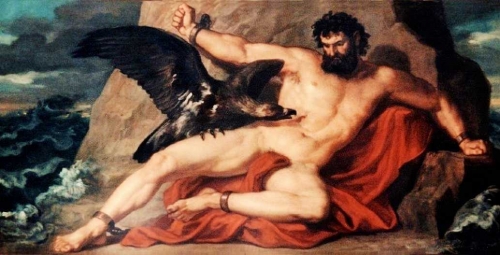
El segundo momento del mito se produce cuando Prometeo le roba, escondido en el hueco de una cañaheja, el fuego que Zeus tenía oculto a los hombres. Percatado Zeus del robo manda encadenar a Prometeo desnudo a un peñasco en las montañas del Cáucaso, donde durante el día un buitre le comía el hígado que luego crecía por la noche. Viendo su excesivo sufrimiento Heracles mata al buitre y lo libera de las cadenas, pero, si bien Zeus le concedió el perdón, para que Prometeo siguiese pareciendo un prisionero le impuso llevar un anillo realizado con un eslabón de su cadena con una piedra caucásica engarzada. Desde entonces la humanidad comenzó a llevar anillos en homenaje a Prometeo y recordar que el hombre es, en cierta media, un prisionero en esta tierra.
Lo que llama la atención de este segundo momento es el conocimiento de medicina que ya tenían los griegos del siglo VIII a.C. en el sentido que sabían que el hígado de reponía a sí mismo. Este dato se confirma científicamente recién en el siglo XVIII.
Como son casi infinitas las conclusiones que se han sacado de este mito: a) se lo comparó con Cristo, en tanto liberador de la humanidad. b) las consecuencias morales de la teoría de la culpa. c) los dioses no son tales sino solo proyecciones de los hombres. d) Pandora como nueva Eva y la introducción del mal en el mundo y un sin número de alii. Nosotros dejamos libre el campo de las múltiples interpretaciones y nos inclinamos por la apertura de la conciencia individual del hombre antiguo.
[1] Los trabajos que nos llegaron de Hesíodo son: Teogonía, Trabajos y días, Fragmentos, y Certamen.
[2] Para los eruditos el mito está formado por mitos etiológicos: a) por qué los hombres se reservan la carne y dan a los dioses la grasa y los huesos. b) cómo encontraron el fuego y c) el origen de la mujer como ruina para los hombres.
00:46 Publié dans Philosophie | Lien permanent | Commentaires (0) | Tags : prométhéer, alberto buela, philosophie, grèce antique, hellénisme | | del.icio.us | | Digg | Facebook
vendredi, 15 février 2019
Effondrement civilisationnel et Katechon
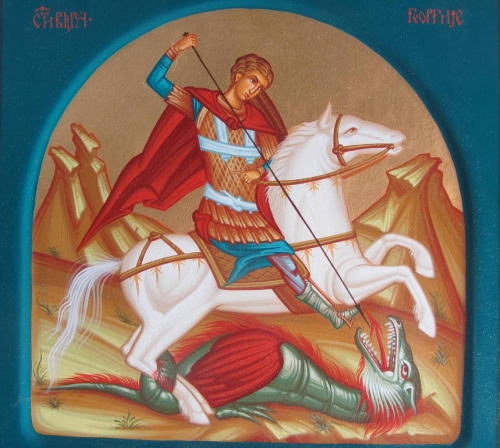
Effondrement civilisationnel et Katechon
Nous avons fait remarquer ailleurs dans ce blog que le monde était en voie d’entropisation. Pour comprendre les notions d’entropie et de néguentropie (ce qui s’oppose à l’entropie), on peut s’imaginer un jardinier aux prises avec la nature environnante. Généralement, le jardinier commence par humaniser un coin de cette nature, traçant une frontière entre le monde ordonné de son jardin et le monde extérieur, désordonné. Puis dans ce monde ordonné, son potager par exemple, il trace de nouvelles frontières : des allées, des parcelles pour les différentes variétés, un lieu pour le compost, etc. Imaginons que le jardinier décède ou soit malade. Immédiatement, les mauvaises herbes vont affluer, les ronces de l’extérieur vont pénétrer le jardin, les différentes variétés vont se mélanger ou disparaître, des nuisibles vont proliférer, etc. Bref le potager va retourner à l’état de nature. Dans notre schéma, ce processus de retour au désordre, au chaos, au mélange, à la confusion, ce processus de déstructuration et d’abolition des séparations, s’appelle l’entropie. Le jardinier, quant à lui, qui lutte pour conserver un ordre fondé sur des distinctions et qui s’oppose donc à ce processus de dissolution peut être considéré comme une force néguentropique.
Les cosmogonies de toutes les religions imaginent un dieu ou des dieux, voire des forces, qui au début des temps entrent en jeu pour ordonner le chaos (ou le Rien qui est le summum du chaos), et ainsi créer l’Univers, le monde et la vie. Ces forces ne procèdent pas autrement que notre jardinier : elles séparent les différents éléments (dans la cosmogonie biblique Dieu sépare le ciel de la terre, la lumière des ténèbres, les végétaux de la terre, la femme de l’homme….), elles distinguent et créent un ordre harmonieux que seule une force contraire et négative (Satan) cherche à contrecarrer. L’objectif de Satan est que le monde retourne au chaos originel, à la confusion et au désordre.
A l’évidence, Satan représente l’entropie et les forces à l’origine de monde représentent la néguentropie. Ici, les religions paraissent diverger sur la manière de contrecarrer l’entropie. Imaginons une maison. Laissée à l’abandon celle-ci va subir le processus d’entropie : les tapisseries vont se décoller, les meubles vont pourrir, le toit va s’effondrer, les murs vont s’écrouler… quelques décennies plus tard, la maison n’est plus qu’un tas informe de gravats où tout se mélange dans l’indistinction : meubles, murs, toiture, matériaux… bref, la maison est devenue un chaos. Toutes les religions disent que la maison ne doit pas devenir chaos, mais elles ne le disent pas de la même façon.
Le judaïsme et l’islam contrecarrent l’entropie par des commandements. Le propriétaire de la maison ne doit pas réfléchir à leur bien fondé, il n’est même pas utile qu’il croit en leur utilité : il doit simplement les exécuter de manière immédiate et passive. Sous peine de punition il devra refaire tous les dix ans les tapisseries et les peintures, il devra laver tous les jours les sols, il devra visiter tous les ans la toiture et tous les mois il devra racler les mousses qui s’accrochent à la façade (etc.).
Le christianisme contrecarre l’entropie par la foi dans les œuvres. Jésus ne commande pas, il ne révoque pas l’ancienne loi vétéro-testamentaire (les anciens commandements) mais il s’attend à que chacun, convaincu de l’utilité d’entretenir sa maison, le fasse naturellement et sans contrainte légale.
Le paganisme européen, quant à lui, contrecarre l’entropie par l’esthétique. Il tient en substance ce discours : « de toute manière, quoi que tu fasses, ta maison ressemblera tôt ou tard à un monticule de gravats. Maintenant, tu as deux solutions : soit vivre dans un taudis, soit entretenir ta maison. La mort nous attend tous, mais on peut être autre chose qu’une larve vivant dans de la crasse ».
En fait, les païens avaient raison : l’entropie finira par l’emporter. Quoi que fasse le jardinier, son potager bien ordonné retournera tôt ou tard à l’état de nature désordonné. C’est ainsi. Mais les païens disent aussi que la victoire de l’entropie est temporaire car sitôt victorieuse un nouveau cycle néguentropique s’annonce. L’histoire est sans fin. Elle est faite de recommencements, comme les saisons.
Le christianisme dit presque la même chose. Il annonce la venue de l’Antéchrist, c’est-à-dire, en langage non théologique, la victoire de l’entropie. Il annonce aussi, après l’Antéchrist, la venue du Christ, c’est-à-dire la victoire définitive de la néguentropie. Au contraire de l’Histoire cyclique et sans fin des païens, l’Histoire chrétienne est linéaire, avec un début et une fin : paradis originel et règne de l’ordre néguentropique / arrivée du Serpent et chute dans un monde où règne l’entropie : c’est le début de l’Histoire / première venue du Christ : l’entropie est contrecarrée / arrivée de l’Antéchrist et victoire de l’entropie / retour du Christ et retour au paradis originel : c’est le règne définitif des forces néguentropiques, c’est aussi la fin de l’Histoire.
C’est dans cette histoire linéaire chrétienne que s’insère le concept de « Katechon » (prononcer Katékone). Dans le Nouveau Testament, le terme apparaît dans la seconde lettre aux Thessaloniciens (2 Thessaloniciens 2.6-7). Il signifie, en grec, « ce qui le retient » ou « celui qui le retient ». Saint Paul explique ici que l’Antéchrist ne pourra venir qu’après la suppression de « ce qui le retient ». Toutefois, il n’explique pas ce qu’est ce « quelque chose » ou ce « quelqu’un » qui empêche la venue de l’Antéchrist. Paul tient cependant pour acquis que les Thessaloniciens le « savent » : « Et maintenant vous savez ce qui le retient, afin qu’il ne paraisse qu’en son temps ». La tradition chrétienne a pensé trouver une indication dans l’Epître aux Romains (13.1-7) : « celui qui s'oppose à l'autorité résiste à l'ordre que Dieu a établi ». Autrement dit, l’Empire et l’empereur romains seraient le Katechon. Celui qui leur résisterait, résisterait à l’ordre établi par Dieu pour contrecarrer le désordre entropique. Mais de ce point de vue, l’Eglise et l’ordre chrétien peuvent également être vus comme le Katechon, ainsi que plus tard l’empire carolingien, le Saint Empire romain germanique, ou les monarchies européennes de droit divin.
Dans son Journal, à la date du 19 décembre 1947, Carl Schmitt, juriste et penseur politique allemand (1885-1988) écrit : «Je crois au katechon (…) Il faut pouvoir nommer le katechon pour chaque époque des 1948 dernières années. Le lieu n'a jamais été vide, sinon nous n'existerions plus.". Pour Carl Schmitt, le Katechon (Théologie politique, 1922) peut être une nation, un peuple, un Etat, un homme ou un groupe d’hommes. Par son action, l’exemple qu’il donne ou la résistance dont il fait preuve face au déclin des valeurs morales, religieuses et civiques, face à la destruction de l’ordre social, face à la déstructuration des sociétés comme des individus (anomie), le Katechon freine la satanisation du monde, l’installation du chaos et l’arrivée de l’Antéchrist.
Carl Schmitt pointe d’une part ceux qui sont les serviteurs de l’Antéchrist (ceux qui œuvrent à l’entropie du monde et à la dissolution des sociétés) et ceux qui freinent l’arrivée du « fils de la perdition » (les forces katechoniques). Pour le philosophe catholique il ne fait aucun doute : il faut s’opposer à l’Antéchrist, il faut faire partie du Katechon ! Pour d’autres catholiques au contraire, il faut laisser faire, car il faut passer par l’Antéchrist pour retrouver le Christ. On se demande, de ce point de vue, si Vatican II n’a pas pris, par calcul diabolique, le parti des forces dissolvantes, de l’Antéchrist, pour hâter, peut-être, le retour du Christ !
Pour illustrer l’action des forces entropiques et la résistance des forces katechoniques, prenons l’exemple de l’institution du mariage. Le mariage est un des piliers de l’ordre social. Abattre ce pilier mettra en danger tout l’édifice. Le mariage a été institué pour que la femme puisse mettre au monde et élever ses enfants avec l’assurance qu’elle ne sera pas abandonnée mais au contraire qu’elle sera protégée par son époux. Le mariage institue un lien sacré devant Dieu. Il est énergiquement néguentropique. Néanmoins, l’entropie démoniaque va fortement et prioritairement s’attaquer à lui. La révolution “française“ va transformer le lien sacré devant Dieu en contrat devant Monsieur le Maire. Puis la République va décider que ce contrat est révocable, même pour « simple incompatibilité d’humeur ». Ensuite, la République va décider que ce contrat révocable qui unit traditionnellement un homme et une femme, peut unir aussi, au nom de l’Amour, deux hommes ou deux femmes. Nous n’en resterons sans doute pas là et, entropie (et islam) aidant, il est probable que le mariage pourra unir un jour davantage que deux individus (trois, quatre, cinq ?). Encore un cran plus bas et nous pouvons imaginer que le mariage puisse unir des hommes à des animaux. Si j’aime ma chienne d’un amour réciproque, pourquoi ne pourrais-je pas me marier avec elle et en faire mon unique héritière ? Et pourquoi ne pourrait-on pas adjoindre à ce couple merveilleux ma voisine (déjà mariée à mon voisin) et son poney, puisque nous nous aimons tous ? Croire que l’entropie s’arrête en chemin est une illusion. L’entropie va toujours au bout de sa logique, et cette logique suppose à terme le chaos total. Nous n’avons encore rien vu !
Donc, l’épisode du mariage pour tous à mis face à face d’une part des serviteurs de l’entropie (gouvernement, lobby LGBT, journalistes…) et d’autre part des gens qui ont tenté de retenir le plus longtemps possible les forces du déclin et de la déstructuration. Ces gens, ceux qui ont freiné l’adoption de la loi, ceux qui ont « retenu » l’Antéchrist, ont été le Katechon.
Carl Schmitt dit que le Katechon s’est manifesté à chaque époque et que si tel n’avait pas été le cas l’humanité aurait disparu. Mais qui aujourd’hui retient ce Système qui dissout les peuples, déstructure les Etats, désintègre l’ordre sociétal, anéantit les cultures, mélange les lignées, standardise l’humain, éradique les religions, dévalorise les valeurs spirituelles, amoindrit les appartenances, transgresse les frontières et sème le chaos partout où il s’installe, dans les pays comme dans les esprits ? A l’évidence, face aux Etats-Unis-Système, face à l’Europe-Système, la Russie est aujourd’hui le Katechon. Seul cet Etat est encore debout sur le rempart, défendant ouvertement des valeurs katechonique qui sont aux antipodes des valeurs entropiques du Système. L’Eglise, quant à elle, semble s’être définitivement soumises aux forces dissolvantes. Elle se tait, quand elle ne pactise pas.
Mais la Russie n’est pas seule. Tous ceux qui d’une manière ou d’une autre retiennent la progression de l’entropie-Antéchrist font partie du Katechon. Tous ceux qui défendent pied à pied les valeurs spirituelles et l’ordre social autochtone traditionnels sont le Katechon. Les serviteurs-Système de l’Antéchrist ne s’y trompent pas. La guerre est totale. Et cette guerre est moins politique qu’eschatologique : mieux vaut en être conscient pour comprendre les enjeux surhumain de cette lutte absolue.
Pour tous les hommes, le choix est donc simple : faire partie du Katechon ou servir l’entropie. Certes, démonter, casser, détruire est beaucoup plus facile qu’entretenir, conserver et rebâtir. Néanmoins, notre honneur ne se trouve pas dans la facilité, mais dans le courage de se tenir droit. Droit sur le rempart, face au mal absolu.
Antonin Campana
00:34 Publié dans Philosophie, Théorie politique | Lien permanent | Commentaires (0) | Tags : philosophie, philosophie politique, théologie, théologie politique, théorie politique, politologie, sciences politiques, katechon | | del.icio.us | | Digg | Facebook
mercredi, 13 février 2019
Nous avons rencontré Marcel Gauchet
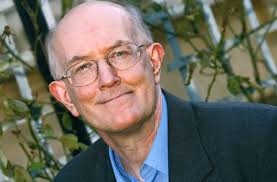
Nous avons rencontré Marcel Gauchet
Par Pierre Ramond et Uriel Gadessaud
Source : Le Grand Continent, Pierre Ramond et Uriel GadessaudRédacteur en chef de la revue Le Débat, le philosophe Marcel Gauchet est l’auteur d’ouvrages majeurs de la pensée contemporaine: Le Désenchantement du monde, L’Avènement de la démocratie ou plus récemment, Robespierre, l’homme qui nous divise le plus.
Dans cet entretien, il dresse le constat d’une Union européenne qui, faute de stratégie politique, se montre incapable de répondre à la déstabilisation identitaire engendrée par la mondialisation et par l’émergence de nouveaux rapports de force à l’échelle mondiale.
Le Grand Continent : Vous portez un discours assez critique vis-à-vis de l’Union européenne. Que lui reprochez-vous ? Pensez-vous qu’elle affaiblit les États nations ?
Marcel Gauchet : Je crois que c’est une mauvaise manière de prendre le problème que de se focaliser sur l’affaiblissement des États-nations. Il faut parler du résultat global du processus. S’il y avait affaiblissement des États-nations au profit de la collectivité des États-nations réunis dans l’Union européenne, il s’agirait d’un indéniable succès politique.
La bonne question est celle de l’efficacité globale du processus européen. La construction européenne promettait une efficacité supérieure à celle des États-nations, or, tel qu’elle fonctionne aujourd’hui, l’Union européenne affaiblit la créativité européenne en général, plus encore qu’elle n’affaiblit les États-nations en tant que tels. Qu’est-ce que l’Europe ? Le continent de l’invention de la modernité – politique, intellectuelle et scientifique, économique et technique (1) . Je sais que c’est pécher par « eurocentrisme » que de le rappeler, mais je n’ai pas de complexe à braver cette fatwa grotesque. Le problème fondamental de l’Europe est celui de sa capacité à continuer de contribuer à cette invention devenue désormais un bien commun planétaire, au-delà des catastrophes suicidaires du XXe siècle Or il me semble que l’Union européenne, loin de relever ce défi, a anesthésié ce qui a été le ressort de cette créativité, à savoir la dialectique de la coopération et de la concurrence entre les nations qui la composent. Voilà la critique majeure qu’on peut lui faire.
Le vice fondamental de l’Union européenne est d’avoir construit une entité apolitique et a-stratégique.
 Le problème de l’Union européenne est l’inversion de l’idée selon laquelle l’union fait la force. Or je dirais, dans le cas précis : l’union fait la faiblesse. Et ce sur tous les plans.
Le vice fondamental de l’Union européenne est d’avoir construit une entité apolitique et a-stratégique, qui ne permet pas aux Européens de se situer dans le monde. Je précise que la dimension stratégique n’implique pas nécessairement une dimension militaire. La puissance aujourd’hui n’a plus primordialement un sens militaire. La puissance militaire des États-Unis ne lui sert pas à grand chose, on pourrait même soutenir qu’elle est devenue contre-productive, en revanche les dépenses militaires américaines servent à fabriquer une industrie très puissante. Le keynésianisme militaire américain est très efficace ! Cela éclaire une autre erreur stratégique des Européens, qui se sont empressés d’empocher après 1991 les dividendes de la paix, en sacrifiant leurs dépenses militaires. Pendant ce temps, on voit que les dépenses militaires américaines, avec leurs ramifications multiples, ont servi à fabriquer une industrie numérique, qui est aujourd’hui le vrai secret de la puissance américaine. En la matière, les européens ont complètement raté le coche, faute d’une réflexion stratégique, et c’est une des raisons de leur affaiblissement durable.
L’un des échecs de l’Union européenne est justement d’avoir été incapable, au moment de l’effondrement de l’URSS, de définir une stratégie vis-à-vis de l’Europe de l’Est.
Dans cette perspective, que pensez-vous du projet d’armée européenne défendu par Emmanuel Macron ?
C’est une erreur politique grossière, en plus d’un vœu inconsistant ! Aujourd’hui, l’affichage de cette volonté de créer une armée européenne revient à entrer dans le jeu américain, qui consiste à faire de Poutine le repoussoir qui justifie des dépenses militaires servant à tout autre chose qu’à des buts militaires. Certes, dans l’abstrait, on ne peut que soutenir l’idée que les européens doivent être capables de se défendre par leurs propres moyens . Mais en pratique à quoi servirait cette armée européenne ? Nous ne sommes pas menacés par la Turquie ou par les pays du Maghreb ! Le seul adversaire sérieux serait éventuellement la Russie, mais est-il réaliste de la regarder comme une menace militaire directe ?
L’un des échecs de l’Union européenne est justement d’avoir été incapable, au moment de l’effondrement de l’URSS, de définir une stratégie vis-à-vis de l’Europe de l’Est. On a laissé faire les Américains, qui ont multiplié les erreurs, alors qu’il s’agissait de notre voisinage vital vis-à-vis duquel nous devions arrêter une ligne de conduite claire. Les États-Unis sont et doivent demeurer des alliés, mais cela ne doit pas empêcher les Européens de développer une réflexion indépendante sur leur environnement et leurs priorités, et de faire valoir leurs conclusions auprès de leur grand allié. Au lieu de quoi les Européens se laissent passivement mener par les États-Unis, qui poursuivent des buts qui leurs sont propres.
« Ce n’est pas l’Europe qui a bâti la paix, mais l’inverse : l’Europe s’est bâtie grâce à la paix assurée par la Guerre froide » écrivez-vous dans Comprendre le malheur français. Vous semblez ainsi remettre en question l’idée, chère aux europhiles, selon laquelle l’Union serait un rempart contre les conflits armés.
Cette idée est une vulgate propagandiste d’une telle absurdité historique que sa longévité me stupéfie. Soyons sérieux : une possible guerre européenne aurait concerné trois pays : la France, le Royaume-Uni et l’Allemagne. Or de 1945 à 1948, aucune de ces trois nations n’était en mesure de mener une guerre quelconque, avec une armée américaine omniprésente et une armée rouge stationnant à trois cents kilomètres de Strasbourg.
Je ne suis pas sûr que sans la Guerre froide l’impératif de la construction européenne aurait eu la même vigueur.
 Avec la guerre froide, cette pression s’est encore accentuée. Même en imaginant un retour sur le devant de la scène politique de bellicistes, qui n’étaient pas au rendez-vous, et pour cause, comment auraient-ils pu mener une guerre ? Le projet européen est d’abord bâti comme un moyen de résister à l’URSS en renforçant la cohésion de l’Ouest. Un des points trop souvent oubliés est le rôle majeur des États-Unis dans la construction européenne. Le plan Marshall n’était pas un geste philanthropique et désintéressé des Américains. Il avait une finalité très précise : renforcer l’Europe de l’Ouest à un moment où elle semblait menacée. La paix s’imposait donc aux Européens. Dans l’ensemble, ils étaient alignés sur les États-Unis, et il était parfaitement raisonnable de l’être. Il y avait une évidence stratégique du renforcement de l’Union à l’intérieur de l’OTAN.
C’est dans ce contexte qu’il faut comprendre la politique gaullienne ; Elle fut une tentative de desserrer l’étreinte que représentait la Guerre froide. Elle fut rendue possible seulement par les débuts de la Détente.
Je ne suis pas sûr que sans la Guerre froide l’impératif de la construction européenne aurait eu la même vigueur. Il n’aurait pas eu de ressort suffisant pour rompre avec les politiques institutionnelles propres à chaque pays.
Les nouveaux mouvements néo-nationalistes européens peuvent être définis comme des nationalistes internationalistes en ce qu’ils n’ont pas de visées expansionnistes, mais bien plutôt tissent des alliances avec leurs voisins. Pour ce faire, des pays comme la Hongrie s’appuient de plus en plus sur une rhétorique imprégnée de références eschatologiques. Quel regard portez-vous sur le renouveau de la spiritualité en politique ?
Premièrement, il y a une grande difficulté à définir une nébuleuse, elle-même très confuse. C’est une grande différence avec les totalitarismes du vingtième siècle, qui avaient une dimension idéologique très marquée, notamment le communisme.
Les « néo-nationalistes » appartiennent à des mouvements plus affectivo-identitaires que politiques […] Ils sont à peine politiques, au sens où ils sont plus réactifs que programmatiques.
Que dire sur le discours d’Orban ? C’est un potage démagogique qui agite classiquement des motivations très fortes : le sentiment d’un danger et la nécessité d’un pouvoir fort pour s’en défendre. C’est un discours décourageant sur le plan de l’analyse idéologique, mais qui met le doigt là où ça fait mal ! Il ne réussit pas par hasard. De manière générale, vos « néo-nationalistes » appartiennent à des mouvements plus affectivo-identitaires que politiques, au sens classique du terme, avec des programmes et des visées bien identifiables.
Deuxièmement, l’élément religieux que vous pointez existe effectivement à l’échelle globale, mais il concerne essentiellement le continent américain, avec l’électorat évangéliste. Quand Trump déplace l’ambassade américaine à Jérusalem, c’est pour plaire à une fraction bien déterminée de l’électorat. Plus largement, l’eschatologie est inscrite dans l’identité américaine avec l’idée de Destinée manifeste (2). Ce qui est nouveau, c’est la percée de l’eschatologie au sud du continent américain. Cette dimension pourrait jouer un rôle très important pour la suite, je n’en disconviens pas.
Le christianisme d’Orban me semble beaucoup moins eschatologique qu’identitaire.
 En revanche, quand Orban parle de la Hongrie chrétienne, son christianisme me semble beaucoup moins eschatologique qu’identitaire. La perspective qu’il mobilise, c’est la défense de la culture chrétienne contre la culture musulmane. Tous les électeurs comprennent que quand on parle de culture chrétienne, on parle d’une culture sans-les-musulmans ! Si vous parlez d’eschatologie aux électeurs de Salvini, je doute même qu’ils sachent de quoi il est question.
En somme, il me semble que les mouvements « néo-nationalistes » sont à peine politiques, au sens où ils sont plus réactifs que programmatiques. Trump et Bolsonaro n’ont pas de projet, mais réagissent à une situation, la globalisation, avec ses traductions locales particulières.
La déstabilisation identitaire provoquée par la mondialisation est un ressort tout à fait nouveau qui est le vrai cœur des mouvements qualifiés un peu vite de populistes.
La mondialisation constitue un double défi identitaire pour l’ensemble des sociétés du monde, plus ou moins ressenti selon le degré de cohésion identitaire et culturel qu’elles ont. En effet, elle les oblige à se définir par rapport à l’extérieur comme elles n’ont jamais eu à le faire dans le passé. La réponse à la question : « qui sommes-nous ? » passait essentiellement par l’histoire, par l’héritage, par la continuité d’une tradition et dans une moindre mesure par la comparaison avec ses voisins immédiats. Cette réponse classique est balayée par l’inscription obligée dans une géographie globale. Cette exigence de redéfinition interne sous la pression de l’extérieur est un élément qui joue diversement selon le degré où les gens se sentent atteints dans leur définition traditionnelle.
Les ex-puissances coloniales ont une certaine habitude du monde. Pour des Hongrois ou des Polonais, en revanche, il s’agit d’un choc brutal. Même les États-Unis sont concernés, car s’ils jouent un rôle dans le monde depuis un siècle, ils l’ont toujours fait par projection à l’extérieur. Avec le 11 septembre, le monde arrive sur le sol américain. À la limite, au fond de l’Iowa on pouvait pratiquement ignorer qu’il y avait eu des guerres mondiales. En tout cas, si on le savait, cela ne faisait que conforter la définition interne de l’Amérique dans sa vocation providentielle. La nouveauté, c’est cette irruption du monde extérieur avec ce qu’elle appelle de redéfinition en profondeur.
Quand on parle de définition stratégique, cela ne concerne donc plus seulement des diplomates ou des militaires, mais n’importe qui œuvrant, en tant que citoyen, dans un champ culturel et politique. J’ajoute que dans cette mondialisation technico-économique il y a un phénomène d’uniformisation qui ébranle gravement les manières de faire locales. Elle introduit une norme très contraignante à tous les niveaux qui s’impose à tous les acteurs en rupture avec des coutumes, des façons de faire, de penser qui étaient très établies.
La déstabilisation identitaire provoquée par la mondialisation me paraît le grand facteur méconnu par la plupart des analyses politiques. On est là dans un ressort tout à fait nouveau qui est le vrai cœur de ces mouvements qualifiés un peu vite de populistes.
Vous parlez de puissances qui ne sont pas habituées au monde et qui vivent un bouleversement identitaire face à la globalisation. Dès lors, il peut sembler étonnant que le Royaume-Uni ait voté majoritairement le Brexit, alors même qu’il s’agit d’une puissance habituée au monde, par son empire passé, et son ouverture économique et culturelle internationale.
Le peuple anglais fait partie des quelques peuples politiques de la planète. Tous les peuples ne sont pas politiques, au sens où ils n’ont pas tous une forme de tradition historique, nourrie par une longue réflexion collective, sur la manière de se conduire à l’égard du monde extérieur. Or en la matière, la tradition anglaise est très déterminée : elle a consisté à tirer les ficelles de la politique continentale tout en se tenant à l’écart. Cette tradition a été ébranlée par les deux guerres mondiales mais elle reste ancrée profondément. Elle a encore présidé à l’entrée dans la communauté européenne, après une expectative prolongée. Elle y a très bien fonctionné, d’ailleurs, jusqu’à ce que l’inertie de la machine ne finisse par la digérer. D’où le réveil brutal le jour où cette absorption est devenue palpable. Le refus de se diluer dans une politique européenne collégiale me paraît le ressort fondamental pour comprendre la diversité des rejets qui se sont coalisés, des déclassés de Birmingham aux conservateurs les mieux nantis, dont on ne voit pas en quoi l’Union a pu les léser en quoi que ce soit !
L’appartenance à l’Union a ébranlé quelque chose de la vision que les Britanniques avaient d’eux-mêmes.
Une des erreurs d’analyse courante est de douter de leur sincérité et d’attribuer leur euroscepticisme à des manœuvres politiciennes. C’est ne pas voir comment l’appartenance à l’Union a fini par ébranler quelque chose de la vision qu’ils avaient d’eux-mêmes, surtout depuis son élargissement. Cette classe dominante avait l’habitude d’un monde qu’elle avait le sentiment de maîtriser et la voilà confrontée à un monde qui lui échappe, même si elle en profite.
Ne peut-on aussi penser que l’accueil des migrants a renforcé la méfiance contre l’Union européenne ?
C’est en effet un facteur qui a joué un rôle important, manifestement, mais pas forcément celui qu’on croit – la simple xénophobie. Il y a là une bizarrerie qui doit faire réfléchir. L’immigration ex coloniale ne posait de problèmes particuliers. Ce qui a posé un problème, ce sont les polonais ! Comment peut-il se faire que l’immigration polonaise, bien que plus proche géographiquement et culturellement que l’immigration pakistanaise ou indienne, ait représenté un défi plus grand pour les Britanniques ? C’est le signe que ce ne sont pas des spécificités culturelles inassimilables qui ont fait la question, mais le mécanisme politique non maîtrisé qui a présidé à cette immigration et la signification que cela lui a donné. Au contraire, quand on bâtit un empire, on conçoit que le contrôle de certaines régions entraîne en retour une certaine immigration.
Ce ne sont pas des spécificités culturelles inassimilables qui ont fait la question migratoire, mais le mécanisme politique non maîtrisé qui a présidé à cette immigration et la signification que cela lui a donné.
Faites-vous la même analyse concernant l’Union européenne ?
 De manière générale, oui. Pour ses peuples, l’Union se présente comme un ensemble qui n’a aucun contrôle direct de son environnement direct, au Sud. L’absence de maîtrise de cet environnement est mise en évidence par des flux migratoires incontrôlés.
La population européenne représente 7 % de la population mondiale. Les Européens sont en train de se rendre compte confusément de la petitesse de leur « Grand continent », comme vous dites, à l’échelle globale. Ils sont comparativement très riches, mais leur poids relatif est mince et ils sont faibles. C’est un élément crucial de leur perception d’eux-mêmes et des perspectives que cela dessine quant à leur destin. Ajoutez-y cet élément culturel, qui prend les Européens à contre-pied par rapport à leur propre éloignement de la religion, que constitue l’effervescence de l’Islam et vous n’avez pas de peine à comprendre l’inquiétude qui les travaille. Le problème de l’Union, désormais, c’est qu’elle ne paraît pas faite pour répondre à cette inquiétude.
Pour ses peuples, l’Union se présente comme un ensemble qui n’a aucun contrôle direct de son environnement direct, au Sud.
L’Union s’est absorbée dans un processus interne alors que la demande des peuples, dans le contexte de la mondialisation, est, très logiquement, une demande de réponse à la pression de l’extérieur. Dans ce contexte-là, le libre-échange tel qu’il est conçu à Bruxelles et tel qu’il est pratiqué, apparaît comme un irénisme naïf. Non que des accords de libre-échange ne puissent être une arme stratégique de première importance. Encore faut-il qu’ils s’inscrivent dans un cadre intellectuel solidement pensé comme une manière de défendre et d’affirmer sa position dans le monde.
À terme les mouvements affectivo-identitaires ne risquent-ils pas de gagner sur les positionnements européistes ? Comment renverser la tendance, si ce n’est en développant, comme vous le suggérez, une vision stratégique de ce que doit être l’Union européenne ?
L’histoire est ouverte, mais si on continue sans rien faire, les mouvements affectivo-identitaires l’emporteront – encore qu’ils aient un problème de crédibilité politique évident – ou constitueront un facteur de blocage insurmontable, ce qui n’est pas beaucoup mieux. C’est une course de vitesse à beaucoup d’égards. Tout tient dans la réponse qu’on peut leur apporter. Je vous avoue que je suis tristement sceptique sur cette capacité : nous n’avons pas de dirigeants politiques qui ont une vraie conscience de ces enjeux, je ne vois pas dans la technocratie européenne telle qu’elle fonctionne des gens qui aient des idées sur la question. L’Europe est aussi tragiquement somnambulique en 2019 que ses milieux dirigeants pouvaient l’être en 1914.
Si on continue sans rien faire, les mouvements affectivo-identitaires l’emporteront ou constitueront un facteur de blocage insurmontable.
 Je vous recommande le livre de Luuk Van Middelaar : Quand l’Europe improvise (3). C’est un livre passionnant mais accablant par rapport à cet autisme situation bureaucratique. Il le résume en disant en substance : « L’UE ne sait pratiquer qu’une politique de la règle, alors que ce qui lui est demandé est une politique de l’événement ». Ma différence avec lui, qui me rend plus pessimiste, serait que la politique de l’événement ne suffit pas. Elle se contente de faire face à des situations qui s’imposent, alors qu’une politique stratégique est celle qui permet d’anticiper ces événements et de parer à toute éventualité. A ce jour nous n’en avons aucune. Et je ne vois pas par quelles voies le Conseil des chefs d’État qui s’est imposé comme l’instance la moins inadéquate de riposte aux crises, Van Middelaar le montre bien, pourrait en élaborer une.
Ce qui est un peu vivant en Europe, ce sont les mouvements protestataires. Mais sur l’Europe ils sont prisonniers d’une contradiction paralysante. Les politiques redistributives qu’ils préconisent supposent pour être acceptées un cadre politique arrêté et reconnu. Or, leur idéologie universaliste s’oppose à la définition d’un tel cadre. Ce qui fait que c’est le plus petit dénominateur commun qui l’emporte : un petit peu de social, un petit peu d’Europe mais pas trop. Le statu quo l’emporte de tous les côtés.
Il y a eu en Europe l’invention d’un modèle politique, social, intellectuel et culturel préférable à celui qui règne partout ailleurs dans le monde : c’est ce que pense l’immense majorité des Européens, mais ils n’ont pas le droit de le dire !
« On a inventé la modernité », dîtes-vous. Pourquoi ne pas mettre en avant, pour renforcer notre soft power, l’invention de la démocratie libérale, afin de faire (re)naître une forme d’orgueil européen ?
Ce devrait être en effet notre ligne de conduite. Mais cette histoire n’est pas assumée par les Européens, ou du moins par leurs élites. C’est la folie de la situation que nous connaissons. Le discours académique dominant s’emploie en sens inverse à dénoncer l’eurocentrisme et son prolongement pratique, la domination coloniale. Ce n’est pas ce que l’Europe a fait de plus glorieux, c’est évident – mais le visage de notre passé qui en épuise le sens.
Qu’il y ait une invention de la modernité, d’un modèle politique, social, intellectuel et culturel préférable à celui qui règne partout ailleurs dans le monde, c’est ce que pense l’immense majorité des Européens in petto, mais ils n’ont pas le droit de le dire ! Il s’agit pourtant d’un sentiment sur lequel il serait essentiel de s’appuyer, si l’on souhaitait mener une construction européenne vivante. Qui sommes-nous ? Certainement plus les maîtres du monde ! Au fond, tout le monde est très content de ne plus l’être. Personne ne rêve de recommencer la grande aventure impérialiste. Tout cela est derrière nous. Mais il y a un legs de notre histoire qui est tout à fait avouable et dont le sens d’une construction européenne digne de ce nom serait de le porter à un plus grand degré d’achèvement.
Il faut trouver une manière d’assumer cette qualité spécifique de l’invention européenne, dont les Européens n’ont pas à rougir, en commençant par nouer un rapport critique intelligent avec le passé. Ce rapport des Européens à leur histoire, c’est en quelque sorte le vrai défi, car c’est la clef de la réponse à la question « Qui sommes-nous par rapport au reste du monde ? ».
C’est sur cette base là que l’on pourrait, par exemple, développer une vraie politique d’accueil, en sachant ce qu’on veut obtenir dans cet accueil, en ayant à l’esprit des raisons d’accueillir. Ce n’est pas seulement parce que nous disposons d’un niveau de vie par habitant plus élevé que nous devons accueillir des réfugiés. Si l’on commence à réfléchir de la sorte, on est rapidement entraîné à mettre les victimes en concurrence : les défavorisés de chez nous contre les défavorisés de la planète. On ne s’en sort pas ! En revanche, si le sens collectif de l’accueil est déterminé par une fierté civique, pourquoi pas ? Cela change tout : nous savons que c’est un comportement sensé d’avoir envie de venir chez nous et de s’y installer pour contribuer à cette qualité européenne, et pas simplement pour venir profiter des allocations familiales ou d’un cadre économique plus favorable.
Les défenseurs d’une politique d’accueil élargie invoquent régulièrement les droits de l’homme. Or, vous êtes assez critique des droits de l’homme, dès lors qu’on essaie de les ériger en une politique (4). Pouvez-vous développer ce thème ?
 Droits de l’homme et politique : toute la question est celle de l’alliance des deux termes et du passage de l’un à l’autre. Je ne suis pas critique à l’égard de l’idée des droits de l’homme en elle-même. La question porte sur les conditions de leur utilisation et de leur application : qu’en fait-on ? J’ai assez écrit sur lesdits droits de l’homme pour qu’on ne me suspecte pas de penser qu’il y a mieux à côté ! Qu’on les aime ou non, il faut faire avec. C’est le principe de légitimité inventé par la modernité et qui est en train de devenir planétaire. J’ai bien dit : en train.
Les droits de l’homme sont le principe de légitimité qui se substitue au principe de légitimité religieux : c’est le cœur de l’invention européenne.
Si j’ai consacré beaucoup de temps à cette problématique des droits de l’homme, c’est d’abord pour identifier ce qu’elle représente et ce qui s’y joue. Le grand problème des droits de l’homme, c’est que ceux qui s’en réclament avec le plus de véhémence ne s’interrogent pas sur ce qu’ils veulent dire, sur ce qu’est leur fonction. Les droits de l’homme sont le principe de légitimité qui se substitue au principe de légitimité religieux : c’est le cœur de l’invention européenne (5).
Puisque les droits de l’homme sont la source du pouvoir au sein des États européens, ne suffit-il pas de les respecter pour mettre en oeuvre une politique cohérente ?
Les droits de l’homme peuvent-ils à eux seuls fournir la clef de construction d’une cité juste ? L’histoire et l’analyse me semblent établir que non, car les droits de l’homme sont faits pour s’appliquer à une matière politique et à une réalité sociale qui leur est hétérogène. Le problème politique de nos régimes, dès lors, réside dans la composition de ces impératifs distincts. C’est là le vrai pluralisme des sociétés modernes. Il y a le principe de légitimité, il y a un cadre politique dont on voit bien qu’il ne répond pas spontanément, de manière nécessaire, aux dits droits de l’homme. S’enfermer dans la politique des droits de l’homme, c’est s’interdire de penser ce qu’il y a en-dehors d’eux, qui conditionne pourtant leur expression.
Peut-on honnêtement espérer retrouver la maîtrise de l’économie par un programme tiré des droits de l’homme ?
L’économie est un élément de cette politique, elle est même devenue son principal objet, puisque l’économie a pris le pas sur la politique. Le problème de la politique est de retrouver la maîtrise sur l’économie. Peut-on honnêtement espérer retrouver la maîtrise de l’économie par un programme tiré des droits de l’homme ? Il définira à la rigueur l’objectif, et encore, mais certainement pas les moyens. Les normes d’efficacité du monde économique sont extrinsèques à la problématique des droits de l’homme. Elles ont leur parfaite justification dans leur ordre, une économie se doit d’être efficace ou elle est dépourvue de sens. Le problème est l’ajustement de ces réalités : comment rendre le salariat compatible avec les droits des individus, qui sont par principe menacés dans la relation salariale. Mais on voit bien qu’il ne peut y avoir d’économie sans organisation hiérarchique au sein des entreprises. Donc il faut trouver les moyens de rendre compatible la structure de commandement que suppose une entreprise avec le respect de la dignité de ses salariés.
Le problème est analogue dans le champ politique avec la structure de commandement qu’est un État, qu’il s’agit d’ajuster avec l’impératif de liberté des citoyens. Or la politique des droits de l’homme escamote ce problème en posant comme postulat que tout doit s’aligner ou découler dans la vie collective de ses normes premières. Certes, elles sont une indispensable source de légitimité mais elles ne définissent pas le cadre politique. Au nom des droits de l’homme, comment voulez-vous justifier la représentation politique ? Si l’on pose au départ des individus également libres, pourquoi certains auraient-ils plus de capacités normatives que d’autres ? C’est insoluble. De la même façon, les droits de l’homme permettent-ils de choisir un système électoral, dont on sait pourtant qu’il est la pièce déterminante d’un régime ? Pourquoi plutôt la proportionnelle ou le scrutin majoritaire ? La réponse est d’un autre ordre.
L’enjeu de la question des droits de l’homme est de circonscrire leur domaine d’application et de comprendre la fonction qu’ils jouent, ce qu’on peut en tirer et comment s’en servir. C’est cette démarche nécessaire que la notion de politique des droits de l’homme escamote complètement.
Propos recueillis par Pierre Ramond et Uriel Gadessaud.
Suite à lire sur : Le Grand Continent, Pierre Ramond et Uriel Gadessaud, 06-02-2019
NOTES
1. Marcel Gauchet définit la modernité européenne comme le passage à la structuration sociale autonome, en fonction du processus de sortie de la religion et de la structuration hétéronome à laquelle elle est associée. Lire « Pourquoi l’avènement de la démocratie ? », Le Débat, n°193 (2017)
2. Dans le contexte de la sécession texane du Mexique puis de son rattachement aux Etats-Unis en 1845, à la fin du mandat de John Tyler, le journaliste John O’Sullivan publie un article dans le Democratic review où il défend l’idée d’une “Destinée manifeste”. Une vingtaine d’années après la doctrine Monroe (1823), il réaffirme le lien unissant les Etats-Unis et le continent américain. Elus par Dieu, les premiers auraient pour mission de s’étendre sur le continent américain pour y implanter leurs institutions.
3. Luuke Van Middelaar, Quand l’Europe improvise, Gallimard, 2018. Lire aussi Dieter Grimm « L’Europe par le droit: jusqu’où », Le Débat, n°187 (2015) et Dieter Grimm « Quand le juge dissout l’électeur », Le Monde diplomatique (juillet 2017)
4. Lire « Les Droits de l’homme ne sont pas une politique », Le Débat, n°3 (1980) et « Quand les droits de l’homme deviennent une politique », Le Débat, n°110 (2000)
5. Ici, Marcel Gauchet s’intéresse à la religion non comme croyance individuelle mais comme mode de structuration des communautés humaines fondées sur l’hétéronomie, ou pour ainsi dire, déterminées du dehors. Parler de « fin de la religion » revient alors non à postuler l’avènement d’un monde sans croyant, mais l’émergence de sociétés fonctionnant en dehors du religieux comme principe régulateur, dans un double mouvement d’autonomisation de l’ici-bas et d’internalisation de l’au-delà. Lire « Fin de la religion » , Le Débat, n°28 (1984).

Nous vous proposons cet article afin d'élargir votre champ de réflexion. Cela ne signifie pas forcément que nous approuvions la vision développée ici. Dans tous les cas, notre responsabilité s'arrête aux propos que nous reportons ici. [Lire plus]
00:35 Publié dans Entretiens, Philosophie, Théorie politique | Lien permanent | Commentaires (0) | Tags : marcel gauchet, entretien, philosophie, philosophie politique, théorie politique, politologie, sciences politiques | | del.icio.us | | Digg | Facebook
Pour mieux saisir la post-vérité, relire Hannah Arendt
Pour mieux saisir la post-vérité, relire Hannah Arendt
par Mazarine Pingeot
Source : The Conversation, Mazarine Pingeot
M’interrogeant sur la « post-vérité », ou ce qu’on appelle ainsi, j’ouvris la page Wikipédiafort documentée et anormalement longue (détaillée et passionnante) pour une notion aussi récente. Sans doute la longueur des articles du net sur le net est-elle à proportion de la contemporanéité, pour ne pas dire de l’actualité bien que les deux notions aient tendance à fusionner, du concept. Un concept encore assez mal défini, et qui fut forgé en réaction à une série d’événements politiques et géopolitiques dont le mensonge de Bush Junior à propos des armes de destruction massive en Irak est le préalable, mais dont la multiplication, de la propagande du Brexit au grand déballage de « Bullshit » de Trump sont la consécration.
Raison pour laquelle l’expression d’ère « post-vérité » a été élue « mot de l’année 2016 » par le dictionnaire d’Oxford, qui la définit ainsi :
« ce qui fait référence à des circonstances dans lesquelles les faits objectifs ont moins d’influence pour modeler l’opinion publique que les appels à l’émotion et aux opinions personnelles. »
Ère post-vérité, ère de l’indifférence
Et si j’utilise le terme de « bullshit », c’est que Wikipédia me rappelle justement le titre de l’article du philosophe américain Harry Frankfurt, publié en 1986 : « De l’art de dire des conneries », où il distingue le mensonge qui s’appuie sur une reconnaissance de la vérité et la connerie qui se fiche éperdument de la simple distinction entre vérité et mensonge.
Or cette indifférence à la vérité a été très précisément analysée par Hannah Arendt dans « vérité et politique » où elle revient en philosophe sur le monde qu’Orwell avait décrit en romancier. C’est même là son point central, et je ne résiste pas à la tentation de la citer,
« … le résultat d’une substitution cohérente et totale de mensonges à la vérité de fait n’est pas que les mensonges seront maintenant acceptés comme vérité, ni que la vérité sera diffamée comme mensonge, mais que le sens par lequel nous nous orientons dans le monde réel – et la catégorie de la vérité relativement à la fausseté compte parmi les moyens mentaux de cette fin – se trouve détruit. » (« Vérité et politique », dans La crise de la culture, folio poche p. 327-328).
Autrement dit, le danger de la post-vérité n’est pas le mensonge, qui en soit peut même constituer une forme de liberté par rapport au factuel, mais bien l’indifférence à la distinction entre mensonge et vérité. Nous parlons ici de « vérité de fait », et si la prétention à la vérité peut aussi être un danger pour le politique en ce que le réel est soumis à des interprétations diverses et contradictoires, elle doit demeurer une idée régulatrice à moins de sombrer dans un parfait cynisme.
 Les traces du totalitarisme
Si Hannah Arendt me semble être une source stimulante pour comprendre l’ère post-vérité, ce n’est pas seulement parce qu’elle a écrit ce texte en 1964, (et déjà, dans les Origines du totalitarismes publié en 1951 elle en faisait état) et qu’à ce titre, on peut admettre soit qu’elle était visionnaire, soit que le concept de post-vérité remonte malheureusement bien plus loin que les lubies d’un Donald Trump adossées à l’exponentielle prolifération de la rumeur et de l’opinion indépendamment de tout fact checking que représente la Toile ; la post-vérité est la vérité de tout totalitarisme, autrement dit de toute politique où l’idéologie tend à se substituer intégralement au réel.
Totalitarisme dont l’école de Francfort, et Hannah Arendt elle-même montrent que certaines de ses tendances perdurent en démocratie, du fait de la structure de masse : la masse est la condition de possibilité du régime totalitaire, elle l’est aussi du capitalisme libéral – la publicité par exemple substituant là aussi à la valeur réelle d’une chose, une simple image, et peu importe que cette image soit fausse.
Homme privé – homme public
Revenons alors à la deuxième raison pour laquelle j’en appelle à Hannah Arendt, et à sa conception de la vie privée dans son opposition à la vie publique qu’elle emprunte à la philosophie grecque – ce qu’elle expose dans la Condition de l’homme moderne, paru en 1958 ; opposition qui me semble particulièrement pertinente pour comprendre la victoire de l’ère post-vérité.
Les Grecs distinguaient la vie privée et la vie publique de façon très différente de la nôtre, qui a vu émerger le phénomène du social, dépassant, voire abolissant cette distinction : la vie privée est celle de l’homme économique, indépendamment de son inscription dans le monde humain, c’est-à-dire le monde où l’on produit du sens reconnu et manifeste, des objets, et des œuvres, et tout ce qui, étant public, transcende l’homme privé aliéné à la seule nature.
« Vivre une vie entièrement privée, c’est avant tout être privé de choses essentielles à une vie véritablement humaine : être privé de la réalité qui provient de ce que l’on est vu et entendu par autrui, être privé d’une relation “objective” avec les autres, qui provient de ce que l’on est relié aux objets communs, être privé de la possibilité d’accomplir quelque chose de plus permanent que la vie. La privation tient à l’absence des autres ; en ce qui les concerne l’homme privé n’apparaît point, c’est donc comme s’il n’existait pas. » écrit Hannah Arendt (éd. Pocket, p. 99).
Et voilà que l’homme privé est devenu tout puissant. Tout puissant, mais demeurant privé, privé de cette transcendance qui caractérise le monde humain. L’ascension de l’homme économique est allée de pair avec la destruction du monde commun et du politique tout à la fois. Or « la réalité » est étroitement liée à l’idée de monde commun comme seul lieu d’une véritable existence humaine. C’est dans cet espace-là que peut avoir encore du sens la notion de vérité de fait, dans sa relation à la réalité humaine (et non scientifique) :
« Notre sens du réel dépend entièrement de l’apparence, et donc de l’existence d’un domaine public où les choses peuvent apparaître en échappant aux ténèbres de la vie cachée ».
Et dans « apparence », il ne faut pas entendre l’apparaître dans son opposition à l’être, mais au contraire comme sa révélation.
« Pour nous l’apparence – ce qui est vu et entendu par autrui comme par nous mêmes – constitue la réalité. Comparées à la réalité que confèrent la vue et l’ouïe, les plus grandes forces de la vie intime – les passions, les pensées, les plaisirs des sens – mènent une vague existence d’ombres tant qu’elles ne sont pas transformées (arrachées au privé, désindividualisées pour ainsi dire) en objets dignes de paraître en public. (…). C’est la présence des autres voyant ce que nous voyons, entendant ce que nous entendons, qui nous assure de la réalité du monde et de nous-mêmes (…) ».
Mise en scène du « moi privé »
Mais si l’individu privé, non pas dans sa singularité mais dans son conformisme, se substitue, à travers sa duplication, et la guise de relation que constitue le réseau, au monde commun, si la structure de « masse », remplace la notion de « commun » corrélative de pluralité, alors la réalité en effet n’a plus lieu d’être, sinon à s’éparpiller en de multiples points de vue, dont la vue ne porte pas sur une réalité commune, comme le proposerait le modèle monadologique de Leibniz, mais sur le point de vue lui-même, dans un reflet à l’infini de l’œil : le point de vue qui ne reflète plus le monde, mais bien le moi privé.
Et de fait, c’est encore le moi privé que la télévision vient mettre en scène aujourd’hui, non seulement celui d’anonymes qui par ce biais deviennent ce qu’il est convenu d’appeler des « people » ou « demi-people », exposant leur intimité et déplaçant ce qui auparavant n’était pas digne d’appartenir à la sphère publique, vers ce nouvel espace, où les choses apparaissent, mais délestées de toute possibilité de transcendance.
Cet espace d’apparaître est devenu le champ du public, et de ce fait la mort du public. Le privé l’a emporté, cédant la place à l’intimité de l’homme politique au détriment de son discours – aux émotions et à la psychologie au détriment de la pensée.
À ce titre, je citerais volontiers la phrase de Guy Carcassonne, constitutionnaliste, et trouvée sur Wikipédia, tiré du papier d’Éric Aeschimann dans Libération le 14 juillet 2004 :
« À tort ou à raison, les hommes politiques ont l’impression que l’appréciation que les Français vont porter sur eux ne sera pas liée à la qualité de ce qu’ils disent, mais à la rapidité et à l’intensité de leur émotion. »
ou encore Claude Poissenot dans The Conversation du 22 novembre 2016 :
« Les individus sont désormais définis par un « moi émotionnel ». Devenir soi-même est devenu une norme. (…) Le populisme de « l’après-vérité » (est) un effet pervers de la modernité qui invite les individus à se construire eux-mêmes »

Faillite du commun, faillite du langage
L’homme privé était jadis l’esclave. Il l’est encore aujourd’hui. C’est l’esclavage qui est devenu public, et de ce fait vertu. L’aliénation à des « valeurs » qui n’ont rien de partageable en tant que valeurs communes, puisqu’elles consacrent l’individualisme – ce qui est « à moi » et non aux autres, de la richesse à l’enfance, de la femme ou des enfants à la coiffure. Bref, tout ce qui était exclu du champ du politique et du monde humain par les Grecs.
La réalité commune qui définissait le monde humain, champ de l’action et de la parole, a fait faillite : chacun a la sienne, les communautés ont les leurs, les algorithmes s’occupent de ne les faire jamais se rencontrer. Faillite de l’idée même de vrai, et de toute prétention à établir quelque chose de commun à partir du réel.
Car pour établir quelque chose de commun, encore faut-il parler le même langage : faillite donc du langage qui s’est déconnecté de sa vocation à dire, au profit d’un simple accompagnement d’émotions, et qui pourrait en réalité se réduire à des interjections ou des onomatopées, mais auxquelles on a rajouté des story tellings. Le plaisir du récit n’a pas totalement disparu.
 Car si l’on est dans une ère post-vérité, c’est donc qu’on est dans une ère post-langage. Certes, déjà les sophistes usaient du langage comme d’un simple outil de pouvoir, au demeurant fort rémunérateur (cf. Les Zemmour qui en font profession et gagnent très bien leur vie, à proportion de leurs outrances – l’outrance est aujourd’hui économiquement rentable) – ce qui tendrait à relativiser le préfixe de « post ».
Il semble pourtant que le phénomène se soit accentué. Et s’il est vrai que la Raison est soumise à un perpétuel mouvement dialectique, disons que nous sommes confrontés à sa figure la plus triste, à sa fixité la plus morbide, avant qu’elle-même ne se réinvente pour se libérer de ce qu’elle est devenue : la technique autonome d’un côté, la crédulité dans la parole humaine et sa valeur de l’autre.
Platon s’était érigé contre les sophistes pour asseoir l’idée du vrai qui sauverait et le logos et la pensée ; Descartes s’était érigé contre les sceptiques pour sauver la philosophie et la science ; c’est lors de crises majeures de la vérité que la philosophie s’est refondée. On peut espérer voir surgir le nouveau héraut du « critère ».
La reconnaissance du vrai contre l’opinion
Pourtant, la société de masse semble être un phénomène nouveau au regard des millénaires passés, et rendre le différend d’autant plus irréductible : car lorsque le commun n’est plus, lorsque le moi est érigé en norme et dupliqué à l’envi, lorsque les réseaux et la toile offrent aux pulsions la possibilité d’immédiatement s’exprimer, lorsqu’il n’est plus de sanction face au mensonge puisqu’il se présente comme une opinion et que l’opinion est devenue toute puissante (le moi émotionnel étant son fondement inattaquable), puisque l’émotion elle-même n’entre pas dans le champ de la vérité ni celle du mensonge, et se dégage ainsi de tout débat pour le remplacer, dans ces conditions, qu’importe en effet la vérité ?
Ou la tentative d’ajuster ses propos à une réalité qui serait communément reconnue ? Comment résister à l’autonomie pure du discours qui se détache de ses conditions de validation ou de vérification. L’acte même de vérification est rendu caduc par l’indifférence au vrai.
Cette indifférence n’est pas universellement partagée, bien sûr, et il demeure des soldats de la reconnaissance du Vrai (parfois même fanatiques), qui vérifient incessamment, prennent des risques, recoupent leurs sources, mais la conséquence de leur action n’aura d’intérêt que pour ceux qui tiennent la vérité pour une valeur commune.
Les négationnistes ne font pas autre chose : le principe de contradiction n’a pas de prise sur eux ; la démonstration scientifique, le témoignage humain, rien ne peut les faire changer d’avis puisque leur avis relève d’une croyance, dont la clé d’intelligibilité n’est pas à chercher du côté de la passion scientifique, mais d’une passion d’un autre ordre. Le réel n’a pas de prise sur eux. Comme il n’en a pas sur les électeurs de Trump ou de Marine Le Pen.
La démocratie contre le « mensonge complet »
La vraie question devient alors : qu’est-ce que l’avenir d’une démocratie si ce que Arendt appelle la « vérité de fait » n’a plus lieu d’être ? Car « la possibilité du mensonge complet et définitif, qui était méconnu aux époques antérieures, est le danger qui naît de la manipulation des faits ».
Qu’en sera-t-il en outre pour les historiens, si
« Les chances qu’a la vérité de fait de survivre à l’assaut du pouvoir sont effectivement très minces : elle est toujours en danger d’être mise hors du monde, par des manœuvres, non seulement pour un temps, mais, virtuellement, pour toujours. » (p. 294) ; et en effet, « qu’est-ce qui empêche ces histoires, images et non-faits nouveaux de devenir un substitut adéquat de la réalité et de la factualité ? »
(Arendt, « Vérité et politique » p. 323)
Source : The Conversation, Mazarine Pingeot, 20-01-2017
00:26 Publié dans Philosophie, Théorie politique | Lien permanent | Commentaires (0) | Tags : hannah arendt, philosophie, philosophie politique, post-vérité, totalitarisme, théorie politique, politologie, sciences politiques | | del.icio.us | | Digg | Facebook
dimanche, 10 février 2019
Le ternaire en relation avec le Quatrième Théorie Politique de Douguine
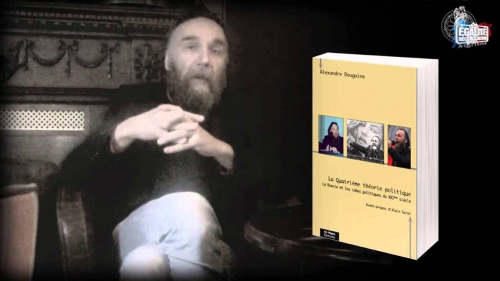
Le ternaire en relation avec le Quatrième Théorie Politique de Douguine : un commentaire de « Chlodomir »
La magie du ternaire est très puissante, mais il ne faut pas s’y laisser enfermer. Au niveau politique, un tel cercle vicieux se forma avec les trois grandes idéologies qui ont dominé le XXe siècle : libéralisme, communisme, fascisme (le nazisme n’étant qu’une branche hypertrophiée du fascisme, un « fascisme radical » dans la terminologie marxiste). Si l’on en rejette deux au profit d’une troisième, quelle qu’elle soit, on reste enfermé dans le cercle, car ces idéologies viennent toutes trois de la Modernité occidentale. L’un des mérites du théoricien et philosophe russe Alexandre Douguine est d’avoir compris qu’il fallait sortir de ce cercle vicieux, « rompre » le cercle (« En science politique au siècle dernier, nous avions appris à ne compter que jusqu’à trois. (…) nous n’avons pas d’autre solution que d’apprendre à compter jusqu’à quatre », A. Douguine, article sur https://rusreinfo.ru/, 2016).
Après quelques tâtonnements (dans un premier temps, il parla de « trinité dialectique »), et après être passé par le national-bolchevisme puis par l’eurasisme, Douguine finit par élaborer la Quatrième Théorie Politique. Cette « 4TP » rejette les trois vieilles idéologies et adopte de nouveaux concepts, en empruntant à la Révolution Conservatrice allemande, aux auteurs eurasistes russes (notamment L. Gumilev), au Traditionalisme (ou Pérennialisme), à la géopolitique, et aussi à la pensée de Heidegger (à qui il emprunta le concept du « Dasein »).
Le succès rapide du livre éponyme de Douguine, La Quatrième Théorie Politique (traduit en anglais et en français en 2012), montra que sa démarche correspondait à une certaine attente dans les élites intellectuelles. La 4TP, par son nom même, a un peu servi d’outil « maïeutique » pour toute une génération militante enfermée dans le mécanisme mental de la « troisième voie » et de la « troisième position », voire de la « troisième idéologie ». Cette approche a eu pendant longtemps de grands avantages, mais est maintenant dépassée. Le « Trois » permet de dépasser le stérile dualisme (cultivé notamment par la Deuxième Théorie Politique) et c’est un pas en avant énorme, mais la vie est mouvement et le ternaire a montré ses limites. La force du « Quatre » permet de « tout faire sauter », de faire appel au « chaos créateur », de réintroduire le Multiple (le Multipolaire, dans le domaine géopolitique), et ensuite « les dix mille êtres »... Douguine explique d’ailleurs que la 4TP est une théorie ouverte et en construction ; mais dès qu’elle existe (ou existera, avec un corpus théorique cohérent et opératif), il n’est pas interdit de réintroduire certains éléments des trois idéologies précédentes…
L’« eurasisme » est une idéologie très bien adaptée à la Russie, mais la 4TP va plus loin et permet de libérer à nouveau la créativité idéologique et politique (l’eurasisme est en quelque sorte la partie russe de la 4TP). On peut même parler de Quatrième Voie, concept peut-être encore plus opératif. Dans les trois vieilles idéologies de la Modernité, le Sujet politique était respectivement l’Individu, la Classe, la Race (ou plutôt le Peuple et/ou la Nation essentialisés, avec une forte connotation ethnique, en ce qui concerne le fascisme « générique »).
Dans la 4TP (qui rejette la Modernité), le fondement philosophique est le Dasein et le Sujet politique est, très logiquement, la Civilisation (phénomène organique fondé sur une ethnogenèse et se déployant sur un Grand Espace). Après Huntington, Douguine distingue à peu près une dizaine de civilisations existantes ou potentielles sur la planète. L’humanité arriverait donc à un nouveau stade de développement organique, après les tribus, les cités-Etats, les royaumes, les empires, et les Etats-nations. On peut alors entrevoir un ordre mondial alternatif et multipolaire, fondé sur la coexistence d’une dizaine d’« Etats-civilisations » (mais sans gouvernement mondial, contrairement au sinistre « Nouvel Ordre Mondial » oligarchique et prédateur ; un organe de coordination devrait suffire). Ce qui serait tout de même plus facile à gérer que plusieurs centaines d’Etats-nations (et le nombre a tendance à augmenter, un spectacle assez grotesque…) représentés à l’ONU.
Comme l’explique Douguine, le libéralisme ultra-capitaliste (le « commercialisme ») et pseudo-démocratique est devenu le Troisième Totalitarisme, le dernier avatar de la Modernité. Sa réalité est la domination oligarchique planétaire, son fantasme et son projet secret (de moins en moins secret, à vrai dire…) est le transhumanisme. En voulant passer directement au globalisme en grillant l’étape organique des Civilisations, il est devenu une Utopie totalitaire et s’est condamné à l’échec historique. En voulant imposer son utopie par la force, le globalisme libéral plonge le monde dans le chaos. Après une dernière crise d’hystérie meurtrière, il terminera dans la poubelle de l’histoire avec le fascisme et le communisme. Mais il risque d’y avoir un mauvais moment à passer, car les prédateurs libéraux globalistes ne voudront pas lâcher leur proie (les peuples enracinés) si facilement…
CRITIQUE DE LA DIALECTIQUE HEGELIENNE
par Ludwig Gumplowicz
(ou la « fascination du ternaire »)
Hegel… cherche à résoudre le dualisme obscur et contradictoire qui se retrouve dans tout l’ouvrage de Herder ; il essaie de concilier Dieu et la nature en une unité supérieure, son fameux « esprit absolu ». En ne voyant et en ne représentant dans toute l’histoire que le développement de cet esprit absolu seul et indivisible, il abandonne le terrain de toute réalité et de toute science ; il réduit sa philosophie de l’histoire à une simple fantasmagorie.
En nous décrivant quelque chose qui n’existe que dans sa tête, il nous affirme que telle est la réalité, et, en donnant à ses fantaisies, pour leur assurer plus de créance, des noms empruntés à l’histoire universelle, il réussit à créer l’illusion.
On sait que, d’après Hegel, le développement et la propagation de l’esprit absolu se règlent « sur une mesure à 3 temps » : thèse, antithèse et synthèse. La formule est habile : on peut l’appliquer à tout en général, à chaque chose en particulier. Il n’est pas un ensemble de mouvements qu’elle n’embrasse ; il n’est pas un mouvement qui lui échappe. Que ce mouvement soit physique, intellectuel ou social, on n’a qu’à considérer une phase quelconque de son développement, comme l’un des temps de la mesure à 3 temps, et voilà le moyen de bâcler la philosophie de tel ou tel sujet, et les sujets ne manquent pas, la nature et la vie nous offrant partout des mouvements. Rien de plus facile que d’écrire ainsi une philosophie de la physique. La thèse sera, par exemple, l’attraction, alors l’antithèse sera la répulsion ; la synthèse, la cohésion. Quant aux détails, il suffira de les traiter tant bien que mal. Une philosophie de la musique ou de la peinture, etc., ne présenterait pas de plus grandes difficultés.
Pour créer sa philosophie de l’histoire, Hegel n’a eu qu’à prendre l’Orient pour thèse de « l’esprit absolu », l’antiquité classique pour antithèse, le monde germanique pour synthèse, et à faire rentrer l’histoire universelle, de gré ou de force, dans ses formules. Un Chinois, à la vérité, aurait tout aussi bien le droit de prendre l’Europe pour thèse, l’Amérique pour antithèse, le monde chinois pour synthèse de l’esprit absolu, et de fabriquer ainsi une philosophie chinoise de l’histoire. Il acquerrait probablement en Chine la popularité que Hegel s’est acquise en Allemagne, car la théorie qui permet le plus facilement aux hommes de comprendre le monde et la vie humaine devient toujours populaire. C’est pourquoi la Bible est le plus populaire des livres, sa formule pour comprendre le monde et la vie étant la plus simple.
Mais il y avait des hommes qui ne voulaient pas se placer au point de vue théologique, qui prétendaient concevoir le monde « philosophiquement ». A ceux-là Hegel est venu fournir une formule « philosophique » non moins simple, d’une assimilation non moins facile : « l’esprit absolu se développe ». Un point, c’est tout. Et les gens de distinguer, dans leurs sujets, une thèse, une antithèse et une synthèse. On y arrive toujours, pourvu que l’on ait été dressé, et dès lors on a la satisfaction de comprendre le monde.
(Ludwig Gumplowicz, La lutte des races, 1883)
11:51 Publié dans Nouvelle Droite, Philosophie, Théorie politique | Lien permanent | Commentaires (0) | Tags : philosophie, nouvelle droite, philosophie politique, politologie, sciences politiques, quatrième théorie politique, alexandre douguine, ludwig gumplowicz | | del.icio.us | | Digg | Facebook
mardi, 05 février 2019
Rusia y su misión histórica: El legado de Iván Ilyin
Ex: http://www.elespiadigital.com
El presidente de Rusia, Vladimir Putin, en su famoso Mensaje anual del Estado de diciembre de 2014, fundamentando la nueva doctrina nacional, citó al filósofo Iván Alexandrovich Ilyin (Иван Александрович Ильин) [1883-1954] como uno de los grandes referentes teóricos y espirituales para el tiempo histórico presente.
Sergio Fernández Riquelme
00:52 Publié dans Biographie, Philosophie | Lien permanent | Commentaires (0) | Tags : russie, ivan ilyine, biographie, philosophie, philosophie russe | | del.icio.us | | Digg | Facebook
dimanche, 03 février 2019
Dezsö Csejtei auf der Oswald-Spengler-Konferenz 2018
Dezsö Csejtei auf der Oswald-
Spengler-Konferenz 2018

Dezsö Csejtei auf der Oswald-Spengler-Konferenz 2018
00:44 Publié dans Philosophie, Révolution conservatrice | Lien permanent | Commentaires (0) | Tags : philosophie, philosophie de l'histoire, oswald spengler, allemagne, révolution conservatrice | | del.icio.us | | Digg | Facebook
samedi, 02 février 2019
Prof. Dr. Max Otte auf der Oswald-Spengler-Konferenz 2018

Prof. Dr. Max Otte auf der Oswald-Spengler-Konferenz 2018
00:40 Publié dans Philosophie, Révolution conservatrice | Lien permanent | Commentaires (0) | Tags : philosophie, philosophie de l'histoire, oswald spengler, allemagne, révolution conservatrice | | del.icio.us | | Digg | Facebook
vendredi, 01 février 2019
Gregory Swer auf der Oswald-Spengler-Konferenz 2018
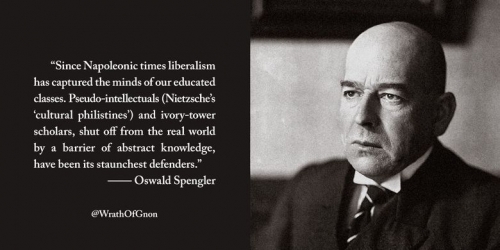
Gregory Swer auf der Oswald-Spengler-Konferenz 2018
00:35 Publié dans Philosophie, Révolution conservatrice | Lien permanent | Commentaires (0) | Tags : philosophie, philosophie de l'histoire, oswald spengler, révolution conservatrice, allemagne | | del.icio.us | | Digg | Facebook
jeudi, 31 janvier 2019
Prof. Dr. Alexander Demandt auf der Oswald-Spengler-Konferenz 2018
01:38 Publié dans Philosophie, Révolution conservatrice | Lien permanent | Commentaires (0) | Tags : allemagne, alexander demandt, oswald sepngler, révolution conservatrice, philosophie, philosophie de l'histoire | | del.icio.us | | Digg | Facebook
Postmodernism on the Right: A Case for Adopting Deconstructing as a Tool
Postmodernism on the Right:
A Case for Adopting Deconstructing as a Tool
By Eumaios One of the realities that must be recognized by the Dissident Right, particularly in the Anglophone world, is that that those modes of thought and analysis broadly encapsulated by terms like postmodernism, critical theory, or the Frankfurt School are not inherently “Left-wing.” Collectively and individually, they are not inherently anything other than a means to an end. It was a success on the part of those who deployed these framing techniques that they convinced so many that they were actual philosophical positions. This sleight-of-hand duped several generations of Western society into believing that deployers of “critique” were arguing in good faith. Postmodernism and its cognate modes of thought and analysis could never amount to an end in themselves because they are by definition null space. Postmodernism is the analytic imperative to stand nowhere at no time, and critical theory is an injunction to critique and deconstruct from outside a value structure, not to imagine or construct one. That is not to say, however, that these intellectual currents belong to those with no values of their own.
The “ends” of deconstruction were conceived through an entirely separate mode of discourse to deconstruction itself. The Left-wing innovators of critical theory and postmodernism imagined replacing the foundational and time-tested cultural frameworks that their timeless and valueless intellectual techniques would destroy, with social constructs built on Left-wing values. These Left-wing values did not emerge from, nor were they explicitly present in, the instrumentalized nihilism of deconstruction. Quite the opposite, in fact. It is no secret that the values which animate Leftist thinkers derive from Enlightenment thought. Enlightenment streams of thought positively moralize on universal terms. They do so from initial constructs of sacred meaning that tend to be less internally challenged by the community adhering to them than were the moral precepts of the Catholic Church. The base of Leftist thought is thus anything but the hyper-self-aware and indiscriminately critical frame of nihilism that defines deconstruction.
Therefore, rather than “Leftist” schools of thought, the tools of deconstruction are better understood as weapons which may have proved more powerful than even their own progenitors thought they ever would be. I need not belabor this point. Most of you have undoubtedly encountered the logical shutdowns and bouts of indignant fury caused by simply and honestly considering the possibility that peoples of European descent may have their own collective history and that it may be legitimate for those who share that history, and its subsets, to preserve their biological heritage or act in their own interests. As many before me have pointed out, this is the net effect of deconstruction. In two generations, it rendered the most powerful family of peoples in human history a demographic nonentity struggling to even justify their own continued existence as recognizable peoples in their own homelands.
It is unsurprising, considering its net effect, that those who wish for peoples of European descent to have group autonomy/autonomies, and to continue existing in any recognizable way, consider deconstruction to be a pure and unmitigated evil. However, as I mentioned earlier, it is only a tool. This remains true regardless of whether or not it was a tool first used by those whose ideal future involves everything you find most sacred, including what you call your own people, ceasing to exist as you believe it to be doing now. Consequently, like any tool, you can use it yourself if you can figure out how it works.
Science is only your friend if you make it that way
I am aware that many who are right of center will contend that they do not need such beguiling linguistic contrivances, because they have “science” on their side. Surely it is only the Left that needs to make reality appear a certain way, because it is only the Left who adhere to a worldview that runs counter to objective truth? Perhaps this is true, but regardless of whether it is, “objective truth” is not synonymous with “science.” To assume such a thing is to mistakenly conflate non-human-created realities, and empirical evidence collected about the nature of those realities, with a set of social practices. This social dimension includes the conventions that define different scientific disciplines, as well as the role that science plays as a regulator of mainstream society. If it were true that all these phenomena constituted an indissoluble entity called “science,” and that the definition of this entity was coextensive with that of objective truth, then the Dissident Right would need to make some undesired concessions.
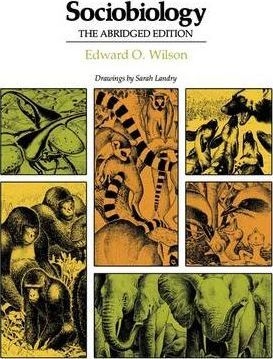 Among such concessions would be that it is unscientific to form a research community around sociobiology, or to explore the possibility that the individual selection model of evolution may not capture all aspects of natural selection, and that group-level fitness may play a role. After all, this remains the official view of mainstream science, which is a testament to the success of the Left-wing Sociobiological Study Group. This scientific research community arose in response to E. O. Wilson’s Harvard-based sociobiological research circle, and it functioned with the sole purpose of preventing sociobiology ever becoming a scientific discipline.[1] [2] Another necessary concession would be that it is not “scientific” to form a research community focused on population genetics and intelligence, as the recent “investigations” of such a community by the managers of institutional science at University College London have indicated.[2] [3] Finally, if the social practices and institutions of “science” are coextensive with objective truth, the Dissident Right would have to accept that the categories of male and female “have no basis in science,” and thus whatever social customs have been organized around that binary system are illegitimate. This revelation is, after all, the official position of what is surely the uncontested apogee of scientific knowledge and authority: the journal Nature.[3] [4] If the official position of the editors of Nature does not constitute authoritative scientific truth, then what else could?
What these unfortunate situations have hopefully made clear is that “science” has proven to be no more capable of preventing itself from being deconstructed into the narrative of social justice than even the most “airy fairy” of humanities departments. This is because scientific disciplines are social practices, and always have been. The institutions carrying scientific authority over mainstream Western ontology are clearly not interested in revealing “objective truth,” but in shaping society in accordance with the cultural Left’s interpretation of “Enlightenment” principles. The reason for this is that the most powerful institutions of science have already been convinced that either “objective truth” does not exist, or at least that it is less meaningful than the pursuit of “progress.” Even the ever-unstable “scientific method,” purported to unite the work of all those disciplines bearing the name “science,” is the formulation of philosophers or scientists acting as philosophers, and not a revelation of objective truth made by science itself. The most recent iteration of the “scientific method,” generally described as “falsifiability,” is the work of Karl Popper, a scientifically uninitiated philosopher whose work and general worldview inspired the machinations of none other than George Soros.[4] [5]
My intention is not to argue that science is only shaped by social forces, and never provides access to objective truth, or at least the nearest thing to it. I don’t think that is true. Hilary Putnam’s “No Miracles” argument, which generally asserts that “scientific realism” is the only way to explain the success of scientifically-derived technology without resorting to miracles, indicates that science can indeed do more than simply reflect social arrangements.[5] [6] However, regardless of whether or not science offers a route to objective truth, it should not be treated as a monolith. The practices that define scientific disciplines, and those which delineate the wider community whose members are recognized as practitioners of “science,” are mediated through social forces. The Right’s refusal to accept that science is, at least to some degree, social and political in both its inner and outer workings has allowed its enemies to go unchallenged in consolidating their influence over “science” as an institution of public authority. If “science” alone could not prevent itself from being deconstructed into a puppet of Leftist progressivism, on what grounds should anyone believe that appealing to “science” would help in a culture war against the Left? “Science” is powerfully influenced by social values in the areas that matter most, and the cultural Left are the only ones who have worked to insert any such values among scientific communities. The Right must deconstruct scientific practice to remove these values, before reinserting their own.
To be clear, I am not arguing against objective truth. I think there are perfectly good reasons to believe that it exists, and that it is the most sensible position to assume that it exists. All I wish to argue is that the highly diffuse agglomeration of institutions, social conventions, material objects, and historically contingent practices which now happen to be labeled under the term “science” should be scrutinized independently of each other. “Science” should not be considered the single best route to truth at all times, in the same way that such may be true of thinking in a way that tries to avoid internal contradictions to explain something with all available evidence. High degrees of accuracy in physics does not imply that geneticists were pursuing an objective truth in targeting the genetic evidence for Cheddar Man’s skin color, nor that their findings reflect any such objective truth.
Deconstruction as rhetoric for the academy
The discourse of deconstruction loosely referred to as postmodernism is particularly valuable to the Dissident Right. This is because it allows one to think creatively outside the modernist set of rails which emerged from the conditions that obtained of nineteenth- and twentieth-century Western Europe and America. Riding through history on these rails has resulted in European-derived peoples finding themselves where they are now. As such, it would make sense for those who find the present condition unacceptable, and who wish to move those of European descent toward an alternative, to value a socially acceptable way to think outside the mode of thought that got them to where they currently are. Fróði Midjord and others have already pointed to the importance of the Dissident Right coming to understand and use postmodernism’s discovery of “hyper-realism.” He has described how this can be done by deconstructing the political baggage carried by most products of Western media. This is, of course, absolutely correct, and its importance can’t be overstated. However, I am referring to the reengineering of another one of postmodernism’s capacities. This capacity has more to do with brute rhetoric than with the self-aware deconstructive reflection that Mr. Midjord proposes. The following anecdote will hopefully demonstrate what this rhetorical capacity looks like when properly deployed.
Having recently gone to a seminar in my department, I noted an interesting phenomenon. There were a number of faces there which I had not seen before. One was a faculty member I had encountered once or twice, and the others were clearly four of her Ph.D. students. The seminar concerned a new way to approach species demarcation, a question that inevitably involves the application of a normative standard to define a biological population. After the talk came the questions I have heard so many times before, and they revealed the reason these new faces were here: “What provision does your model make for variations between individuals?”, “Isn’t a normative value system exclusionary?”, “How is your idea different from rhetorical tools that enlist scientific authority to pathologize and exclude ‘the other’?”, and so on.
It became clear at this point what was going on and why I had never seen these people at other seminars. It was because they only appear at seminars which are not directly related to their “field,” when they believe the content of that seminar either weakens their deontic framework, or is classed as morally objectionable by it. It is in these cases that they not only attend, but attend in force to dominate the question period with their “critique.” Evidently, one full-time staff hire had become a vector for an army of received morality enforcers, whose complete academic energies are dedicated to reinforcing their ideology and deploying it as the only lens through which they ever encounter other ideas. This was a social justice wolfpack.
Unsurprisingly, the speaker, like nearly all modern academics, had never interrogated his own deontic frame, making his implicit value system generally consistent with that symbolized by the “NPC” meme. He was not a social justice inquisitor himself, which was why he was applying his academic energy to an entirely separate subject. Nonetheless, he presumed tropes like “inclusion,” “diversity,” and “tolerance” to be moral imperatives, without ever considering what these words mean either in absolute terms or in different contexts. As such, the social justice enforcers didn’t have to locate any internal weaknesses in his argument to assault it. In fact, they didn’t have to engage with the logic or evidence he presented at all. All they had to do was point out where the supporting evidence and framework of logic, which undoubtedly took him months to compile and build, didn’t align with their own conceptual framework. Being that the speaker unquestioningly presumed the foundational axioms of this framework (which the wolfpack simply took to their logical extremes), all he could do was sheepishly accept their “critique” as revealing genuine flaws in his argument, apologize for these errors, and gradually retreat from nearly all the interesting points he had made. It took them seconds to use a set of ideas, that they acquired in hours, to defeat the framework of logic and evidence that took him months or years to construct.
One point illustrated by this anecdote is that the universities are not inherently impenetrable to a system of thought or analysis operating outside a non-Leftist frame. If they were, then there would be no need for Leftist wolfpacks to patrol conferences or workshops. Their critique of this man’s ideas were “correct,” to a degree. Many mainstream academics regularly, and unintentionally, introduce new ideas that lend themselves to strengthening the normative axioms from which the Dissident Right views the world, or at least could be repurposed that way with minimal effort. However, the second, and seemingly contradictory, point to take away from my anecdote is that the universities, at their deepest level of social convention, are not as free as the “Alt Lite” or “intellectual darkweb” presume that they are. The now-ubiquitous whining about “the SJWs!” emerging from “radical” publications like Quillete paint a picture of a few totalitarian puritans somehow perverting an otherwise completely free and functional domain of academic discourse. However, it is clearly the mainstream social rules of academic discourse themselves that grant such unholy power to the social justice priesthood. These rules mean that enforcers of social justice need only one “knockout” argument to defeat every idea from every other field, with near-zero intellectual energy expenditure. This universally effective tool is actually no argument at all, but a formula for merely identifying where any new ideas may come at the cost of their own unquestionable mandates for “inclusion,” “diversity,” or “tolerance.”
It is clear that any families of thought, such as the Dissident Right, which are genuinely dedicated to creatively exploring new ways to approach fundamental perspectives on the world simply do not have the ability to counteract the ideology of social justice, while its adherents win every argument by simply “deconstructing” everything into their own frame, while closing that frame to critique. This cannot be solved by only “deconstructing” the weaponized messages they dispatch in your direction. This is simply defense. It is their frame that needs to be challenged. However, because this frame is morally charged, it needs to be challenged by deconstruction from a different frame, whose adherents must hold it, whether explicitly or implicitly, to be morally self-evident. This is not the realm of positive discourse and dialectic, but that of rhetoric. Vox Day has made some sound observations on this point.
Rhetorically speaking, I will concede to my critics that introducing discourse from outside the conceptual rails which the Left derisively calls “bourgeois” values may appear absurd, obscurantist, or downright hostile by the bulk of Westerners who tend toward Right-wing thinking. My personal bias tells me that this is a signal that the structure of social conventions which ascribe meaning to the sacred values that the Dissident Right is trying to protect are worth protecting. To have a negative gut response to something that manifests nothingness and nowhere, as does postmodernism, is healthy. Considering that postmodernism was introduced into the academy only to destroy, it is also healthy to intuitively oppose it for that reason. I wouldn’t personally value a community who worship nuclear weapons for being engines of destruction. However, if you have any desire at all of gaining a foothold in the universities, which have proven to be an extremely powerful piece on the culture-war chessboard, deconstruction is not only a potentially effective strategy to adopt, but is, in my estimation, singularly necessary.
Some possible attack vectors in the universities
As I mentioned earlier, the Left’s worldview is not itself a product of deconstruction. This makes it vulnerable to the latter. Yet as things stand, academic agents of social justice remain spared from justifying what might be called the “opportunity cost” of universalizing their system of thought. This means that those applying Leftist “critique” are free to presume that something which comes at the cost of what they call “social justice” is necessarily an intellectual and moral hindrance to their opponent’s argument. Thus, whenever an agent of social justice begins a debate with the target of his “critique,” the entirety of his intellectual energy may be spent on positively pursuing his rhetorical objectives (which are coextensive with his moral objectives). He never has to defensively justify those objectives or the metaphysical presumptions upon which they are founded. By contrast, when all other actors in Western societies, academic or otherwise, encounter agents of social justice, they must split their energies between justifying why their objectives are worthwhile in positive terms, and then explaining how their objectives do not conflict with the ends of social justice. This leaves those subjected to a social justice critique only minimal intellectual energy to actually make their own arguments. It is this asymmetrical freedom to conserve their intellectual and rhetorical resources which converted shrieking harpies of usually moderate-to-low intelligence into feared academic arbiters to whom even the most brilliant professors defer in a debate.
A vocabulary needs to be developed which does to the initial axioms presumed by social justice what it did to the initial axioms of the paradigms that it was used to destroy. The ends of social justice themselves need to be found to be potentially “problematic” through another critical lens. This weaponized vocabulary must be built on a moral framework which presumes that, even if social justice were effectively executed, it would come at the cost of other things which are of greater value. This will allow for a rhetorically effective way to simply bypass having to defend an idea from a social justice critique, while simultaneously putting the deployer of that critique on the defensive. They will then have to waste time and energy finding ways to justify their own normative assumptions, with each attempt making them appear more linguistically deceptive and morally suspect.
This task is slow and difficult, but not impossible. It also gets easier as more absurd Leftist assumptions are identified and left out in the open. For instance, Leftist critiques nearly always assume that “inclusion” is a positive thing. They see inclusion as synonymous with “progress” and “equality,” and this predicates their strategy of doubting the grounds for which any category they don’t like excludes things. However, inclusion can just as easily be synonymous with regression and destruction. The existence of a hospital building, for instance, is predicated on the assumption that exclusion can be a good and constructive thing, which in turn presumes that universal inclusion relative to hospital buildings is a bad and destructive thing. If every possible thing were forced to be included in a hospital building, the category would be meaningless, and what might have been a hospital building would simply be a pile of rubble. Yet, every hospital building embodies the notion that some things belong and others do not. This embodiment presumes both differences between things, as well as an implicit hierarchy relative to what is “good” for the category “hospital building.”
A Leftist critique would point out that there are no objective grounds to support the implicit hierarchy that gives the normative category “hospital building” any meaning. From this, they would contend that your “hospital building” category is arbitrary, since they assume that any subjective values and hierarchies apart from their own are “arbitrary” by definition. This in turn allows them to imply that what is “true” could not be what motivates anyone to police the category “hospital building.” This leaves only the possibility that the category “hospital building,” which the victim of the critique chooses to police, is an imposition on the world, which could only be motivated by a desire to separate things, exclude things, and make some things inferior to other things. This is the essential nature of their notion of “oppression” which, as I have shown, could be used against literally anything they take issue with, for whatever reason. That is how agile and adaptable the Left’s rhetorical tools are. One who values hospital buildings may even be shown to be “xenophobic,” as their subjective category would “arbitrarily” exclude black people from comprising a part of hospital buildings. After all, the inclusion of black people in the superstructure of hospital buildings would be deemed to be something negative by anyone who values the structural integrity of hospital buildings. Yet we have already shown that anyone who believes in the oppressive social construct “hospital buildings” could only ever be motivated by the love of “division,” “judgment,” and ultimately, “hate.”
The Left’s academic strategy rests on the hope that the opponent will forget that their categories have, or may have, implicit value. If one points this out, and argues from the assumption that, for instance, the category of “hospital building” has implicit value, it can easily be shown that the “inclusion,” which the Left presumes to be a universal good, is in fact destructive. However, it cannot always be known if a category has value, and in some cases that value may only be knowable by those within the category. This is one of the foundations of the postmodern critique.
Academics sympathetic to the Dissident Right, or simply to challenging the status quo, should be asking their hecklers what the expense of forced “inclusion” might be, and what makes the Leftist heckler in question believe they have the moral legitimacy to enforce it. Another question that should be asked is if “inclusion” and “diversity” are necessarily desirable at all levels of everything, at all times? If so, why? One does not need to know the answers to these questions to effectively deploy them against proponents of social justice, if that deployment occurs with an equivalent degree of moral indignation. Fortunately, that indignation can be justified.
The great irony of social justice, as I see many on the Dissident Right are already aware, is that universal “diversity” at every level and at all times destroys the requisite particularities of “diversity”, because each discrete category becomes homogenized. The imposition of a universally distributed degree of “diversity” in a class of categories makes all the categories exactly the same, thus rendering them meaningless. Yet in social terms, within each category may exist an identity, way of life, or normative framework from which humans moralize and act. Forced “inclusion” and “diversity” thus destroys all categories everywhere at all times, and these impositions also come at the cost of other normative frameworks, from which people may derive meaning and purpose. Among such frameworks, one might include the “indigenous ways of knowing” of the Tiwi people, but also the foundational value structure of the Dissident Right. By pointing out what is being unthinkingly destroyed, the moral presumptions of universalist social justice can be framed as destructive, mindless, homogenizing impositions emerging from centers of power, which would strip the Left’s “critique” of its radical facade.
Another effective approach would be to “historicize” social justice. Social justice scholars never have to consider the historical contingency of their own analytical frame, despite regularly using this historicizing imperative as a blunt instrument against every other mode of discourse, e.g. “science studies.” This is because, up until now, they were the only ones comfortable arguing in such abominably bad faith. However, it would be both appropriate and effective for modern scholarship to ask “under what conditions of privilege did the homogenizing imperative of ‘social justice’ emerge?”, and “To what extent are the supposed standards of social justice merely historically contingent obsessions of powerful actors trying to forcibly shape the world in their image?” Courses that emerge one day may include “social justice in context,” in which the “aggressive triumphalism” of social justice is explored as a product of the toxic climate of “implicit oikophobia” which prevailed in the mid- to late-twentieth century. This would provide a non-resource intensive way to pathologize social justice within a prearranged narrative that could be easily transported to multiple sites.
Another key function of the historical approach is to depict social justice as being contingent on forces apart from itself, which diffuses the implicit assumption that it was “inevitable.” This is important, because something can only be considered “progress” that internally presumes the inevitability of historical movement toward its own endpoint. Take that away, and social justice simply becomes one cluster of reasoning from which humans derive meaning, among many. It ceases to be the truth and becomes a convention, which thus could only exist where it was imposed by agents with power trying to pursue more power. This technique is what the Left calls “parochializing,” and it proved deadly effective in destroying the Western Canon, leading to a generation of Europeans with no binding sense of a past, future, or present culture.
Conclusion
So what is the takeaway message from all of this? The Dissident Right and those sympathetic to its cause rest the legitimacy and meaning of their ideas on a set of values. This it shares with the Left, despite its initial values being different. However, what the Dissident Right does not share with the Left is the ability to “deconstruct” its opponent’s set of values. Academic enforcers of social justice have mastered the art of “deconstructing” all neutral parties whose discourse is in good faith, but they have no weapons against those whose discourse may be in bad faith. They know how to manipulate language, but not how to respond to their language being manipulated. To frame their analysis as morally suspect rhetoric and to demand that they justify it, is to force the social justice enforcer back into the realm of dialectic, a discourse in which they are generally incompetent. However, getting them there is not within the domain of dialectic itself.
A rhetorical strategy must be designed and agreed upon by a small community of people, who will need to train others to be dedicated to the task of “deconstructing” the deconstructors, if there is to be any hope for your side of the culture war to have a fair hearing in the academy. As such, I advise undercover academics to resist putting their energies toward positive arguments that support the worldview of the Dissident Right, at least at this point in time. Rather, they should make contact with each other and begin formulating a way to plausibly sell moral disgust at the most basic assumptions made by agents of social justice, and thus corrupt the moral firmware on which it runs. This may sound ridiculous, but it has already been accomplished with the tools of postmodernism.
The postmodernists of yesteryear conditioned an entire generation of white Westerners to be disgusted by the core moral axiom that once underwrote the “progressive” activities of their white Western predecessors. This axiom was the belief in the moral imperative to “civilize” the non-Western world. It underwrote the morality that justified the imperial march of “progress” as foundationally as “inclusion” and “diversity” underwrite the “progressive” activities of modern Leftists. The fact that mainstream discourse puts the word “civilize” in quotation marks today is a testament to the success of the postmodernists in deconstructing away an entire moral framework. It can be your success, too, and must be. Before any honest work can be done by anyone toward building anything new in academia, we must remove the cultural Left’s ability to destroy without consequence. This will involve identifying and deconstructing the platform from which they do it. This will need to occur with the same singlemindedness and cynicism that accompanied the rhetorical brilliance of Adorno, Marcuse, Horkheimer, and later Foucault, Lacan, and Latour.
Notes
[1] [7] Ullica Segerstrale, Defenders of The Truth: The Battle for Science in the Sociobiology Debate and Beyond (Great Clarendon Street Oxford: Oxford University Press, 2000), p. 406.
[2] [8] UCL, “UCL Statement on The London Conference on Intelligence [9],” January 13, 2018.
[3] [10] “Anatomy does not define gender,” Nature 563, no. 5 (2018).
[4] [11] George Soros, Soros on Soros: Staying Ahead of the Curve (New York: John Wiley & Sons, 1995), p. 33.
[5] [12] Hilary Putnam, Philosophical Papers, vol. 1, Mathematics Matter and Method (Trumpington Street Cambridge: Cambridge University Press, 1979), p. 73.
00:01 Publié dans Philosophie | Lien permanent | Commentaires (0) | Tags : philosophie, déconstruction, déconstructionnisme, postmodernité | | del.icio.us | | Digg | Facebook
mercredi, 30 janvier 2019
Werner Sombart ce grand oublié de l'histoire

01:25 Publié dans Philosophie, Révolution conservatrice, Théorie politique | Lien permanent | Commentaires (0) | Tags : capitalisme, werner sombart, socialisme, socialisme allemand, allemagne, philosophie politique, théorie politique, sciences politiques, politologie, révolution conservatrice | | del.icio.us | | Digg | Facebook
Prof. Dr. Gerd Morgenthaler auf der Oswald-Spengler-Konferenz 2018
Prof. Dr. Gerd Morgenthaler auf der Oswald-Spengler-Konferenz 2018
Prof. Dr. Gerd Morgenthaler auf der Oswald-Spengler-Konferenz 2018 https://www.oswaldspenglersociety.com/ --- Gerd Morgenthaler ist Inhaber eines Lehrstuhls für Öffentliches Recht an der Universität Siegen. Nach Studium der Rechtswissenschaft (Erstes Staatsexamen 1987), Promotion zu einem international-steuerrechtlichen Thema (Heidelberg 1991) und Rechtsreferendariat in Baden-Württemberg (Zweites Staatsexamen 1991) habilitierte er sich mit einer Arbeit zum Freiheitsbegriff des Grundgesetzes in seiner historischen Prägung durch die Naturrechtsphilosophie der europäischen Moderne (Heidelberg 1999). Seine Forschungsschwerpunkte liegen in den Bereichen des Verfassungsrechts (Freiheitsgrundrechte, Nachhhaltigkeit, Rechtsstaat), der europäischen Integration (Krisen, Zukunftsperspektiven) und des Zusammenhangs von Recht und Entwicklung in außereuropäischen Kulturen (insbesondere im Südkaukasus, in Zentralasien und in China).
00:32 Publié dans Philosophie, Révolution conservatrice | Lien permanent | Commentaires (0) | Tags : oswald spengler, révolution conservatrice, allemagne, philosophie, philosophie de l'histoire | | del.icio.us | | Digg | Facebook
mardi, 29 janvier 2019
"Oswald Spengler ou le tourment de l'avenir"
11:57 Publié dans Philosophie, Révolution conservatrice | Lien permanent | Commentaires (0) | Tags : philosophie, philosophie de l'histoire, oswald spengler, allemagne, révolution conservatrice | | del.icio.us | | Digg | Facebook
Emmanuel Pasquier - Le terrorisme à la lumière de la Théorie du partisan de Carl Schmitt

Emmanuel Pasquier - Le terrorisme à la lumière de la Théorie du partisan de Carl Schmitt

02:00 Publié dans Philosophie, Révolution conservatrice, Théorie politique | Lien permanent | Commentaires (0) | Tags : terrorisme, révolution conservatrice, carl schmitt, théorie du partisan, théorie politique, politologie, sciences politiques, philosophie politique | | del.icio.us | | Digg | Facebook
lundi, 28 janvier 2019
Bergson et les blasphèmes de la société ouverte
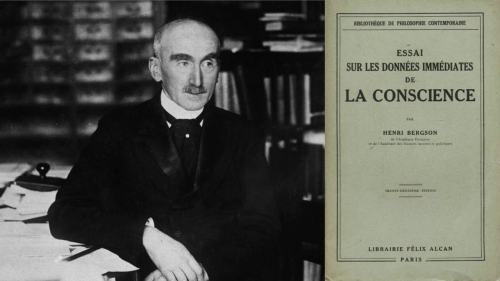
Bergson et les blasphèmes de la société ouverte
Les Carnets de Nicolas Bonnal
Ex: http://www.dedefensa.org
Ce sujet effrayant mériterait un livre détaillé. La société ouverte de Soros veut imposer le chaos partout : comme le chaos n’est pas naturel (relisez Gilles Chatelet) il faut l’imposer par la force, un peu comme le néolibéralisme s’impose par les thérapies de choc. Mais d’où vient cette société ouverte qui veut nous clouer le bec ?
On commence par le médiocre Karl Popper. On sait que Popper utilise cette expression pour s’en prendre aux ennemis que seraient les géants Platon, Hegel et Marx. Bref les plus grands génies de la pensée occidentale deviennent les ennemis de cette société moderne et ouverte. Ah, ce passé.... Vague prof d’université qui se prit pour le petit juge de la philosophie occidentale, Popper, libéral autrichien exilé en Nouvelle-Zélande, faisait partie de ces vrais penseurs de notre temps dont parla un jour Guy Sorman, et qui n’avaient de penseur que le nom. Ils étaient là pour imposer la société libérale chaotique, inégalitaire et fascisante dans laquelle nous sommes maintenant plongés à plein-temps. Dans Vivre et penser comme des porcs, livre qui me fut recommandé par Chevènement (nous avions le même éditeur), Gilles Chatelet décrivait l’origine britannique de cette pensée postmoderne : Hobbes et Bentham bien sûr, l’ineffable Malthus (voyez ce qu’on fait de nos jeunes), Mill, Hayek, Gary Becker, etc. On en reparlera.
Point n’est besoin d’être cacique pour remettre Popper à sa place. Wikipédia, rédigé parfois par d’honorables profs de philo, le fait pour nous :
« En 1959, le philosophe Walter Kaufmann a fortement critiqué les passages de cet ouvrage concernant Hegel. Il écrit notamment que le livre de Popper « contient plus d’idées fausses au sujet de Hegel que n’importe quel autre ouvrage » et que les méthodes de Popper « sont malheureusement semblables à celles des ‘universitaires totalitaires’ ». Kaufmann accuse Popper d’ignorer « qui a influencé qui » en matière de philosophie, de trahir les principes scientifiques qu’il prétend pourtant défendre, et de ne pas bien connaître les textes de Hegel – s’étant basé sur « une petite anthologie pour étudiants ne contenant pas un seul texte complet. » De même pour Eric Voegelin, le livre de Popper est un « scandale », une « camelote idéologique » qui utilise des concepts sans les maitriser, ignorant de la littérature et des problématiques des sujets traités. »
Et Wikipédia d’insister encore avec ce drôle :
« La philosophe Anne Baudart reproche à Popper ses rapprochements hâtifs, ainsi que le fait de porter sur les philosophes grecs « un regard tout à fait anachronique, fort loin de l'impartialité. »
Mais l’expression de société ouverte ne vient pas de Popper. Elle vient comme on sait de Bergson, le prof philosophe, subversif et mondain du siècle dernier, selon notre René Guénon, qui évoquait dans son Règne de la quantité le « nomadisme dévié ».
Bien avant la société liquide dénoncée par Zygmunt Bauman et par le brillant styliste et matheux Gilles Chatelet, Guénon note la menace de la pensée fluidique de Bergson (Règne de la Quantité, chapitre XXIII). Il souligne la fascination fin de cycle pour la dissolution de toute chose (nations, sexes, religions, familles…) :
« …de là leur allure « fuyante » et inconsistante, qui donne vraiment, en contraste avec la « solidification » rationaliste et matérialiste, comme une image anticipée de la dissolution de toutes choses dans le « chaos » final. On en trouve notamment un exemple significatif dans la façon dont la religion y est envisagée, et qui est exposée précisément dans un des ouvrages de Bergson qui représentent ce « dernier état » dont nous parlions tout à l’heure… »
La religion ouverte de Bergson va donner la société ouverte de Soros-Popper (et même la religion du père François). Dans ses Deux sources de la morale et de la religion, Bergson définit deux origines à la religion ; la mauvaise, qui est la traditionnelle ; et la bonne, qui est la sienne, et qui est « ouverte » comme la société de l’autre.
Guénon, très remonté :
« Il y a donc pour lui deux sortes de religions, l’une « statique » et l’autre « dynamique », qu’il appelle aussi, plutôt bizarrement, « religion close » et « religion ouverte » ; la première est de nature sociale, la seconde de nature psychologique ; et, naturellement, c’est à celle-ci que vont ses préférences, c’est elle qu’il considère comme la forme supérieure de la religion… »
On fait la chasse à la statique :
« Mais, dira-t-on, une telle philosophie, pour laquelle il n’y a pas de « vérités éternelles », doit logiquement refuser toute valeur, non seulement à la métaphysique, mais aussi à la religion ; c’est bien ce qui arrive en effet, car la religion au vrai sens de ce mot, c’est justement celle que Bergson appelle « religion statique », et dans laquelle il ne veut voir qu’une « fabulation » tout imaginaire ; et, quant à sa « religion dynamique », la vérité est que ce n’est pas du tout une religion. »
Cette religion ouverte façon Vatican 2 n’est plus une religion :
« Cette soi-disant « religion dynamique », en effet, ne possède aucun des éléments caractéristiques qui entrent dans la définition même de la religion : pas de dogmes, puisque c’est là quelque chose d’immuable et, comme dit Bergson, de « figé » ; pas de rites non plus, bien entendu, pour la même raison, et aussi à cause de leur caractère social ; les uns et les autres doivent être laissés à la « religion statique » ; et, pour ce qui est de la morale, Bergson a commencé par la mettre à part, comme quelque chose qui est en dehors de la religion telle qu’il l’entend. »
Précisons que Bergson inspira le romancier néo-catholique Joseph Malègue qui est lui l’une des références méphitiques de ce pape.
Guénon passe à la religiosité :
« Alors, il ne reste plus rien, ou du moins il ne reste qu’une vague « religiosité », sorte d’aspiration confuse vers un « idéal » quelconque, assez proche en somme de celle des modernistes et des protestants libéraux, et qui rappelle aussi, à bien des égards, l’« expérience religieuse » de William James, car tout cela se tient évidemment de fort près. C’est cette « religiosité » que Bergson prend pour une religion supérieure, croyant ainsi, comme tous ceux qui obéissent aux mêmes tendances, « sublimer » la religion alors qu’il n’a fait que la vider de tout son contenu positif, parce qu’il n’y a effectivement, dans celui-ci, rien qui soit compatible avec ses conceptions… »
La religion ouverte comme la société ouverte relève de la divagation mais attention, la férocité des méthodes n’est jamais loin, voir l’autoritarisme de ce pape ou du président français :
« …au fond, ce qui lui plaît chez les mystiques, il faut le dire nettement, c’est la tendance à la « divagation », au sens étymologique du mot, qu’ils ne manifestent que trop facilement lorsqu’ils sont livrés à eux-mêmes. Quant à ce qui fait la base même du mysticisme proprement dit, en laissant de côté ses déviations plus ou moins anormales ou « excentriques », c’est-à-dire, qu’on le veuille ou non, son rattachement à une « religion statique », il le tient visiblement pour négligeable… Ce qui lui appartient peut-être en propre, c’est le rôle qu’il attribue dans tout cela à une soi-disant « fonction fabulatrice », qui nous paraît beaucoup plus véritablement « fabuleuse » que ce qu’elle sert à expliquer… »
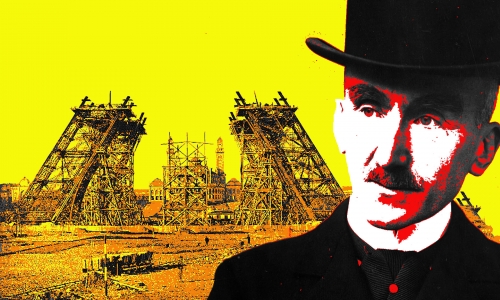
Et Guénon rappelle l’incroyable : la propre sœur (Moina, voyez sa fiche) du prestigieux Bergson était une sorcière mariée au grand maître de la Golden Dawn, le fameux Samuel Liddell Mathers, lui-même premier véganien…
« Il est bien regrettable que Bergson ait été en mauvais termes avec sa sœur Mme Mac-Gregor (alias « Soror Vestigia Nulla Retrorsum ») qui aurait pu l’instruire quelque peu à cet égard ! »
Cela n’étonnera personne quand on sait la proximité de notre société ouverte et des nouveaux cultes Illuminati et autres tendances savantes es-sorcellerie…
Je rappellerai également que l’expression « élan vital », qui est comme une marque de fabrique de la philosophie passe-partout de Bergson se retrouve usitée par Jerry Fields, un ponte de la pub américaine dans les années soixante ! Ah, la rébellion du grand marché, ah la créativité du publicitaire apprenti luciférien ! C’est chez Thomas Frank, l’auteur du grand livre sur le capitalisme de la subversion. Cela confirme que le trop oublié Henri Bergson est un grand-père de la culture des sixties.
On a pu depuis découvrir que la société du chaos a recours à l’autoritarisme pour imposer son imbuvable agenda.
Et pour qu’on n’accuse pas René Guénon de malfaçon herméneutique, on citera sans les commenter deux extraits assez déments du livre de Bergson, que certains doivent lire encore, et de quelle manière. C’est dans les Deux sources, chapitre IV, incroyablement nommé « Mécanique et mystique », où Bergson évoque la société ouverte à venir :
« Qu'un génie mystique surgisse ; il entraînera derrière lui une humanité au corps déjà immensément accru, à l'âme par lui transfigurée. Il voudra faire d'elle une espèce nouvelle, ou plutôt la délivrer de la nécessité d'être une espèce : qui dit espèce dit stationnement collectif, et l'existence complète est dans l'individualité. »
Et dans la conclusion :
« Ne nous bornons donc pas à dire, comme nous le faisions plus haut, que la mystique appelle la mécanique. Ajoutons que le corps agrandi attend un supplément d’âme, et que la mécanique exigerait une mystique. Les origines de cette mécanique sont peut-être plus mystiques qu’on ne le croirait ; elle ne retrouvera sa direction vraie, elle ne rendra des services proportionnés à sa puissance, que si l’humanité qu’elle a courbée encore davantage vers la terre arrive par elle à se redresser, et à regarder le ciel. »
Les dernières lignes sont aussi assez étourdissantes :
« L’humanité ne sait pas assez que son avenir dépend d'elle. A elle de voir d'abord si elle veut continuer à vivre. A elle de se demander ensuite si elle veut vivre seulement, ou fournir en outre l'effort nécessaire pour que s'accomplisse, jusque sur notre planète réfractaire, la fonction essentielle de l'univers, qui est une machine à faire des dieux. »
Et dire que Bergson a reçu le prix Nobel… Il est vrai que son héritier Soros, qui doit se prendre pour le génie mystique évoqué plus haut vient d’être promu homme de l’année par le Financial Times, feuille paroissiale du capitalisme mondial et possédé. Davos, la montagne magique…
Sources et notes
Gilles Chatelet – Vivre et penser comme des porcs (Gallimard)
Henri Bergson – Les deux sources de la morale et de la religion (classiques.uqac.ca)
Thomas Frank – The conquest of cool, chapter six.
Le règne de la quantité et les signes des temps (classiques.uqac.ca). Chapitre XXXIII : L’intuitionnisme contemporain
11:56 Publié dans Philosophie | Lien permanent | Commentaires (0) | Tags : henri bergson, philosophie, nicolas bonnal | | del.icio.us | | Digg | Facebook
La política clásica frente a la política moderna
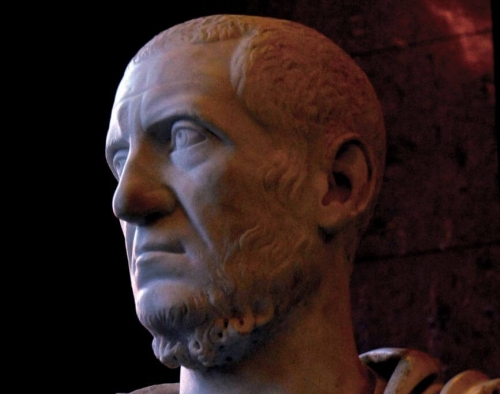
La política clásica frente a la política moderna
Ex: https://www.elcritico.org
Los grandes literatos de la República Romana y del posterior Imperio, en general aquellos que constituían la intelectualidad de la sociedad romana, formaron también parte principal del gobierno romano, de su establishment político. La alta cultura de Roma coincidía con el gobierno de Roma. Catón, Cicerón, Varrón, Salustio, César, Nepote, Babrio, Veleyo Patérculo, Séneca, Tácito, Quintiliano, Suetonio, Arriano, Eutropio, Amiano Marcelino, Aurelio Víctor, Celio Antípatro, Rufino Festo, Pomponio Mela, Plinio, Macrobio, etc, formaron parte fundamental del gobierno de Roma. Diríase que la identificación entre Cultura y Gobierno era total. El Estado Romano fue un estado hegeliano. Hoy esto ha cambiado mucho. Como diría San Agustín, “Surgunt indocti et rapiunt caelum”. Salvo algunas excepciones, cultura y política no coinciden nunca hoy en España.
Todos los grandes Estados – y la mayor parte de los pequeños - que en el mundo han sido estuvieron pilotados por la intelectualidad del momento: la Atenas de Pericles, Roma, el Imperio Chino, el Imperio Carolingio, las Repúblicas italianas del Renacimiento, el Imperio Español, el Imperio Portugués, la Francia de Luis XIV, la Revolución Americana, la Revolución Francesa, el Imperio Británico, el Imperio Francés, el Imperio Alemán, la Revolución Rusa, el Fascismo Italiano, la IIª República Española y hasta los 39 años de franquismo. Es verdad que durante los primeros años de la llamada Transición importantes cargos del Gobierno, del Estado, del Poder Legislativo y del Poder Judicial estuvieron en manos de intelectuales, “de hombres que escribían muchos libros, algunos importantes”, pero en la actualidad no hay un solo ministro – quizás sólo el astronauta por sus amplios conocimientos científicos y el Ministro de Cultura, Guirao – y, desde luego, ningún parlamentario – o tres o cuatro – que puedan llamarse propiamente intelectuales. Vade retro, omni doctrina praedite!
Aristófanes llamaba a la Democracia sin intelectuales en su gobierno, “régimen de salchicheros”, debido al oficio que tenía un afamado demagogo iletrado que lideró durante años el partido demótico. Hoy España es un régimen de salchicheros. O quizás el problema sea distinto. En los regímenes citados anteriormente la intelectualidad, además de una gran competencia técnica, estaba animada por un incuestionable espíritu patriótico. Y hoy la intelectualidad “intra regnum” tiene deseos disolventes y suicidas, y sus intereses no coinciden con los intereses de la Nación. Lo mismo que podría pasar en nuestra España también pasa en otro lugares, como en los mismos EEUU. Como ha puesto de manifiesto Hermann Tertsch en el ABC del 15 de enero, “son las elites académicas de EEUU, que desde hace medio siglo salen de las universidades intoxicadas por la escuela de Francfort para servir en la administración, las finanzas, la política, los medios y las instituciones las que con extrañeza trabajan contra los sagrados intereses de la Nación”.
La verdad es que, sopesando una cosa y la otra, es peor tener intelectuales antipatriotas – v. gr. los discípulos de Marcuse y Adorno - en el Estado y en el Gobierno, que no tenerlos en ningún sentido, como es el caso español, según barrunta este humilde servidor. A nuestros políticos hace tiempo que ya no les interesa los creadores de pensamiento político que actualicen los grandes principios y valores que fundamentan - y justifican – la ideología de Partido, sino los expertos en tecnología de mercado, capaces de barruntar por dónde van los aires de los gustos sociales, como si esos gustos no hubiesen sido programados previamente por otras instancias de pensamiento político y siempre por intereses económicos. Así, hemos visto con demasiada frecuencia que el político que abrazaba la novedad, dejándose seducir por el atractivo que todo ignorante siente ante lo nuevo (“novitas”), estaba realmente abrazando al adversario, y metiendo en su reino un Caballo de Troya especialmente deletéreo. El Partido Popular ha sufrido esta invasión del ideario ajeno en el último decenio, aunque ahora intenta recuperarse limpiando sus establos de Augias ideológicos. Ningún Partido bien cuajado puede vender sus productos a todos los clientes. Y si persiste en venderlos a todos, universalmente, su producto no valdrá nada para nadie.
Por otro lado, la honestidad intelectual supone la sumisión completa a la razón, y ésta es la principal causa por la que los intelectuales tienen poco poder o ningún poder en los partidos políticos. Por ello, la aparición de intelectuales en la Convención Nacional del Partido Popular de este fin de semana es otro signo fresco y esperanzador sobre los cambios proficuos que la nueva dirección del Partido quiere hacer. Carlos Rodríguez-Braun, Johan Norberg, Mario Vargas Llosa o Inger Enkvist son buenos ejemplos de esta apuesta por el pensamiento libre. Un pensamiento que sabe que lo que más necesita el hombre en el mundo es vivir por su propia voluntad, aunque esta voluntad sea estúpida. En el fondo del alma humana vive la indestructible demanda y el eterno sueño de vivir según la propia voluntad. Es verdad que el intelecto político de altura puede traer la salvación, y quizás también la destrucción, pero siempre es mejor el movimiento, aunque entrañe peligros, que el estancamiento, que un barco varado al pairo de la Historia.
11:13 Publié dans Philosophie, Théorie politique | Lien permanent | Commentaires (0) | Tags : théorie politique, politologie, philosophie, philosophie politique, sciences politiques | | del.icio.us | | Digg | Facebook
dimanche, 27 janvier 2019
Cioran: The Postwar European Nihilism
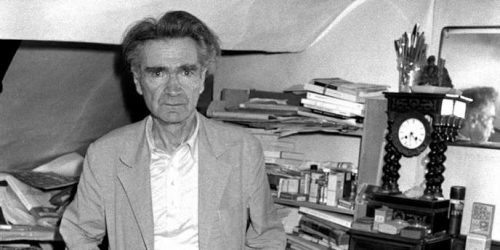
Ex: http://www.unz.com
Emil Cioran, De l’inconvénient d’être né (Paris: Gallimard, 1973).
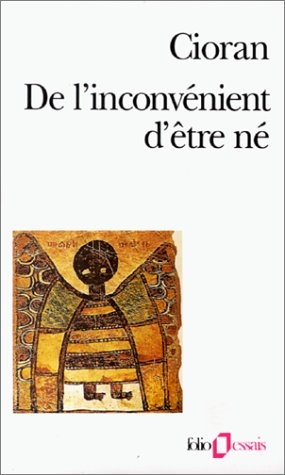 Growing up in France, I was never attracted to Emil Cioran’s nihilist and pessimistic aesthetic as a writer. Cioran was sometimes presented to us as unflinchingly realistic, as expressing something very deep and true, but too dark to be comfortable with. I recently had the opportunity to read his De l’inconvénient d’être né (On the Trouble with Being Born) and feel I can say something of the man.
The absolutely crucial fact, the elephant in the room, the silently screaming subtext concerning Cioran is that he had been in his youth a far-Right nationalist, penning positive appraisals of Adolf Hitler and a moving ode to the murdered Romanian mystic-fascist leader Cornelius Zelea Codreanu. Cioran had hoped for the “transfiguration” of Romania into a great nation through zeal and sacrifice. Instead, you got utter defeat and Stalinist tyranny and retardation. I’d be depressed too.
A perpetual question for me is: Why did such great intellectuals (we could add Louis-Ferdinand Céline, Ezra Pound, Knut Hamsun, Mircea Eliade . . .) support the “far-Right”? This is often not so clear because the historical record tends to be muddied both by apologetics (“he didn’t really support them”) and anathemas (“aha! You see! He’s a bad man!”). Like John Toland, I don’t want to condemn or praise, I just want to understand: Why did he believe in this? Was it:
- Fear of communism?
- Skepticism towards democracy and preference for a stable, spirited regime? (That argument was very popular among thinking men in the 1920s, even the notorious Count Coudenhove-Kalergi, spiritual godfather of the European Union, supported Italian Fascism on these grounds!)
- Racialism?
- Anti-Semitism?
- Opposition to decadence?
- The dangerous propensity of many intellectuals for ecstatic spasms and mystical revolutions?
In Cioran’s case, his Right-wing sentiment appears to have been motivated by 1), 2), 4) 5), and perhaps especially 6).
After the war, Cioran renounced his Right-wing past. This may have been motivated by understandable revulsion at the horrors of the Eastern Front and the concentration camps. In any event, this was certainly not a disinterested move. Mircea Eliade – a fellow supporter of Codreanu who later thrived as a historian of religions at the University of Chicago, infiltrating the academy with Traditionalists – wrote of Cioran in his diary on September 22, 1942: “He refuses to contribute anything to German newspapers, in order not to compromise himself in the eyes of his French friends. Cioran, like all the others, foresees the fall of Germany and the victory of Communism. This is enough to detach him from everything.”[1]
There had been a thriving far-Right French literary and intellectual scene, with writers who often had had both a fascist and pan-European sensibility. The Libération in 1944 put an end to that: Robert Brasillach was executed by the Gaullist government during the Épuration (Purge) despite the protestations of many fellow writers (including André Malraux and Albert Camus), Pierre Drieu La Rochelle committed suicide, and Lucien Rebatet was jailed for seven years and blacklisted.
 As literally an apatride metic (he would lose his Romanian citizenship in 1946), Cioran, then, did not have much of a choice if he wished to exist a bit in postwar French intellectual life, which went from the fashionable Marxoid Jean-Paul Sartre on the left to the Jewish liberal-conservative Raymond Aron on the right. (I actually would speak highly of Aron’s work on modernity as measured, realistic, and empirical, quite refreshing as far as French writers go. Furthermore he was quite aware of Western decadence and made a convincing case for the culturally-homogeneous nation-state as “the political masterpiece.”) Although Cioran had written several bestsellers in his native Romania, he had to adapt to a French environment or face economic and literary oblivion. What’s an apology secured under coercion actually worth?
This is the context in which we must read De l’inconvénient d’être né. These are the obsessive grumblings of a depressed insomniac. (Cioran’s more general mood swings between lyrical ecstasy and doom-and-gloom suggest bipolar disorder.) His aphorisms often ring true, but equally tend to be hyperbolic or exaggerated, and are almost always negative, like a demotivational Nietzsche. In some respects preferable to Nietzsche, insofar as the great explosion the German hysteric foresaw is past us, and his brand of barbaric politics seems quite impossible in this century. Cioran, like Nietzsche and Spengler, knows that nihilism and decadence are the order of the day, but living in the postwar era, he can certainly no longer hope that “blond beasts” or “Caesarism” might still save us. Cioran in this sense is more relatable, he is talking about our world.
Cioran despairs at the inevitable mediocrity of human beings and the vain temporality of the human condition. (What’s the point of even a good feeling or event, if this event will, in a second, disappear and only exist in my memory, which will in turn disappear? This will no doubt have occurred to thoughtful, angsty teenagers.) Birth, embodiment, is the first tragedy – like the fall of man – from a perfect non-existence, with limitless potentiality, to a flawed and stunted being.
Jean-François Revel observes: “Imagine Pascal’s mood if he had learned that he had lost his bet, and you’ll have Cioran.”
A question: Was Cioran’s despair more motivated by being a Rightist spurned by destiny or by his own dark temperament? Would he have written such works in a triumphant Axis Europe?
Cioran is like a Buddha (the spiritual figure most often cited in De l’inconvénient) who stopped halfway, that is to say, at nihilism and despair. But Siddhartha Gautama went further, from the terrifying recognition of our impermanent and insubstantial experiential reality, to a new mental state, reconciled with this reality, to the path of sovereignty and freedom.
Had I been able to meet him, I’d have invited Cioran to my Zendō – where speaking, indeed all expression of human stupidity, is formally banned through the most truthful silence. And how good is truth for the soul!
The Way of Awakening is not found in books.
Actually, Cioran’s Buddhist connection should be dug into. The Zen monk Taisen Deshimaru was in Paris passing on the Dharma to Europe at exactly the same time, in the 1970s.
 My initial response to De l’inconvénient was annoyance that it had been written (I can quite understand Alain Soral’s frustration with Cioran). The postwar Cioran can certainly seem like an umpteenth authorized manifestation of the ‘glamorously aesthetic’ French décadent intellectual, the misunderstood genius, the starving artist, who is just way ‘too deep’ for his own good or for you plebs to grasp.
I remember his 1941 On France, a perversely playful ode to decadent France (those three words together disgust me), as an ostensibly appalling little work. France does not need any more encouragement on the downward path.
Cioran certainly has a morbid fascination with spiritual rot.
The Germans of the nineteenth and early twentieth centuries were already quite right to want to preserve themselves from the contagion of French decadence (oh sure, there’s a straight line of Kultur from the “Indo-Germans” to Frederick the Great’s Prussia); right up to the May-June 1940 editions of Signal understatedly mocking the infertile French with photographs of fez- and turban-wearing Negro and Mohammedan POWs. (Apologies for not providing a direct link to the relevant Signal issues, apparently our historians have still not got around to digitizing this publication, peak circulation 2.5 million in 1943.)
Sorry, krauts, it came anyway through the North-American route!
De l’inconvénient initially reinforced my impression that the postwar Cioran was not worth reading. However, there are some hopeful diamonds in the despairing rough. Some of Cioran’s aphorisms are actually quite inspiring, such as the following: “Any overcoming of desire empowers us. We have all the more control over this world as we take our distance from it, when we do not commit to it. Renunciation confers limitless power” (p. 44). (And let us bear in mind again Eliade’s paraphrase above, that it was the prospect of German defeat and communist triumph which was “enough to detach him from everything.”)[2]
On one level, Cioran’s work is a legitimate expression of the depths of postwar despair. From the psychological point of view, man really was (and is still, despite a few flickers) sinking more and more into untruth, into materialism and consumerism and ‘choice,’ into a childish view of life, one not cognizant of our nature as mortal, social, and unequal beings. All the truths contained in our dying traditions, however imperfect the latter were, are forgotten.
Amidst the politically-harmless mass of depressing and demotivational thoughts, Cioran sneaks in some very true observations about decadence. This shows, as plainly as anything, that he remained a man of the Right in his heart.
I believe Cioran provides a key to understanding his nihilist work in this book, namely:
We get a grip on ourselves, and we commit all the more to being, by reacting against nay-saying, corrosive books [livres négateurs, dissolvants], against their noxious power. These are, in short, books that fortify, because they summon the energy which contradicts them. The more poison they contain, the greater their salutary effect, as long as we read them against the grain, as we should read any book, starting with the catechism. (p. 97)
Cioran is putting forth a challenge to be overcome: taste the depths of my despair, truly contemplate and acknowledge the futility of life . . . What is your answer?
Cioran’s books: contemplation of the void . . . a summoning.
I find Cioran both uncomfortable and stimulating, clamoring for more, eager to discover and accomplish more. Fecund stimulation is most important, whether in reading, work, or life. (For that reason I also recommend reading Ezra Pound’s non-fiction.)
Cioran’s nihilist and depressing aesthetic will not appeal to everyone or even to most. But if that’s how a man builds up his brand and sells his books, who am I to judge? Especially if you can sneak in some subversive truths. (In this respect, Cioran reminds me of Michel Houellebecq, one of the last manifestations of French culture. All this goes back to Socrates-as-satyr.)
Still, we observe that many men of the Right took a more straightforward route: Maurice Bardèche avenged his brother-in-law Brasillach’s execution by continuing to write in favor of fascism, Julius Evola always stood up for the Axis and for Tradition, Dominique Venner wrote as a historian, Europe’s living memory, and committed his own seppuku, as a sacrifice to the gods . . .
Each man fights in his own way. Again, who am I to judge?
Notes
[1] Mircea Eliade, The Portugal Journal (Albany, New York: State University of New York Press, 2010), 35.
[2] Note: detachment does not mean surrender. For those who do not understand, I recommend the Baghavad Gita, the Hagakure, D. T. Suzuki’s explication of “the Way of the Sword” in Zen and Japanese Culture, or indeed watching the countenance of the faces of men about to strike their opponent in Akira Kurosawa’s classic film Seven Samurai.
12:45 Publié dans Livre, Livre, Philosophie | Lien permanent | Commentaires (0) | Tags : philosophie, cioran, livre, roumanie, france, nihilisme | | del.icio.us | | Digg | Facebook
vendredi, 25 janvier 2019
Tecnicidad, Biopolítica y Decadencia. Comentarios al libro "El Hombre y la Técnica" de Oswald Spengler.
Tecnicidad, Biopolítica y Decadencia.
Comentarios al libro "El Hombre y la Técnica" de Oswald Spengler.
Carlos Javier Blanco Martín
Resumen. El presente artículo es un comentario detenido de la pequeña obra de Oswald Spengler "El Hombre y la Técnica". En él desarrollamos el concepto de tecnicidad, necesario para comprender la amplia perspectiva (zoológica, naturalista, dialéctica, operatiológica) esbozada por el filósofo alemán. No se trata de un ensayo sobre la Técnica en el sentido artefactual y objetivo sino sobre el desarrollo de las capacidades operatorias (viso-quirúrgicas) de los ancestros del hombre, que lo llevaron desde la depredación hasta la Cultura, y desde la Cultura hasta la decadencia. Especialmente la decadencia de los pueblos occidentales que más han contribuido al despegue de esa tecnicidad.
Abstract. This article is a detailed commentary on Oswald Spengler's little work "The Man and the Technique". In it we develop the concept of technicality, necessary to understand the broad perspective (zoological, naturalistic, dialectic, operatiological) outlined by the German philosopher. This is not an essay on the Technique in the objective and artifactual sense, but rather on the development of the operative capacities (visual and manual) of the ancestors of man, which led him from predation to Culture, and from Culture to decline: especially the decadence of the western peoples that have contributed most to the takeoff of this technicality
Introducción. Justificación del presente comentario. Indagaciones sobre la Tecnicidad según Oswald Spengler.
 En un trabajo anterior ya quisimos hacer una aproximación antropológica al concepto spengleriano de la Técnica[i] . El presente trabajo quiere ser una prolongación del mismo, profundizando en los conceptos spenglerianos sobre la tecnicidad y lo hacemos por medio de un comentario detenido de las páginas de su pequeña obra El Hombre y la Técnica.[ii] Este breve texto spengleriano aclara muchos aspectos de la filosofía, poco sistemática y, a veces, impresionista, del gran pensador alemán, el creador de la magna obra La Decadencia de Occidente. Este breve libro traza un cuadro evolutivo de la técnica en la historia natural y cultural del hombre. Pero hace algo más: esboza de una manera dialéctica el destino fatal de los pueblos de Occidente, pueblos que han desarrollado toda su tecnicidad hasta ponerla en manos de sus enemigos. Este examen detenido de los párrafos enérgicos y vibrantes del librito puede ayudar a comprender la peculiar dialéctica pesimista –a diferencia de la optimista hegeliana- del pensador alemán Oswald Spengler. En vez de alcanzar un progresivo dominio técnico del mundo, encaminado a su mayor comodidad y salud, el hombre y sus antepasados simplemente han ido diferenciando cualidades sensitivo-etológicas desde hace millones de años, cualidades en las que ya está presente la tecnicidad, aun cuando todavía nuestros antepasados no era capaces de fabricar herramientas, o sólo empleaban órganos y partes sensomotoras de su cuerpo para ejercer su dominio. Por ello, en nuestro comentario empleamos el término tecnicidad, contrapuesto a "técnica" para hacer referencia a esas capacidades generales implícitas a la hora de ejercer dominio, control o alteración del propio medio envolvente, con independencia de la existencia de herramientas, armas u otros objetos extra-somáticos. La tecnicidad es la cualidad o el carácter técnico de algo o alguien, y no se debe circunscribir a los productos de las artes humanas o proto-humanas ni al aspecto normativo o envolvente del Espíritu Objetivo. Nuestro comentario, pues, se enmarca en el espacio antropológico. Queremos ahondar en la antropología spengleriana, tal y como llevamos haciendo desde hace unos años. [iii]
- El concepto de tecnicidad.
Spengler comienza su estudio sobre la técnica mostrando su olímpico desprecio hacia las charlas del siglo XVIII y XIX sobre la "cultura". Desde las robinsonadas al mito del "buen salvaje", los "hombres de cultura" que habían llenado los salones europeos de aquellos años habían olvidado por completo el verdadero papel de la técnica en la civilización. El arte, la poesía, la novela, la cultura entendida como segunda naturaleza sublime del hombre, relumbraban en la mente de ilustrados y románticos, y con ese resplandor se cegaban a las realidades terribles de que estaba preñado el siglo XX, cuando el contexto geopolítico, social y económico ya había mutado por completo y la Ilustración o el romanticismo sólo habitaba en la mente retardataria de los demagogos y los "intelectuales", no en los hombres fácticos y de acción. El escalpelo de Spengler se extiende hasta los utilitaristas ingleses. Para ellos la técnica era el recurso idóneo para instaurar la holgazanería en el mundo:
Aber nützlich war, was dem »Glück der Meisten« diente. Und Glück bestand im Nichtstun. Das ist im letzten Grunde die Lehre von Bentham, Mill und Spencer. Das Ziel der Menschheit bestand darin, dem einzelnen einen möglichst großen Teil der Arbeit abzunehmen und der Maschine aufzubürden. Freiheit vom »Elend der Lohnsklaverei« und Gleichheit im Amüsement, Behagen und »Kunstgenuß«: das »panem et circenses« der späten Weltstädte meldet sich an. Die Fortschrittsphilister begeisterten sich über jeden Druckknopf, der eine Vorrichtung in Bewegung setzte, die – angeblich – menschliche Arbeit ersparte. An Stelle der echten Religion früher Zeiten tritt die platte Schwärmerei für die »Errungenschaften der Menschheit«, worunter lediglich Fortschritte der arbeitersparenden und amüsierenden Technik verstanden wurden. Von der Seele war nicht die Rede.
"Útil, empero, era lo que sirve a la "felicidad del mayor número". Y esta felicidad consistía en no hacer nada. Tal es, en último término, la doctrina de Bentam, Mill y Spencer, El fin de la Humanidad consistía en aliviar al individuo de la mayor cantidad posible de trabajo, cargándola a la máquina. Libertad de "la miseria, de la esclavitud asalariada" [Elend der Lohnsklaverei] e igualdad en diversiones, bienandanza y “deleite artístico”. Anúnciase el panem et circenses de las urbes mundiales en las épocas de decadencia. Los filisteos de la cultura se entusiasmaban a cada botón que ponía en marcha un dispositivo y que, al parecer, ahorraba trabajo humano. En lugar de la auténtica religión de épocas pasadas, aparece el superficial entusiasmo “por las conquistas de la Humanidad” [Errungenschaften der Menschheit], considerando como tales exclusivamente los progresos de la técnica, destinados a ahorrar trabajo y a divertir a los hombres. Pero del alma, ni una palabra." [iv]
La técnica para el utilitarismo inglés era vista como instancia ahorradora de trabajo, como mera herramienta liberadora de esclavitud del trabajo asalariado, pero no como la esencia misma del hombre fáustico, del hombre que transforma el mundo, que lo modifica substancialmente. Oswald Spengler repudia con toda su rabia y fuerzas ese sentimentalismo vulgar que arranca de Rousseau, de los románticos y también de los "progresistas". Un sentimentalismo que reduce la filosofía de la Historia a mero "optimismo", esto es, un estado de ánimo confiado y tranquilizador en el cual ya no habrá más guerras ni dominaciones de unos pueblos sobre otros. Un estado de quietud que, al modo más nietzscheano, Spengler intuye como deprimente, laminador, una antesala de un suicidio colectivo, un estado alienado y de falsedad. La Historia de los hombres sigue su curso con completa independencia de sus deseos, anhelos y expectativas. Como acontece con las leyes de la naturaleza, inexorables y devoradoras de civilizaciones, razas y universos enteros, las "leyes" de la historia siguen su marcha con independencia absoluta de nuestra mente.
Para comprender los tiempos, al hombre, a la vida que nos toca –históricamente- vivir, se precisa de una facultad especial, el "tacto fisiognómico":
Der physiognomische Takt, wie ich das bezeichnet habe, was allein zum Eindringen in den Sinn alles Geschehens befähigt, der Blick Goethes, der Blick geborener Menschenkenner, Lebenskenner, Geschichtskenner über die Zeiten hin erschließt im einzelnen dessen tiefere Bedeutung.
"El tacto fisiognómico, como he denominado la facultad que nos permite penetrar en el sentido de todo acontecer; la mirada de Goethe, la mirada de los que conocen a los hombres y conocen la vida, y conocen la Historia y contemplan los tiempos, es la que descubre en lo particular su significación profunda" [v].
El naturalismo, el determinismo, de la misma manera que el "culturalismo", se mostrarán incapaces de comprender el significado de la técnica en la historia de los hombres. Hace falta el tacto fisiognómico, es preciso sentir esa especie de empatía o intuición hacia lo que hacen las distintas clases de hombres, para así poder insertar adecuadamente el papel de la técnica en la cultura. La técnica no es la pariente pobre de la Cultura. No se trata de la versión ínfima de "cuanto puede hacer el Homo sapiens". Esta especie "sapiente" que construye catedrales góticas, compone sinfonías, escribe El Quijote, la Suma Teológica o la Ilíada, es también la especie que ha comenzado empuñando palos, forjado espadas o construido cañones anti-aéreos. La técnica –y de entre ella, la técnica depredatorio-bélica- sería la versión grisácea, deprimente, prosaica de la sublime Cultura. El naturalismo verá la evolución desde la maza asesina hasta el cohete espacial (recordemos la genial escena cinematográfica de Stanley Kubrick en 2001, Una Odisea Espacial). El determinismo, cercano al naturalismo y, a veces, complementario de éste, verá en la técnica una condición sine qua non de la Cultura sublime, condición que habrá que retirar del escenario convenientemente cuando ya actúe la Cultura sublime (Bellas Artes, Poesía, Espíritu, etc.). Finalmente, el "culturalismo", que Spengler detesta, pues representa el idealismo y la ceguera ignorante de los "literatos", escinde en dos la vida humana, una mitad sublime y otra prosaica; la mitad "prosaica" es condenada a la oscuridad por el idealismo rampante (pero también por el utilitarismo y el materialismo dialéctico) una vez que ha brotado la Cultura. Pero he aquí que el Filósofo de la Historia no puede ni debe dejar de lado aquello que es consustancial a la vida humana en su devenir. La técnica, reivindicada ahora por Spengler desde un naturalismo mucho más profundo, es esencial a la vida misma de todos los animales. La técnica no es la colección de "cosas" que ha producido el hombre para matar, destruir, crear, dominar. La técnica no se deja reducir a un estudio "supra-orgánico", "extra-somático", "objetivo". En la propia organicidad animal ya está presente la técnica:
 Das ist der andre Fehler, der hier vermieden werden muß: Technik ist nicht vom Werkzeug her zu verstehen. Es kommt nicht auf die Herstellung von Dingen an, sondern auf das Verfahren mit ihnen, nicht auf die Waffe, sondern auf den Kampf
"Este es el otro error que debe evitarse aquí: la técnica no debe comprenderse partiendo de la herramienta. No se trata de la fabricación de cosas, sino del manejo de ellas; no se trata de las armas, sino de la lucha."[vi]
La técnica no es la herramienta [Werkzeug], una suerte de prolongación extra-somática y objetiva del sujeto humano. La técnica, en realidad, es el manejo [Verfahren] con las cosas. Este es el corazón del comienzo del librito de Spengler: la técnica es la táctica de la vida. La vida no es una colección de cosas, a saber: sujetos corpóreos y objetos producidos por esos sujetos corpóreos. Esta sería la miope visión compartida al alimón por idealistas y por realistas. Los primeros se fijan en la "creatividad" del sujeto hacedor (se "crean" tanto obras de arte como misiles de cabeza nuclear), y los segundos paran mientes en lo creado. Pero en medio está la vida misma, la acción, a saber, el uso de los medios para la lucha.
- La Biopolítica spengleriana. Un naturalismo dialéctico.
La vida es comprendida como una guerra ya en sus más arcaicos estratos zoológicos.
Es gibt keinen »Menschen an sich«, wie die Philosophen schwatzen, sondern nur Menschen zu einer Zeit, an einem Ort, von einer Rasse, einer persönlichen Art, die sich im Kampfe mit einer gegebenen Welt durchsetzt oder unterliegt, während das Weltall göttlich unbekümmert ringsum verweilt. Dieser Kampf ist das Leben, und zwar im Sinne Nietzsches als ein Kampf aus dem Willen zur Macht, grausam, unerbittlich, ein Kampf ohne Gnade.
"No existe el “hombre en sí” — palabrería de filósofos —, sino sólo los hombres de una época, de un lugar, de una raza, de una índole personal, que se imponen en lucha con un mundo dado, o sucumben, mientras el universo prosigue en torno su curso, como deidad erguida en magnífica indiferencia. Esa lucha es la vida; y lo es, en el sentido de Nietzsche, como una lucha que brota de la voluntad de poderío; lucha cruel, sin tregua; lucha sin cuartel ni merced" [vii] .
Si Spengler rechaza tanto el idealismo como el realismo en su tratamiento de la técnica, otro tanto se ha de decir de la "antropología predicativa". "El hombre"… ¿qué es? Si hablamos de un Homo faber –hombre fabricante- pensado con el mismo formato que el concepto de Homo sapiens, sapiente, estamos eligiendo un predicado esencial que definirá a esta especie animal concreta a la que pertenecemos. Hay poca ganancia con respecto a estas antropologías tradicionales si al Homo, a nuestro género, le añadimos el predicado de "animal técnico". No existe el "hombre en sí" [Es gibt keinen »Menschen an sich«]. No hay tal cosa previamente definida, recortada, a la cual podamos asignarle (casi, podríamos decir "inyectarle") la cualidad esencial de su tecnicidad, de la misma manera que antaño se decía del hombre que era un "animal social" o "animal racional". No hay que hablar de tecnicidad de ese "Hombre" pre-dado . De lo que se ha de hablar es de una lucha cósmica eterna, en la que se insertan los seres vivos de todas las escalas zoológicas. A las enormes galaxias y a los descomunales astros les resulta por completo indiferente el resultado de esta minúscula guerra, una contienda ésta que para sus héroes y víctimas sin embargo les es esencial. La antroposfera de éste diminuto planeta es una capa extrafina y efímera que nada importa en el decurso del universo. Los hombres mueren por "pequeñas cosas" desde el punto de vista cósmico, aun cuando esas "pequeñeces" como la defensa de la patria, la preservación de un ideal, de una civilización o una fe comporten un valor infinito a los actores humanos.
Y estos supuestos valores supremos, relativos entre las mismas culturas humanas, y susceptibles de relativización a escalas supra-humanas, cósmicas, son en gran medida "mentira" si tras de ellos captamos su esencia: la voluntad de poder. En efecto, según Spengler, "el hombre es un animal de rapiña" [viii] [Denn der Mensch ist ein Raubtier.]. Depredador, es la palabra castellana que de la manera más neutra y zoológica describe nuestra condición. A años luz nos hallamos de los herbívoros. La clave de nuestra evolución como primates estriba en la depredación. El hombre como depredador encarna un estilo de vida, una complexión físico-espiritual que los métodos naturalistas groseros no podrán captar. Sabido es que Spengler apuesta por el naturalismo de Goethe y de la fisiognómica, y no por el materialismo de Linneo y de Darwin. Las "ciencias de la vida" estudian cadáveres y compuestos físico-químicos, diseccionan y clasifican, buscan causas deterministas al modo mecanicista, pero renuncian y hasta desprecian "el tacto fisiognómico". Este tacto, imprescindible para la comprensión de la vida, nos da la clave de la tecnicidad. La clave consiste en una superación del carácter pasivo de los sujetos vivos. De la planta podemos decir que "en ella y en torno a ella está la vida" más que afirmar, propiamente, que es un ser vivo[ix]. En rigor, es un "escenario" [Schauplatz] de los procesos vivientes.
Eine Pflanze lebt, obwohl sie nur im eingeschränkten Sinne ein Lebewesen ist. In Wirklichkeit lebt es in ihr oder um sie herum. »Sie« atmet, »sie« nährt sich, »sie« vermehrt sich, und trotzdem ist sie ganz eigentlich nur der Schauplatz dieser Vorgänge, die mit solchen der umgebenden Natur, mit Tag und Nacht, mit Sonnenbestrahlung und der Gärung im Boden eine Einheit bilden, so daß die Pflanze selbst nicht wollen und wählen kann. Alles geschieht mit ihr und in ihr. Sie sucht weder den Standort, noch die Nahrung, noch die andere Pflanze, mit welcher sie die Nachkommen erzeugt. Sie bewegt sich nicht, sondern der Wind, die Wärme, das Licht bewegen sie.
 "La planta vive; aunque sólo en sentido limitado, es un ser viviente. En realidad, más que vivir puede decirse que en ella y en torno a ella está la vida. “Ella” respira, “ella” se alimenta, “ella” se multiplica; y, sin embargo, no es propiamente más que el escenario de esos procesos, que constituyen una unidad con los procesos de la naturaleza circundante, con el día y la noche, con los rayos del sol y la fermentación del suelo; de suerte que la planta misma no puede ni querer ni elegir. Todo acontece con ella y en ella. Ella no busca ni su lugar propio, ni su alimento, ni las demás plantas con quienes engendra su sucesión. No se mueve, sino que son el viento, el calor, la luz, quienes la mueven." [x]
La vida, pues, en su estrato ínfimo, vegetal, si bien es un entrecruzamiento de procesos vitales (ellos mismos activos), el sujeto o "escenario" donde acontecen consiste, no obstante, en un mero receptáculo dominado por la pasividad. La vida vegetal es sometimiento al mundo-entorno [umgebenden Natur], a la naturaleza envolvente. A su vez, la vida vegetal es el sustrato sobre el que se asienta la "vida movediza" [freibewegliche Leben], esto es, el Reino animal. El carácter móvil, auto-portátil por así decir, de la vida animal es ya una forma de libertad, de sobre-posición, por encima de la situación pasiva y sometida del vegetal. Pero la movilidad libre de las criaturas animales está, a su vez, dividida en dos escalones: la vida del herbívoro, hecha para huir, y la vida del carnívoro, para depredar.
Es a través de la primacía de alguno de los sentidos como se crea un mundo-entorno específico para cada uno de los dos escalones de lo animal. El oído para los herbívoros, nacidos para huir o caer como presas, y el ojo –la mirada- para los cazadores, los más libres y sagaces de entre los animales. Este predominio sensorial unilateral, según parece decirnos Spengler, determina los distintos mundos-entorno.
Erst durch die geheimnisvolle und von keinem menschlichen Nachdenken zu erklärende Art der Beziehungen zwischen dem Tier und seiner Umgebung mittels der tastenden, ordnenden, verstehenden Sinne entsteht aus der Umgebung eine Umwelt für jedes einzelne Wesen. Die höheren Pflanzenfresser werden neben dem Gehör vor allem durch die Witterung beherrscht, die höheren Raubtiere aber herrschen durch das Auge. Die Witterung ist der eigentliche Sinn der Verteidigung. Die Nase spürt Herkunft und Entfernung der Gefahr und gibt damit der Fluchtbewegung eine zweckmäßige Richtung von etwas fort.
"La misteriosa índole — por ninguna reflexión humana explicable — de las relaciones entre el animal y su contorno, mediante los sentidos palpadores, ordenadores e intelectivos, es la que convierte el contorno en un mundo circundante para cada ser en particular. Los herbívoros superiores son dominados por el oído y, sobre todo, por el olfato. Los rapaces superiores, en cambio, dominan por la mirada. El olfato es el sentido propio de la defensa. Por la nariz rastrea el animal el origen y la distancia del peligro, dando así a los movimientos de huida una dirección conveniente: la dirección que se aleja del peligro. [xi]
El "contorno" [Umgebung] al cual todavía se veía sometida la planta, es en el animal un mundo-entorno [Umwelt]. Cada especie animal lo percibe a su modo. Las teorías de von Uexküll, conocidas por Spengler, resuenan aquí. Pero ese mundo percibido de manera distinta por cada especie determina, a su vez, una básica relación de poder, la relación de dominante a dominado. De la Biología teórica se pasa recta y necesariamente a una Biopolítica. En la propia Biología teórica se pre-contiene la base zoológica del Poder. La mirada del animal de presa es ya una mirada que busca obtener botín y dominio, que fija rectilínea y frontalmente sus objetivos.
Para el depredador, "el mundo es la presa" [Die Welt ist die Beute]. Spengler nos describe así el origen de la Cultura, la raíz del mundo histórico específico del ser humano. Justamente como el hueso-maza, el arma letal en manos de un simio, se transforma en la película 2001 Una Odisea Espacial, en un artefacto cosmonáutico, la tecnicidad del hombre hunde sus raíces en el propio escalonamiento superior del ancestro, el homínida comedor y cazador de otros animales.
Ein unendliches Machtgefühl liegt in diesem weiten ruhigen Blick, ein Gefühl der Freiheit, die aus Überlegenheit entspringt und auf der größeren Gewalt beruht, und die Gewißheit, niemandes Beute zu sein. Die Welt ist die Beute, und aus dieser Tatsache ist letzten Endes die menschliche Kultur erwachsen
"Un sentimiento infinito de poderío palpita en esa mirada larga y tranquila; un sentimiento de libertad que brota de la superioridad y descansa en el mayor poder, en la certidumbre de no ser nunca botín ni presa de nadie. El mundo es la presa; y de este hecho, en último término, ha nacido toda la cultura humana." [xii]
 Esa mirada poderosa, unida a ese sentimiento de poder, es el germen de la Historia. Y la Historia se individualiza. No se trata de una historia de las masas. Las masas no poseen la historia. Antes de alzarse culturas individualizadas, en la fase zoológica y pre-cultural, la Historia la hacen los individuos. El animal de presa destaca y se recorta ante el animal de rebaño. El herbívoro precisa de muchos como él, y entre ellos (como luego, en las sociedades de masas) una muchedumbre de iguales constituye ya el individuo. Ha de verse aquí, en El Hombre y la Técnica, no una teoría, en el sentido riguroso o científico, sino una analogía. Spengler discurre por analogías, y esas analogías presiden toda su filosofía de la historia. Si una Cultura es, toda ella, un ser vivo dotado de su morfología propia y de su propio ciclo vital, un herbívoro es un análogo de un "hombre masa". El hombre masa del siglo XIX y XX es un retroceso hacia la animalización, pero hacia la animalización del escalón inferior, la de la presa, la del cobarde herbívoro.
La analogía naturalista de Spengler discurre por canales muy diversos al naturalismo metafísico de Schopenhauer, aunque también conduce al pesimismo, o el de Darwin que induce a pensar en términos progresistas y, por ende, optimistas. El hombre es más que un mono. El hombre es más que un cuerpo que, por búsqueda de homologías rigurosas, esté próximo a los primates. La anatomía evolucionista, y, antes que ella, el comparatismo linneano, tratan ante todo con cadáveres. Los cuerpos estáticos de los científicos naturales son, en opinión de Spengler, naturalezas muertas. Frente a esta biología cadavérica Spengler busca el contacto con una filosofía de la biología de los cuerpos en acción. Tal concepción encuentra analogías en las acciones mismas. De tales analogías no hay razones para quejarse de un "antropomorfismo". Decir que es antropomorfismo que ciertos insectos "conocen la agricultura" o "practican la esclavitud", por ejemplo, sólo podría justificarse si admitiéramos que el hombre es un punto de vista privilegiado. De manera cerrada, y por tanto "ilógica", el círculo del antropomorfismo ve antropomorfismo en nuestras atribuciones acerca de las acciones de los animales. Lo que Spengler quiere decirnos simplemente es que la aparición de instituciones culturales, históricas, cuenta siempre con análogos zoológicos. El plano institucional en el que se puede hablar, como historiador, de una agricultura, una milicia, un Estado, una técnica, una esclavitud en una cultura humana es un plano que "corta" geométricamente con el plano zoológico y con el cual, al menos, hay una recta, una línea de puntos muy reales, donde también estarán presentes esos análogos.
- La tecnicidad y la analogía zoológica.
Ciñéndonos a la tecnicidad, Spengler la quiere ver en las más diversas escalas zoológicas, como ya llevamos visto. Pero no obstante se trata de una tecnicidad muy diversa. Y es que el método analógico, de gran aplicación en filosofías muy distintas a la spengleriana (p.e. en el tomismo) nos recuerda que la relación entre dos términos en parte distintos y en parte semejantes puede establecerse en orden a penetrar de alguna manera en un sector ignoto del mundo. Esta relación de analogía, y no de identidad, es legítima, cuidando de no bascular nunca hacia la univocidad ni hacia la equivocidad. Es una relación susceptible de quedar establecida en función de una proporción o regla. La técnica de los animales es análoga a la de los animales, pero no lo es en todos los aspectos ni en la misma medida. Los castores hacen presas y los ingenieros humanos también. Pero no igual, no en la misma medida. La tecnicidad del hombre es, por así decir, diferenciada. En el hombre se da la individualidad mientras que en el animal esa individualidad se pierde y se difumina en la especie:
Die Technik dieser Tiere ist Gattungstechnik.
"La técnica de los animales es técnica de la especie". [xiii]
La de los animales no humanos es técnica genérica (Gattung). Está incorporada en su instinto, y es invariable. El sujeto es aquí, como vimos en el caso de las plantas, un vehículo o escenario de la voz de la especie. Es una técnica no individualizada, invariable.[xiv]
Die Menschentechnik und sie allein aber ist unabhängig vom Leben der Menschengattung. Es ist der einzige Fall in der gesamten Geschichte des Lebens, daß das Einzelwesen aus dem Zwang der Gattung heraustritt. Man muß lange nachdenken, um das Ungeheure dieser Tatsache zu begreifen. Die Technik im Leben des Menschen ist bewußt, willkürlich, veränderlich, persönlich, erfinderisch. Sie wird erlernt und verbessert. Der Mensch ist der Schöpfer seiner Lebenstaktik geworden. Sie ist seine Größe und sein Verhängnis. Und die innere Form dieses schöpferischen Lebens nennen wir Kultur, Kultur besitzen, Kultur schaffen, an der Kultur leiden. Die Schöpfungen des Menschen sind Ausdruck dieses Daseins in persönlicher Form.
"La técnica humana, y sólo ella, es, empero, independiente de la vida de la especie humana. Es el único caso, en toda la historia de la vida, en que el ser individual escapa a la coacción de la especie. Hay que meditar mucho para comprender lo enorme de este hecho. La técnica en la vida del hombre es consciente, voluntaria, variable, personal, inventiva. Se aprende y se mejora. El hombre es el creador de su táctica vital. Esta es su grandeza y su fatalidad. Y la forma interior de esa vida creadora llamémosla cultura, poseer cultura, crear cultura, padecer por la cultura. Las creaciones del hombre son expresión de esa existencia, en forma personal."[xv]
 El hombre es artífice de su táctica vital [Der Mensch ist der Schöpfer seiner Lebenstaktik geworden]. Esta palabra, "táctica", es crucial para comprender la gran analogía belicista que recorre por igual la filosofía de la naturaleza y la filosofía de la historia spenglerianas. De esa creación libre brota, no obstante, un plano nuevo de coacción y de condena sobre los aprendices de brujo que son los humanos. El Espíritu Objetivo podrá verse, hegelianamente, como un fruto de la libertad esencial de los hombres, pero, a la par, se alza como envoltorio determinante y coactivo que canaliza y bloquea los cursos en principio libres de los sujetos. Es una libertad que se auto-restringe al devenir objetivo. La cultura no es ya, sin más, el Reino de la Libertad confrontado al Reino de la Necesidad (material y físico-química). La optimista dualidad kantiana, como en general la optimista y felicitaría dualidad teológico-cristiana de la que partía, ya ha quedado atrás. De la cultura también procede un destino, una fatalidad [Verhängnis].
- El hombre se ha hecho hombre por la mano.
Del carnívoro y depredador, cuyo órgano señorial es el ojo, pasamos al animal de la técnica en el sentido propio y formal, el animal que domina por medio de sus manos. Ese animal es ya el hombre. Dice Spengler que "el hombre se ha hecho hombre por la mano" [Durch die Entstehung der Hand.][xvi].
El ojo y la mano se complementan en lo que respecta a la dominación del mundo-entorno. El ojo domina desde el punto de vista teórico, y la mano desde el punto de vista práctico, nos dice el autor de El Hombre y la Técnica. El relato que nuestro filósofo nos brinda respecto a la aparición de la mano es de todo punto inaceptable. En el texto que comentamos se habla de una aparición repentina. A Spengler no se le pasa por la cabeza, al menos en relación con éste tema, la existencia de una causalidad circular alternativa a la "aparición súbita". La mano, junto con la marcha erguida, la técnica, la posición de la cabeza, etc. son novedades ellas que se podrían explicar de forma evolucionista pero no necesariamente en términos de sucesión lenta y gradual. En la antropología evolucionista se pueden establecer modelos de realimentación causal en donde las novedades "empujan" a otras, ofreciendo ventajas sinérgicas en cuanto a adaptación. Así parece haber sido el proceso de hominización, ciertamente un proceso acelerado, en donde el ritmo del cambio se hace vertiginoso. El papel de la mano en ese conjunto de procesos sinérgicos parece haber sido determinante. En esta misma revista hemos dado noticia de las investigaciones del profesor Manuel Fernández Lorenzo en ese sentido.[xvii]
Por el contrario, los prejuicios anti-evolucionistas de Spengler, y su apuesta por el mutacionismo de Hugo de Vries, hoy tan desacreditado, lastran la genial intuición. La mano hizo al hombre: he aquí una proposición que damos como cierta siempre y cuando no se oscurezcan las otras novedades bioculturales que, en sinergia con la conversión de la garra en mano, nos diferenciaron de manera muy notable dentro del grupo de los primates. Lo que Spengler ve como simultaneidad, nosotros deberíamos hoy analizarlo (con los enormes datos disponibles hoy por la paleoantropología, inexistentes en la época en que nuestro filósofo vivió) en términos de causalidad circular y sinérgica. De hecho, en el siguiente párrafo se podría vislumbrar este enfoque sustituyendo la simultaneidad repentina por este tipo de causalidad:
Aber nicht nur müssen Hand, Gang und Haltung des Menschen gleichzeitig entstanden sein, sondern auch – und das hat bis jetzt niemand bemerkt – Hand und Werkzeug. Die unbewaffnete Hand für sich allein ist nichts wert. Sie fordert die Waffe, um selbst Waffe zu sein. Wie sichdas Werkzeug aus der Gestalt der Hand gebildet hat, so umgekehrt die Hand an der Gestalt des Werkzeugs. Es ist sinnlos, das zeitlich trennen zu wollen. Es ist unmöglich, daß die ausgebildete Hand auch nur kurze Zeit hindurch ohne Werkzeug tätig war. Die frühesten Reste des Menschen und seiner Geräte sind gleich alt.
"Pero no sólo la mano, la marcha y la actitud del hombre debieron surgir a la vez, sino también — y esto es lo que nadie ha observado hasta hoy — la mano y la herramienta. La mano inerme no tiene valor por sí sola. La mano exige el arma, para ser ella misma arma. Así como la herramienta se ha formado por la figura de la mano, así inversamente la mano se ha hecho sobre la figura de la herramienta. Es absurdo pretender separarlas en el tiempo. Es imposible que la mano ya formada haya actuado ni aun por poco tiempo sin herramienta. Los más antiguos restos humanos y las más antiguas herramientas tienen la misma edad." [xviii]
 La forma o figura [Gestalt] de la mano determina la de la herramienta, y viceversa. La garra no precisa de herramientas. Cuando la garra del simio comienza a tomar palos y emplearlos, inicial y esencialmente como armas, ésta garra ya deviene mano. Y en este momento ya nace un nuevo tipo de depredador: no es sólo el depredador de los ojos, con un pensamiento ocular, sino un pensar de la mano. Ojo y manos, en el plano sensomotor, representan por analogía la doble faceta del pensar humano, el plano cognoscitivo: el pensar intelectual (relaciones causa-efecto) y el pensar práctico (relaciones medio-fin).
- Intelecto y Praxis.
Ambas formas de pensamiento representan una liberación frente al "pensar de la especie" de los demás animales. En el pensar de la especie no hay individuación. La especie "piensa" por el individuo y ese pensar es acción instintiva. En cambio, en el hombre el pensar es acción personal y creativa. Y desde la lejana prehistoria parece prepararse una doble clase o condición en el ser de los hombres: el hombre teórico (sacerdote, científico y filósofo) que busca y atesora verdades, y el hombre fáctico, el de los hechos (negociante, general, estadista)[xix].
Esta distinción presenta un carácter universal, pues entrecruza las más diversas culturas y civilizaciones. En todas ellas hay la suficiente diversidad humana como para que uno pueda nacer en el grupo "contemplativo" o en el "fáctico" y desarrollarse cada individuo según ese particular destino. De todas las maneras da la impresión de que las civilizaciones, esto es, las culturas rígidas que ya han iniciado su inexorable declive, propenden a extender y encumbrar un tipo de hombre contemplativo progresivamente ciego y sordo ante los hechos, y tienden igualmente a favorecer modos de vida poco realistas, poco pragmáticos e incluso modos de vida claramente contrarios a la adaptación y al más básico instinto de supervivencia. Modos de vida en los cuales se extienden los sabios "que huyen del mundo" y de otros muchos papanatas que les imitan, mientras a las puertas de sus ciudades o en el limes cada vez peor defendido, aguardan los bárbaros, sedientos de sangre, hambrientos de riquezas o simplemente hambrientos. Y en ese momento crucial del declive de una civilización, cuando los sabios huyen del mundo, vale decir simplemente que "huyen", y ya no hay hombres de hechos que sepan afrontarse con el abismo, se puede decir que todo está perdido. La sabiduría del ojo, que inicialmente fue la sagacidad y claridad del animal de presa, no se ha visto debidamente potenciada por la astucia de la mano, la del animal de acción, facta et non verba.
Nuestro filósofo remonta la tecnicidad hasta los estratos más básicos de la vida, y sólo en la animalidad superior, depredadora, encuentra la verdadera base sensomotora para la técnica –el ojo y la mano. Sin embargo no cifra en esta base la aparición del "arte". El "arte" es enfrentamiento con la naturaleza. Ya no es sólo la lucha contra el animal (caza) y contra el semejante (guerra), es la guerra contra la naturaleza. Es una guerra que se alza cuando la propia cultura objetiva extiende su capa sobre la historia de los hombres, y los hombres se desdoblan en teóricos y prácticos, y aun la propia práctica se desdobla en la praxis constructiva y en la praxis ejecutiva (como dice Spengler, hay quien sabe fabricar un violín y hay quien sabe tocarlo). Lo mismo hemos de ver con las armas: quienes las inventaron, quienes desarrollaron las bases científico-tecnológicas para su existencia –la cultura occidental- pueden ser hoy las víctimas de sus propios ingenios. A la tecnicidad le sucede lo mismo que al pensamiento entero. Los sabios que huyen del mundo se exponen a encontrarse con masas de bárbaros dispuestos a violar todo su saber, a rebanarles el cuello y a incendiar sus bibliotecas y laboratorios. La tecnicidad es el comienzo mismo de la divergencia entre naturaleza e historia, es el punto en que comienza la tragedia esencial de los hombres. Y las culturas que, como la europea, más han logrado domeñar la naturaleza, acaso por su falta de benignidad climática, más habrán de sufrir la venganza de ésta naturaleza. La cultura europea y su extensión, la civilización occidental, ha creado todo el arsenal con el cual se puede liquidar el mundo. Pero este arsenal no es poseído por un Imperio que lo administre, que sea el prudente ejecutor de los actos de defensa común de los valores civilizatorios. No. Este arsenal se ha "difundido". Culturas y potencias por completo ajenas a Europa y a sus valores se han apropiado de la técnica –y muy especialmente de la técnica destructiva- para sojuzgar Europa, y destruir, en el límite, el mundo mismo.
- El lenguaje. La concepción operatoria según Spengler.
Formando parte de la tecnicidad está el lenguaje mismo. Y Spengler se apresura a deslindar su concepción operatoria del lenguaje frente a otras muy usuales como son la romántica y la racionalista. La concepción romántica se fija sólo en el aspecto expresivo, el origen del habla está en la función poética y mitológica. En el otro extremo, la concepción racionalista considera que el lenguaje es un sistema de proposiciones. Las palabras son meros vehículos que transmiten pensamientos. Por el contrario, la concepción operatoria del lenguaje que en breves pinceladas (pues eso son, nada más, unas breves pinceladas) nos ofrece Spengler es dialógica. El lenguaje existe para comunicarse dos o más individuos, y no para expresarse o para meditar aisladamente. En lugar de un enfoque monológico, hay que hablar aquí de un enfoque dialógico. El lenguaje, y con él la operatoriedad que lleva implícita consta de preguntas y respuestas, mandatos, instrucciones, apremios. El lenguaje primitivo era extraordinariamente parco y conciso. Por eso dice Spengler que antaño, acaso en la Prehistoria, sólo se hablaba lo estrictamente necesario y que aún hoy los aldeanos son personas muy silenciosas. Y por supuesto, el medio ambiente y el alma de cada pueblo exige un "medio" lingüístico completamente distinto, pues diversas son las necesidades (pueblo de cazadores, pueblo de pastores, labradores, nómadas…).[xx] La base del lenguaje es completamente práctica-operatoria. En este sentido, las ideas lingüísticas de de Spengler son muy cercanas a las del materialismo filosófico de Gustavo Bueno o, más aún, a las ideas de la Operatiología de Manuel Fernández Lorenzo. Al igual que éste último, Spengler dice explícitamente que el hombre "piensa con la mano":
 Der ursprüngliche Zweck des Sprechens ist die Durchführung einer Tat nach Absicht, Zeit, Ort, Mitteln. Die klare, eindeutige Fassung derselben ist das Erste, und aus der Schwierigkeit, sich verständlich zu machen, den eigenen Willen anderen aufzuerlegen, ergibt sich die Technik derGrammatik, die Technik der Bildung von Sätzen und Satzarten, des richtigen Befehlens, Fragens, Antwortens, der Ausbildung von Wortklassen auf Grund der praktischen, nicht der theoretischen Absichten und Ziele. Das theoretische Nachdenken hat am Entstehen des Sprechens in Sätzen so gut wie gar keinen Anteil. Alles Sprechen ist praktischer Natur und geht vom »Denken der Hand« aus.
"La finalidad primitiva del lenguaje es la ejecución de un acto, según propósito, tiempo, lugar y medios. La concepción clara e inequívoca del acto es lo primero; y la dificultad de hacerse comprender, de imponer a los demás la propia voluntad, produce la técnica de la gramática, la técnica de la formación de oraciones y cláusulas, la técnica del correcto mandato, de la interrogación, de la respuesta, de la formación de las palabras generales, sobre la base de los fines y propósitos prácticos, no de los teóricos. La meditación teorética no tiene participación alguna en el origen del lenguaje oracional. Todo lenguaje es de naturaleza práctica; su base es el “pensar de la mano"". [xxi]
Para eso está el lenguaje: para realizar un acto [Durchführung einer Tat]. Hablamos de un pensamiento "ejecutivo". La propia mano ya "piensa" en el momento en que realiza sus diversas ejecuciones. La gramática es una técnica, y su existencia original, antes de asumir otras funciones, es puramente práctica. El lenguaje, incluso si está basado en lo sensible, adquiere una autonomía por razón a su entrelazamiento colectivo. De la acción de muchos surge la empresa [Das Tun zu mehreren nennen wir Unternehmen]. [xxii].
- Biopolítica jerárquica.
Se da aquí, del paso de la mano al lenguaje, una segunda clase de Espíritu Objetivo: a parte de las máquinas, objetos, artefactos y cultura material "extra-objetiva", se da una cultura estrictamente institucional, lingüística, en la cual el propio hombre individual puede quedar atrapado. En esa realidad institucional y objetivada aparecen las dos clases fundamentales de hombres: la clase de los gobernantes y la de los gobernados. Todas las sociedades "sanas" han reconocido esta diferencia, la cual se funda en la más práctica escisión entre talentos: unos talentos saben dirigir y otros saben ejecutar. En toda empresa, además del ojo que ve y de la mano que ejecuta, hay "hombres oculares" que se invisten de talento práctico en virtud de su función de mando, y "hombres manuales", que ejecutan en medio de la red normativa e institucional que implica una ejecución. Existe, a nuestro modo de ver, una antropología materialista spengleriana que va montando, en función de una jerarquía sensorial (el ojo del depredador, relegado luego al ojo del hombre teórico) y operatoria (la mano que crea y que se ve armada, relegada luego a la mano del ejecutor obediente) explica el rebasamiento del naturalismo y su superación por un plano institucional. El filósofo germano no desarrolla este proceso, y lo expone de forma demasiado apretada, aunque lo escrito por él contiene muchas enseñanzas.
Es gibt zuletzt einen natürlichen Rangunterschied zwischen Menschen, die zum Herrschen und die zum Dienen geboren sind, zwischen Führern und Geführten des Lebens. Er ist schlechthin vorhanden und wird in gesunden Zeiten und Bevölkerungen von jedermann unwillkürlich anerkannt, als Tatsache, obgleich sich in Jahrhunderten des Verfalls die meisten zwingen, das zu leugnen oder nicht zu sehen. Aber gerade das Gerede von der »natürlichen Gleichheit aller« beweist, daß es hier etwas fortzubeweisen gibt.
"Existe al fin una diferencia natural de rango entre los hombres que han nacido para mandar y los hombres que han nacido para servir, entre los dirigentes y los dirigidos de la vida. Esa diferencia de rango existe absolutamente; y en las épocas y en los pueblos sanos es reconocida involuntariamente por todo el mundo como un hecho, aun cuando en los siglos de decadencia la mayoría se esfuerce por negarla o no verla. Pero justamente ese continuo hablar de la “igualdad natural entre todos”, demuestra un esfuerzo que se encamina a probar la no existencia de esa diferenciación." [xxiii]
En la fase civilizada, no en la cultural-ascendente, se inicia un resentido movimiento de las masas, excitado por los talentos más mediocres, un movimiento encaminado hacia la nivelación. En la fase civilizada se deteriora de manera calculada la educación, se cuestiona la autoridad y se acorrala al autoritario, al capitán dotado de derecho natural al mando. Los lobos solitarios se ven rodeados de ovejas resentidas, feroces en su afán revanchista para con el depredador natural, pero mansas y obedientes ante los nuevos demagogos,
 Spengler se sitúa resueltamente entre los filósofos anti-igualitarios, en la misma línea de los clásicos Platón y Aristóteles y seguida por Nietzsche. La diferencia entre los hombres es un "hecho" [Tatsache] acerca del cual cabe poca o nula discusión. La vida práctica de los individuos sólo empieza a comprenderse en el seno de una organización, cuya decadencia civilizada es "masa", pero cuya existencia "en forma" se denomina Estado. El origen del Estado estriba en esa tecnicidad devenida en forma de organización militar. En la milicia existe ya un Estado in nuce. La organización de la empresa humana, especialmente ante enemigos potenciales exteriores, es el Ejército, la institución que encarna la tecnicidad elevada al plano institucional, objetivo-espiritual: […] der Staat ist die innere Ordnung eines Volkes für den äußeren Zweck. Der Staat ist als Form, als Möglichkeit, was die Geschichte eines Volkes als Wirklichkeit ist. Geschichte aber ist Kriegsgeschichte, damals wie heute. Politik ist nur der vorübergehende Ersatz des Krieges durch den Kampf mit geistigeren Waffen. Und die Mannschaft eines Volkes ist ursprünglich gleichbedeutend mit seinem Heer. Der Charakter des freien Raubtieres ist in wesentlichen Zügen vom einzelnen auf das organisierte Volk übergegangen, das Tier mit einer Seele und vielen Händen. Regierungs-, Kriegs- und diplomatische Technik haben dieselbe Wurzel und zu allen Zeiten eine tief innerliche Verwandtschaft.
"[…] El Estado es el orden interior de un pueblo para los fines exteriores. El Estado es, como forma, como posibilidad, lo que la historia de un pueblo es como realidad. Pero la historia es historia guerrera, entonces lo mismo que hoy. La política es más simplemente el efímero sucedáneo de la guerra, mediante la lucha con armas espirituales. Y el conjunto de los hombres en un pueblo es originariamente equivalente a su ejército. El carácter del animal rapaz y libre se ha trasladado, con sus rasgos esenciales, desde el individuo al pueblo organizado, que es el animal con un alma y muchas manos. La técnica del gobernante, del guerrero y del diplomático tienen la misma raíz y, en todos los tiempos, una afinidad interna muy profunda."[xxiv]
Partiendo de un naturalismo –ciertamente anti-evolucionista- desde el cual se encuentran los elementos etológicos de la tecnicidad, Spengler emplea su método analógico a fondo con vistas a equiparar distintas clases de actividad práctica. Una vez equiparadas esas "técnicas", especialmente las técnicas humanas regentes (gobernante, guerrero, diplomático), se acude a la raíz [Wurzel] común. Este proceder spengleriano puede suscitar críticas merecidas si en él hay circularidad. La analogía lleva a la raíz, y la raíz alumbra la analogía. No habría círculo vicioso en la exposición sobre la evolución de la tecnicidad, desde la propia sensorialidad y operatoriedad etológicas hasta las instituciones humanas de una cultura superior (Estado, Ejército, etc.), si las meras analogías fueran transformadas en capas de complejidad creciente en las cuales los estratos inferiores (p.e. la depredación etológica) conservaran partes materiales que se integran en los estratos superiores (p.e. la conquista y dominación de un Estado sobre otros). El estilo fogoso, impresionista, en ocasiones poético, del filósofo alemán, parece impedir la paciente construcción de verdaderas homologías –y no analogías. De otra parte, la intencionalidad y estilo "belicista" de las palabras spenglerianas le llevan a insistir de manera muy particular en la propia guerra como eje en torno al cual girarán todas las demás indagaciones sobre la tecnicidad. Había tecnicidad en el ojo del cazador. Había tecnicidad en la mano armada del homínido. Había tecnicidad en la dirección de hombres armados en cooperación. Hay tecnicidad en cualquier "empresa", esto es, en cualquier cooperación que lleva a una masa organizada en la que se dan relaciones de poder (dominantes-dominados) hacia fuera y hacia dentro, etc.…Creemos no haber expuesto de forma caricaturesca la manera en que un pensamiento jerárquico y "belicista" como el de Spengler consigue reducir la tecnicidad a la lucha y la dominación. Pero se da la circunstancia de que esa lucha y ese afán de dominación (Voluntad de Poder), iniciada contra animales de otras especies y proseguida contra otros grupos de individuos de la propia especie humana crea todo un mundo artefactual, un Espíritu Objetivo que, por medio del lenguaje y de las instituciones y no sólo de armas y herramientas productivas, encierra al animal humano en su propia jaula. El hombre se encarcela: la casa y la ciudad, símbolos supremos de la Cultura, encarnan perfectamente la nueva clase de servidumbre universal de los humanos. Así, Spengler nos presenta la historia de los hombres a largo plazo, una lucha por capturar animales y hombres, una conflagración universal en pos de evitar ser esclavizado o lograr esclavizar a otros. Pero este panorama no puede conducir sino a otro, en el cual la esclavitud de una parte frente a otra parte de los hombres conduce a la esclavitud universal. Todos, con independencia de su posición económica, política, militar, todos sin excepción son esclavos de una cárcel "cultural".
In dieser wachsenden gegenseitigen Abhängigkeit liegt die stille und tiefe Rache der Natur an dem Wesen, das ihr das Vorrecht auf Schöpfertum entriß. Dieser kleine Schöpfer wider die Natur, dieser Revolutionär in der Welt des Lebens ist der Sklave seiner Schöpfung geworden. Die Kultur, der Inbegriff künstlicher, persönlicher, selbstgeschaffener Lebensformen, entwickelt sich zu einem Käfig mit engen Gittern für diese unbändige Seele. Das Raubtier, das andere Wesen zu Haustieren machte, um sie für sich auszubeuten, hat sich selbst gefangen. Das Haus des Menschen ist das große Symbol dafür.
"En esta creciente dependencia mutua reside la muda y profunda venganza de la naturaleza sobre el ser que supo arrebatarle el privilegio de la creación. Ese pequeño creador contra natura, ese revolucionario en el mundo de la vida, conviértese en el esclavo de su propia creación. La cultura, el conjunto de las formas artificiales, personales, propias de la vida, desarróllase en jaula de estrechas rejas para aquella alma indomable. El animal de rapiña, que convirtió a los otros seres en animales domésticos, para explotarlos en su propio provecho, hace aprisionado a sí mismo. La casa del hombre es el símbolo magno de este hecho." [xxv]
El hombre se vuelve un esclavo de su propia creación [der Sklave seiner Schöpfung geworden]. Con estas breves palabras se podría resumir todo el recorrido de la metafísica alemana desde Kant. Partiendo del idealismo clásico germano y del pensamiento romántico, regresa en Spengler el tópico del hombre como ser enfrentado metafísicamente al objeto. Si el Reino de la Libertad se llama ahora, Reino de la Cultura y éste fue entendido, bajo el humanismo idealista y romántico, como una liberación de la necesidad (naturaleza), ahora, en las postrimerías del siglo XIX corresponde a la fase "vitalista" de la metafísica germana entender la propia Cultura no como libertad sino a modo de jaula y prisión. En la medida en que el hombre ya no es Razón o Espíritu, sino un "animal depredador" [Das Raubtier], la Cultura es la cárcel que le retiene. Se ha completado el ciclo del "aprendiz de brujo". Nuestra especie pretende escapar de la naturaleza y ésta, en su lado más salvaje, sigue presente incluso habiéndose recluido en una fortaleza cultural. Dentro del recinto carcelario va creciendo la base de los subordinados. La clase dirigente, la cúpula de los depredadores, necesita cada vez más manos controladas por menos ojos. Las manos de las masas ejecutoras –esclavos, siervos, asalariados- se ven desprovistas de su consustancial inteligencia. La pre-visión, la planificación dirigente es suficiente para conducir los trabajos y las empresas. Es evidente que en tiempos de decadencia hay una rebelión de las masas. Se extiende el igualitarismo, esto es, la envidia. En la más pura línea nietzscheana, Spengler, como nuestro Ortega, vincula el triunfo de la oclocracia (el poder de la chusma) a un sentimiento exacerbado de envidia y fobia al talento. Esta rebelión de las masas no puede acaecer sino después de todo un ciclo que no dudamos en calificar sino de dialéctico. Es dialéctico puesto que incluye negaciones, rebasamientos de fases anteriores. Sin embargo es dialéctico pero no al modo hegeliano. No hay en Spengler una Teología optimista. En Hegel el dolor y el error quedaban sobradamente justificados en el largo plazo, en la consumación final, siempre victoriosa. En Spengler, en cambio, el dolor y el error no se justifican, son subproductos –al modo schopenhaueriano- que tan sólo para los sujetos pacientes y los sentimentales, poseen alguna relevancia. La dialéctica spengleriana es la de un naturalismo crudo. Es un sistema de negaciones y de rebasamientos de estratos previos, no necesariamente encaminados hacia "lo mejor". El tránsito de la Cultura hacia la Civilización no es, precisamente, el tránsito hacia capas superiores. En la propia Civilización hay recaídas en la barbarie, en el salvajismo y en la propia animalidad. Así han de contemplarse las perversiones de todas las grandes ciudades de todas las épocas civilizatorias en fase senil o terminal, infestadas de "proletarios" y desarraigados. En ellas regresa la selva y la propia animalidad, y las perversiones del hombre decadente de la ciudad son las propias de un animalismo elevado de potencia, el animalismo del frío animal post-racional encerrado en el cemento y el asfalto. La naturaleza siempre se venga: "…die stille und tiefe Rache der Natur an dem Wesen, das ihr das Vorrecht auf Schöpfertum entriß. ["…la muda y profunda venganza de la naturaleza sobre el ser que supo arrebatarle el privilegio de la creación"]. Prometeo ha robado el fuego a los dioses, y debe pagar por ello. La bestia alada que le roe sin cesar las entrañas bien puede simbolizar el retorno de "lo peor", el avance de la selva entre las selvas de asfalto de aquel que un día se autoerigió como Rey de la Creación.
- Conclusiones: Tecnicidad y decadencia.
 La decadencia de Occidente se ilumina plenamente mirando esta civilización bajo el aspecto de la técnica. La técnica, nacida en toda cultura humana básicamente como arma y como potenciación del ojo y la mano depredadora, ya en fase mecanista pasa a ser la tumba de la civilización que con más energía y saña la desarrolló, la civilización europea de Occidente. Otros pueblos se beneficiarán de aquellos logros de la cultura fáustica. Los frailes escolásticos europeos, en torno a los siglos XII y XIII introdujeron el verdadero Renacimiento[xxvi]. Spengler no duda en llamarlos "vikingos del espíritu". Sin miedo a navegar todo lo lejos posible, y con el mismo afán dominador de sus antecedentes piráticos y navegantes, fueron aquellos escolásticos de la cultura fáustica quienes sentaron las bases de la ciencia moderna, mucho tiempo antes de Galileo, Copérnico, Descartes o Newton. Un Mundo y un Dios entendidos en términos de fuerza, energía, y una naturaleza entendida como botín y campo para la conquista. Los vikingos del espíritu, los escolásticos medievales, impulsaron el verdadero Renacimiento y la primera fase científico-técnica de la cultura fáustica. Ellos prepararon el terreno para la segunda oleada de descubrimientos, y con los descubrimientos, las conquistas. Los conquistadores españoles fueron, a ojos de Spengler, los nuevos vikingos, los herederos de la "sangre nórdica", destinados a revolucionar el mundo, como hicieran, unos siglos antes, sus antepasados.
Esa conexión entre piratería, depredación y conquista de la naturaleza, es señalada con toda su intensidad en la parte final del ensayo que comentamos. La conexión es posible precisamente por sobrevolar el aspecto racional. Spengler sobrevuela la diferencia entre la ciencia, una empresa racional de "conquista", y las exploraciones piráticas, guerreras, etc. de los pueblos europeos de todas las épocas, especialmente a partir de la emergencia de la cultura fáustica. La desconsideración hacia la razón, o el verla precisamente como una parte más de las cualidades depredadoras de esta clase de hombres que el autor llama "hombres de las comarcas del Norte", se inscribe en su teoría sobre las dos clases de hombres en general: hombres de hechos y hombres de verdades. En todas las razas humanas existen estas dos clases de individuos pero es la cultura la que otorga predominio o equilibrio diferenciado a una de ellas. En la historia específica de Occidente sucedió que no fue la clase sacerdotal (al estilo judaico) la que se impuso, pese a toda la fuerza de sus pretensiones. Las luchas entre el Papado y el Imperio, entre güelfos y gibelinos, son un aspecto de esta lucha entre hombres de verdades y hombres de hechos, a pesar del entrecruzamiento de tipos, y a pesar de que la propia Iglesia se sobrepuso a príncipes y guerreros porque en ella no faltaron clérigos que eran, netamente, verdaderos hombres de hechos. En la actualidad los estados sucumben ante demagogos, filisteos y supuestos "hombres de verdades".
Son hoy los estados inmersos en la ideología y en la palabrería, la clase de estados que existen en su condición de meras piezas al servicio del capital. El hombre occidental del siglo XXI es, en gran medida, un hombre post-técnico. Depende de la máquina, y su vida se encuentra progresivamente automatizada. Siendo un robot de carne y hueso, desprecia la técnica y ensaya el escapismo. Ese escapismo "contracultural" ya existía en la Europa de hace casi un siglo, en el mundo occidental en que se fraguó esta obrita, El Hombre y la Técnica[xxvii]. El orientalismo, el espiritismo, el neo-nomadismo y la mentalidad suicida y nihilista [xxviii]. El demiurgo que hizo posible la Gran Técnica, y por ende, la técnica de dominación, control y sometimiento sobre todas las demás razas y pueblos, ahora es esclavo de ella y se abandona a sí mismo. Ese demiurgo, el hombre europeo, fracasa, entierra sus armas, se deja invadir y comprar. Lo vemos hoy, con la civilización del petróleo. Sus autos y sus chimeneas reclaman sin cesar ese oro negro, a la vez que parlotean todos sin cesar sobre "energías alternativas" y "desarrollo sostenible". Mientras se sucede tanta charla y tantas cortinas de humo se levantan sobre la corteza terrestre, países productores de combustible compran voluntades y esclavizan naciones "blancas" enteras. De rodillas, como un perro amaestrado, el europeo lame las botas de quien posee los petrodólares.
[i] Blanco Martín (2014): "Una antropología de la Técnica. Consideraciones spenglerianas" La Razón Histórica, nº27, 2014 [117-130]. ISSN 1989-2659 [https://www.revistalarazonhistorica.com/27-8/]
[ii] La edición española que tenemos a la vista, y cuya paginación empleamos es la correspondiente al volumen editado por Ediciones Fides: Oswald Spengler, Regeneración del Imperio Alemán. El hombre y la Técnica, Torredembarra (Tarragona), 2016. En dicha edición no figura traductor pero el texto español coincide con la traducción de Manuel García Morente aparecida en la editorial Espasa Calpe, Madrid, 1934. Las citas correspondientes del original en alemán, cuya paginación no aportamos, están tomadas del siguiente sitio web :http://www.zeno.org/nid/20009270388, que reproduce la siguiente edición
Oswald Spengler: Der Mensch und die Technik. München 1931. Erstdruck: München: Beck, 1931.
[iii] Fruto de nuestras investigaciones ya ha salido un libro: Blanco Martín (2016): Oswald Spengler y la Europa Fáustica, Ediciones Fides, (Tarragona), con prólogo de Alain de Benoist; volumen que recoge diversos artículos aparecidos con anterioridad, más numerosas publicaciones en papel o en internet. Alguna de esas publicaciones están recogidas en el listado de la Oswald Spengler Society for the Study of Humanity and World Society.
https://www.oswaldspenglersociety.com/sources
[iv] El Hombre y la Técnica, a partir de ahora, según la edición citada: HT, p. 95.
[v] HT, p. 96.
[vi] HT, p. 97.
[vii] HT, p. 100.
[viii] HT, p. 100.
[ix] HT, p. 101.
[x] íbidem
[xi] HT, pps., 102-103.
[xii] HT, p. 103.
[xiii] HT, P. 105.
[xiv] HT, p. 106.
[xv] íbidem.
[xvi] HT, p. 107.
[xvii] Blanco Martín (2017): El pensamiento “a mano”. En torno al “Pensamiento Hábil”. Reseña de dos libros de Manuel Fernández Lorenzo y su contraste con el Materialismo Filosófico , Revista La Razón Histórica, Número 35, Año 2017, páginas 20-35 [https://www.revistalarazonhistorica.com/35-2/]
[xviii] HT, p. 108.
[xix] HT, p. 110.
[xx] HT, pps. 115-116.
[xxi] HT, P. 116
[xxii] ibídem.
[xxiii] HT, p. 120.
[xxiv] HT, p. 121.
[xxv] HT, p. 122.
[xxvi] HT, pps. 128-129.
[xxvii] Esta obra fue publicada por primera vez en 1931. Véase nota 1.
[xxviii] HT, p. 136.
00:13 Publié dans Philosophie, Révolution conservatrice | Lien permanent | Commentaires (1) | Tags : technique, oswald spengler, révolution conservatrice, allemagne, philosophie, philosophie politique | | del.icio.us | | Digg | Facebook
mercredi, 23 janvier 2019
Fukuyama on Diversity

Fukuyama on Diversity
By Greg JohnsonFrancis Fukuyama’s latest book Identity was written to forestall the rise of Right-wing identity politics, but, as I argued in “Fukuyama on Identity Politics [2],” the book is actually very useful to White Nationalists because it concedes a number of our basic premises while offering weak reasons to resist our ultimate political conclusions. This is especially apparent in his discussion of diversity.
Diversity within the Same Society Causes Conflict
One of Fukuyama’s most useful concessions is that diversity within the same state causes conflict. He opens chapter 12, “We the People,” with an account of how Syria—a racially homogeneous society with significant ethnic and religious diversity—descended into a devastating civil war in 2011.
Let’s bracket the role of US intervention in kicking off the Syrian civil war, since outside forces were only exploiting existing fault lines. Instead, let’s just ask—given that religious and ethnic diversity caused Syria to descend into war—how is the much greater religious, ethnic, and racial diversity of America a strength?
It is a good question, to which Fukuyama offers four remarkably weak answers.
Fukuyama’s first reason for making one’s homeland more like Yugoslavia is the throwaway claim that “Exposure to different ways of thinking and acting can often stimulate innovation, creativity, and entrepreneurship” (p. 126). Of course we can expose ourselves to different ways of thinking and acting without changing the ethnic compositions of our societies. Furthermore, how much of this alleged innovation, creativity, and entrepreneurship is due to handling the problems of diversity? After all, you can stimulate economic activity by breaking windows. Increasing ethnic diversity certainly stimulates the market for CCTVs, window bars, pepper spray, car alarms, concrete barriers, and morning after pills. But those aren’t good things.
Fukuyama’s second reason to increase the risk of a Syrian-style civil war is all the great restaurants. No, I am not kidding:
Diversity provides interest and excitement. In the year 1970, Washington D.C. was a rather boring biracial city in which the most exotic food one would dine on was served at the Yenching Palace on Connecticut Avenue. Today, the greater Washington area is home to an incredible amount of ethnic diversity: one can get Ethiopian, Peruvian, Cambodian, and Pakistani food and travel from one small ethnic enclave to another. The internationalization of the city has stimulated other forms of interest: as it becomes a place where young people want to live, they bring new music, arts, technologies, and entire neighborhoods that didn’t exist before. (p. 127)
Where to begin?
First, to say that Washington DC in 1970 was a rather boring biracial city is to snobbishly denigrate both the black and white populations of the city, who—when they weren’t clashing with one another—found it a nice place to live. (Presumably the whites who could not economically segregate themselves from blacks were pretty well gone by then.)
Second, since when is the presence of ethnic restaurants an index of social well-being—as opposed, say, to social trust, neighborliness, and other values that Robert Putnam found decline as diversity increases?[1] [3]
Third, what percentage of non-whites run ethnic restaurants? Is it even 1%? I would gladly allow them to stay if we could deport the rest. But even better, if there is such a crying need for shawarma, why not learn to cook it ourselves?
Fourth, who are these young rootless cosmopolitan urbanites we are supposed to prize? Basically, they are Jews and people who think and live like them. But why should their preferences trump those of “boring” white (and black) people with families and jobs and communities?
And those “entire neighborhoods that didn’t exist before,” actually did exist before. At first they were occupied by white people, who were displaced by black riots and crime. Then they were occupied by blacks, who were displaced by hipsters driving up rents and calling in the police to enforce their preferred standards of behavior.
Diversity, in short, is not progress for all. Diversity is just a euphemism for fewer white people, especially “boring” white people who have families and yards but often lack tattoos and a taste for micro-brews. Do you really think these people won’t eventually start fighting back against their ethnic displacement?
 The third reason Fukuyama gives for emulating the Star Wars cantina comes from biology. Diversity, he informs us, is “crucial to [biological] resilience” and “the motor of evolution itself.” Amazingly, Fukuyama does not see that this is actually an argument for racial and cultural homogeneity and separatism. For when two distinct species occupy the same ecological niche, the result is the destruction of biological diversity through extinction or hybridization. If human biological and cultural diversity are values, then ethnonationalism follows as a matter of course, for ethnonationalism creates barriers to the chief causes of biological extinction, namely habitat loss, competition from invasive species, hybridization, and predation.
Fukuyama’s fourth reason for becoming more like Rwanda is that diversity is valuable because immigrants “resent being homogenized into larger cultures” and “want to hold on to the world’s fast-disappearing indigenous languages, and traditional practices that recall earlier ways of life” (p. 127).
There are several problems with this point. First, it is not an argument for why increased diversity is good for the natives of a society. How is America a better place by being more accommodating to immigrants who refuse to assimilate our customs and language? Second, if immigrants want to preserve their languages and customs, they should simply stay in their homelands. If they want to move to another country, shouldn’t they have to bear the cost of assimilation rather than impose the burden of unassimilated immigrants on their new society? Third, Fukuyama himself recommends imposing assimilationist policies two chapters later. So in what sense does he regard this sort of diversity as a value at all?
Fukuyama’s arguments for diversity are so weak, one has to wonder if he is even sincere. This impression is underscored by the fact that as soon as he offers his final argument (which he takes back later), he declares, “On the other hand, diversity is not an unalloyed good. Syria and Afghanistan are very diverse places, but such diversity yields violence and conflict rather than creativity and resilience” (pp. 127–28). National unity, he claims, has gotten a bad reputation “because it came to be associated with an exclusive, ethnically based sense of belonging known as ethno-nationalism” (p. 128). But there is nothing wrong with national identity as such, only “narrow, ethnically based, intolerant, aggressive, and deeply illiberal” forms of national identity. But, Fukuyama assures us, “National identities can be built around liberal and democratic political values” (p. 128).
Fukuyama then offers six arguments for the goodness of national unity.
First, it promotes physical security, as opposed to civil war and ethnic cleansing.
Second, it promotes just government as opposed to corrupt and factional government.
Third, it facilitates economic development.
Fourth, it promotes a wide range of social trust, which is an important factor in ensuring honest government and economic flourishing.
Fifth, it makes possible the welfare state. People are willing to pay high taxes if they think they are doing it for themselves, not for parasitic out groups. This is one reason why the United States did not develop as extensive a welfare state as Scandinavia or even Canada next door. The US has a large non-white population, and dark skin has proved to be a reliable marker of those who take more from the state than they contribute. Thus we can predict that rising non-white populations in Europe and elsewhere will lead to the decline of the welfare state.
Finally, national unity makes possible liberal democracy—and all forms of self-government, really—since without unity people do not feel that they are governing themselves. Instead, some groups inevitably feel they are being governed—and exploited—by other groups. For there to be pluralistic democracy without civil war, the different parties have to believe that they are fundamentally part of the same people. People are willing to trade power with other factions only if they do not feel they are being subjugated by an alien people.
All of these arguments have merit. But one has to ask: in what sort of society are they most likely to actually pertain, a society in which there is one race and one culture—or a multiracial, multicultural society where people share a democratic creed and culture? Genetic Similarity theory would predict the former, and the empirical studies of Robert Putnam and Tatu Vanhanen bear this out.
 Putnam studied 41 communities in the United States, ranging from highly diverse to highly homogeneous, and found that social trust was strongly correlated with homogeneity and social distrust with diversity. Putnam eliminated other possible causes for variations in social trust and concluded that “diversity per se has a major effect.”[2] [4] The loss of social trust leads to the decline of social order. People feel isolated, alienated, and powerless. They are less trusting of social institutions and strangers and less likely to be altruistic.
Vanhanen arrived at similar conclusions from a comparative study of diversity and conflict in 148 countries.[3] [5] Vanhanen found that whether they are rich or poor, democratic or authoritarian, diverse societies have more conflict than homogeneous societies, which are more harmonious, regardless of levels of wealth or democratization.
The Limits of Creedal Nationalism
Another remarkable concession that Fukuyama makes is that merely sharing the same creed is not enough to politically unify a society. National identity is not based on reason but on thumos. People have to passionately identify with their society:
. . . democracies will not survive if citizens are not in some measure irrationally attached to the ideas of constitutional government and human equality through feelings of pride and patriotism. These attachments will see societies through their low points, when reason alone may counsel despair at the working of institutions. (p. 131)
This explains a lot of the White Nationalist frustration with the post-World War II “Baby Boom” Generation. Boomer conservatives are highly resistant to White Nationalist arguments simply because their attachment to color-blind conservative civic nationalism was never based on arguments. Instead, it is based on a passionate thumotic identification with an America that is melting away before their very eyes—and they are remarkably blind to it.
This brings us to the fundamental White Nationalist objection to colorblind civic nationalism. Fukuyama wants all Americans to stop engaging in factional identity politics and instead identify with the whole of America, defined in maximally inclusive liberal democratic terms. But American civic nationalism is not a workable political ideology, because it will only be adopted by whites. Non-whites will continue openly or covertly to practice identity politics, because it benefits them.
Team strategies consistently outperform individualist strategies. Thus if whites practice color-blind individualism while non-whites practice racial and ethnic collectivism, whites will steadily lose wealth and power to non-whites. Thus, in practice, color-blind civic nationalism is simply a mechanism of white dispossession—a mechanism that blinds whites to what is happening and teaches them that blindness is a moral virtue. If you preach blindness as a moral virtue, chances are you are up to no good.
Our people’s irrational identification with American civic nationalism is a huge impediment to White Nationalism. But on balance, thumos works in our favor, because attachments to family, ethnicity, and race are far more concrete and real than attachments to an increasingly polarized and dysfunctional empire and its threadbare ideology.
Thus the best way to deprogram our people is to use thumos against itself by systematically confronting them with how their loyalty to the imperial ideology clashes with their more concrete and natural loyalties. Nothing brings home the moral obscenity of liberal civic nationalism quite like the reactions of the Tibbetts family of Iowa [6] to the murder of their daughter by an illegal alien. Some people are willing to pay quite a lot for authentic burritos.
Liberal Democratic Theory Undermines National Identities
Yet another useful concession to White Nationalism is Fukuyama’s admission that liberal democratic theory undermines national identities. This problem is brought home by the problem of immigration, which is one of the primary forces driving people toward National Populism. Fukuyama concedes that this backlash is essentially reasonable, since levels of migration are at historic highs in America, which has a long history of immigration, and Europe, which does not.
But then Fukuyama offers a stunningly dishonest rejoinder to the white Americans who want to “take back” their country. The US Constitution, he says, establishes a particular political order for “ourselves and our Posterity.” “But it does not define who the people are, or on what basis individuals are to be included in the national community” (p. 133). In fact, the Constitution makes it pretty clear who “ourselves and our posterity” are. Blacks and American Indians are not considered part of the American polity. And in 1790, when the Founders turned their attention to who they were willing to “naturalize” and allow to mix with their posterity, they specified that they be “free white people.”
Thus many white Americans correctly believe that a white republic is their birthright, a birthright that has been long eroded and is now on the brink of being wrested away from them irrevocably. Again, does anyone really believe that white Americans would not start resisting their dispossession once the endgame became clear?
Nonetheless, Fukuyama is correct to point out—citing fellow neocon Pierre Manent—that liberal theory simply assumes the existence of nation-states. Moreover, because liberalism is based on the idea of universal human rights, which prescind from ethnic and racial differences, liberal theory cannot generate borders between states. Indeed, liberalism tends to undermine nation-states and promote global government.
Surprisingly, Fukuyama rejects global government because “no one has been able to come up with a good method for holding such bodies democratically accountable” (p. 138). Moreover, “The functioning of democratic institutions depends on shared norms, perspectives, and ultimately culture, all of which can exist on the level of a national state but which do not exist internationally” (p. 138). Thus Fukuyama concludes that international bodies must be based on the cooperation of sovereign states.
But this defense of the nation-state rings hollow when one recalls that Fukuyama recommends that nation-states make a commitment to liberal democracy central to their identity, which entails that eventually there will be no meaningful differences between them, anyway.
How to Create an Ethnostate
For me, the most remarkable concession that Fukuyama makes to White Nationalism is his discussion of how national identities are created.
First, we can keep borders constant and move people across them, removing existing populations and bringing in new ones.
Second, we can let people stay where they are and move borders to fit them.
These are, of course, the two mechanisms to create racially and ethnically homogeneous states.
Third, we can “assimilate minority populations into the culture of an existing ethnic or linguistic group” (p. 141).
Fourth, we can “reshape national identity to fit the existing characteristics of the society in question” (p. 141).
 These are the mechanisms preferred by civic nationalists like Fukuyama.
Astonishingly, Fukuyama also grants that “All four of the paths to national identity can be accomplished peacefully and consensually, or through violence and coercion” (p. 142). Yes, Fukuyama is saying that we can create ethnostates by moving borders and peoples in a peaceful and consensual manner, without resorting to violence and coercion. Lest some peoples mount their high horse and lecture other peoples on their historical guilt, Fukuyama also adds that, “All existing nations are the historical by-product of some combination of the four and drew on some combination or coercion and consensus” (p. 142).
But then Fukuyama pulls a fast one:
The challenge facing contemporary liberal democracies in the face of immigration and growing diversity is to undertake some combination of the third and fourth paths—to define an inclusive national identity that fits the society’s diverse reality, and to assimilate newcomers to that identity. What is at stake in this task is the preservation of liberal democracy itself. (p. 143)
Later he writes:
We need to promote creedal national identities built around the foundational ideas of modern liberal democracy, and use public policies to deliberately assimilate newcomers to those identities. Liberal democracy has its own culture, which must be held in higher esteem than cultures rejecting democracy’s values. (p. 166)
First, note that Fukuyama is treating immigration and diversity simply as problems that must be managed. This is true. But since he has only given weak reasons to value diversity at all, why stop at merely managing it?
Why not reduce immigration and diversity dramatically—or eliminate them entirely? Why shouldn’t a society try to be less like Syria, Yugoslavia, or Rwanda? It is not clear whether Fukuyama ever envisions stopping additional diversity. Will there always be “newcomers”? Why?
Fukuyama has already pointed out that it is possible to create more homogeneous societies by moving borders and moving peoples in a completely moral manner, so why are the first two options simply passed over?
Later, Fukuyama writes:
The question is not whether Americans should go backward into an ethnic and religious understanding of identity. The contemporary fate of the United States—and that of any other culturally diverse democracy that wants to survive—is to be a creedal nation. (p. 161)
No, America is not “fated” to be a multicultural society. Nor is Sweden, France, or any other white society. It was not “fate” that opened our borders and deconstructed white norms and cultures in favor of multiculturalism. It was men who decided on this experiment in social engineering, and it was men wielding the tools of statecraft and propaganda that forced it upon white societies.
These decisions can, moreover, be reversed by other, better men, and the consequences can be undone by the same tools. If it is possible for immigrants to enter white countries, it is possible for them to leave the same way. So the question really is whether white countries should want to restore themselves. Because where there’s a will, there’s a way—a completely non-violent and humane way, according to Fukuyama.
Multiculturalism is a program of social engineering that was only imposed on most white countries in the decades following the Second World War. The consequences, moreover, have been catastrophic—and they only get worse with time. For instance, second generation Muslim immigrants are more of a problem than their parents. Why should this recent experiment in social engineering—an experiment that has failed as badly as Communism—be treated as sacrosanct? Beware of Hegelians talking about “fate.”
For White Nationalists, it is not a question of wanting to “survive” as a “culturally diverse democracy.” We wish, first and foremost, to survive as a race and as distinct white nations, and we believe that white survival is not compatible with racially and ethnically diverse democracies. As I argue in The White Nationalist Manifesto [7], multicultural liberal democracy is subjecting the white race in all of our homelands to conditions that will lead to our biological and cultural extinction [8]—unless White Nationalism turns these trends around. Compared to extinction, every other political issue that divides us pales into insignificance.
Fukuyama does not address the question of whether multicultural, multiracial liberal democracies are consistent with the long-term survival of whites. And he offers no good reason for why whites should not seek to restore or create homogeneous homelands. Instead, he merely offers proposals on how to make multiracial liberal democracies work better, in order to forestall the rise of Right-wing populism. However, as we shall see in the final installment of this series [9], his proposals are astonishingly weak.
Notes
[1] [10] Robert D. Putnam, “E Pluribus Unum: Diversity and Community in the Twenty-First Century,” Scandinavian Political Studies, 30 (2007).
[2] [11] Ibid., p. 153.
[3] [12] Tatu Vanhanen, Ethnic Conflicts Explained by Ethnic Nepotism (Stamford, Conn.: JAI Press, 1999).
02:28 Publié dans Philosophie, Théorie politique | Lien permanent | Commentaires (0) | Tags : diversité, francis fukuyama, philosophie, philosophie politique, théorie politique, politologie, sciences politiques | | del.icio.us | | Digg | Facebook
vendredi, 11 janvier 2019
From the Arsenal of Hephaestus
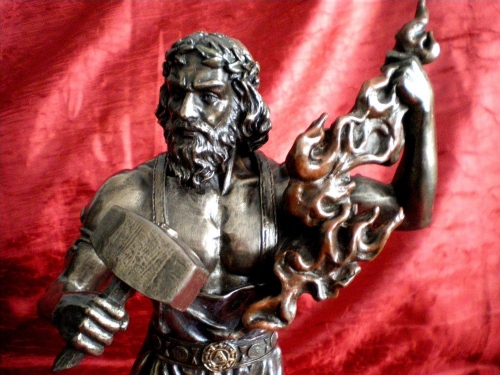
From the Arsenal of Hephaestus
Ten Traditionalist Perspectives on the Ideology of the Hostile Elite in the Exegesis of Robert Steuckers’ Sur et autour de Carl Schmitt. Un monument revisité (Les Edition du Lore, 2018).
Prologue: the Anatomy Lesson of Carl Schmitt and Robert Steuckers[1]
Without power, righteousness cannot flourish,
without righteousness, the world will flounder in ashes and dust
- Guru Gobind Singh
 Some aspects of the intellectual heritage of German legal philosopher Carl Schmitt (1888-1985) have already been dealt with by the author in general terms[2] - this essay is meant to look at Schmitt’s scientific oeuvre in more detail. The recent publication of the latest book of Belgian Traditionalist publicist Robert Steuckers affords a suitable opportunity for revisiting Schmitt’ work in a more comprehensive fashion. In the Low Countries, Steuckers’ book Sur et autour de Carl Schmitt represents the first substantial monograph dedicated to the rehabilitation of Schmitt’s highly original - and highly topical philosophy of law.[3] For many years, Schmitt’s intellectual universe and life-world were effectively ‘taboo’ due to his - complex and therefore easily vulgarized - association with the Nazi regime. It is a fact that Schmitt became a member of the NSDAP in May 1933, only a few months after Hitler’s seizure of power, and that he supported Hitler’s authoritarian amputation of the Weimar institutions - as did nearly all other German men and women at the time. It is a fact that he was interned by the American occupation authorities after the downfall of the Third Reich[4] and that he consistently refused to be subjected to the politically correct ‘second baptism’ of semi-obligatory ‘denazification’. His principled stance against foreign occupation cost him his academic career and social status. This stance, however, was not inspired by any great enthusiasm - or even basic respect - for the Nazi regime: in Schmitt’s view, this regime was fatally flawed in terms of higher legitimacy and historical authenticity.[5] After Stunde Null, Schmitt simply refused the new ideological Gleichschaltung demanded by the occupying powers. Irrespective of the exact degree to which Schmitt’s work can be considered intrinsically ‘tainted’ in the context of the virulent excesses of National Socialism, the fact remains that his life’s work was placed in the same post-war quarantine that befell the life work of other great European thinkers. It ended up in history’s cabinet of curiosities, together with that of Italy’s Julius Evola, France’s Louis-Ferdinand Céline, Romania’s Mircea Eliade, Norway’s Knut Hamsun and America’s Ezra Pound.
But seventy years later it is becoming increasingly evident that the historical-materialist mythology of ‘progress’ and ‘constructability’, now raised to the status of standard doctrine (with a socialist variety in the Eastern Bloc and a liberal variety in the Western Bloc), has brought Western civilization to the brink of extinction. After the fall of Eastern Bloc Realsozialmus, the entire Western world has fallen prey to what may be termed ‘Cultural Nihilism’: a poisonous cocktail of neo-liberal ‘capitalism for the poor and socialism for the rich’ and cultural-marxist ‘identity politics’ (the new ‘class struggle’ of old against young, female against male and black against white). This Cultural Nihilism is characterized by militant secularism (destroying religious cohesion), monetarized social-darwinism (destroying social-economic cohesion), totalitarian matriarchy (destroying family cohesion) and doctrinal oikophobia (destroying ethnic cohesion) and it is practised through the Macht durch Nivellierung (‘power through levelling’) mechanism of the totalitarian-collectivist Gleichheitsstaat.[6] The prime carrier of Cultural Nihilism is still the forever young ‘baby boomer’ generation of rebels without a cause, but that generation is now replacing itself by a time-less, shape-shifting ‘hostile elite’, feeding off continuous new discoveries of ‘repressed minorities’ (resentful feminists, ambitious immigrants, psychotic LBTG-activists). The power of this hostile elite resides in two distinct but intricately linked force fields: (1) the globalist institutional machinery (the ‘letter institutions’ - UN, IMF, WTO, WEF, EU, ECB, NATO) that allows it to overrule state sovereignty and electoral correction and (2) the universalist-humanist discourse of ‘human rights’, ‘democracy’ and ‘freedom’ that allows it to monopolize the ‘moral high ground’. This double trans-national and meta-political power position allows the hostile elite to systematically elude any responsibility for the stupendous damage it is inflicting on Western civilization. The crimes committed by the hostile elite - industrial ecocide (anthropogenic climate change, environmental degradation, diabolical bio-industry), hyper-capitalist exploitation (‘free market’, ‘privatization’, ‘social return’), social implosion (matriarchy, feminization, transgenderism) and ethnic replacement (‘asylum policy’, ‘labour migration’, ‘family reunification’) - go unpunished within an institutional and ideological framework that operates literally ‘above the law’. Only an entirely new legal framework can end the legal immunity enjoyed by the hostile elite. Carl Schmitt’s philosophy of law provides that new frame: it offers a restoration of the lost link between institutional law and authentic authority and of what is found between these two - actual justice. To restore this link, Schmitt uses the concept of ‘political theology’, i.e. the assumption that all political philosophies are shaped, directly or indirectly, by theological positions that may or may not take on an ostensibly ‘secularized’ shape. From that perspective, the political imperative of promoting institutional laws aimed at immanent justice is derived from transcendently - theologically - defined authority.
The time has come to end the entirely anachronistic and increasingly untenable ‘taboo’ on Carl Schmitt’s work and thought - and to investigate its relevance during the contemporary Crisis of the Postmodern West.[7] Robert Steuckers’ Sur et autour de Carl Schmitt permits us not only a fascinating visit to a monumental past. It also permits us to find the weapons that are needed in the here and now - it gives us access to the mighty ‘Arsenal of Hephaestus’.[8]
(*) As in the earlier review of Steuckers’ work Europa II,[9] the reviewer has chosen for a double presentation of Steuckers’ original French text - sharp and acidic as usual - as well as an English translation. As stated in that earlier review, the reviewer shares the view of patriotic publicist Alfred Vierling that the French literary culture is essentially different from the English literary culture to a degree that virtually precludes one-on-one ‘translation’. This means that French language skills are actually indispensable for any conscientious studia humanitatis. The lack of such skills among the younger generations of the West, however, is not primarily due to any intellectual complacency: it can be directly attributed to the hostile elite’s anti-education policy of deliberate ‘dumbing down’. The reviewer is therefore willing to meet younger readers half-way by presenting both Steuckers’ original text and his own somewhat ‘free’ English translation. Obviously, the reviewer acknowledges his responsibility for the less successful attempts at transposing Steuckers’ ‘biting’ Walloon-French into English. A glossary of Steuckerian neologisms is added at the end of the text.
(**) This essay is not only meant to provide a review, it is also meant as a metapolitical analysis and a contribution to the patriotic-identitarian deconstruction of the Postmodern Western hostile elite. It is important to know who the enemy is, what he aims at and how he thinks. Carl Schmitt’s life work provides an ‘anatomical’ dissection of the hostile elite’s legal philosophy - it effectively deprives the hostile elite of any authentic foundation. Robert Steuckers has achieved a brilliant rehabilitation of Schmitt’s work - the patriotic-identitarian movement of the Low Countries owes him gratitude and congratulations.
(***) On the one hand, those readers that have still been traditionally educated are asked for patience with the somewhat ‘patronizing’ explanatory notes: these are meant to assist those younger readers that have been deprived of their basic intellectual heritage by decades of anti-education. On the other hand, those readers that lack a traditional education - and that may feel ‘put off’ by any ‘pretentious’ text - are asked for an effort at bettering themselves. They should realize that what may appear ‘pretentious’ reflects, in fact, nothing else than their own stolen heritage - the heritage of Western civilization. If the patriotic-identitarian movement is meant to protect anything of value, then it is exactly that: Western civilization itself - ΜΟΛΩΝ ΛΑΒΕ.[10]
1. The World of Normativism as Will and Representation[11]
auctoritas non veritas facit legem
[power, not truth, makes law]
Steuckers commences his extensive overview of the life and work of Carl Schmitt with a reconstruction of the cultural-historical roots of post-war Western legal-philosophical thought. He retraces the historical-materialist reduction - one might say ‘secularization’ - of the Western philosophy of law to the Reformation and the Enlightenment.[12] The religious wars of the 16th and 17th Centuries resulted in the temporary regression of Western civilization into a ‘state of nature’ which could only be partially compensated for by the ‘emergency measure’ of classical Absolutism during the second half of the 17th and the first half of the 18th Century.[13] This ‘emergency brake’ Absolutism is characterized by a highly stylized personification of totally sovereign monarchic power as the last protection of a traditionalist community against the demonic forces of modernist chaos. After the abolition of the old securities of the sacred and feudal order, the ‘absolutist’ monarchs intervene in order to channel the disruptive dynamics of early mercantile capitalism, the incipient civil rights movement and the escalating tendency to religious decentralization. From a cultural-historical perspective, this ultimate resort to ‘hyper-personalized’ Auctoritas can be interpreted as a temporary ‘emergency measure’: ...en cas de normalité, l’autorité peut ne pas jouer, mais en cas d’exception, elle doit décider d’agir, de sévir ou de légiférer. ‘...in normal circumstances, [such an absolute] authority does not play a role, but in exceptional circumstances, it must act in a decisive, over-ruling and legislating fashion.’ (p.4) But this absolutist ‘emergency measure’ is only locally and temporarily effective: the pioneering nations of modernity, such as Great Britain and the Dutch Republic, remain exempt - despite ‘semi-absolutist’ measures such as the Stuart Restoration and the stadtholderate of William III. Even in its heartland, Absolutism reaches its expiry date in less than a century - the American and French Revolutions mark the end of Absolutism and the final Machtergreifung of the bourgeoisie as the new dominant force in the Western political arena.
The bourgeois-capitalist Wille zur Macht is abstractly expressed in a political doctrine that is based on the effective inversion of the preceding Traditionalist philosophy of law (i.e. of the clerical-feudal ‘political theology’): this new Normativism, constructed around bourgeois-capitalist interests, abstractifies and depersonalizes state authority - Thomas Hobbes already describes it as the mythically invisible ‘Leviathan’.[14] Abstractification is achieved through ideologization and depersonalization is achieved through institutionalization: both processes are directed at the foundation and consolidation of the new bourgeois-capitalist hegemony in the political sphere. Rigid routines and mechanical procedures (‘bureaucracy’, ‘administration’, ‘legislation’) replace the human measure and the personal dimension of Traditionalist power: concrete power is replaced by abstract ‘governance’. L’idéologie républicaine ou bourgeoise a voulu dépersonnaliser les mécanismes de la politique. La norme a avancé, au détriment de l‘incarnation du pouvoir. ‘The republican and bourgeois ideology needs to depersonalize the mechanics of politics. It favours normative power over embodied power.’ (p.4) The first consistent experiment with Normativism as Realpolitik ends with the Great Terror of the First French Republic: it illustrates the totalitarian reality that necessarily results from the consistent application of the do-or-die motto that covers the bourgeois-capitalist power project in its formal (republican) as well as its informal (freemasonic) forms: liberté, égalité, et fraternité ou la mort, ‘liberty, equality and fraternity - or death’. The ethical discrepancy between the utopian ideology and the practical application of this power project is ideologically covered by - and established as a norm in - 19th Century Liberalism. Liberalism is the political ‘default setting’ of modernity. The propagandistic surface of Liberalism - its utopia of ‘humanism’, ‘individualism’ and ‘progress’ - covers its deeper substances: the pseudo-scientifically (social-darwinistically) justified economic disenfranchisement (‘monetarization’, ‘free market’, ‘competition’) and social deconstruction (‘individual responsibility’, ‘labour marker participation’, ‘calculating citizenship’) that mathematically result in social implosion (Karl Marx’ Entfremdung and Emile Durkheim’s anomie). In the long term, Liberalism results in a ‘superstructure’ that is based on a very puritanical - and therefore highly resilient - form of Normativism: Liberalism has the highest totalitarian potential of all modernist (historical-materialist) ideologies. Thus, Alexander Dugin historical analysis, translated into English as The Fourth Political Theory, points to the intrinsic - logically-consistent and existentially-adaptive - superiority of Liberalism. ...[L]e libéralisme-normativisme est néanmoins coercitif, voire plus coercitif que la coercition exercée par une personne mortelle, car il ne tolère justement aucune forme d’indépendance personnalisée à l’égard de la norme, du discours conventionnel, de l’idéologie établie, etc., qui seraient des principes immortels, impassables, appelés à régner en dépit des vicissitudes du réel. ‘...[S]till, Liberal Normativism is coercive - it is even much more coercive than the power exerted by any mortal ruler, because it does not tolerate any form of personalized autonomy with regard to its own ‘norm’ (conventional consensus, standard ideology, political correctness), which is elevated to an eternal and unapproachable principle that is permanently exempt from the vagaries of real life’. (p.5) From a sociological perspective, the totalitarian superstructure of Liberal Normativism can be described as ‘hyper-morality’.[15]
The apparently inviolable foundation of the Liberal Normative monolith in the bedrock of Postmodern social psychology raises the question of whether or not it is possible to dislodge by the application of legal philosophy. An affirmative answer to that question depends on breaking through the ‘event horizon’ of Liberal Normative Postmodernity, i.e. stepping beyond its epistemological boundary. A break-out from the ‘timeless’ dimension of Liberal Normativism is by means of an ‘Archaeo-Futurist’ formula: the simultaneous mobilization of re-discovered ancient knowledge and newly discovered strength will provide the necessary combination of imagination and willpower.
2. Through the Glass Ceiling of Postmodernism
ΔΩΣ ΜΟΙ ΠΑ ΣΤΩ ΚΑΙ ΤΑΝ ΓΑΝ ΚΙΝΑΣΩ
[give me a place on which to stand, and I will move the Earth]
- Archimedes
One of the most important childhood diseases of the patriotic-identitarian resistance movement, now rising up against the globalist New World Order throughout the entire Western world, is its inability to correctly assess the nature and power of the hostile elite. The widening (‘populist’) public anger and incipient (‘alt-right’) intellectual criticism that feeds this resistance movement are partially characterized by superficial pragmatism (political opportunism) and emotional regression (extremist conspiracy theories). Both of these phenomena can be understood as the political and ideological reflections of the natural instinct of self-preservation: in a confrontation with direct existential threats, such as the ethnic replacement of the Western peoples and the escalating psychosocial deconstruction of Western civilization, political purity and intellectual integrity simply lack priority. Still, it is of vital importance that the patriotic-identitarian movement outgrows these childhood diseases as quickly as possible - especially its ‘quick fix’ political islamophobia and its ‘shortcut’ ideological anti-semitism.[16] It should be empathically stated that this does not imply any recourse to the kind of ‘preventive self-censorship’ that is now practised by the politically correct journalistic and academic establishment with regard to legitimate cultural-historical questions that are embedded within the larger discourses of ‘islamophobia’ and ‘anti-semitism’. The patriotic-identitarian movement is bound to prioritize authentic - not merely legalistic - freedom of expression: it is bound to the position that politically correct (self-)censorship and repressive media policies are counter-productive because they increase public distrust and because they feed political extremism. The obvious ‘pride and prejudice’ of the system press (which stigmatizes every rational cost-benefit analysis of ‘mass-immigration’, ignores the ethnic profiles of ‘grooming gangs’ and re-interprets incidents of islamist terror) and the governmental policy of ‘shoot the messenger’ with regard to critical media (through ‘fake news’ projections, ‘Russian involvement’ smear campaigns and digital ‘deplatforming’) have caused the public to abandon the journalistic and political ‘mainstream’. The downfall of the traditional (paper and television) media and the splintering of the political landscape merely represent the surface reflections of this development. Now it is up to the patriotic-identitarian movement to lead the defence of the old freedoms of press and opinion, freedoms that have been now been discarded by the hostile elite as superfluous - and dangerous.[17] The task of defending Western civilization, which has been sold out by the neo-liberals and betrayed by the cultural-marxists, has now devolved upon the patriotic-identitarian movement. A correct assessment of the nature and power of the hostile elite is now its highest priority - without it, a winning strategy is impossible. A short-cut identification of the ‘enemy’ as ‘the Islam’ or a ‘Jewish world conspiracy’ simply does not stand up to cold calculus and ruthless realism required from this assessment.
The correct identification of the hostile elite requires more than a simple - albeit ethically and existentially correct - reference to its undeniably ‘demonic’ quality. The absolute evil that results from industrial ecocide, bloodthirsty bio-industry, neo-liberal debt slavery and matriarchal social deconstruction is self-evident.[18] But more is needed: it is necessary to achieve a legal understanding and a political strategy that ‘frames’ the hostile elite in a definitive manner. In this regard, Robert Steuckers’ analysis of Carl Schmitt’s ‘political theology’ is of great value: it offers the intellectual tools that are necessary to complete this - possibly greatest - task of the Western patriotic-identitarian movement.
3. Liberalism as Totalitarian Nihilism
...le libéralisme est le mal, le mal à l’état pur, le mal essentiel et substantiel...
[...liberalism is evil, evil in its purest form, evil in essence and substance...] (p.37)
Steuckers analyzes Liberal Normativism as the ‘default ideology’ of the hostile elite, i.e. the ideology that ultimately legitimizes its hold on power: Le libéralisme... monopolise le droit (et le droit de dire le droit) pour lui exclusivement, en le figeant et en n’autorisant plus aucune modification et, simultanément, en le soumettant aux coups dissolvants de l’économie et de l’éthique (elle-même détachée de la religion et livrée à la philosophie laïque) ; exactement comme, en niant et en combattant toutes les autres formes de représentation populaire et de redistribution qui s’effectuait au nom de la caritas, il avait monopolisé à son unique profit les idéaux et pratiques de la liberté et de l’égalité/équité : en opérant cette triple monopolisation, la libéralisme et son instrument, l’Etat dit ‘de droit’, prétendant à l’universalité. A ses propres yeux, l’Etat libéral représente dorénavant la seule voie possible vers le droit, la liberté et l’égalité : il n’y a donc plus qu’une seule formule politique qui soit encore tolérable, la sienne et la sienne seule. ‘Liberalism monopolizes (1) the law (and the right to legislate) by [permanently] setting its boundaries, by not allowing for any fundamental adaptations and by exposing it to the ‘dissolving’ effects of [an uncontrolled] economy and [borderless] ethics (ethics that escape any religious framework and are hijacked by ‘secular philosophy). By denying and sabotaging all other forms of (2) [non-party political] representation and (3) [non-monetarized economic] redistribution for the sake of its own exclusive profits, liberalism also monopolizes the [entire] ideal and practical [discourse] of freedom, equality [and] fairness. Through this triple monopoly [and] through its state-enforced ‘legal order’, liberalism is able to claim [an absolute] universal validity. In its own eyes, the liberal state represents the sole possible [and sole redeeming] way to achieve law, freedom and equality. Thus, only one acceptable political formula remains: liberalism - and liberalism alone.’ (p.38) This is the background on which neo-liberal globalism is able to project ‘universal’ and ‘absolute’ values such as ‘good governance’ and ‘human rights’. From a Traditionalist perspective, Liberal Normativism as defined by Steuckers represents the political and ideological ‘infrastructure’ that reflects the higher but intangible cultural- and psycho-historical ‘superstructure’ that was here earlier defined as ‘Cultural Nihilism’, viz. the experiential reality that is pre-conditioned by social-economic Entfremdung, psycho-social anomie, urban-hedonist stasis and collectively-functional malignant narcissism.[19] This Traditionalist perspective fits seamlessly into Steuckers’ analysis of the tangible cultural-historical effects of Liberal Normativism. Steuckers explicitly describes Liberal Normativism as ....[le] principe dissolvant et déliquescent au sein de civilisation occidentale et européenne. ...[L]e libéralisme est l’idéologie et la pratique qui affaiblissent les sociétés et dissolvent les valeurs porteuses d’Etat ou d’empire telles l’amour de la patrie, la raison politique, les mœurs traditionnelles et la notion de honneur... ‘...[t]he ‘dissolving’ principle and ‘rot’ in the heart of Western and European civilization. ...[L]iberalism represents the ideology and practice that most effectively weakens communities and that most effectively dissolves the values on which state[s] and empire[s] are build: love of country, responsible statesmanship, traditional loyalty and authentic honour.’ (p.36-7)[20]
From a Traditionalist perspective, the cultural-historical effects of Liberal Normativism are determined by larger meta-historical dynamic, i.e. the downward time spiral that Hindu Tradition interprets as Kali Yuga and that the Christian Tradition interprets as ‘Latter Days’. The historical agency of Liberal Normativism as a carrier of a contextually functional Wertblindheit is explicitly recognized in Steuckers’ prognosis: ...une ‘révolution’ plus diabolique encore que celle de 1789 remplacera forcément, un jour, les vides béants laissés par la déliquescence libérale ‘...[it is] inevitable that, someday, an even more [openly] demonic revolution than that of 1789 will fill the gaping void that has been caused by the liberal rot.’ (p.37) A first indication of the deeper ‘outer dark’ that still lies hidden beyond the Liberal Normativist facade is found in the recent monster alliance between neo-liberalism and cultural-marxism in Western politics (in Dutch politics this alliance is visible in the program of the governing coalition parties, which combines the ‘disaster capitalist’ agenda of the VVD and the ‘deep nihilist’ agenda of the D66).[21] Steuckers highlights Schmitt’s doubly philosophical and theological interpretation of the regressive cultural-historical tendency of Liberal Normativism. Schmitt draws attention to the consistent Liberal-Normativist support for pre-Indo-European primitivism (Etruscan matriarchy, Pelagianist ‘katagogic’ theology) at the expense of Indo-European civilization (Roman patriarchy, Augustinian ‘anagogic’ theology).[22] Traditionalism associates this tendency with a meta-historical movement towards a ‘neo-matriarchy’: this explains the chronological relation between the Postmodern hegemony of Liberal Normativism and typically Postmodern symptoms such as feminization, xenophilia and oikophobia.[23] In sociological terms, this phenomenology can be accurately described as befitting the development of a ‘dissociative society’.[24] The spectre of an absolute nihilist void is already casting ahead its shadow in Postmodern discourses such as ‘open borders’ (genocide-on-demand), ‘transgenderism’ (depersonalization-on-demand), ‘reproductive freedom’ (abortion-on-demand) and ‘completed life’ (euthanasia-on-demand) - discourses that are straightforwardly demonic in any authentic Tradition.[25]
Leaving aside the natural interethnic (effectively ‘neo-tribal’) conflicts of contemporary ‘multicultural societies’ (conflicting bio-evolutionary strategies, interracial libido trajectories, post-colonial inferiority complexes), the prime trigger of the existential conflict between indigenous Westerners and non-Western immigrants is found in the increasingly diabolical life-world of Liberal-Normativist Western ‘society’. For every traditional Muslim from the Middle East, for every traditional Hindu from South Asia and for every traditional Christian from Africa the Liberal-Normativist ‘open society’ or the Postmodern West not only an abstract (theological) evil but also a lived (experiential) horror. Even if the armed terror of the islamicist jihad is (a tolerated) part of the offensive ‘divide and rule’ strategy of the hostile elite in form, in substance it can also be understood as a defensive mechanism against the blasphemous and dehumanizing experience of life under Liberal-Normativist rule. From a Traditionalist perspective, it could be said that for the Western peoples an Islamic Caliphate would, in fact, represent a (very relatively) ‘better’ alternative to the bestial dehumanization that will logically result from the ‘harrowing of hell’ of fully-implemented Liberal Normativism.
Thus, the greatest enemy of all the Western peoples - in fact, the common enemy of all peoples that still live according to authentic Traditions - is politically identified: totalitarian-nihilist Liberalism. Liberal Normativism is politically realized through Liberalism: the program of the hostile elite is shaped by Liberalism. In this regard, it is important to note the fact that, since the Second World War, Liberalism has gradually gained the status of ‘standard political discourse’. Liberalism has infiltrated, disfigured and transformed its political rivals, including Christian Democracy (the Dutch CDA and CU, which have joined the liberal governing coalition without the slightest compunction), Social Democracy (the Dutch PVDA and SP, which have been marginalized through decades of compromise) and Civil Nationalism (the Dutch PVV and FVD, which have failed to formulate a viable alternative vision of society). This process has advanced to point of eradicating any trace of authentic democratic-parliamentarian opposition in key areas such as economic and social policy. Steuckers views this process of ‘politicide’ as a function of Liberalism’s intrinsic power of ‘ideological sterilization’. Even outside of the core party cartels (in the Netherlands these are represented by standard ‘governing parties’ of VVD, D66, CDA, CU and PVDA) Liberalism has become a political habitus[26] - all other parties automatically (largely unintentionally) take on the role of ‘controlled opposition’. The result is ‘mainstream politics’ (in the Netherlands it is explicitly referred as the all-levelling ‘polder model’), now dominating the entire West since the 1980’s rise of ‘Neo-Liberalism’: the rise to power of Margaret Thatcher in Britain, Ronald Reagan in America and Ruud Lubbers in the Netherlands.
4. Liberalism as Politicide
A ‘democratically elected’ parliament can never be the place for authentic debate:
it is always the place where collectivist absolutism issues its decrees.
- Nicolás Gómez Dávila
The formation of Liberalist-led party cartels and Liberalist-guided consensus politics is largely due to the simple practice of parliamentarism: the parliamentary technique of the hyper-democratically dumbed-down and hyper-regulated unrealistic ‘debate’ reduces all ‘opinions’ and ‘viewpoints’ to their lowest common denominator, which is always found in grossly materialist and totally amoral Liberalism. The all-levelling debate replaces quality with quantity (‘democracy’), thought with feeling (‘humanism’), concrete justice with abstract governance (regulation, bureaucracy, protocol) and collective future planning with individual impulse gratification. ‘Purchasing power’ always outweighs generational legacy, ‘lifestyle’ always prevails over ecological sustainability and ‘relationship experiments’ always have priority over family life. Parliamentarism is nothing but the political and institutional reflection of the collectivist levelling sentiment that underpins bourgeois Liberalism: it represents the reductio ad absurdum of politics - politics as talk show entertainment.[L]’essence du parlementarisme, c’est le débat, la discussion et la publicité. Ce parlementarisme peut s’avérer valable dans les aréopages d’hommes rationnels et lucides, mais plus quand s’y affrontent des partis à idéologies rigides qui prétendent tous détenir la vérité ultime. Le débat n’est alors plus loyal, la finalité des protagonistes n’est plus de découvrir par la discussion, par la confrontation d’opinions et d’expériences diverses, un ‘bien commun’. C’est cela la crise du parlementarisme. La rationalité du système parlementaire est mise en échec par l’irrationalité fondamentale des parties. ‘[T]he essence of parliamentarism is found in debate, discussion and publicity. Such parliamentarism may prove itself an asset in an Aeropagus [assembly][27] of rational and clear-minded gentlemen, but this is no longer the case when rigidly ideological parties are confronting each other with claims of possessing the ultimate truth. The latter debate is no longer loyal: the aim of its participants is no longer the discovery of the ‘higher cause’ through a discussion and an exchange of opinions and experiences. Herein lies [the cause of] the crisis of [comtemporary] parliamentarism. The rationality of the [present] parliamentary system fails due to the fundamental irrationality of the parties.’ (p.18-9)
It is inevitable that this self-reinforcing crisis is increasingly fed by groups that were previously ‘invisible’ in the political landscape. The escalating process of political levelling is fed by the individual ambitions and resentments of the self-appointed ‘representatives’ of supposedly ‘discriminated’ groups. Seek and you shall find: there are always more ‘under-privileged’ groups (to be invented): young people, old people, women, immigrants, homosexuals, transgenders. Totalitarian nihilist Liberalism is the deepest (maximally ‘deconstructed’, maximally ‘desubstantivized’ political sediment - and sentiment - that results from this implosive process: it is the political ‘zero position’ that remains after the all-levelling ‘debate’, i.e. after the neutralization of all attempts at political idealism, political intelligence and political willpower.
Liberalism realizes the political (parliamentarist, partitocratic) dialectics of the Liberal-Normativist ideology. In Schmitt’ view, the dialectically vicious circle that results from this ideology can only be broken by a fundamental restoration of political authority. Steuckers states this as follows: Dans [cette idéologie], aucun ennemi n’existe : évoquer son éventuelle existence relève d’une mentalité paranoïaque ou obsidionale (assimilée à un ‘fascisme’ irréel et fantasmagorique) - ...il n’y a que des partenaires de discussion. Avec qui on organisera des débats, suite auxquels on trouvera immanquablement une solution. Mais si ce partenaire, toujours idéal, venait un jour à refuser tout débat, cessant du même coup d’être idéal. Le choc est alors inévitable. L’élite dominante, constituée de disciples conscients ou inconscients de [cette] idéologie naïve et puérile..., se retrouve sans réponse au défi, comme l’eurocratisme néoliberal ou social-libéral aujourd’hui face à l’[islamisme politique]... De telles élites n’ont plus leur place au-devant de la scène. Elles doivent être remplacées. ‘In [this ideology] a [real] enemy cannot be conceived of: even to suggest the possible existence of such an [enemy] is ‘proof’ of the paranoid or obsessive mentality (always associated with an unreal and imaginary ‘fascism’) - ...there are only ‘debating partners’. With [such partners] debates are organized and these debates always end in a solution. But if, one day, this partner - always thought of in abstract terms of rational perfection - would actually refuse the debate, then the ideal [‘discussion’ model] would immediately fail. An [existential] shock would be inevitable. The ruling elite, which is [entirely] made up of conscious and unconscious adherents to [this utterly] naive and infantile ideology..., would have no answer to this challenge - in the same manner that neoliberal and social-democrat eurocrats [have no answer] to [political islamism]... Such elites do not deserve a place on the [political] stage - they have to be replaced.’ (p.245)
5. Liberalism as Anti-Law and Anti-State
A Marxist system can be recognized by its protection of criminals
and its criminalization of opponents.
- Alexander Solzhenitsyn
Sometime during the aftermath of the Machtergreifung of the soixante-huitards the hostile elite has taken the strategic decision to replace the indigenous peoples of the West.[28] Its underlying logic is as clear as it is ruthless. The European peoples have proven to be historically incompatible with Modernity, as it is defined by Culture Nihilism: this is why they have to be mixed with and replaced by more malleable - less intellectual, less demanding, less self-conscious - slave peoples. The European peoples are demographically infertile under totalitarian dictatorship, they are economically unproductive in urban-hedonist stasis and they are politically unreliable in debt slavery.[29] But the ethnic replacement of the Western peoples is a project with considerable risks: even the most optimally calibrated Umvolkung recipe and the most carefully calculated dosage of its various ingredients (mass immigration, ethnically selective natalist policy, affirmative action, native economic deprivation) demand a political balancing act of unparalleled refinement. To achieve the political ‘point of no return’ (the demographically-democratically checkmate of the Western peoples) the hostile elite runs the risk that its amputation-transplantation operation will fail when the double psychological and spiritual anaesthesia fails, causing the patient to awake on the operating table. Until that point is reached, the expiry date of the hostile elite depends on two main anaesthetic medicines: (1) the hedonist-consumerist defined level of ‘wealth’ and ‘wellness’ and (2) the educative-journalistic manipulated politically correct consensus. If one of these two elements fall under a certain critical measure (a measure that is gradually revised downward), the danger of the patient awakening increases exponentially. Thus, a certain minimum remnant (constantly revised downward as well) of the welfare state, labour legislation, political pluriformity and freedom of opinion must be maintained until the process of ethnic replacement has been completed. The neoliberal-globalist ideals of entirely ‘open borders’, of an entirely amoral ‘open society’ and a total social-economic bellum omnium contra omnes can only be fully realized after the ethnic replacement project has reduced the native Western population to the status of ‘endangered species’, confined to marginal ‘reservations’. Until that time, the transition process creates a legal predicament for the hostile elite: it has to carefully manage the maximum speed with which Western state institutions and laws can be demolished and replaced with Liberal anti-state institutions and anti-laws. If this demolition and replacement take place too quickly, the Liberal anti-state risks an uncontrollable backlash: an early overdose of chaos and injustice in the public sphere risks a premature alienation and collective countermovement among the native Western populace.
The increasingly grotesque side-effects of the Liberal demolition of state institutions and legal safeguards are particularly problematic in case of those privileges that are the exclusive preserve of the ‘immigrants’ (‘affirmative action’, ‘preferential treatment’, ‘housing priorities’, ‘targeted subsidies’) and of those sanctions that are explicitly aimed at the natives (student loans, commercial credit and administrative fines for natives vs. scholarships, grants and prosecution dismissal for ‘immigrants’). The contrast between the bureaucratic hurdles, fiscal pressure, labour market congestion and housing shortages faced by the native population (particularly its unfortunates: the homeless, the infirm, the poor) and the red carpet treatment (free legal assistance, free shelter and free money followed by priority housing, start-up facilities and full access to social support) provided to foreign colonists (including masses of fraudsters, thieves and rapists) is becoming more grotesque every year. As the immigrant population explodes due to ‘managed migration’ (‘Marrakesh’),‘family reunification’ (‘human rights’) and ‘child allowances’ (‘legal equality’) - always at the expense by the native population - the hostile elite risks pushing the native population into electoral resistance (‘populist parties’) and civil disobedience (gilets jaunes) too soon and too far. The hostile elite is attempting to abolish the historical gains of 150 years of Western civilization - legal recourse, labour law, social security, educational opportunity, universal healthcare, administrative integrity, responsible governance - in the space of no more than two generations. Here, the generational divide (essentially the divide between baby-boomer and post-baby-boomer) is essential because it is vitally important to ‘clean’ the collective memory of the Western populace: to make sure that inconvenient concepts such as ‘educational standards’, ‘living wage’, ‘income security’, ‘old age insurance’ and ‘justice for all’ are eradicated as quickly as possible. The hostile elite is close to achieving this aim, even if it is not fully ‘in the clear’ yet.
The Liberal anti-state and anti-law of the hostile elite has already basically reduced its hardworking, conscientious and naive indigenous subjects to ‘milk cows’ and ‘slaughter cattle’ to be exploited on behalf of a rapidly increasing mass of ruthless, unproductive, fraudulent and criminal ‘immigrants’. The sickening burden of this colonizing immigration is particularly crushing for the most vulnerable indigenous groups: day labourers, small entrepreneurs, pensioners, the physically and mentally handicapped and single-parent families. The hostile elite is silencing their feeble protests against demographic inundation and social-economic marginalization with mind-twisting and utterly cynical one-liners such ‘multicultural enrichment’ and ‘humanitarian duty’, ‘market forces’ and ‘private responsibility’. In the Dutch context, their situation is best symbolized by a caricature picture that is now frequently becoming reality: the humble indigenous bicyclist who is stopped in the pouring rain by the traffic police to be fined for a defect light, when a few yards away an ‘immigrant’ drugs lord is speeding through the red light in his sports car on the way to launder his ill-gotten riches in the ‘convenient store’ of his family clan.
But worse is yet to come - and many are starting to experience this ‘in the flesh’. Worse is the experience of indigenous girls and women: with the clients of their ‘lover boys’[30] during their school years, with their ‘rapefugee’ stalkers during their college years and with their ‘#metoo’ affirmative action ‘bosses’ during their working lives. And the worst is hidden still: the murderous decolonization (Lari 1953, Algiers 1956, Stanleyville 1964, Kolwezi 1978, Air Rhodesia Flight 827 1979) and the postcolonial atavism (Macías Nguema in Equatorial Guinea 1968-79, Muammar Kaddafi in Libya 1969-2011, Idi Amin in Uganda 1971-79, Pol Pot in Cambodia 1976-79, Saddam Hussein in Iraq 1979-2003) of the Third World bode ill for the future of the remnant native population of the West once it is fully colonized by primitive Africans and resentful Asians. Perversion is already the becoming the standard modality of Western bureaucracies and judiciaries as the indigenous Western peoples are abandoned and left to face terrorism, criminality and persecution without effective recourse. They are left with a toothless police that is caught up in red tape, a matriarchal anti-judiciary that is protecting criminals against victims, a silent media cartel that is hiding the ‘colour of crime’[31] and a perverted political system that prioritizes ‘public perception’ over public responsibility. These collective experiences, however, are now fast accumulating into a critical mass that threatens the whole ethnic replacement: they are, in fact, creating space for an effective collective challenge to the hostile elite. The moral legitimacy of the native resistance is giving it the status of an ‘Authority in the Making’, empowering it to tear up the seemingly inescapable but wholly fraudulent ‘IOU from history’ that the hostile elite is foisting on the Western peoples. The traffic light of history is flashing yellow for Liberalism. The gilets jaunes have already shown the Liberal hostile elite the ‘yellow card of history’: it is now up to the Western peoples to write out its red card - and to transfer it from the political stage to the penalty box of history.
6. The Patriotic-Identitarian Resistance as Authority in the Making[32]
And that, knowing the time, that now it is high time to awake out of sleep:
for now is our salvation nearer than when we believed.
The night is far spent, the day is at hand:
let us therefore cast off the works of darkness,
and let us put on the armour of light.
- Romans 13:11-12
The basis of a successful campaign of Liberal Normativism as an ideological model and of Liberalism as a political force is the realization that both are the mortal enemies of Western civilization. For the Western peoples, the annihilation of Liberalism as a political force is an absolute precondition for a successful reconquista of state sovereignty and ethnic identity. In this case, the absolute right of survival coincides with the ethical imperative of resistance. This ethical imperative applies to all nations with ‘their back against the wall’, as formulated by Marek Edelman, the last leader of the Zydowska Organizacja Bojowa (‘Jewish Combat Organization’): We knew perfectly well that we had no chance of winning. We fought simply not to allow the Germans alone to pick the time and place of our deaths. We knew we were going to die.[33]
In this regard, the Western patriotic-identitarian movement would be well advised to take to heart what Steuckers has to say about the illusion of ‘dialogue’ with the hostile elite. Reasonability and dialogue end - have to end - when one is faced with an existential threat: ...l’ennemi n’est pas bon car il veut ma destruction totale, mon éradication de la surface de la Terre: au mal qu’il représente pour moi, je ne peux, en aucun cas et sous peine de périr, opposer des expressions juridiques ou morales procédant d’une anthropologie optimiste. Je dois être capable de riposter avec la même vigueur. La distinction ami/ennemi apporte donc clarté et honnêteté à tout discours sur le politique. ‘...the enemy simply cannot be good, because he seeks my total destruction [and] my eradication from the face of the Earth: I cannot, when faced with the [absolute] evil that he represents to me, apply the legal and moral prescriptions of [a misguided] anthropological optimism - if I do so, I will become extinct. I must be able to retaliate with equal vigour. Thus, the distinction between friend [and] enemy provides the political discourse with clarity and honesty.’ (p.51)
The hostile elite, which speaks through Liberal Normativism and which acts through Liberalism, has declared war on the Western peoples and on Western civilization: the Western peoples are simply left with no other choice than to fight for their lives and to appoint a newly-legitimate ‘authority in the making’. The weapons with which the Western patriotic-identitarian resistance can deal the intellectual deathblow to the hostile elite can be found in the arsenal of Carl Schmitt - Robert Steuckers’ Sur et autour provides the key to this arsenal. One of the weapons to be found there is Schmitt’s philosophical validation of the restoration of authentic Auctoritas.
7. Decisionism as State Theory
In Gefahr und grosser Noth
Bringt der Mittel-Weg den Tod
[In danger and distress
The middle way leads to death]
- Friedrich von Logau
The weakness of the hostile elite’s pseudo-philosophy of law is ruthlessly exposed in Steuckers’ analysis of Schmitt’s basic notions of the inevitably concrete and personal dimension of all authentic forms of legitimate law and power. The concrete and personal dimensions of law and power are best illustrated in its unavoidable incarnation in the person of the judge: the person of the judge bridges the gap between abstract and historically determined law (legal code, jurisprudence) and the concrete and contemporary reality (event, circumstance). La pratique quotidienne des palais de justice, pratique inévitable, incontournable, contredit l’idéal libéral-normativiste qui rêve que le droit, la norme, s’incarneront tous seuls, sans intermédiaire de chair et de sang. En imaginant, dans l’absolu, que l’on puisse faire l’économie de la personne du juge, on introduit une fiction dans le fonctionnement de la justice, fiction qui croit que sans la subjectivité inévitable du juge, on obtiendra un meilleur droit, plus juste, plus objectif, plus sûr. Mais c’est là une impossibilité pratique. ‘The daily, inevitable and undeniable practice of due legal process contradicts the Liberal-Normativist illusion that laws and norms can [somehow] be realized without a flesh-and-blood intermediary. By imagining an ‘absolute law’ that eliminates the person of the judge, it introduced a legal fiction: a fiction that proposes a better, more just and more objective law without the inevitable subjective [mediation of the] judge. But, [of course,] no such thing is possible in practice.’ (p.5-6) No legal verdict can be conceived of without the physical presence of a Vermittler, i.e. a man of flesh and blood who is - consciously or unconsciously - shaped by values and sentiments. Thus, no legal order can be conceived of without the imprint of the specific (historically and contextually experienced) charisma of the judge. In the Postmodern context, this charisma will tend to be of a collectivist-tainted, resentment-fed and downward-directed negative nature. Parce qu’il y a inévitablement une césure entre la norme et le cas concret, il faut l’intercession d’une personne qui soit une autorité. La loi [et] la norme ne peu[vent] pas s’incarner toute[s] seule[s]. ‘Because there will always be a gap between the [abstract] norm and the concrete [case], mediation by personalized authority is a necessity. [Thus,] the law [and] the norm can never incarnate themsel[ves].’ (p.6) The same concrete and personalized dimension apply with regard to political power: the entirely abstract, institutionalized and bureaucratized form of political power that is wished for, believed in and aimed at my Liberal Normativism is simply impossible. Thus, the inevitable and indispensable incarnation of political authority remains ...le démenti le plus flagrant à cet indécrottable espoir libéralo-progressisto-normativiste de voir advenir un droit, une norme, une loi, une constitution, dans le réel, par la seule force de sa qualité juridique, philosophique, idéelle, etc. ‘...the most definitive argument against the incorrigible liberal-progressivist-normativist hope that it will be possible, one day, to achieve a real-world law, norm [and] order that is solely based on judicial, philosophical and idealist quality.’ (p.6)
Under the aegis of totalitarian Liberal Normativism, however, Postmodern West politics has no longer any space for rational debate and superior argumentation: only ‘might is right’. L’idéologie républicaine ou bourgeoise a voulu dépersonnaliser les mécanismes de la politique. La norme a avancé, au détriment de l‘incarnation du pouvoir. ‘The republican and bourgeois ideology is aimed at the depersonalization of the mechanics of politics. It favours normative power at the expense of personalized power.’ (p.4) The contemporary power of Liberal Normativism is psychosocially anchored in an anti-rational matriarchal conditioning that abolishes all personalized forms of authentic authority in a hyper-collectivist règne de la quantité.[34] Dramatic illustrations of this increasingly oppressive matriarchal reality can be found in the Western European ‘ground zero’ of Postmodernity: in the ex-nation states of ‘Anti-Frankrijk’ en ‘Anti-Germany’ the policies of anti-tradition, anti-nationalism and anti-masculine are now metastasizing into openly sadomasochistic projects of self-mutilating and suicidal Umvolkung à l’outrance. In this context, every form of collectivist resistance (parliamentary ‘opposition’ and extra-parliamentary ‘activism’) against the idiocratic and absurdist excesses of Liberal Normativism is doomed to failure because it will limit itself to pragmatic ‘symptom management’. By limiting themselves to the matriarchal-collectivist (doubly politically-institutional and psycho-social) ‘frame’ of Liberal Normativism, such parliamentary opposition (the AfD in Germany, the FvD in the Netherlands) and such extra-parliamentary activism (the Reichbürger movement in Germany, the gilets jaunes movement in France[35]) are effectively reduced to ‘lightning conductors’. There exists only one true remedy for the matriarchal-collectivist ‘anti-authority’ of Liberal Normativism: patriarchal-personalized authority as defined in Traditionalist Decisionism.
The Decisionist approach to law and politics is always concrete, and therefore also physical and personal. In legal-philosophical terms, it is primarily concerned with the physical protection of the concrete (geographically and biologically bounded) realities of state and ethnicity. In Decisionism, earthly realities always take priority over abstract norms: ist erdhaft und auf Erde bezogen [the law is earth-bound and refers to earthly reality]. In metapolitical terms, it proceeds from the recognized necessity of personalized authority in order to meet physical calamities as well as overdoses of ‘normative’ power. It sanctions personalized authority for the effective management of existential threats against the state and the people: Ausnahmezustand, ‘state of emergency’, Ernstfall, ‘case of emergency’, Grenzfall, ‘borderline case’. This highest command authority is based on the (temporary) suspension (in fact: correction) of (normative) law through its (temporary) personification: this emergency measure is applied whenever the legal order, the power of the state or the survival of the nation are undermined or shaken. ...[E]n cas de normalité, [cet] autorité peut ne pas jouer, mais en cas d’exception, elle doit décider d’agir, de sévir ou de légiférer. ‘...[U]nder normal circumstances, th[is] authority stands outside daily life, but in case of emergency it is obliged to act, to rule and to legislate [directly].’ (p.4) This ‘emergency power’ kicks in case of existential threats from without (natural disaster, enemy invasion) and from within (rebellion, treason). In Traditional societies, this personalized authority is permanently (institutionally) available in the ‘reserve functionality’ of sacred office. In pre-modern Western societies, this reserve functionality is institutionally represented in the Monarchy, regulated either through election or succession. The sacred nature of the highest command authority is derived from the transcendental (and therefore anagogical) concept of state and nation that prevailed in all pre-modern societies. Carl Schmitt’s philosophy of law - inspired by the Traditionalist-Catholic state theory of Donoso Cortés[36] - retains this sacred element in its transcendental definition of a holistically conceived unity of state, nation and society. This unit, as qualified through the ancient notions of Unitas Ordinis, ‘Unified Order’, Societas Civiles, ‘Civil Society’ and Corpus Mysticum, ‘Mystical Body’, is taken to represent a creation that is naturally organic as well as divinely ordained - as such it can never be wholly encompassed by any political institution. The man that fate has called upon to defend the life of this mysterious ‘creature’ is held to be imbued with a sacred vocation of the highest order.
Thus, from a Traditionalist perspective, the state-nation-society agglomerate constitutes a living organism and a historical community with a mystical destiny that constitutes a political a priori: politics should be shaped around its needs and interests and politics serves it. ...[L]e peuple... n’est pas chose formée (par une volonté humaine et arbitraire) mais fait empirique et n’est jamais ‘formable’ complètement; il restera toujours de lui un résidu rétif à tout formatage, un reste qui échappera à la volonté de contrôle des instances dérivées de certaines ‘Lumières’... [L]a souveraineté populaire ne peut être entièrement représentée (par des députés) car alors une part plus ou moins importante de sa présence concrète est houspillée hors des institutions de représentation, lesquelles ne représent[e]nt plus que les intérêts ou des réalités fragmentaires. ‘...[T]he people... is not a ‘construct’ (to be made and unmade according to human will), but rather an empirical given fact that can never be entirely ‘malleable’ [in a political sense]: it always retains an indivisible residue that resists [all attempts at] ‘construction’ - a residue that remains intangible in terms of the kind of institutional control that derives from ‘Enlightenment’ [thought]... [N]ational sovereignty [and electoral mandates] can never be entirely representative through ‘representation’, because a [certain] - larger or smaller - part of the concrete presence [of the nation] will always be excluded from institutional representation, [because such a representation] will be inevitably focussed on fragmentary interest and realities.’ (p.33) The Traditionalist definition of the state-nation-society agglomerate is found in the vision of ... la ‘nation unie’, non mutilée par des dissensions partisanes, donc une nation tournant ses forces vives vers l’extérieur, et non pas vers sa seule sphère interne en y semant la discorde et en y désignant des ennemis, provoquant à terme rapide l’inéluctable implosion du tout. La Nation comme l’Eglise doit être un coïncidentia oppositorum : elle doit faire coïncider et s’harmoniser toutes les forces et différences qui l’irriguent, en évitant les modi operandi politiciens qui sèment les dissensus et ruinent la continuité étatique... ‘...the ‘unified nation’, undivided by partisan strife - a nation that directs its vital force outwards, and not merely inwards, where [that force] will create frictions and factions, results in inevitable and early total implosion. As in the case of the Church, the Nation is called upon to constitute a coïncidentia oppositorum: it must focus all [its] powers and harmonize the differences that feed its growth. It must avoid all politicized modi operandi - [factional divides and party-political narrow-mindedness] - that would cause [societal] friction and that would endanger the continuity of its state [sovereignty]...’ (p.38)
From this follows the double theological and legal imperative of a trans-democratic and trans-secular state authority which is simultaneously open in a downward (earthly) and upward (heavenly) direction and which guarantees the historical continuity of the nation(s) that it represents. A built-in permanent Decisionist ‘reserve option’ - a (temporal) ‘dictatorial’ command structure to deal with the Ernstfall - is an indispensable part of this state authority. Within the Traditionalist philosophy of law of the Christian world this reserve option is always ‘framed’ - and limited - by the higher transcendental principle of Caritas, which is explicitly expressed in the key principles of Catholic politics: Community, Solidarity and Subsidiarity. Caritas: the ‘anthropologically pessimistic’ Christian ethical imperative and pious practice of magnanimity with all creatures that need protection and assistance. First and foremost these are those people that are vulnerable, incapacitated or weak-minded - children, women, the poor, the sick, the handicapped and the dying. But these are also the animals and plants that cannot speak up for themselves and that are subject to man’s dominion. Noblesse oblige. In the Traditionalist philosophy of law of the Christian world the Monarchy was the highest natural and legitimate carrier of Decisionistically defined Auctoritas: ...les familles royales, qui incarnent charnellement les Etats dans l’Ancien régime, offrent de successions de monarques, différents sur le plan du caractère et de la formation, permettant une plus grande souplesse que les régimes normatifs et normateurs. Elles permettent la continuité dans l’adaptation et le changement, apportés par les héritiers de la lignée. En ce sens, les monarchies constituent des contrepoids contre le déploiement purement technique de la raison normative, qui fait basculer les Etats dans l’abstraction et apportent, in fine, la dictature. ‘...royal families - which are made to literally embody the state during the [Absolutist] ancien régime - offer a [continuous] succession of [ever new generations of] monarchs differ in character, upbringing and education: they offer a [‘built-in’ and] much greater flexibility than ‘normative’,... [democratically liberal] regimes. In this sense, monarchies offer a counterbalance against the purely ‘technocratic’ rule of normative ‘reason’ that reduces states to legal abstractions and, eventually, to [normative] dictatorships.’ (p.36) In a Monarchy the principle of Subsidiarity postulates an additional and derivative role for other ‘privileged’ institutions as well: the Clergy and the Nobility are called upon to carry many responsibilities - they are burdened with a secondary Decisionist Pflicht zur Tat, or ‘obligation to act’. All of these Traditional institutions were assumed to take on a number of natural and legitimate obligations on the basis of an existential quality that is simply unimaginable under the aegis of Liberal-Normativist modernity - a quality that can best be grasped in a number of concepts of more ‘aristocratically minded’ languages: solemnidad, ‘solemnity’, gravedad, ‘gravity’, Haltung, ‘composure’, Würde, ‘dignity’. In this regard, Steuckers points to the ‘Roman Form’ that is essential to this existential orientation - an orientation that was largely eliminated from the originally Roman-Catholic Church during the 20th Century aggiornamento that is now associated with Second Vatican Council (1962-65).[37] This Roman Form views ...l’homme... comme un être combattant, un être sans cesse préoccupé de limiter le chaos naturel des choses, de donner forme au réel, de maintenir les continuités constructives léguées par l’histoire... ‘man... as a warrior creature, a creature that is waging an incessant struggle against the chaotic state of the natural [world and that is called upon] to give structure to the reality [around himself and] to maintain the constructive continuities that he has inherited from history...’ (p.41)
This Roman Form is deconstructed in the utterly false ‘anthropological optimism’ of Liberal Normativism, which sets ‘self-made’ - cosmologically ‘autonomous’, sinless ‘free’, morally ‘self-determining’ - ‘modern man’ aside from Divine Creation, the Divine Order and Divine Providence. Liberal Normativism does not offer - cannot offer - any alternative for the Roman Form that it has ‘deconstructed’: Liberal Normativism is an exclusively negative ideology that can only thrive on denial, deconstruction and destruction. In political terms, it represents the abdication of Fortitudo, ‘fortitude’, and its replacement with administrative chaos and legal impunity. In economic terms, it represents the abdication of Temperantia, ‘self-restraint’, and its replacement with greedy materialism and unbridled consumerism. In social terms, it represents the abdication of Castitas, ‘chastity’, and its replacement with public feminization and private immorality. In psychological terms, it represents the abdication of Humilitas, ‘humility’, and its replacement with megalomania and narcissism. Thus, in the sense of Carl Schmitt’s politische Theologie, Liberal-Normativism can be interpreted as the political application of theological antinomianism.
8. The Antinomianist Project of the Hostile Elite
errare humanum est, perservare est diabolicum
[to err is human, to persist is diabolic]
Liberal-Normativism is entirely incompatible with any form of positive (eudaemonic, anagogic) - let alone Traditionalist (holistic, Decisionistic) - philosophy of law or concept of state. Its antinomianism - its pretence to be exempt from Divine Order and the Divine Law - places it outside and under and transcendentally inspired form of philosophy and statecraft. In the words of Robert Steuckers: Le normativisme se place en dehors de tout continuum historique puisque la norme, une fois instaurée, est jugée tout à la fois comme un aboutissement final et comme indépassable et, en théorie, le normativisme exclut toute dérogation au fonctionnement posé une fois pour toutes comme ‘normal’, même en cas d’extrême danger pour les choses publiques. ‘Normativism places itself outside all forms of historical continuity because, as soon as it is installed, its norm achieves the status of necessary and unsurpassable finality. Strictly speaking, normativism excludes any kind of exemption from the once-and-for-always established ‘normal’ functionality [of state power], even if the greater good is threatened in an unprecedented manner.’ (p.35) The epistemological and ontological ‘steel cage’ of Liberal Normativism closes with mathematical precision - in its doctrinal perfection, it wholly excludes all corrective possibilities. In this regard, Steuckers designates the legalism of Liberal Normativism as the ultimate arcanum of Western Postmodernity. This pharisaic legalism guarantees the (mentally preventive) ‘deconstruction’ of all authentic visions of a societas perfecta. It literally rules out the Decisionist (pragmatic, flexible, temporary) Auctoritas that is built into every Traditionalist concept of state power and philosophy of law.
In the chapter La décision dans l’oeuvre de Carl Schmitt, ‘The Decision in the Work of Carl Schmitt’, Steuckers provides a precise analysis of Schmitt’s intellectual Werdegang. He points to the remarkable parallelism between Schmitt’s intellectual development and the 20th Century development of the Liberal-Normativist epistemological-ontological ‘steel cage’. The three phases that Steuckers distinguishes in Schmitt’s work and life can be interpreted as three phases in the development of the antinomian project of the hostile elite, i.e. three phases in the construction of the Liberal-Normativist totalitarian dictatorship that is nearing completion under the aegis of Western Postmodernity. Steuckers names each of these three phases after the historical function of the ‘decision-maker’ - the symbolic personification of highest command power - during the phase in question. In the framework of this essay, which aims at a ‘short anatomy of the ideology of the hostile elite’, it is useful to briefly review each of these three ‘decision makers’ according to an improvised - artificial but investigative - ‘timetable’.
(1) The phase of the Beschleuniger, the ‘Accelerator’, which covers the forty years between two symbolically important years in Western history, viz. 1905, marking the first military-political victory of a non-Western over a Western great power (the Russo-Japanese War) and the ‘constitutionalization’ of the last Traditional Western autocracy (First Russian Revolution), and 1945, marking the final military-political victory by late-modern trans-nationalism (Grossraum, American and Soviet superpower) over the classic-modern nation-state (Lebensraum, Axis powers).[38] This phase is characterized by an ‘engineering ideology’ that allows for a technical acceleration of power, in the sense of a chronological break-through as well as a spatial break-out. Here, ‘1905’ expresses a double breaking-point in terms of significant power expansions in technique (submarine exploration, aviation, ether communication, spectrum analysis) as well as cognition (Einstein’s annus mirabilis, the Weber Thesis, de Saussure’s semiotics, Durkheim’s social fact-finding). The technical suppression of the classic-modern nation-state during this phase starts with an acceleration of sea power (1905 marks the launch of the Dreadnought and the start of the Naval Arms Race) and ends with a break-out into literally supra-terrestrial power: the launch of V-2 Wunderwaffe number MW18014 on 20 June 1944 marks the start of the Space Age and the ‘Trinity Test’ of 16 July 1945 marks the start of the Nuclear Age. It is ironic that the pursuit of revolutionary and transformative forms of power was most explicitly incorporated in the ideologies of the geopolitical losers of 20th Century, viz. in Italian Futurism and in German Technical Idealism.[39] In this regard, Steuckers points to the fact that Schmitt’s legal-philosophical analysis of the economically and technologically motivated Beschleuniger can only be properly understood as an expression of the new ‘titanic’ ontology that is incarnated in German Technical Idealism, i.e. the same ‘spectral’ spirituality that inspires technocrats of the Third Reich such as Albert Speer and Wernher von Braun. The German Technical-Idealist aim of transformative Beschleunigung also characterized the parallel philosophical explorations of Martin Heidegger.[40] Here it should be noted that the search for a way out of the dead-end of Western Postmodernity would benefit from a systematic revaluation of the ideal content of German Technical Idealism - such a revaluation would be much more interesting than the endless ruminations over its ideological weight. A revaluation of German Technical Idealism can proceed from its emphasis on a productive (qualitatively measured) rather than a commercial (quantitatively measured) economy and on an explorative rather than a utilitarian science.
(2) The phase of the Aufhalter, the ‘Inhibitor’, which covers the forty years between the Götterdämmerung of German Technical Idealism and the Promethium Sky over Hiroshima[41] from 1945 till 1985. 1985 is not only the year of Carl Schmitt’s death; it is also symbolically significant as the year after George Orwell’s 1984 and as ‘point of no return’ in anthropogenic global warming - it marks the point at which the Postmodern ‘fall into the future’[42] becomes inevitable and at which all ‘inhibitions’ fail. This phase is characterized by a protracted ‘delaying action’ of the (political, social, cultural) traditional institutions of Western civilization against the rising tide of (doubly technical-industrial and psycho-social mobilized) proto-globalism that starts to flood the Western heartland in 1945. During this phase, these traditional institutions (Monarchy, Church, Nobility, Academy) are gradually pushed back in their role as Katechon. As Aufhalter the Katechon represents the ‘shield of civilization’ that surrounds any Traditional society.[43] Le katechon est le dernier pilier d’une société en perdition; il arrête le chaos, en maintient les vecteurs la tête sous l’eau. ‘The katechon is the last pillar of a society in dissolution: it holds back the [forces of] chaos by holding [its] vectors below the surface.’ (p.10) During this phase, the roots of authentic philosophy of law are gradually cut away: its Ortungen (as expressed in Schmitt’s adage Das Recht ist erdhaft und auf die Erde bezogen, ‘the law derives from the Earth and refers back to the earthly realm’) are abolished in a global process of de-naturalization, de-territorialization and de-location. During this phase, the Katechon institutions are no longer able to stop the literally all-mobilizing but teleologically negative process of globalization - they mere retain a residual function as a temporary inhibitor.[44] The political reflection of this cultural-historical process is found in the deliberate globalist demolition of the nation-state: states and ethnicities are stripped of their sovereign rights and authentic identities. The geopolitical force field is increasingly dominated by an all-mobilizing, all-liquefying and border-less thalassocracy: the all-monetarizing ‘sea power’ that gradually expands outwards from its Atlantic-Anglo-Saxon heartland through tides of money and commerce.[45] Globalist fata morgana’s such as ‘universal human rights’, ‘international law’, ‘free market mechanisms’ and ‘open borders’ are raised to the status of ‘norm’ in the political arena. L’horreur moderne, dans cette perspective généalogique du droit, c’est l’abolition de tous les loci, les lieux, les enracinements, les im-brications. Ces dé-localisations, ces Ent-Ortungen, sont dues aux accélérations favorisées par les régimes du XXe siècle, quelle que soit par ailleurs l’idéologie dont ils se réclamaient. ‘The modern horror that finds expression in this genealogy of law is the eradication of all loci - all placements, all roots [and] all enclosures. These ‘displacements’, these Ent-Ortungen, result from the accelerations that are favoured by all 20th Century regimes, irrespective of the [formal] ideological [discourses] that they claim to represent.’ (p.10)
(3) The phase of the Normalisateur, the ‘Normalizer’, approximately coincides with the Postmodern Era. During this phase, the structural inversion of the traditional institutions and values of Western civilization is basically completed. The political-institution and legal-philosophical role of the Katechon, which was previously determined by the positive (anagogic) trajectory of Western civilization is now reversed and replaced by that of the ‘Normalizer’, i.e. by the political-institutional and legal-philosophical ‘anti-christ’ in pursuit of the negative (katagogic) norm of globalist Postmodernity. This is the phase of fully-fledged Liberal Normativism. Steuckers points to the ‘Weimar Standard’ as the ‘factory setting’ of Liberal Normativism: this standard provides, as it were, the ‘sacred’ reference point and the ideal form of secular-bourgeois Liberalism. The thalassocratic ‘New World Order’, enforced by the ‘letter institutions’ (UN, IMF, WEF, EU, NATO), implements this ‘Weimar Standard’ on a global scale, hijacking the technical (digital, virtual) innovations that are now directly linking ‘borderless’ products and services to ‘borderless’ demands and emotions (world wide web, social media, virtual reality). Instability becomes the standard modality in all spheres of life. In the political sphere, ‘open borders’ prevail. In the social sphere, ‘open relations’ prevail. In the psychological sphere, ‘open access’ prevails: relations are reduced to ‘role-playing’, interactions are reduced to narcissist ‘ego communication’ and intimacies are reduced to the ‘pornosphere’. In the cultural sphere, ‘open sources’ prevail: knowledge is reduced to ‘resource management’ and publicity is reduced to ‘(b)log activity’ - Schmitt uses the term Logbücher. The spiritual ‘melt-down’ of Western civilization during this nearly literal new ‘Age of Aquarius’ is a fact. Against this background the role of the ‘Normalizer’ becomes clear. La fluidité de la société actuelle... est devenue une normalité, qui entend conserver ce jeu de dé-normalisation et de re-normalisation en dehors du principe politique et de toute dynamique de territorialisation. Le normalisateur, troisième figure du décideur chez Schmitt, est celui qui doit empêcher que la crise conduirait à un retour du politique, à une re-territorialisation de trop longue durée ou définitive. La normalisateur est donc celui qui prévoit et prévient la crise. ‘The fluidity of society... has [now] become ‘norm’: the [dialectic] process of de-normalization and re-normalization is permanently put beyond the grasp of political power and territoriality. The normalizer, the third avatar of the ‘decision-maker’ in Schmitt[’s work], is appointed to manage all crises in such a way as to prevent any definitive or prolonged return to the [exercise of] political power or re-territorialization. Thus, the normalizer is the one that foresees and prevents such crises.’ (p.14) Effectively, the ‘Normalizer’ is charged with the permanent maintenance of the Liberal-Normativist anti-order: he must prevent the widespread recognition of the Ernstfall and the resulting declaration of a state of emergency. In religious terms, this would be the classical function of the ‘anti-christ’. This ‘Normalizer’ is now incarnated in the hostile elite of the Postmodern West. The functionality of the hostile elite as ‘Normalizer’ explains the extreme forms of its antinomian project: institutional oikophobia, rabid demophobia, politically correct totalitarianism, Orwellian censorship, matriarchal ‘anti-law’, idiocratic anti-education, social deconstruction and ethnic replacement.
9. The Decisionist Alternative
In the beginning of a change the patriot is a scarce man,
and brave, and hated and scorned.
When his cause succeeds, the timid join him,
for then it costs nothing to be a patriot.
- Mark Twain
An answer to the question of whether or not the fast-growing patriotic-identitarian movement in the heavily battered nation-states of the West is able to politically destroy the globalist New World Order in its old heartland will depend on its meta-political - philosophical, ideological - ability to break out of the ‘frame’ of Postmodernity, which was here identified as the ‘steel cage’ of Liberal-Normativism. Within the limited framework of this essay, extensive consideration of this problem is impossible - all that can be done here is to indicate the approximate direction in which this ability must be sought.
Martin Heidegger already pointed to the profound psycho-social conditioning that follows from the ontological quality of Western Modernity. Liberal Normativism can be defined as the psycho-social reflection of this ontological quality, which Heidegger exposes as embodied in the Modern-Western Gestell, or ‘technical frame’. Jason Jorjani has pointed to the necessity of an explicit re-orientation on the Techne as an autonomous and self-creative force field that determines this Gestell: only a brand-new technical-idealist ‘re-thinking’ of this Techne will provide control over the Gestell. Jorjani has started this process of re-thinking: his Archaeo-Futurist approach encapsulates this Techne and is thus able to break through the epistemological ceiling of historical-materialism. Jorjani’s break-out from historical-materialist discursive dialectics has delivered a fatal blow to the Liberal-Normativist ideology that is based upon these dialectics - but only if and when that break-out is followed up by a ruthless exploitation of its final (political, economic, social, cultural) consequences. In terms of this exploitation, Carl Schmitt’s philosophy of law is highly relevant, because it offers a possibility of an Archaeo-Futurist deconstruction of Liberal Normativism in its political and legal guises. It provides a ‘crowbar’ with which to wrench open the political-legal ‘steel cage’ of the Liberal-Normativist anti-state and anti-law. This crowbar is found in Decisionism, as sanctioned by Carl Schmitt’s philosophy of law. Carl Schmitt breaks down the (abstract, deconstructive) discursive dialectics of Liberal Normativism by the (concrete, constructive) Realdialektik of Decisionism. Decisionism recovers the habitus of Ordnungsdenken and it restores the authentic (flexible, pragmatic) counter-norm of the Obrigkeitsstaat. Decisionism offers the patriotic-identitarian movement an Archaeo-Futuristically valid deconstruction of Liberal Normativism.
Steuckers’ reconstruction of Schmitt’s philosophy of law provides the building blocks of a new, Archaeo-Futuristically framed Decisionism as a remedy for Liberal Normativism. An Archaeo-Futuristically determined Decisionism will have to take its cue from the institutional and legal-philosophical Western Tradition: Tout avenir doit être tributaire du passé, être dans sa continuité, participer d’une perpétuation, faute de quoi il ne serait qu’une sinistre farce, un projet éradicateur et, par là même, criminel. ‘Every [vision of the] future must recognize itself as heir of the past and as [carrier of historical] continuity: otherwise, it will be nothing more than a sinister farce, a project of destruction and, therefore, a criminal [enterprise].’ (p.60-1) At the same time, it is important to build in an important caveat: Steuckers points to the need for a pragmatic application of Decisionism, befitting the contemporary reality: ...il y a... deux dangers à éviter, celui de caricaturer la tradition, [comme] éloigné[e] de tout véritable souci du...’ politique politique’, et celui de l’abandonner au profit de maigres schémas normativistes. ‘... two dangers must be avoided: [first,] a caricature of tradition, divorced from an effective concern for... a [always pragmatic] ‘political politics’, and, [second,] an abandonment of tradition in favour of substance-less normativist schemes.’ (p.63) Accordingly, there can be no neo-reactionary return to anachronistic forms of Decisionism: ...les régimes pré-libéraux... étaient plus stables sur le long terme, [m]ais... on ne pourra pas les restaurer sans d’effroyables bains de sang, sans une sorte d’apocalypse. [On] doit dès lors éviter l’enfer sur terre et œuvrer au maintien des stabilités politiques réellement existantes. ‘...the pre-liberal forms of government [that ruled the pre-modern world]... were more stable in the long term, [b]ut... they cannot be restored without a horrific bloodbath [and] a kind of apocalypse. [It] is imperative to avoid hell on earth and to work within the framework of such political stability as can still be found.’ (p.31) Thus, modern Decisionism should avoid anachronistic purism: it should seek organic development.
Key elements of such an organic development can be found in Steuckers’ reconstruction of the historical trajectory of Western Decisionism. Partially secularized, but still transcendentally-inspired aspects of a Decisionism that serves the ‘greater good’ can be found in a series of chronologically sequential but organically related notions that are scattered throughout the history of the Western philosophy of law. These include: the Corpus Mysticum of Francisco Suárez (1548-1617), the volonté générale of Jean-Jacques Rousseau (1712-78), the élan vital of Henri Bergson[46] (1859-1941), the omul nou of Corneliu Codreanu (1899-1938) and the Reichstheologie of Erich Przywara (1889-1972). These notion transcend all 19th and 20th Century ‘isms’: the transcend fascism (which tends to wrongly view the state as an aim instead of a means), nationalism (which tends to wrongly ascribe an active instead of a passive role to the nation) and parliamentarism (which tends to wrongly prioritize procedures over problem-solving). Thus, there exists an uninterrupted (semi-)Traditionalist continuity that develops alongside - and in constant opposition to - the gradual modernist devolution that has now resulted in the Liberal Normativist New World Order, realized through the (trans-national and informal) potestas indirecta of the hostile elite. This alternative Decisionist continuity offers a guideline for an Archaeo-Futurist deconstruction of Liberal Normativism: it offers an exit from the total Staatsdämmerung of neo-Liberalism and the permanent Ersatz-Revolution of cultural-marxism.
In the peripheral areas of the West, the first signs of a proto-Archaeo-Futurist reaction to Liberal Normativism are already becoming visible: these are the ‘Enlightened Decisionisms’ of Vladimir Putin, Viktor Orbán and Recep Erdogan, very accurate defined as ‘illiberal’ by the Liberal-Normativist propaganda machine. The Western hostile elite is now scrambling to prevent the spread of this Decisionist reactive movement into the Western heartland, a spread that can already be discerned in phenomena such as ‘Brexit’, ‘Trump’ and ‘M5S’. The hostile elite is opting for a Flucht nach vorn, a ‘flight forward’, by an accelerating of its core strategies: the introduction of totalitarian matriarchy (anti-white ‘multiculturalism’, anti-male ‘transgenderism’, anti-intellectual ‘political correctness’), the fostering of social implosion (‘no-fault divorce’, ‘birth control’, ‘sexual revolution’) and the enforcement of ethnic replacement (‘refugee quotas’, ‘migration pacts’, ‘high-skill migration’).
The success of the Western patriotic-identitarian movement in its struggle with the hostile elite depends not only on an intellectual re-armament through the re-instatement of a Decisionist (meta-)political discourse, but also on the inner re-enactment of a deeper Wehr- und Waffen-Instinkt, or ‘defence and armament instinct’.[47] In this regard, Steuckers emphasizes the importance of traditional Western ethics of the crusader, i.e. the double monastic and knightly archetype of the ‘military Katechon’. There is a direct psycho-historical relation between the Crisis of the Modern West and the abolition of the Western monastic and knightly traditions. Steuckers points to the crucial role of crusader ideal in Western history, which tends to recur in highly stylized forms in heroic figures such as Johann Tserclaes Count von Tilly, commander of the Catholic League from 1610 till 1632, Prince Eugene of Savoy, victorious over the French hereditary enemy at Blenheim (1704) and Oudenaerde (1708) and over the Turkish archenemy at Zenta (1697) and Belgrade (1717). The capacity of the Western patriotic-identitarian movement to mount a credible Decisionist challenge against the Liberal-Normativist hostile elite will also depend on a re-enactment of the Western Wehr- und Waffen-Instinkt. This means the capacity to wage war in all spheres: physical, psychological, intellectual and spiritual. The ‘training’ required to reach a sufficient level of ‘fitness’ will have to start with a therapeutic confrontation with the psycho-historical traumas of the West. Session One: a positive inner re-enactment of the existential attitude that is expressed in - obviously German and Prussian - ‘taboo words’ such as Beharrung, ‘persistence’, Kleinkrieg, ‘guerrilla’, Zermürbung, ‘attrition’, totaler Widerstand, ‘total resistance’, totaler Krieg, ‘total war’. Session Two: a transformative projection of this re-enactment into brand-new ‘catch phrases’ that call for peaceful but effective civic resistance: ‘Take the Hit’ (Jared Taylor) and ‘Great White Strike’ (Frodi Midjord). Session Three: the development of an unwavering commitment through a permanent confrontation with the enemy: inward in what the Islamic Tradition terms al-jihad al-akbar, or ‘Greater Holy War’, and outward in what the Augustinian Tradition terms the bellum justum, or ‘Just War’. The discipline and courage that will result from these exercises will bring the hostile elite to its knees soon enough: the hostile elite maybe malicious - it is also cowardly.
Noch sitzt ihr da oben, ihr feigen Gestalten.
Vom Feinde bezahlt, dem Volke zum Spott.
Doch einst wird wieder Gerechtigkeit walten, dann richtet das Volk.
Dann genade Euch Gott!
[Still you are on top, you cowardly figures,
paid by our enemy, ridiculed by our people.
But one day righteousness will prevail - on you will be judged by our people.
On that day, may God be with you!]
- Theodor Körner
10. The Eurasianist Dimension
à tous les coeurs bien-nés que la patrie est chère
[to all well-born hearts the fatherland is dear]
The struggle against the globalist hostile elite, which is thinking and operating on a planetary scale, demands more than a patriotic-identitarian intervention at the national level within each Western nation-state: it also demands a certain degree of geopolitical coordination at an international level. In this regard, Steuckers’ brilliant ‘update’ of Schmitt’s Land und Meer analysis[48] is highly relevant. Steuckers points to the fact that the approaching apogee globalism - effectively the apogee of Atlanticist-Anglo-Saxon thalassocracy analyzed by Schmitt - is characterized by ‘pyro-politics’, i.e. a compulsive resort to globalist ‘arson’ in all parts of the world that are not directly accessible to sea power-based globalism. Les forces hydropolitique cherchent à détruire par tous les moyens possibles cette terre qui ne cesse de résister. Pour parvenir à cette fin, l’hydropolitique cherchera à provoquer des explosions sur les lambeaux de continent toujours résistants ou même simplement survivants. L’hydropolitique thalassocratique va alors chercher à mobiliser à son profit l’élément Feu comme allié, un Feu qu’elle ne va pas manier directement mais confier à des forces mercenaires, recrutées secrètement dans des pays ou des zones urbaines en déréliction, disposant d’une jeunesse masculine surabondante et sans emplois utiles. Ces forces mercenaires seront en charge des sales boulots de destruction pure, de destruction de tout ce qui ne s’était pas encore laissé submerger. ‘The hydro-political powers are pursuing the destruction of all land[power] that persists in resisting [globalist thalassocracy] with all means at their disposal. To achieve that aim, hydro-politics is seeking to provoke explosions in all remnants of continent[al power] that continue to exist, or simply continue to survive. To this end, thalassocratic hydro-politics is attempting to mobilize the Fire element as an ally - an [element] that it cannot apply directly, but which it entrusts to those mercenary forces that it secretly recruits from the unemployed surplus male youth [found] in [backward] countries and derelict suburbs. These mercenary forces are committed to the ‘dirty work’ of wanton destruction - [to] the destruction of everything that has not yet allowed itself to be submerged [by globalism].’ (p.241)
Thus, Steuckers explains a number of contemporary geopolitical patterns, such as the waves of ‘humanitarian interventions’ (Somalia 1992, Kosovo 1999, Libya 2011), ‘proxy wars’ (Chechenia from 1994, Sinkiang from 2007, Syria from 2011) and ethnic émeutes, or ‘city riots’ (Los Angeles 1992, Paris 2005, London 2011). Other phenomena that can be explained through the prism of Steuckers’ pyro-politics are the hostile elite’s deliberate creation of ‘colour revolution’, ‘separatism movements’ and ‘failed states’. The writer of this essay proposes to extend this pyro-political analysis to even greater contemporary patterns. Thus, anthropogenic climate change (‘fired up’ through global-scale hyper-consumerism and industrial ‘outsourcing’ to the Third World), global overpopulation (‘fired up’ through ‘development aid’ to the Third World) and intercontinental migration (‘fired up’ through ‘refugee resettlement’ and ‘humanitarian assistance’) can be understood as calculated experiments in globalist pyro-politics. ...[L]a stratégie thalassocratique de mettre le Feu à des régions entières du globe en incitant à des révoltes, en ranimant des haines religieuses ou des conflits tribaux n’est certes pas nouvelle mais vient de prendre récemment des proportions plus gigantesque qu’auparavant dans l’histoire. C’est là le défi majeur lancé à l’Europe en cette deuxième décennie du XXIe siècle. ‘...[T]he thalassocratic ‘scorched earth’ strategy, which is [now] affecting entire regions of the globe by inciting revolts, stoking up religious hatreds and reanimating tribal conflicts, is certainly not new, but it has recently taken on historically unprecedented proportions. This is the greatest challenge facing Europe in the second decade of the 21st Century.’ (p.243)
Steuckers points to Schmitt legal-philosophical validation of a geopolitical vision that offers Europe an alternative to globalist pyro-politics: a European Monroe Doctrine. This alternative finds its legal-philosophical validity in the Decisionist priority of earthly Realpolitik over abstract ‘normative politics’: das Recht ist erdhaft und auf die Erde bezogen, ‘the law derives from the Earth and refers back to the earthly realm’. In the geopolitical vision of Schmitt that has been reconstructed by Steuckers, the atrocious atavism of globalist pyro-politics is directly caused by the philosophical regression that runs parallel to America’s rise as a thalassocratic superpower - the American intervention in the First World War marks the fatal turning point. ...[L]e droit n’existe pas sans territoire et... les civilisations se basent sur une organisation spécifique de l’espace (Raumordnung), d’où découle un jus publicum admis par tous. En Europe, de la fin du Moyen Age jusqu’au début de notre siècle, l’histoire a connu un jus publicum europaeum où l’on admettait que chaque Etat, chaque Nation menaient une guerre juste de son point de vue. Ce respect de l’adversaire et des [motives] qui le poussent à agir humanisera la guerre. Avec Wilson, on assiste à un retour à la discrimination entre les ennemis car l’Amérique s’arroge le droit de mener seule une guerre juste. ‘...[T]here can be no law without territory and... all civilizations base themselves on their own particular Raumordnung, or ‘spatial order’, from which they derive a jus publicum, or ‘public law’, that is recognized by all. From the late Middle Ages till the beginning of the [20th] Century, the history of Europe is determined by a jus publicum europaeum which recognizes the legitimate right of every State and every Nation to wage war, commensurate to its lawful interests. This respect for the enemy and for the motives that cause him to act led to a [relative] ‘humanization’ in [European] warfare. But during [the presidency of Woodrow] Wilson, there is a regression into discrimination between enemies, because [under his leadership] America claims the exclusive right to wage a just war.’ (p.19)
The abstractly normativist philosophy of law that underpins globalist geopolitics and that continues to follow the Wilsonian path can only be deconstructed by a systematic return to concrete legal-philosophical Ortungen, i.e. by literal re-territorializations and the reconstitution of multiple place-bound legal orders. This is the legal-philosophical basis for a viable multipolar geopolitical order - a multipolarity that forms the basis for the Neo-Eurasianist project proposed by Alexander Dugin.[49] Dugin’s work reflects the re-territorialization of the Russian State and Nation after the seventy-year de-territorialization of the trans-national Soviet project. Thus, what Steuckers already predicted in 1985, before Gorbachev’s Glasnost and Perestroika, has come true : Quand les Russes cesseront de se laisser gouverner par de vieux idéocrates, ils seront à nouveau eux-mêmes: le peuple théophore, le peuple porteur du sublime. ‘When the Russian stop allowing themselves to be ruled by old ideocrats, they will again be what they were before: the theophoric people, the people that carry the Sublime’. (p.27) The miraculous resurrection of Russia from the ashes of Soviet Communism can inspire the Western peoples: it sets a precedent for their own resurrection from the ashes of Liberal Normativism.
Thus, the basis of a Eurasianist ‘Monroe Doctrine’ that can protect the peoples and civilizations of Eurasia from globalist thalassocracy must be sought in a concrete legal-philosophical Ortung. Si l’Europe a un droit à l’identité, il convient de définir cette identité à la lumière du concret, en rappelant les lourdes concrétudes de l’histoire et sans ressasser ces pseudo-arguments complètement stériles qu’avancent tous les fétichistes adorateurs d’idéaux désincarnés. Parce que l’Europe n’est pas d’abord une idée, belle et abstraite... L’Europe, c’est d’abord une terre, un espace, morcelé en Etats nationaux depuis le XVIIe siècle, balkanisée avant la lettre en son centre géographique depuis ce pré-Yalta que furent les traités de Westphalie conclus en 1648. ‘If Europe has the right to an identity, then it is necessary to define that identity in the light of concrete [reality], recalling the burdensome concrete facts of [its] history without regressing into the entirely vacuous and sterile pseudo-arguments that have been launched by the adoring fetishists of abstract ideas. Because Europe is not a beautiful and abstract idea... Above all, Europe is a territory, a space that has been divided up into nation-states since the 17th Century, and that has been ‘balkanized’ avant la lettre since the proto-Yalta of the Westphalia Treaties signed in 1648.’ (p.25) Accordingly, the Eurasianist project aims at re-territorializations: politically in restored state sovereignty, socially in restored ethnic identity and economically in restored autarky (i.e. a maximum of self-sufficiency in the production of food, energy and industry for each of its regional ‘welfare spheres’). L’économie, par la crise, nous défie et nous accuse d’avoir fait fausse route. La géopolitique nous dicte ses vieux déterminismes que personne ne peut contourner. Il n’y a que nos volontés qui vacillent, qui ne suivent pas l’implacable diktat du réel et de l’histoire. ‘[Chronic] economic crises are challenging us and they prove to us that we have chosen the wrong path. Geopolitics forces us to deal with the older [earth-bound] realities that cannot be overturned by anybody. It is only our will that is [still] lacking: [we should recover our] determination to follow the incontrovertible signposts of [earthly] and historical reality.’ (p.27)
To defeat the globalist hostile elite, the patriotic-identitarian movement of the West must gain insight into the enemy’s mind and motives. In this respect, it has much to gain by simply revisiting the great thinkers of the Western Tradition. It therefore owes a great debt of gratitude to Robert Steuckers for providing updated access to the rich heritage of Carl Schmitt - and for providing the weaponry it needs to destroy the hostile elite.
Behold, I have created the smith that bloweth the coals in the fire,
and that bringeth forth an instrument for his work;
and I have created the waster to destroy.
No weapon that is formed against thee shall prosper;
and every tongue that shall rise against thee in judgment thou shalt condemn.
This is the heritage of the servants of the Lord,
and their righteousness is of me, saith the Lord.
- Isaiah 54:16-17
Glossary
|
Decisionism |
doctrine of directly-concrete and physically-embodied command authority, opposite of indirectly-abstract and psychologically-manipulative Normativism (Rex vs. Lex); |
|
Kakocracy |
‘government by the worst’, rule of the hostile ‘fake-elite of counterfeits’[50]; |
|
Normativism |
totalitarian doctrine based on the absolute ‘anti-political’ norm established by the combined praxis of neo-liberal nihilism and culture-marxist deconstruction; |
|
Partitocracy |
political ‘hostage-taking’ of parliamentary institutions by party-political interests and party-cartels; mechanism behind Politicide; |
|
Politicide |
destruction of political plurality through a monolithic politically-correct party-cartel, introduction of dogmatic political-correctness as ‘public consensus’ (‘1984’); |
|
Pyro-politics |
geopolitical ‘scorched earth’ strategy of the globalist hostile elite to ‘burn away’ all multipolar resistance to its New World Order; |
|
Quiritary |
inflexibly legalistic interpretation of political command authority, historically reflected in some of the totalitarian practices of fascism and nazism. |
Notes
[1] An oblique reference to the title of one of the most famous works of Dutch Golden Age painter Rembrandt, entitled ‘The Anatomy Lesson of Dr. Nicolaes Tulp’ (1632).
[3] Alaine de Benoist’s Carl Schmitt actuel (2007), which provides a concise and updated introduction to Schmitt’s work, has recently been published in English translation by Arktos Publishing – for a review cf. https://www.counter-currents.com/carl-schmitt-today/.
[4] On the day of Hitler’s death Schmitt was arrested in Berlin by Red Army troops, but he was released almost immediately after a short interview. Later, he was re-arrested and interned by the Americans as a potential suspect in the Nuremberg Trials. Plettenberg, the place of Schmitt’s birth, residence and death, is located in Westphalia and it was therefore located in the American Zone of Occupation.
[5] The following excerpt from his diary elucidates Schmitt’s deeply critical attitude to the subrational-collectivist (‘popular democratic’) roots of the Nazi regime: Wer ist der wahre Verbrecher, der wahre Urheber des Hitlerismus? Wer hat diese Figur erfunden? Wer hat die Greuelepisode in die Welt gesetzt? Wem verdanken wir die 12 Mio. [sic] toten Juden? Ich kann es euch sehr genau sagen: Hitler hat sich nicht selbst erfunden. Wir verdanken ihn dem echt demokratischen Gehirn, das die mythische Figur des unbekannten Soldaten des Ersten Weltkriegs ausgeheckt hat. [Who is the true criminal and the true perpetrator of Hitlerism? Who invented this figure? Who has birthed this monstrous episode of horror? To whom we owe these 12 million [sic] dead Jews? I can tell you very exactly: Hitler did not invent himself. We owe hi[s appearance] to the truly democratic brain that concocted the mythical ‘unknown soldier’ of the First World War.]
[6] A reference to the title of a work by German legal philosopher Walter Leisner.
[7] For convenience sake, the ‘West’ will here be defined as the agglomerate of European nation-states that are historically associated with the Western Roman/Catholic Tradition rather than the Eastern Roman/Orthodox Tradition – in short: Western Europe plus the overseas Anglosphere.
[8] In Classical Antiquity (Greek) Hephaestus (Latin: Vulcan) was the smith of the gods and the guardian divinity of smithery: German Schmitt is English ‘Smith’.
[10] The ‘laconic’ bon mot of Spartan king Leonidas at the Battle of Thermopylae (480 BC), where he faced hopeless odds and was summoned by his Persian enemy to put down his weapons - the meaning is a stronger version of ‘Come and take them’.
[11] An oblique reference to the title (and contents) of the main work of German philosopher Arthur Schopenhauer (1788-1860), Die Welt als Wille und Vorstellung.
[12] Cf. Alexander Wolfheze, The Sunset of Tradition and the Origin of the Great War (2018) 53ff and 367ff (preface freely accessible under the button ‘View Extract’ at https://www.cambridgescholars.com/the-sunset-of-tradition... - review freely available at https://www.counter-currents.com/tag/alexander-wolfheze/ ).
[13] An important cultural-historical reflection of this regression may be found in Thomas Hobbes’ mid-17th Century concept of a universally projected (proto-social-darwinist) bellum omnium contra omnes.
[14] For a literary analysis of the 20th Century cultural-historical consequences of Normativism cf. Tom Zwitzer, Permafrost: een filosofisch essay over de westerse geopolitiek van 1914 tot heden (2017).
[15] Cf. Jost Bauch’s Abschied von Deutschland: Eine politische Grabschrift (2018).
[16] Dutch patriotic-identitarian working group IDNL has already addressed these issues in the Dutch context: cf., respectively, http://www.identitair.nl/2018/08/laat-de-islam-met-rust.h... en http://www.identitair.nl/2018/12/van-jq-naar-iq.html .
[18] For a cultural- and psycho-historical analysis of the hostile elite cf. https://www.geopolitica.ru/en/article/living-dead .
[19] For an overview of the most important cultural-historical phenomena that coincide in this ‘superstructure’, cf. Alexander Wolfheze, The Sunset of Tradition and the Origin of the Great War (2018) 9-12.
[20] A bio- and psycho-social analysis of the cultural-historical effects of Liberal Normativism may be found in the work of German sociologist Arnold Gehlen (1904-76). His structural opposition between (anagogically directed) Zucht and (katagogically directed) Entartung allows for the objectively scientific calculus of the Liberal-Normativist process of de-socialization (social ‘deconstruction’).
[21] The VVD (‘People’s Party for Freedom and Democracy’) is the ex-‘classic liberal’ and now utterly corrupt banksterite-globalist party of PM Mark Rutte; the D66 (‘Democrats [19]66’) is the ex-‘progressive liberal’ and now militantly anti-normative (anti-royalist, anti-national, anti-family, anti-religious) party that was until recently led by Alexander Pechtold, who had to resign after a series of scandals in the public and private sphere.
[22] A theological reference to an early Christian doctrinal controversy that was originally resolved by the recognition of the doctrine of original sin (Augustine 354-430) and the rejection of its denial by Pelagius (360-418).
[23] For a cultural-historical development of neo-matriarchy, cf. https://www.geopolitica.ru/en/article/living-dead - for a descriptive insight into the experiential reality of neo-matriarchy, cf. https://www.counter-currents.com/2018/12/against-escapism/ .
[24] Cf. Jost Bauch’s Abschied von Deutschland: Eine politische Grabschrift (2018).
[25] The spectre of the ultimate totalitarian state, i.e. a life-world in which the entire social and individual sphere is controlled by the state, already provided the central theme of 20th Century dystopian literary classics such as Jevgeny Zamjatin’s My (1924), Aldous Huxley’s Brave New World (1932) and George Orwell’s Nineteen Eighty-Four (1949).
[26] A sociological concept covering social-psychological conditioning (hexis, mimesis) developed by Pierre Bourdieu.
[27] A reference to the hill near the Acropolis where the Athenian senate met during Classical Antiquity.
[28] A proto-type strategy of ethnic replacement is found in the political writings of one of the ideological founders of the trans-national project ‘European Union’, Richard Count von Coudenhove-Kalergi (1894-1972). The possible existence of an anti-European ethnocidal ‘Kalergi Plan’ to implement his vision is the subject of a controversial conspiracy theory, but that vision itself is as clear as it needs to be: The man of the future will be of mixed race. Today's races and classes will gradually disappear owing to the vanishing of space, time, and prejudice. The Eurasian-Negroid race of the future, similar in its appearance to the Ancient Egyptians, will replace the diversity of peoples with a diversity of individuals. (Praktischer Idealismus p.22-3, cf. https://en.wikipedia.org/wiki/Richard_von_Coudenhove-Kale... ).
[29] From Alexander Wolfheze, Alba Rosa. Ten Traditionalist Essays about the Crisis in the Modern West (forthcoming, advance ordering: https://www.goodreads.com/book/show/43409181-alba-rosa ).
[30] In the Netherlands, ‘lover boy’ is a politically-correct euphemism that describes the same ‘grooming gang’ phenomenon that is terrorizing Great Britain.
[31] A reference to the title of a work by Jared Taylor, freely available at https://www.amren.com/the-color-of-crime/ .
[32] A reference to Carl Schmitt’s legal philosophical analysis of the partisan as ‘authority in the making’ in the context of the popular insurrections led by Mao Tse-Tung in China, Vo Nguyen Giap in Vietnam and Ernesto ‘Che’ Guevara in Congo.
[33] On 8 May 1943, Marek Edelman succeeded to the highest command position after the suicide of Mordechai Anielewicz in the bunker of 18 Mila Street. The author had the privilege of speaking to several eye-witnesses of the Warsaw Ghetto Uprising – he lived near Edelman in the Polish city of Lodz (Edelman was anti-zionist, fought for Poland during the Warsaw Uprising of 1944 and thereafter lived in Lodz till his death in 2009).
[34] Cf. René Guénon, Le Règne de la Quantité et les Signes des Temps (1945).
[35] References to, respectively, the German civil rights movement that denies the sovereignty of the Federal Republic of Germany and the French civil rights movement that demanded the resignation of President Macron.
[36] A reference to the Spanish political philosopher Marquis Donoso Cortés (1809-53).
[37] An ‘Archaeo-Futurist’ revaluation of this theme may be found in John Leonard’s recent analysis of the ‘CQ’ (‘Catholic Question’) within the context of Western Postmodernity, cf. https://arktos.com/2018/12/20/the-problem-of-christianity... .
[38] Chronological terminology according to the scheme of Alexander Wolfheze, The Sunset of Tradition and the Origin of the Great War (2018), 390-2 (Early Modernity 1488-1776, Classic Modernity 1776-1920, Late Modernity 1920-1992, Post-Modernity 1992-present).
[39] Cf. Alexander Wolfheze, The Sunset of Tradition and the Origin of the Great War (2018) 237ff.
[40] A first systematic attempt at resuming the Heideggerian line of exploration, directed at a break-through of the historical-materialist Gestell of Western Modernity and a break-out into the ‘spectral space’ that encapsulates it, is found in the work of Jason Jorjani.
[41] A reference to Jason Jorjani’s ‘magical’ interpretation of the ontological (Atlanticist) transformation of Japan, enacted in the collective experience of nuclear warfare.
[42] A reference to the cultural-historical analysis of Peter Sloterdijk’s Die schrecklichen Kinder der Neuzeit. Über das anti-genealogische Experiment der Moderne (2014).
[43] The theme of the Katechon in its Dutch setting is explored in https://www.geopolitica.ru/en/article/dutch-ernstfall .
[44] Carl Schmitt projected this role on Adolf Hitler as ‘Protector of the Law’ (der Führer schützt das Recht) against the revolutionary power of atavist chaos that was (temporarily) disabled during the Nacht der langen Messern, the ‘Night of the Long Knives’.
[45] For a short introduction to the theme of ‘thalassocracy’ cf. https://www.geopolitica.ru/en/article/le-rouge-et-le-noir... .
[46] A notion that implies morpho-genetic synergy that he develops in his best-known work, L’Evolution créatrice – for its Archaeo-Futurist reinterpretation cf. Jason Jorjani’s Prometheus and Atlas (review freely available at https://www.geopolitica.ru/en/article/archaeo-futurist-re... ).
[47] A reference to Friedrich Nietzsche’s usage of Martin Luther’s theme ‘A mighty fortress is our God, a good defence and weapon’.
[48] A reference to Carl Schmitt’s Land und Meer. Eine weltgeschichtliche Betrachtung (1942).
[49] For a brief introduction to Eurasianism cf. https://www.geopolitica.ru/en/article/le-rouge-et-le-noir... .
[50] A reference to the title of a Dutch political treatise written by Martin Bosma, second in command of Geert Wilders’ patriotic party PVV (De schijn-élite van de valsemunters (2010), made freely available by Bosma at https://gratis-boek.nl/martin-bosma-de-schijn-elite-van-d... ).
00:36 Publié dans Livre, Livre, Philosophie, Révolution conservatrice, Synergies européennes, Théorie politique | Lien permanent | Commentaires (1) | Tags : carl schmitt, robert steuckers, synergies européennes, philosophie, philosophie politique, révolution conservatrice, théorie politique, politologie, sciences politiques | | del.icio.us | | Digg | Facebook
jeudi, 10 janvier 2019
Nicolas Berdiaev : l’Idée russe
Nicolas Berdiaev : l’Idée russe
Traduction française par Chlodomir
L’Occident est obligé de prêter attention à la Russie, mais l’Occident ne comprend pas la Russie. La Russie était sonnée pour le compte après la chute du mur de Berlin, laissant la voie libre à l’Occident pour que celui-ci réalise sa destinée manifeste et chevauche le globe triomphalement. Mais maintenant il y a de la confusion et de la consternation en découvrant que la Russie a regagné sa conscience, est à nouveau debout, et se trouve à nouveau sur le chemin de l’Occident ; ne cherchant pas seulement à donner des petits coups, mais ayant l’intention de mettre l’Occident knockout. La Russie déclare impudemment à son adversaire : « Je suis là, je reste là ! ».
Winston Churchill décrivit fameusement la Russie comme une devinette enveloppée dans un mystère à l’intérieur d’une énigme. L’Occident, ayant passé les derniers siècles à regarder son propre reflet avec admiration, trouve difficile de comprendre l’Autre, d’autant plus que c’est à l’Autre de rejoindre Narcisse dans l’appréciation de sa propre beauté, plutôt que l’inverse. Mais la Russie, pense l’Occident, semble n’avoir aucune compréhension ou d’appréciation de la beauté, laissant l’Occident s’interroger sur la raison.
La religion est un concept inévitable. Tout le monde a une religion – un ensemble d’hypothèses fondamentales sur la métaphysique, l’épistémologie et l’éthique. Comme l’a reconnu le jugement de la Cour Suprême US dans l’affaire Torcaso contre Watkins, même l’humanisme laïc est une religion. Mais si affirmer que tout le monde a une religion pose problème, alors nous pouvons au moins reconnaître que tout le monde a une Weltanschauung, une vision-du-monde.
 Et c’est en regardant la question de la religion que l’on peut commencer à comprendre la Weltanschauung russe, l’Idée russe. L’Occident, pendant les derniers siècles, a lentement apostasié le christianisme, cette apostasie s’accélérant à partir des années 60. Aujourd’hui l’Occident souligne l’étendue de sa rébellion contre Dieu en célébrant des choses comme l’homosexualité, en appelant bien ce qui est mal et mal ce qui est bien.
Mais la Russie a maintenu le cap et a refusé de tuer et d’enterrer Dieu, comme Nietzsche a reconnu que l’Occident l’avait fait. Cela confirme dans l’esprit de nombreux Russes que le christianisme orthodoxe oriental est la forme la plus vraie et la plus fidèle du christianisme, justifiant leurs raisons originelles pour se séparer du christianisme occidental en 1054. En ce qui les concerne, la direction que le christianisme occidental prit après ce schisme ouvrit la voie à l’apostasie finale de l’Occident, menant à ce christianisme décrépit d’aujourd’hui qui a pratiquement fait son temps, réclamant même l’existence de la Gaystapo.
Nicolas Berdiaev est un penseur russe qui offre à l’étranger curieux une fenêtre dans l’âme russe. « Les Russes », explique-t-il dans son livre L’Idée russe, « appartiennent au type religieux et sont religieux dans leur constitution spirituelle ». Même durant la plus grande partie du XXe siècle où leur pays était officiellement sans Dieu,
« …ils sont croyants même lorsqu’ils professent le communisme matérialiste. Même parmi ces Russes qui non seulement ne professent pas la foi orthodoxe mais mènent même une persécution contre l’Eglise orthodoxe, il reste dans les profondeurs de leurs âmes une strate qui est formée par l’Orthodoxie. »
Il semble que même quand les Russes font leur lit en enfer, l’Orthodoxie est encore là !
Découlant de cette constitution religieuse et spirituelle russe, il y a l’idée messianique russe qui informe largement le modus operandi historique de la Russie. « Le peuple russe est un peuple porteur-de-Dieu », explique Berdiaev, faisant écho à Dostoïevski, qui inventa cette expression. Au début du livre, Berdiaev cite Pierre Tchaadaïev pour donner une idée du sentiment messianique russe :
« J’ai le profonde conviction que nous avons la vocation de résoudre un grand nombre des problèmes d’ordre social, d’amener la réalisation d’un grand nombre d’idées qui sont apparues dans les sociétés du passé, et de donner une réponse à des questions de grande importance qui préoccupent l’humanité. »
Berdiaev lui-même affirme : « Les Russes sont un peuple du futur ; ils décideront des questions que l’Occident n’a pas encore la force de décider, qu’il ne pose même pas dans leur pleine profondeur ».
Cette allusion au futur est liée à un autre thème récurrent que Berdiaev voit comme définissant l’idée russe, à savoir un type russe d’eschatologie. « La pensée russe est essentiellement eschatologique et cette eschatologie prend des formes variées », explique-t-il. Elle est « inconsciente, et exprimée dans une philosophie pitoyable, un effort vers la fin, une tension vers l’état ultime… l’enlèvement des ornements frauduleux, le refus d’accepter le monde qui ‘se trouve dans le mal’ ». L’interprétation de l’eschatologie russe par Berdiaev est « active et créative, non passive. La fin de ce monde, et la fin de l’histoire, dépend aussi de l’acte créatif de l’homme ». Ce dernier point, concernant l’acte créatif de l’homme, semble faire allusion au curieux concept de Katehon, qui fait référence à ce qui retarde l’arrivée de l’antéchrist, d’après la Deuxième Epître aux Thessaloniciens, 2: 6-7.
Une partie de cette résistance katéchonique au prince de ce monde se reflète dans l’engagement russe pour la fraternité des hommes, un motif important dans L’Idée russe. A cet égard la mentalité russe contraste avec la mentalité occidentale, qui a cherché à subjuguer et dominer l’Autre :
« Les Russes ont pensé que la Russie était un pays absolument spécial et particulier, avec sa propre vocation spéciale. Mais la chose principale n’était pas la Russie elle-même mais ce que la Russie apporte au monde, avant tout la fraternité de l’homme et la liberté de l’esprit … Les Russes ne cherchent pas un royaume de ce monde ; ils ne sont pas mus par la volonté de puissance et de pouvoir. »
 Berdiaev reproche à Nietzsche d’être une métonymie de l’Occident :
« [Nietzsche] voulait connaître le divin lorsqu’il n’y avait pas de Dieu, quand Dieu avait été tué, connaître l’extase quand le monde était si dégradé, connaître l’exaltation jusqu’aux hauteurs quand le monde était plat et qu’il n’y avait pas de hauteurs. Dans l’analyse finale il exprima son thème religieux dans l’idée du surhomme dans lequel l’homme finit son existence. L’homme n’était qu’une transition ; tout ce qu’il avait à faire était de fertiliser le sol pour l’apparition du surhomme. Ici se produit une rupture avec la moralité chrétienne et la moralité humaniste, l’humanisme se transforme en antihumanisme. »
Si les nazis représentaient l’expression la plus prononcée de cet antihumanisme, il en voyait une expression générale dans l’Occident, même si elle était un peu moins violente. L’Autre était ethniquement purifié, asservi, ou déclaré être le lien manquant reliant l’homme à ses prédécesseurs animaux. L’Occident s’était repenti de ces péchés particulièrement depuis les années 60, mais les événements récents suggèrent une possibilité de récidive. Berdiaev explique les suppositions opposées entre l’Occident et l’Orient, qui ont conduit et conduisent à leur comportement différent :
« Il y a deux interprétations de la société ; soit la société doit être comprise comme nature, soit la société doit être comprise comme esprit. Si la société est nature, alors la violence du fort contre le faible, la sélection du fort et du mieux adapté, la volonté de puissance, la domination de l’homme sur l’homme, l’esclavage et l’inégalité, l’homme comme un loup pour l’homme, sont justifiés. Si la société est esprit, alors la plus haute valeur de l’homme et les droits de l’homme, la liberté, l’égalité et la fraternité sont affirmés. »
Un corollaire intéressant de cette vision est que les Russes « adoptent une attitude différente envers le péché et le crime », parce que leurs idées éthiques sont très différentes de celles de l’Occident. Ils ont « pitié pour les déchus et les avilis ». Ainsi on peut comprendre l’attitude étrangement indulgente des Russes envers les Allemands. « L’Etat allemand est l’ennemi historique de la Russie », dit Berdiaev. Cependant, continue-t-il, « Nous sommes attachés à désirer des relations fraternelles avec le peuple allemand qui a accompli beaucoup de grandes choses, mais à condition qu’il répudie la volonté de puissance. A la volonté de puissance et de domination, il faut opposer le pouvoir masculin de défense » (oui, la Russie a un gros bâton, le brandissant actuellement vers les Etats-Unis). Ainsi s’exprime l’engagement russe en faveur de la communauté et de la fraternité de l’homme, même pour ceux qui ont apporté tant de souffrances aux Russes.
Il est difficile, sinon impossible, de réprimer cette nature spirituelle, même avec l’athéisme officiel : « Moscou la Troisième Rome et Moscou la Troisième Internationale étaient toutes deux reliées à l’idée messianique russe ; elles en représentaient une forme déformée ». Et maintenant que l’idée russe peut à nouveau déployer ses ailes, nous voyons son impact sur le monde, la Russie poursuivant une fois de plus sa vocation.
Le livre de Berdiaev L’Idée russe donne un aperçu éclairant sur l’âme russe, la vision-du-monde russe, aidant l’étranger curieux à découvrir le mystère qu’est la Russie, à expliquer et à comprendre son énigme. Mais le gouffre millénaire séparant la pensée occidentale et la pensée orientale est tel qu’il vaut peut-être mieux commencer par quelque chose comme l’excellent livre de James R. Payton Jr. Light from the Christian East: An Introduction to the Orthodox Tradition, qui aide le chrétien occidental à commencer à comprendre ce qui autrement semblerait si étrange et même si bizarre dans l’Orthodoxie. Puisque l’Orthodoxie est au cœur de l’Idée russe, il vaut peut-être mieux apprendre d’abord à marcher avant d’essayer de courir. Dès que cela est fait, on peut alors tenter de pénétrer plus profondément dans la pensée des gens comme Berdiaev et les autres slavophiles.
17:44 Publié dans Philosophie, Philosophie | Lien permanent | Commentaires (0) | Tags : nicolas berdiaev, philosophie, russie | | del.icio.us | | Digg | Facebook