


vendredi, 06 mai 2011
Gabriele Adinolfi à Gand - 6 avril 2011
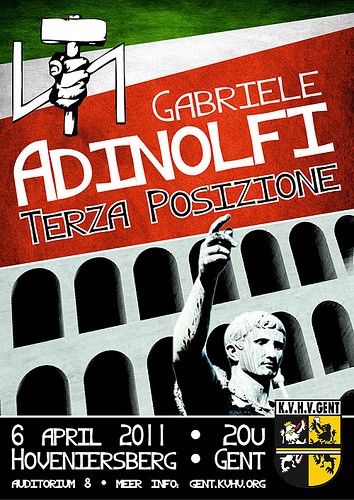
Gabriele Adinolfi à Gand !
Mercredi 6 avril 2011
Introduction
C’est la toute première fois que Gabriele Adinolfi a pris la parole dans une université de l’Europe du Nord-Ouest. Parmi les étudiants gantois, qui l’ont invité, on trouve quelques personnalités séduites par le projet « Casa Pound », qui multiplie les foyers identitaires dans toutes les villes d’Italie. A Rome, sept à huit maisons accueillent les identitaires qui ont décidé de rompre avec le système. Gabriele Adinolfi s’est adressé aux étudiants flamands, pour la plupart membres du groupe catholique KVHV, en langue française, ce qui est inhabituel au sein d’un mouvement soucieux de préserver la langue populaire face aux assauts du français des fausses élites dominantes, mais ce discours en français a été accepté avec joie, vu l’intérêt nouveau pour les initiatives italiennes, dont « Casa Pound », et pour l’itinéraire de Gabriele Adinolfi, commencé, fin des années 70, dans le groupe, désormais mythique, que fut « Terza Posizione » (« 3P »).
Sollicité par les étudiants, Gabriele Adinolfi évoque les années de plomb et l’émergence de « Terza Posizione » (« 3P »). Il rappelle qu’il s’agit d’une époque bien révolue, tout à fait différente de celle que nous vivons (et subissons) aujourd’hui. La situation a totalement changé, tant du point de vue social que du point de vue international. L’époque de « Terza Posizione » était certes plus violente —on risquait sa vie en optant pour les idées de 3P— mais les hommes étaient plus libres d’exprimer leurs opinions qu’ils ne le sont aujourd’hui. Les changements ont donc été radicaux mais, de ces mutations, on doit retenir la diminution drastique de liberté.
Le mouvement 3P remonte à trente-cinq ans environ, à une époque où son public d’étudiant gantois n’était pas encore né et où leurs parents étaient des adolescents. Gabriele Adinolfi sait que la situation italienne est quasi inconnue en dehors de la péninsule : il rappelle que, pendant la deuxième guerre mondiale, l’Italie fut un Etat qui résistait à la tentative anglo-saxonne de faire main basse sur l’Europe et sur le monde. Envahie au départ de la Sicile et du Sud, l’Italie a résisté pendant deux ans aux envahisseurs, dans le cadre de ce que l’on appelait à l’époque la « République Sociale Italienne ». L’Italie a subi une guerre civile entre 1943 et 1945, d’où a émergé un « Parti Communiste italien » (PCI), qui deviendra le plus fort de toute l’Europe occidentale. Mais la violence n’a jamais été vraiment éradiquée : après 1945, la guerre civile s’est poursuivie, si bien que l’on peut dire qu’elle se poursuit encore aujourd’hui mais à feu beaucoup plus doux.
A la fin des années 60, l’Europe a été secouée par les révoltes étudiantes, qui entendaient traduire dans la réalité le « rêve de 68 » (en gros l’idéologie de Marcuse, exprimée pour l’essentiel dans « Eros et la civilisation », qui deviendra le fondement idéologique de l’ère festiviste, telle que définie par le regretté Philippe Muray - ndlr). A la différence de l’Allemagne ou de la France, le mouvement contestataire étudiant en Italie recelait une plus forte composante nationaliste, qui a su tenir le coup face à la contestation de types communiste et gauchiste. Vainqueurs de la guerre civile en 1945, les communistes italiens pouvaient tout faire au niveau intérieur : personne n’osait s’opposer à leurs exactions. Des dizaines de militants ont été assassinés sans que jamais un coupable n’ait été arrêté ou condamné. Face à cette terreur, étudiants et intellectuels critiques cherchaient un espace de liberté, à partir duquel ils pouvaient « tenir ». Le mouvement 3P fut l’un de ces espaces de liberté, fut une tentative pour sortir de l’étau. Il était composé de jeunes âgés entre 16 et 22 ans, qui ont subi la répression de plein fouet. La persécution fut féroce. Certains d’entre eux furent jetés pendant quatre ou cinq ans en prison avant d’être relâchés sans jamais avoir été jugés ni condamnés. D’autres ont été tués. D’autres se sont exilés.
Le mouvement 3P constituait un danger au regard du système parce qu’il lançait des idées nouvelles, qui sont aujourd’hui parfaitement réactualisables. Gabriele Adinolfi en cite trois faisceaux : 1) Ne pas accepter les manipulations, courantes dans la situation de la guerre froide, caractérisée par le dualisme de Yalta ; les militants de 3P ne croyaient pas au duopole de Yalta : pour eux, les ennemis apparents d’alors créaient un faux antagonisme, ils restaient en réalité les alliés de 1941-45 ; 2) Croire à la liberté des peuples. Dans le cadre de cette idée-force, les militants de 3P se référaient à Peron (Argentine) et à Nasser (Egypte), deux figures plus ou moins liées aux perdants de la seconde guerre mondiale ; Peron et Nasser ont mené des luttes de libération réelles contre le système bancaire international et contre les réseaux criminels ; 3) Il ne faut pas tenter de faire la conquête de l’Etat, qui, en fait, n’existe plus, est réduit à une fiction. Ce qu’il faut faire, c’est créer un espace réellement libre au sein de la société italienne réellement existante.
Ces trois postulats majeurs du mouvement 3P conduisirent à l’analyse suivante : l’Italie était au beau milieu d’une guerre visant la conquête définitive et totale de la Méditerranée ; c’est le cas aujourd’hui encore et même plus qu’hier, vu les événements de Palestine, de Chypre, d’Egypte, de Tunisie et de Libye. Le terrorisme est un instrument utilisé dans cette guerre. Les services de puissances comme la Grande-Bretagne, la France et Israël manipulent le terrorisme. Exemple : à Londres existe une « école de langues » où s’inscrivent les terroristes de gauche protégés par les services secrets occidentaux et orientaux. L’objectif est d’utiliser ce potentiel pour faire la guerre aux peuples réels. Ce modus operandi existe depuis longtemps : rien n’a jamais changé, sauf peut-être certaines formes.
En 1989, quand tombe le Mur de Berlin, nous constatons un enlisement de la situation, un recyclage de certains terroristes dans le trafic de drogues et nous assistons à un nouvel asservissement des peuples, non plus à des Etats ou à des machines politiques de forme conventionnelle, mais aux multinationales qui n’ont plus leur « ennemi » communiste ou soviétique, avec lequel il fallait composer ou faire semblant de composer : le champ est désormais totalement libre pour les exactions des circuits économiques multinationaux. Dès 1960, un journal économique américain constatait que « les usages et les coutumes des peuples étaient un frein au développement économique ». Il préconisait dans la foulée de modifier les styles de vie, de susciter une perpétuelle « conscience malheureuse », de susciter le désir (de consommer), ce qui, à terme, devait provoque un développement économique illimité. C’est cette société-là qui est advenue de nos jours. Elle a émergé dans un contexte différent de celui des années 70, où était apparu 3P. La marche de la politique mondiale est aujourd’hui gérée par quelques grandes puissances qui veulent contrôler essentiellement deux choses : le pétrole et le narco-trafic. Seul pierre d’achoppement : la Chine. La question demeure ouverte : va-t-on partager le pouvoir avec elle ou la posera-t-on comme nouvel ennemi du « genre humain » ?
Le contexte actuel est celui de la disparition progressive des Etats, à l’exception de ceux qui vendent des armes ou organisent le trafic des drogues. Le monde actuel est caractérisé par une absence de « point ferme », de « lieu fixe », ce qui conduit à une logique d’avachissement généralisé, qui n’est rien d’autre qu’une logique économique anti-civilisationnelle. C’est le résultat du mai 68 gauchiste et de l’idéologie néolibérale. L’Etat est réduit à ses fonctions désagréables : l’administration, le fisc, la répression ; il n’a plus aucune fonction de protection, de solidarité, d’éducation. Il n’élève plus le niveau, ne fait pas accéder les humbles parmi les siens à la dignité. Il écrase et réprime.
L’Europe dans un tel contexte n’est plus un continent qui se consacre à la production. En 2030, l’Afrique comptera 900 millions d’habitants (dont 300 millions auront entre 15 et 24 ans) ; l’Inde comptera 250 millions d’habitants entre 15 et 24 ans ; la Chine comptera 900 millions de citoyens entre 15 et 59 ans (elle connaîtra également un ressac démographique) ; l’Europe, elle, ne comptera plus que 450 millions d’habitants entre 15 et 59 ans, dont 75 millions seulement auront entre 15 et 24 ans. Avec une situation démographique aussi désastreuse et sans la structure d’un Etat protecteur, les salaires seront sans cesse à la baisse et les lois répressives se multiplieront. L’Europe risque de subir le sort de l’Argentine, pays potentiellement riche (grâce notamment à son élevage) mais détruit par le FMI. En Argentine, les gens sont descendus dans la rue et ont protesté. Mais, ici, en Europe, avec le chaos mental qui caractérise nos sociétés, à qui s’en prendre ? Car les réactions potentielles sont inhibées par les faux débats.
Le débat sur l’islam, l’islamisme et l’immigration est l’un de ces débats que l’on fausse systématiquement. On parle d’invasion islamique, en nous disant que cette invasion islamique et islamiste est hostile à l’Occident : or le Hamas comme les Frères musulmans ont reçu armes et soutiens des Etats-Unis, de la Grande-Bretagne et d’Israël. Bon nombre d’immigrés sont certes musulmans mais s’ils étaient chrétiens ou animistes, le problème que pose toute masse allochtone (non intégration, irrespect pour la culture hôte, méconnaissance des us et coutumes des uns et des autres) resterait le même. Jadis, pendant la « Guerre Froide », l’URSS et les Etats-Unis étaient soi-disant ennemis, en réalité, ils étaient toujours les alliés de 1941. Aujourd’hui, les fondamentalistes islamistes disent qu’ils sont les ennemis des Etats-Unis : en réalité, ils sont leurs alliés.
On dit souvent que les votes de protestation peuvent servir à modifier la situation déplorable dans laquelle nous nous trouvons. C’est sans doute vrai, ou partiellement vrai. Mais, souvent, l’accession de protestataires, désignés comme tels par les médias aux ordres, à des postes de décision ne sert à rien : ils entérinent trop souvent ce que leur dictent les bureaucrates, à l’échelon de l’Etat national comme à l’échelon européen. Nous devons toujours nous rappeler que nous n’avons aucune liberté politique, nous n’avons que la liberté de consommer : nous ne sommes plus des « zoon politikon », nous n’appartenons plus à des peuples politiques, nous ne sommes plus les acteurs de notre destin, nous sommes tous devenus des consommateurs passifs. Nous n’avons plus aucun pouvoir d’agir réellement et efficacement.
Que faire dans un cas pareil ?
Nous pouvons viser l’émergence d’une Europe différente, autre, dé-bureaucratisée. Nous pouvons parier sur le régionalisme ou le localisme : dans ce cas, nous nous renforcerons, si notre action est bien agencée ; mais nous courons un réel danger si nous sommes manipulés. Ce qu’il faut viser par-dessus tout, c’est l’AUTONOMIE. Dans cette perspective, nous devons nous dire que la LOI est en nous : elle existe comme fait de monde positif mais elle est battue en brèche par le système, elle est attaquée de partout par les tenants du nouveau totalitarisme mou, plus insidieux, moins visible que les totalitarismes durs de jadis. Il faut faire vivre la LOI en soi. Pour ce faire, il faut créer des réseaux alternatifs qui permettront aux nôtres d’échapper aux réseaux du système, à ceux des banques, des lobbies et des mafias. Nous créerons ainsi derechef un nouvel antagonisme : celui qui opposera les lobbies des catégories sectorielles aux lobbies du peuple réel. Ndlr : « Adinolfi serait-il un Toni Negri de ‘Troisième Position’ ? ». Pour mettre sur pied ce réseau de lobbies émanant du peuple réel, il faut faire vite, il faudra les renforcer et les étayer en quelques décennies à peine. Le point d’appui pour faire basculer les hésitants, les égarés, les désorientés, c’est la CULTURE. La CULTURE est la grande laissée pour compte du système : celui-ci a pu s’établir, devenir ce « talon d’acier », cet « Iron Heel », seulement au détriment de la culture générale, de la culture propre aux peuples, qu’ils soient européens ou autres. La CULTURE, dans toutes ses facettes, recèle implicitement la LOI, le « Nomos » d’Hérodote (ndlr : voir ce qu’en a dit l’ancien Recteur François Ost, des facultés Universitaires Saint-Louis à Bruxelles). La LOI, le « Nomos », revivra en chacun d’entre nous si la CULTURE redevient vivante en nos cœurs. Nous devons donc multiplier les initiatives culturelles, en dehors de la fausse culture, fabriquée et abstraite, que diffuse le système pour donner le change et camoufler ses intentions anti-culturelles, sa volonté de détruire la LOI en détruisant la culture qui sert de terreau à celle-ci.
Faire revivre la CULTURE, minée par le système, et faire triompher ainsi la LOI, tel est l’objectif du mouvement CASA POUND. Ce dernier se veut un lobby populaire et « re-culturant », qui vise à parfaire une « révolution » de ce type. L’instrument le plus efficace du mouvement CASA POUND, dans cette optique, est son aile étudiante, le BLOCO STUDENTESCO. Ce « Bloc étudiant » s’est surtout distingué en Italie par sa protestation véhémente contre les privatisations qui menacent l’institution universitaire, comme partout ailleurs en Europe. Les gouvernements européens sabrent dans les budgets habituellement consacrés à l’école et à l’université au détriment de la qualité de l’enseignement classique et au bénéfice des études à la carte, taillées exclusivement pour les besoins immédiats de l’économie. C’est de cette façon que l’on tue et la CULTURE et la LOI : c’est donc là qu’il faut porter le fer. Nous avons la satisfaction de constater que le BLOCO STUDENTESCO est aujourd’hui, en Italie, le mouvement étudiant le plus représentatif, comptant le plus de membres, tant au niveau des écoles et des lycées que des universités. Entre 12 et 18 ans, le jeune lycéen italien d’aujourd’hui va plus spontanément vers le BLOCO STUDENTESCO que vers n’importe quel autre mouvement étudiant.
Le succès de CASA POUND et de BLOCO STUDENTESCO est dû à la personnalité de Gianluca Ianone. Il a compris que la défense de la culture ne devait pas se limiter à évoquer les pages sublimes de nos héritages littéraires, politiques, historiques et culturels, effacées des mémoires par le système, mais aussi à redonner de la dignité à ceux que le système avait marginalisés. Son objectif initial a été de donner un logement à bas prix aux familles qui, autrement, auraient été réduites à la précarité, à vivre dans des taudis abjects, avec le risque permanent d’en être expulsés. Les autres sphères politiques, les partis traditionnels, les syndicats inféodés au système ne savent plus quoi faire face aux dégâts que celui-ci a provoqués dans la société ; intellectuellement, les instances liées au système n’ont plus aucune orientation, n’offrent plus aucune possibilité d’échapper au déclin social généralisé, amorcé dès le début des années 80 par l’avènement du néolibéralisme, avec son cortège de mesures antisociales comme les privatisations, les restrictions budgétaires, les mesures d’austérité et les délocalisations. Par voie de conséquence, certaines strates de la population sont désormais sensibles à ce que peut dire ou énoncer une instance perçue comme étrangère au système, donc une instance qui est lobbyiste mais émane cette fois du peuple réel et non plus de l’Etat démonétisé ou du système.
Dans un tel contexte, la population, abandonnée par le système qui lui a pourtant promis monts et merveilles, est en droit et en mesure de créer des organisations ludiques, culturelles, sportives et caritatives (notamment au bénéfice des handicapés) sans passer par l’Etat, les pouvoirs publics à tous niveaux ou le « sponsoring » économique des banques, des grandes compagnies d’assurance ou des entreprises aux bénéfices plantureux qui cherchent à échapper à l’impôt. Ces organisations sont en prise avec la vie quotidienne : elles visent à résoudre des problèmes réels en toute autonomie, sans argent public et sans l’intermédiaire du fonctionnariat prévu à ces effets, car ce fonctionnariat ne résout plus rien, tout en n’utilisant les biens publics que pour sa seule survie et non plus pour soulager ceux pour lesquels, initialement, cet argent public était destiné.
Si on veut que ça change, il faut en effet multiplier ces zones d’autonomie, appelées à prendre le relais des institutions en faillite. L’objectif est de « privatiser », comme l’annonce aussi le néolibéralisme, mais de privatiser ce que le privé néolibéral a cherché à étouffer et à effacer au cours de ces dernières décennies, notamment l’héritage culturel européen, fruit de plusieurs siècles voire de plusieurs millénaires de culture et de civilisation. L’objectif du réseau de Ianone est de créer du « privé social » car la vague déferlante des privatisations néolibérales n’a généré que du « privé antisocial ».
Cette multiplication volontariste d’autonomies de tous genres va de paire avec la création d’un centre d’études, apte à innerver ce réseau d’autonomies. Car force est de constater que le système ne produit plus rien, sinon de la précarité sociale. Les forces politiques conventionnelles, les syndicats et le monde économique ne produisent plus d’idées capables d’être traduites dans le réel au bénéfice de la population. Cette production d’idées et de projets exige beaucoup de travail et d’investissement personnel. Celui qui dit aujourd’hui qu’il est non conformiste, qu’il rejette le système, ne peut donc plus jouer aux esthètes en chambre comme ce fut le cas dans bon nombre de partis, groupuscules ou cénacles considérés par le système comme « extrémistes ». Plotin nous disait : « Aucun Dieu ne prend les armes à la place de ceux qui doivent se défendre ». Rien n’est donné, tout doit être conquis.
(Résumé réalisé par Denis Ilmas, Gand, 6 avril 2011).
00:16 Publié dans Evénement | Lien permanent | Commentaires (0) | Tags : mouvement étudiant, flanbdre, italie, europe, affaires européennes, événement, gand, mouvement flamand, mouvement étudiant, terza posizione |  |
|  del.icio.us |
  |
|  Digg |
  Facebook
mardi, 26 avril 2011
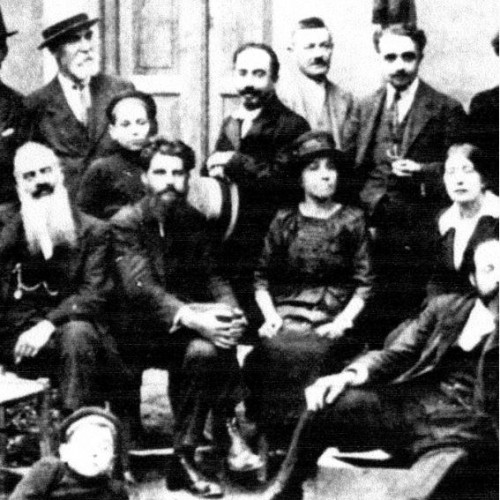
Nicola Bombacci: de Lênin a Mussolini
Nicola Bombacci: de Lênin a Mussolini
por Erik Norling
A 29 de Abril de 1945 eram assassinados os principais líderes fascistas às mãos dos guerrilheiros comunistas. E entre estes fascistas encontramos, curiosamente, Nicola Bombacci, antiga figura máxima do comunismo italiano, fundador do Partido Comunista de Itália (PCI), amigo pessoal de Lenine com quem esteve na URSS durante os anos da Revolução, apodado de “O Papa Vermelho” pela burguesia e finalmente incondicional seguidor de Mussolini, a quem se juntou nos últimos meses do seu regime. A sua história é uma história de conversão ou de traição?... Ou, talvez, de evolução natural de um nacional-bolchevique?...
Um jovem revolucionário
Nicola Bombacci nasce no seio de uma família católica (o seu pai era agricultor, antigo soldado do Estado Pontifício) da Romagna, na província de Forli, a 24 de Outubro de 1879, a escassos quilómetros de Predappio, onde quatro anos mais tarde nascerá o futuro fundador do Fascismo. Trata-se de uma região marcada por duras lutas operárias e por um campesinato habituado à rebelião, terra de paixões extremas. Por imposição paterna ingressa no seminário mas rapidamente o abandona aquando da morte do seu progenitor. Em 1903 ingressa no anticlerical Partido Socialista (PSI) e decide tornar-se professor para poder assim servir as classes menos favorecidas na sua luta (novamente as semelhanças com o Duce são evidentes, tendo chegado a estudar na mesma escola superior) mas rapidamente passa a dedicar-se de corpo e alma à revolução socialista. A sua capacidade de trabalho e os seus dotes de organizador valem-lhe a direcção dos órgãos da imprensa socialista, o que lhe permitirá aumentar a sua influência no seio do movimento operário, chegando a ser Secretário do Comité Central do Partido, onde conhecerá um jovem uns anos mais novo: Benito Mussolini, que, não nos esqueçamos, foi a promessa do socialismo italiano antes de se tornar nacional-revolucionário. [1]
Opondo-se à linha moderada da social-democracia, Bombacci fundará juntamente com Gramsci o Partido Comunista de Itália após a cisão interna do PSI e viajará em princípios dos anos 20 para a URSS, para participar na revolução bolchevique, aonde já antes tinha estado como representante do Partido Socialista tendo sido conquistado pela causa dos sovietes. Aí trava amizade com o próprio Lenine que lhe dirá numa recepção no Kremlin estas famosas palavras sobre Mussolini: “Em Itália, companheiros, em Itália só há um socialista capaz de guiar o povo para a revolução: Benito Mussolini”, e pouco depois o Duce encabeçaria uma revolução, mas fascista… [2]
Como líder (António Gramsci era o teórico, Bombacci o organizador) do recém-criado PCI, torna-se no autêntico “inimigo público nº 1” da burguesia italiana, que o apoda de “O Papa Vermelho”. Revalidará brilhantemente o seu lugar de deputado, desta vez nas listas da nova formação, enquanto que as esquadras fascistas começam a tomar as ruas enfrentando as milícias comunistas em sangrentos combates. Bombacci empenhar-se-á em deter a marcha para o poder do fascismo mas fracassará, desde as páginas dos seus jornais lança invectivas contra o fascismo arengando a defesa da revolução comunista. É uma época em que os esquadristas de camisa negra cantam canções irreverentes como “Não tenho medo de Bombacci / Com a barba de Bombacci faremos spazzolini (escovas) / Para abrilhantar a careca de Benito Mussolini”. Etapa em que o comunismo se vê imerso em numerosas tensões internas e o próprio Bombacci entra em polémica com os seus companheiros de partido sendo um dos pontos de fricção a opção entre nacionalismo e internacionalismo. Já antes tinha demonstrado tendências nacionalistas, que faziam pressagiar a sua futura linha. Quando ainda estava no Partido Socialista e como consequência de um documento protestando contra a acção de Fiume levada a cabo por D’Annunzio que o Partido queria apresentar, Bombacci rebelou-se e escreveu sobre este que era “Perfeita e profundamente revolucionário; porque D’Annunzio é revolucionário. Disse-o Lenine no Congresso de Moscovo”. [3]
Nicola Bombacci nasce no seio de uma família católica (o seu pai era agricultor, antigo soldado do Estado Pontifício) da Romagna, na província de Forli, a 24 de Outubro de 1879, a escassos quilómetros de Predappio, onde quatro anos mais tarde nascerá o futuro fundador do Fascismo. Trata-se de uma região marcada por duras lutas operárias e por um campesinato habituado à rebelião, terra de paixões extremas. Por imposição paterna ingressa no seminário mas rapidamente o abandona aquando da morte do seu progenitor. Em 1903 ingressa no anticlerical Partido Socialista (PSI) e decide tornar-se professor para poder assim servir as classes menos favorecidas na sua luta (novamente as semelhanças com o Duce são evidentes, tendo chegado a estudar na mesma escola superior) mas rapidamente passa a dedicar-se de corpo e alma à revolução socialista. A sua capacidade de trabalho e os seus dotes de organizador valem-lhe a direcção dos órgãos da imprensa socialista, o que lhe permitirá aumentar a sua influência no seio do movimento operário, chegando a ser Secretário do Comité Central do Partido, onde conhecerá um jovem uns anos mais novo: Benito Mussolini, que, não nos esqueçamos, foi a promessa do socialismo italiano antes de se tornar nacional-revolucionário. [1]
Opondo-se à linha moderada da social-democracia, Bombacci fundará juntamente com Gramsci o Partido Comunista de Itália após a cisão interna do PSI e viajará em princípios dos anos 20 para a URSS, para participar na revolução bolchevique, aonde já antes tinha estado como representante do Partido Socialista tendo sido conquistado pela causa dos sovietes. Aí trava amizade com o próprio Lenine que lhe dirá numa recepção no Kremlin estas famosas palavras sobre Mussolini: “Em Itália, companheiros, em Itália só há um socialista capaz de guiar o povo para a revolução: Benito Mussolini”, e pouco depois o Duce encabeçaria uma revolução, mas fascista… [2]
Como líder (António Gramsci era o teórico, Bombacci o organizador) do recém-criado PCI, torna-se no autêntico “inimigo público nº 1” da burguesia italiana, que o apoda de “O Papa Vermelho”. Revalidará brilhantemente o seu lugar de deputado, desta vez nas listas da nova formação, enquanto que as esquadras fascistas começam a tomar as ruas enfrentando as milícias comunistas em sangrentos combates. Bombacci empenhar-se-á em deter a marcha para o poder do fascismo mas fracassará, desde as páginas dos seus jornais lança invectivas contra o fascismo arengando a defesa da revolução comunista. É uma época em que os esquadristas de camisa negra cantam canções irreverentes como “Não tenho medo de Bombacci / Com a barba de Bombacci faremos spazzolini (escovas) / Para abrilhantar a careca de Benito Mussolini”. Etapa em que o comunismo se vê imerso em numerosas tensões internas e o próprio Bombacci entra em polémica com os seus companheiros de partido sendo um dos pontos de fricção a opção entre nacionalismo e internacionalismo. Já antes tinha demonstrado tendências nacionalistas, que faziam pressagiar a sua futura linha. Quando ainda estava no Partido Socialista e como consequência de um documento protestando contra a acção de Fiume levada a cabo por D’Annunzio que o Partido queria apresentar, Bombacci rebelou-se e escreveu sobre este que era “Perfeita e profundamente revolucionário; porque D’Annunzio é revolucionário. Disse-o Lenine no Congresso de Moscovo”. [3]
O primeiro fascismo
Em 1922 os fascistas marcham sobre a capital do Tibre; nada pode impedir que Mussolini assuma o poder, ainda que este não seja absoluto durante os primeiros anos do regime. Como deputado e membro do Comité Central do Partido, assim como encarregado das relações exteriores do mesmo, Bombacci viaja ao estrangeiro frequentemente. Participa no IV Congresso da Internacional Comunista representando a Itália, e, no Comité de Acção Antifascista, entrevista-se com dirigentes bolcheviques russos. Leva já metade da sua vida dedicada à causa do proletariado e não está disposto a desistir do seu empenho em levar à prática o seu sonho socialista. Torna-se fervente defensor da aproximação da Itália à URSS na Câmara e na imprensa comunista, falando seguramente em nome e por instigação dos dirigentes moscovitas, mas utilizando um discurso nacional-revolucionário que incomoda no seio do Partido, que por outro lado está em plena debandada após a vitória fascista. As relações com o revolucionário Estado soviético seriam uma vantagem para a Itália enquanto nação que também atravessa um processo revolucionário, ainda que fascista. É imediatamente acusado de herético e pedem-lhe que rectifique as suas posições. Não podem admitir que um comunista exija, como o faz Bombacci, “superar a Nação (sem) a destruir, queremo-la maior, porque queremos um governo de trabalhadores e agricultores”, socialista e sem negar a Pátria “direito incontestável e sacro de todo o homem e de todos os grupos de homens”. É a chamada “Terceira Via” onde o nacionalismo revolucionário do fascismo se encontra com o socialismo revolucionário comunista.
Bombacci é progressivamente marginalizado no seio do PCI e condenado ao ostracismo político, embora não deixe de manter contactos com alguns dirigentes russos e com a embaixada russa para a qual trabalha, além de que um dos seus filhos vivia na URSS. Acreditava sinceramente na revolução bolchevique e que, ao contrário dos camaradas italianos, os russos tinham um sentido nacional da revolução pelo que jamais renegará a sua amizade para com a URSS, nem sequer depois de aderir definitivamente ao fascismo.
Com a expulsão definitiva do partido em 1927, Bombacci entra numa etapa que podemos qualificar como os anos do silêncio que dura até 1936, altura em que lança a sua editorial e a revista homónima baptizada “La Veritá” e que culminará em 1943 numa progressiva conversão ao fascismo. No entanto é demasiado fácil considerar que Bombacci simplesmente se passou de armas e bagagens para o fascismo como pretendem os que o acusam de ser um “traidor”. Assistiremos a um processo lento de aproximação, não ao fascismo mas sim a Mussolini e à ala esquerdista do movimento fascista, onde Bombacci se sente aconchegado e em família, próximo das suas concepções revolucionárias, o corporativismo e as leis sociais deste fascismo de que “todo o postulado é um programa do socialismo”, segundo dirá em 1928 reconhecendo a sua identificação. [4]
Em 1922 os fascistas marcham sobre a capital do Tibre; nada pode impedir que Mussolini assuma o poder, ainda que este não seja absoluto durante os primeiros anos do regime. Como deputado e membro do Comité Central do Partido, assim como encarregado das relações exteriores do mesmo, Bombacci viaja ao estrangeiro frequentemente. Participa no IV Congresso da Internacional Comunista representando a Itália, e, no Comité de Acção Antifascista, entrevista-se com dirigentes bolcheviques russos. Leva já metade da sua vida dedicada à causa do proletariado e não está disposto a desistir do seu empenho em levar à prática o seu sonho socialista. Torna-se fervente defensor da aproximação da Itália à URSS na Câmara e na imprensa comunista, falando seguramente em nome e por instigação dos dirigentes moscovitas, mas utilizando um discurso nacional-revolucionário que incomoda no seio do Partido, que por outro lado está em plena debandada após a vitória fascista. As relações com o revolucionário Estado soviético seriam uma vantagem para a Itália enquanto nação que também atravessa um processo revolucionário, ainda que fascista. É imediatamente acusado de herético e pedem-lhe que rectifique as suas posições. Não podem admitir que um comunista exija, como o faz Bombacci, “superar a Nação (sem) a destruir, queremo-la maior, porque queremos um governo de trabalhadores e agricultores”, socialista e sem negar a Pátria “direito incontestável e sacro de todo o homem e de todos os grupos de homens”. É a chamada “Terceira Via” onde o nacionalismo revolucionário do fascismo se encontra com o socialismo revolucionário comunista.
Bombacci é progressivamente marginalizado no seio do PCI e condenado ao ostracismo político, embora não deixe de manter contactos com alguns dirigentes russos e com a embaixada russa para a qual trabalha, além de que um dos seus filhos vivia na URSS. Acreditava sinceramente na revolução bolchevique e que, ao contrário dos camaradas italianos, os russos tinham um sentido nacional da revolução pelo que jamais renegará a sua amizade para com a URSS, nem sequer depois de aderir definitivamente ao fascismo.
Com a expulsão definitiva do partido em 1927, Bombacci entra numa etapa que podemos qualificar como os anos do silêncio que dura até 1936, altura em que lança a sua editorial e a revista homónima baptizada “La Veritá” e que culminará em 1943 numa progressiva conversão ao fascismo. No entanto é demasiado fácil considerar que Bombacci simplesmente se passou de armas e bagagens para o fascismo como pretendem os que o acusam de ser um “traidor”. Assistiremos a um processo lento de aproximação, não ao fascismo mas sim a Mussolini e à ala esquerdista do movimento fascista, onde Bombacci se sente aconchegado e em família, próximo das suas concepções revolucionárias, o corporativismo e as leis sociais deste fascismo de que “todo o postulado é um programa do socialismo”, segundo dirá em 1928 reconhecendo a sua identificação. [4]
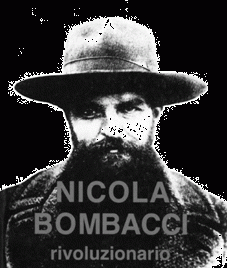 Comprovamos assim que Bombacci não é um fascista, mas defende as conquistas do regime e a figura de Mussolini. Não se aproximou do partido fascista – jamais se inscreveu no Partido Nacional Fascista – apesar da sua amizade reconhecida com Mussolini, não aceitou cargos que lhe poderiam oferecer nem renegou as suas origens comunistas. A sua independência valia mais. No entanto convenceu-se de que o Estado Corporativo proposto pelo fascismo era a realização mais perfeita, o socialismo levado à prática, um estado superior ao comunismo. Jamais camuflará os seus ideais, em 1936 escrevia na revista “La Veritá”, confessando a sua adesão ao fascismo mas também ao comunismo:
“O fascismo fez uma grandiosa revolução social, Mussolini e Lenine. Soviete e Estado fascista corporativo, Roma e Moscovo. Muito tivemos que rectificar, nada de que nos fazer perdoar, pois hoje como ontem move-nos o mesmo ideal: o triunfo do trabalho”. [5]
Enquanto isto sucedia Bombacci tem um longo intercâmbio epistolar com o Duce tentando influenciar o antigo socialista na sua política social. O máximo historiador do fascismo, Renzo de Felice, escreveu a este respeito que Bombacci tem o mérito de ter sugerido a Mussolini mais do que uma das medidas adoptadas nesses anos 30. [6] Numa destas missivas, datada de Julho de 1934, propõe um programa de economia autárquica (que Mussolini aplicará) que, diz Bombacci ao Duce, é mostra da sua “vontade de trabalhar mais naquilo que agora concerne, no interesse e pelo triunfo do Estado Corporativo…”, como faz também desde as páginas da sua revista onde uma e outra vez batalha por uma autarcia que faça da Itália um país independente e capaz de enfrentar as potências plutocráticas (entenda-se os EUA, mas também a França e a Inglaterra). Por isso apoia decididamente a intervenção na Etiópia em 1935, mas não como campanha colonial senão como prelúdio da confrontação entre os países “proletários” (entre os quais estaria a Itália fascista) e os “capitalistas” que irremediavelmente chegaria, essa “revolução mundial (que) restabelecerá o equilíbrio mundial”. A acção italiana seria uma “típica e inconfundível conquista proletária”, destinada a derrotar as potências “capitalistas” e cuja experiência “deverá ser assumida… como um dado fundamental para a redenção das gentes de cor, ainda sob a opressão do capitalismo mais terrível”. [7]
Contra Estaline
Entre os anos de 1936 e 1943, difíceis para o fascismo pois iniciam-se os conflitos armados, prelúdio da derrota, Bombacci acrescenta a sua adesão ideológica a Mussolini. É um homem com quase 60 anos, viu como muitos dos seus sonhos socialistas não se realizaram, mas é um eterno idealista e não está disposto a abandonar a luta pelo socialismo, por “essa obra de redenção económica e de elevação espiritual do proletariado italiano que os socialistas da primeira hora tínhamos iniciado”. A sua editorial é uma ruína económica, os seus biógrafos deixaram constância das dificuldades e penúrias que sofre. Ter-lhe-ia bastado um passo oportunista e integrar-se no fascismo oficial e teria disposto de todas as ajudas do aparato do Estado mas não quer perder a sua independência ainda que em ocasiões deva aceitar subvenções do Ministério de Cultura Popular.
Esta etapa coincide com uma profunda reflexão sobre os seus erros passados e uma série de ataques ao comunismo russo que se tinha vendido às potências capitalistas traindo os postulados de Lenine. Assim, escreve Bombacci em Novembro de 1937, as relações entre a URSS e os países democráticos só tinha uma explicação que revelaria tudo o resto: “a razão é só uma, frívola, vulgar, mas real: o interesse, o dinheiro, o negócio”, pelo que este antigo comunista podia declarar abertamente que “nós proclamamos com a consciência limpa que a Rússia bolchevique de Estaline se tornou uma colónia do capitalismo maçónico-hebraico-internacional…”. A alusão anti-semita não é nova em Bombacci, nem nos teóricos socialistas do início do século, pois não devemos esquecer que o anti-semitismo moderno teve os seus mais ferventes defensores precisamente entre os doutrinários revolucionários de finais do século XIX, quando o judeu encarnava a figura do odiado capitalista. Em Bombacci não encontramos um anti-semitismo racialista mas sim social, de acordo com os posicionamentos mediterrânicos do problema judeu diferentemente do anti-judaismo alemão ou gaulês.
Quando estala a II Guerra Mundial, e especialmente ao estalar na frente Leste, Bombacci participa em pleno nas campanhas anticomunistas do regime. Como dirigente comunista conhecedor da URSS a sua voz faz-se ouvir. No entanto não renega os seus ideais, pelo contrário aprofunda a tese de que Estaline e os seus acólitos traíram a revolução. Escreve numerosos artigos contra Estaline, sobre as condições reais de vida no chamado “paraíso comunista”, as medidas adoptadas por este para destruir todos os sucessos do socialismo leninista. Em 1943, pouco antes da queda do Fascismo, concluía Bombacci resumindo a sua posição num folheto de propaganda:
“Qual das duas revoluções, a fascista ou a bolchevique, fará história no século XX e ficará na história como criadora de uma ordem nova de valores sociais e mundiais?
Qual das duas revoluções resolveu o problema agrário interpretando verdadeiramente os desejos e aspirações dos camponeses e os interesses económicos e sociais da colectividade nacional?
Roma venceu!
Moscovo materialista e semi-bárbara, com um capitalismo totalitário de Estado-Patrão quer juntar-se à força (planos quinquenais), levando à miséria mais negra os seus cidadãos, à industrialização existente nos países que durante o século XIX seguiram um processo de regime capitalista burguês. Moscovo completa a fase capitalista.
Roma é outra coisa.
Moscovo, com a reforma de Estaline, retrata-se institucionalmente ao nível de qualquer Estado burguês parlamentar. Economicamente há uma diferença substancial, porque, enquanto que nos Estados burgueses o governo é formado por delegados da classe capitalista, aqui o governo está nas mãos da burocracia bolchevique, uma nova classe que na realidade é pior que essa classe capitalista porque dispõe sem qualquer controlo do trabalho, da produção e da vida dos cidadãos”. [8]
A República Social Italiana
 Quando Mussolini é deposto em Julho de 1943 e resgatado pelos alemães uns meses depois, o Partido Nacional Fascista já se desagregou. A estrutura orgânica desapareceu, os dirigentes do partido, provenientes das camadas privilegiadas da sociedade passaram-se em massa para o governo de Badoglio e a Itália encontra-se dividida em dois (ao sul de Roma os Aliados avançam em direcção ao norte). Mussolini reagrupa os seus mais fiéis, todos eles velhos camaradas da primeira hora ou jovens entusiastas, quase nenhum dirigente de alto nível, que ainda acreditam na revolução fascista e proclama a República Social Italiana. Imediatamente o fascismo parece voltar às suas origens revolucionárias e Nicola Bombacci adere à república proclamada e presta a Mussolini todo o seu apoio. O seu sonho é poder levar a cabo a construção dessa “República dos trabalhadores” pela qual tanto ele como Mussolini se bateram juntos no início do século. Tal como Bombacci, outros conhecidos intelectuais de esquerda juntam-se ao novo governo: Carlo Silvestri (deputado socialista, depois da guerra defensor da memória do Duce), Edmondo Cione (filosofo socialista que será autorizado a criar um partido socialista aparte do Partido Fascista Republicano), etc.
O primeiro contacto com Mussolini ocorre a 11 de Outubro, apenas um mês depois da proclamação da RSI, e é epistolar. Bombacci escreve a Mussolini a partir de Roma, cidade onde o fascismo ruiu estrepitosamente (os romanos destruíram todos os símbolos do anterior regime nas ruas), mas onde ainda existem muitos fascistas de coração, e é este o momento que escolhe para declarar a Mussolini que está consigo. Não quando tudo corria bem, mas sim nos momentos difíceis como tão-só o fazem os verdadeiros camaradas:
“Estou hoje mais que ontem totalmente consigo” – confessa Bombacci – “a vil traição do rei-Badoglio trouxe por todos os lados a ruína e a desonra de Itália mas libertou-a de todos os compromissos pluto-monárquicos de 22.
Hoje o caminho está livre e em minha opinião só se pode recorrer ao abrigo socialista. Acima de tudo: a vitória das armas.
Mas para assegurar a vitória deve ter a adesão da massa operária. Como? Com feitos decisivos e radicais no sector económico-produtivo e sindical…
Sempre às suas ordens com o grande afecto já de trinta anos.”
Mussolini, acossado pela situação militar mas mais decidido que nunca a levar a cabo a sua revolução agora que se libertou dos lastros do passado, autoriza que os sectores mais radicais do partido assumam o poder e inicia-se uma etapa denominada de “socialização” (nome proposto por Bombacci e aceite pelo Duce) que se traduzirá na promulgação de leis de inspiração claramente socialista, em relação à criação de sindicatos, à co-gestão das empresas, à distribuição de lucros e à nacionalização dos sectores industriais de importância. Tudo isto foi resumido nos 18 Pontos do primeiro (e único) congresso do Partido Fascista Republicano em Verona, documento redigido conjuntamente por Mussolini e Bombacci, que se constituiria como a base do Estado Social Republicano. Na política exterior tentará convencer Mussolini a assinar a paz com a URSS e a prosseguir a guerra contra a plutocracia anglo-saxã, ressuscitar o eixo Roma-Berlim-Moscovo dos pensadores geopolíticos do nacional-bolchevismo dos anos 20, proposta que parece ter tido êxito em Mussolini que escreverá vários artigos para a imprensa republicana sobre este assunto mesmo sabendo que esta proposta tinha uma tenaz oposição por parte de um amplo sector do partido, em particular de Roberto Farinacci. Bombacci viaja para o norte e reinstala-se perto do seu amigo Walter Mocchi, outro veterano dirigente comunista convertido ao fascismo mussoliniano que trabalha para o Ministério de Cultura Popular.
Se para muitos o último Mussolini era um homem acabado, títere dos alemães, não deixa de surpreender a adesão que recebe de homens como Bombacci, um verdadeiro idealista, de estatura imponente, com a barba crescida e uma oratória atraente, alérgico a tudo o que pudesse significar acomodar-se ou aburguesar-se, que tão-pouco agora aceitará salário ou prebendas (apenas em princípios de 1945 aparecerá o seu nome numa lista de propostas de salários do ministério da Economia ou como Chefe da Confederação Única do Trabalho e da Técnica). Bombacci tornar-se-á assessor pessoal e confidente de Mussolini, para atrair de novo às bases do partido os trabalhadores. Propõe a criação de comités sindicais, abertos a não militantes fascistas, eleições sindicais livres, viajará pelas fábricas do norte industrializado (Milão-Turim) explicando a revolução social do novo regime e o porquê da sua adesão. O velho combatente revolucionário parece de novo rejuvenescer, após um comício em Verona e várias visitas a empresas socializadas escreve ao Duce a 22 de Dezembro de 1944: “Falei durante uma hora e trinta minutos num teatro entregue e entusiasta… a plateia, composta na maior parte por operários vibrou gritando: sim, queremos combater por Itália, pela república, pela socialização… pela manhã visitei a Mondadori, já socializada, e falei com os operários que constituem o Conselho de Gestão que achei cheio de entusiasmo e compreensão por esta nossa missão”. Enquanto a situação militar se deteriorava, os grupos terroristas comunistas (os tragicamente famosos GAP) já tinham decidido eliminá-lo pelo perigo que a sua actividade representava para os seus objectivos. [9]
Mas a guerra está a chegar ao fim. Benito Mussolini, aconselhado pelo deputado ex-socialista Carlo Silvestri e Bombacci, propõe entregar o poder aos socialistas, integrados no Comité Nacional de Libertação. [10] Em Abril de 1945 as autoridades militares alemãs rendem-se aos Aliados, sem informar os italianos, é o fim. Abandonados e sós.
Se para muitos o último Mussolini era um homem acabado, títere dos alemães, não deixa de surpreender a adesão que recebe de homens como Bombacci, um verdadeiro idealista, de estatura imponente, com a barba crescida e uma oratória atraente, alérgico a tudo o que pudesse significar acomodar-se ou aburguesar-se, que tão-pouco agora aceitará salário ou prebendas (apenas em princípios de 1945 aparecerá o seu nome numa lista de propostas de salários do ministério da Economia ou como Chefe da Confederação Única do Trabalho e da Técnica). Bombacci tornar-se-á assessor pessoal e confidente de Mussolini, para atrair de novo às bases do partido os trabalhadores. Propõe a criação de comités sindicais, abertos a não militantes fascistas, eleições sindicais livres, viajará pelas fábricas do norte industrializado (Milão-Turim) explicando a revolução social do novo regime e o porquê da sua adesão. O velho combatente revolucionário parece de novo rejuvenescer, após um comício em Verona e várias visitas a empresas socializadas escreve ao Duce a 22 de Dezembro de 1944: “Falei durante uma hora e trinta minutos num teatro entregue e entusiasta… a plateia, composta na maior parte por operários vibrou gritando: sim, queremos combater por Itália, pela república, pela socialização… pela manhã visitei a Mondadori, já socializada, e falei com os operários que constituem o Conselho de Gestão que achei cheio de entusiasmo e compreensão por esta nossa missão”. Enquanto a situação militar se deteriorava, os grupos terroristas comunistas (os tragicamente famosos GAP) já tinham decidido eliminá-lo pelo perigo que a sua actividade representava para os seus objectivos. [9]
Mas a guerra está a chegar ao fim. Benito Mussolini, aconselhado pelo deputado ex-socialista Carlo Silvestri e Bombacci, propõe entregar o poder aos socialistas, integrados no Comité Nacional de Libertação. [10] Em Abril de 1945 as autoridades militares alemãs rendem-se aos Aliados, sem informar os italianos, é o fim. Abandonados e sós.
Crepúsculo de um nacional-revolucionário
Durante os últimos meses da RSI Bombbaci continuou a campanha para recuperar as massas populares e evitar que se decantassem pelo bolchevismo. Em finais de 1944 publicava um opúsculo intitulado «Isto é o Bolchevismo», reproduzido no jornal católico «Crociata Italica» em Março de 1945. Bombacci insiste nas críticas aos desvios estalinistas do comunismo real que destruiu o verdadeiro sindicalismo revolucionário na Europa com as ingerências russas. Nestas últimas semanas de vida da experiência republicana, Bombacci está ao lado dos que ainda acreditam numa solução de compromisso com o inimigo para assim evitar a ruína do país. Leal até ao fim, ficará com Mussolini mesmo quando tudo já está definitivamente perdido. Profeticamente fala disso aos seus operários numa das suas últimas aparições públicas, em Março de 1945:
“Irmãos de fé e de luta… não reneguei aos meus ideais pelos quais lutei e pelos quais, se Deus me deixar viver mais, lutarei sempre. Mas agora encontro-me nas fileiras das cores que militam na República Social Italiana, e vim outra vez porque agora sim é a sério e é verdadeiramente decisivo reivindicar os direitos dos operários…”
Nicola Bombacci, sempre fiel, sempre sereno, acompanhará Mussolini na sua última e dramática viagem até à morte. A 25 de Abril está em Milão. O relato de Vittorio Mussolini, filho do Duce, sobre o seu último encontro com o seu pai, acompanhado por Bombacci, mostra-nos a inteireza deste:
“Pensei no destino deste homem, um verdadeiro apóstolo do proletariado, em certa altura inimigo acérrimo do fascismo e agora ao lado do meu pai, sem nenhum cargo nem prebenda, fiel a dois chefes diferentes até à morte. A sua calma serviu-me de consolo”. [11]
Pouco depois, após Mussolini se separar da coluna dos seus últimos fiéis para os poupar ao seu destino, Bombacci é detido por um grupo de guerrilheiros comunistas junto com um grupo de hierarcas fascistas. Na manhã de 28 de Abril era colocado contra o paredão em Dongo, no norte do país, ao lado de Barracu, valoroso ex-combatente, mutilado de guerra, de Pavolini, o poeta-secretário do partido, de Valério Zerbino, um intelectual e Coppola, outro pensador. Todos gritam, perante o pelotão que os assassina, “Viva Itália!”. Bombacci, enquanto tomba crivado pelas balas dos comunistas, grita: “Viva o Socialismo!”.
Durante os últimos meses da RSI Bombbaci continuou a campanha para recuperar as massas populares e evitar que se decantassem pelo bolchevismo. Em finais de 1944 publicava um opúsculo intitulado «Isto é o Bolchevismo», reproduzido no jornal católico «Crociata Italica» em Março de 1945. Bombacci insiste nas críticas aos desvios estalinistas do comunismo real que destruiu o verdadeiro sindicalismo revolucionário na Europa com as ingerências russas. Nestas últimas semanas de vida da experiência republicana, Bombacci está ao lado dos que ainda acreditam numa solução de compromisso com o inimigo para assim evitar a ruína do país. Leal até ao fim, ficará com Mussolini mesmo quando tudo já está definitivamente perdido. Profeticamente fala disso aos seus operários numa das suas últimas aparições públicas, em Março de 1945:
“Irmãos de fé e de luta… não reneguei aos meus ideais pelos quais lutei e pelos quais, se Deus me deixar viver mais, lutarei sempre. Mas agora encontro-me nas fileiras das cores que militam na República Social Italiana, e vim outra vez porque agora sim é a sério e é verdadeiramente decisivo reivindicar os direitos dos operários…”
Nicola Bombacci, sempre fiel, sempre sereno, acompanhará Mussolini na sua última e dramática viagem até à morte. A 25 de Abril está em Milão. O relato de Vittorio Mussolini, filho do Duce, sobre o seu último encontro com o seu pai, acompanhado por Bombacci, mostra-nos a inteireza deste:
“Pensei no destino deste homem, um verdadeiro apóstolo do proletariado, em certa altura inimigo acérrimo do fascismo e agora ao lado do meu pai, sem nenhum cargo nem prebenda, fiel a dois chefes diferentes até à morte. A sua calma serviu-me de consolo”. [11]
Pouco depois, após Mussolini se separar da coluna dos seus últimos fiéis para os poupar ao seu destino, Bombacci é detido por um grupo de guerrilheiros comunistas junto com um grupo de hierarcas fascistas. Na manhã de 28 de Abril era colocado contra o paredão em Dongo, no norte do país, ao lado de Barracu, valoroso ex-combatente, mutilado de guerra, de Pavolini, o poeta-secretário do partido, de Valério Zerbino, um intelectual e Coppola, outro pensador. Todos gritam, perante o pelotão que os assassina, “Viva Itália!”. Bombacci, enquanto tomba crivado pelas balas dos comunistas, grita: “Viva o Socialismo!”.
_____________
Notas:
1. Em português, sobre o movimento revolucionário do pré-fascismo veja-se o excelente trabalho do professor israelita Zeev Sternhell e dos seus colaboradores, «Nascimento da ideologia fascista», onde curiosamente quase não se menciona Bombacci.
2. Sobre a trajectória revolucionária de Bombacci há um excelente trabalho de Gugliemo Salotti intitulado «Nicola Bombacci, da Mosca a Saló».
3. Referimo-nos à tomada da cidade dálmata em 1919 pelo poeta-soldado Gabrielle D’Annunzio, que é considerada por muitos autores como o primeiro capítulo da revolução fascista. Veja-se Carlos Caballero, “La fascinante historia D’Annunzio en Fiume”, em Revisión, Alicante, ano I, 2, vol. IV, Outubro de 1990.
4. Sobre a ala esquerdista do fascismo: Luca Leonello Rimbotti, «Il fascismo di sinistra. Da Piazza San Sepolcro al congresso di Verona», Roma, Settimo Sigillo, 1989. Ver também: Giuseppe Parlato, “La Sinistra fascista. Storia de un progetto mancato”, Bolinia, Il Mulino, 2000.
5. Cit. Arrigo Petacco, «Il comunista in camicia nera. Nicola Bombacci tra Lenin e Mussolini», Milão, Mondadori Editori, 1996, p. 115.
6. «Mussolini il Duce. II. Lo Stato totalitario 1936-1940», Turim, Einaudi, 1981 (2a, 1996), p. 331 n.
7. A correspondência de Bombacci para Mussolini (mas não a do Duce para este) está conservada em parte no Arquivo Central do Estado Italiano.
8. Nicola Bombacci, «I contadini nell’Italia di Mussolini», Roma, 1943, pp. 34 e ss.
9. Mais de 50 mil fascistas serão executados por estes grupos terroristas durante estes dois anos, e mais 50 mil na trágica Primavera-Verão de 1945. Foram especialmente visados os dirigentes fascistas que possuíssem uma certa aura de popularidade e que pudessem encarnar uma face mais populista do fascismo. O caso mais chamativo foi o do filósofo Giovanni Gentile, que deu lugar inclusivamente a protestos no seio da resistência antifascista. Existe uma ampla bibliografia sobre o assunto, embora na actualidade se tente reduzir as cifras e o impacto desta sangrenta guerra civil.
10. É curioso comprovar como em vários países da Europa, com o aproximar do final da guerra, os únicos elementos fieis à nova ordem são as chamadas alas “proletárias” dos movimentos nacional-revolucionários e que se negoceie a entrega do poder aos grupos socialistas da resistência por oposição aos comunistas e aos burgueses. Assim sucederá na Noruega onde os sectores sindicais propõe um governo de coligação à resistência social-democrata em Abril de 1945, ou em França onde após a queda do governo de Petain no Outono de 1944 Marcel Deat e Jacques Doriot pugnam por instaurar um governo socialista.
11. «La vida con mi padre», Madrid, Ediciones Cid, 1958, p. 267.
00:05 Publié dans Biographie, Histoire | Lien permanent | Commentaires (0) | Tags : histoire, italie, fascisme, communisme, années 20, années 30, années 40, deuxième guerre mondiale, seconde guerre mondiale, politique, théorie politique, sciences politiques, politologie | | del.icio.us | | Digg | Facebook
mercredi, 20 avril 2011
Bataglione S. Marco - X-Mas
Battaglione S. Marco & X-MAS
00:05 Publié dans Histoire, Militaria, Musique | Lien permanent | Commentaires (0) | Tags : musique, histoire, italie, militaria | | del.icio.us | | Digg | Facebook
lundi, 11 avril 2011
Il manifesto antimoderno di Luigi Iannone
Il manifesto antimoderno di Luigi Iannone
 Nelle settimane passate ho letto un saggio interessante di Luigi Iannone intitolato Manifesto antimoderno (Rubbettino). Per la varietà dei temi trattati e la densità delle considerazioni e dei rimandi che racchiude (in poco più di centosessanta pagine) è difficile, o quasi impossibile, tentarne una recensione esaustiva, che dia cioè conto di tutte le questioni sollevate. Mi limito quindi, più modestamente, ad alcune considerazioni sorte dalla mia lettura.
Come rivela il titolo, oggetto del libro è la modernità. Effettivamente l’autore attua una critica serrata ai fondamenti filosofici, storici, materiali e spirituali del moderno, tanto nella sua totalità quanto nei suoi elementi costitutivi; ma parte dalla consapevolezza che è impraticabile ogni passatismo. Questa è un’impostazione condivisibile: la semplice riproposizione di schemi ormai travolti da nuove idee vittoriose è tragicamente destinata alla sconfitta, e ancor più ogni forma di mitificazione di un passato puramente astratto e ideale, secondo il modello rousseauviano variamente declinato. È però anche vero che la ripresa del passato in chiave mitica è stata operata tante e tante volte nella storia, sin da epoche molto remote. Ancora in età imperiale avanzata era diffusa tra i Romani una (ri-e)vocazione dell’epoca repubblicana che, in forme assai diverse, avrebbe costituito la cifra anche del Rinascimento, poi dell’arte neoclassica e, ancora successivamente, persino della tendenza predominante nell’architettura di alcuni regimi totalitari; e gli esempi si potrebbero moltiplicare con molti altri riferimenti, anche extraeuropei. Forse sarà nuovamente concepito un legame ideale con il passato, magari arcaico, capace di spingerci, con una forma definita, nell’avvenire.
Il libro si costituisce di quattro capitoli, dedicati al disagio della realtà, alla morte della bellezza, a tempo e storia e alla Tecnica. Forse l’ultimo dei temi è il primo per rilevanza, come viene riconosciuto da tanti filosofi contemporanei, e come venne messo in luce da alcune tra le menti più acute della Rivoluzione conservatrice tedesca, cui Iannone ha dedicato lunghi studi (Jünger, Schmitt, Heidegger, Spengler ecc.). Dai tempi dell’Operaio jüngeriano la Tecnica sembra però aver mutato volto, o meglio aver mutato il volto del mondo da essa mobilitato; lo Stato mondiale che sta affermandosi in modo (almeno apparentemente) inesorabile è speculare a quello preconizzato da Jünger, essendo a tutti gli effetti un matriarcato – come “valori”, estetica e visione del mondo. La Tecnica ha cioè effettivamente forgiato una nuova Figura, ma più che di Operaio sembra trattarsi di Consumatore.
A proposito di Figure, sono molto interessanti le considerazioni di Iannone sul Partigiano schmittiano, che pare divenuta la caratteristica fondamentale dei conflitti contemporanei. L’inimicizia totale che ne è la caratteristica, con il conseguente travolgimento di quei limiti che caratterizzavano le guerre normate dallo jus publicum europaeum, ha invaso ogni angolo del mondo, con risultati di ferocia abissale divenuti ormai quotidiani; e persino il dilagare di episodi aberranti di cronaca nera sembra inserirsi in questa stessa logica.
Anche riguardo l’eclissi del sacro, su cui Iannone si sofferma, potrebbe valere la considerazione che non ha senso tentare di rianimare i cadaveri. Ma d’altra parte appare probabile che il sacro torni comunque a manifestarsi con impeto, se è vera la considerazione di Mircea Eliade che il sacro è condizione della stessa esistenza umana: solo la totale de-umanizzazione potrebbe portare alla perdita completa del sacro (ma, a mio avviso, dovrebbe trattarsi di una de-umanizzazione in senso completamente regressivo e animalesco). E’ vano tentare di preconizzare quali forme il sacro possa assumere in futuro; è però verosimile che un’enorme crisi spirituale, come l’attuale, possa propiziarne la riaffermazione.
Il lettore del Manifesto antimoderno si troverà ad osservare i problemi caratteristici della modernità in maniera particolarmente cruda e radicale, e talvolta ancor più di quanto non fosse già portato a fare per indole o formazione: già questo è sufficiente a consigliarne la lettura. A ciò si deve però aggiungere che l’autore ha un’eccezionale capacità di analisi, una grande forza espressiva e arricchisce il suo testo con innumerevoli rimandi e consigli di approfondimento più o meno impliciti: chi osservi il mondo con autentico interesse troverà quindi in questo libro un riferimento tanto prezioso quanto raro nell’editoria odierna.
00:10 Publié dans Livre, Politique | Lien permanent | Commentaires (0) | Tags : italie, livre, antimodernisme, monde moderne, luigi iannone | | del.icio.us | | Digg | Facebook
dimanche, 10 avril 2011
Europa am Ende
Europa am Ende
Michael Grandt
Immer neue EU-Krisengipfel, immer mehr Geld, das in das marode Euro-Währungssystem gepumpt wird und immer weitere europäische Länder, die vor dem Bankrott stehen. Doch unsere »Volksvertreter« wollen das alles nicht wahrhaben. Milliarden über Milliarden unserer Steuergelder versenken sie in einem Fass ohne Boden. Dabei ist eines klar: Der Euro und damit die EU sind am Ende.
Mehr: http://info.kopp-verlag.de/hintergruende/europa/michael-grandt/europa-am-ende.html
1.JPG)
00:25 Publié dans Actualité, Affaires européennes | Lien permanent | Commentaires (0) | Tags : politique internationale, europe, affaires européennes, euro, crise financière, portugal, irlande, grèce, belgique, espagne, italie, chypre, économie | | del.icio.us | | Digg | Facebook
Machiavelli the European
Machiavelli the European
Dominique Venner
Translated by Greg Johnson
Ex: http://www.counter-currents.com/
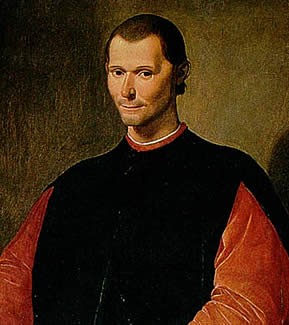 Even his own name has been turned against him. Indeed it is hardly flattering to be described as “Machiavellian.” One immediately envisions a hint of cunning and treacherous violence. And yet what led Machiavelli to write his most famous and scandalous works, The Prince
Born in Florence in 1469, dying in 1527, Niccolò Machiavelli was a senior civil servant and diplomat. He participated in the great politics of his time. What he learned offended his patriotism, inciting him to reflect on the art of leading public affairs. Life enrolled him in the school of great upheavals. He was 23 years old when Lorenzo the Magnificent died in 1492. That same year, Alexander VI Borgia became pope. He temporarily made his son Cesare (in this time, the popes were not always celibate) a very young cardinal. Then he became Duke of Valentinois thanks to the king of France. This Cesare, who was tormented by a terrible ambition, never troubled himself about means. In spite of his failures, his ardor fascinated Machiavelli.
But I anticipate. In 1494, an immense event occurred that upset Italy for a long time. Charles VIII, the young and ambitious king of France, carried out his famous “descent,” i.e., an attempt at conquest that upset the balance of the peninsula. After being received in Florence, Rome, and Naples, Charles VIII met with resistance and had to withdraw, leaving Italy in chaos. But it was not over. His cousin and successor, Louis XII, returned in 1500, staying longer this time, until the rise of Francis I. In the meantime, Florence had sunk into civil war and Italy had been devastated by condottieri avid for plunder.
Dismayed, Machiavelli observed the damage. He was indignant at the impotence of the Italians. From his reflections was born The Prince, the famous political treatise written thanks to a disgrace. The argument, with irrefutable logic, aims at the conversion of the reader. The method is historical. It rests on the comparison between the past and the present. Machiavelli states his conviction that men and things do not change. He continues to speak to the Europeans who we are.
In the manner of the Ancients – his models – he believes that Fortune (chance), illustrated as a woman balancing on an unstable wheel, determines one half of human actions. But, he says, that leaves the other half governed by virtue (the virile quality of audacity and energy). To the men of action whom he calls to do his wishes, Machiavelli teaches the means of governing well. Symbolized by the lion, force is the first of these means to conquer or maintain a state. But it is necessary to join it with the slyness of the fox. In reality, it is necessary to be lion and fox at the same time: “It is necessary to be a fox to avoid the traps and a lion to frighten the wolves” (The Prince, ch. 18). Hence his praise, stripped of all moral prejudice, of pope Alexander VI Borgia who “never did anything, never thought of anything, but deceiving people and always found ways of doing it” (The Prince, ch. 18). However, it is the son of this curious pope, Cesare Borgia, whom Machiavelli saw as the incarnation of the Prince according to his wishes, able “to conquer either by force or by ruse” (The Prince, ch. 7).
Put on the Index, accused of impiety and atheism, Machiavelli actually had a complex attitude with respect to religion. Certainly not devout, he nevertheless bowed to its practices. In his Discourses on the First Ten Books of Titus Livy
Source: http://www.dominiquevenner.fr/#/edito-nrh-53-machiavel/3813836
00:10 Publié dans Nouvelle Droite, Philosophie, Théorie politique | Lien permanent | Commentaires (1) | Tags : nouvelle droite, dominique venner, philosophie, théorie politique, politologie, sciences politiques, machiavel, italie, renaissance, 16ème siècle | | del.icio.us | | Digg | Facebook
jeudi, 07 avril 2011
La visione "corporativa" di Ugo Spirito
 Nel 1935, il filosofo Ugo Spirito (Arezzo, 1896 – Roma, 1979) presentava al Convegno di studi corporativi di Roma la sua relazione – intitolata Corporativismo e libertà – con la quale esprimeva la convinzione che la sfida al capitalismo dovesse essere vinta tanto sul piano tecnico quanto su quello spirituale, marcando una superiorità di tipo gerarchico-totalitario “in cui i valori umani si differenzino al massimo”. La concezione corporativistica di Spirito è infatti una visione, poiché non si derubrica a semplice metodologia, a insieme di processi di funzionalità tecnica, ma si eleva a momento spirituale nel quale la vita sociale si unifica moralmente “nella gioia del dare e del sacrificarsi”; in buona sostanza nel rifiuto di ogni fine privato dell’esistenza. In uno scritto del 1934, significativamente intitolato Il corporativismo come negazione dell’economia, Spirito afferma chiaramente che il corporativismo “non è economia, ma politica, morale, religione, essenza unica della rivoluzione fascista”. E proprio per questa ragione egli parlò di “comunismo gerarchico”, dove il primo termine va inteso in un senso assai distante da qualsiasi dogmatismo marxista-bolscevico; mentre il secondo rimanda alla libertà caratterizzata dal diritto al lavoro che seleziona un’èlite umana in grado di accedere ai vertici della comunità. Il comunismo inteso da Spirito è stile di vita più che sistema politico. Come scriverà nel 1947 in Filosofia del comunismo: “…Il comunismo può dare luogo ad istituzioni sociali e giuridiche…Può tendere ad una vita collettiva in cui il criterio di distribuzione dei beni sia fissato in funzione della produttività di ognuno; può eliminare le sperequazioni più gravi della vita attuale e le forme più chiare di sfruttamento. Ma detto questo risulta altresì è evidente che il comunismo può realizzarsi prima e senza la trasfigurazione della società, [può realizzarsi] in quella più profonda società che è in ognuno di noi – la societas in interiore homine – e che da noi soltanto acquista valore”. Il comunismo di Spirito è quindi più platonico che marxista, nell’affermazione che questo può realizzarsi prima e senza la rivoluzione delle strutture socio-economiche, in quanto rivoluzione interiore delle coscienze. Ma a questo proposito, Ugo Spirito chiarisce ulteriormente il suo punto di vista “Quando spontaneamente e gioiosamente rinuncio al di più, so di avere realizzato, anche nel mezzo del più anticomunistico regime politico, l’ideale del comunismo. Ideale che può sussistere non soltanto in un solo Paese…ma anche e soprattutto in un solo uomo, vale a dire nella coscienza del singolo; là dove può rivelarsi nella pura spiritualità”. Di qui l’apparentemente paradossale affermazione che non è il proletariato a costituire la forza realizzante l’avvento della società comunista – dato che esso aspira in fondo solo al comfort borghese. Soltanto il borghese che ha preso coscienza della metafisica comunista –cioè di una coscienza anticonsumistica – può rappresentare la forza trainante della Rivoluzione.
Spirito contro la ‘Carta del Lavoro’ del 1927
Per questo Ugo Spirito percepì come insufficiente la ‘Carta del Lavoro’ del 1927 che conservava gli aspetti di quel mondo borghese-capitalistico contro cui il fascismo, ispirandosi ad un’altra Carta, quella del Carnaro, era sorto. Il fascismo nasceva infatti per contrapporsi all’’individuocrazia’ liberale, affermando l’immanenza dello Stato nelle singole parti che lo compongono. Tuttavia, tentando di conciliare la proprietà privata con il dovere di metterla al servizio della collettività – al di là della reale capacità e volontà politica di trovare la giusta sintesi a tutto ciò – di fatto cedeva alla superiorità della prima, il cui diritto rimaneva intangibile. Nel Convegno di Ferrara del 1932, Spirito propose di tagliare il nodo di Gordio con la spada della “corporazione proprietaria”: tesi con la quale si affermava che la proprietà privata dei mezzi di produzione doveva passare alla corporazione intesa come corpo sociale intermedio tra individuo e Stato. In questo modo la Rivoluzione fascista avrebbe superato quella francese e la sua egoistica rivendicazione della proprietà privata, con un concetto di proprietà non più volto a fare di essa un inalienabile e assoluto diritto dell’individuo, ma una funzione utile all’interesse della Nazione. Concezione che in parte il fascismo faceva propria se pensiamo che la legge sulla Bonifica integrale autorizzava la revoca della proprietà qualora questa fosse stata lasciata inattiva. In ogni caso, se la ‘Carta del Lavoro’ aveva giustapposto l’interesse pubblico e quello privato, la tesi di Spirito tendeva a fonderli nell’identità di capitale e lavoro, di sindacalismo e proprietà. Con la corporazione “proprietaria”, il capitale sarebbe infatti passato dagli azionisti ai lavoratori, i quali avrebbero acquisito la proprietà in base a meriti gerarchici determinati da competenza e impegno.
L’’eresia’ di Ugo Spirito venne immediatamente tacciata di bolscevismo. Reazione abbastanza scontata, anche perché lo stesso filosofo chiuse la sua relazione ferrarese dichiarò che la proposta da lui fatta andava verso un certo tipo di ‘socialismo nazionale’. Se l’oggi vedeva contrapposti Fascismo e Bolscevismo, il domani sarebbe stato di quel sistema che avrebbe saputo non negare l’altro, ma incorporarlo e superarlo in una forma più elevata. Ragione per cui “il Fascismo ha il dovere di fare sentire che esso rappresenta una forza costruttrice storicamente all’avanguardia, capace di lasciarsi alle spalle, dopo averli riassorbiti, Socialismo e Bolscevismo”. Chiuse il convegno il ministro Giuseppe Bottai (1895 –1959) che difese l’autonomia di corporazione, sindacato, impresa e Stato che Spirito voleva fondere nella già citata ‘corporazione proprietaria’; ma che nel contempo prese le distanze da quelli che, indossata la “maschera di cartone” del liberalismo, consideravano conclusa la sperimentazione corporativa.
Il periodo della ‘rielaborazione’
Negli anni successivi, Ugo Spirito abbandonò la tesi ‘eretica’ sostenuta a Ferrara, pur riaffermando costantemente il carattere pubblicistico della proprietà e dichiarando un controsenso il concepirla privatisticamente. Tanto più che la fondazione dell’IRI sembrò a tutti gli effetti un passo avanti verso il riconoscimento della proprietà come res pubblica, attraverso un deciso intervento dello Stato in economia. Ancora nel 1941, Spirito scriveva in Guerra rivoluzionaria (rimasto inedito fino al 1989) che la Rivoluzione fascista non avrebbe mai condotto ad un comunismo ‘livellatore’, figlio diretto delle democrazie liberali: “Non aristocrazia ereditaria e neppure il suo astratto opposto segnato dalla democrazia maggioritaria, bensì la gerarchia di tutti continuamente formantesi e rinnovantesi nell’assolvimento delle funzioni sociali, dalle più elevate e complesse alle più umili e semplici. Non comunismo, dunque, fondato sul peso della massa come numero, ma ‘comunismo gerarchico’, ossia collaborazione di tutti all’opera comune, determinata in ogni suo aspetto con il solo criterio della competenza”. Proprio in quell’anno, tuttavia, il nuovo Codice civile stabiliva sì la funzione sociale della proprietà, ma ne tutelava comunque il carattere privatistico. La necessità di conseguire scopi sociali veniva affidata dunque all’impulso individuale e all’iniziativa del proprietario secondo la nota favola liberale, stando alla quale dall’interesse privato di alcuni nascerebbe l’utile per tutti. Nulla di strano però, se consideriamo i mille compromessi con le forze borghesi e clericali, con i grandi gruppi finanziari che certamente trovavano sponda e sostegno nella monarchia “borghese” dei Savoia, ai quali era ormai costretto il fascismo. Quando però la trahison des clercs – cioè il vero o presunto abbandono del fascismo da parte della borghesia – e il tradimento del re fecero venire meno la ragione stessa dei compromessi, fu però possibile un’accelerazione dell’evoluzione del sistema corporativo in direzione delle tesi di Spirito. Ma ciò avvenne troppo tardi, soprattutto in quanto il regime aveva ormai di fronte un ostacolo nuovo, oltre che poco disposto a compromessi: la Germania. La necessità da parte di quest’ultima di trasferire in patria lavoratori italiani e di utilizzare pure le industrie ubicate in Nord Italia per le proprie necessità, comportò l’opposizione del generale Hans Leyers, capo della Commissione Guerra e Armamenti del Nord d’Italia, al processo di socializzazione.
Fu comunque significativo che il ‘Manifesto’ di Verona venne redatto dal segretario del partito Alessandro Pavolini insieme con Nicola Bombacci, e rivisto infine dal duce. Nel documento si parlò di socializzazione, ovvero della cooperazione delle forze del lavoro nella gestione delle imprese, eliminando così il dualismo tra lavoratori e datori di lavoro. Nella sostanza, l’obiettivo era certo quello di un miglioramento delle condizioni di vita degli operai delle industrie – il cui appoggio risultava fondamentale anche per la Repubblica Sociale Italiana – anche se attraverso la ‘socializzazione’ si riproponeva di realizzare una nuova concezione del lavoro, capace di sviluppare un senso di appartenenza, di solidarietà, di responsabilità. Un ethos capace di rivoluzionare il rapporto tra cittadini e quello tra popolo e Stato. Il lavoro si sarebbe ‘spiritualizzato’ poiché il peso fondamentale non sarebbe stato più attribuito alla semplice materialità del possesso dei mezzi di produzione. Ed era poi il senso di quanto il filosofo Giovanni Gentile, maestro di Spirito ebbe a dire in Genesi e struttura della società a proposito dell’Umanesimo del lavoro. Detto ciò, occorre riconoscere che la “corporazione proprietaria” di Spirito si spinse oltre la stessa socializzazione che, in ogni caso, avrebbe conservato il principio della proprietà privata intesa come beneficio esclusivo del capitalista.
Il ruolo sociale ed etico della Corporazione
Spirito attribuiva infatti la proprietà dei mezzi di produzione alla corporazione, affermando che la stessa produzione, avendo un ruolo sociale, non avrebbe potuto di conseguenza essere abbandonata all’arbitrio individuale del proprietario. La tesi di Spirito eliminava dunque ogni rischio; ma la socializzazione lasciò però uno spiraglio di cui i capitalisti del Nord seppero approfittare. Essa ebbe comunque il merito di introdurre principi di quel ‘socialismo nazionale’ auspicato da Spirito, riconsegnando dignità spirituale al lavoro e al lavoratore, nel rifiuto di ogni materialismo marxistico, di ogni determinismo storico e della lotta di classe. A guerra conclusa, il CNLAI dominato dai comunisti decretò l’abrogazione della legge sulla socializzazione delle imprese. E mentre il bolscevismo non abolì il capitalismo, la ‘socializzazione’ ebbe il merito di sapere ipotizzare un ‘socialismo nazionale’ assai prossimo alla Volksgemeinschaft, la Comunità di popolo tedesca. Un organismo in grado di eliminare ogni antagonismo di classe e capace di realizzare nelle aziende un modello di Stato nazionalsocialista. Ma la fine del Secondo Conflitto fece naufragare anche questo tentativo rivoluzionario, consentendo al mondo borghese-capitalistico si riappropriarsi dei suoi privilegi. Tuttavia, pochi anni dopo in Filosofia del comunismo, Spirito scriveva ancora: “…la civiltà liberale e borghese ha potuto fare della libertà il monopolio di una classe solo a patto che i molti non liberi ne pagassero il prezzo; ma se oggi la stessa libertà vuole essere rivendicata da tutti, sì che nessuno resti a condizionarne il privilegio, la lotta di classe si muta in lotta di gruppi e di individui, tutti al privilegio anelanti e tutti impegnati nella corsa degli egoismi più sfrenati. La presunta libertà diventa il principio della disgregazione, dell’atomismo e del conseguente caos, del quale già si avvertono i segni premonitori. Perché a questa logica sia dato sottrarsi, occorre vivere di un’altra fede, credere in un nuovo mondo sociale, che vada al di là del liberalismo e realizzi nella comunità degli uomini un ideale che non sia quello del tornaconto del singolo e del calcolo economico di chi guarda alla propria persona come centro del mondo”. Negli anni successivi, questa fede prese per Spirito sempre più il nome di comunismo; ma nonostante una sua certa ammirazione per il mondo sovietico (che ebbe modo di visitare in un viaggio di appena un mese), il comunismo di Spirito si identificava pur sempre in una forma di ‘corporativismo antindividualistico’ e antimaterialistico che con il realismo sovietico non aveva proprio nulla da spartire.
Rielaborazioni. La ‘nuova religione’
Nello scritto del 1958, Cristianesimo e comunismo, Spirito vide nel socialismo e nel comunismo addirittura i veri continuatori della ‘rivoluzione cristiana’ in virtù della rivendicazione della dignità del lavoro nelle sue forme più umili e per la definitiva negazione della proprietà privata, caposaldo della rivoluzione borghese. Il comunismo avrebbe realizzato ciò non con la lotta di partito e con le sue rivendicazioni – che Spirito giudicava mere continuazioni del mondo borghese – ma trasformandosi in ‘nuova metafisica’ e ‘nuova religione’ fondata sul rifiuto dello stesso principio individualistico. Un ideale compiuto che avrebbe consegnato alle coscienze un programma che “nasce dalla collaborazione di tutti, come ragione d’essere di una vita comune” in cui la volontà di ognuno si risolve nella volontà sociale. “Nessuno appartiene più a se stesso perché ognuno diventa soltanto parte di un organismo e dell’organismo acquista il carattere superiore, la forza, la coscienza e la finalità”. Ora, agli inizi del XXI secolo, dove il principio individualistico e il privilegio borghese sembrano avere trionfato ovunque, al di là del nome che ognuno di noi attribuisce alla ‘nuova fede’ di cui parla Spirito, non si può tralasciare di realizzarla dentro di noi, affinché la civiltà europea possa ancora guardare al futuro con un briciolo di speranza.
Rodolfo Sideri
00:05 Publié dans Histoire, Philosophie, Théorie politique | Lien permanent | Commentaires (0) | Tags : histoire, philosophie, théorie politique, sciences politiques, politologie, italie, corporations, corporatisme, sociologie | | del.icio.us | | Digg | Facebook
mercredi, 06 avril 2011
Little Caesar - Gabriele D'Annunzio the Abruzzese
Little Caesar
Gabriele D’Annunzio the Abruzzese
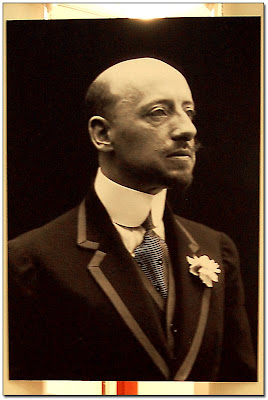
Self-proclaimed “Superman” Gabriele D’Annunzio (Photo by New York Scugnizzo)
“In men of the highest character and noblest genius there is to be found an insatiable desire for honor, command, power and glory.”
– Cicero: De Oficiis, I, 78 B.C.
The end of World War I witnessed the breakup of three of the great royal dynasties of Europe. The Hohenzollern Empire of Germany, the Hapsburg Empire of Austria-Hungary and the Romanov Empire of Russia all went the way of the Imperium Romanum before them…into the misty and romanticized pages of history. In their places were created various new geopolitical entities ranging from ethno-states like Poland to multi-national states like Czechoslovakia. With some notable exceptions (like Yugoslavia) the new governments were republics.
Centuries of authoritarian, monarchial rule plus the exorbitant costs of the war left the new crop of leaders ill-equipped to deal with the problems afflicting their respective societies. Soon a wave of demagogues, strongmen and tinpot dictators would enter the picture, attempting to carve out a legacy for themselves in the ruins of postwar Europe.
In Hungary the Bolshevik revolutionary Béla Kun (née Cohn Béla) established a brutal, short-lived Communist regime (1919) before being overthrown in a disastrous war with Romania. He fled to the nascent Soviet Union where he lived, and continued to brutalize, until he was executed under Stalin’s orders in 1938 “…because he knew too much.” Kun’s brief reign was ironically instrumental in subsequently moving Hungarian politics far to the Right.
In one of the more laughable episodes of this period, on March 13th, 1920 a group of 5,000 Freikorps (German paramilitary volunteers) led by a man named Hermann Ehrhardt seized control of the city of Berlin, drove out the Weimar government, and installed a nondescript fellow by the name of Wolfgang Kapp as figurehead ‘Chancellor’. A group of rightists led by one General Walther von Luëttwitz was the real power behind the throne.
Kapp, a bespectacled bureaucrat and journalist, lacked the charisma to make a convincing frontman. Most of the other Freikorps and military commanders as well as conservative politicians refused to have anything to do with him or his “government”. Four days later the whole scheme fell apart when the Weimar Cabinet called for a general strike and Kapp fled to Sweden. The schlemiel died of cancer two years later while in German custody in Leipzig.
The only happening during the so-called “Kapp Putsch” worth noting was the effect a singular, harsh incident associated with it (the shooting of a rambunctious, small boy by several Freikorps troops) would have on an eyewitness: a young Austrian veteran of the German Army by the name of Adolf Hitler. Several years later in his book Mein Kampf he would remark it was his first lesson in the use of force to rule the masses.
While its monarchy survived the war, Italy was not immune to the intrigues of demagogues. One, in fact, would eventually seize power in 1922. Four years later he would proclaim himself dictator while keeping the King around as a figurehead. His name was Benito Mussolini. As Il Duce he would march Italy nearly to its ruin in World War II. Before all this happened, however, he would have to contend with another forceful personality who very nearly ‘stole his thunder’. Though Mussolini won the contest, he was nonetheless profoundly influenced by this most remarkable individual whose biography is studied to this day by those fascinated with the lives of “those who dare”.
Place of birth in Pescara
(Courtesy of Wikimedia Commons)
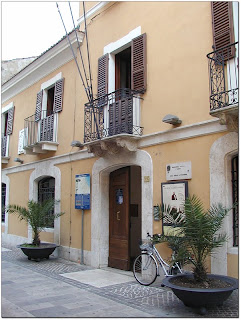
Gabriele D’Annunzio was born on March 12th, 1863 in the town of Pescara, Abruzzi. Just a couple of years earlier the region had been part of the Kingdom of the Two Sicilies before its conquest by Giuseppe Garibaldi. Some controversy apparently exists among historians as to D’Annunzio’s birth name. His father, Francesco Paolo Rapagnetta, had been adopted at the age of 13 by a childless uncle named Antonio D’Annunzio. He was raised with the surname Rapagnetta-D’Annunzio. In 1858 he married Luisa De Benedictis, by whom he had five children – three girls and two boys. According to Professor John Woodhouse (Fiat-Serena Prof. of Italian Studies, Univ. of Oxford), at the time of Gabriele’s baptism Rapagnetta had been dropped and the elder boy was officially registered as Gabriele D’Annunzio. Later in his life he would take to writing his surname as “d’Annunzio” to give it a more noble air.
Francesco Paolo had inherited half of his uncle’s fortune and as a result Gabriele and his siblings grew up fairly well off. His father, however, was a notorious drinker and womanizer who kept a string of mistresses. This caused no small amount of ill feeling between father and son. The level of dysfunctional feelings in the D’Annunzio family household was revealed when Gabriele refused to travel a short distance to be with his father before he died. After his father’s death, Gabriele realized the family had been saddled with heavy debts, forcing him to sell the D’Annunzio country home.
Gabriele D’Annunzio’s talents as a writer, as well as his disregard for personal danger, were recognized early in his life. An oft-repeated tale goes that a local fisherman had once given the boisterous lad a mussel to eat. In trying to pry it open he accidentally stabbed himself in the left thumb, bleeding profusely. Instead of running home to his mother for aid, he first ate the mollusk before binding the wound himself.
Originally tutored at home, at the age of 11 his father sent him to a prestigious boarding school, the Collegio Cicognini, in Prato, Tuscany. It must have made quite an impression on young Gabriele as years later he would describe this place as “…a plantation made in the images of the second Circle [of Dante’s Inferno], reducing the most vivacious of human saplings to ‘dried twigs with poison’. Oddly, he would later send both of his sons there when they were old enough.
D’Annunzio’s first brush with fame came in 1879 when he wrote and later published a small collection of 30 poems he entitled Primo vere. The poetry was written in the neo-Latin style of the great Tuscan poet (and future Nobel laureate) Giosuè Carducci. Against the rules of the Collegio Cicognini, he sent a complimentary copy of the book to Giuseppe Chiarini, one of Italy’s leading critics, who gave the book a mostly favorable review in the influential newspaper Il fanfulla della domenica.
Veiled bust of Eleonora Druse
(Photo by New York Scugnizzo)
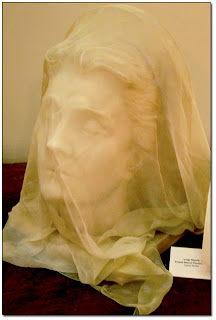
It was also during his adolescent phase D’Annunzio discovered his fascination with, and his power over, women. He was known to have had at least several passionate affairs with females while still a teenager. Given his physique, this was certainly strange, for Gabriele D’Annunzio stood less than 5’6” tall, was slightly built, and had teeth that would make an Englishman envious! Yet despite this and the fact he would bald early in life, he was never lacking for female company.
In 1881 he entered l’Universita di Roma La Sapienza where he aggressively pursued a literary career by joining various literary groups and writing articles for a number of local newspapers. A year later he published his second volume of poetry, Canto novo, which illustrated his break with the austerity of Carducci’s style by its sensuality and exultation of nature. Some of the 63 poems in the book dealt with the poet’s love for the landscape of his native Abruzzi.
Shortly after this he published Terra Vergine (It: Virgin Land), a collection of short stories dealing with the hardships of peasant life in his native Abruzzi. It was inspired by the pen of noted Sicilian writer Giovanni Verga, who achieved fame by his tales of the grinding poverty in his own native Sicily. For this some accused D’Annunzio of copying Verga’s ideas and plots. Most, though, recognized the originality of D’Annunzio’s work, especially his penchant for the shocking and grotesque. This contrasted with Verga’s use of pathos to arouse sympathy in the reader. Their writings were similar only in the subject matter.
When circumstances forced him to temporarily ‘retire’ from his journalistic activities, he devoted himself to writing novels. His first, Il piacere (1889), was later translated into English as The Child of Pleasure. His next novel was Giovanni Episcopo (1891). It was his third novel, L’innocente (It: The Intruder), published in 1892 and later translated into French, that first brought him attention and acclaim from foreign critics. His pen worked feverishly after this, creating novels and books of poetry. Of the former, his novel Il fuoco (1900) is considered by many literary critics to be the most lavish glorification of any city (in this case, Venice) ever written. Of the latter, his book Il Poema Paradisiaco (1893) is considered among the finest examples of D’Annunzio’s poetry.
His entrance into upper-class Roman society came in the form of a young, attractive woman named Maria Hardouin di Gallese. He seduced and impregnated her in April of1893, marrying her four months later under a cloud of scandal. Maria was the daughter of a noble house, and her father, a duke, strongly disapproved of D’Annunzio as a son-in-law. He was even conspicuously absent from their wedding. Though initially smitten with his young bride, Gabriele would later develop the disinterest that characterized his relationships with women throughout his life. After bringing three sons into the world, D’Annunzio and his wife divorced in 1891.
It would seem only natural a man with his surpassing ambitions would develop an interest in politics, and in that regard Gabriele D’Annunzio would hardly defy convention. Taking advantage of a vacancy in the Italian Parliament, D’Annunzio campaigned for a seat representing Ortona a Mare in his native Abruzzi. It was at this time D’Annunzio the dramatist first made use of giving speeches from balconies to the masses, one of many innovations of his that his fascist protégé Benito Mussolini would later emulate.
By 1897 he was elected to the Chamber of Deputies where he sat for three years as an independent. His devil-may-care attitude, however, caused him to amass a sizable debt. He was eventually forced to flee Italy for France to escape his creditors. During his self-imposed exile he did not grow lax. Among his works he wrote the Italian libretto for Pietro Mascagni’s powerful but inordinately long opera Parasina. In 1908 he took a flight with aviation pioneer Wilbur Wright, which piqued D’Annunzio’s interest in flying. He proved to be an able aviator.
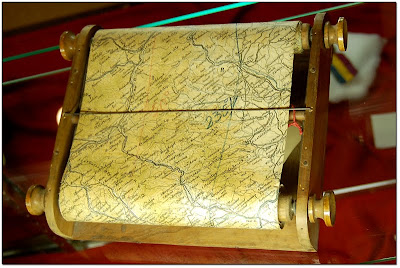
D'Annunzio's airplane navigator scroll (Photo by New York Scugnizzo)
World War I saw his return to Italy in the spring of 1915 where he campaigned extensively for that country’s entry into the war on the side of the Triple Entente (UK, France and Russia). Unbeknownst to him was the fact Italy had by April 26th, 1915 signed a treaty (known later as the Treaty of London) pledging to enter the war on the side of the entente powers. After Italy entered the war on May 23rd, 1915, he volunteered his services as a fighter pilot, taking part in many battles. The publicity he received fueled his already tremendous ego. On January 16th, 1916 while trying to fly over the city of Trieste, his flying boat was attacked by Austrian fighter aircraft. Forced to make an emergency landing, he sustained an injury to the right side of his head which left him permanently blind in his right eye.
In spite of this serious injury, he continued to fly missions into Austrian territory. In August of 1917 he led no less than three daring bombing raids on the Austrian port city of Pola (now Pula, Croatia). These raids became famous in part because of D’Annunzio’s insistence his Italian airmen celebrate the success of each raid by yelling out the ancient Greco-Roman battle cry of “Eia, eia, eia, alala!” instead of the more traditional Germanic “Ip, ip, urrah!” which he considered uncouth and barbaric.
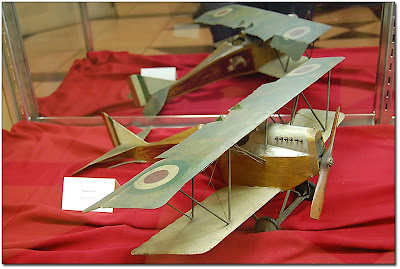
D'Annunzio's model SVA (Photo by New York Scugnizzo)
On October 24th, 1917 Italy suffered its greatest defeat of the war in the disaster at Caporetto. On February 10-11th, 1918 he took part in a daring, if militarily unimportant raid, into Austrian territory now known as the Bakar Mockery. Though it achieved no physical military objective, it uplifted Italian morale which had suffered as a result of Caporetto while delivering a psychological blow to the Austrians.
D’Annunzio’s greatest feat during the war came on August 9th, 1918 when leading the 87th fighter squadron “La Serenissima” he dropped a total of 400,000 propaganda leaflets (50,000 of them painted in the colors of the Italian flag) over the city of Vienna, capital of the Austro-Hungarian Empire. This daring mission is immortalized in Italy as “Il Volo su Vienna” (It: The Flight over Vienna).
At war’s end the internationally acclaimed “fighter-poet” returned to Italy, his ultra-nationalist and irredentist feelings having been hardened by years of battle. With the collapse of the Hapsburg Empire of Austria-Hungary, he dreamed of Italy expanding into the Balkans by annexing lands historically inhabited by Italian-speaking peoples. It was a dream shared by many both in Italy and on the other side of the Adriatic Sea. What would follow would catapult Gabriele D’Annunzio to the pinnacle of the fame and controversy that characterized his life.
After the war Italian armies occupied considerable territory in the Trentino, South Tyrol, Venezia Giulia, the Istrian Peninsula, Dalmatia and most of what is now Albania. In fact, these were most of the lands promised them four years earlier by the entente powers.
What threw a monkey wrench in the works was a man named Woodrow Wilson, President of the United States. The U.S. had been a late entry into the war, and in the minds of American diplomats they didn’t have to abide by the terms of the Treaty of London. Since the administration of President Teddy Roosevelt, America’s WASP elites had turned their previous continent-specific belief in “Manifest Destiny” to a global arena. At the negotiations pursuant to the infamous Treaty of Versailles, Wilson let it be known he believed every recognizable ethnos had the right to self-determination (translation: America had vested business and political interests in the creation of the pseudo-nation known as Yugoslavia).
As documented by Prof. Woodhouse, Wilson also inherited that wonderful Anglo-American tradition known as anti-Italian bigotry. This tradition had revealed itself previously on numerous occasions, most notably on March 14th, 1891 when a total of 17 Sicilian-Americans were murdered by a lynch mob comprised of a good chunk of the adult male population of the city of New Orleans, Louisiana!
During the negotiations in Paris on April 23rd, 1919 the head of the American delegation went so far as to publish a column in the French newspaper Le Temps condemning what he called “Italian imperialism”. He arrogantly claimed Italian negotiators were acting “contrary to Italian public opinion” (without stating exactly how he knew this to be true).
The crux of all this was the city of Fiume (now Rijeka, Croatia). A number of powers (including America’s ‘good friend’ the UK) desired control of this strategically important area. Wilson was adamant Fiume be turned over to the nascent state of Yugoslavia to fulfill its right to ‘self-determination’. That the bulk of the citizenry was Italian-speaking and had already voted by a wide margin to become part of Italy was irrelevant.
D'Annunzio's Uniform
(Photo by New York Scugnizzo)
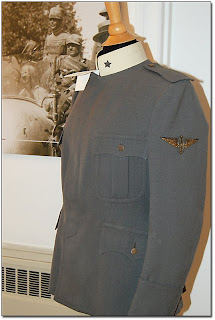
D’Annunzio the pan-Italian ultra-nationalist was furious with what he saw as American interference in what was basically an Italian affair. In a series of speeches he whipped up the Italian masses in preparation for his “grand adventure” in Fiume. His speeches denouncing the treachery of the Allies and the arrogance of Wilson were given wide coverage in the American press, which gratuitously heaped anti-Italian invectives on him in turn.
It also didn’t help the Italian government’s case that numerous private individuals besides D’Annunzio were taking matters into their own hands. Benito Mussolini by this time had organized his first bands of squadristi (the future Blackshirts) to battle his political opponents and pave the way for his eventual takeover of Italy. Giovanni Host-Venturi, a captain of the Arditi (elite Italian storm troopers during World War I) and a Major Giovanni Giuriati formed the Legione Fiumana (Fiume Legion) to take the port city by force, if necessary. American, British and French critics pointed to this as “proof” the Italians could not be depended upon to correctly administer the territories promised them.
On September 12th, 1919 at the head of a motley force of 2,500 irregulars, Gabriele D’Annunzio the “fighter-poet” invaded the city of Fiume. The inter-Allied force of British, American and French soldiers garrisoned there chose not to force a confrontation in order to avoid an international incident with their Italian allies. Instead they withdrew. From the governor’s balcony D’Annunzio addressed a throng of the citizenry and informed them of his plan to annex Fiume to Italy. Their wildly enthusiastic response affirmed in his mind the justness of his actions.
The Italian government, however, was not so enthusiastic. General Pietro Badoglio telegraphed the Italian soldiers who had followed D’Annunzio into Fiume that they were guilty of desertion. D’Annunzio reacted by publicly condemning the government for its weakness and indecision.
Similarly, he lashed out (though privately) at Mussolini, who up until this time was a partner in D’Annunzio’s endeavor. D’Annunzio had expected material support from Il Duce. Mussolini, however, was not yet strong enough to make such a move and chose to bide his time, instead. He even went so far as to edit and then publish the highly vituperative letter D’Annunzio had written, denouncing him, to make it seem the poet-hero was in fact supportive of him. Only in 1954 was the text of the original letter published. By then, though, D’Annunzio’s name had become so thoroughly linked with Fascism few were willing to stick their necks out to expose the true contempt he had early on developed for Mussolini and his movement.
Italian Prime Minister Francesco Saverio Nitti, realizing the weight of popular opinion was with D’Annunzio, offered him generous terms, among which was a general amnesty for him and his men. Fiume and surrounding territories would also be ultimately joined with Italy. All should have proceeded smoothly after this, but for the fact that it was now D’Annunzio himself who began to stonewall. A referendum by the people of Fiume seemed supportive of Nitti’s offer; D’Annunzio declared the vote null and void.
Apparently Gabriele D’Annunzio, like Gaius Julius Caesar 2,000 years before him, had become addicted to the powers he now wielded. The notoriety, and the legion of female admirers now at his disposal, didn’t hurt either. He rejected Nitti’s offer.
The government in Rome then demanded the plotters surrender and sent a naval task force to blockade Fiume. Things became embarrassing, however, when a number of Italian sailors, including basically the entire crew of the destroyer Espero, joined up with D’Annunzio’s forces. It has also been long alleged that a number of sympathetic rightists in Northern Italy’s industrial community clandestinely shipped supplies to D’Annunzio’s forces (in violation of the blockade) while claiming losses due to ‘piracy’.
Renato Brozzi Fiume medal
(Photo by New York Scugnizzo)
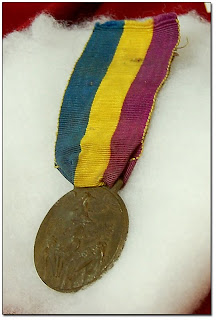
In retaliation for the blockade D’Annunzio declared Fiume an independent state, the Reggenza Italiana del Carnaro (It: Italian Regency of Carnaro) with himself as Duce. This was the closest he came to becoming the Renaissance despot he dreamed of being. As Duce he indulged his megalomania, giving balcony speeches, surrounding himself with military trappings, black-shirted followers and fostering a cult of personality.
With the help of Italian syndicalist Alceste De Ambris he wrote a constitution for Fiume, the Carta del Carnaro (It: Charter of Carnaro), which combined elements of syndicalist, corporatist and liberal republican ideals. The Charter stipulated that Fiume was a corporatist state, with nine corporations controlling various sectors of the economy and a tenth, created by D’Annunzio, representing the people he judged to be ‘superior’ (poets, prophets, heroes and “supermen”).
It must be mentioned D’Annunzio’s idea of the ‘superman’ was more in line with the philosophical vision of Nietzsche rather than the racial one of Hitler. It is also worth noting the Charter declared music to be the fundamental principle of the state. This document plus D’Annunzio’s antics in Fiume greatly interested Benito Mussolini and in no small way influenced the future course of Fascism in Italy. In fact, D’Annunzio has been described by his detractors as the “John the Baptist of Fascism”.
On November 12, 1920 Italy signed the Treaty of Rapallo with the newly-formed Kingdom of Serbs, Croats and Slovenes (renamed Yugoslavia in 1929) which, among other things, established Fiume as the independent “Free State of Fiume”, effectively ending D’Annunzio’s dictatorship. D’Annunzio responded by declaring war on Italy. By this time it was obvious his hold on the city was crumbling. On Christmas Eve Italian troops invaded Fiume in the face of stiff resistance from diehard loyalists. A naval artillery shell from the Andrea Doria through the window of his headquarters impressed upon him the wisdom of surrender.
In a way, though, he won. Fiume would be a de facto Italian possession by 1924. It would remain so until the end of World War II when the victorious Allies would pry it from Italian hands and give it to Yugoslavia (after the ‘ethnic cleansing’ of its Italian population).
Far from returning with his tail between his legs, D’Annunzio’s popularity with the Italian populace was actually enhanced by his Fiume adventure. In spite of claims by many of his Fascist sympathies, he consistently refused to have anything to do with the movement. He even ignored fascist entreaties to run in the elections on May 21, 1921.
Piazza G. D'Annunzio, Ravenna (Photo by New York Scugnizzo)
In spite of this, Mussolini regarded the erstwhile dictator as a rival for his future control of Italy. His fears were probably well-placed as by this time a number of high-ranking members of the Fascist Party of Italy, including Blackshirt leader Italo Balbo, seriously considered the idea of turning to D’Annunzio for leadership. Thus, on August 13th, 1922, when Gabriele D’Annunzio fell out of a window two days before a scheduled meeting with Mussolini and Italian PM Nitti, many believed (and still believe) he had ‘help’ from some of Il Duce’s thugs.
D’Annunzio’s injuries as a result of his fall incapacitated him, leaving him unable to witness Mussolini’s triumphal “March on Rome” (October 22-29, 1922). After this he withdrew from politics, though he still from time to time “stuck his two cents in” many of Mussolini’s decisions. In 1924, after Italy formally annexed Fiume, D’Annunzio was ennobled the Prince of Monte Nevoso by the King upon the ‘recommendation’ of Mussolini. He approved of the Italian invasion of Ethiopia in 1935. However, he was adamantly opposed (along with Italo Balbo) to Mussolini having anything to do with Adolf Hitler, whom he contemptuously referred to in a letter to Mussolini as a marrano (Sp: swine).
Mussolini, for his part, was content to leave D’Annunzio alone after his ascension to power, preferring instead to regularly dole out large sums of money to him to finance his various egocentric projects. The most notable of these was a museum to himself D’Annunzio began during his lifetime, dubbed Il Vittoriale degli Italiani (It: The Shrine of Italian Victories) and located at his estate in Gardone Riviera, Lombardia. It contains his mausoleum.
Gabriele D’Annunzio died on March 1st, 1938, presumably of a stroke. His death caused a period of national mourning throughout Italy and beyond. Even in countries now hostile to Italy his passing was noted with sorrow. No less than The Times of London published this eulogy of him under the heading “The Spirit of the Cinquecento”:
Poet, novelist and politician, dramatist and demagogue, aesthete and soldier, Gabriele D’Annunzio, Prince of Monte Nevoso, is dead. No poet of our time has led a fuller life than this Byron of the modern world […] showed himself a fighter of dauntless courage and a politician who swayed the fortunes of Europe […] bore his wounds with stoic fortitude.
After his death his memory would be all but buried with him for the next 50 years. Scholars in recent decades, however, have shown a renewed interest in his life and works.
It would be simple to dismiss him as a mere hedonist and fascist (as many have done), ignoring his many contributions to the fields of journalism, poetry and drama. In truth, he was no fascist at all, for Gabriele D’Annunzio served neither Mussolini nor Fascism. He served no one and nothing other than his own ego and surpassing ambitions. His inability to form a lasting relationship with women, plus his penchant for decadent living, were perhaps his greatest personal flaws, but history has a habit of forgiving earth-shakers their frailties. His love of nature and aesthetics, as well as his utter rejection of Hitler, put him on a much higher plane than the plebe who became ruler of Italy. Had he lived in an earlier time, today he might be numbered with other tragic heroes who tried and failed like Cola di Rienzo or even Pompey the Great. His legacy is most certainly clouded by the politics of our times. His biography remains a case study of one of the most fascinating and striking personalities of the early part of the 20th century.
Niccolò Graffio
Further reading:
• John Woodhouse: Gabriele D’Annunzio: Defiant Archangel, Clarendon Press, 1998
• http://www.gabrieledannunzio.net/english/index.htm
00:05 Publié dans Littérature | Lien permanent | Commentaires (0) | Tags : littérature, lettres, lettres italiennes, littérature italienne, italie, d'annunzio | | del.icio.us | | Digg | Facebook
mardi, 22 mars 2011
Portrait: Gabriele d'Annunzio
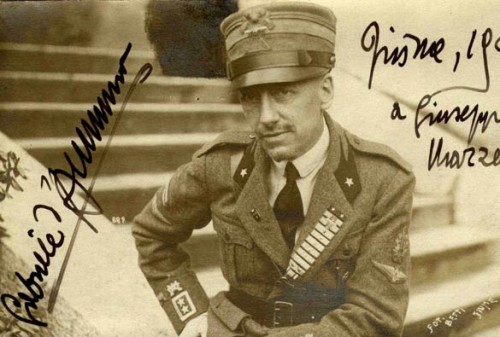
Portrait: Gabriel d'Annunzio
Il avait le teint brouillé des grands nerveux, les yeux bleuâtres, d'un azur profond et embrumé, voilé de quelque lointain rêve, la cornée et l'iris légèrement en saillie entre les paupières glabres, comme les yeux des bustes antiques – déjà. Les lèvres d'un gris mauve, comme des lèvres de marbre – déjà – d'un marbre jadis teinté, dont la nuance purpurine se serait effacée. Les dents mauvaises. Mais qu'importaient ces couleurs de la face et de l'émail dentaire ! La couleur est la chose éphémère, comme l'était cette nuance roussâtre du poil sur l'arcade sourcilière, sous le nez, à la pointe du menton. Et qu'importait, de même, ce corps petit et musclé, avec son torse long, ses jambes courtes ! De ces proportions sans grâce le poète s'accommodait, sachant bien que sa gloire future concentrait tout l'intérêt de son humaine apparence dans le buste, promis – déjà – à l'éternité. Or, la tête était admirable par la forme et par les volumes, par tout ce qui ressortit à la statuaire. Il n'est pas jusqu'à cette complète calvitie qui ne parût par avance un dépouillement volontaire de toute simulation et de tout accident. « Ma clarté frontale », comme l'appelait le maître, avec ce mélange d'orgueil et de sarcasme qui, dans sa bouche, prenait le ton d'un défi, d'une raillerie adressée aux circonstances, aux bizarreries de la nature, aux défaillances d'un dieu distrait. Et la main aussi – la main qui caresse et qui tient la plume (et l'épée) – la main qui est volupté et qui est esprit (et fierté), la main était belle : petite, féminine, ciselée, impérieuse, ayant cette force de dédain que le plus hautain visage ne peut exprimer et que, seule, une belle main reflète avec tranquillité. Au petit doigt, deux bagues d'or, chacune ornée d'une émeraude cabochon. J'ai lu que, sur le lit funèbre, le doigt ne portait plus que deux minces anneaux nus, sans aucune pierre précieuse. Il y a tout un symbole de grandeur et de renoncement dans cette disparition des émeraudes.
Sur le ciel noir de l'époque, la mort de Gabriele d'Annunzio a jeté, durant quelques jours, les suprêmes clartés de la fusée qui s'éteint ou du météore qui rentre dans la nuit. Astre ou bouquet d'artifice ? Là est la question. Certes, la fin d'un tel homme ne pouvait passer inaperçue. Elle devait éblouir encore, les puissances du feu étant les caractéristiques mêmes de l'âme qui prenait congé de nous. Mais je ne puis m'empêcher de noter combien fut bref ce dernier éblouissement, combien la nécrologie (en maints articles où il faut voir un signe des temps et le reflet des modes changées) fut prompte à diminuer, à « minimiser », comme on dit dans un affreux jargon, l'importance de ce brusque départ,
Me trompé-je ? Mais il me semble que, en Italie même, c'est avec quelque précipitation que furent rendus à la haute renommée du défunt les honneurs qu'on lui devait, ou qu'on ne pouvait lui refuser. Dans quelques semaines, la «Voie triomphale » ouvrira sa vaste perspective devant le char de M. Hitler. Ses dalles toutes neuves retentiront sous les martèlements sourds de ce « pas romain » qui fait sa rentrée dans Rome après un bien long détour. Mais le char funèbre du poète n'aura pas suivi la nouvelle avenue. Sans doute parce qu'il y aurait eu antimonie à ce que les gloires du passé empruntassent les routes de l'avenir. Dans une petite église de campagne, un simple cercueil de noyer ciré a reçu l'absoute rituelle. Et la dépouille du héros fut inhumée dans la terre de cette même colline où il avait vécu retiré durant les seize ou dix-sept dernières années de sa vie.
Ainsi va le siècle, ainsi vont les destins des hommes et des États, et les cieux, un instant déchirés par le suprême éclair de la flamme que le vent a soufflée, les cieux sont redevenus ce qu'ils étaient : un amoncellement de nuages sombres.
Quel grand vide, pourtant, ce mort laisse après soi ! Ce vide, on ne le mesure pas encore. Ou bien disons, pour ceux qui pensent que la vie est un renouvellement incessant où nul vide ne se creuse qui ne soit aussitôt comblé, où ce qui s'en va est aussitôt remplacé (fût-ce par son contraire, ce qui est le cas le plus fréquent), disons pour ceux-là que la mort de Gabriele d'Annunzio constitue un grand événement, et point seulement dans l'Histoire de la Littérature universelle, mais dans l'Histoire universelle tout court, l'Histoire de l'Humanité.
C'est toute une conception du monde qui s'efface avec cette éclatante figure. Et j'entends bien que cette conception était depuis longtemps déjà dépassée, démodée, périmée (comme disent les générations nouvelles, avec ce luxe d'expressions méprisantes qu'elles ont toujours à l'égard des gens et des choses qui les ont précédées). Mais Gabriele d'Annunzio, jusqu'à ce soir du 1er mars où la mort l'a frappé à sa table de travail, était le plus illustre « survivant » d'une époque évanouie, le représentant le plus magnifique et le plus accompli d'un certain ordre de grandeur. Lui disparu, c'est tout un pan de la civilisation qui s'effondre ou, si l'on veut, c'est tout un décor qui disparaît comme dans une trappe.
Il a commencé par le culte de l'Amour et de la Beauté. Il ne s'agissait pas, dans son esprit, comprenez bien, de deux religions séparées, ayant chacune leur objet distinct, mais d'une religion unique ayant un double objet sur un seul autel. Les exigences des sens le tourmentaient, et ses aventures furent nombreuses, mais il n'eût point donné satisfaction à ses instincts s'il ne les eût associés – du moins en pensée, car l'imagination du poète supplée parfois aux réalités – à la poursuite d'une forme belle. D'autre part, la définition selon laquelle la beauté serait « une promesse de bonheur » correspond exactement à la manière de sentir qu'il eut dans sa jeunesse, et sa jeunesse se prolongea longtemps, comme on sait, jusque dans son vieil âge. Il ne distinguait point alors la Beauté de la Volupté. Certes, il ne ravalait pas son idole à n'être qu'un instrument du plaisir, mais il considérait l'extase amoureuse, les paradis physiques, comme un accroissement de la Beauté, laquelle ne pouvait, selon lui, atteindre son point de perfection et, si je puis dire, culminer que dans le délire sensuel.
Mais ici encore, gardez-vous d'une équivoque ! N'allez pas confondre cette chasse ardente avec la morne dépravation. Dès l'instant que l'amour est requis, ou que l'âme aspire à lui, le voluptueux cesse d'être enfermé dans le cercle de la débauche. Ce qu'il cherche dans les voies de la sensualité, c'est une évasion, un moyen de se surpasser soi-même, c'est une issue vers le sublime. La Beauté, aux yeux de Gabriele d'Annunzio, fut donc toujours une sorte de prêtresse qui a pour sacerdoce l'initiation aux mystères, et le plus grand mystère de la vie, peut-être son unique but, pense le poète à cette époque, c'est l'Amour.
De plus, comme cet artiste du verbe était en même temps très érudit en matière d'art, toutes les tentatives que les peintres, les sculpteurs, les orfèvres, les émailleurs, les tailleurs d'ivoire et autres servants de la Beauté avaient faites en tous les siècles et tous les pays pour saisir et fixer quelque aspect particulier, éphémère de l'éternelle idole, il les connaissait. Aux figures évoquées par sa propre imagination, laquelle ne cessait d'inventer des formes et des symboles, s'ajoutait un peuple de souvenirs. Il était environné d'images rêvées, mais aussi d'une multitude d'images rencontrées par lui dans tous les musées d'Europe. Entre les créatures de son esprit et les visages des portraits, des statues, des médailles, s'établissaient de perpétuels échanges. Il se créait, entre les deux plans, tout un jeu de références et d'allusions. Le danger eût été qu'une mémoire si fidèle n'étouffât, sous ses apports constants, le jaillissement spontané de l'imagination créatrice. Mais la Poésie, chez Gabriele d'Annunzio, n'avait rien à craindre de Mnémosyne. Combien de fois la Muse annunziesque n'a-t-elle pas prouvé, en souriant, à sa redoutable compagne, qu'elle aurait pu se passer d'elle ! Une flamme extraordinaire maintenait à la température voulue le creuset où s'opérait la fusion magique.
Dans le domaine du vers notamment, où il excella tout jeune, (son premier recueil, Primo vere, contient les poèmes écrits en 1879 et 1880, entre seize et dix-sept ans), Annunzio possède le double don sans lequel il n'est pas de grand poète : l'alliance de l'image neuve et de la sonorité ; il est plastique et musical. Romancier, il a, par les illustrations qu'il a données du culte « Amour et Beauté », imposé à toute une époque sa vue personnelle du monde, la mystique sensualiste d'un paganisme nouveau. Il est à l'origine d'un certain romanesque lyrique, tout à l'opposé de l'école naturaliste, qui, elle, a bien souvent caché, cultivé comme un vice, sous le couvert de la recherche du Vrai, un amour monstrueux, assidu, acharné de la Laideur. Il a créé une atmosphère d'enchantement qui n'appartient qu'à lui, détourné le XIXe siècle finissant des spectacles amers, des étalages complaisants de la bassesse humaine et de la platitude. Il nous a induits en des rêveries fastueuses ; il nous a rendu les clés des jardins ornés, des palais au fond des parcs ; il a peuplé nos songes de fascinantes figures de femmes, restauré les loisirs heureux ou ravagés par des passions aristocratiques.
Et sans doute, il a pu entrer quelque naïveté dans ces évocations, de même qu'il y eut quelque bric-à-brac dans l'existence de l'auteur lorsqu'il voulut, pour son propre compte, mettre sa vie en accord avec ce luxe imaginaire.
Mais on aurait tort de limiter au goût du pittoresque et du bibelot ce vœu profond d'un cœur fervent. N'oublions pas que, dans les romans de Gabriele d'Annunzio, la Mort est toujours présente, accoudée aux terrasses avec les amoureux ou, solitaire, jouant de la harpe, en attendant son heure, dans le boudoir voisin de la chambre à coucher. Le culte « Amour et Beauté » ne peut être sincère, pratiqué avec foi, et ne peut mener loin sans que s'y glissent l'odeur attristante des roses effeuillées, la saveur de la lie au fond du verre, tout ce qui présage, annonce, révèle les approches de la visiteuse voilée.
Ensuite il y a entre l'esthétique et l'éthique de secrets passages. Le culte du Beau ne suffirait point à faire accéder une âme à la sainteté. Le Beau ne se confond pas avec le Bon. Que de fois n'est-il pas son contraire ! Mais il est rare que quelqu'un de bien déterminé à faire du culte de la Beauté sa raison de vivre, ne soit pas porté vers ce qui est noble et vers ce qui est grand. Cette ascension est patente dans l'œuvre et le caractère de Gabriele d'Annunzio.
Comparée à son œuvre romanesque, son œuvre dramatique frappe déjà par un certain caractère d'austérité. Les passions y règnent encore en maîtresses, mais il ne s'agit plus uniquement ici de la passion amoureuse et de l'exaltation de la Beauté. Ce sont tous les tragiques de la vie qui se donnent rendez-vous en ces drames étranges. La volonté de transposer le réel dans le lyrisme, de l'intégrer à la poésie, voilà ce qui crée l'unité entre ces drames divers, ainsi que le lien entre ce théâtre et les romans qui l'ont précédé.
Les Lettres françaises garderont une reconnaissance particulière à ce grand poète italien, ce merveilleux génie bilingue, qui sut couler ses sentiments, ses rêves légendaires, la vibration de sa lyre épique et sacrée dans notre « doux parler ». Lui-même s'est dépeint tel qu'il fut en sa première jeunesse, attentif aux leçons de ceux qu'il nomme ses deux maîtres en matière de langage : l'Italien Ernesto Monaci et le Français Gaston Paris. Il a conté comment, à la veille de la Grande Guerre, exilé sur notre sol, entre le cap de Grave et l'Adour, il se plaisait à reconnaître, au cours de ses promenades à cheval, le long des grèves, dans le large déferlement de la houle atlantique, la grande chevelure glauque de la fée Morgane, divinité bienfaisante des Gaules. Or, « en cet automne lointain des Landes », le poète écrivait le Martyre de saint Sébastien, ce poème français, unique dans notre littérature, où les sources communes de notre langue et de la langue italienne retrouvent parfois leur surgeon primitif, comme deux sœurs jumelles, à certaines heures, et quoique depuis longtemps séparées, sentent palpiter encore au fond de leur subconscient le souvenir du tendre emmêlement qu'elles avaient dans le sein maternel.
Ce français poétique de Gabriele d'Annunzio est « en dehors de tout » peut-être, hors du courant, hors du temps écoulé. Mais quelle étonnante merveille ! Nourri aux allégories et symboles du Roman de la Rose, aux truculences et trivialités magnifiques de nos vieux fabliaux, il est, avec cela, aussi éloigné que possible de l'archaïsme pédantesque, aussi embaumé, aussi frais qu'un parterre de fleurs à l'aurore.
Vint la guerre. On sait ce que la France doit à Gabriele d'Annunzio. Dans la lettre fameuse que le poète écrivit à Maurice Barrès, le jour où l'Italie se rangea aux côtés des Alliés, il est une phrase superbe que je n’ai jamais pu relire sans être parcouru de ce frisson qui se transmet de l'âme au corps lorsque retentit dans l'air la voix de l'héroïsme : « ... le vert et le bleu de nos drapeaux confondent leurs couleurs dans le soir qui tombe ».
Une vie nouvelle commençait alors pour le grand écrivain. Elle devait être courte et flamboyante. Six années à peine, avant la retraite au bord du lac, sur la colline ! Mais, à partir de ce mois de mai 1915, où il quitta son appartement parisien pour regagner son pays, qu'il allait entraîner dans la guerre, quel changement chez cet homme qui, moins d'un an auparavant, souriait, au milieu d'un cercle de femmes, dans les théâtres et les salons de Paris.
Pourtant, du premier jour où son destin le requiert d'agir, il est prêt, armé chevalier en lui-même, et par lui-même, et sur l'heure ! De la religion « Amour et Beauté », sans transition apparente (mais les transitions, il les avait sans doute vécues dans son cœur, durant ses méditations solitaires sous les pins brûlants d'Arcachon), il passe, non seulement au culte des Héros, mais à la pratique de l'héroïsme, non seulement à la « chanson de geste », mais à la « geste » elle-même. Il n'est plus le troubadour qui s'exalte à célébrer les exploits des Roland, des Olivier, des Renaud. Il est l'égal des preux. Et un jour, il les surpasse. Il s'est élancé dans le ciel, suivi de ses compagnons montés sur des monstres ailés. Il libère Fiume, comme Persée délivra Andromède, et il la rend à sa patrie.
François PORCHE.
Extrait de La Revue Belge, 1920-1930.
00:05 Publié dans Histoire, Littérature | Lien permanent | Commentaires (0) | Tags : littérature, lettres, lettres italiennes, littérature italienne, italie, histoire, gabriele d'annunzio | | del.icio.us | | Digg | Facebook
vendredi, 11 mars 2011
G. Adinolfi: "Het fascisme heeft de antwoorden op de huidige problemen"
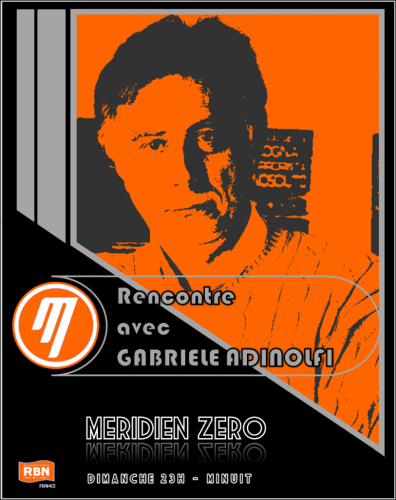
Gabriele Adinolfi: "Het fascisme heeft de antwoorden op de huidige problemen"
Gabriele Adinolfi is een van de meest prominente non-conformistische intellectuelen van Italië. Deze sterk door Julius Evola beïnvloede nationaal-revolutionaire militant heeft twintig jaar in gedwongen Franse ballingschap geleefd. Van zijn hand zijn twee opmerkelijke recente werken: Nos belles années de plomb (Onze mooie loden jaren) uit 2004 en Pensées Corsaires. Abécédaire de lutte et de victoire (Kapersgedachten. Het ABC van strijd en van overwinning) uit 2008. Hij staat méér dan ooit in het brandpunt van de strijd in Italië en heeft toegestemd om enkele vragen van ons te beantwoorden.
Rivarol: Allereerst, meneer Adinolfi, kunt u – die een zeer ervaren militant bent en talloze offers voor het fascistische ideaal hebt gebracht – ons vertellen hoe u de toekomst van Italië en die van zijn jeugd ziet?
Gabriele Adinolfi: Heel negatief. Italië is een vergrijzend land met het laagste geboortecijfer van de wereld; het heeft bijna geen industrie meer, een kleine landbouwsector en een zeer beperkte soevereiniteit. De enige elementen die Italië tegenwoordig van de ondergang redden, zijn de nationale energiemaatschappijen (in het bijzonder ENI), de wapenindustrie, de kleine ondernemingen en wat overblijft van het spaargeld van de families.
In de huidige globaliseringscontext geeft dat ons amper enkele jaren om te overleven als de feiten niet radicaal veranderen.
R: Welke rol kan het fascisme in de toekomst van Italië spelen?
GA: Het is een paradox. Het fascisme biedt nog steeds alle antwoorden op de huidige problemen. Men kan zeggen dat het het enige denk- en organisatiesysteem is dat de oplossingen voor de grote uitdagingen van onze tijd bezit. Maar het slaagt er nog steeds niet in om zich in de huidige omstandigheden te plaatsen. De Italianen die het echte fascisme in het dagelijkse leven gekend hebben, blijven het werk van Mussolini waarderen en er zelfs van houden: zij hebben van al zijn sociale, economische, ethische en culturele weldaden genoten. Dat is heel anders voor degenen die van het fascisme slechts de "zwarte legende" hebben gekend en die het, zoals de Fransen, nooit hebben meegemaakt (Vichy kwam voort uit even onverwachte als ongunstige omstandigheden en belichaamde in elk geval geen fascistisch project).
Die nostalgie groeit met de dag door de eenvoudige vergelijking van het Italië van Mussolini met eerst het antifascistische en daarna het post-fascistische Italië. Niettemin ontbreken alle objectieve voorwaarden voor de vestiging van een fascistisch geïnspireerde natiestaat, waardoor het fascisme zich in de huidige toestand niet zal kunnen aanbieden. Toch is het mogelijk om aan het fascisme een hele reeks oplossingen te ontlenen voor de problemen die ons overspoelen. Laten we zeggen dat, als een bepaald aantal voorwaarden is vervuld, we kunnen hopen op een gemengde formule in de Italiaanse toekomst: een soort peronisme op zijn Italiaans.
R: Waaruit bestaat uw activiteit vandaag?
GA: Ik analyseer, becommentarieer, stel voor, schrijf. Ik leid een internetkrant, geef lezingen, houd debatten met mensen van alle gezindten, neem met Soccorso Sociale (Sociale Hulp) deel aan concrete acties voor de rechten van de zwaksten. Ik coördineer een studiecentrum, Polaris, dat een driemaandelijks tijdschrift uitgeeft, dat al een reeks overzichtswerken heeft voortgebracht en dat openbare bijeenkomsten inricht met vertegenwoordigers van de cultuur en de lokale of internationale instellingen. Ik weiger ook nooit om in een meer militant kader deel te nemen aan de ethische vorming en de intellectuele vorming. Ik volg met bijzonder veel aandacht en betrokkenheid het Casa Pound. Ik verzorg ook internationale betrekkingen, steeds in de geest van de heropleving en de "culturele revolutie" alsook met zeer veel aandacht voor het ontkrachten van gemeenplaatsen uit het antifascistische discours, dat met zijn nefaste effect de geschiedschrijving en de ideologie van het post-fascistische tijdperk beïnvloedt.
R: Hoe beoordeelt u de rol van het Vaticaan en, in bredere zin, die van de Kerk in het Italiaanse leven?
GA: Al 17 eeuwen lang, afgezien van een korte onderbreking in Avignon, moet Italië samenleven met de Kerk, wat eerst de burgeroorlogen tussen Welfen en Ghibellijnen heeft voortgebracht, daarna lange tijd de eenwording van Italië heeft verhinderd en na 1945 heeft bijgedragen aan de internationalisering van de Italiaanse politiek. Vandaag heeft de katholieke godsdienst veel minder invloed op het dagelijkse leven, maar hij behoudt een zekere algemene macht zoals blijkt uit de absolute meerderheid die in het parlement de euthanasiewet heeft weggestemd. De conciliaire Kerk is vorig jaar ook een kruistocht begonnen tegen het restrictieve immigratiebeleid van de regering-Berlusconi.
Het Vaticaan steunt de immigratie om ideologische, maar ook om economische redenen. "Migrantes", een kerkelijke organisatie van "Caritas", stelt officieel dat de "vermenging van culturen een bron van rijkdom is" en besteedt de helft van het Italiaanse(!) belastinggeld dat voor het Vaticaan bestemd is aan immigratie. De krachtmeting tussen het Vaticaan en de Italiaanse regering, die in 2010 naar schatting 400.000 immigranten zou hebben tegengehouden, is uitgedraaid op een compromis waarbij Italië wordt verplicht om – begin 2011 – bijna 100 000 nieuwe immigranten binnen te laten. Het Vaticaan lijkt te hebben gewonnen, wat de ontscheping van vreemdelingen alleen nog zal vergemakkelijken. R: Heb je sterk het gevoel dat de Italiaanse fascistische dynamiek een marginaal verschijnsel in Europa is?
GA: Eerder dat het een zeer typisch en zeer Italiaans verschijnsel is. Wat de sociologische achtergronden van de beweging betreft en de ideologische impulsen die haar kenmerken, denk ik dat het West-Europa – en niet Europa – is dat zo sterk afwijkt van de Italiaanse dynamiek. De redenen zijn veelvuldig, maar de gebreken van de westerse nationalisten zijn niet onbelangrijk. Het moet worden gezegd dat de westerse nationalisten – politiek gemarginaliseerd als gevolg van ongelijke krachtverhoudingen – ook dikwijls de belichaming van de marginalisering zijn geweest door al de complexen van marginalen en mislukkelingen aan te nemen. Ze hebben hun politieke onmacht weggemoffeld achter het rookgordijn van de holle taal en de meest stompzinnige clichés. Dat alles verwijdert hen van de werkelijkheid en maakt van hen dikwijls de levende bevestiging van de antifascistische karikatuur van het “zwarte schaap”. Een zwart schaap [bête noire] dat voor de rest dikwijls méér dom [bête] dan zwart [noire] is... [woordspeling]
R: Wat is volgens u de belangrijkste bedreiging voor de Europese wereld?
GA: De Europese wereld zélf. De ouderdom van Europa, zijn geestelijke, psychologische en biologische doodsstrijd, zijn afnemende geboortecijfer gekoppeld aan de schuldcomplexen en aan de verafgoding van het burgerlijke concept van "verworven rechten", de afwezigheid van machtswil en veroveringszin – dat zijn de elementen die ons veroordelen. Vervolgens zijn er de verloochening van onze economische productie en onze gewapende landsverdediging, de afwijzing van de oorlogsgeest die ons veroordelen. Die effecten zijn ons gedeeltelijk opgedrongen door de overwinnaars van Europa, d.w.z. de multinationale reus die zijn gezag heeft gevestigd op een bondgenootschap tussen de financiële wereld en de georganiseerde misdaad (en die vandaag nog steeds New York als hoofdstad heeft en Washington als bijhuis). De rest – al de rest – zijn slechts de gevolgen daarvan. De massa-immigratie en het multiculturalisme komen ervandaan en worden er dikwijls door gevoed.
Wat men er ook van denke, we hoeven geen enkele oplossing te verwachten als we niet onze levensenergie terugvinden en afstand nemen van de overwinnaar van Europa. Degenen die denken dat onze problemen in de omgekeerde zin kunnen worden opgelost, d.w.z. van beneden naar boven, dwalen. Het idee om de immigratie tegen te gaan via een enge "religieuze oorlog" (die wordt gesteund door CNN, maar die noch het Vaticaan noch de meeste moslims bereid zijn te voeren) is een ware manipulatie.
Proberen om een "verdediging van het Westen" op de been te brengen, een Westen dat wel héél ruim wordt opgevat – gaande van Londen tot New York en van Washington tot Tel Aviv – is gewoonweg belachelijk.
Het volstaat te bekijken wie de islamitische drugsmaffiastaten in Europa (Bosnië en Kosovo) steunen: de VS en Israël; Al Qaeda hebben uitgevonden: de VS; en Hamas hebben gesteund om de Palestijnse eenheid te ondermijnen: Israël. Dan begrijpt men dat zij die hopen op een Amerikaanse (= WASP) en "joods-christelijke" (volgens een neologisme dat in zwang is) “herovering” op een verkeerd spoor zitten. Of beter nog: het helemaal verkeerd voorhebben. Overigens zitten ze op een dood spoor.
R: De marxisten hebben het fascisme dikwijls verweten zich niet tegen het kapitalisme te verzetten. Wat denkt u van een dergelijke bewering?
GA: Het is pure onwetendheid en/of propaganda. Het volstaat erop te wijzen dat het kapitalisme het fascisme de oorlog heeft verklaard en er een wereldoorlog tegen heeft gevoerd, terwijl het altijd wel gemene zaak heeft gemaakt met elke marxistisch geïnspireerde regering. Dat is de moeite van een debat niet waard.
R: Het experiment van Mussolini heeft geleid tot de totale verstaatsing van Italië (naar Jacobijns model). Wat denkt u daarvan? Welke rol zou u geven aan de staat?
GA: We moeten altijd de werkelijkheid van de propaganda onderscheiden. De Italiaanse staat was autoritair en overweldigend vóór Mussolini. De Duce heeft hem een totalitaire impuls gegeven, maar tegelijkertijd het initiatief en de vrijheid van de individuen, de families en het maatschappelijke middenveld bevordert. Ik zie geen andere formules om enerzijds een lotsgemeenschap aaneen te smeden en te versterken; en anderzijds alle vrijheid om te leven te waarborgen. Wat vandaag gebeurt, is het omgekeerde. De instellingen vernietigen de families en het maatschappelijke middenveld, leggen alles op: op cultureel, ideologisch, financieel, economisch, moreel en zelfs gastronomisch vlak. We leven in een beschaving die alles verbiedt, met rokersgetto's en een schuldgevoel voor vleeseters, alcoholdrinkers en rokkenjagers. Het is het Grote Chicago van de gangsters. Ik kan geen enkele rol aan de staat toekennen om de redenen die ik in het begin heb aangehaald: hij heeft geen enkel concreet gezag meer, noch op wetgevend, noch op economisch, noch – en het minst van al – op militair vlak.
Er is vóór alles een ethische, spirituele en biologische wedergeboorte nodig én voor een lange periode; terwijl we de nieuwe elites trachten te vormen, zal het nodig zijn om te strijden voor de vormen van autonomie die de verdere uitverkoop van de staat zullen kunnen verzachten. Zonder ooit te vergeten dat het uiteindelijke doel de wederopbouw van de staat is.
R: Hoe ziet u het Franse politieke en intellectuele leven van vandaag?
GA: Frankrijk is altijd een "poolster" op intellectueel vlak geweest. Toch heb ik de indruk dat het vandaag in een impasse zit. Het moet ook worden gezegd dat Frankrijk in tegenstelling tot Italië, dat al 66 jaar een kolonie is, decennialang een rol in de wereld heeft gespeeld. De snelle geopolitieke opgave van Frankrijk in Afrika; de geleidelijke, maar versnelde opgave van zijn beschaving, zelfs in eigen land – hoewel gecompenseerd met beursbelangen en aandelen in de meest duistere handels van Latijns-Amerika, iets waarvan Frankrijk voordien nooit had geprofiteerd – dat alles heeft de Fransen ineens van elk optimisme beroofd in het eerste decennium van deze eeuw. Al was het maar op economisch vlak.
Uit de cijfers blijkt dat, hoewel ze hogere lonen hebben, de Fransen veel meer hebben betaald dan wij, Italianen, voor de wereldwijde en door de financiële wereld ontketende economische crisis.
Anderzijds gaat de Franse cultuur erop achteruit, zelfs op de scholen in Frankrijk, waar de taal is verworden tot een vervangingsmiddel voor elke idioot en een zeldzaam en kostbaar goed is bij de min-45-jarigen. Buiten enkele Frans-kosmopolitische miljonairs heeft niemand redenen om enthousiast te zijn over de toestand waarin Frankrijk nu verkeert. En bij gebrek aan een cultuur en een filosofie – vakkundig ontmanteld door professoren met linkse psychopathieën – is het zelfs moeilijk om in de wereld van de kunst een uitweg voor de wanhoop te vinden. Noch vrolijk noch tragisch voelen de Fransen zich opgesloten in hun ellende. Een beetje zoals de Amerikanen die ze de laatste kwarteeuw zijn beginnen na te bootsen. En zoals de Amerikaanse burgers ondergaan, niet delen in de veroveringen van de oligarchieën die hen regeren, zo doen de Franse hetzelfde ten opzichte van hun heersers, die in de abstracties van een andere werkelijkheid leven. Om onszelf een toekomst te geven moeten we voorkomen dat dit proces van "zelfverlies" zich over heel Europa verspreidt. Daarom moeten we weten én willen. Want het is tegen de wil en de kennis dat de helse machine die de beschaving aan het vermorzelen is al haar middelen inzet. De uitdaging is groot, maar de wil kan des te groter zijn. En als de wil zich voedt met kennis is niets definitief gedaan. Niets.
Vraaggesprek afgenomen door Yann KERMADEC voor "Rivarol”.
Lees ook: Casapound, "de fascisten van het derde millennium" (Rivarol)
00:15 Publié dans Actualité, Entretiens, Théorie politique | Lien permanent | Commentaires (0) | Tags : entretiens, actualité, politique, théorie politique, politologie, sciences politiques, fascisme, néo-fascisme, italie, gabriele adinolfi | | del.icio.us | | Digg | Facebook
dimanche, 06 mars 2011
Camerata Mediolanense - Il Lupo (1994) & Fuoco
Camerata Mediolanense - Il Lupo (1004)
Fuoco
00:05 Publié dans Musique | Lien permanent | Commentaires (0) | Tags : camerata mediolanense, italie, musique | | del.icio.us | | Digg | Facebook
vendredi, 04 mars 2011
NRH: L'Italie, de la chute de Rome à l'unité
Nouvelle Revue d'Histoire:
L’Italie, de la chute de Rome à l’unité

La Nouvelle Revue d’Histoire est en kiosque (n°53, mars – avril 2011). Le dossier central est consacré à l’Italie, de la chute de Rome à l’unité de 1861. On peut y lire, notamment, des articles de Jacques Heers, de Michel Ostenc (« L’Eveil du Risorgimento », « Mazzini ou le nationalisme républicain ») ou de Philippe Conrad (« Napoléon III, l’acteur essentiel ») et un entretien avec Marco Perruzi, intellectuel padanien, proche de la Ligue du Nord (« Vers une partition de l’Italie ? »). Hors dossier, on pourra lire, en particulier, une analyse du dernier ouvrage de Pierre Manent sous la plume de Dominique Venner, un article de François Bousquet sur l’oeuvre de D.H. Lawrence, un entretien avec Bernard Lugan sur le Maroc et un entretien sur le populisme européen avec le conseiller national suisse Oskar Freysinger, ainsi que la chronique de Péroncel-Hugoz.
00:11 Publié dans Histoire, Revue | Lien permanent | Commentaires (0) | Tags : revue, histoire, italie | | del.icio.us | | Digg | Facebook
jeudi, 24 février 2011
Futurisme et dadaisme chez Evola
Futurisme et dadaïsme chez Evola
Salvatore FRANCIA
 Nous devons également mentionner l'influence qu'exerça sur Evola adolescent le groupe qui s'était constitué autour des revues de Giovanni Papini et du mouvement futuriste. Le jeune Evola ne tarda pas à reconnaître toutefois que l'orientation générale du futurisme ne s'accordait que fort peu avec ses propres inclinaisons. Dans le futurisme, beaucoup de choses lui déplaisaient : le sensualisme, l'absence d'intériorité, les aspects tapageurs et exhibitionnistes, l'exaltation grossière de la vie et de l'instinct, curieusement mêlée avec celle du machinisme et d'une espèce d'américanisme, même si, par ailleurs, le futurisme se référait à des formes chauvines de nationalisme.
Justement, à propos du nationalisme, ses divergences de vue avec les futuristes apparaissent dès le déclenchement de la première guerre mondiale, à cause de la violente campagne interventionniste déclenchée par le groupe de Papini et le mouvement futuriste. Pour Evola, il était inconcevable que tous ces gens, avec à leur tête Papini, épousassent les lieux communs patriotards les plus éculés de la propagande anti-germanique, croyant ainsi sérieusement appuyer une guerre pour la défense de la civilisation et de la liberté contre la barbarie et l'agression.
Evola, à l'époque, n'avait encore jamais quitté l'Italie et n'avait qu'un sentiment confus des structures hiérarchiques, féodales et traditionnelles présentes en Europe centrale, alors qu'elles avaient quasiment disparu du reste de l'Europe à la suite de la révolution française. Malgré l'imprécision de ses vues, ses sympathies allaient vers l'Autriche et l'Allemagne et il ne souhaitait pas l'abstention et la neutralité italiennes, mais une intervention aux côtés des puissances impériales d'Europe centrale. Après avoir lu un article d'Evola dans ce sens, Marinetti lui aurait dit textuellement : « Tes idées sont aussi éloignées des miennes que celles d'un Esquimau ».
Après 1918, Evola est attiré par le mouvement dadaïste, surtout à cause de son radicalisme. Le dadaïsme défendait une vision générale de la vie sous-tendue par une impulsion vers une libération absolue se manifestant sous des formes paradoxales et déconcertantes, accompagnées d'un bouleversement de toutes les catégories logiques, éthiques et esthétiques. « Ce qui vit en nous est de l'ordre du divin, affirmait Tristan Tzara, c'est le réveil de l'action anti-humaine ». Ou encore : « Nous cherchons la force directe, pure, sobre, unique, nous ne cherchons rien d'autre ». Le dadaïsme ne pouvait conduire nulle part : il signalait bien plutôt l'auto-dissolution de l'art dans un état supérieur de liberté. Pour Evola, c'est en cela que résidait la signification essentielle du dadaïsme. C'est ce que nous constatons en effet à la lecture de son article « Sul significato dell'arte modernissima », reproduit en appendice de ses Saggi sull'idealismo magico, publiés en 1925. En réalité, le mouvement auquel Evola avait été associé n'a réalisé que bien peu de choses. Evola en avait espéré davantage. Si le dadaïsme représentait la limite extrême et indépassable de tous les courants d'avant-garde, tout ne s'auto-consommait pas dans l'expérience d'une rupture effective avec toutes les formes d'art.
Au dadaïsme succéda le surréalisme, dont le caractère, du point de vue d'Evola, était régressif, parce que, d'une part, il cultivait une espèce d'automatisme psychique se tournant vers les strates subconscientes et inconscientes de l'être (au point de se solidariser avec le psychanalyse elle-même) et, d'autre part, se bornait à transmettre des sensations confuses venues d'un « au-delà » inquiétant et insaisissable de la réalité, sans aucune ouverture véritable vers le haut.
Il est difficile de parler de la peinture d'Evola, vu l'abstraction des sujets. En contemplant les tableaux d'Evola et en lisant ses poèmes dadaïstes, on comprend que le monde moderne, tel que le percevaient les élites des premières années de notre siècle, apparaissait comme le symbole du dénuement et de la purification. Ces élites rejetaient les oripeaux de la culture bourgeoise du XIXème et voulaient créer rapidement une « nouvelle objectivité » que certains ont cru découvrir dans le bolchevisme et d'autres dans le nazisme.
À 23 ans, Evola cesse définitivement de peindre et d'écrire des poésies. Ses intérêts le portent vers une autre sphère.
(Extrait de Il pensiero tradizionale di Julius Evola, Società Editrice Barbarossa, Milano, 1994 ; ouvrage disponible auprès de notre service librairie. Prix: 240 FB ou 45 FF, port compris).
00:05 Publié dans art, Traditions | Lien permanent | Commentaires (0) | Tags : art, dadaïsme, futurisme, italie, julius evola, avant-gardes, tradition, traditionalisme, art, arts plastiques, peinture | | del.icio.us | | Digg | Facebook
vendredi, 11 février 2011
Julius Evola's Concept of Race: A Racism of Three Degrees
Julius Evola’s Concept of Race:
A Racism of Three Degrees
Ex: http://www.counter-currents.com/
 Since the rise of physical anthropology, the definition of the term “race” has undergone several changes. In 1899, William Z. Ripley stated that, “Race, properly speaking, is responsible only for those peculiarities, mental or bodily, which are transmitted with constancy along the lines of direct physical descent.”[1]
In 1916, Madison Grant described it as the “immutability of somatological or bodily characters, with which is closely associated the immutability of psychical predispositions and impulses.”[2] He was echoed a decade later by German anthropologist Hans F. K. Günther, who in his Racial Elements of European History said, “A race shows itself in a human group which is marked off from every other human group through its own proper combination of bodily and mental characteristics, and in turn produces only its like.”[3]
According to the English-born Canadian evolutionary psychologist J. Philippe Rushton:
Each race (or variety) is characterized by a more or less distinct combination of inherited morphological, behavioral, physiological traits. . . . Formation of a new race takes place when, over several generations, individuals in one group reproduce more frequently among themselves than they do with individuals in other groups. This process is most apparent when the individuals live in diverse geographic areas and therefore evolve unique, recognizable adaptations (such as skin color) that are advantageous in their specific environments.[4]
These examples indicate that, within the academic context (where those who still believe in “race” are fighting a losing battle with the hierophants of cultural anthropology), a race is simply a human group with distinct common physical and mental traits that are inherited.
Among white racialists, where race has more than a merely scientific importance, a deeper dimension was added to the concept: that of the spirit. In The Decline of the West, Oswald Spengler set forth the idea of the Apollinian, Faustian, and Magian “soul forms,” which can be understood as spiritual racial types.[5] In his highly influential Spenglerian tome Imperium, Francis Parker Yockey elaborated this notion, asserting that while there are genetically related individuals within any particular human group, race itself is spiritual: it is a deeply felt sense of identity connected with a drive to perpetuate not just genes, but a whole way of life. “Race impels toward self-preservation, continuance of the cycle of generations, increase of power.”[6] Spiritual race is a drive toward a collective destiny.
The spiritual side of race, however, was never systematically explained to the same extent as the physical. Its existence was, rather, merely suggested and taken for granted. It was only in the writings of the much overlooked Italian Radical Traditionalist and esotericist Julius Evola that the spiritual dimension was finally articulated in detail. One who has studied race from the biological, psychological, and social perspectives should turn to Evola’s writings for a culminating lesson on the subject. Evola’s writings provide a wealth of information that one cannot get elsewhere. Through a careful analysis of ancient literature and myths, along with anthropology, biology, history, and related subjects, Evola has pieced together a comprehensive explanation of the racial spirit.
My purpose here is simply to outline Evola’s doctrine of race. Since Evola’s life and career have been thoroughly examined elsewhere,[7] the only biographical fact relevant here is that Evola’s thoughts on race were officially adopted as policy by Mussolini’s Fascist party in 1942.[8]
Body and Mind
Evola’s precise definition of “race” is similar to Yockey’s: it is an inner essence that a person must “have”; this will be explained further below. In the meantime, a good starting point is Evola’s understanding of distinct human groups.
Evola agrees with the physical anthropologists that there are distinct groups with common physical traits produced by a common genotype: “the external form . . . which, from birth to birth, derives from the ‘gene’ . . . is called phenotype.”[9] He refers to these groups as “races of the body,” and concurs with Günther that suitable examples include the Nordic, Mediterranean, East Baltic, Orientalid, Negroid, and many others.[10]
Evola decribes the “race of the soul” as the collective mental and behavioral traits of a human stock, and the outward “style” through which these are exhibited. Every race has essentially the same mental predispositions; all human peoples, for example, desire sexual satisfaction from a mate. However, each human stock manifests these inner instincts externally in a different way, and it is this “style,” as Evola terms it, which is the key component of the “race of the soul.”
To illustrate this point, compare the Spartan strategos (Nordic soul) to the Carthaginian shofet (Levantine soul)[11]: the Spartan considers it heroic to fight hand-to-hand with shield and spear and cowardly to attack from a distance with projectiles, whereas the Carthaginian finds it natural to employ elephants and grand siege equipment to utterly shock and scatter his enemies for an expedient victory.
The names of these races of the soul correspond to those of the body, hence a Nordic soul, a Mediterranean soul, Levantine soul, etc. Evola devotes an entire chapter in Men Among the Ruins to comparing the “Nordic” or “Aryo-Roman” soul to the “Mediterranean.” The Nordic soul is that of “‘the race of the active man,’ of the man who feels that the world is presented to him as material for possession and attack.”[12] It is the character of the quintessential “strong and silent type”:
Among them we should include self-control, an enlightened boldness, a concise speech and determined and coherent conduct, and a cold dominating attitude, exempt from personalism and vanity. . . . The same style is characterized by deliberate actions, without grand gestures; a realism that is not materialism, but rather love for the essential . . . the readiness to unite, as free human beings and without losing one’s identity, in view of a higher goal or for an idea.[13]
Evola also quotes Helmuth Graf von Moltke (the Elder) on the Nordic ethos: “Talk little, do much, and be more than you appear to be.”[14]
The Mediterranean soul is the antithesis of the Nordic. This sort of person is a vain, noisy show-off who does things just to be noticed. Such a person might even do great deeds sometimes, but they are not done primarily for their positive value, but merely to draw attention. In addition, the Mediterranean makes sexuality the focal point of his existence.[15] The resemblance of this picture to the average narcissistic, sex- and celebrity-obsessed American of today—whether genetically Nordic or Mediterranean—is striking. One need only watch American Idol or browse through the profiles of Myspace.com to see this.
Race of the Spirit
The deepest and therefore most complicated aspect of race for Evola is that of the “spirit.” He defines it as a human stock’s “varying attitude towards the spiritual, supra-human, and divine world, as expressed in the form of speculative systems, myths, and symbols, and the diversity of religious experience itself.”[16] In other words, it is the manner in which different peoples interact with the gods as conveyed through their cultures; a “culture” would include rituals, temple architecture, the role of a priesthood (or complete lack thereof), social hierarchy, the status of women, religious symbolism, sexuality, art, etc. This culture, or worldview, is not simply the product of sociological causes, however. It is the product of something innate within a stock, a “meta-biological force, which conditions both the physical and the psychical structures” of its individual members.[17]
The “meta-biological force” in question has two different forms. The first corresponds to an id or a collective unconscious, a sort of group mind-spirit that splinters off into individual spirits and enters a group member’s body upon birth. Evola describes it as “subpersonal” and belonging “to nature and the infernal world.”[18] Most ancient peoples, as he explains, depicted this force symbolically in their myths and sagas; examples would include the animal totems of American aborigines, the ka of the Pharaonic Egyptians, or the lares of the Latin peoples. The “infernal” nature of the latter example was emphasized by the fact that the lares were believed to be ruled over by an underground deity named Mania.[19] When a person died, this metaphysical element would be absorbed back into the collective from whence it came, only to be recycled into another body, but devoid of any recollection of its former life.
The second form, superior to the first, is one that does not exist in every stock naturally, or in every member of a given stock; it is an otherworldly force that must be drawn into the blood of a people through the practice of certain rites. This action corresponds to the Hindu notion of “realizing the Self,” or experiencing a oneness with the divine source of all existence and order (Brahman). Such a task can only be accomplished by a gifted few, who by making this divine connection undergo an inner transformation. They become aware of immutable principles, in the name of which they go on to forge their ethnic kin into holistic States—microcosmic versions of the transcendent principle of Order itself. Thus, the Brahmins and Kshatriyas of India, the patricians of Rome, and the samurai of Japan had a “race of the spirit,” which is essential to “having race” itself. Others may have the races of body and soul, but race of the spirit is race par excellence.
Transcendence is experienced differently by different ethnic groups. As a result, different understandings of the immutable arise across the world; from these differences emerge several “races of the spirit.” Evola focuses on two in particular. The first is the “telluric spirit” characterized by a deep “connection to the soil.” This race worships the Earth in its various cultural manifestations (Cybele, Gaia, Magna Mater, Ishtar, Inanna, etc.) and a consort of “demons.” Their view of the afterlife is fatalistic: the individual spirit is spawned from the Earth and then returns to the Earth, or to the infernal realm of Mania, upon death, with no other possibility.[20] Their society is matriarchal, with men often taking the last names of their mothers and familial descent being traced through the mother. In addition, women often serve as high priestesses. The priesthood, in fact, is given preeminence, whereas the aristocratic warrior element is subordinated, if it exists at all.
This race has had representatives in all the lands of Europe, Asia, and Africa that were first populated by pre-Aryans: the Iberians, Etruscans, Pelasgic-Minoans, Phoenicians, the Indus Valley peoples, and all others of Mediterranean, Oriental, and Negroid origin. The invasions of Aryan stock would introduce to these peoples a diametrically opposed racial spirit: the “Solar” or “Olympian” race.
The latter race worships the heavenly god of Order, manifested as Brahman, Ahura-Mazda, Tuisto (the antecedent of Odin), Chronos, Saturn, and the various sun deities from America to Japan. Its method of worship is not the self-prostration and humility practiced by Semites, or the ecstatic orgies of Mediterraneans, but heroic action (for the warriors) and meditative contemplation (for the priests), both of which establish a direct link with the divine. Olympian societies are hierarchical, with a priestly caste at the top, followed by a warrior caste, then a caste of tradesmen, and finally a laboring caste. The ruler himself assumes the dual role of priest and warrior, which demonstrates that the priesthood did not occupy the helm of society as they did among telluric peoples. Finally, the afterlife was not seen as an inescapable dissolution into nothingness, but as one of two potential conclusions of a test. Those who live according to the principles of their caste, without straying totally from the path, and who come to “realize the Self,” experience a oneness with God and enter a heavenly realm that is beyond death. Those who live a worthless, restless existence that places all emphasis on material and physical things, without ever realizing the presence of the divine Self within all life, undergoes the “second death,”[21] or the return to the collective racial mind-spirit mentioned earlier.
The Olympian race has appeared throughout history in the following forms: in America as the Incas; in Europe and Asia as the Indo-European speaking peoples; in Africa as the Egyptians; and in the Far East as the Japanese. Generally, this race of the spirit has been carried by waves of phenotypically Nordic peoples, which will be explained further below.
Racial Genesis
Of considerable importance to Evola’s racial worldview is his explanation of human history. Contrary to the views of most physical anthropologists and archaeologists, and even many intellectual white racialists, humanity did not evolve from a primitive, simian ancestor, and then branch off into different genetic populations. Evolution itself is a fallacy to Evola, who believed it to be rooted in the equally false ideology of progressivism: “We do not believe that man is derived from the ape by evolution. We believe that the ape is derived from man by involution. We agree with De Maistre that savage peoples are not primitive peoples, but rather the degenerating remnants of more ancient races that have disappeared.”[22]
Evola argues in many of his works, like Bal Ganghadar Tilak and René Guénon before him, that the Aryan peoples of the world descend from a race that once inhabited the Arctic. In “distant prehistory” this land was the seat of a super-civilization—“super” not for its material attainments, but for its connection to the gods—that has been remembered by various peoples as Hyperborea, Airyana-Vaego, Mount Meru, Tullan, Eden, and other labels; Evola uses the Hellenic rendition “Hyperborea” more than the rest, probably to remain consistent and avoid confusion among his readers. The Hyperboreans themselves, as he explains, were the original bearers of the Olympian racial spirit.
Due to a horrible cataclysm, the primordial seat was destroyed, and the Hyperboreans were forced to migrate. A heavy concentration of refugees ended up at a now lost continent somewhere in the Atlantic, where they established a new civilization that corresponded to the “Atlantis” of Plato and the “Western land” of the Celts and other peoples. History repeated itself, and ultimately this seat was also destroyed, sending forth an Eastward-Westward wave of migrants. As Evola notes, this particular wave “[corresponded] to Cro-Magnon man, who made his appearance toward the end of the glacial age in the Western part of Europe,”[23] thus lending some historical evidence to his account. This “pure Aryan” stock would ultimately become the proto-Nordic race of Europe, which would then locally evolve into the multitude of Nordic stocks who traveled across the world and founded the grandest civilizations, from Incan Peru to Shintoist Japan.
Evola spends less time tracing the genesis of nonwhite peoples, which he consistently refers to as “autochthonous,” “bestial,” and “Southern” races. In his seminal work Revolt Against the Modern World, he says that the “proto-Mongoloid and Negroid races . . . probably represented the last residues of the inhabitants of a second prehistoric continent, now lost, which was located in the South, and which some designated as Lemuria.”[24] In contrast to the superior Nordic-Olympians, these stocks were telluric worshippers of the Earth and its elemental demons. Semites and other mixed races, Evola asserts, are the products of miscegenation between Atlantean settlers and these Lemurian races. Civilizations such as those of the pre-Hellenes, Mohenjo-Daro, pre-dynastic Egyptians, and Phoenicians, among countless others, were founded by these mixed peoples.
Racialism in Practice
Racialist movements from National Socialist Germany to contemporary America have tended to emphasize preserving physical racial types. While phenotypes were important to Evola, his foremost goal for racialism was to safeguard the Olympian racial spirit of European man. It was from this spirit that the greatest Indo-European civilizations received the source of their leadership, the principles around which they centered their lives, and thus the wellspring of their vitality. While de Gobineau, Grant, and Hitler argued that blood purity was the determining factor in the life of a civilization, Evola contended that “Only when a civilization’s ‘spiritual race’ is worn out or broken does its decline set in.”[25] Any people who manages to maintain a physical racial ideal with no inner spiritual substance is a race of “very beautiful animals destined to work,”[26] but not destined to produce a higher civilization.
The importance of phenotypes is described thusly: “The physical form is the instrument, expression, and symbol of the psychic form.”[27] Evola felt that it would only be possible to discover the desired spiritual type (Olympian) through a systematic examination of physical types. Even to Evola, a Sicilian baron, the best place to look in this regard was the “Aryan or Nordic-Aryan body”; as he mentions on several occasions, it was, after all, this race that carried the Olympian Tradition across the world. He called this process of physical selection “racism of the first degree,” which was the first of three stages.
Once the proper Nordic phenotype was identified, various “appropriate” tests comprising racism of the second and third degrees would be implemented to determine a person’s racial soul and spirit.[28] Evola never laid out a specific program for this, but makes allusions in his works to assessments in which a person’s political and racial opinions would be taken into account. In his Elements of Racial Education, he asserts that “The one who says yes to racism is one in which race still lives,” and that one who has race is intrinsically against democratic ideals. He also likens true racism to the “classical spirit,” which is rooted in “exaltation of everything which has form, face, and individuation, as opposed to what is formless, vague, and undifferentiated.”[29] Keep in mind that for Evola, “having race” is synonymous with having the “Olympian race” of the spirit. Upon discovering a mentality that fits the criteria for soul and spirit, a subsequent education of “appropriate disciplines” would be carried out to ensure that the racial spirit within this person is “maintained and developed.” Through such trials, conducted on a wide scale, a nation can determine those people within it who embody the racial ideal and the capacity for leadership.
Protecting and developing the Nordic-Olympians was primary for Evola, but his racialism had other goals. He sought to produce the “unified type,” or a person in whom the races of body, soul, and spirit matched one another and worked together harmoniously. For example: “A soul which experiences the world as something before which it takes a stand actively, which regards the world as an object of attack and conquest, should have a face which reflects by determined and daring features this inner experience, a slim, tall, nervous, straight body—an Aryan or Nordic-Aryan body.”[30]
This was important because “it is not impossible that physical appearances peculiar to a given race may be accompanied by the psychic traits of a different race.”[31] To Evola, if people chose mates on the basis of physical features alone, there is a good chance that various mental and spiritual elements would become intermingled and generate a dangerous confusion; there would be Nordics with Semitic mental characteristics and Asiatic spiritual predispositions, Alpines with Nordic proclivities and fatalistic religious attitudes, and so on. Such a mixture was what Evola considered to be a mongrel type, in whom “cosmopolitan myths of equality” become manifested mentally, thus paving the way for the beasts of democracy and communism to permeate the nation and take hold.
Evola cared more about the aristocratic racial type, but he did not want the populace to become a bastardized mass: “We must commit ourselves to the task of applying to the nation as a whole the criteria of coherence and unity, of correspondence between outer and inner elements.”[32] If the aristocracy had as its subjects a blob of spiritless, internally broken people, the nation would have no hope. For the Fascist state, he promoted an educational campaign to ensure that the peoples of Italy selected their mates appropriately, looking for both appearances and behavior; non-Europeans would of course be excluded entirely. The school system would play its role, as would popular literature and films.[33]
Another way to develop the “inner race” is through combat. Not combat in the modern sense of pressing a button and instantly obliterating a hundred people, but combat as it unfolds in the trenches and on the battlefield, when it is man against man, as well as man against his inner demons. Evola writes “the experience of war, and the instincts and currents of deep forces which emerge through such an experience, give the racial sense a right, fecund direction.”[34] Meanwhile, the comfortable bourgeois lifestyle and its pacifist worldview lead to the crippling of the inner race, which will ultimately become extinguished if external damage is thenceforth inflicted (via intermixing with inferior elements).
Conclusion
American racialists have much to gain from an introduction to Evola’s thoughts on race. In the American context, racialism is virtually devoid of any higher, spiritual element; many racialists even take pride in this. There are, without a doubt, many racialists who consider themselves devout Catholics or Protestants, and they may even be so. However, the reality of race as a spiritual phenomenon is given little attention, if any at all. For whatever reason, American racialists are convinced that the greatness of Western civilization, evinced by its literature, architecture, discoveries, inventions, conquests, empires, political treatises, economic achievements, and the like, lie solely in the mental characteristics of its people. For instance, the Romans erected the coliseum, the English invented capitalism, and the Greeks developed the Pythagorean theorem simply because they all had high IQs. When one compares the achievements of different Western peoples, and those of the West to the East, however, this explanation appears inadequate.
Intelligence alone cannot explain the different styles that are conveyed through the culture forms of different peoples; the Greeks’ Corinthian order on the one hand, and the Arabs’ mosques and minarets on the other, are not results of mere intellect. Sociological explanations do not work either; the Egyptians and the Mayans lived in vastly different environments, yet both evoked their style through pyramids and hieroglyphs. The only explanation for these phenomena is that there is something deeper within a folk, something deeper and more powerful than bodily structures and mental predispositions. As Evola elucidates through his multitude of works—themselves the result of intense study of ancient and modern texts from every discipline imaginable—race has a “super-biological” aspect: a spiritual force. Ancient peoples understood this reality and conveyed it through their myths: the Romans used the lares; the Mayans used totemic animal symbols; the Persians used the fravashi, which were synonymous with the Nordic valkyries[35]; the Egyptians used the ka; and the Hindus in the Bhagavad-Gita used Lord Krishna.
To better understand the spiritual side of race, the best place to look is Julius Evola. Through his works, which have greatly influenced the European New Right, Evola dissects and examines the concept of the Volksgeist, or racial spirit. It is the supernatural force that animates the bodies of a given race and stimulates the wiring in their brains. It is the substance from which cultures arise, and from which an aristocracy materializes to raise those cultures to higher civilizations. Without it, a race is simply a tribe of automatons that feed and copulate:
When the super biological element that is the center and the measure of true virility is lost, people can call themselves men, but in reality they are just eunuchs and their paternity simply reflects the quality of animals who, blinded by instinct, procreate randomly other animals, who in turn are mere vestiges of existence.[36]
Nowhere would Evola’s racial ideas be more valuable than in the United States, a land in which the idea of transcendent realities is mocked, if not violently attacked. Even American racialists, who nostalgically look back to “better” times when people were more “traditional,” are completely unaware of how the Aryan Tradition, in its purest form, understands the concept of race. Many of these people claim to be “Aryan” while simultaneously calling themselves “atheist” or “agnostic,” although in ancient societies, one needed to practice the necessary religious rites and undergo certain trials before having the right to style onself an Aryan. Hence the need for these “atheist Aryans” to become more familiar with Julius Evola.
Notes
1. William Z. Ripley, The Races of Europe: A Sociological Study (New York: D. Appleton and Co., 1899), 1.
2. Madison Grant, The Passing of the Great Race (North Stratford, N.H.: Ayer Company Publishers, Inc., 2000), xix.
3. H. F. K. Günther, The Racial Elements of European History, trans. G. C. Wheeler (Uckfield, Sussex, UK: Historical Review Press, 2007), 9.
4. J. Philippe Rushton, “Statement on Race as a Biological Concept,” November 4, 1996, http://www.nationalistlibrary.com/index2.php?option=com_c...
5. Oswald Spengler, The Decline of the West, 2 vols., trans. Charles Francis Atkinson (New York: Knopf, 1926 & 1928), vol. 1, chs. 6 and 9; cf. vol. 2, ch. 5, “Cities and Peoples. (B) Peoples, Races, Tongues.”
6. Francis Parker Yockey, Imperium (Newport Beach, Cal.: Noontide Press, 2000), 293.
7. See the Introduction to Julius Evola, Men Among the Ruins, trans. Guido Stucco, (Rochester, Vt.: Inner Traditions International, 2002).
8. Evola, Men Among the Ruins, 47.
9. Julius Evola, The Elements of Racial Education, trans. Thompkins and Cariou (Thompkins & Cariou, 2005), 11.
10. Evola, Elements of Racial Education, 34–35.
11. For more on the Levantine “race of the soul” see Elements of Racial Education, 35.
12. Evola, Elements of Racial Education, 35.
13. Evola, Men Among the Ruins, 259.
14. Evola, Men Among the Ruins, 262.
15. Evola, Men Among the Ruins, 260. Evola’s descriptions of Nordic and Mediterranean proclivities show the strong influence of Günther’s The Racial Elements of European History.
16. Evola, Elements of Racial Education, 29.
17. Julius Evola, Metaphysics of War: Battle, Victory & Death in the World of Tradition, ed. John Morgan and Patrick Boch (Aarhus, Denmark: Integral Tradition Publishing, 2007), 63.
18. Julius Evola, Revolt Against the Modern World, trans. Guido Stucco (Rochester, Vt.: Inner Traditions International, 1995), 48.
19. Evola, Revolt Against the Modern World, 48.
20. Evola, Elements of Racial Education, 40.
21. Evola, Revolt Against the Modern World, 48.
22. Julius Evola, Eros and the Mysteries of Love, trans. anonymous (Rochester, Vt.: Inner Traditions International, 1991), 9.
23. Evola, Revolt Against the Modern World, 195.
24. Evola, Revolt Against the Modern World, 197.
25. Evola, Revolt Against the Modern World, 58.
26. Evola, Revolt Against the Modern World, 170.
27. Evola, Elements of Racial Education, 30.
28. Julius Evola, “Race as a Builder of Leaders,” trans. Thompkins and Cariou, http://thompkins_cariou.tripod.com/id7.html.
29. Evola, The Elements of Racial Education, 14, 15.
30. Evola, The Elements of Racial Education, 31.
31. Evola, “Race as a Builder of Leaders.”
32. Evola, Elements of Racial Education, 33.
33. Evola, Elements of Racial Education, 25.
34. Evola, Metaphysics of War, 69.
35. Evola, Metaphysics of War, 34.
36. Evola, Revolt Against the Modern World, 170.
Source: TOQ, vol.9, no. 2 (Spring 2009).
00:05 Publié dans Traditions | Lien permanent | Commentaires (0) | Tags : tradition, traditions, traditionalisme, evola, julius evola, italie, races, racisme, raciologie | | del.icio.us | | Digg | Facebook
mardi, 08 février 2011
Sulla via del risveglio
Domenico Turco Da qui deriva la successiva attenzione per le più diverse tradizioni spirituali, ampliando lo schema di riferimento del Tradizionalismo integrale, mediante la scoperta o la rivalutazione di insegnamenti alternativi, come la dottrina del risveglio buddhista, lo Shintoismo e altre religioni, valorizzate in relazione al percorso evolutivo dell’esistenza individuale verso il risveglio o l’illuminazione spirituale dell’io. Rispetto ad altri esponenti della corrente tradizionalista, Evola si distingue per la sua originale formulazione del problema esistenziale, in genere scarsamente frequentato da Guénon e seguaci. L’interesse per l’esistenza si giustifica con la finalità prevalentemente pratica del Tradizionalismo evoliano, diretto alla realizzazione dell’io in termini spirituali e trascendenti, ma riconducibile anche ad un orientamento etico, relativo ad una trasformazione delle istanze valoriali. La dimensione esistenziale era presente già prima della svolta tradizionalista degli anni Trenta, all’epoca dell’Idealismo magico, orientamento filosofico tendente a oltrepassare le ristrette vedute della concezione idealistica di origine hegeliana. L’espressione idealismo magico non presuppone un riferimento alla magia nel significato corrente del termine; per magia infatti Evola intende un’attività demiurgica sull’io che porti al dominio di sé e al rigetto della realtà empirica, secondo un principio ascetico che verte sulla nozione di purificazione, peculiare di ogni visione spirituale che si rispetti. È con atteggiamento quasi mistico che Evola parlerà di una estinzione del legame tutto terreno e immanente tra noi e gli enti. La possibilità di una realizzazione del nostro mondo interiore nel segno della personalità autentica risiede nel rivolgimento all’io come centro di gravitazione spirituale, e non certo nel banale commercio consumistico con l’ente in qualità di “semplice-presenza”. Il compimento dell’esistenza consiste in una graduale liberazione dalla “sete” o “brama” nel senso della <<dottrina del risveglio>> buddhista, liberazione come e in quanto liquidazione di ogni compromesso tra le cose e l'uomo, secondo una significativa ed efficace espressione evoliana. Il trapasso dell’Idealismo prevede appunto un concentrarsi su quella prospettiva magica individuata nell’autorealizzazione di un io in via di costruzione o di cristallizzazione, per usare un termine tecnico dell'alchimia. Qui entra in gioco l’ideale della personalità, che da mezzo dell’esistenza deve tornare ad esserne il fine... La persona immemore di sé stessa può guadagnare la sua liberazione evolvendo in personalità, dimensione di una rinnovata consapevolezza spirituale, che Evola definisce come potenza e che deriva dal riconoscimento di un principio divino immanente nell’io, secondo un’ottica da illuminazione buddhista, sia pure nel quadro di una terminologia ancora influenzata dall’Idealismo. In ogni caso, l’Idealismo evoliano denota una forte volontà di emanciparsi dal paradigma hegeliano, in cui la realtà era subordinata alle ragioni dell’Assoluto. Evola modifica l’Idealismo riportandolo alle origini, al suo fondo spirituale. La concezione idealistica è qui interpretata solo come presa di contatto con una realtà più ampia di quella proiettata dai nostri sensi e rielaborata dall’intelletto, ma senza nessuna concessione ai deliri visionari della riflessione romantica. Evola accentua soprattutto la funzione formatrice del pensiero metafisico, gli attribuisce una vocazione didattica, che è riconosciuta sin dagli inizi della sua attività di pensatore-scrittore. Consapevole che la filosofia idealistica era giunta al crepuscolo, Evola rimarrà fedele alla propria equazione personale di "idealismo," riformato profondamente in senso esistenziale, esoterico e metafisico nell’accezione aristotelica, relativa alla dimensione che va al di là del semplice piano “fisico”, sovra-naturale in un significato superiore. L’attenzione di Evola al problema dell’esistenza può sorprendere, considerata la successiva sconfessione dei vari esistenzialismi contemporanei. In realtà la sua critica sarà in seguito indirizzata all’ Esistenzialismo come filosofia del piagnisteo, che abbandona ogni programma di riscatto sul piano ascetico o eroico , per lasciare il posto ai remissivi miti del vivere-per-la-morte e del naufragio nichilistico. Evola rende ragione dell'importanza della corrente esistenzialistica come pensiero della coscienza infelice sperimentata dall’uomo-massa contemporaneo, pensiero della crisi che per sortire una valenza positiva deve essere superato, attraverso una messa in questione della realtà di tutti i giorni, in direzione della Trascendenza. Evola propone un rifiuto delle sovrastrutture che soffocano il nucleo fondamentale della dottrina idealistica, che pone una realtà superiore a quella suggerita dai sensi della comune esperienza, e come tale determinante un principio peraltro già presente nella filosofia perenne e nelle prospettive spirituali, religiose o di carattere esoterico, che saranno discusse a vario titolo nel successivo sviluppo tradizionale della riflessione evoliana. L’esistenza è interpretata come laboratorio, opera in divenire e luogo di scontro con le forze occulte sovrastanti il singolo, che ha l’obbligo di costruire la sua personalità e così identificarsi progressivamente nel ruolo di uomo differenziato, che è un ruolo estremamente complicato nell’era del secolarismo contemporaneo e delle sue contraddizioni. La differenziazione come modalità di intervento sull’io sembra rinviare a un concetto di autocompimento esistenziale assimilabile alla posizione del Buddhismo, qui inteso come prassi di dominio della coscienza e tecnica d’ascesi. Il senso dell’illuminazione ascetica presuppone un processo di graduale liberazione dagli orpelli della conoscenza ordinaria, che ha come suo fine specifico il purificare la dimensione umana dalle cose. Nella prospettiva evoliana, non è essenziale assumere integralmente gli aspetti confessionali del messaggio di Siddharta: al Buddhismo si attribuisce soprattutto una funzione pratica, come complesso di metodologie dirette al prodursi di una forza interiore, di una potenza esotericamente orientata. Il Buddhismo delle origini pone inoltre l’accento su un percorso di salvezza individuale non consolatorio, che è particolarmente congeniale alla sensibilità di Julius Evola, e in linea con l’ideale della spiritualità virile. Evola sente una profonda vocazione a diffondere un messaggio che è sì filosofico, ma che sarebbe del tutto incomprensibile senza la preventiva adozione di una prospettiva di vita individuale, di sperimentazione attiva e in prima persona di un percorso di cambiamento. L’esistenza reclama una filosofia che ne guidi l’orientamento nel mondo, la quale, tornando a essere amore della sapienza, deve necessariamente alimentarsi dell’esistenza, di una progettualità esistenziale di origine alchemica, finalizzata alla trasmutazione e quindi all’autorealizzazione dell’io, al dominio di sé e delle vere leggi della realtà. Evola caldeggia l’ipotesi di una filosofia sperimentale, che vincoli il sapere all’agire, e l’agire al vivere nel mondo, assumendo una missione esistenziale, che consiste nel promuovere una visione spirituale trascendente. E, di contro, è espresso con forza il rifiuto di una statica e passiva adesione a quelli che sono i valori correnti, le categorie negative del nichilismo, dell’edonismo esasperato, del materialismo, e del dogmatismo fine a sé stesso. La ragione della differenza peculiare da Guenon consiste anche nel fatto che Evola non si accosta al mondo della Tradizione da un punto di vista meramente teorico, ma solo dopo aver sperimentato di persona e sulla propria pelle quell’esigenza di autorealizzazione spirituale che è l’obiettivo principale di ogni ricerca sull’essenza della verità, e quindi sul valore da assegnare alla nostra esistenza…
SULLA VIA DEL RISVEGLIO
L’Idealismo “esistenziale” di Julius Evola
00:05 Publié dans Traditions | Lien permanent | Commentaires (0) | Tags : tradition, traditions, traditionalisme, doctrine du réveil, julius evola, italie, bouddhisme, yoga | | del.icio.us | | Digg | Facebook
dimanche, 06 février 2011
Vor 100 Jahren starb Carlo Michelstaedter
Vor 100 Jahren starb Carlo Michelstaedter
Ex: http://traditionundmetaphysik.wordpress.com/
„Carlo ist das empfindsame Bewußtsein des Jahrhunderts, und der Tod hat keine Macht über die Konjugation des Seins, nur über das Haben.“ (Claudio Magris, S. 46)
Am 17. Oktober 1910 tötete sich der Görzer Philosophiestudent Carlo Michelstaedter im Alter von 23 Jahren mit einer Pistole, die ihm ein Freund überlassen hatte, nach einer Auseinandersetzung mit seiner Mutter an deren Geburtstag. Die Mutter sollte drei Jahrzehnte später im Alter von 89 Jahren im Konzentrationslager Auschwitz ums Leben kommen. Der Freund Enrico Mreule war zwei Jahre zuvor nach Argentinien abgereist um dem Wehrdienst zu entgehen, die Pistole hatte er nicht mit aufs Schiff nehmen dürfen. Die Isolation, in die der junge Maler, Poet und Philosoph nach diesem entfernungsbedingten Verlust des engen Freundes und durch zwei Selbstmorde – seines Bruders Gino in Neu-York zur gleichen Zeit und einer Freundin zwei Jahre zuvor – geraten war, dürfte wesentlich zur impulsiven Tat, der kein schriftlicher Abschied vorausgegangen war, beigetragen haben. Manche wollen in der gerade für die Universität Florenz fertiggestellten philosophischen Dissertation „Überzeugung und Rhetorik“ einen solchen Abschied vor einem „metaphysischen Selbstmord“ sehen. Dies ist aber nicht zwingend, vielleicht war es eher die Anstrengung und Erschöpfung der intellektuellen Leistung als der Inhalt, der zu der Tat beigetragen hat. Zehn Tage vor dem Tod hatte er auch seine zweite wichtige philosophische Arbeit, den „Dialog über die Gesundheit“ fertiggestellt. Beigesetzt ist Michelstaedter auf dem hebräischen Friedhof, der heute im slowenisch annektierten Teil von Görz, „Nova Gorica“, liegt. (Eine aktuelle Abbildung des Grabsteins: La tomba di Carlo Michelstaedter al cimitero ebraico di Gorizia (Nova Gorica)
Der „Buddha des Westens“
Carlo Michelstaedter, geboren am 3. Juni 1887, der in den Schulregistern noch als Karl Michlstädter geführt worden war, entstammte einer deutsch-jüdischen Familie, die im österreichischen Görz, einer multikulturellen – italienisch-slowenisch-deutschen -Stadt eine Heimat gefunden hatte. Der jüdische Aspekt der Familiengeschichte hat im Leben von Carlo Michelstaedter praktisch keine Rolle gespielt. Carlos Vater, ein Direktor eines Versicherungsinstitus, war als Positivist der jüdischen Religion völlig entfremdet. Carlo durchschaute die Rhetorik der wissenschaftliche Zivilisation und des bürgerlichen Lebens, beschäftigte sich mit dem Judentum aber kaum, mit der Ausnahme eines gewissen Interesses für einen entfernten Verwandten, Isacco Samuele Reggio, der als Verfechter der Übereinstimmung des jüdischen Gesetzes mit der –aufklärerischen – Philosophie in Görz im 19. Jahrhundert von Bedeutung gewesen war. Carlos hauptsächlichen intellektuellen Bezugspunkte waren aber die griechische Antike und die deutsche Philosophie: Homer, Platon, Aristoteles, Schopenhauer, Nietzsche, dazu die Literatur von Leopardi, Ibsen und Tolstoj. Die Lehren Christi und Buddhas übten wie die Veden und Upanishaden ebenfalls einen Einfluß aus, der aber durch das platonisch-schopenhauerische Prisma gebrochen war. Im Gymnasium wurde Michelstaedter von einem bemerkenswerten Mann unterrichtet: Richard von Schubert-Soldern, der von seinem Lehrstuhl an der Universität Leipzig an das Görzer Gymnasium gekommen war, Vertreter eines erkenntnistheoretischen gnoseologischen Solipsismus oder Immanentismus (Verneinung der – erkenntnismäßigen, nicht praktischen – Transzendenz der Außenwelt.)
Ein abgebrochenes Studium der Mathematik in Wien, das den künstlerischen Neigungen weichen mußte, ergänzt noch das Bild eines vielseitig begabten Mannes, „der gelehrt hatte, daß Philosophie – die Liebe zur ungeteilten Wahrheit – bedeutet, ferne Dinge zu sehen, als wären sie nah, und das brennende Verlangen auszulöschen, sie zu ergreifen, denn sie sind einfach da, in der tiefen Stille des Seins.“ So der italienische Germanist Claudio Magris in seinem Roman „Ein anderes Meer“, der die Geschichte von Carlos Freund Enrico, beginnend mit der Überfahrt nach Argentinien bis zu seiner Rückkehr nach Görz und die darauffolgenden Jahre des Faschismus und der jugoslawisch-kommunistischen Annexion, aus dessen Perspektive schildert. Die eigentliche Hauptfigur ist jedoch der abwesende Carlo, der „Buddha des Westens“. Enrico wie auch die anderen engeren Freunde und Familienmitglieder läßt die zeitlich so kurze Bekanntschaft mit Carlo und die von ihm auf Dauer ausgehende Herausforderung nie mehr aus dem Bann. Es „war etwas Einfaches und Endgültiges geschehen, war eine unwiderrufliche Aufforderung ergangen.“ Eine Aufforderung zur Eigentlichkeit des Lebens, wie man mit Heidegger sagen könnte, dessen Existenzphilosophie Michelstaedter nach der Auffassung von manchen vorweggenommen hat. Michelstaedter spricht nicht von Eigentlichkeit sondern von „Überzeugung“, die er in einem Kommentar zu Aristoteles „Rhetorik“ als Gegenbegriff, mehr noch als Gegenwelt zur „Rhetorik“ entwickelt. Magris erläutert:
„Die Überzeugung, sagt Carlo, ist der Besitz des eigenen Lebens und der eigenen Person in der Gegenwart, die Fähigkeit, ganz den Augenblick zu leben, ohne ihn einer Sache zu opfern, die noch kommen muß und von der man hofft, daß sie so schnell wie möglich eintritt, denn so wird das Leben mit der Erwartung zerstört, daß es so schnell wie möglich vorbeigehen möge. Doch Zivilisation ist die Geschichte von Menschen, die unfähig sind, überzeugt zu leben, die die kolossale Mauer der Rhetorik errichten, die soziale Organisation des Wissens und Handelns, um den Anblick und das Bewußtsein ihrer Leere vor sich selbst zu verbergen.“
Julius Evola und Carlo Michelstaedter
„Überzeugung und Rhetorik“ wurde bereits 1913 herausgegeben. Giovanni Papini und der Kreis der Triester Zeitschrift „La Voce“ gehören zu den ersten, die den Ruhm des früh verstorbenen Genies begründen und erweisen daß die „unwiderrufliche Aufforderung“ auch auf Menschen übergehen kann, die Michelstaedter nicht persönlich gekannt haben. So wird auch Julius Evola von ihm erfahren haben, er war jedoch auch mit einem Cousin Carlos bekannt und hatte dadurch Zugang zu nicht publizierten Informationen. In seinen „Saggi sull’ Idealismo magico“ hat er schließlich 1925 Carlo Michelstaedter als ersten von fünf in die Richtung des „magischen Idealismus“ führenden Persönlichkeiten gewürdigt, neben Otto Braun, Giovanni Gentile, Octave Hamelin und Hermann Keyserling.
Evola sieht den Weg zu dem „magischen Idealismus“, den er in seinen drei philosophischen Werken dargelegt hat, als logische Konsequenz in Michelstaedters philosophischem Hauptwerk bereits angelegt. Michelstaedters „Weg der Überzeugung“ reduziere die Möglichkeiten der menschlichen Existenz irrtümlich auf das Aufgehen in der (endlichen) Vielheit (der Ablenkung von der eigenen Leere, der Verfallenheit) und die – letztlich ebenfalls leere – absolute (unendliche) Reinheit der Negierung. Wie Evola betont, sind Endlichkeit und Unendlichkeit aber als zwei Weisen des Seins beide unabhängig von irgendeinem Objekt oder irgendeiner Aktion. Was Evola als Macht bezeichnet und schließlich später mit der Initiation und der Tradition zu verbinden versucht, ist das Sein oder das Handeln (diese Unterscheidung verschwindet in der reinen Aktion) ohne Begierde und ohne Gewalt. Das „absolute Individuum“ ist der Mensch als Macht – wie auch sein ebenfalls 1925 erschienenes Buch über den Tantrismus heißt – , als Einheit von Sein und Handeln, von Negation und Affirmation. Ob der Anspruch Evolas die innere Logik Michelstaedters zu Ende zu denken, zu Recht besteht, ist umstritten, denn Michelstaedters anspruchsvolles Hauptwerk wird durchaus unterschiedlich verstanden. Der von uns zitierte Claudio Magris präsentiert eine schophenhauer-buddhistische Variante der Auflösung des Willens im Augenblick der (selbst-)negierenden Präsenz. Evolas Verständnis des Buddhas des Ostens, wie er es in „La dottrina del Risveglio“ (1943) entwickelt hat, steht mit seiner Philosophie der Macht, des absoluten Individuums, im Einklang. Seine Begegnung mit dem „Buddha des Westens“ hat jedenfalls Evolas gesamte denkerisch-existenzielle Bahn geprägt. Diesen Einfluß hat Evola in der 1963 erschienen Quasi-Autobiographie „Il Cammino del Cinabro“ bekannt, auch die Wiederaufnahme des Michelstaedter-Abschnitts aus den „Saggi“ (die zu Lebzeiten Evolas keine Neuauflage erfahren durften) in das im Todesjahr erschienene Buch „Ricognizioni. Uomini e problemi“ spricht eine deutliche Sprache. Letztlich verhält es sich mit Michelstaedter wie mit jedem wirklichen Meister: er ist für den Schüler keine Kopiervorlage, sondern ein Spiegel mit dessen Hilfe er sein eigenes Selbst sehen kann.
Literaturangaben:
Julius Evola, Saggi sull’ idealismo magico, Opere di Julius Evola, Roma 2006.
Claudio Magris, Ein anderes Meer, München / Wien 1992.
Carlo Michelstaedter, Überzeugung und Rhetorik, Frankfurt am Main 1999.
Robert W. Th. Lamers, Richard von Schubert-Solderns Philosophie des erkenntnistheoretischen Solipsismus, Frankfurt am Main 1990.
00:05 Publié dans Philosophie, Traditions | Lien permanent | Commentaires (0) | Tags : carlo michelstaedter, julius evola, italie, philosophie, tradition, traditionalisme | | del.icio.us | | Digg | Facebook
mercredi, 02 février 2011
Niccolo Giani e la Mistica della rivoluzione fascista
Niccolò Giani e la Mistica della rivoluzione fascista
 Il suo nome ai più non dirà molto. Ma Niccolò Giani fu uno dei più importanti, radicali e oltranzisti esponenti del Fascismo rivoluzionario. Fu, infatti, tra i fondatori, nonché uno dei massimi rappresentanti, della Scuola di Mistica Fascista (SMF). Vissuto il suo ideale fino all’ultimo respiro, morì combattendo sul fronte greco nel 1941, ricevendo, per l’esempio offerto, la medaglia d’oro al valore. Tutto questo, mentre molti “fascisti” – le virgolette sono d’obbligo – s’imboscavano in patria, nascondendosi dietro la retorica di vuoti slogan e sterili parole d’ordine. Quegli stessi che, dopo il 1945, seppero bene in che direzione riciclarsi.
Oggi, con il titolo Mistica della rivoluzione fascista. Antologia di scritti, 1932-1941, la casa editrice catanese Il Cinabro (ufficiostampa@ilcinabro.it) porta alla luce i suoi scritti più significativi, fino ad ora mai ripubblicati. L’antologia prodotta – 268 pagine di passione, analisi politica e militanza vissuta – è un quadro completo ed esplicativo non solo della sua figura, ma anche dell’anima più intransigente della Scuola. Negli scritti di Giani si percepisce, infatti, in modo assolutamente lucido, puntuale e analitico, l’intento della SMF: vivere radicalmente, senza compromessi né mezze misure, lo spirito rivoluzionario dei primi anni del Fascismo. Quello stesso spirito che col passare del tempo e con la strutturazione del partito in regime, con le sue logiche di potere e la tendenza di molti a cavalcarne l’onda per fini personali, si stava ormai perdendo.
Nei testi di Giani si può osservare come quei compromessi di partito venissero, in modo radicale, combattuti e tentati d’estirpare dallo spirito degli appartenenti alla Scuola di Mistica. Ma nel libro non si ritrova solo un’analisi politica contestuale al suo tempo. Si trova anche una visione politica e storica d’insieme dai tratti chiari e netti, in cui il tentativo lampante (si veda, a questo proposito, l’articolo La marcia ideale sul mondo della Civiltà fascista), è quello di superare le categorie politiche derivanti dalle visioni materialistiche, razionalistiche ed economicistiche sorte dal 1789, per dar spazio ad una visione del mondo basata sullo spirito e sulla dedizione totale e incondizionata all’idea e al suo capo.
«Nudi alla meta», non a caso, era uno dei motti dei mistici, che avevano in Arnaldo Mussolini, fratello di Benito – e sua “eminenza grigia”- il loro riferimento. Non fu perciò un caso, che ebbero in dono, come sede, “il Covo” di via Paolo da Cannobio a Milano: vecchia sede del Popolo d’Italia e uno dei centri aggregativi dei primi squadristi. Proprio gli squadristi, il loro spirito rivoluzionario e la loro volontà d’affermazione, furono uno dei principali punti di riferimento dei mistici, i quali intendevano farsi strenui difensori di un ideale che sì, si era affermato, ma che andava sempre più imborghesendosi. Non a caso «Ogni rivoluzione – come aveva detto Mussolini ai capi della SMF – ha tre momenti. Si comincia con la Mistica, si continua con la politica, si finisce nell’amministrazione», e la Scuola avrebbe dovuto perpetuare questo primo momento per la totalità della nuova “era”. Era fascista, appunto.
Il libro, dunque, rappresenta un documento unico e di rara importanza, impreziosito da un ricca bibliografia finale, e dagli interessanti saggi introduttivi di Maurizio Rossi e Luca Leonello Rimbotti. Saggi che aiutano il lettore a districarsi in un contesto storico non facile, e nella vita di un fenomeno ancora troppo poco conosciuto: qual è quello della Scuola di Mistica Fascista. Fenomeno che, non a caso, ha visto, negli ultimi anni, un interessamento di pubblico, studiosi e critica sempre maggiore: e di cui il Borghese si è già più volte interessato.
Consigliamo perciò la lettura di questo volume, senza se e senza ma. Si scoprirà così un mondo di «assurdi» e «fanatici» del movimento fascista messi per troppo tempo in soffitta dalla storiografia ufficiale. Ma che ora bussano prepotentemente alla porta della storia.
* * *
Niccolò Giani, Mistica della rivoluzione fascista. Antologia di scritti, 1932-1941 (con saggi introduttivi di M. Rossi e L. L. Rimbotti), Edizioni Il Cinabro, Pp. 268, Euro 15. Articolo tratto da Il Borghese, dicembre 2010.
00:05 Publié dans Histoire | Lien permanent | Commentaires (0) | Tags : histoire, italie, fascisme, mystique, mystique fasciste, années 20, années 30, années 40, politique, théorie politique, sciences politiques, politologie | | del.icio.us | | Digg | Facebook
lundi, 31 janvier 2011
Portrait of Julius Evola - Alexander Slavros


00:10 Publié dans art, Traditions | Lien permanent | Commentaires (0) | Tags : peinture, art, tradition, traditionalisme, evola, italie | | del.icio.us | | Digg | Facebook
vendredi, 21 janvier 2011
Casapound, de "fascisten van het derde millenium"
Casapound, de "fascisten van het derde millennium"
(Rivarol)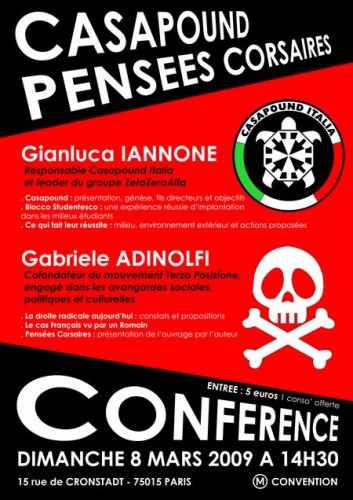 HET NATIONALISME in Italië kent sinds enkele jaren een zeer vernieuwende militante, intellectuele en artistieke activiteit die zich heel uitdrukkelijk op het fascisme beroept. Precies zeven jaar geleden, op 26 december 2003, beslisten jonge Romeinse neofascistische militanten om een leegstaand gebouw in te nemen volgens de door de Italiaanse revolutionaire rechterzijde ontwikkelde strategie van de zogenaamde "Non-conforme bezetting / Bezetting met het oog op huisvesting" (ONC/OSA). "Non-conformiteit" is de duidelijke eis waarmee ze de politieke correctheid over alle onderwerpen afwijst; een eis verheven tot de rang van ware filosofie. De bezetting was erop gericht om de neofascistische jeugd in Rome te voorzien van een ruimte waar ze het sociale en culturele alternatief zou kunnen organiseren dat ze tot dusver moest missen.
Door bepaalde methoden van uiterst-links voor eigen rekening over te nemen werd ze doelmatiger en maakte ze die laatste voorgoed achterhaald. Het gebouw is vernoemd naar de Amerikaanse dichter en onvoorwaardelijke steun van het Italiaanse fascistische regime, Ezra Pound. De Italiaanse revolutionaire rechterzijde was in volle verandering en besteedde van dat ogenblik af een bijzondere aandacht aan de sociale en culturele dimensie van haar strijd en haar methoden om de Italiaanse jeugd te verleiden.
EEN JONG, MILITANT EN REVOLUTIONAIR NETWERK DAT ZICH UITBREIDT
Casapound – in 2010 een vereniging geworden die meer dan 2.000 ingeschreven leden telt – heeft zich sindsdien verspreid over heel Italië, waar het bars, sportclubs en non-conforme ruimten beheert. In Rome beschikt Casapound over steunpunten om de nieuwe fascistische cultuur te verspreiden die ze is beginnen vorm te geven en die ze aanpast aan de uitdagingen van de 21ste eeuw en de nieuwe generatie die ermee gepaard gaat. De militanten kunnen elkaar vinden in de pub “Cutty Sark”, terwijl een uitgeverij in de promotie van het literaire en doctrinaire werk van de beweging voorziet. Haar naam, “Quatrocinqueuno”, is een toespeling op de roman Fahrenheit 451 – een visionair werk over een totalitaire maatschappij die wordt bepaald door een eenheidsdenken dat stelselmatig de boeken vernietigt. Aan het hoofd van de bekende muziekgroep van Casapound, “Zetazeroalfa”, staat Gianluca Ianonne, leider van de beweging. Het is hij die, samen met anderen, de toon aangeeft. Volgens hem moeten de fascisten breken met de logica van het getto, het terugplooien op zichzelf, het electoralisme; ze moeten – zoals hij nadrukkelijk stelt – "het heden stormenderhand veroveren”. Zijn logica: meer dan ooit de mythe van Mussolini, het fascistische en nationaal-revolutionaire avontuur doen leven in het begin van het derde millennium. Daarom geeft Casapound voorrang aan vier assen: cultuur, samenhorigheid, sport en natuurlijk politiek. De vereniging heeft geen enkele band met de Italiaanse partijen die ze zonder uitzondering als ondoeltreffend en enggeestig beschouwt. In elk van die gebieden heeft Casapound stof gevonden om iets te doen. Sport is een bevoorrecht gebied en wordt als een alternatief gezien voor de omringende middelmatigheid en de drugs. In Lecce richtte Casapound een voetbalclub op, in Bolzano een hockeyclub, in Rome een rugbyschool en –ploeg, evenals een waterpoloclub die straks in staat is om het nationale niveau te bereiken. Een boksclub is ontstaan, evenals een parachuteclub met de naam “Istincto Raptor" en de alpinismeclub “La Muvra”. Op sociaal gebied strijdt Casapound met zijn structuur "Mutuo Sociale" voor het “eigen volk eerst” (nationale voorkeur) inzake huisvesting ofwel komt het Italiaanse families in moeilijkheden ter hulp, zoals tijdens de aardbeving in L’Aquilla. Een van de belangrijkste intellectuelen van de beweging, Gabriele Adinolfi, vertelt naar aanleiding daarvan dat een bejaarde boerin, terwijl de democratische burgemeester de inbreng van fascistische hulp aan het aanklagen was, iedereen toeriep: "Ik wist het dat de fascisten goeie mensen waren!” Vandaar is het binnen Casapound tot de oprichting gekomen van een vrijwillige burgerbescherming, belast met de hulp aan de armste Italianen.
VOOR EEN AVANT-GARDISTISCHE ESTHETIEK Op artistiek gebied herneemt Casapound in zijn publicaties en affiches de esthetiek van de Italiaanse futuristen uit de jaren ‘20, toen het esthetische uitstalraam van het nationalisme op het schiereiland. Ruimte dus voor de rechte lijnen, de hoeken, de beweging als evocatie van de actie, de energie en de durf, maar ook voor alles wat kan verwijzen naar het heldendom, voorgesteld als opperste deugd van een dagelijkse levenskunst. De boekenwinkel “Testa di Ferro” biedt de werken aan van de grote intellectuele en politieke figuren van de conservatieve revolutie, van Codreanu over Mishima tot Nietzsche. Er zijn ook meer sulfureuze auteurs als Hitler en natuurlijk Mussolini. Opgehangen aan de theorie van het “mediatieke squadrisme”, d.w.z. spectaculaire blits-acties om de leidmotieven van de beweging te verspreiden en indruk te maken op politieke vijanden. Casapound heeft trouwens zijn eigen artistieke beweging: het “turbodynamisme”. Een van de eerste uitvoeringen van deze alternatieve en non-conformistische kunstschool was een retroprojectie van enorme portretten van Robert Brasillach op de muren van Rome. De affiches van Casapound, die vergaderingen, concerten en andere bijeenkomsten aankondigen, worden ook ontworpen volgens die wil om de fascistische esthetiek bijdetijds te maken met de nieuwe creatieve middelen die door de computer worden aangeboden. De scherpste geometrische vormen worden in zwart-wit geplaatst met de portretten van grote mannen uit de geschiedenis van het nationalisme, terwijl ze vrijheid, verbeeldingskracht, kameraadschap en strijdlust verheerlijken. Deze posters zijn nu gemeengoed in sommige delen van Rome en aanvaard door de bevolking. De term "fascistisch" is er normaal geworden dankzij de propaganda-inspanning van Casapound. De stad van de Caesars knoopt geleidelijk aan weer aan met zijn grote politieke traditie, die opnieuw tot leven is gewekt door de jonge generatie. Verlangend om het hart te zijn van een cultureel alternatief voor het conformisme van de burgerlijke linker- en rechterzijde, biedt Casapound verschillende kunstenaars tentoonstellingsruimtes aan, evenals een kunsttijdschrift. "De droom vernieuwen", dat is de voortdurende motivatie van de militanten die onophoudelijk blijven vernieuwen op alle gebieden. Kunst en muziek zijn de twee machtige instrumenten die deze ontwikkeling mogelijk maken; ze bereiken de meeste mensen, in het bijzonder de jongeren.
INTELLECTUELE INTENSITEIT, ACTIVISME EN LEVENSLUST Casapound weigert mee te doen met het spel van de partijen. De vereniging ziet die laatste als een rem op elke durf, omdat ze in naam van de verkiezingen verplicht zijn zich gematigder op te stellen. Bevrijd van elke gedwongenheid op dit gebied is haar vrijheid des te groter. De vereniging heeft een maandblad: “Occidentale”. Een van de boegbeelden van dat blad is Gabriele Adinolfi; hij leidt ook het Studiecentrum Polaris, waarmee hij vernieuwende politieke voorstellen ontwikkelt. Hij legt ons uit dat zijn strategie aangepast is aan elke doelgroep. Op zijn site “noreporter.org” legt hij zich enkel toe op de actualiteit, daar waar Polaris liever geschiedenis behandelt – en in het bijzonder die van de Tweede Wereldoorlog, maar dan wel herzien en verbeterd. In zijn lezingen voor Casapound biedt hij zijn raad aan als ervaren fascistische militant; Gabriele Adinolfi heeft 20 jaar in Franse ballingschap moeten leven vanwege zijn engagement tijdens de “loden jaren” in Italië. De meest veelbetekenende doorbraak is misschien die van het Blocco Studentesco – de studentenformatie van Casapound – dat in 2010 bijna 40% van de stemmen in de Romeinse onderwijsinstellingen verzamelde en dit terwijl het zich openlijk op het fascisme beroept. Het is de gewoonste zaak geworden om jongeren van vijftien en zestien jaar, afkomstig uit de volksbuurten, elkaar de Romeinse groet te zien brengen. Begin december verzamelde het Blocco Studentesco drieduizend betogers in de hoofdstad tegen een hervorming van het openbare onderwijs. De stem van Blocco Studentesco is overheersend geworden tegenover een linkse (communistische of sociaaldemocratische) studentenbeweging die niet bij machte is om de algemene trend te stuiten. De vreugde, de jeugd, de scheppingskracht zijn de basisprincipes van een bijna militair gestructureerde beweging. Door de oranje en okeren straten van Rome stapt voortaan een jeugd die opnieuw fier met de zwarte vlag zwaait en zich beroept op de prestigieuze herinnering aan de Romeinse Republiek en haar geestelijke erfgenaam, die het fascisme is. De snelle en organische uitbreiding van Casapound Italia laat een glimp zien van de spectaculaire ideologische en culturele successen binnen de nieuwe Italiaanse generatie. Zoals Gabriele Adinolfi zegt: “Nooit sinds mijn geboorte is het fascisme zo populair geweest in de Italiaanse publieke opinie”. De oogst zal ongetwijfeld gaan naar diegenen die zich aandienen als de “fascisten van het derde millennium” en aantonen dat de dageraard zal komen met een gezonde, verstandige, hedendaagse en onbuigzame radicaliteit. Lange leve Casapound en de camerati!
Yann KERMADEC
00:15 Publié dans Actualité, Affaires européennes, Politique | Lien permanent | Commentaires (0) | Tags : casa pound, italie, europe, affaires européennes, politique, fascisme, contestation | | del.icio.us | | Digg | Facebook
mercredi, 19 janvier 2011
Casa Pound: les fascistes du Troisième Millénaire
Casa Pound, les fascistes du troisième millénaire...
Par Yann Kermadec
Rivarol ( * )
LE NATIONALISME italien connaît depuis quelques années un bouillonnement militant, intellectuel et artistique très novateur et dynamique, se revendiquant très expressément du fascisme. Il y a sept ans exactement, le 26 décembre 2003, de jeunes militants néo-fascistes romains décidaient de s’emparer d’un bâtiment vide selon la stratégie mise au point par la droite révolutionnaire italienne dite « Occupation Non Conforme / Occupation à But d’Habitation». La « non conformité » est la revendication affirmée du refus du politiquement correct sur tous les sujets, une revendication hissée au rang de véritable philosophie. L’occupation avait pour but de doter la jeunesse néo-fasciste romaine d’un espace ou elle pourrait organiser l’alternative sociale et culturelle dont elle était privée par ailleurs.
Reprenant à son compte certaines méthodes d’extrême gauche, elle gagna en efficacité et ringardisa définitivement cette dernière. Le bâtiment fut baptisé du nom du poète américain et soutien inconditionnel du régime fasciste italien, Ezra Pound. La droite révolutionnaire italienne en pleine mutation accorda dès lors une attention particulière à la dimension sociale et culturelle de ses luttes et de ses méthodes afin de séduire la jeunesse italienne.
UN RÉSEAU MILITANT JEUNE ET RÉVOLUTIONNAIRE QUI S’ÉTEND
Casapound, devenue une association qui compte en 2010 plus de 2 000 membres encartés, a depuis essaimé dans toute l’Italie ou elle gère des bars, des clubs de sport, des espaces non-conformes. À Rome, Casapound dispose de points d’appuis pour diffuser la nouvelle culture fasciste qu’elle a entrepris de forger et qu’elle adapte aux enjeux du XXIe siècle et à la nouvelle génération qui l’accompagne. Les militants peuvent se retrouver au pub « le Cutty Sark », tandis qu’une maison d’édition assure la promotion de la production littéraire et doctrinale du mouvement. Son nom, “quatrocinqueuno”, est une allusion au roman Fahrenheit 451, oeuvre visionnaire d’une société totalitaire conditionnée par une pensée unique reposant sur la destruction systématique des livres. À la tête du groupe de musique phare de Casapound, “Zetazeroalfa”, Gianluca Ianonne, chef du mouvement C’est lui parmi d’autres qui donne le ton. À ses yeux, les fascistes doivent rompre avec la logique du ghetto, de l’enfermement sur soi, de l’électoralisme et, comme il l’affirme avec force, « prendre d’assaut le présent ». Sa logique, faire vivre plus que jamais le mythe mussolinien, l’aventure fasciste et nationale-révolutionnaire dans le troisième millénaire qui débute. Pour cela, Casapound privilégie quatre axes que sont culture, solidarité, sport et bien sûr politique.

L’association n’entretient aucun lien avec les partis italiens unanimement jugés inefficaces et boutiquiers. Dans chacun de ces domaines, Casapound a trouvé matière à agir. Le sport est un domaine privilégié, pensé comme une alternative à la médiocrité ambiante et à la drogue. À Lecce, Casapound a créé un club de football, un autre de hockey à Bolzano, une école et équipe de rugby à Rome ainsi qu’une autre de water polo bientôt capable d’atteindre le niveau national. Un club de boxe a vu le jour ainsi qu’un club de parachutisme appelé « Istincto Rapace » et un autre d’alpinisme, « La Muvra ». Dans le domaine social, Casapound lutte pour obtenir la préférence nationale dans le logement avec sa structure « Mutuo Sociale » ou encore vient en aide aux familles italiennes en difficulté comme lors du séisme d’Aquilla. Un des intellectuels majeurs du mouvement, Gabriele Adinolfi, raconte à cette occasion comment une paysanne âgée, alors que le maire démocrate dénonçait l’intrusion des secours fascistes, criait à tout le monde « Je le savais que les fascistes étaient des gens bons ! ». De là a découlé la création d’un service de protection civile volontaire au sein de Casapound chargé d’aider les Italiens les plus démunis. POUR UNE ESTHÉTIQUE AVANT-GARDISTE

Dans le domaine artistique, Casapound reprend à son compte dans ses publications et affiches l’esthétique produite par les futuristes italiens des années 1920, alors vitrine esthétique du nationalisme de la péninsule. Place donc aux lignes droites, aux angles, au mouvement comme évocateur de l’action, de l’énergie et de l’audace, mais aussi à tout ce qui peut se référer à l’héroïsme, présenté comme vertu suprême d’un art de vivre quotidien. La librairie « Testo di Ferro » propose les oeuvres des grandes figures intellectuelles et politiques de la révolution conservatrice, de Codreanu à Nietzsche en passant par Mishima. On y trouve aussi des auteurs plus sulfureux comme Hitler et bien sûr Mussolini. Partisan de la théorie du « squadrisme médiatique », c’està- dire des actions spectaculaires et éclair visant à diffuser les idées forces du mouvement et à impressionner les ennemis politiques. Casapound a par ailleurs créé son propre mouvement artistique, le “turbodynamisme”. Une des premières performances de cette école artistique alternative et nonconformiste fut la projection d’immenses portraits de Robert Brasillach par rétroprojecteurs sur les murs de Rome. Les affiches de Casapound qui annoncent les réunions, concerts et autres conférences, sont elles mêmes conçues selon cette volonté de réactualiser l’esthétique fasciste avec les formes nouvelles qu’offrent les outils de création informatiques. Les formes géométriques les plus tranchées s’exposent en noir et blanc avec les portraits de grands hommes de l’histoire du nationalisme, exaltant la liberté, l’imagination la camaraderie et l’esprit de lutte. Ces affiches sont désormais monnaie courante dans certains quartiers de Rome et admises par la population. Le terme “fasciste” y est normalisé grâce à l’effort de propagande de Casapound. La cité des Césars renoue progressivement avec sa grande tradition politique, régénérée par la jeune génération. Désireux d’être le coeur d’une alternative culturelle au conformisme de la gauche et de la droite bourgeoises, Casapound offre à plusieurs artistes des espaces d’exposition ainsi qu’une revue artistique. « Renouveler le rêve », telle est la motivation permanente des militants qui cherchent sans cesse à innover dans tous les domaines. L’art et la musique sont les deux puissants instruments qui rendent possible cette démarche en touchant le plus grand nombre, tout spécialement la jeunesse.
INTENSITÉ INTELLECTUELLE, ACTIVISME ET JOIE DE VIVRE
La Casapound refuse d’entrer dans le jeu des partis considérés par l’association comme propres à inhiber toutes les audaces au nom d’une modération électoraliste obligatoire. Libérée de toute contrainte en la matière, sa liberté en est d’autant plus grande. L’association possède un mensuel, L’Occidental. Une de ses figures de proue est Gabriele Adinolfi qui anime le Centre d’Études Polaris ou il développe des propositions politiques novatrices. Il nous explique sa stratégie comme adaptée à chaque public. Sur son site “noreporter.org”, il s’attache à la seule actualité là où Polaris traite plus volontiers d’histoire et notamment de celle, revue et corrigée, de la Seconde Guerre mondiale. Dans ses conférences à Casapound il offre ses conseils de militant fasciste expérimenté, Gabriele Adinolfi ayant dû s’exiler vingt ans en France en raison de son engagement durant les « années de plomb » en Italie. La percée la plus significative du mouvement étant peut-être celle du Blocco Studentesco, la formation étudiante de Casapound, qui rassemble en 2010 près de 40% des suffrages dans les établissements romains et ceci en se revendiquant ouvertement du fascisme. Il est devenu chose courante de voir des jeunes de quinze et seize ans issus des couches populaires échanger le salut romain. Début décembre le Blocco Studentesco rassemblait trois mille personnes dans la capitale contre une réforme de l’Instruction Publique. Sa voix est prépondérante face à une gauche étudiante, communiste ou sociale-démocrate, devenue impuissante à enrayer l’engouement général. La joie, la jeunesse, la créativité sont les principes fondamentaux d’un mouvement charpenté presque militairement. Les rues d’orange et d’ocre de Rome sont désormais battues par une jeunesse brandissant à nouveau fièrement le drapeau noir et revendiquant la prestigieuse mémoire de la République Romaine et de son héritier spirituel qu’est le fascisme. L’extension rapide et organique de Casapound Italia laisse entrevoir des succès idéologiques et culturels spectaculaires au sein de la nouvelle génération italienne. Comme le dit Gabriele Adinolfi, « Jamais depuis ma naissance le fascisme n’a été aussi populaire dans l’opinion publique italienne ». Les récoltes seront à n’en pas douter au rendez-vous pour ceux qui se présentent comme les « fascistes du troisième millénaire » et qui démontrent que l’aube viendra avec une saine, intelligente, moderne et intransigeante radicalité. Longue vie à Casapound et aux camerati !
 (*) Article publié dans le dernier numéro de Rivarol (cliquez ici)
Site de Casapound :
Site de Gabriele Adinolfi : cliquez là
Article repris sur Zentropa : cliquez là
00:15 Publié dans Actualité, Affaires européennes, Politique | Lien permanent | Commentaires (0) | Tags : italie, rome, casa pound, nationalisme, solidarisme, europe, politique, politique internationale, affaires européennes, mouvement contestataire, contestation | | del.icio.us | | Digg | Facebook
mardi, 04 janvier 2011
Deux coeurs fascistes nés dans des familles rouges
Michelangelo INGRASSIA :
Deux cœurs fascistes nés dans des familles rouges
Sur le destin oublié de Mario Gramsci et de Teresa Labriola
Dans l’histoire italienne du 20ème siècle, on relève deux cas emblématiques d’adhésion au fascisme, qui expliquent la présence précoce de cette idéologie quiritaire dans la société italienne préfasciste : il s’agit de Mario Gramsci, le frère fasciste du fondateur du PCI et du quotidien « L’Unità », et de Teresa Labriola, la fille fasciste de l’homme qui joua un grand rôle dans la diffusion du « socialisme scientifique » et du « matérialisme historique » en Italie.
Dans la trajectoire historique du fascisme, il y a un petit instant fugace dont les historiens de cette idéologie n’ont pas voulu ou n’ont pas su saisir l’importance ; ce moment fugace s’est alors dilué dans les définitions éparses que l’on a données du fascisme, au point de perdre toute consistance dans les interprétations et les jugements historiques ultérieurs ; ce moment fugace, c’est la perception que les contemporains avaient du fascisme au moment même où il a fait son apparition sur la scène politique nationale italienne.
Quand nous parlons de « perception », nous entendons la perception initiale du fascisme à ses tout premiers débuts, une perception que l’on pourrait très bien qualifier d’initiatique parce qu’y interagissaient de multiples impressions, émotions, sentiments, affects, etc. qui généraient et caractérisaient la saisie immédiate du phénomène, faisaient qu’on jugeait de sa valeur sans filtres, de manière immédiate, tout en prenant acte de son existence et donc de son contenu axiologique et politique. Ce moment, cet instant, est celui qui précède et détermine l’élan vers le phénomène nouveau qu’était le fascisme, la durée et l’intensité de l’adhésion à son credo et son programme.
En ce sens, cet instant de la perception première du fascisme permet d’aborder la question irrésolue qu’il recèle encore et toujours : celle de sa genèse ab ovo. Si l’on sonde en profondeur cet instant, on pourra mieux comprendre le moment suivant de son évolution dans le temps, celui de l’adhésion effective. Ces instants révèlent la signification et, partant, la légitimité, du fascisme, quand il émerge sur la scène politique italienne.
Nous n’entendons pas parler ici de consensus mais d’adhésion. Le consensus va vers une action politique déterminée, vers un certain type de gouvernement, vers une certaine façon de gouverner le pays, mais il peut s’avérer superficiel, il n’indique pas qu’il y a imprégnation de l’idée jusqu’aux tréfonds de l’âme ; le consensus peut s’accroître ou se restreindre selon les circonstances. L’adhésion, elle, va vers l’idée, vers la doctrine, vers le système de valeurs : en ce sens, elle est totale et totalitaire ; elle possède le chrisme du serment intérieur et peut se transformer en désespoir, en abîme de tristesse, si la praxis s’éloigne de la théorie.
On a très justement démontré que le fascisme avait obtenu le consensus des masses, du moins jusqu’à un certain point ; ce consensus a été expliqué de manières diverses : Adriano Romualdi, par exemple, parlait d’une imprégnation culturelle inachevée, d’un manque d’imprégnation véritablement révolutionnaire dans le sens fasciste du terme. On a parlé de l’adhésion au fascisme comme d’une adhésion superficielle, par calcul ou par réflexe familial. Il est bien possible en effet que les Gattuso, Pintor, Spadolini, Ingrao, Cantimori (la liste n’est pas exhaustive…) aient adhéré au fascisme « parce que tout le monde faisait pareil ». En somme, l’adhésion n’aurait été, chez ces hommes-là, qu’une coïncidence tragicomique… Si nous tenons en dehors de notre discours sur le fascisme le moment même où l’idéologie a été perçue, saisie dans son ensemble avant d’être traduite dans la réalité politique, alors, effectivement, nous pouvons croire aux litanies que nous débitent ceux qui parlent de « leurs erreurs de jeunesse », qui disent « avoir été grugés », trompés par la camelote idéologique, etc. En revanche, si nous nous penchons plutôt sur l’instant premier et fugace de la perception initiale du fascisme, nous devons changer de discours : l’adhésion n’est plus une coïncidence mais une « conception » dans le sens d’une naissance à une vie nouvelle.
Le fait est là : avant qu’il n’apparaisse, avant d’être accepté et toléré, le fascisme a été « conçu ». Cela signifie qu’il a d’abord déchiré les consciences et les familles, qu’il a opéré des césures entre catégories sociales et amitiés humaines, qu’il a suscité des discussions dans les foyers, les bureaux, les usines, les rues : tout cela ne crée pas des coïncidences mais oblige à des choix. En vérité, il n’y a pas eu que des choix en faveur du fascisme : des oppositions à lui sont nées et se sont consolidées, mais l’émergence de telles hostilités ne nie pas la pertinence de cet instant primordial qu’est la perception du fascisme, moment où toutes les conséquences de cette perception sont déjà là in nuce.
Le fascisme, qu’il plaise ou non, n’a pas vécu dans l’indifférence et de l’indifférence mais a fait partie intégrante de la réalité humaine (avant de faire partie intégrante de la réalité politique) de la nation italienne, à un moment déterminant de son histoire ; il a été conçu et perçu comme un mouvement révolutionnaire, capable de jeter les fondements d’un Etat nouveau, de résoudre les crises sociale et nationale, en donnant une nouvelle vigueur aux idéaux ambiants : le personnalisme, le socialisme, le sorélisme.
Nous allons maintenant examiner deux cas emblématiques de cette perception/conception du fascisme, qui expliquent sa présence originelle et originale dans la société italienne et montrent que ce fascisme a été capable de séparer deux frères, de séparer une fille de son père : il s’agit de Mario Gramsci, le frère fasciste d’Antonio Gramsci, fondateur du PCI et du quotidien « L’Unità » ; et de Teresa Labriola, la fille fasciste de l’homme qui joua un très grand rôle dans la diffusion du « socialisme scientifique » et du « matérialisme historique » en Italie.
L’adhésion au fascisme du frère d’Antonio Gramsci et de la fille d’Antonio Labriola ne fut pas une simple coïncidence comme on en trouve en abondance dans l’histoire ni un fait mineur et éphémère surexploité par la propagande : elle fut la suite logique d’une certaine conception du fascisme. Sur Teresa Labriola, nous disposons d’une biographie, fruit des recherches menées par Fiorenza Taricone (Teresa Labriola – Biografia politica di un’intelletuale tra ottocento e novecento, Edizioni Franco Angeli, 1995) ; cet ouvrage a été remarquablement bien recensé par Annalise Terranova dans les colonnes du Secolo d’Italia, le 3 juin 1995. Ce livre ne consacre qu’un seul chapitre au fascisme de Teresa Labriola mais il nous révèle suffisamment de choses pour saisir les causes de l’adhésion de cette intellectuelle féministe en chemise noire. Teresa Labriola, à l’aube de la « biennale rouge », découvre qu’il y une chose bien plus importante que la « conscience de classe » marxiste : c’est la conscience patriotique ; ensuite, l’émancipation féminine ne se fera pas comme l’antithèse de la famille, ne se fera pas contre l’homme et contre l’Etat, mais en harmonie avec les valeurs masculines et étatiques, et dans le cadre de la nation. C’est donc sa vision organique de l’Etat et de l’émancipation féminine dans le contexte national qui fait que Teresa Labriola perçoit le fascisme comme la seule et unique possibilité de donner à la femme un rôle révolutionnaire dans le processus de régénérescence nationale et d’élévation du peuple, et de donner à la maternité une dimension et une valeur sociales. Teresa Labriola a beaucoup écrit ; elle est morte en 1941, en étant toujours membre du mouvement fasciste. Son adhésion fut militante, justifiée par les fondements mêmes de l’idéologie fasciste et non une simple formalité bureaucratique, effectuée au moment où le régime connaissait son apogée. Le caractère militant de son adhésion donne un sens plein et entier à ses démarches politiques.
Mario Gramsci, contrairement à Teresa Labriola, attend toujours son biographe, pour qu’on en sache un peu plus sur sa personnalité et son engagement. Pour l’instant, la seule manière d’apprendre quelque chose sur sa vie, c’est de se référer à une biographie de son frère, mondialement connu. Cette biographie est celle de Giuseppe Fiori (Vita di Antonio Gramsci, Roma/Bari, 1974). Fiori fut l’un des rares historiens à avoir osé parler du frère fasciste de l’icône communiste. Le Gramsci fasciste est né à Sorgono (Nuoro) en 1893, deux après Antonio. Ce dernier était un garçon solitaire et silencieux. Mario, au contraire, est turbulent et vif ; en 1904, quand il a achevé ses études primaires, sa mère l’envoie au séminaire, mais quelques années plus tard, il abandonne prestement la bure monacale : « Donne-la à Nino (= Antonio), à toutes fins utiles. Lui, il ne pense pas aux filles et il pourrait bien devenir prêtre ». A dix-huit ans, Mario Gramsci s’engage dans l’armée comme soldat volontaire, participe à la Grande Guerre et obtient le grade de sous-lieutenant. La « biennale rouge » le surprend à Varese, où il adhère au fascisme. C’est dans cette ville qu’il deviendra le premier secrétaire fédéral du fascisme local. Entretemps, il épouse Anna Maffei Parravicini, quitte l’armée et se lance dans une entreprise commerciale. En 1921 encore, son frère Antonio cherche à le dissuader ; les deux frères ont une longue discussion commune, où Antonio invite Mario à « réfléchir ».
Mario ne cède pas et reste fasciste, même après avoir été bastonné jusqu’au sang par des comparses de son frère Antonio. Les deux frères ne se verront plus avant 1928 : Antonio, le communiste, est en prison ; Mario, le fasciste, reste fasciste mais n’obtient plus aucune charge importante dans la hiérarchie. Antonio écrit à sa mère : « J’ai su qu’il s’était occupé de moi : voudrais-tu bien lui écrire pour l’en remercier ? ». Mario rend visite à son frère en prison mais les liens entre les deux hommes finissent par s’étioler parce qu’Antonio est irrité du fait que son frère décrit, à l’attention de leur mère, son état de santé sur un ton préoccupé. Après cette fâcherie, les deux frères ne se reverront plus jamais.
Mario s’engage comme volontaire pour la campagne d’Abyssinie puis participe à la seconde guerre mondiale ; en 1941, il combat en Afrique du Nord. Malgré l’affaire du Grand Conseil fasciste du 25 juillet 1943 et après la décision de Badoglio et du Roi, le 8 septembre 1943, de poursuivre la guerre aux côtés des Alliés anglo-saxons, il reste fidèle à Mussolini et à la République Sociale, comme l’a rappelé Veneziani. Il demeure encore et toujours fasciste même après sa déportation dans un camp de concentration australien, où il a été torturé et battu pour qu’il abjure. Mario Gramsci n’a pas abjuré. A la suite des mauvais traitements subis, Mario attrape une grave maladie, qui le terrasse dès son retour en Italie, à la fin de l’année 1945. Il n’avait que 52 ans. Il laissait deux enfants : Gianfranco et Cesarina.
La biographie de Mario Gramsci est la biographie d’un fasciste sincère, le témoignage d’une cohérence politique. Mario était désintéressé comme l’atteste son refus de participer à la hiérarchie du mouvement, laquelle a petit à petit succombé à l’absence de qualité de ses membres et au conformisme.
Si Mario Gramsci a choisi l’action, Teresa Labriola a préféré la pensée. Tous deux, cependant, ont perçu et conçu le fascisme comme quelque chose de foncièrement différent des autres idées politiques de l’époque, comme quelque chose de plus actuel, de plus révolutionnaire. On ne peut nier l’honnêteté de leurs prises de position, leur bonne foi, tout comme on ne peut nier les mêmes qualités chez le frère de Mario et le père de Teresa, quand ils défendaient et illustraient leurs propres idées. Mario Gramsci et Teresa Labriola mériteraient bien de revenir « dans la patrie » des idées fascistes, après un long exil qui les a houspillés hors de la mémoire historique nationale, tout comme les autres tenants d’un fascisme perçu comme phénomène véritablement révolutionnaire.
Michelangelo INGRASSIA.
(article tiré d’ « Area », Rome, avril 2000 ; trad. franç. : décembre 2010)
00:15 Publié dans Histoire | Lien permanent | Commentaires (0) | Tags : histoire, fascisme, italie, mario gramsci, teresa labriola | | del.icio.us | | Digg | Facebook
vendredi, 17 décembre 2010
Cavalcare la crisi
Cavalcare la crisi
di Stefano Zecchi - Marco Iacona
Fonte: scandalizzareeundiritto
 -Evola ha costruito gran parte delle sue riflessioni attorno al concetto di crisi. Lei crede che ciò lo allontani da una cultura italiana che nella sua generalità, nel XX secolo, non ha partorito grandi opere su questo tema?
«Il tema della crisi è un argomento che ha impegnato buona parte della cultura europea e in questo senso Evola si pone come serio interlocutore. In Italia però, nonostante sia ben conosciuta, la cultura della crisi non viene tematizzata perché domina l’idealismo, quello crociano e quello gentiliano. Si pensi al disconoscimento da parte di Croce del valore di un libro famosissimo come Der Untergang des Abendlandes oppure alle ricerche e alle conferenze in tema di crisi di Husserl o alle tematiche heideggeriane. Ecco, alla sua domanda risponderei di sì, Evola si pone al di fuori della cultura filosofica dominante. Certo poi gioca a suo sfavore la collocazione politica che aumenta il distacco della sua ricerca filosofica dalla restante parte della cultura italiana».
-Perché ha scritto il saggio introduttivo alla V edizione di Cavalcare la tigre (Stefano Zecchi, Evola, o una filosofia della responsabilità contro il nichilismo, Mediterranee 1995)?
«Fu Gianfranco de Turris ad offrirmi quest’opportunità ed io accetti volentieri. Penso che Cavalcare la tigre sia un testo importante. Evola mostra i limiti della modernità nel momento in cui è trionfante e nel momento in cui esprimersi contro di essa era né più e né meno che un’eresia. Il libro s’incrociava anche con i miei studi, nonostante le tematiche svolte fossero assai diverse. La conoscenza di Cavalcare la tigre era fondamentale perché fondamentale era per me la proposta di un angolo di visuale sul tema della modernità e sul concetto di crisi».
-Cavalcare la tigre esce agli inizi degli anni Sessanta. Qual è il clima culturale italiano di quel periodo?
«È il clima più ostile possibile nei confronti di una critica alla modernità! La cultura di destra era sotterranea quindi non aveva voce all’interno del dibattito culturale; la cultura laico-liberale e quella comunista si sviluppavano invece su prospettive totalmente diverse da una critica all’idea di modernità. Ma non era solo Evola ad essere bistrattato, si pensi a come erano stati trattati Heidegger e Husserl, cioè gli esponenti di una filosofia che usciva fuori da prospettive diciamo così à la page. Di più, in Italia si stava instaurando, costruita con grande meticolosità, l’egemonia culturale della sinistra, quindi Evola come altri grandi pensatori europei era posto ai margini del dibattito culturale».
-Cosa pensa dell’interesse in negativo di Evola per gli esistenzialisti?
«Credo che Evola per certi aspetti abbia visto giusto. La critica evoliana agli esistenzialisti per qualche verso mi sembra analoga alla critica fatta da Henry Miller ai surrealisti. Miller scrisse la Lettera aperta ai surrealisti (che si trova nel volume Max e i fagociti bianchi) accusandoli di intellettualismo e di incapacità di toccare a fondo i temi che essi stessi avevano sollevato. Evola mi dà l’idea di sviluppare una critica, diciamo così, metodologicamente analoga a quella di Miller perché mette in evidenza la mistificazione e le ambiguità di un pensiero esistenziale che in realtà non arriva a porre i veri temi dell’esistenza. Un pensiero che resta come una forma superficiale di interrogazione dell’essere umano».
-Lei scrive che Cavalcare la tigre «può essere letto come un manuale di sopravvivenza» «da chi crede che la società moderna porti al disastro personale e sociale, culturale e politico». Ma in quanto strumento di “salvezza” secondo lei Cavalcare la tigre è davvero efficace?
«Paradossalmente le tematiche evoliane, o comunque se non Evola il clima culturale a cui Evola appartiene sono ben più attuali oggi. Con la perdita dell’enfasi sull’idea di sviluppo e di progresso c’è maggior attenzione ai temi della crisi, e quindi i punti che Evola ha toccato sono di maggiore attualità. Ecco, le critiche di Evola (come alcune cose dette da Heidegger e da Husserl) proprio per questa perdita del valore teoretico ed etico del progresso oggi ritornano. Devo dire però che Cavalcare la tigre ci anche ha dato una mano ad attraversare un deserto: così siamo arrivati all’oggi potendo dire che per fortuna i tempi sono molto diversi».
-Lei mostra qualche affinità col pensiero di Evola...
«Io non sono un “evoliano”, il mio pensiero si sviluppa in modo diverso, sebbene, come dicevo, alcuni aspetti della critica della modernità ritornino nei miei libri. Ricordo ad esempio che quando scrissi un libro come La Bellezza (1990) soltanto il termine “bellezza” venne considerato offensivo nei riguardi della modernità».
-Parafrasando il titolo di un suo libro degli anni Novanta (Stefano Zecchi, Sillabario del nuovo millennio, Mondadori 1993), secondo lei Evola potrebbe essere un pensatore capace di decrittare il nuovo millennio?
«Sicuramente sì. Evola è uno dei grandi pensatori del nostro secolo collocabile, come ho detto più volte, all’interno del filone della crisi. Piuttosto, ripeto, su di lui ha giocato negativamente l’esperienza politica e il fatto che la cultura egemone fosse legata al dibattito politico italiano. Penso che Evola paghi un prezzo che col passare del tempo sarà sempre meno salato».
-Un’ultima domanda. Lei ha scritto di televisione e conosce i mezzi di comunicazione. Potremmo fare un parallelo fra Evola e Pasolini dicendo che si tratta di due autori che si sono opposti al potere trionfante dei moderni mezzi di comunicazione?
«Beh, in Evola c’è anche una sorta di filo moralistico, secondo il quale qualunque fenomeno moderno conduce alla massificazione. In Pasolini invece, a parte il tema moralistico, c’e un’accettazione e perfino un utilizzo dei mezzi di comunicazione di massa. Pasolini è più disponibile perché la sua è una critica ad una modernità dimentica degli aspetti originari dell’esistenza, della dimensione rurale e di quella operaia. Pasolini usa cinema, televisione e giornali ed esercita sul campo le sue critiche. Ritengo invece che Evola non avrebbe mai voluto sporcarsi gli abiti inserendosi fra i protagonisti dei più moderni mezzi di comunicazione».
Tante altre notizie su www.ariannaeditrice.it
09:42 Publié dans Entretiens, Traditions | Lien permanent | Commentaires (0) | Tags : evola, julius evola, tradition, traditionalisme, entretiens, italie, philosophie | | del.icio.us | | Digg | Facebook
mardi, 30 novembre 2010
March on Fiume
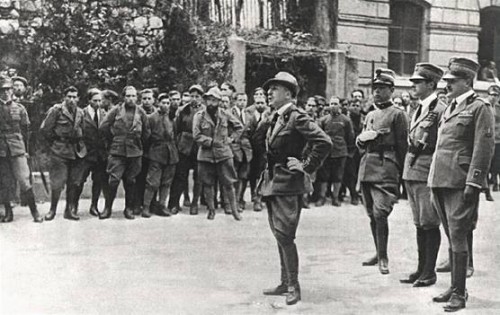
MARCH ON FIUME
Excerpted from Hakim Bey’s T.A.Z. The Temporary Autonomous Zone, Ontological Anarchy, Poetic Terrorism
Ex: http://www.freespeechproject.com/
“To die is not enough.”
— D’Annunzio
When pressed about his political allegiance, Gabriele D’Annunzio (1863-1938) refused to commit himself. “My undertaking may seem rash and alien to my art and style of life,” he wrote to his publisher, “but… people must realise that I am capable of doing anything.” After his election to Italy’s Chamber of Deputies he showed his contempt for the parliamentary circus by rarely attending the sessions, and behaving unpredictably when he did. Nicknamed “the deputy of beauty”, D’Annunzio watched the parliamentary debates as an artist rather than a participant. Originally elected to the Chamber as a ‘rightwing’ nationalist, he had no trouble crossing the floor to vote — and sit with — members of the ‘extreme left’.
Plagued by creditors, D’Annunzio settled in France in 1910 to concentrate on his writing and art. Since the 1890s he had enjoyed mass appeal and on returning to Italy in 1915 he was greeted by some one hundred thousand admirers. A strong supporter of Italy’s involvement in the First World War, D’Annunzio, aged fifty-two, volunteered for active service in the trenches. A daring aviator, he led bombing raids, losing an eye in an aeroplane accident. In a final act of heroism, as the war drew to a close, he flew as far as Vienna and there dropped propaganda pamphlets from his aeroplane.
At the Peace Conference of 1919, Italy claimed the port of Fiume on the grounds of self-determination. Little aroused the indignation of so many Italians as much as the question of Fiume. The US, Britain and France argued that Fiume be included in Yugoslavia and occupied the port. A group of young army officers begged the war hero D’Annunzio to seize Fiume for Italy. On September 12 he marched from Rome at the head of a thousand black shirted legionaries; the Allied troops withdrew and D’Annunzio, who announced his intention of remaining in the city until it was annexed by Italy, assumed control of the port city as the ‘Commandante’.
Within a few weeks some seven thousand legionaries and four hundred sailors had joined him. They saw in D’Annunzio a heroic alternative to the sedentary parliamentarians they despised. For them the Commandante’s Fiume became “the symbol of a moral, political and social rejection of the entire established order.” The legionaries called for the freedom of all oppressed people and viewed with interest the Soviet experiment in Russia. They were open to an alliance with the syndicalists, anarchists and Socialists. D’Annunzio established contacts with Sean O’Kelly, the future President of Ireland, who then represented Sinn Fein in Paris; with the Egyptian nationalists; and with the Soviet government. Lenin referred to D’Annunzio as one of the only revolutionaries in Italy.
In asserting the independence of Fiume, Gabriele D’ Annunzio denounced the big powers, especially British imperialism:
“Fiume is as invincible as she has ever been. True, we may all perish beneath her ruins, but from these same ruins the spirit will rise again strong and vigorous. From the indomitable Sinn Fein of Ireland to the Red Flag which unites cross and crescent in Egypt, rebellions of the spirit, catching fire from our sparks, will burn afresh against the devourers of raw flesh, and the oppressors of unarmed nations. The voracious Empire which has possessed itself of Persia, Mesopotamia, New Arabia and a greater part of Africa, and yet is never satisfied, can, if it so wishes, send its aviator-murderers against us, just as in Egypt it was not ashamed to massacre insurgents, who were armed with nothing more than sticks.”
Many of D’Annunzio’s emblems were later taken over by Mussolini. The legionaries’ black shirts derived from the tunics of first world war shock troops. Garibaldi, the father of modern Italy, had made all Italians familiar with the idea of a coloured shirt as a symbol of a liberating cause. Even the word Fascio, from which is derived Fascism, meaning “group” or “association” (literally “bundle”), had long been used by the Italian leftwing. In 1872 Garibaldi had founded a Fascio Operaio, and in 1891 an extreme leftwing group was set up known as Fascio dei Lavoratori.
For fifteen months the Commandante held out against Allied protests and an Italian government blockade. Then on 24 December 1920, “the Christmas of Blood” as D’Annunzio called it, 20,000 troops moved against D’Annunzio’s 3,000.
While it lasted, the short lived Free State of Fiume, under the direction of Commandante D’Annunzio, stood as a heroic, passionate revolt against mediocrity. For in the words of D’Annunzio:
“Blessed are the youths who hunger and thirst for glory, for they shall be satisfied.”
Gabriele D’Annunzio
“Everything in life depends upon the eternally new. Man must either renew himself or die.”
— D’Annunzio
Gabriele D’Annunzio, Decadent poet, artist, musician, aesthete, womanizer, pioneer daredevil aeronautist, black magician, genius and cad, emerged from World War I as a hero with a small army at his beck and command: the “Arditi.” At a loss for adventure, he decided to capture the city of Fiume from Yugoslavia and give it to Italy. After a necromantic ceremony with his mistress in a cemetery in Venice he set out to conquer Fiume, and succeeded without any trouble to speak of. But Italy turned down his generous offer; the Prime Minister called him a fool.
In a huff, D’Annunzio decided to declare independence and see how long he could get away with it. He and one of his anarchist friends wrote the Constitution, which declared music to be the central principle of the State. The Navy (made up of deserters and Milanese anarchist maritime unionists) named themselves the Uscochi, after the long-vanished pirates who once lived on local offshore islands and preyed on Venetian and Ottoman shipping. The modern Uscochi succeeded in some wild coups: several rich Italian merchant vessels suddenly gave the Republic a future: money in the coffers! Artists, bohemians, adventurers, anarchists (D’Annunzio corresponded with Malatesta), fugitives and Stateless refugees, homosexuals, military dandies (the uniform was black with pirate skull-&-crossbones — later stolen by the SS), and crank reformers of every stripe (including Buddhists, Theosophists and Vedantists) began to show up at Fiume in droves. The party never stopped. Every morning D’Annunzio read poetry and manifestos from his balcony; every evening a concert, then fireworks. This made up the entire activity of the government. Eighteen months later, when the wine and money had run out and the Italian fleet finally showed up and lobbed a few shells at the Municipal Palace, no one had the energy to resist.
D’Annunzio, like many Italian anarchists, later veered toward fascism — in fact, Mussolini (the ex-Syndicalist) himself seduced the poet along that route. By the time D’Annunzio realized his error it was too late: he was too old and sick. But Il Duce had him killed anyway — pushed off a balcony — and turned him into a “martyr.” As for Fiume, though it lacked the seriousness of the free Ukraine or Barcelona, it can probably teach us more about certain aspects of our quest. It was in some ways the last of the pirate utopias (or the only modern example) — in other ways, perhaps, it was very nearly the first modern TAZ [Temporary Autonomous Zone].
I believe that if we compare Fiume with the Paris uprising of 1968 (also the Italian urban insurrections of the early seventies), as well as with the American countercultural communes and their anarcho-New Left influences, we should notice certain similarities, such as: — the importance of aesthetic theory (cf. the Situationists) — also, what might be called “pirate economics,” living high off the surplus of social overproduction — even the popularity of colorful military uniforms — and the concept of music as revolutionary social change — and finally their shared air of impermanence, of being ready to move on, shape-shift, re-locate to other universities, mountaintops, ghettos, factories, safe houses, abandoned farms — or even other planes of reality. No one was trying to impose yet another Revolutionary Dictatorship, either at Fiume, Paris, or Millbrook. Either the world would change, or it wouldn’t. Meanwhile keep on the move and live intensely.
00:05 Publié dans Histoire | Lien permanent | Commentaires (1) | Tags : histoire, italie, d'annunzio, fiume, istrie, adriatique, première guerre mondiale, fascisme, préfascisme | | del.icio.us | | Digg | Facebook
vendredi, 26 novembre 2010
Nazionalpopolari contro destra e sinistra
Nazionalpopolari contro destra e sinistra
LUCA LIONELLO RIMBOTTI
Ex: http://www.centroitalicum.it/
L’inutilità di stare a destra
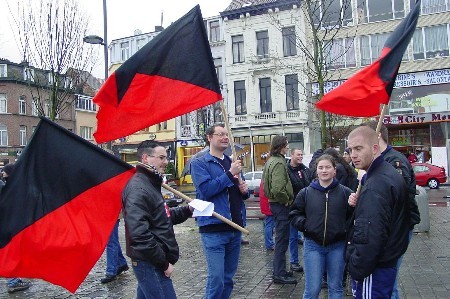 Chiunque abbia a cuore il superamento del presente sistema liberaldemocratico, imperniato sul tradimento dei popoli a vantaggio del potere finanziario mondiale, e chiunque voglia agire nel nome di valori di socialità condivisa, di solidarismo anti-utilitario e di eredità bio-storica, non può seriamente prendere in considerazione l’opzione costituita dalle varie Destre oggi all’opera. Esse sono, senza eccezioni, colonne portanti del liberismo e dello sgretolamento identitario.
Chi si pone sul saliente della difesa della specificità della cultura di appartenenza, proponendosi di opporsi in qualche misura allo sfaldamento della società programmato dai signori della globalizzazione, non può vedere nelle Destre un alleato, ma un tenace oppositore. Al di là di scarne proposizioni di blanda, semimassonica e borghese “nazionalità” e al di là di un ottuso conservatorismo etico-religioso, il Centro-destra italiano ed europeo è un bacino di raccolta di tutto quanto è individualismo, frazionismo sociale, carrierismo, cosmopolitismo, idolatria finanziaria, conservatorismo sociale, identificazione con la peggiore idea di Occidente grande-capitalistico. Se c’è un concetto che appare estraneo a questo schieramento, è quello di popolo. All’interno della dittatura del pensiero unico mondiale – frutto della copula tra progressismo e liberalismo – le differenze e le peculiarità che rendono ogni popolo distinguibile dall’altro, e soprattutto lo rendono diverso dalla massa cosmopolita, vengono metodicamente smussate ed erose. Ma è proprio e soltanto il popolo che dovrebbe giustificare e condizionare ogni aspetto della politica intesa come gestione del benessere materiale e galvanizzazione dei giacimenti valoriali comunitari.
Il protagonismo dell’idea, dei bisogni e dei famosi “diritti” del popolo nei regimi liberaldemocratici è soltanto un’ingannevole perorazione di principio. Anzi, una confutazione. Poiché la sua presenza nelle carte costituzionali borghesi si rivela una truffa atroce, qualora si misurino questi attestati retorici con l’attacco quotidiano che viene portato proprio dalle Destre di ogni colorazione alle basi stesse del popolo e della sua esistenza come ceppo unitario e solidale. Persino la nozione di essenza identitaria popolare, persino l’esistenza biologica, antropologica, genetica dei popoli è messa in discussione non da ineluttabili moti tellurici o da imperscrutabili voleri divini, ma dalle scelte che vengono fatte giorno dopo giorno dai quei governi e partiti che antepongono gli interessi economici di cosche ristrette, di cerchie oligarchiche internazionaliste, al primario interesse di ogni popolo: che è, semplicemente e prima di tutto, quello di esistere.
Il diritto all’esistenza di ogni popolo sulla faccia della Terra è messo a repentaglio e minacciato sempre più da vicino proprio da quelle tali politiche di Destra che programmano e attuano con logica ferrea i flussi migratori, la dislocazione delle risorse nazionali, l’accaparramento delle energie e il dominio del mercato mondiale senza tenere in nessun conto la storia, la cultura, la geografia e la tradizione politica dei popoli: tutti elementi che rendono impossibile la vita di un popolo come comunità nazionale indipendente, in grado di aspettarsi un futuro.
La possibilità che qualche microcosmica Destra radicale, magari nominalmente nazionalpopolare e magari anche in buona fede, sia in grado di condizionare in qualche modo le Destre liberali ed economiche, limitando i danni da queste sistematicamente apportati ai residui di socialità e di tradizionalismo culturale, è risultata più volte nulla. L’inutilità di guardare a Destra, da un punto di vista nazionalpopolare, è evidente. È inutile aspettarsi qualcosa da chi lavora contro di noi. È inutile aspettarsi qualcosa da chi ha dimostrato di volere il contrario di ciò che noi vogliamo: l’esistenza dei popoli, la difesa delle loro differenze, la protezione delle culture, il predominio dei valori di legame su quelli di rapina economica.
Oggi una Destra popolare, identitaria, sociale, non esiste. Oggi la Destra si identifica con il conservatorismo borghese liberale più arrogante e aggressivo. Dice: ma i Poli sono due, o di qua o di là, nel mezzo non c’è spazio…la Sinistra non ci vuole, la Destra, almeno, qualche briciola la lascia cadere…Qui si tratta di capirsi: fare una politica servile senza un partito serio, senza classe dirigente, senza uomini, senza una base, senza uno straccio di programma alternativo, senza organizzazione e senza volontà antagonista, non è forse pretendere troppo? E in quali mani andrebbero le briciole lasciate generosamente cadere dagli oligarchi liberali? Un assessore qui? Un deputato là? È questa la via per l’affermazione dei significati nazionalpopolari? Una politica di Destra radicale, al momento, non esiste da nessuna parte, perché non esistono in maniera presentabile le organizzazioni, gli uomini, le idee e i seguaci…ce n’è abbastanza, perché si smetta di coltivare un miraggio nefasto. Devono ancora nascere il movimento, il clima storico, l’avanguardia, la strategia, le occasioni, affinché qualcosa di nazionalpopolare che respira e si muove sia riconoscibile ad occhio nudo, senza bisogno di lenti di ingrandimento…Al momento esistono protoplasmi, amebe, al più insetti di Destra radicale, non ancora strutture biologiche evolute, mancano gli organi sviluppati, manca una volontà antropologica che disponga di geni attivi, in grado di lottare per la sopravvivenza, per la crescita e magari per l’affermazione e il dominio nel bio-spazio del proprio habitat…nel frattempo…qualcuno potrebbe dire…forse basterebbe anche il solo porre mano alle idee, rinnovando, rilanciando, ripotenziando…Si è mai vista una rivoluzione senza un minimo di progetto e di retroterra ideologico? Ma, anche qui, sul terreno della formulazione teorica, non si colgono segnali di un’onda di ritorno, in forza della quale i valori rivoluzionario-conservatori di solito attribuiti alla Destra radicale mostrino di poter godere di un contesto credibile e di aggregazioni più vaste di quella dell’ambiente di nicchia. Mettersi sotto l’etichetta della Destra oggi può solo significare abdicare al ruolo storico che determinati ideali sociali e politici hanno svolto e ancora potrebbero svolgere, se diversamente veicolati e presentati a masse rese impolitiche a forza di bastonate liberali. L’etichetta di Destra porta alla sudditanza ai poteri forti della conservazione, dell’economicismo e dell’individualismo liberista. Che, poi, in ambienti circoscritti, all’esile ombra di questo o quel piccolo leader di provincia, si dica che continuino ad esser veicolati in qualche modo relazioni comunitarie, valori di legame, tradizionalismi nazionalpopolari, può interessare forse l’antropologia o la sociologia della Destra contemporanea, non può riguardare invece la rilevanza politica del fenomeno. Che, essendo sottotraccia, mimetico, iperminoritario, e dovendo usufruire per forza di linguaggi e comportamenti in codice, non ha veste pubblica, non ha rilevanza immaginale né tantomeno mediatica. In sostanza, non conta nulla, se non al livello di una ricreazione circoscritta, e tutta privata, di miti destituiti di visibilità e di forza politica.
La pericolosità di stare a destra
Per un movimento nazionalpopolare, che abbia qualche pretesa di radicalismo nazionale e sociale, mettersi sotto l’ombrello di un potere di Destra liberale sperando di cavarne qualche beneficio, è come per un condannato mettere la testa tra le mani del boia sperando in un salutare massaggio alla cervicale: pessima idea. Le recenti elezioni francesi, se ancora ce ne fosse stato bisogno, hanno dimostrato quello che sapevamo già: un buon dinamismo liberal-conservatore è sufficiente per prosciugare le velleità radicali. Proprio de Benoist ci ha recentemente ricordato che la batosta di Le Pen è stata figlia della strategia facile facile di Sarkozy. È bastato che un qualunque elemento partorito dal sistema, senza carisma, senza particolari programmi, senza alcuna idea innovatrice, con la faccia anonima del funzionario liberale – Sarkozy non è nulla di più di questo -, ma ben inserito nei poteri forti e ben garantito dalle centrali mondialiste appostate dietro di lui, è bastato che questo liquidatore della Destra radicale in nome della Destra moderata dicesse qualche parolina sulla Francia e sull’orgoglio di essere francesi, perché si vedesse il bacino elettorale di Le Pen prosciugarsi di brutto: «Storicamente parlando – ha scritto de Benoist -, in effetti, la destra dura non è mai stata battuta dalla sinistra, ma sempre dalla destra moderata, più abile a captare la sua eredità. Il grande errore di Le Pen è stato di non aver compreso in pieno questa minaccia e di non aver denunciato Sarkozy come suo avversario principale sin dall’inizio del gioco». Semplice, no?
Non è difficile immaginarsi ogni volta l’esito mortale, per uno schieramento di Destra radicale, che ha un abbraccio con la Destra borghese. Sono un centinaio d’anni che i movimenti nazional-rivoluzionari europei vengono regolarmente giocati dai loro finti patrocinatori liberal-moderati…eppure c’è ancora chi, nello sparuto campo della Destra radicale, si ostina a sperare che reggere la coda del liberista di turno porti fortuna…no, porta sfiga, molta sfiga…Ogni movimento nazionalpopolare europeo del secolo XX ha sempre trovato il proprio giustiziere tra le file non della Sinistra socialdemocratica o comunista, ma proprio del Centro-Destra liberale e conservatore: dal Falangismo alla Guardia di Ferro alle Croci Frecciate ai partiti collaborazionisti di Vichy…E anche il Fascismo e il Nazionalsocialismo, come sappiamo, trovarono gli ossi più duri e infidi proprio tra i liberali…e oggi, incredibilmente, si vogliono ancora e sempre replicare quelle storiche tragedie europee in forma di commedia o, più spesso, di farsa. Come è nel caso italiano.
Qui, d’altronde, oltre al vuoto politico, si registra nel campo della Destra “sociale” un deserto di idee che continua a non promettere nulla di buono. In assenza di una possibilità politica qualsivoglia, ci si aspetterebbe che i residui di intellettualità nazionalpopolare intagliassero almeno solide tavole dei valori, sfrondando i rami secchi qui, coltivando nuovi ributti là, cercando per quanto possibile di dar vita a un quadro di valori a forti tinte che all’alternativa aggiunga magari l’antagonismo, rafforzando i patrimoni, armando i dispersi retaggi, spendendo parole di fuoco, rianimando, tratteggiando scenari futuri, chiamando a raccolta con tutte le forze e attraverso tutti i canali disponibili…Nulla di tutto questo. Quei pochi libri che escono sulla “cultura di destra” fanno rimpiangere il “Manifesto dei conservatori” di prezzoliniana memoria. Al confronto, certe summae teoriche di recente impostazione rendono il conservatorismo di Prezzolini - intelligente ma trapassato da decenni, e comunque di inaccettabile individualismo - una travolgente valanga di futuristiche novità.
Cercare di fondere le due anime della Destra, quella borghese e liberale e quella antiborghese e rivoluzionaria, è un lavoro di cucitura che appartiene alla più retriva retroguardia ideologica…un lavoro nel quale dispiace che si sia azzardato ad esempio un Marcello Veneziani, il quale (capiamo il restyling, capiamo la casa editrice di regime, capiamo il momentaccio storico, ma è un po’ troppo…) sotto la voce “cultura di destra” usa fare un grande uso di Montesquieu, Vico e Gramsci…, ma inspiegabilmente non osa nominare neppure una volta, che so, per dire un nome, Mussolini pudore?...ritrosia?...imbarazzo?...cattiva gestione delle opportunità? Ma forse è vero…molti storici l’hanno già detto e ripetuto, Mussolini era più di Sinistra che di Destra…o forse tutte e due le cose insieme, o nessuna delle due, ma qualcosa di più della loro somma…eppure nel giro de “La Voce”, che è stato il nerbo della cultura politica italiana del Novecento, c’era anche lui, no? Perché censurarlo? Perché auto-censurarsi? La Destra borghese non cambia mai…la Destra borghese è questa, è anche paura, è anche e soprattutto nascondersi dietro le persiane…La borghesissima codardia della Destra è il motivo principale per cui alla conservazione e alla divulgazione dei patrimoni culturali rivoluzionario-conservatori vediamo provvedere la sfiatata “Sinistra-intelligente”, quella che, grazie ai suoi potentati economici e agli spazi lasciati liberi, è ancora capace di catturare, edulcorare, liftare, insinuandosi nei meandri più intimi dei nostri retaggi: è così che oggi la Sinistra sta cercando di ricostruire se stessa – un attimo prima di morire e sperando di far sopravvivere il proprio cadavere - dichiarandosi ora “reazionaria”, ora “antiegualitaria”, ora “tradizionalista”. È qualcosa di più di un gioco al massacro intellettuale. È il sintomo che la Sinistra, dopo il suo fallimento politico, e una volta constatata l’incapacità della Destra di difendere i suoi patrimoni culturali, annusa da vicino anche il proprio fallimento ideologico e culturale e, come tutti i disperati, si aggrappa a tutto quello che ancora mostra di esser saldo…Tanto per dire: il rilancio dei vari Jünger, Schmitt, Drieu, Céline…non è opera della Destra, ma della Sinistra; i migliori libri sulla rivoluzione fascista e sulla socialità nazionalsocialista non sono scritti da storici di Destra, ma di Sinistra; le pensate più originali su comunitarismo, reciprocità, antiutilitarismo, ancora una volta nascono sempre a Sinistra e solo dopo, a volte molto dopo, diventano pane per denti di Destra, e così via…
Stando così le cose, è evidente che, di questa Destra, un nazionalpopolare appena decente non sa che farsene. Meglio sarebbe tagliare i cordoni ombelicali che portano alla sicura e dimostrata asfissìa e guadagnare il campo aperto. Abbandonando il peso morto di un’etichetta che non ci appartiene, può essere che si ritrovino le coordinate per scrivere, dire, pensare, comunicare qualcosa di rivoluzionario dal punto di vista della tradizione.
Eppure, non dovrebbe essere impossibile: ci sono molti uomini con le mani su consistenti brandelli di potere e sottopotere che sanno di cosa stiamo parlando, ma, ogni volta, quando li si interroga su quale sia alla fin fine questa benedetta Destra, su dove stia di casa questa sfingea cultura di Destra, non riescono a tirar fuori altro che Croce, Gramsci o Gentile…questo è troppo, è davvero troppo anche per chi ha già da un pezzo capito che da quella parte non verrà mai nulla di buono.
Occorre dunque seppellire la Destra, la settaria, invidiosa, provinciale Destra dei nostri giorni, quella Destra dove formicolano il furbo, l’accattone delle idee altrui, il faccendiere, l’approfittatore, l’inetto velleitario, l’incolto nemico della cultura e dell’innovazione, il tanghero portaborse, il frazionista che non capisce nulla di politica e crea mortali trombosi nella circolazione degli ideali…seppelliamo questa infame Destra moderata…che, intanto, la Sinistra si sta già seppellendo da sola…Non più dunque il vecchio “al di là della Destra e della Sinistra”, ma un nuovissimo e risolutissimo contro: contro la Destra e contro la Sinistra…Quando non ci fossero più queste due cariatidi tubercolotiche a bloccare ogni possibilità di rimescolamento delle carte politiche, l’aria tornerebbe a farsi tersa, le idee tornerebbero a farsi nitide e leggibili e…hai visto mai…con un colpo di fortuna, i giochi potrebbero anche improvvisamente riaprirsi…
Le nuove sintesi? Le contaminazioni? La trasversalità? Tutti ottimi slogan, tutte parole non seguite dai fatti, tutte buone intenzioni atte a lastricare struggenti viali del tramonto: ma il meccanismo ha già da tempo dimostrato di non saper funzionare, neppure tra ristrettissime cerchie di opinionisti politici…
A sommesso parere di chi scrive, alla base di tutto c’è la parola popolo. Questa parola, già di per sé e senza nulla aggiungere, nasconde un programma, un’ideologia, un metodo politico, un potenziale di enorme aggregazione e un fine sociale sufficientemente chiari. E sufficientemente in grado, se opportunamente agitati con coraggio radicale e capacità innovativa, di smuovere l’immobile montagna della società narcotizzata dai controvalori liberali. Quando si troverà un capo politico in grado di parlare di popolo al popolo, quando si formerà un pugno di buoni divulgatori di questo concetto partendo dai bisogni reali e da quelli immaginali, si sarà trovata la chiave: allora non ci sarà più alcun bisogno di dirsi di Destra o di Sinistra. Una rivoluzione, oppure un cambio di sistema, o anche solo un semplice ma profondo ridisegno della geografia politica, che sia appena accettabile e in grado di incidere lasciando il segno, non hanno mai bisogno di darsi etichette da parlamento liberale anglosassone. Il nuovo non nasce da miserabili contrattazioni di corridoio o da avvilenti apparentamenti ad alto costo e a incasso zero. Il nuovo, quando è rivendicazione di arcaici diritti all’identità e alla vita, ha spalle grosse perché poggianti sull’eterno, avanza con la forza dell’ineluttabile, vive del sangue vivo della gente, si nutre di entusiasmo e di passione concreti, mobilitabili, che si possono toccare. Tutto questo è una potenza in senso letterale. Questa potenza aspetta solo che qualcuno coraggiosamente la evochi e la scateni al di sopra e contro tutti i mercanteggiamenti e i tradimenti liberali, quelli di Destra come quelli di Sinistra, così da dar vita all’ultima possibilità per il nostro destino europeo.
00:15 Publié dans Politique | Lien permanent | Commentaires (0) | Tags : nationaux-piopulistes, populistes, droite, gauche, idéologie, politique, italie | | del.icio.us | | Digg | Facebook
dimanche, 21 novembre 2010
Prima che Nietzsche venisse: Giacomo Leopardi
Prima che Nietzsche venisse: Giacomo Leopardi
Alessandra COLLA - http://www.alessandracolla.net/
Archives: 1994
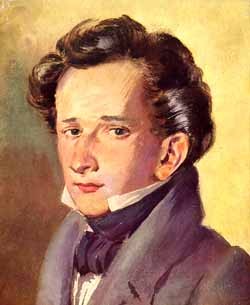 Negli scritti di Nietzsche, è stato detto, si può trovare tutto e il contrario di tutto. Questa pretesa contraddizione interna del grande pensatore ha fornito materiale in quantità per molte opere — talvolta critiche talvolta denigratorie — che hanno accompagnato negli anni la fortuna del filosofo senza, peraltro, mai scalfirne il nòcciolo.
In mezzo alla feconda complessità dei temi trattati, emergono però alcuni aspetti interessanti e solitamente poco noti ai più. Vogliamo qui accennarne qualcuno, almeno per suggerire nuove curiosità.
L’UOMO CHE VISSE DIETRO LA SIEPE
… questa siepe, che da tanta parte
dell’ultimo orizzonte il guardo esclude.
(G. Leopardi, L’infinito, 1819)
Il XVIII secolo sta per finire quando, nel 1798, nasce a Recanati Giacomo Taldegardo Francesco Leopardi, figlio del conte Monaldo e della marchesa Adelaide Antici. Autentico bambino prodigio, all’età di undici anni Giacomo si ritrova senza precettore: sa già tutto quello che c’è da sapere, e non c’è nessuno in grado di seguirlo negli studi. Con la beata incoscienza della sua età, il primogenito di casa Leopardi continua da solo. Da solo impara il greco, l’ebraico, il francese, l’inglese e lo spagnolo; padrone, a soli quindici anni, di tante lingue vive e morte, sviluppa a quest’età l’amore per gli studi filologici: le grammatiche e le sintassi non hanno più per lui alcun segreto, ed ora è finalmente libero di cogliere nella loro pienezza i tesori che si celano dietro l’aridità apparente delle forme verbali e delle declinazioni.
Il 1816 segna una svolta di importanza capitale nella vita e nel pensiero di Leopardi: è in quest’anno, infatti, che il giovane scopre le lettere e la poesia, sulle quali riversa la passione finora consacrata all’erudizione e alla disciplina filologica. Dello stesso anno è anche la prima, e non la più grave, delle molte crisi fisiche e nervose che travaglieranno la sua breve vita: con orrore e certo senza rassegnazione, Giacomo intuisce di aver definitivamente minato la sua già gracile costituzione con un’applicazione mentale eccessiva. Ad aggravare la situazione psicologica del giovane sopraggiunge, sul finire dell’anno, il breve soggiorno in casa Leopardi della bella cugina Gertrude Cassi sposata Lazzari: scoppia la prima infatuazione amorosa, tutta platonica e ovviamente unilaterale, di Giacomo, che recita qui per la prima volta il copione dell’amore illuso e deluso — lo ripeterà per tutta la vita.
Il suo stato d’animo non migliora affatto. In una celebre, drammatica lettera all’amico scrittore Pietro Giordani, datata 2 marzo 1818, Leopardi lascia sgorgare senza pudori tutta la sua amarezza profonda e inconsolabile: «[…] in somma io mi sono rovinato con sette anni di studio matto e disperatissimo in quel tempo che mi s’andava formando e mi si doveva assodare la complessione. E mi sono rovinato infelicemente e senza rimedio per tutta la vita, e rendutomi l’aspetto miserabile, e dispregevolissima tutta quella gran parte dell’uomo, che è la sola a cui guardino i più; e coi più bisogna conversare in questo mondo». Nel settembre dello stesso anno il Giordani, allarmato dalle parole del giovane, lo raggiunge a Recanati per condurlo con sé a Macerata: un viaggio di ben pochi chilometri — il primo in assoluto di Giacomo, allora ventenne. L’impatto con una dimensione estranea a quella del sonnolento “borgo natio” e la consapevolezza di un mondo vasto e sconosciuto destinato a restare fuori dalla sua portata non fanno che aumentare l’inquietudine di Leopardi, che si sente (e sa di essere davvero) profondamente diverso dagli altri, e anela alla gloria.
Nella primavera del 1819 la sua già malferma salute va peggiorando: un esaurimento fisico generale lo prostra, e si manifestano i primi disturbi agli occhi che gli impediscono di leggere per quasi un anno e che, d’ora in poi, lo accompagneranno per tutta la vita. Questo episodio rientra a pieno titolo fra i motivi scatenanti di quel pessimismo assoluto che diverrà cifra e referente del pensiero leopardiano (1).
Corollario inevitabile di questo crollo di ogni illusione è la perdita della fede religiosa; per compensare la quale il Leopardi si getta nell’elaborazione di un suo sistema filosofico — una sorta di materialismo pessimistico radicale sull’onda, paradossalmente, delle suggestioni illuministiche. Se infatti l’illuminismo tracciava il disegno grandioso di un progresso inarrestabile volto a condurre l’umanità intera verso luminosi e necessari destini, per il Leopardi le istanze deterministiche e la constatazione di uno “stato di natura” suggeriscono piuttosto l’idea di un decadimento dell’uomo dalle altezze dell’età antica alle bassure di quella moderna; e la civiltà, lungi dal rappresentare il punto d’arrivo dell’evoluzione umana, si configura invece come l’allontanamento dell’uomo dalla beata condizione naturale, unica e sola in grado di garantire la felicità — cioè l’assenza o la cessazione del dolore (secondo la scuola stoica prediletta dal poeta-filosofo). Il grande passo è compiuto: da qui in avanti il Leopardi alternerà meditazioni filosofiche a composizioni poetiche, per approdare, dopo un silenzio durato cinque anni (dal 1823 al 1828), alla sublime fusione di sostanza filosofica e forma poetica. Sempre più minato nel fisico, trascinerà un’esistenza sofferente, alleviata soltanto dalle cure assidue e affettuose di pochi amici, fino alla morte, sopravvenuta il 14 giugno 1837 a Napoli, in casa dell’amico Antonio Ranieri.
IL POETA E IL FILOSOFO: AFFINITÀ ELETTIVE
È un destino singolare, come si vede, quello che accomuna Giacomo Leopardi e Friedrich Nietzsche: entrambi sono stati mutilati dalla critica, contemporanea e successiva, in gran parte della loro opera — si sa che il Leopardi è noto, apprezzato e studiato come poeta, ma per lo più ignorato come filosofo, mentre Nietzsche è giudicato a buon diritto un gigante del pensiero ma poco più che un semplice dilettante nel campo delle arti. Eppure, come pochi ormai si azzardano a negare, la verità è molto diversa.
Ma le somiglianze non finiscono qui. Sia l’italiano inquieto che il riservato tedesco iniziano il loro percorso intellettuale sui testi di filologia, anche se per motivi dìversi: il piccolo Giacomo perché la pur nutrita biblioteca paterna non era in grado di offrire più niente a un bambino così sorprendentemente dotato; il giovane Federico perché la formazione ricevuta nel prestigioso istituto di Pforta gli aveva rivelato le immense possibilità speculative legate allo studio del mondo classico e delle sue lingue. Inoltre, entrambi furono costretti a viaggiare molto, ed entrambi per questioni di sopravvivenza, soggiornando addirittura negli stessi luoghi; entrambi furono di salute assai cagionevole, soffrendo persino degli stessi disturbi; entrambi trovarono l’ultimo conforto nella vicinanza di amici fedeli e disinteressati; e, per finire, il pensiero di entrambi è stato spesso snaturato e stravolto così da renderli invisi non soltanto a generazioni di studenti, ma anche a molti seri studiosi irrimediabilmente viziati nell’interpretazione dei loro testi.
La complementarità dei loro destini li rende simili al di là delle differenze oggettive, portandoli verso un unico sentire e un’identica visione della vita, tanto che sarà proprio Leopardi ad anticipare alcune delle più brillanti e rivoluzionarie intuizioni di Nietzsche.
Il pensatore di Röcken conosceva, almeno in parte, il Leopardi: sappiamo che nella biblioteca di Nietzsche figuravano due traduzioni tedesche di Leopardi, ad opera dello Hamerling e dello Heyse; sicuramente vi erano compresi i Canti, che il poeta italiano scrisse a partire dal 1818, lo Zibaldone e molto probabilmente le Operette morali. Ed è lo stesso Nietzsche a menzionare il Leopardi, anche se di passata e in modo non proprio lusinghiero: «Gli infelici raffinati, come Leopardi, che dalla loro sofferenza traggono orgogliosamente vendetta su tutta l’esistenza, non si accorgono come il divino mezzano dell’esistenza rida di loro: proprio così essi ora berranno di nuovo dalla sua coppa; infatti la loro vendetta, il loro orgoglio, la loro inclinazione a pensare tutto quanto soffrono, la loro arte nel dirlo: tutto questo non è di nuovo — dolce miele?» (2).
Alla luce di un’attenta lettura del poeta italiano e del filosofo tedesco, è innegabile che le influenze del primo sul secondo esistano, e siano ben documentabili. Confrontiamo, ad esempio, Il sabato del villaggio e La sera del dì di festa (composte entrambe nel settembre 1829) con un frammento di Nietzsche. Il Leopardi scrive:
«[…] intanto riede alla sua parca mensa,
fischiando, il zappatore,
e seco pensa al dì del suo riposo.
Poi, quando intorno è spenta ogni altra face,
e tutto l’altro tace,
odi il martel picchiare, odi la sega
del legnaiuol, che veglia
nella chiusa bottega alla lucerna,
e s’affretta, e s’adopra
di fornir l’opra anzi il chiarir dell’alba.
Questo di sette è il più gradito giorno,
pien di speme e di gioia:
diman tristezza e noia
recheran l’ore, ed al travaglio usato
ciascuno in suo pensier farà ritorno» (3).
E ancora:
«[…] Ahi, per la via
odo non lunge il solitario canto
dell’artigian che riede a tarda notte,
dopo i sollazzi, al suo povero ostello;
e fieramente mi si stringe il core,
a pensar come tutto al mondo passa,
e quasi orma non lascia. Ecco è fuggito
il dì festivo, ed al festivo il giorno
volgar succede, e se ne porta il tempo
ogni umano accidente. […]» (4).
Quello che segue, invece, è il testo nietzscheano:
«Il pomeriggio del sabato si deve passare per un villaggio, se si vuol vedere sui volti dei contadini la vera quiete del dì di festa: allora essi hanno ancora indelibata davanti a sé la giornata di riposo e si industriano a far ordine e pulizia in suo onore con una specie di piacere anticipato, quale non sarà raggiunta dal piacere stesso. La domenica è già quasi lunedì» (5).
Oppure si paragonino questi due brani:
«Ogni grande amore porta con sé il crudele pensiero di uccidere l’oggetto dell’amore, perché sia sottratto una volta per tutte al sacrilego giuoco del mutamento: giacché di fronte al mutamento l’amore inorridisce più che di fronte alla distruzione»;
«Il veder morire una persona amata, è molto meno lacerante che il vederla deperire e trasformarsi nel corpo e nell’animo da malattia (o anche da altra cagione)».
Il primo è di Nietzsche (6), mentre il secondo è di Leopardi (7).
Con un minimo di attenzione, è facilissimo trovare, sparsi qua e là nello Zibaldone senza un ordine fisso, ma sull’onda di meditazioni e concatenamenti apparentemente confusi che fanno delle elaborazioni leopardiane un autentico “pensiero in movimento” destinato ad arrestarsi soltanto con la morte, intuizioni e abbozzi di teorie poi ripresi e sviluppati compiutamente da Nietzsche nell’arco di pochi decenni, e che nella prosa densa del Leopardi spiccano in tutta la loro grandezza.
Così alcuni notevoli passi che anticipano la Genealogia della morale sono del 4-5 settembre 1821: «La legge naturale varia secondo le nature. Un cavallo che non è carnivoro giudicherà forse ingiusto un lupo che assalga e uccida una pecora, l’odierà come sanguinario, e proverà un senso di ribrezzo e d’indignazione abbattendosi a vedere qualche sua carnificina. Non così un lione. Il bene e il male morale non ha dunque nulla di assoluto. Non v’è altra azione malvagia, se non quelle che ripugnano alle inclinazioni di ciascun genere di esseri operanti: né sono malvage quelle che nocciono ad altri esseri, mentre non ripugnino alla natura di chi le eseguisce» (8); «Si suol dire che tutte le cose, tutte le verità hanno due facce, diverse o contrarie, anzi infinite. Non c’è verità che prendendo l’argomento più o meno da lungi, e camminando per una strada più o meno nuova, non si possa dimostrar falsa con evidenza ec. ec. ec. Quest’osservazione (che puoi molto specificare ed estendere) non prova ella che nessuna verità né falsità è assoluta, neppure in ordine al nostro modo di vedere e di ragionare, neppur dentro i limiti della concezione e ragione umana?» (9); «Da ciò che si è detto della legge pretesa naturale, risulta che ne vi è bene né male assoluto di azioni; ci queste non sono buone o cattive fuorché secondo le convenienze, le quali son stabilite, cioè determinate dal solo Dio ossia, come diciamo, dalla natura; che variando le circostanze, e quindi le convenienze, varia ancora la morale, né v’è legge alcuna scolpita primordialmente ne’ nostri cuori; che molto meno v’è una morale eterna e preesistente alla natura delle cose, ma ch’ella dipende e consiste del tutto nella volontà e nell’arbitrio di Dio padrone sì di stabilire quelle determinate convenienze che voleva […]. Da tutto ciò resta spiegata la differenza fra la legge che corse prima di Mosè, quella di Mosè, e quella di Cristo. […] L’antica legge Ebraica permetteva il concubinato, fuorché colle donne forestiere ec. L’odio del nemico costituiva lo spirito delle antiche nazioni. Ecco le leggi di Mosè tutte patriottiche, ecco santificate le invasioni, le guerre contro i forestieri, proibite le nozze con loro, permesso anche l’odio del nemico privato. E Gesù comandando l’amor del nemico, dice formalmente che dà un precetto nuovo. Come ciò, se la morale è eterna e necessaria? Come è male oggi, quel ch’era forse bene ieri? Ma la morale non è altro che convenienza, e i tempi avevano portato nuove convenienze. Questo discorso potrebbe infinitamente estendersi generalizzando sullo stato del mondo antico e moderno, e sulla differente morale adattata a questi diversi stati. L’uomo isolato non aveva bisogno di morale, e nessuna ne ebbe infatti, essendo un sogno la legge naturale. Egli ebbe solo dei doveri d’inclinazione verso se stesso, i soli doveri utili e convenienti nel suo stato. Stretta la società, la morale fu convenienza, e Dio la diede all’uomo appoco appoco, o piuttosto ora una ora un’altra, secondo i successivi stati della società: e ciascuna di queste morali era ugualmente perfetta, perché conveniente; e perfetto è l’uomo isolato, senza morale» (10).
Un rilievo del 1823 sembra attagliarsi perfettamente a certe considerazioni contenute nell’Anticristo: «Persone imperfette, difettose, mostruose di corpo, tra quelle che non arrivano a nascere e […] tra quelle che son tali dalla nascita […]; quelle che così nate vivono e […] quelle finalmente che tali son divenute dopo la nascita […]; sommando dico e raccogliendo tutti questi individui insieme, si vedrà a colpo d’occhio e senza molta riflessione che il loro numero nel solo genere umano, anzi nella sola parte civile di esso, avanza di gran lunga non solamente quello che trovasi in qualsivoglia altro intero genere d’animali, non solamente eziandio quello che veggiamo in ciascheduna specie degli animali domestici, che pur sono corrotti e mutati dalla naturale condizione e vita, e da noi in mille guise travagliati e malmenati; ma tutto insieme il numero degl’individui difettosi e mostruosi che noi veggiamo in tutte le specie di animali che ci si offrono giornalmente alla vista, prese e considerate insieme. La qual verità è così manifesta, che niuno, io credo, purché vi pensi un solo momento e raccolga le sue reminiscenze, la potrà contrastare. Simile differenza si troverà in questo particolare fra le nazioni civile e le selvagge, e proporzionatamente fra le più civili e le meno, secondo un’esatta scala» (11). Di questa lunga citazione merita, a nostro avviso, sottolineare anche l’accenno agli animali, che è una costante del Leopardi: la sua attenzione nei confronti della natura e degli esseri viventi è continua e delicata, comprendendo ogni forma di vita nel mistero del dolore universale e del pessimismo cosmico. Anche questo è un tratto (e non dei minori) che lo accomuna a Nietzsche.
Sempre nell’Anticristo, troviamo invece una frase illuminante del filosofo tedesco: «Se si avesse nel petto una qualche misura, anche esigua, di religiosità, un Dio che cura al momento giusto il raffreddore o che ci fa salire in carrozza nel preciso istante in cui si scatena un acquazzone dovrebbe essere per noi tanto assurdo, che occorrerebbe eliminarlo anche nel caso in cui esistesse. Un Dio come domestico, come portalettere, come venditore d’almanacchi — una sola parola, in fondo, per indicare la specie più stupida tra tutte le circostanze fortuite…» (12). Il riferimento alla celebre operetta morale che il Leopardi scrisse nel 1832, e intitolata appunto Dialogo di un venditore di almanacchi e di un passeggere, ci sembra assolutamente fuor di dubbio: nel Dialogo, il poeta immagina l’incontro fra un “passeggere” e un venditore di calendari che propone al passante l’acquisto di un calendario per l’anno nuovo. Il passante si informa se l’anno nuovo sarà o no migliore del precedente, e il venditore risponde di sì; ma il passante incalza, e vuole sapere a quale degli ultimi vent’anni potrebbe essere paragonato l’anno nuovo in quanto a bontà; il venditore annaspa, travolto dalla stupidità dei luoghi comuni che il passante gli sciorina uno dietro l’altro, e il dialogo si conclude col timido “speriamo…” del venditore che non può fare altro che rifilare al passante un calendario qualsiasi, nell’illusione che il futuro sarà comunque migliore del passato. Eccolo qua, il Dio schernito da Nietzsche: un Dio buono per tutte le stagioni, che porterà il sole al villeggiante e la pioggia al contadino, la pace a chi combatte e la guerra al mercante d’armi — proprio un Dio che, se davvero esistesse, andrebbe eliminato.
Non sono — ovviamente — tutti qui i paralleli fra il poeta-filosofo e il filosofo-poeta. L’argomento meriterebbe ben più di qualche cenno frettoloso, ma sappiamo che l’insofferenza di troppi per la poesia leopardiana non è certo né il minore né l’ultimo dei guasti fatti dalla scuola italiana. Per chiudere in bellezza, scegliamo l’insegnamento supremo di Zarathustra il Distruttore: «Uomini superiori, imparatemi - a ridere!» (13), adombrato in uno degli ultimi appunti dello Zibaldone: «Terribile e awful è la potenza del riso; chi ha il coraggio di ridere, è padrone degli altri, come chi ha il coraggio di morire» (14).
(testo apparso originariamente sulla rivista “Origini”,
numero monografico su Friedrich Nietzsche, 1994)
NOTE
(1) Lui stesso descriverà così l’avvenuto mutamento, in un’annotazione datata 1 luglio 1820: «Sono stato sempre sventurato, ma le mie sventure d’allora erano piene di vita, e mi disperavano perché mi pareva […] che m’impedissero la felicità, della quale gli altri credea che godessero. […] La mutazione totale in me […] seguì […] nel 1819 dove privato dell’uso della vista, e della continua distrazione della lettura, cominciai […] a divenir filosofo di professione (di poeta ch’io era), a sentire l’infelicità certa del mondo» (Giacomo Leopardi, Zibaldone, Oscar Mondadori, Milano 1972, vol. 1, p. 118).
(2) Friedrich Nietzsche, Umano, troppo umano (e scelta di frammenti postumi), Oscar Mondadori, Milano 1976, vol. II, fr. 38 [2], p. 273.
(3) G. Leopardi, Il sabato del villaggio, vv. 28-42.
(4) Idem, La sera del dì di festa, vv. 24-33.
(5) F. Nietzsche, Umano…, cit., fr. 45 [3], p. 286.
(6) Ivi, fr. 280. p. 95.
(7) G. Leopardi, Zibaldone, cit., p. 290 (8 gennaio 1821).
(8) Idem, Zibaldone, cit., vol. II, p. 582 (4 settembre 1821).
(9) Ivi, p. 585 (5 settembre 1821).
(10) Ivi, pp. 587-589 (5 settembre 1821).
(11) Ivi, p. 844 (28 luglio 1823).
(12) F. Nietzsche, L’Anticristo. Maledizione del cristianesimo, Adelphi, Milano 1977, par. 52, p. 75.
(13) F. Nietzsche, Così parlò Zarathustra, Adelphi, Milano 1973, p. 359 (“Dell’uomo superiore” - 20, 25).
(14) G. Leopardi, Zibaldone, cit., vol. II, p. 1160 (23 settembre 1828).
(© Alessandra Colla, Prima che Nietzsche venisse, 1994, in “Origini - Nietzsche”, 2006)
00:05 Publié dans Philosophie | Lien permanent | Commentaires (0) | Tags : philosophie, italie, allemagne, nietzsche, giacomo leopardi, 18ème siècle, 19ème siècle | | del.icio.us | | Digg | Facebook